REVIEW 3 major objections 6 minor 1 cited by
Personalized One-shot Federated Graph Learning for Heterogeneous Clients
T0 review · 3 major / 6 minor · reviewed 2026-08-12 · deepseek-v4-flash
Pith's one-line read One-shot federated graph learning beats 100-round methods on average, the paper claims.
desk verdict First real one-shot personalized FGL paper with broad, consistent empirical gains, but the headline unbiasedness claim for its variance aggregation is wrong and needs fixing before the method's guarantees can be taken at face value. read the letter →
The pith
A machine-rendered reading of the paper's core claim, the machinery that carries it, and where it could break.
The reading
What carries the argument
The load-bearing object is the global surrogate graph $G' = (A', X', Y')$, a small graph (under 300 nodes in the experiments) generated on the server so that its class-wise propagated feature means and variances match the unbiased aggregated global statistics. The adjacency matrix $A'$ comes from a learnable link predictor $g_\theta$ over node features, with a smoothness loss $\mathcal{L}_{\text{smt}}$ to encourage a realistic structure, and the node features $X'$ are optimized against the alignment loss $\mathcal{L}_{\text{align}}$. Around this object sit two supporting mechanisms: the Homophily-guided Reliable node Expansion (HRE) strategy, which uses label propagation and class homophily to expand scarce labeled sets for more accurate statistics, and node-adaptive distillation, which weights the KL divergence from the global teacher by $\gamma_i = \beta \tilde{y}_i \cdot w_{\text{dist}}$ with $w_{\text{dist}}[c] = 1/(1 + \log(H(c) + 1))$, so that nodes in low-homophily or minority classes inherit more global knowledge.
What would settle it
Run O-pFGL on a synthetic heterophilic graph whose class-wise feature means and variances are constructed to be identical across classes while labels are determined by triadic closure or other higher-order patterns. If the method fails to beat standalone local training on that graph, the claim that class-wise first and second moments of propagated features suffice for a useful surrogate graph is refuted.
Extended reading notes
Core claim
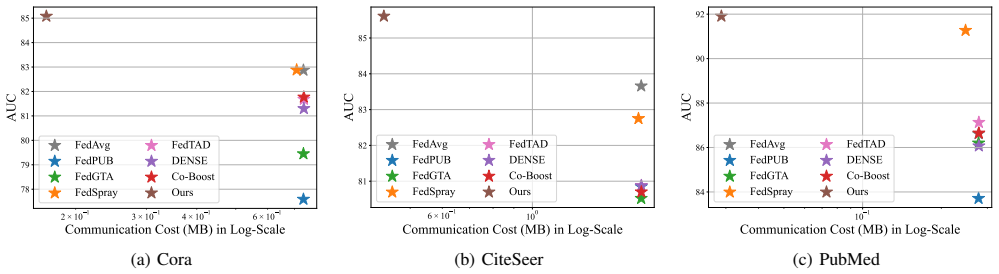
The central discovery is that the information needed to personalize a graph model across heterogeneous clients can be carried by class-wise first and second moments of propagated features, rather than by model parameters or raw graph data. From these aggregated moments the server synthesizes a small surrogate graph whose propagated feature distribution matches the recovered global distribution, and this surrogate graph serves as a teacher for a two-stage local training procedure. In the second stage, a node-adaptive distillation weight, derived from class homophily and soft labels, decides per node how much to trust the global teacher versus local fine-tuning, which the paper argues corrects the bias of fine-tuning toward majority classes. The paper reports consistent gains in accuracy and F1-macro over eleven baselines on 14 real-world datasets, and better average performance than multi-round methods allowed 100 communication rounds.
Load-bearing premise
The method works only if a small graph whose class-wise propagated feature means and variances match the global statistics captures enough of the true graph structure and feature distribution to train a teacher model that improves each client's personalization.
Editorial extensions
If this is right
- Communication cost becomes independent of model size: clients upload only $O(C \cdot h \cdot f)$ statistics and download a small surrogate graph, which scales better than parameter exchange as models grow.
- Because no model parameters are shared, clients can use heterogeneous architectures and protect model intellectual property, with statistics upload compatible with Secure Aggregation protocols.
- The node-adaptive distillation is claimed to raise F1-macro substantially over fine-tuning, implying better performance on minority classes in imbalanced local graphs.
- The method reportedly beats multi-round federated baselines trained for 100 rounds on average, suggesting one-shot collaboration may be sufficient for node classification in many real-world regimes.
- The approach carries over to inductive datasets and other GNN backbones (GraphSage, GAT, SGC) per the experiments.
Reading between the lines
- The method's success would imply that cross-client graph knowledge transfer can be reduced to moment matching of propagated features, a much weaker commitment than sharing structure; this suggests a general design principle for one-shot federated learning on non-Euclidean data.
- A testable extension is to apply the surrogate-graph idea to graph-level tasks (graph classification) or to link prediction, where the same statistics-plus-smoothness recipe might need higher-order moments to capture motif structure.
- The reliance on class-wise moments predicts a failure mode: on graphs where classes are separated by higher-order structural patterns (e.g., role detection in heterophilic networks), the surrogate graph may be information-poor; experiments that withhold second-order moments or scramble topology would isolate how much structure the method actually uses.
- Because the method assumes honest clients and an honest server, an adversary-free setting is load-bearing for the privacy claims; a malicious server could still infer class proportions and feature statistics from the aggregated moments.
Editorial analysis
A structured set of objections, weighed in public.
Referee Report
Summary. The manuscript proposes O-pFGL, a one-shot personalized federated graph learning method for node classification. Each client estimates class-wise means and variances of propagated node features and uploads these statistics in a form compatible with Secure Aggregation. The server aggregates the statistics into a purported global class-wise distribution and synthesizes a small global surrogate graph by matching the first two moments of propagated features and enforcing a smoothness prior. Clients then train a generalized model on the surrogate graph (Stage 1) and fine-tune it on local data with node-adaptive knowledge distillation that up-weights minority and low-homophily nodes (Stage 2). The method supports heterogeneous client models. Experiments on 14 real-world datasets compare O-pFGL against 11 baselines under Louvain/Metis partitions with 10 and 20 clients, plus heterophilic, inductive, model-heterogeneity, and large-client settings. The paper reports consistent accuracy and F1-macro gains, and Appendix D.2 reports better average performance than multi-round baselines run for 100 rounds.
Significance. The problem is timely and the empirical study is unusually broad: 14 datasets, multiple partition schemes, 10/20 clients, inductive and heterophilic benchmarks, model-heterogeneity experiments, and a detailed ablation study. The evaluation is on held-out nodes and the surrogate graph is generated from training-set statistics, so the reported gains are not fitted values; the empirical contribution is genuine evidence for the approach. The communication cost (class-wise statistics plus a small surrogate graph) and the compatibility with Secure Aggregation are practical strengths. However, the paper's central theoretical claim that the aggregated global variance is unbiased is mathematically incorrect, and the implementation of the variance alignment for surrogate graphs with one node per class is left unspecified. The main result is therefore supported empirically but not by the stated derivation; the manuscript needs a corrected aggregation formula and a corresponding re-examination of the surrogate-generation loss before the claims can be accepted.
major comments (3)
- [Global Surrogate Graph Generation, Eq. (8)] The aggregation formula in Eq. (8) is not an unbiased estimator of the global class-wise feature variance, contradicting the sentence immediately after it. Under IID sampling from a common distribution per class, the total sum of squares in the numerator has expectation (N_c - 1) sigma_c^2, so dividing by N_c - m yields E[s^{2c}] = (N_c - 1)/(N_c - m) sigma_c^2, which overestimates the variance. Under heterogeneous client means, the between-client term additionally inflates the estimate, so the bias grows with non-IIDness. Moreover, if a class has N_c < m total samples, which can occur under the label-skew partitions used in the experiments, the denominator is non-positive and the formula yields an undefined or negative variance with no stated fallback. Since Eq. (10) aligns the surrogate graph's variance to this value, the distortion propagates into the global model and the distillation stage. The manuscript should either divide by N_c - 1 to estimate the pooled total variance or explicitly define and justify the target quantity being estimated, and it must specify a valid fallback for small N_c.
- [Global Surrogate Graph Generation, Eq. (5) and Appendix C] The surrogate graph generation uses a sample variance defined in Eq. (5) with denominator |V| - 1. Appendix C states that on Cora, CiteSeer, and PubMed the global surrogate graph is set to exactly one node per class. For a class with one node, the sample variance is undefined (division by zero), yet Eq. (10) includes the term (s'^{2c} - s^{2c})^2. The paper does not describe the fallback estimator actually used in the implementation, nor how the variance alignment is computed for one-node classes. This is a load-bearing implementation detail because the entire surrogate graph is generated from these moments. The text must state the actual variance estimator used for the surrogate graph or adjust the node-count configuration so that the stated equations are well defined.
- [Global Surrogate Graph Generation, Eqs. (10)-(11)] The surrogate graph is generated by matching only the first two moments of propagated features plus a smoothness prior. The paper does not provide evidence that these statistics capture the structural information needed to transfer global knowledge in heterophilic or structurally heterogeneous graphs, such as degree distributions, edge homophily, or higher-order neighborhood structure. Because the surrogate graph is the only channel through which cross-client knowledge enters Stage 1 and the distillation stage, a diagnostic test would substantiate the mechanism: for example, compare the surrogate graph's edge homophily and degree distribution with the client graphs, or compare the Stage-1 model's accuracy against a model trained on an oracle global graph. Without such evidence, the end-to-end gains demonstrate that the method works but do not establish that the proposed surrogate-graph construction is the reason.
minor comments (6)
- [Feature Distribution Estimation, Eq. (5)] The local class-wise variance is undefined when a client has exactly one labeled node of a class, since the denominator |V^c_{k,L}| - 1 is zero. The manuscript says the statistics are estimated only for classes with sufficient labeled nodes but never defines the minimum count or a fallback estimator.
- [Table 3] The Actor row lists the property as 'Heterophlic'; this should be 'Heterophilic'.
- [Appendix D.2] The sentence 'We set the communication round of these 6 methods to 100' is followed by a list of seven methods (FedAvg, FedPUB, FedGTA, FedTAD, FedSpray, FedLoG, and FedGM); the count should be corrected.
- [Preliminaries, Eq. (1)] The definition of hnode(vi) divides by |N_vi ∩ V_L|, which is zero for an isolated labeled node; the paper should state the convention adopted in that case.
- [Appendix J] The statement that the aggregation process is 'lossless and unbiased regardless of the data distributions' repeats the incorrect claim from Eq. (8) and should be revised consistently with the corrected variance estimator.
- [Figure 2] The text describes the pipeline as comprising five steps, but the figure does not show step indices; adding visible step numbers would make the correspondence between the text and the figure much clearer.
Circularity Check
Partial circularity: HRE moves test-set nodes into training, so part of the reported 'prediction' is a fit to pseudo-labels on the evaluation set.
-
fitted input called prediction
[Preliminaries (test-set definition), Feature Distribution Estimation (Eq. 6-7), Personalization with Node Adaptive Distillation (Eq. 14-15)]
"nodes on the k-th client are partitioned into labeled nodes Vk,L (i.e., training set) and unlabeled nodes Vk,U (i.e., test set). ... Vk,r ={vi|(vi ∈ Vk,U ) ∧ (d(vi) ≥ dth) ∧ (˜yi(c′) ≥ fth) ∧ (c′ ∈ topK(H))}. ... The reliable nodes Vk,r, along with their inferred labels, can expand the original labeled nodes set Vk,L. ... Ldist = Σ_{xi∈Xk} γiLkl(Mk(Ak, xi), MG(Ak, xi))."
By Eq. 6, the reliable nodes Vk,r are explicitly a subset of Vk,U, which the paper defines as the test set. Eq. 7 then uses Vk,r∪Vk,L to compute the class-wise statistics that generate the surrogate graph and train the teacher MG. The Stage-2 objective (Eq. 14-15) further applies a distillation loss over all xi∈Xk, which includes every node of Vk,U. The reported accuracy and F1-macro are computed on Vk,U. Therefore a subset of the test nodes is assigned label-propagation pseudo-labels, used as training targets (directly in Eq. 7 and indirectly through MG), and then counted again as 'predicted' in the final evaluation. The model is fitted to those pseudo-labels, so the test score on that subset is a measure of fit to the pseudo-labeling input, not an independent prediction.
full rationale
The central derivation chain (local class-wise statistics in Eq. 5-7, global aggregation in Eq. 8, surrogate-graph generation in Eq. 9-11, global-teacher training in Eq. 13, and personalized fine-tuning in Eq. 14-15) is not circular in the sense of a parameter being fitted and then renamed as a prediction: the surrogate graph is generated from training-set moments, and the true test labels are never used as training targets. Self-citations to OpenFGL, FedGTA, AdaFGL, and FedTAD are benchmark, baseline, or partition references, not load-bearing uniqueness theorems, so they do not raise the circularity score. The Eq. 8 variance estimator is not actually unbiased for m>1 (a correctness risk, not a circularity). The genuine circular element is evaluative: HRE selects 'reliable' unlabeled nodes from the test set Vk,U, uses their pseudo-labels to augment the training data (Eq. 7), trains the final model also by distillation over all xi∈Xk (Eq. 15), and then reports test metrics on Vk,U. Hence a component of the reported test performance is a fit to pseudo-labels on evaluation nodes rather than an independent prediction, making the SOTA claim partially circular by construction.
Assumptions & free parameters
free parameters (8)
- p (surrogate graph size per class, as percentage of class training size) =
0.25%, 0.04%, 1%, 1%, 1%, 0.5%, 0.2%, 0.05%, 0.05%, 2%, 0.1% for ogbn-arxiv, ogbn-products, Computers, Photo, CS…
- f_th (HRE confidence threshold) =
tuned within [0.95, 1]
- d_th (HRE degree threshold) =
tuned according to graph scale
- K (top homophily classes in HRE) =
client-defined
- beta (distillation scaling) =
tuned within [0.1, 1]
- alpha (smoothness loss weight) =
adopted from Xiao et al. 2024, not reported explicitly
- delta (sparsity threshold in link predictor) =
hyperparameter, values not reported per dataset
- propagation depth h =
h <= 2 in experiments
assumptions (4)
- domain assumption Class-wise mean and variance of propagated features are sufficient to generate a surrogate graph that represents the global graph distribution.
- ad hoc to paper The aggregation formula in Eq 8 yields an unbiased estimate of global class-wise variance.
- domain assumption Label propagation produces reliable soft labels for high-degree, high-confidence nodes in top-homophily classes.
- domain assumption The global model MG trained on the surrogate graph provides useful knowledge for minority classes during distillation.
Cite this review
Pith. "Pith review of Personalized One-shot Federated Graph Learning for Heterogeneous Clients." pith.science (2026). https://pith.science/paper/CQ354PE7
@misc{pith2026241111304,
  author       = {Pith},
  title        = {Pith review of: Personalized One-shot Federated Graph Learning for Heterogeneous Clients},
  year         = {2026},
  howpublished = {\url{https://pith.science/paper/CQ354PE7}},
  note         = {Machine review of arXiv:2411.11304}
}
read the original abstract
Federated Graph Learning (FGL) has emerged as a promising paradigm for breaking data silos among distributed private graphs. In practical scenarios involving heterogeneous distributed graph data, personalized Federated Graph Learning (pFGL) aims to enhance model utility by training personalized models tailored to client needs. However, existing pFGL methods often require numerous communication rounds under heterogeneous graphs, leading to significant communication overhead and security concerns. While One-shot Federated Learning (OFL) enables collaboration in a single round, existing OFL methods are designed for image-centric tasks and are ineffective for graph data, leaving a critical gap in the field. Additionally, personalized models derived from existing methods suffer from bias, failing to effectively generalize to the minority. To address these challenges, we propose the first \textbf{O}ne-shot \textbf{p}ersonalized \textbf{F}ederated \textbf{G}raph \textbf{L}earning method (\textbf{O-pFGL}) for node classification, compatible with Secure Aggregation protocols for privacy preservation. Specifically, for effective graph learning in one communication round, our method estimates and aggregates class-wise feature distribution statistics to construct a global surrogate graph on the server, facilitating the training of a global graph model. To mitigate bias, we introduce a two-stage personalized training approach that adaptively balances local personal information and global insights from the surrogate graph, improving both personalization and generalization. Extensive experiments on 14 diverse real-world graph datasets demonstrate that our method significantly outperforms state-of-the-art baselines across various settings.
Figures


Figures from the paper (9 more)


Forward citations
Cited by 1 Pith paper
-
A Comprehensive Data-centric Overview of Federated Graph Learning
A data-centric taxonomy for Federated Graph Learning that classifies 79 studies by data characteristics and data utilization, plus a discussion of integration with pre-trained large models.
Reference graph
Works this paper leans on
-
[1]
, " * write output.state after.block = add.period write newline
ENTRY address archivePrefix author booktitle chapter edition editor eid eprint howpublished institution isbn journal key month note number organization pages publisher school series title type volume year label extra.label sort.label short.list INTEGERS output.state before.all mid.sentence after.sentence after.block FUNCTION init.state.consts #0 'before.a...
-
[2]
write newline
" write newline "" before.all 'output.state := FUNCTION n.dashify 't := "" t empty not t #1 #1 substring "-" = t #1 #2 substring "--" = not "--" * t #2 global.max substring 't := t #1 #1 substring "-" = "-" * t #2 global.max substring 't := while if t #1 #1 substring * t #2 global.max substring 't := if while FUNCTION word.in bbl.in capitalize " " * FUNCT...
-
[3]
Abu-El-Haija, S.; Perozzi, B.; Kapoor, A.; Alipourfard, N.; Lerman, K.; Harutyunyan, H.; Ver Steeg, G.; and Galstyan, A. 2019. Mixhop: Higher-order graph convolutional architectures via sparsified neighborhood mixing. In international conference on machine learning, 21--29. PMLR
work page 2019
-
[4]
Acar, A.; Aksu, H.; Uluagac, A. S.; and Conti, M. 2018. A survey on homomorphic encryption schemes: Theory and implementation. ACM Computing Surveys (Csur), 51(4): 1--35
work page 2018
-
[5]
Aliakbari, J.; \"O stman, J.; et al. 2024. Decoupled Subgraph Federated Learning. arXiv preprint arXiv:2402.19163
work page Pith review arXiv 2024
-
[6]
Baek, J.; Jeong, W.; Jin, J.; Yoon, J.; and Hwang, S. J. 2023. Personalized subgraph federated learning. In International conference on machine learning, 1396--1415. PMLR
2023
-
[7]
Bang, D.; Lim, S.; Lee, S.; and Kim, S. 2023. Biomedical knowledge graph learning for drug repurposing by extending guilt-by-association to multiple layers. Nature Communications, 14(1): 3570
2023
-
[8]
B.; Patel, S.; Ramage, D.; Segal, A.; and Seth, K
Bonawitz, K.; Ivanov, V.; Kreuter, B.; Marcedone, A.; McMahan, H. B.; Patel, S.; Ramage, D.; Segal, A.; and Seth, K. 2017. Practical secure aggregation for privacy-preserving machine learning. In proceedings of the 2017 ACM SIGSAC Conference on Computer and Communications Security, 1175--1191
2017
Show all 75 references
-
[9]
Chen, C.; Xu, Z.; Hu, W.; Zheng, Z.; and Zhang, J. 2024. FedGL: Federated graph learning framework with global self-supervision. Information Sciences, 657: 119976
2024
-
[10]
Chen, D.; Lin, Y.; Zhao, G.; Ren, X.; Li, P.; Zhou, J.; and Sun, X. 2021 a . Topology-imbalance learning for semi-supervised node classification. Advances in Neural Information Processing Systems, 34: 29885--29897
2021
-
[11]
Chen, M.; Zhang, W.; Yuan, Z.; Jia, Y.; and Chen, H. 2021 b . Fede: Embedding knowledge graphs in federated setting. In Proceedings of the 10th International Joint Conference on Knowledge Graphs, 80--88
2021
-
[12]
Dai, R.; Shen, L.; He, F.; Tian, X.; and Tao, D. 2022. Dispfl: Towards communication-efficient personalized federated learning via decentralized sparse training. In International conference on machine learning, 4587--4604. PMLR
2022
-
[13]
Dai, R.; Zhang, Y.; Li, A.; Liu, T.; Yang, X.; and Han, B. 2024. Enhancing One-Shot Federated Learning Through Data and Ensemble Co-Boosting. arXiv preprint arXiv:2402.15070
2024 arXiv
-
[14]
Diao, Y.; Li, Q.; and He, B. 2023. Towards addressing label skews in one-shot federated learning. In The Eleventh International Conference on Learning Representations
2023
-
[15]
Finn, C.; Abbeel, P.; and Levine, S. 2017. Model-agnostic meta-learning for fast adaptation of deep networks. In International conference on machine learning, 1126--1135. PMLR
2017
-
[16]
Frasca, F.; Rossi, E.; Eynard, D.; Chamberlain, B.; Bronstein, M.; and Monti, F. 2020. Sign: Scalable inception graph neural networks. arXiv preprint arXiv:2004.11198
2020 arXiv
-
[17]
Fu, X.; Chen, Z.; He, Y.; Wang, S.; Zhang, B.; Chen, C.; and Li, J. 2025. Virtual Nodes Can Help: Tackling Distribution Shifts in Federated Graph Learning. In Proceedings of the AAAI Conference on Artificial Intelligence, volume 39, 16657--16665
2025
-
[18]
Fu, X.; Chen, Z.; Zhang, B.; Chen, C.; and Li, J. 2024. Federated graph learning with structure proxy alignment. In Proceedings of the 30th ACM SIGKDD Conference on Knowledge Discovery and Data Mining, 827--838
2024
-
[19]
Fu, X.; Zhang, B.; Dong, Y.; Chen, C.; and Li, J. 2022. Federated graph machine learning: A survey of concepts, techniques, and applications. ACM SIGKDD Explorations Newsletter, 24(2): 32--47
2022
-
[20]
Gasteiger, J.; Bojchevski, A.; and G \"u nnemann, S. 2018. Predict then propagate: Graph neural networks meet personalized pagerank. arXiv preprint arXiv:1810.05997
2018 arXiv
-
[21]
Gu, Z.; Zhang, K.; Bai, G.; Chen, L.; Zhao, L.; and Yang, C. 2023. Dynamic activation of clients and parameters for federated learning over heterogeneous graphs. In 2023 IEEE 39th International Conference on Data Engineering (ICDE), 1597--1610. IEEE
2023
-
[22]
Guha, N.; Talwalkar, A.; and Smith, V. 2019. One-shot federated learning. arXiv preprint arXiv:1902.11175
2019 arXiv
-
[23]
Hamilton, W.; Ying, Z.; and Leskovec, J. 2017. Inductive representation learning on large graphs. Advances in neural information processing systems, 30
2017
-
[24]
E.; Luz-Ricca, E.; and Shao, H
Heinbaugh, C. E.; Luz-Ricca, E.; and Shao, H. 2023. Data-free one-shot federated learning under very high statistical heterogeneity. In The Eleventh International Conference on Learning Representations
2023
-
[25]
W.; Laskey, K
Holland, P. W.; Laskey, K. B.; and Leinhardt, S. 1983. Stochastic blockmodels: First steps. Social networks, 5(2): 109--137
1983
-
[26]
Hu, W.; Fey, M.; Zitnik, M.; Dong, Y.; Ren, H.; Liu, B.; Catasta, M.; and Leskovec, J. 2020. Open graph benchmark: Datasets for machine learning on graphs. Advances in neural information processing systems, 33: 22118--22133
2020
-
[27]
Huang, W.; Wan, G.; Ye, M.; and Du, B. 2024. Federated graph semantic and structural learning. arXiv preprint arXiv:2406.18937
2024 arXiv
-
[28]
Hyun, W.; Lee, J.; and Suh, B. 2023. Anti-money laundering in cryptocurrency via multi-relational graph neural network. In Pacific-Asia Conference on Knowledge Discovery and Data Mining, 118--130. Springer
2023
-
[29]
Iscen, A.; Tolias, G.; Avrithis, Y.; and Chum, O. 2019. Label propagation for deep semi-supervised learning. In Proceedings of the IEEE/CVF conference on computer vision and pattern recognition, 5070--5079
2019
-
[30]
A.; Jordan, M
Jacobs, R. A.; Jordan, M. I.; Nowlan, S. J.; and Hinton, G. E. 1991. Adaptive mixtures of local experts. Neural computation, 3(1): 79--87
1991
-
[31]
B.; Avent, B.; Bellet, A.; Bennis, M.; Bhagoji, A
Kairouz, P.; McMahan, H. B.; Avent, B.; Bellet, A.; Bennis, M.; Bhagoji, A. N.; Bonawitz, K.; Charles, Z.; Cormode, G.; Cummings, R.; et al. 2021. Advances and open problems in federated learning. Foundations and trends in machine learning , 14(1--2): 1--210
2021
-
[32]
P.; Kale, S.; Mohri, M.; Reddi, S.; Stich, S.; and Suresh, A
Karimireddy, S. P.; Kale, S.; Mohri, M.; Reddi, S.; Stich, S.; and Suresh, A. T. 2020. Scaffold: Stochastic controlled averaging for federated learning. In International conference on machine learning, 5132--5143. PMLR
2020
-
[33]
Kim, S.; Lee, Y.; Oh, Y.; Lee, N.; Yun, S.; Lee, J.; Kim, S.; Yang, C.; and Park, C. 2025. Subgraph federated learning for local generalization. arXiv preprint arXiv:2503.03995
2025 arXiv
-
[34]
N.; and Welling, M
Kipf, T. N.; and Welling, M. 2016. Semi-supervised classification with graph convolutional networks. arXiv preprint arXiv:1609.02907
2016 arXiv
-
[35]
Li, N. 2010. Research on Diffie-Hellman key exchange protocol. In 2010 2nd International Conference on Computer Engineering and Technology, volume 4, V4--634. IEEE
2010
-
[36]
Li, X.; Wu, Z.; Zhang, W.; Sun, H.; Li, R.-H.; and Wang, G. 2024 a . AdaFGL: A New Paradigm for Federated Node Classification with Topology Heterogeneity. arXiv preprint arXiv:2401.11750
2024 arXiv
-
[37]
Li, X.; Wu, Z.; Zhang, W.; Zhu, Y.; Li, R.-H.; and Wang, G. 2024 b . Fedgta: Topology-aware averaging for federated graph learning. arXiv preprint arXiv:2401.11755
2024 arXiv
-
[38]
Li, X.; Zhu, Y.; Pang, B.; Yan, G.; Yan, Y.; Li, Z.; Wu, Z.; Zhang, W.; Li, R.-H.; and Wang, G. 2024 c . OpenFGL: A Comprehensive Benchmarks for Federated Graph Learning. arXiv preprint arXiv:2408.16288
2024 arXiv
-
[39]
Luan, S.; Hua, C.; Lu, Q.; Ma, L.; Wu, L.; Wang, X.; Xu, M.; Chang, X.-W.; Precup, D.; Ying, R.; et al. 2024. The heterophilic graph learning handbook: Benchmarks, models, theoretical analysis, applications and challenges. arXiv preprint arXiv:2407.09618
2024 arXiv
-
[40]
Pan, Q.; Zhu, Y.; and Chu, L. 2023. Lumos: Heterogeneity-aware federated graph learning over decentralized devices. In 2023 IEEE 39th International Conference on Data Engineering (ICDE), 1914--1926. IEEE
2023
-
[41]
Qian, J.; Wan, G.; Huang, W.; Zhang, G.; Wu, Y.; Du, B.; and Ye, M. 2025. GHOST: Generalizable One-Shot Federated Graph Learning with Proxy-Based Topology Knowledge Retention. In Forty-second International Conference on Machine Learning
2025
-
[42]
Rombach, R.; Blattmann, A.; Lorenz, D.; Esser, P.; and Ommer, B. 2022. High-resolution image synthesis with latent diffusion models. In Proceedings of the IEEE/CVF conference on computer vision and pattern recognition, 10684--10695
2022
-
[43]
Ross, T.-Y.; and Doll \'a r, G. 2017. Focal loss for dense object detection. In proceedings of the IEEE conference on computer vision and pattern recognition, 2980--2988
2017
-
[44]
Shchur, O.; Mumme, M.; Bojchevski, A.; and G \"u nnemann, S. 2018. Pitfalls of graph neural network evaluation. arXiv preprint arXiv:1811.05868
2018 arXiv
-
[45]
Z.; Festag, A.; Trinitis, C.; Schulz, M.; and Knoll, A
Song, R.; Liu, D.; Chen, D. Z.; Festag, A.; Trinitis, C.; Schulz, M.; and Knoll, A. 2023. Federated learning via decentralized dataset distillation in resource-constrained edge environments. In 2023 International Joint Conference on Neural Networks (IJCNN), 1--10. IEEE
2023
-
[46]
Tan, Y.; Liu, Y.; Long, G.; Jiang, J.; Lu, Q.; and Zhang, C. 2023. Federated learning on non-iid graphs via structural knowledge sharing. In Proceedings of the AAAI conference on artificial intelligence, volume 37, 9953--9961
2023
-
[47]
Tan, Z.; Wan, G.; Huang, W.; and Ye, M. 2024. Fedssp: Federated graph learning with spectral knowledge and personalized preference. Advances in Neural Information Processing Systems, 37: 34561--34581
2024
-
[48]
Tang, T.; Han, Z.; Cai, Z.; Yu, S.; Zhou, X.; Oseni, T.; and Das, S. K. 2024. Personalized Federated Graph Learning on Non-IID Electronic Health Records. IEEE Transactions on Neural Networks and Learning Systems
2024
-
[49]
Veli c kovi \'c , P.; Cucurull, G.; Casanova, A.; Romero, A.; Lio, P.; and Bengio, Y. 2017. Graph attention networks. arXiv preprint arXiv:1710.10903
2017 arXiv
-
[50]
Wang, B.; Li, A.; Pang, M.; Li, H.; and Chen, Y. 2022. Graphfl: A federated learning framework for semi-supervised node classification on graphs. In 2022 IEEE International Conference on Data Mining (ICDM), 498--507. IEEE
2022
-
[51]
Wang, D.; Li, C.; Wen, S.; Nepal, S.; and Xiang, Y. 2020. Man-in-the-middle attacks against machine learning classifiers via malicious generative models. IEEE Transactions on Dependable and Secure Computing, 18(5): 2074--2087
2020
-
[52]
Wu, C.; Wu, F.; Cao, Y.; Huang, Y.; and Xie, X. 2021. Fedgnn: Federated graph neural network for privacy-preserving recommendation. arXiv preprint arXiv:2102.04925
2021 arXiv
-
[53]
Wu, F.; Souza, A.; Zhang, T.; Fifty, C.; Yu, T.; and Weinberger, K. 2019. Simplifying graph convolutional networks. In International conference on machine learning, 6861--6871. PMLR
2019
-
[54]
Wu, Z.; Pan, S.; Chen, F.; Long, G.; Zhang, C.; and Philip, S. Y. 2020. A comprehensive survey on graph neural networks. IEEE transactions on neural networks and learning systems, 32(1): 4--24
2020
-
[55]
Xiao, Z.; Wang, Y.; Liu, S.; Wang, H.; Song, M.; and Zheng, T. 2024. Simple graph condensation. In Joint European Conference on Machine Learning and Knowledge Discovery in Databases, 53--71. Springer
2024
-
[56]
Xie, H.; Ma, J.; Xiong, L.; and Yang, C. 2021. Federated graph classification over non-iid graphs. Advances in neural information processing systems, 34: 18839--18852
2021
-
[57]
Yan, B.; Cao, Y.; Wang, H.; Yang, W.; Du, J.; and Shi, C. 2024. Federated heterogeneous graph neural network for privacy-preserving recommendation. In Proceedings of the ACM on Web Conference 2024, 3919--3929
2024
-
[58]
Yang, M.; Su, S.; Li, B.; and Xue, X. 2024 a . Exploring One-Shot Semi-supervised Federated Learning with Pre-trained Diffusion Models. In Proceedings of the AAAI Conference on Artificial Intelligence, volume 38, 16325--16333
2024
-
[59]
Yang, M.; Su, S.; Li, B.; and Xue, X. 2024 b . FedDEO: Description-Enhanced One-Shot Federated Learning with Diffusion Models. arXiv preprint arXiv:2407.19953
2024 arXiv
-
[60]
Yang, Z.; Cohen, W.; and Salakhudinov, R. 2016. Revisiting semi-supervised learning with graph embeddings. In International conference on machine learning, 40--48. PMLR
2016
-
[61]
Yao, Y.; Jin, W.; Ravi, S.; and Joe-Wong, C. 2024. FedGCN: Convergence-communication tradeoffs in federated training of graph convolutional networks. Advances in neural information processing systems, 36
2024
-
[62]
M.; Li, Z.; Mallya, A.; Hoiem, D.; Jha, N
Yin, H.; Molchanov, P.; Alvarez, J. M.; Li, Z.; Mallya, A.; Hoiem, D.; Jha, N. K.; and Kautz, J. 2020. Dreaming to distill: Data-free knowledge transfer via deepinversion. In Proceedings of the IEEE/CVF conference on computer vision and pattern recognition, 8715--8724
2020
-
[63]
Zeng, H.; Xu, M.; Zhou, T.; Wu, X.; Kang, J.; Cai, Z.; and Niyato, D. 2024. One-shot-but-not-degraded Federated Learning. In Proceedings of the 32nd ACM International Conference on Multimedia, 11070--11079
2024
-
[64]
Zeng, H.; Zhou, H.; Srivastava, A.; Kannan, R.; and Prasanna, V. 2019. Graphsaint: Graph sampling based inductive learning method. arXiv preprint arXiv:1907.04931
2019 arXiv
-
[65]
Zhang, C.; Long, G.; Zhou, T.; Zhang, Z.; Yan, P.; and Yang, B. 2024 a . GPFedRec: Graph-Guided Personalization for Federated Recommendation. In Proceedings of the 30th ACM SIGKDD Conference on Knowledge Discovery and Data Mining, 4131--4142
2024
-
[66]
Zhang, H.; Li, X.; Zhu, Y.; and Hu, L. 2025. Rethinking Federated Graph Learning: A Data Condensation Perspective. arXiv preprint arXiv:2505.02573
2025 arXiv
-
[67]
Zhang, J.; Chen, C.; Li, B.; Lyu, L.; Wu, S.; Ding, S.; Shen, C.; and Wu, C. 2022. Dense: Data-free one-shot federated learning. Advances in Neural Information Processing Systems, 35: 21414--21428
2022
-
[68]
M.; and Yang, C
Zhang, K.; Sun, L.; Ding, B.; Yiu, S. M.; and Yang, C. 2024 b . Deep Efficient Private Neighbor Generation for Subgraph Federated Learning. In Proceedings of the 2024 SIAM International Conference on Data Mining (SDM), 806--814. SIAM
2024
-
[69]
Zhang, K.; Yang, C.; Li, X.; Sun, L.; and Yiu, S. M. 2021. Subgraph federated learning with missing neighbor generation. Advances in Neural Information Processing Systems, 34: 6671--6682
2021
-
[70]
Zhao, Y.; Li, M.; Lai, L.; Suda, N.; Civin, D.; and Chandra, V. 2018. Federated learning with non-iid data. arXiv preprint arXiv:1806.00582
2018 arXiv
-
[71]
Zhou, Y.; Pu, G.; Ma, X.; Li, X.; and Wu, D. 2020. Distilled one-shot federated learning. arXiv preprint arXiv:2009.07999
2020 arXiv
-
[72]
Zhu, G.; Li, D.; Gu, H.; Han, Y.; Yao, Y.; Fan, L.; and Yang, Q. 2024 a . Evaluating Membership Inference Attacks and Defenses in Federated Learning. arXiv preprint arXiv:2402.06289
2024 arXiv
-
[73]
Zhu, H.; and Koniusz, P. 2021. Simple spectral graph convolution. In International conference on learning representations
2021
-
[74]
Zhu, Y.; Li, X.; Wu, Z.; Wu, D.; Hu, M.; and Li, R.-H. 2024 b . FedTAD: Topology-aware Data-free Knowledge Distillation for Subgraph Federated Learning. arXiv preprint arXiv:2404.14061
2024 arXiv
-
[75]
Zhu, Z.; Hong, J.; and Zhou, J. 2021. Data-free knowledge distillation for heterogeneous federated learning. In International conference on machine learning, 12878--12889. PMLR
2021
Reviewed August 12, 2026 · model on record in the stance chip above.
Discussion (0). Continue with ORCID to comment.