REVIEW 2 major objections 4 minor 157 references
Linear-optical protocols for mitigating and suppressing noise in bosonic systems
T0 review · 2 major / 4 minor · reviewed 2026-08-12 · deepseek-v4-flash
Pith's one-line read This paper claims that linear-optical components and photon counting, without nonlinear elements, can mitigate thermal and random-displacement noise and fully suppress dephasing noise in bosonic quantum systems.
desk verdict A genuinely useful linear-optics error-mitigation toolbox, but the flagship VMZ infinite-mode claim overreaches its proof by one limit-exchange step. read the letter →
The pith
A machine-rendered reading of the paper's core claim, the machinery that carries it, and where it could break.
The reading
What carries the argument
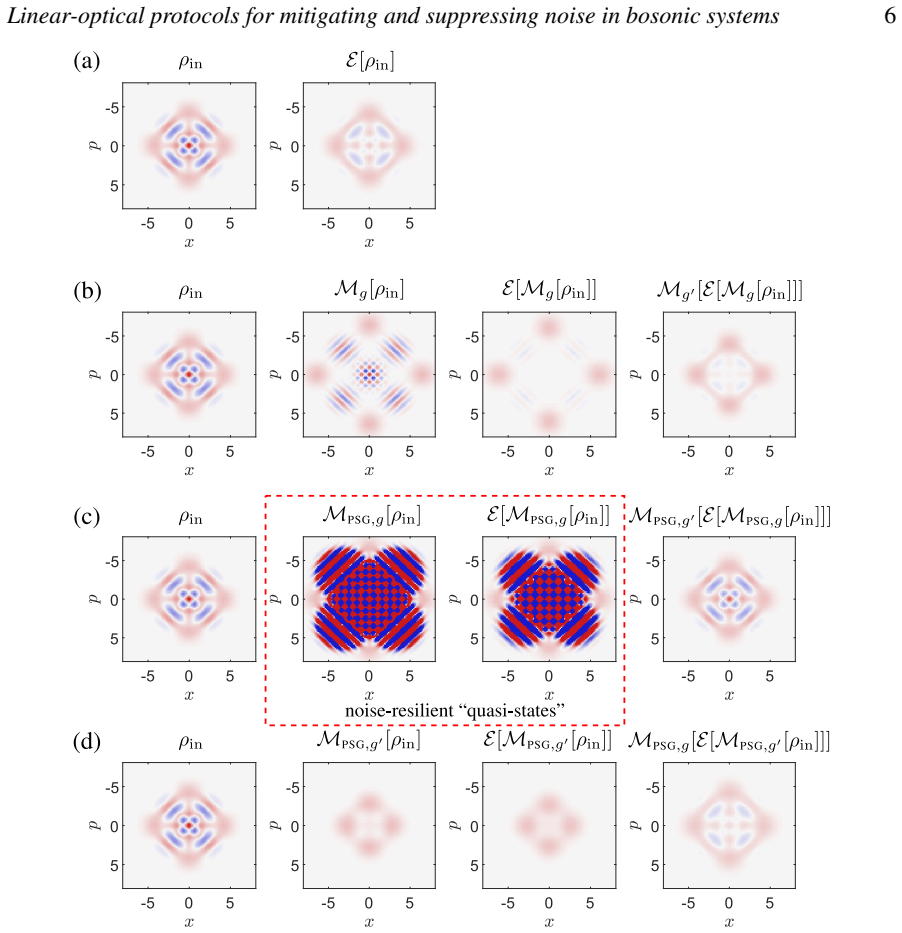
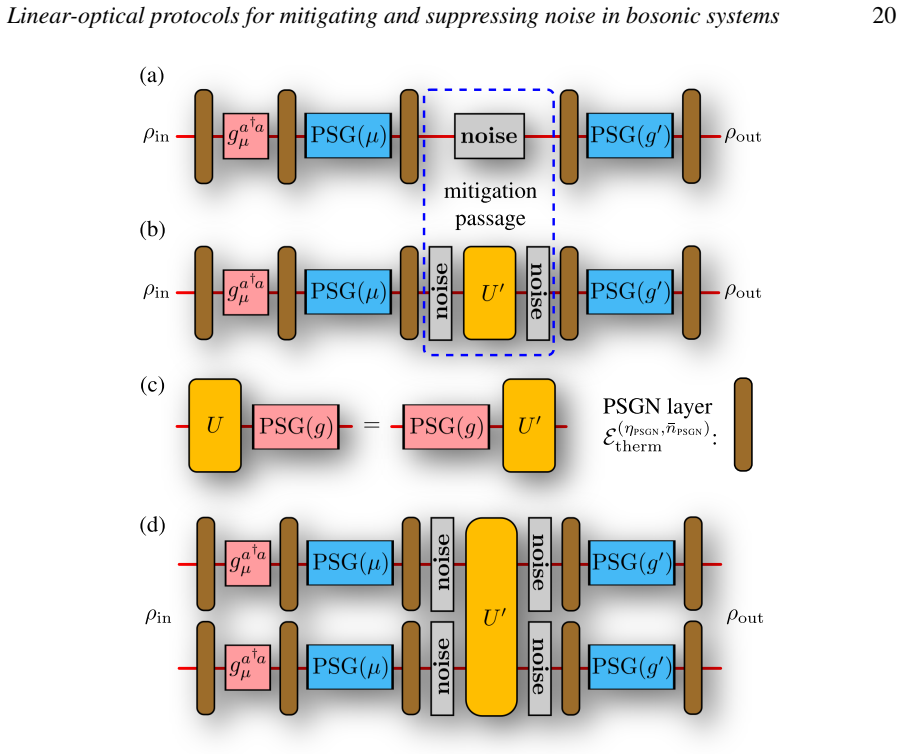
The two load-bearing objects are the photon-subtraction gadget (PSG) and the vacuum-based Mach–Zehnder (VMZ) scheme. A PSG is a noiseless linear amplifier or attenuator followed by photon subtraction; on coherent states it acts as $|\alpha\rangle\langle\alpha|\mapsto|g\alpha\rangle\langle g\alpha|$, which is why two PSGs of reciprocal gain sandwiching a thermal or displacement channel leave a scaled displacement mixture that vanishes for large gain. The VMZ scheme is an $M$-mode interferometer $U$, i.i.d. dephasing in the middle, the inverse $U^\dagger$, and vacuum measurements on $M-1$ ancillas; the random sum $s_1=\sum_j e^{i\phi_j}|U_{j1}|^2$ acts as the attenuating operator $s_1^{a^\dagger a}$, and its concentration via Chebyshev's inequality is what converts dephasing into a known linear-attenuation channel in the large-$M$ limit.
What would settle it
Simulate the VMZ protocol with a Hadamard interferometer on a Schrödinger-cat input state, propagating the full multimode state exactly in Fock space for increasing M, and compare the conditional output with the prediction $\lambda_\gamma^{a^\dagger a}\rho\,\lambda_\gamma^{*a^\dagger a}/\mathrm{tr}(\ldots)$. If the output deviates systematically as M grows, the infinite-M 'any state' claim fails; if it converges, the P-function exchange is supported.
Extended reading notes
Core claim
On the paper's own terms, the central discovery is that dephasing noise is not inherently a nonlinear problem. The VMZ scheme—an $M$-mode interferometer $U$, independent identical dephasing on every mode, the inverse interferometer $U^\dagger$, and vacuum measurements on $M-1$ ancillas—acts on coherent states as the operator $s_1^{a^\dagger a}$, where $s_1=\sum_j e^{i\phi_j}|U_{j1}|^2$ is a random complex number. Chebyshev's inequality shows that for Hadamard or unitary-two-design interferometers $s_1$ concentrates on $\lambda_\gamma=\overline{e^{i\phi}}$ as $M\to\infty$, so the conditional output becomes $\lambda_\gamma^{a^\dagger a}\rho\,\lambda_\gamma^{*a^\dagger a}$ with nonvanishing success probability; this is exactly a phase-space-rotated linear-attenuation channel, invertible by rotated linear amplification. The paper also proves that for thermal and random-displacement noise, amplifying and attenuating photon-subtraction gadgets on either side of the channel produce the same output as a scaled random-displacement channel, which becomes the original state as the gain grows.
Load-bearing premise
The proof that VMZ converts any dephasing channel into a linear-attenuation channel assumes that the infinite-ancilla limit can be moved inside the phase-space integral representing the input state; this exchange is not proven for input states whose phase-space representation is singular, such as highly nonclassical states.
Editorial extensions
If this is right
- For pure dephasing, no Kerr nonlinearity is required: in the large-ancilla limit the residual noise is a known linear-attenuation channel, and linear amplification can invert it.
- Even with finite ancilla count, weak central-Gaussian dephasing is always suppressed, and a uniform (Hadamard) interferometer gives the best suppression fidelity.
- Thermal and Gaussian-displacement noise can be asymptotically removed from expectation values using amplifying and attenuating photon-subtraction gadgets, with optimal physically-constrained estimators minimizing sampling error.
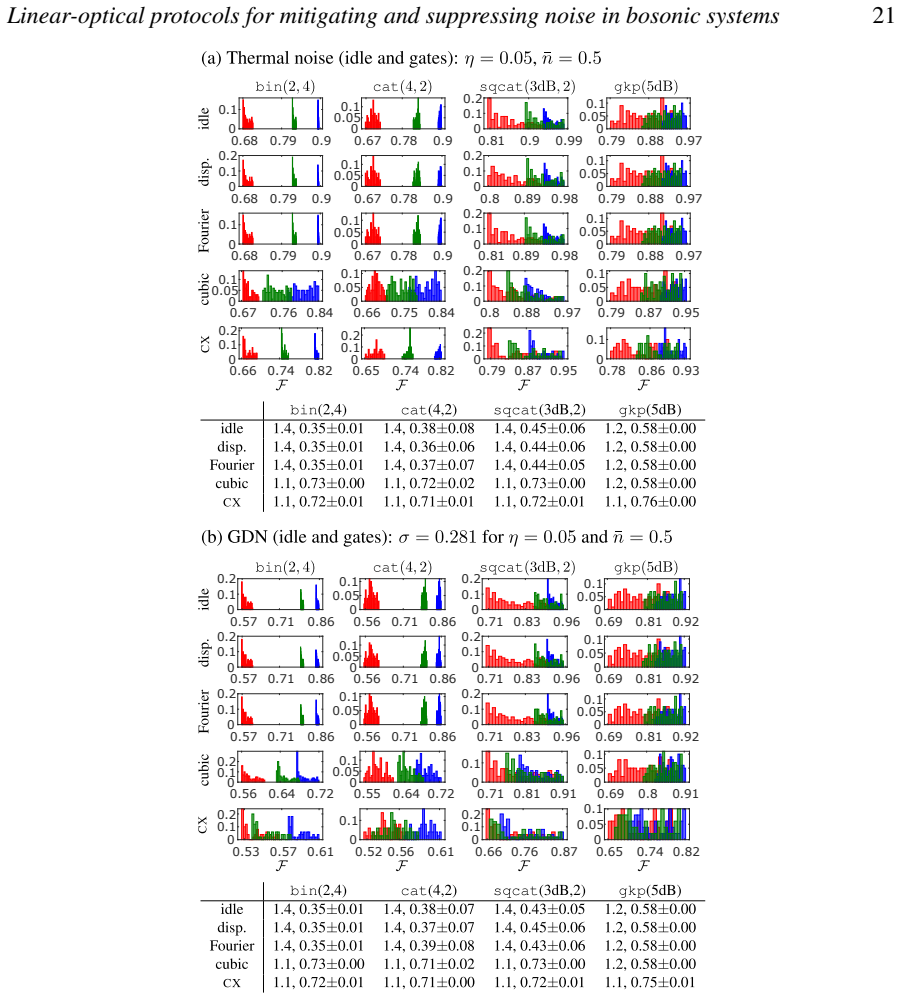
- The two schemes commute, so composite channels such as thermal-plus-dephasing or displacement-plus-dephasing can be treated simultaneously, with improved fidelities for cat, binomial, squeezed-cat, and GKP codes.
- With appropriate gate modifications, the same mitigation and suppression works for noise from universal gate operations, as shown numerically.
Reading between the lines
- A natural testable extension is to apply the VMZ scheme to inputs with singular phase-space distributions (e.g., cat states) at finite $M$ and check convergence to Eq. (20), since the proof's limit exchange is not demonstrated for such distributions.
- The VMZ 'quantum adder' mechanism suggests that the same interferometric setup could be used to estimate dephasing strength from the success probability $p_{\mathrm{VMZ}}$ or as a general phase-averaging primitive in continuous-variable protocols.
- Because PSG and VMZ both use only linear optics and photon counting, integrating them into a single photonic circuit is a plausible engineering step; the dominant cost would be the nondeterministic success of the amplifying PSG, which the paper bounds via a known linear-optical amplification recipe.
Signed reviews
Editorial analysis
A structured set of objections, weighed in public.
Referee Report
Summary. The paper develops two linear-optical noise-handling protocols for bosonic systems. The first combines amplifying and attenuating photon-subtraction gadgets (PSGs) with probabilistic error cancellation (PEC) to mitigate thermal and random-displacement noise, including an optimized constrained estimator for finite sampling. The second, called VMZ, uses a multimode Mach-Zehnder interferometer with conditional vacuum measurements to suppress dephasing noise; the central claim is that in the infinite-ancilla limit the VMZ setup converts any dephasing channel into a rotated linear-attenuation channel for arbitrary input states, which can then be inverted by linear amplification. The paper also presents numerical demonstrations on binomial, cat, squeezed-cat, and GKP codes, including gate-noise scenarios.
Significance. If the central claims hold, the paper provides genuinely useful linear-optical tools for bosonic error mitigation and suppression: the PSG-PEC scheme addresses thermal and random-displacement noise without Kerr nonlinearities, and the VMZ scheme offers a linear-optical method to turn dephasing into an invertible attenuation channel. The analytical work is mostly self-contained: the PSG map identities, the constrained-estimator MSE formulas in Appendix B, and the finite-M fidelity calculations in Section 3.4 are derived carefully and are supported by numerical simulations on multiple bosonic codes. The authors also explicitly disclose the relation to the prior unitary-averaging work of Ref. [141] and state their additional contributions. The main weakness is a missing rigorous justification of the infinite-M limit for nonclassical input states, which is load-bearing for the universality claim of the VMZ protocol.
major comments (2)
- [Sec. 3.3, Eq. (19) to Eq. (20)] The passage from the coherent-state result in Eq. (17) to the arbitrary-state statement in Eq. (20) exchanges the limit M → ∞ with an integral over the Glauber-Sudarshan P function. For states with singular P functions, such as Fock states and squeezed states, this interchange is not justified by the text. Chebyshev's inequality (19) controls the random variable s1 pointwise for a fixed phase tuple, but it does not by itself control the operator-valued average in Eq. (18). The claim that VMZ turns 'any dephasing channel' into a rotated linear-attenuation channel for all input states therefore needs a direct convergence argument, for example by writing the action of s1^{a†a} in the Fock basis, using finite-rank approximations, and applying dominated convergence in trace norm. This is likely repairable, but it is currently absent.
- [Sec. 3.3, Eq. (20) and following text] The statement that the residual channel can be inverted by the rotated linear amplification λ^{-a†a} requires λγ ≠ 0. For dephasing distributions with λγ = 0, such as uniform dephasing over the full circle, Eq. (20) reduces to a projection onto the vacuum (or is undefined when the input has no vacuum component), and the subsequent linear amplification is not defined. The abstract and Section 3.3 should either restrict the universality claim to dephasing distributions with |λγ| > 0 or explicitly describe the vacuum-projection behavior in the λγ = 0 case.
minor comments (4)
- [Sec. 3.3, Eq. (18)] The overline notation for averaging over the phase tuple is introduced after the equation; it would be clearer to define it before Eq. (18) and to specify that the denominator is the corresponding averaged trace.
- [Sec. 2.2, Eq. (5)] The rule-of-thumb expression for g in the thermal-noise case is hard to parse as typeset; the intended parentheses around the square-root expression should be made explicit.
- [Sec. 2.4, Eq. (10)] The constrained-estimator formulas rely on the Gaussian approximation (B.3) for the multinomial distribution; the validity condition and the role of the large-N assumption would be easier to follow if stated in the main text rather than only in Appendix B.
- [Sec. 3.4, Eq. (25) and Fig. 6] The claim that Eq. (25) is accurate even for small m and n is presented as a numerical observation; a brief explanation of why the approximation extends beyond the m,n ≫ 1 regime would strengthen the presentation.
Circularity Check
No significant circularity: the PSG-PEC and VMZ results are analytical derivations from explicit channel definitions, and the self-citations are not load-bearing.
full rationale
The paper's derivation chain is self-contained and non-circular. Section 2 derives PSG-PEC mitigation from the definition of the PSG map (Eq. 2), its coherent-state action (Eq. 3), and the explicit inversion condition g' = 1/(g mu); Eq. (4) is a direct calculation, not a fitted target. The optimal-mu selection uses the analytically derived MSE (Eqs. 9-10) with noise parameters and target state as inputs, and no predicted quantity is defined in terms of a fitted constant. Section 3 derives VMZ suppression from beam-splitter algebra (Eqs. 16-17), the post-selected map (Eq. 18), and Chebyshev concentration (Eq. 19); the M-to-infinity result (Eq. 20) is a limit theorem rather than an ansatz. Self-citations (e.g., Refs. [72] and [153]) appear only as background or as standard identities that are also supported by independent references, so they are not load-bearing. The Special Note candidly acknowledges the prior 'unitary averaging' setup, and the paper's additional inversion and optimality claims are analytical extensions rather than a renaming. The flagged P-function limit interchange in Sec. 3.3 (Eq. 19 to Eq. 20) is a possible correctness gap that would require a dominated-convergence argument, but it is not circular because the target result is not assumed as an input.
Assumptions & free parameters
free parameters (3)
- PSG gain g =
e.g., g = 1.4 in Figs. 3, 4, 8; chosen via rule of thumb in Eq. (5)
- PSG split parameter mu =
mu_opt minimizes MSE in Eq. (9); depends on noise parameters and target state
- Squeezed displaced-Fock coefficients c_kn =
Table E1 values for z = 3dB, alpha = 1; optimized via Alg. 2 to reach F > 0.99
assumptions (6)
- domain assumption Glauber-Sudarshan P function represents arbitrary quantum states, including distributions.
- domain assumption Thermal and random-displacement noise channels have the form of Eq. (1) with known displacement distributions.
- domain assumption Dephasing channels act as independent and identically distributed phase rotations on each mode inside the VMZ interferometer.
- ad hoc to paper The M to infinity limit can be exchanged with the P-function integral over alpha.
- domain assumption Noiseless linear amplification with the maximum success probability from Ref. [106] is physically realizable using linear optics and Fock resource states.
- standard math Chebyshev's inequality and the central limit theorem describe the relevant statistical convergence.
Cite this review
Pith. "Pith review of Linear-optical protocols for mitigating and suppressing noise in bosonic systems." pith.science (2026). https://pith.science/paper/SBPY6JTP
@misc{pith2026241111313,
  author       = {Pith},
  title        = {Pith review of: Linear-optical protocols for mitigating and suppressing noise in bosonic systems},
  year         = {2026},
  howpublished = {\url{https://pith.science/paper/SBPY6JTP}},
  note         = {Machine review of arXiv:2411.11313}
}
read the original abstract
Quantum-information processing and computation with bosonic qubits are corruptible by noise channels. Using interferometers and photon-subtraction gadgets (PSGs) accompanied by linear amplification and attenuation, we establish linear-optical methods to mitigate and suppress bosonic noise channels. We first show that by employing amplifying and attenuating PSGs respectively at the input and output of either a thermal or random-displacement channel, probabilistic error cancellation (PEC) can be carried out to mitigate errors in expectation-value estimation. We also derive optimal physical estimators that are properly constrained to improve the sampling accuracy of PEC. Next, we prove that a purely-dephasing channel is coherently suppressible using a multimode Mach--Zehnder interferometer and conditional vacuum measurements (VMZ). In the limit of infinitely-many ancillas, with nonvanishing success rates, VMZ using either Hadamard or two-design interferometers turns any dephasing channel into a phase-space-rotated linear-attenuation channel that can subsequently be inverted with (rotated) linear amplification without Kerr nonlinearity. Moreover, for weak central-Gaussian dephasing, the suppression fidelity increases monotonically with the number of ancillas and most optimally with Hadamard interferometers. We demonstrate the performance of these linear-optical mitigation and suppression schemes on common noise channels (and their compositions) and popular bosonic codes. While the theoretical formalism pertains to idling noise channels, we also provide numerical evidence supporting mitigation and suppression capabilities with respect to noise from universal gate operations.
Figures


Figures from the paper (10 more)




Reference graph
Works this paper leans on
-
[83]
Adam Taylor, Gabriele Bressanini, Hyukjoon Kwon, and M. S. Kim. Quantum error cancellation in photonic systems: Undoing photon losses. Phys. Rev. A, 110:022622, Aug 2024
work page 2024
-
[141]
Universal gate set for continuous-variable quantum computation with microwave circuits
Timo Hillmann, Fernando Quijandría, Göran Johansson, Alessandro Ferraro, Simone Gasparinetti, and Giulia Ferrini. Universal gate set for continuous-variable quantum computation with microwave circuits. Phys. Rev. Lett., 125:160501, Oct 2020
work page 2020
-
[1]
P. T. Cochrane, G. J. Milburn, and W. J. Munro. Macroscopically distinct quantum-superposition states as a bosonic code for amplitude damping. Phys. Rev. A, 59:2631–2634, Apr 1999
1999
-
[2]
Encoding a qubit in an oscillator
Daniel Gottesman, Alexei Kitaev, and John Preskill. Encoding a qubit in an oscillator. Phys. Rev. A, 64:012310, Jun 2001
2001
-
[3]
Michael, Matti Silveri, R
Marios H. Michael, Matti Silveri, R. T. Brierley, Victor V . Albert, Juha Salmilehto, Liang Jiang, and S. M. Girvin. New class of quantum error-correcting codes for a bosonic mode. Phys. Rev. X, 6:031006, Jul 2016
2016
-
[4]
Albert, Kyungjoo Noh, Kasper Duivenvoorden, Dylan J
Victor V . Albert, Kyungjoo Noh, Kasper Duivenvoorden, Dylan J. Young, R. T. Brierley, Philip Reinhold, Christophe Vuillot, Linshu Li, Chao Shen, S. M. Girvin, Barbara M. Terhal, and Liang Jiang. Performance and structure of single-mode bosonic codes. Phys. Rev. A, 97:032346, Mar 2018
2018
-
[5]
Jacobs, A
K. Jacobs, A. N. Jordan, and E. K. Irish. Energy measurements and preparation of canonical phase states of a nano-mechanical resonator. EPL, 82(1):18003, mar 2008
2008
-
[6]
Encoding a qubit in an oscillator
H. M. Vasconcelos, L. Sanz, and S. Glancy. All-optical generation of states for “Encoding a qubit in an oscillator”. Opt. Lett., 35(19):3261–3263, Oct 2010
2010
Show all 157 references
-
[7]
Schoelkopf, Michel H
Zaki Leghtas, Gerhard Kirchmair, Brian Vlastakis, Robert J. Schoelkopf, Michel H. Devoret, and Mazyar Mirrahimi. Hardware-efficient autonomous quantum memory protection. Phys. Rev. Lett., 111:120501, Sep 2013
2013
-
[8]
Dynamically protected cat-qubits: a new paradigm for universal quantum computation
Mazyar Mirrahimi, Zaki Leghtas, Victor V Albert, Steven Touzard, Robert J Schoelkopf, Liang Jiang, and Michel H Devoret. Dynamically protected cat-qubits: a new paradigm for universal quantum computation. New J. Phys., 16(4):045014, apr 2014
2014
-
[9]
Non-Gaussian and Gottesman–Kitaev–Preskill state preparation by photon catalysis
Miller Eaton, Rajveer Nehra, and Olivier Pfister. Non-Gaussian and Gottesman–Kitaev–Preskill state preparation by photon catalysis. New J. Phys., 21(11):113034, nov 2019
2019
-
[10]
Schoelkopf, Michel H
Wen-Long Ma, Shruti Puri, Robert J. Schoelkopf, Michel H. Devoret, S.M. Girvin, and Liang Jiang. Quantum control of bosonic modes with superconducting circuits. Sci. Bull., 66(17):1789–1805, 2021
2021
-
[11]
Measurement- free preparation of grid states
Jacob Hastrup, Kimin Park, Jonatan Bohr Brask, Radim Filip, and Ulrik Lund Andersen. Measurement- free preparation of grid states. npj Quantum Inf., 7(1):17, Jan 2021
2021
-
[12]
Generating the Gottesman-Kitaev-Preskill qubit using a cross-kerr interaction between squeezed light and fock states in optics
Kosuke Fukui, Mamoru Endo, Warit Asavanant, Atsushi Sakaguchi, Jun-ichi Yoshikawa, and Akira Furusawa. Generating the Gottesman-Kitaev-Preskill qubit using a cross-kerr interaction between squeezed light and fock states in optics. Phys. Rev. A, 105:022436, Feb 2022
2022
-
[13]
Creation of optical cat and GKP states using shaped free electrons
Raphael Dahan, Gefen Baranes, Alexey Gorlach, Ron Ruimy, Nicholas Rivera, and Ido Kaminer. Creation of optical cat and GKP states using shaped free electrons. Phys. Rev. X, 13:031001, Jul 2023
2023
-
[14]
Logical states for fault-tolerant quantum computation with propagating light
Shunya Konno, Warit Asavanant, Fumiya Hanamura, Hironari Nagayoshi, Kosuke Fukui, Atsushi Sakaguchi, Ryuhoh Ide, Fumihiro China, Masahiro Yabuno, Shigehito Miki, Hirotaka Terai, Kan Takase, Mamoru Endo, Petr Marek, Radim Filip, Peter van Loock, and Akira Furusawa. Logical stat...
2024
-
[15]
Eli Bourassa, Rafael N
Kan Takase, Fumiya Hanamura, Hironari Nagayoshi, J. Eli Bourassa, Rafael N. Alexander, Akito Kawasaki, Warit Asavanant, Mamoru Endo, and Akira Furusawa. Generation of flying logical qubits using generalized photon subtraction with adaptive Gaussian operations. Phys. Rev. A, 11...
2024
-
[16]
A. P. Lund, H. Jeong, T. C. Ralph, and M. S. Kim. Conditional production of superpositions of coherent states with inefficient photon detection. Phys. Rev. A, 70:020101, 2004. Linear-optical protocols for mitigating and suppressing noise in bosonic systems 47
2004
-
[17]
Jeong, M
H. Jeong, M. S. Kim, T. C. Ralph, and B. S. Ham. Generation of macroscopic superposition states with small nonlinearity. Phys. Rev. A, 70:061801, 2004
2004
-
[18]
Generation of optical ‘Schrödinger cats’ from photon number states
Alexei Ourjoumtsev, Hyunseok Jeong, Rosa Tualle-Brouri, and Philippe Grangier. Generation of optical ‘Schrödinger cats’ from photon number states. Nature, 448(7155):784–786, 2007
2007
-
[19]
Andersen, G
U.L. Andersen, G. Leuchs, and C. Silberhorn. Continuous-variable quantum information processing. Laser Photonics Rev., 4(3):337–354, 2010
2010
-
[20]
A. Mari, V . Giovannetti, and A. S. Holevo. Quantum state majorization at the output of bosonic Gaussian channels. Nature Commun., 5(1):3826, May 2014
2014
-
[21]
Quantum information processing with bosonic qubits in circuit QED
Atharv Joshi, Kyungjoo Noh, and Yvonne Y Gao. Quantum information processing with bosonic qubits in circuit QED. Quantum Sci. Technol., 6(3):033001, apr 2021
2021
-
[22]
Sample efficient graph classification using binary Gaussian boson sampling
Amanuel Anteneh and Olivier Pfister. Sample efficient graph classification using binary Gaussian boson sampling. Phys. Rev. A, 108:062411, Dec 2023
2023
-
[23]
T. C. Ralph, A. Gilchrist, G. J. Milburn, W. J. Munro, and S. Glancy. Quantum computation with optical coherent states. Phys. Rev. A, 68:042319, 2003
2003
-
[24]
Fault-tolerant computing with biased-noise superconducting qubits: a case study
P Aliferis, F Brito, D P DiVincenzo, J Preskill, M Steffen, and B M Terhal. Fault-tolerant computing with biased-noise superconducting qubits: a case study. New J. Phys., 11(1):013061, 2009
2009
-
[25]
Albert, and Liang Jiang
Kyungjoo Noh, Victor V . Albert, and Liang Jiang. Quantum capacity bounds of Gaussian thermal loss channels and achievable rates with Gottesman-Kitaev-Preskill codes. IEEE Trans. Inf. Theory , 65(4):2563–2582, 2019
2019
-
[26]
Grimsmo, Joshua Combes, and Ben Q
Arne L. Grimsmo, Joshua Combes, and Ben Q. Baragiola. Quantum computing with rotation-symmetric bosonic codes. Phys. Rev. X, 10:011058, Mar 2020
2020
-
[27]
Resource-efficient topological fault-tolerant quantum computation with hybrid entanglement of light
Srikrishna Omkar, Yong Siah Teo, and Hyunseok Jeong. Resource-efficient topological fault-tolerant quantum computation with hybrid entanglement of light. Phys. Rev. Lett., 125:060501, Aug 2020
2020
-
[28]
Madsen, Fabian Laudenbach, Mohsen Falamarzi
Lars S. Madsen, Fabian Laudenbach, Mohsen Falamarzi. Askarani, Fabien Rortais, Trevor Vincent, Jacob F. F. Bulmer, Filippo M. Miatto, Leonhard Neuhaus, Lukas G. Helt, Matthew J. Collins, Adriana E. Lita, Thomas Gerrits, Sae Woo Nam, Varun D. Vaidya, Matteo Menotti, Ish Dhand, ...
2022
-
[29]
Fault-tolerant operation of bosonic qubits with discrete-variable ancillae
Qian Xu, Pei Zeng, Daohong Xu, and Liang Jiang. Fault-tolerant operation of bosonic qubits with discrete-variable ancillae. Phys. Rev. X, 14:031016, Jul 2024
2024
-
[30]
Sufficient condition for universal quantum computation using bosonic circuits
Cameron Calcluth, Nicolas Reichel, Alessandro Ferraro, and Giulia Ferrini. Sufficient condition for universal quantum computation using bosonic circuits. PRX Quantum, 5:020337, May 2024
2024
-
[31]
Fault- tolerant quantum computation by hybrid qubits with bosonic cat code and single photons
Jaehak Lee, Nuri Kang, Seok-Hyung Lee, Hyunseok Jeong, Liang Jiang, and Seung-Woo Lee. Fault- tolerant quantum computation by hybrid qubits with bosonic cat code and single photons. PRX Quantum, 5:030322, Aug 2024
2024
-
[32]
Frattini, Florian Hopfmueller, Chloe Gauvin-Ndiaye, Julien Camirand-Lemyre, and Philippe St-Jean
Marc-Antoine Lemonde, Dany Lachance-Quirion, Guillaume Duclos-Cianci, Nicholas E. Frattini, Florian Hopfmueller, Chloe Gauvin-Ndiaye, Julien Camirand-Lemyre, and Philippe St-Jean. Hardware- efficient fault tolerant quantum computing with bosonic grid states in superconducting ...
2024 arXiv
-
[33]
Aghaee Rad, T
H. Aghaee Rad, T. Ainsworth, R. N. Alexander, B. Altieri, M. F. Askarani, R. Baby, L. Banchi, B. Q. Baragiola, J. E. Bourassa, R. S. Chadwick, I. Charania, H. Chen, M. J. Collins, P. Contu, N. D’Arcy, G. Dauphinais, R. De Prins, D. Deschenes, I. Di Luch, S. Duque, P. Edke, S. ...
2025
-
[34]
Jeong and M
H. Jeong and M. S. Kim. Efficient quantum computation using coherent states. Phys. Rev. A, 65:042305, Mar 2002
2002
-
[35]
Near-deterministic quantum teleportation and resource-efficient quantum computation using linear optics and hybrid qubits
Seung-Woo Lee and Hyunseok Jeong. Near-deterministic quantum teleportation and resource-efficient quantum computation using linear optics and hybrid qubits. Phys. Rev. A, 87:022326, Feb 2013
2013
-
[36]
Multi-mode bosonic Gaussian channels
F Caruso, J Eisert, V Giovannetti, and A S Holevo. Multi-mode bosonic Gaussian channels. New J. Phys., 10(8):083030, aug 2008
2008
-
[37]
Classical capacity of quantum thermal noise channels to within 1.45 bits
Robert König and Graeme Smith. Classical capacity of quantum thermal noise channels to within 1.45 bits. Phys. Rev. Lett., 110:040501, Jan 2013
2013
-
[38]
Dieter Suter and Gonzalo A. Álvarez. Colloquium: Protecting quantum information against environmental noise. Rev. Mod. Phys., 88:041001, Oct 2016
2016
-
[39]
Enhanced energy-constrained quantum communication over bosonic gaussian channels
Kyungjoo Noh, Stefano Pirandola, and Liang Jiang. Enhanced energy-constrained quantum communication over bosonic gaussian channels. Nature Communications, 11(1):457, Jan 2020
2020
-
[40]
Quantum capacity and codes for the bosonic loss-dephasing channel
Peter Leviant, Qian Xu, Liang Jiang, and Serge Rosenblum. Quantum capacity and codes for the bosonic loss-dephasing channel. Quantum, 6:821, September 2022
2022
-
[41]
Menicucci
Kosuke Fukui, Takaya Matsuura, and Nicolas C. Menicucci. Efficient concatenated bosonic code for additive Gaussian noise. Phys. Rev. Lett., 131:170603, Oct 2023
2023
-
[42]
Zixin Huang, Ludovico Lami, and Mark M. Wilde. Exact quantum sensing limits for bosonic dephasing channels. PRX Quantum, 5:020354, Jun 2024
2024
-
[43]
Long-distance entanglement sharing using hybrid states of discrete and continuous variables
Soumyakanti Bose, Jaskaran Singh, Adán Cabello, and Hyunseok Jeong. Long-distance entanglement sharing using hybrid states of discrete and continuous variables. Phys. Rev. Appl. , 21:064013, Jun 2024
2024
-
[44]
T. C. Ralph. Quantum error correction of continuous-variable states against Gaussian noise. Phys. Rev. A, 84:022339, Aug 2011
2011
-
[45]
Quantum error correction against photon loss using multicomponent cat states
Marcel Bergmann and Peter van Loock. Quantum error correction against photon loss using multicomponent cat states. Phys. Rev. A, 94:042332, Oct 2016
2016
-
[46]
Devoret, and S
Shruti Puri, Alexander Grimm, Philippe Campagne-Ibarcq, Alec Eickbusch, Kyungjoo Noh, Gabrielle Roberts, Liang Jiang, Mazyar Mirrahimi, Michel H. Devoret, and S. M. Girvin. Stabilized cat in a driven nonlinear cavity: A fault-tolerant error syndrome detector. Phys. Rev. X, 9:0...
2019
-
[47]
Fault-tolerant bosonic quantum error correction with the surface–Gottesman-Kitaev-Preskill code
Kyungjoo Noh and Christopher Chamberland. Fault-tolerant bosonic quantum error correction with the surface–Gottesman-Kitaev-Preskill code. Phys. Rev. A, 101:012316, Jan 2020
2020
-
[48]
Grimsmo and Shruti Puri
Arne L. Grimsmo and Shruti Puri. Quantum error correction with the Gottesman-Kitaev-Preskill code. PRX Quantum, 2(2), Jun 2021
2021
-
[49]
Bosonic quantum error correction codes in superconducting quantum circuits
Weizhou Cai, Yuwei Ma, Weiting Wang, Chang-Ling Zou, and Luyan Sun. Bosonic quantum error correction codes in superconducting quantum circuits. Fundam. Res., 1(1):50–67, 2021
2021
-
[50]
All-optical cat-code quantum error correction
Jacob Hastrup and Ulrik Lund Andersen. All-optical cat-code quantum error correction. Phys. Rev. Res., 4:043065, Oct 2022
2022
-
[51]
Brady, Alec Eickbusch, Shraddha Singh, Jing Wu, and Quntao Zhuang
Anthony J. Brady, Alec Eickbusch, Shraddha Singh, Jing Wu, and Quntao Zhuang. Advances in bosonic quantum error correction with Gottesman–Kitaev–Preskill codes: Theory, engineering and applications. Prog. Quantum Electron., 93:100496, 2024
2024
-
[52]
Error-corrected quantum repeaters with Gottesman- Kitaev-Preskill qudits
Frank Schmidt, Daniel Miller, and Peter van Loock. Error-corrected quantum repeaters with Gottesman- Kitaev-Preskill qudits. Phys. Rev. A, 109:042427, Apr 2024
2024
-
[53]
Gagatsos, Boulat A
Christos N. Gagatsos, Boulat A. Bash, Saikat Guha, and Animesh Datta. Bounding the quantum limits of precision for phase estimation with loss and thermal noise. Phys. Rev. A, 96:062306, Dec 2017
2017
-
[54]
Efficient classical simulation of noisy quantum computation
Xun Gao and Luming Duan. Efficient classical simulation of noisy quantum computation. arXiv preprint,
-
[55]
Efficient classical simulation of noisy random quantum circuits in one dimension
Kyungjoo Noh, Liang Jiang, and Bill Fefferman. Efficient classical simulation of noisy random quantum circuits in one dimension. Quantum, 4:318, September 2020
2020
-
[56]
Classical simulation of lossy boson sampling using matrix product operators
Changhun Oh, Kyungjoo Noh, Bill Fefferman, and Liang Jiang. Classical simulation of lossy boson sampling using matrix product operators. Phys. Rev. A, 104:022407, Aug 2021
2021
-
[57]
Classical simulation of boson sampling Linear-optical protocols for mitigating and suppressing noise in bosonic systems 49 based on graph structure
Changhun Oh, Youngrong Lim, Bill Fefferman, and Liang Jiang. Classical simulation of boson sampling Linear-optical protocols for mitigating and suppressing noise in bosonic systems 49 based on graph structure. Phys. Rev. Lett., 128:190501, May 2022
2022
-
[58]
Rudolph, Ross Duncan, Ivan Rungger, and Cristina Cîrstoiu
Enrico Fontana, Manuel S. Rudolph, Ross Duncan, Ivan Rungger, and Cristina Cîrstoiu. Classical simulations of noisy variational quantum circuits. arXiv preprint, 2023. arXiv: 2306.05400 [quant-ph]
2023 arXiv
-
[59]
Noisy random quantum circuit sampling and its classical simulation
Meng Zhang, Chao Wang, and Yongjian Han. Noisy random quantum circuit sampling and its classical simulation. Adv. Quantum Technol., 6(7):2300030, 2023
2023
-
[60]
Chen, Wenhan Dai, Dirk Englund, and Yasser Omar
Luís Bugalho, Emmanuel Zambrini Cruzeiro, Kevin C. Chen, Wenhan Dai, Dirk Englund, and Yasser Omar. Resource-efficient simulation of noisy quantum circuits and application to network-enabled qram optimization. npj Quantum Inf., 9(1):105, Oct 2023
2023
-
[61]
Classical simulability of constant-depth linear-optical circuits with noise
Changhun Oh. Classical simulability of constant-depth linear-optical circuits with noise. arXiv preprint,
-
[62]
Gabriele Bressanini, Hyukjoon Kwon, and M. S. Kim. Gaussian boson sampling at finite temperature. Phys. Rev. A, 109:013707, Jan 2024
2024
-
[63]
Nissim Ofek, Andrei Petrenko, Reinier Heeres, Philip Reinhold, Zaki Leghtas, Brian Vlastakis, Yehan Liu, Luigi Frunzio, S. M. Girvin, L. Jiang, Mazyar Mirrahimi, M. H. Devoret, and R. J. Schoelkopf. Extending the lifetime of a quantum bit with error correction in superconducti...
2016
-
[64]
Deterministic generation of a four-component optical cat state
Jacob Hastrup, Jonas Schou Neergaard-Nielsen, and Ulrik Lund Andersen. Deterministic generation of a four-component optical cat state. Opt. Lett., 45(3):640–643, 2020
2020
-
[65]
Daiqin Su, Ish Dhand, and Timothy C. Ralph. Universal quantum computation with optical four- component cat qubits. Phys. Rev. A, 106:042614, 2022
2022
-
[66]
Mi ˇcuda, I
M. Mi ˇcuda, I. Straka, M. Miková, M. Dušek, N. J. Cerf, J. Fiurášek, and M. Ježek. Noiseless loss suppression in quantum optical communication. Phys. Rev. Lett., 109:180503, Nov 2012
2012
-
[67]
Winnel, Nedasadat Hosseinidehaj, and Timothy C
Matthew S. Winnel, Nedasadat Hosseinidehaj, and Timothy C. Ralph. Generalized quantum scissors for noiseless linear amplification. Phys. Rev. A, 102:063715, Dec 2020
2020
-
[68]
C. M. Nunn, J. D. Franson, and T. B. Pittman. Heralding on the detection of zero photons. Phys. Rev. A, 104:033717, Sep 2021
2021
-
[69]
S. U. Shringarpure, C. M. Nunn, T. B. Pittman, and J. D. Franson. Coherence of quantum states after noiseless attenuation. Phys. Rev. A, 105:013704, 2022
2022
-
[70]
C. M. Nunn, J. D. Franson, and T. B. Pittman. Modifying quantum optical states by zero-photon subtraction. Phys. Rev. A, 105:033702, 2022
2022
-
[71]
C. M. Nunn, S. U. Shringarpure, and T. B. Pittman. Transforming photon statistics through zero-photon subtraction. Phys. Rev. A, 107:043711, 2023
2023
-
[72]
Shringarpure, Yong Siah Teo, and Hyunseok Jeong
Saurabh U. Shringarpure, Yong Siah Teo, and Hyunseok Jeong. Error suppression in multicomponent cat codes with photon subtraction and teleamplification. Opt. Express, 32(12):20719–20741, Jun 2024
2024
-
[73]
Gisin, N
N. Gisin, N. Linden, S. Massar, and S. Popescu. Error filtration and entanglement purification for quantum communication. Phys. Rev. A, 72:012338, 2005
2005
-
[74]
Hann, Shruti Puri, S
Gideon Lee, Connor T. Hann, Shruti Puri, S. M. Girvin, and Liang Jiang. Error suppression for arbitrary- size black box quantum operations. Phys. Rev. Lett., 131:190601, Nov 2023
2023
-
[75]
Virtual channel purification
Zhenhuan Liu, Xingjian Zhang, Yue-Yang Fei, and Zhenyu Cai. Virtual channel purification. arXiv preprint, 2024. arXiv: 2402.07866 [quant-ph]
2024 arXiv
-
[76]
Benjamin, Suguru Endo, William J
Zhenyu Cai, Ryan Babbush, Simon C. Benjamin, Suguru Endo, William J. Huggins, Ying Li, Jarrod R. McClean, and Thomas E. O’Brien. Quantum error mitigation. Rev. Mod. Phys., 95:045005, Dec 2023
2023
-
[77]
Quantum error mitigation for rotation symmetric bosonic codes with symmetry expansion
Suguru Endo, Yasunari Suzuki, Kento Tsubouchi, Rui Asaoka, Kaoru Yamamoto, Yuichiro Matsuzaki, and Yuuki Tokunaga. Quantum error mitigation for rotation symmetric bosonic codes with symmetry expansion. arXiv preprint, 2022. arXiv: 2211.06164 [quant-ph]
2022 arXiv
-
[78]
Projective squeezing for translation symmetric bosonic codes
Suguru Endo, Keitaro Anai, Yuichiro Matsuzaki, Yuuki Tokunaga, and Yasunari Suzuki. Projective squeezing for translation symmetric bosonic codes. arXiv preprint, 2024. arXiv: 2403.1421 [quant- ph]
2024
-
[79]
Munro, Peter van Loock, Kae Nemoto, and Nicoló Lo Piparo
Pei-Zhe Li, Josephine Dias, William J. Munro, Peter van Loock, Kae Nemoto, and Nicoló Lo Piparo. Performance of rotation-symmetric bosonic codes in a quantum repeater network. Adv. Quantum Technol., 7(6):2300252, 2024. Linear-optical protocols for mitigating and suppressing no...
2024
-
[80]
Knill, R
E. Knill, R. Laflamme, and G. J. Milburn. A scheme for efficient quantum computation with linear optics. Nature, 409(6816):46–52, Jan 2001
2001
-
[81]
Minev, Abhinav Kandala, and Kristan Temme
Ewout van den Berg, Zlatko K. Minev, Abhinav Kandala, and Kristan Temme. Probabilistic error cancellation with sparse Pauli–Lindblad models on noisy quantum processors. Nature Physics , 19(8):1116–1121, Aug 2023
2023
-
[82]
Gupta, Ewout van den Berg, Maika Takita, Diego Ristè, Kristan Temme, and Abhinav Kandala
Riddhi S. Gupta, Ewout van den Berg, Maika Takita, Diego Ristè, Kristan Temme, and Abhinav Kandala. Probabilistic error cancellation for dynamic quantum circuits. Phys. Rev. A, 109:062617, Jun 2024
2024
-
[84]
Anderson and Boulat A
Evan J.D. Anderson and Boulat A. Bash. Fundamental limits of thermal-noise lossy bosonic multiple access channel. In 2022 IEEE Globecom Workshops (GC Wkshps), pages 1–6, 2022
2022
-
[85]
Changhun Oh, Senrui Chen, Yat Wong, Sisi Zhou, Hsin-Yuan Huang, Jens A. H. Nielsen, Zheng-Hao Liu, Jonas S. Neergaard-Nielsen, Ulrik L. Andersen, Liang Jiang, and John Preskill. Entanglement-enabled advantage for learning a bosonic random displacement channel. Phys. Rev. Lett....
2024
-
[86]
Joachim Schäfer, Evgueni Karpov, and Nicolas J. Cerf. Gaussian capacity of the quantum bosonic memory channel with additive correlated Gaussian noise. Phys. Rev. A, 84:032318, Sep 2011
2011
-
[87]
Kyungjoo Noh, S. M. Girvin, and Liang Jiang. Encoding an oscillator into many oscillators. Phys. Rev. Lett., 125:080503, Aug 2020
2020
-
[88]
Quantum communication on the bosonic loss-dephasing channel
Francesco Anna Mele, Farzin Salek, Vittorio Giovannetti, and Ludovico Lami. Quantum communication on the bosonic loss-dephasing channel. Phys. Rev. A, 110:012460, Jul 2024
2024
-
[89]
Energy-constrained LOCC-assisted quantum capacity of the bosonic dephasing channel
Amir Arqand, Laleh Memarzadeh, and Stefano Mancini. Energy-constrained LOCC-assisted quantum capacity of the bosonic dephasing channel. Entropy, 25(7), 2023
2023
-
[90]
Discrimination of dephasing channels
Milajiguli Rexiti, Laleh Memarzadeh, and Stefano Mancini. Discrimination of dephasing channels. J. Phys. A: Math. Theor., 55(24):245301, may 2022
2022
-
[91]
Quantum-enabled communication without a phase reference
Quntao Zhuang. Quantum-enabled communication without a phase reference. Phys. Rev. Lett. , 126:060502, Feb 2021
2021
-
[92]
Squeezing-enhanced communication without a phase reference
Marco Fanizza, Matteo Rosati, Michalis Skotiniotis, John Calsamiglia, and Vittorio Giovannetti. Squeezing-enhanced communication without a phase reference. Quantum, 5:608, December 2021
2021
-
[93]
Quantum capacity of a bosonic dephasing channel
Amir Arqand, Laleh Memarzadeh, and Stefano Mancini. Quantum capacity of a bosonic dephasing channel. Phys. Rev. A, 102:042413, Oct 2020
2020
-
[94]
K. H. Wanser. Fundamental phase noise limit in optical fibres due to temperature fluctuations. Electron. Lett., 28:53–54(1), January 1992
1992
-
[95]
Derickson
D. Derickson. Fiber Optic Test and Measurement. Prentice Hall PTR, New York, 1998
1998
-
[96]
Barbara M. Terhal. Quantum error correction for quantum memories. Rev. Mod. Phys., 87:307–346, Apr 2015
2015
-
[97]
H. H. Zhu, J. Zou, H. Zhang, Y . Z. Shi, S. B. Luo, N. Wang, H. Cai, L. X. Wan, B. Wang, X. D. Jiang, J. Thompson, X. S. Luo, X. H. Zhou, L. M. Xiao, W. Huang, L. Patrick, M. Gu, L. C. Kwek, and A. Q. Liu. Space-efficient optical computing with an integrated chip diffractive n...
2022
-
[98]
Optical neural networks: progress and challenges
Tingzhao Fu, Jianfa Zhang, Run Sun, Yuyao Huang, Wei Xu, Sigang Yang, Zhihong Zhu, and Hongwei Chen. Optical neural networks: progress and challenges. Light Sci. Appl., 13(1):263, 2024
2024
-
[99]
Harrow and Richard A
Aram W. Harrow and Richard A. Low. Random Quantum Circuits are Approximate 2-designs. Commun. Math. Phys., 291(1):257–302, October 2009
2009
-
[100]
Exact and approximate unitary 2-designs and their application to fidelity estimation
Christoph Dankert, Richard Cleve, Joseph Emerson, and Etera Livine. Exact and approximate unitary 2-designs and their application to fidelity estimation. Phys. Rev. A, 80:012304, Jul 2009
2009
-
[101]
Fernando G. S. L. Brandão, Aram W. Harrow, and Michał Horodecki. Local random quantum circuits are approximate polynomial-designs. Commun. Math. Phys., 346(2):397–434, Sep 2016
2016
-
[102]
Random quantum circuits are approximate unitary
Jonas Haferkamp. Random quantum circuits are approximate unitary. Quantum, 6:795, September 2022
2022
-
[103]
Negativity of quasiprobability distributions as a measure of nonclassicality
Kok Chuan Tan, Seongjeon Choi, and Hyunseok Jeong. Negativity of quasiprobability distributions as a measure of nonclassicality. Phys. Rev. Lett., 124:110404, Mar 2020. Linear-optical protocols for mitigating and suppressing noise in bosonic systems 51
2020
-
[104]
Carlton M. Caves. Quantum limits on noise in linear amplifiers. Phys. Rev. D, 26:1817–1839, Oct 1982
1982
-
[105]
Caves, Joshua Combes, Zhang Jiang, and Shashank Pandey
Carlton M. Caves, Joshua Combes, Zhang Jiang, and Shashank Pandey. Quantum limits on phase- preserving linear amplifiers. Phys. Rev. A, 86:063802, Dec 2012
2012
-
[106]
Guanzon, Matthew S
Joshua J. Guanzon, Matthew S. Winnel, Deepesh Singh, Austin P. Lund, and Timothy C. Ralph. Saturating the maximum success probability bound for noiseless linear amplification using linear optics. PRX Quantum, 5:020359, Jun 2024
2024
-
[107]
Neergaard-Nielsen, Yujiro Eto, Chang-Woo Lee, Hyunseok Jeong, and Masahide Sasaki
Jonas S. Neergaard-Nielsen, Yujiro Eto, Chang-Woo Lee, Hyunseok Jeong, and Masahide Sasaki. Quantum tele-amplification with a continuous-variable superposition state. Nat. Photonics, 7(6):439– 443, Jun 2013
2013
-
[108]
Teleportation-based noiseless quantum amplification of coherent states of light
Jaromír Fiurášek. Teleportation-based noiseless quantum amplification of coherent states of light. Opt. Express, 30(2):1466–1489, Jan 2022
2022
-
[109]
Guanzon, Matthew S
Joshua J. Guanzon, Matthew S. Winnel, Austin P. Lund, and Timothy C. Ralph. Noiseless linear amplification and loss-tolerant quantum relay using coherent-state superpositions. Phys. Rev. A , 108:032411, Sep 2023
2023
-
[110]
Conlon, Spyros Tserkis, Biveen Shajilal, Kui Liu, Timothy C
Jie Zhao, Hao Jeng, Lorcán O. Conlon, Spyros Tserkis, Biveen Shajilal, Kui Liu, Timothy C. Ralph, Syed M. Assad, and Ping Koy Lam. Enhancing quantum teleportation efficacy with noiseless linear amplification. Nature Communications, 14(1):4745, Aug 2023
2023
-
[111]
Analysis of continuous-variable quantum teleportation enhanced by measurement- based noiseless quantum amplification
Jaromír Fiurášek. Analysis of continuous-variable quantum teleportation enhanced by measurement- based noiseless quantum amplification. Opt. Express, 32(2):2527–2538, Jan 2024
2024
-
[112]
Amplifying hybrid entangled states and superpositions of coherent states
InU Jeon, Sungjoo Cho, and Hyunseok Jeong. Amplifying hybrid entangled states and superpositions of coherent states. arXiv preprint, 2024. arXiv: 2409.16562 [quant-ph]
2024 arXiv
-
[113]
Howard, Barry C
Artur Scherer, Regina B. Howard, Barry C. Sanders, and Wolfgang Tittel. Quantum states prepared by realistic entanglement swapping. Phys. Rev. A, 80:062310, Dec 2009
2009
-
[114]
Ultrafast single-photon detection using nanophotonic parametric amplifiers
Elina Sendonaris, James Williams, Rajveer Nehra, Robert Gray, Ryoto Sekine, Luis Ledezma, and Alireza Marandi. Ultrafast single-photon detection using nanophotonic parametric amplifiers. arXiv preprint,
-
[115]
Bernstein, and Philip Bertani
Michael Reck, Anton Zeilinger, Herbert J. Bernstein, and Philip Bertani. Experimental realization of any discrete unitary operator. Phys. Rev. Lett., 73:58–61, Jul 1994
1994
-
[116]
Clements, Peter C
William R. Clements, Peter C. Humphreys, Benjamin J. Metcalf, W. Steven Kolthammer, and Ian A. Walmsley. Optimal design for universal multiport interferometers. Optica, 3(12):1460–1465, Dec 2016
2016
-
[117]
arXiv: 2410.18397 [physics.optics]
-
[118]
Implementing arbitrary multimode continuous-variable quantum gates with fixed non-Gaussian states and adaptive linear optics
Fumiya Hanamura, Warit Asavanant, Hironari Nagayoshi, Atsushi Sakaguchi, Ryuhoh Ide, Kosuke Fukui, Peter van Loock, and Akira Furusawa. Implementing arbitrary multimode continuous-variable quantum gates with fixed non-Gaussian states and adaptive linear optics. Phys. Rev. A, 1...
2024
-
[119]
Jöns, Jin Chang, Andreas Fognini, Stephan Steinhauer, Val Zwiller, Artur Zrenner, and Tim J
Thomas Hummel, Alex Widhalm, Jan Philipp Höpker, Klaus D. Jöns, Jin Chang, Andreas Fognini, Stephan Steinhauer, Val Zwiller, Artur Zrenner, and Tim J. Bartley. Nanosecond gating of superconducting nanowire single-photon detectors using cryogenic bias circuitry. Opt. Express , ...
2023
-
[120]
Christian Arends, Lasse Wolf, Jasmin Meinecke, Sonja Barkhofen, Tobias Weich, and Tim J. Bartley. Decomposing large unitaries into multimode devices of arbitrary size. Phys. Rev. Res., 6:L012043, Feb 2024
2024
-
[121]
Integration with respect to the Haar measure on unitary, orthogonal and symplectic group
Benoît Collins and Piotr ´Sniady. Integration with respect to the Haar measure on unitary, orthogonal and symplectic group. Communications in Mathematical Physics, 264(3):773–795, Jun 2006
2006
-
[122]
Mezzadri
F. Mezzadri. How to generate random matrices from the classical compact groups. Not. Am. Math. Soc., 54:592, 2007
2007
-
[123]
Timon Schapeler, Niklas Lamberty, Thomas Hummel, Fabian Schlue, Michael Stefszky, Benjamin Brecht, Christine Silberhorn, and Tim J. Bartley. Electrical trace analysis of superconducting nanowire photon- number-resolving detectors. Phys. Rev. Appl., 22:014024, Jul 2024
2024
-
[124]
Introduction to Haar measure tools in quantum information: A beginner’s tutorial
Antonio Anna Mele. Introduction to Haar measure tools in quantum information: A beginner’s tutorial. Quantum, 8:1340, 2024
2024
-
[125]
T. A. Severini. Elements of Distribution Theory. Cambridge University Press, Cambridge, 2005
2005
-
[126]
Puchała and J.A
Z. Puchała and J.A. Miszczak. Symbolic integration with respect to the Haar measure on the unitary groups. Bull. Pol. Acad. Sci. Tech. Sci., 65(No 1):21–27, 2017. Linear-optical protocols for mitigating and suppressing noise in bosonic systems 52
2017
-
[127]
Gao, Brian J
Yvonne Y . Gao, Brian J. Lester, Yaxing Zhang, Chen Wang, Serge Rosenblum, Luigi Frunzio, Liang Jiang, S. M. Girvin, and Robert J. Schoelkopf. Programmable interference between two microwave quantum memories. Phys. Rev. X, 8:021073, Jun 2018
2018
-
[128]
R. Y . Teh, P. D. Drummond, and M. D. Reid. Overcoming decoherence of schrödinger cat states formed in a cavity using squeezed-state inputs. Phys. Rev. Res., 2:043387, Dec 2020
2020
-
[129]
Doherty, and Arne L
Juliette Soule, Andrew C. Doherty, and Arne L. Grimsmo. Concatenating binomial codes with the planar code. arXiv preprint, 2023. arXiv: 2312.14390 [quant-ph]
2023 arXiv
-
[130]
Adapting coherent-state superpositions in noisy channels
Jan Provazník, Petr Marek, Julien Laurat, and Radim Filip. Adapting coherent-state superpositions in noisy channels. arXiv preprint, 2024. arXiv: 2406.01081 [quant-ph]
2024
-
[131]
Baptiste Royer, Shraddha Singh, and S. M. Girvin. Stabilization of finite-energy Gottesman-Kitaev- Preskill states. Phys. Rev. Lett., 125:260509, Dec 2020
2020
-
[132]
Schlegel, Fabrizio Minganti, and Vincenzo Savona
David S. Schlegel, Fabrizio Minganti, and Vincenzo Savona. Quantum error correction using squeezed Schrödinger cat states. Phys. Rev. A, 106:022431, Aug 2022
2022
-
[133]
Two-qubit operations for finite-energy Gottesman-Kitaev-Preskill encodings
Ivan Rojkov, Paul Moser Röggla, Martin Wagener, Moritz Fontboté-Schmidt, Stephan Welte, Jonathan Home, and Florentin Reiter. Two-qubit operations for finite-energy Gottesman-Kitaev-Preskill encodings. Phys. Rev. Lett., 133:100601, Sep 2024
2024
-
[134]
Ground state nature and nonlinear squeezing of Gottesman-Kitaev-Preskill states
Petr Marek. Ground state nature and nonlinear squeezing of Gottesman-Kitaev-Preskill states. Phys. Rev. Lett., 132:210601, May 2024
2024
-
[135]
Eli Bourassa, Nicolas C
Ilan Tzitrin, J. Eli Bourassa, Nicolas C. Menicucci, and Krishna Kumar Sabapathy. Progress towards practical qubit computation using approximate Gottesman-Kitaev-Preskill codes. Phys. Rev. A , 101:032315, Mar 2020
2020
-
[136]
Applications of near- term photonic quantum computers: software and algorithms
Thomas R Bromley, Juan Miguel Arrazola, Soran Jahangiri, Josh Izaac, Nicolás Quesada, Alain Delgado Gran, Maria Schuld, Jeremy Swinarton, Zeid Zabaneh, and Nathan Killoran. Applications of near- term photonic quantum computers: software and algorithms. Quantum Sci. Technol. , ...
2020
-
[137]
Riemannian optimization of photonic quantum circuits in phase and Fock space
Yuan Yao, Filippo Miatto, and Nicolás Quesada. Riemannian optimization of photonic quantum circuits in phase and Fock space. SciPost Phys., 17(3), September 2024
2024
-
[138]
Strawberry Fields: A software platform for photonic quantum computing
Nathan Killoran, Josh Izaac, Nicolás Quesada, Ville Bergholm, Matthew Amy, and Christian Weedbrook. Strawberry Fields: A software platform for photonic quantum computing. Quantum, 3:129, March 2019
2019
-
[139]
All-optical quantum computing using cubic phase gates
Niklas Budinger, Akira Furusawa, and Peter van Loock. All-optical quantum computing using cubic phase gates. Phys. Rev. Res., 6:023332, Jun 2024
2024
-
[140]
Marshman, Austin P
Ryan J. Marshman, Austin P. Lund, Peter P. Rohde, and Timothy C. Ralph. Passive quantum error correction of linear optics networks through error averaging. Phys. Rev. A, 97:022324, Feb 2018
2018
-
[142]
Y . S. Teo. Introduction to Quantum-State Estimation. World Scientific, Singapore, 2015
2015
-
[143]
Pe ˇrina
J. Pe ˇrina. Quantum Statistics of Linear and Nonlinear Optical Phenomena . Springer Dordrecht, Dordrecht, 1991
1991
-
[144]
Nibedita Swain, Ryan J
S. Nibedita Swain, Ryan J. Marshman, Peter P. Rohde, Austin P. Lund, Alexander S. Solntsev, and Timothy C. Ralph. Improving continuous-variable quantum channels with unitary averaging. Phys. Rev. A, 110:032622, Sep 2024
2024
-
[145]
K. E. Cahill and R. J. Glauber. Density operators and quasiprobability distributions. Phys. Rev., 177:1882, 1969
1969
-
[146]
Minimal qubit tomography
Jaroslav ˇReháˇcek, Berthold-Georg Englert, and Dagomir Kaszlikowski. Minimal qubit tomography. Linear-optical protocols for mitigating and suppressing noise in bosonic systems 53 Phys. Rev. A, 70:052321, Nov 2004
2004
-
[147]
Quantum Continuous Variables: A Primer of Theoretical Methods
Alessio Serafini. Quantum Continuous Variables: A Primer of Theoretical Methods . CRC Press, Boca Raton, 2017
2017
-
[148]
Convex Optimization
Stephen Boyd and Lieven Vandenberghe. Convex Optimization. Cambridge University Press, Cambridge, 2009
2009
-
[149]
CVX: Matlab software for disciplined convex programming, version 2.1
Michael Grant and Stephen Boyd. CVX: Matlab software for disciplined convex programming, version 2.1. http://cvxr.com/cvx, March 2014
2014
-
[150]
On the operator bases underlying Wigner’s, Kirkwood’s and Glauber’s phase space functions
B G Englert. On the operator bases underlying Wigner’s, Kirkwood’s and Glauber’s phase space functions. J. Phys. A Math. Gen., 22(6):625, mar 1989
1989
-
[151]
Projective measurement onto arbitrary superposition of weak coherent state bases.Sci
Shuro Izumi, Masahiro Takeoka, Kentaro Wakui, Mikio Fujiwara, Kazuhiro Ema, and Masahide Sasaki. Projective measurement onto arbitrary superposition of weak coherent state bases.Sci. Rep., 8(1):2999, Feb 2018
2018
-
[152]
Cerezo, and Patrick J
Zoë Holmes, Kunal Sharma, M. Cerezo, and Patrick J. Coles. Connecting ansatz expressibility to gradient magnitudes and barren plateaus. PRX Quantum, 3:010313, Jan 2022
2022
-
[153]
Graph implementations for nonsmooth convex programs
Michael Grant and Stephen Boyd. Graph implementations for nonsmooth convex programs. In V . Blondel, S. Boyd, and H. Kimura, editors, Recent Advances in Learning and Control , Lecture Notes in Control and Information Sciences, pages 95–110. Springer-Verlag Limited, 2008. http:...
-
[154]
Generation of optical Schrödinger cat states by generalized photon subtraction
Kan Takase, Jun-ichi Yoshikawa, Warit Asavanant, Mamoru Endo, and Akira Furusawa. Generation of optical Schrödinger cat states by generalized photon subtraction. Phys. Rev. A, 103:013710, Jan 2021
2021
-
[156]
Virtual distillation with noise dilution
Yong Siah Teo, Seongwook Shin, Hyukgun Kwon, Seok-Hyung Lee, and Hyunseok Jeong. Virtual distillation with noise dilution. Phys. Rev. A, 107:022608, Feb 2023
2023
-
[2018]
arXiv: 1810.03176 [quant-ph]
-
[2024]
arXiv: 2406.08086 [quant-ph]
Reviewed August 12, 2026 · model on record in the stance chip above.
Discussion (0). Continue with ORCID to comment.