REVIEW 2 major objections 5 minor 4 cited by
The rare decay $B^+ \to K^+\ell^+\ell^-(\nu\bar{\nu})$ under the QCD sum rules approach
T0 review · 2 major / 5 minor · reviewed 2026-08-12 · deepseek-v4-flash
Pith's one-line read This paper predicts the Standard Model rates for $B^+\to K^+\ell^+\ell^-$ and $B^+\to K^+\nu\bar{\nu}$ using $B\to K$ transition form factors from QCD light-cone sum rules with kaon twist-2 and twist-3 light-cone distribution amplitudes.
desk verdict Workmanlike LCSR update with new B→K form factors and branching fractions that agree with lattice, but the error budget omits the dominant kaon-LCDA uncertainty. read the letter →
The pith
A machine-rendered reading of the paper's core claim, the machinery that carries it, and where it could break.
The reading
What carries the argument
The central object is the set of $B\to K$ transition form factors $f_+(q^2)$, $f_0(q^2)$, and $f_T(q^2)$, obtained from a two-point QCD light-cone sum rule for the vacuum-to-kaon correlation function. The kaon side is encoded in light-cone distribution amplitudes (LCDAs) of twist 2, 3, and 4; the paper constructs the leading and twist-3 LCDAs by combining the light-cone harmonic-oscillator model with background-field QCD sum rules and evolving them to a scale near 3 GeV. The $B$-meson ground-state pole is isolated by Borel transformation and continuum subtraction, and the invariant amplitudes $F_{0(1)}$, $\widetilde{F}_{0(1)}$, and $F^T_{0(1)}$ carry the leading and next-to-leading QCD corrections. A simplified $z(q^2)$-series expansion then extrapolates the LCSR results from $0\le q^2\le 10~\mathrm{GeV}^2$ to the full physical region, with fit-quality deviations below one percent.
What would settle it
A precise measurement of the $B^+\to K^+\nu\bar{\nu}$ branching fraction would settle the central claim: if the true value stays near the current evidence-level excess around $2.3\times 10^{-5}$ instead of falling to the predicted $4.135\times 10^{-6}$, the form-factor normalization used here is wrong.
Extended reading notes
Core claim
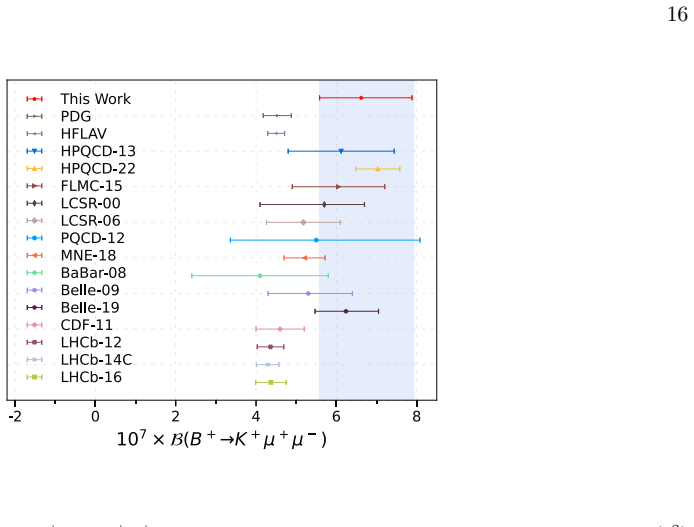
The paper establishes that the kaon twist-2 and twist-3 light-cone distribution amplitudes, built from the light-cone harmonic-oscillator model and QCD background-field sum rules, determine the $B\to K$ vector, scalar, and tensor form factors at next-to-leading order in QCD. At $q^2=0$ the vector and scalar form factors coincide at $0.328^{+0.032}_{-0.028}$, while the tensor form factor is $0.277^{+0.028}_{-0.024}$; the scalar form factor inherits its small-$q^2$ value from the vector one through the standard relation, and the simplified $z$-series expansion carries all three to the full physical region. With these form factors and the Standard Model Wilson coefficients, the paper predicts $\mathcal{B}(B^+\to K^+ e^+e^-)=6.633^{+1.341}_{-1.070}\times 10^{-7}$, $\mathcal{B}(B^+\to K^+ \mu^+\mu^-)=6.620^{+1.323}_{-1.056}\times 10^{-7}$, $\mathcal{B}(B^+\to K^+ \tau^+\tau^-)=1.760^{+0.241}_{-0.197}\times 10^{-7}$, and $\mathcal{B}(B^+\to K^+ \nu\bar{\nu})=4.135^{+0.820}_{-0.655}\times 10^{-6}$. The lepton-universality ratio $R_K$ is $0.995^{+0.021}_{-0.020}$ in the low-$q^2$ window and $1.001^{+0.003}_{-0.003}$ in the central window, and the flat term $F_H^\tau$ is approximately $0.89$ while $F_H^\mu$ is approximately $0.021$.
Load-bearing premise
The calculation rests on the assumption that the kaon twist-2 and twist-3 light-cone distribution amplitudes used in the sum rule are the true kaon distributions at the 3 GeV scale, since their normalization and shape are not included in the quoted uncertainties.
Editorial extensions
If this is right
- The $B^+\to K^+\nu\bar{\nu}$ branching fraction is fixed at $4.135^{+0.820}_{-0.655}\times 10^{-6}$, giving a definite Standard Model target for the ongoing B-factory search.
- The $B^+\to K^+\tau^+\tau^-$ rate is predicted at $1.760^{+0.241}_{-0.197}\times 10^{-7}$, far below the current experimental upper limit, so an observation of this channel would be a clear new-physics signal.
- $R_K$ stays near unity in both $q^2$ windows, confirming lepton universality in $B\to K\ell^+\ell^-$ within the Standard Model.
- The flat term $F_H^\tau \approx 0.89$ makes the tau-channel angular distribution almost flat, a distinctive signature of the heavy-lepton phase space.
Reading between the lines
- If the kaon distribution-amplitude parameters were included in the error budget, the quoted branching-fraction uncertainties would likely grow, because the same LCDA model shifts all three form factors coherently.
- The predicted ratio $f_T(0)/f_+(0)\approx 0.84$ offers a clean cross-check: a lattice-QCD computation of the tensor form factor at low $q^2$ would either confirm the tensor suppression or expose a problem in the twist-3 input.
- A high-statistics measurement of the $B^+\to K^+\mu^+\mu^-$ differential distribution over the full $q^2$ range would test the entire LCSR-plus-$z$-series curve, not just the integrated rate.
Editorial analysis
A structured set of objections, weighed in public.
Referee Report
Summary. This manuscript computes the B→K vector, scalar, and tensor transition form factors using QCD light-cone sum rules at next-to-leading order, with kaon twist-2 and twist-3 distribution amplitudes modeled by the authors' LHCO/BFTSR approach. The form factors are extrapolated to the full kinematic range with a simplified z-series, and are then used to predict the Standard Model branching fractions of B+→K+ℓ+ℓ− (ℓ=e,μ,τ) and B+→K+νν, together with the lepton-universality ratio RK and the flat term FH. The central outputs are f_+^{BK}(0)=f_0^{BK}(0)=0.328^{+0.032}_{-0.028}, f_T^{BK}(0)=0.277^{+0.028}_{-0.024}, B(B+→K+e+e−)=6.633^{+1.341}_{-1.070}×10^{-7}, B(B+→K+μ+μ−)=6.620^{+1.323}_{-1.056}×10^{-7}, B(B+→K+τ+τ−)=1.760^{+0.241}_{-0.197}×10^{-7}, and B(B+→K+νν)=4.135^{+0.820}_{-0.655}×10^{-6}. These values are compared extensively with earlier LCSR, pQCD, lattice QCD, and experimental results.
Significance. If the calculation is taken at face value, it provides an independent LCSR determination of the B→K form factors and derived rare-decay observables that is broadly consistent with the HPQCD lattice results and with other LCSR determinations. The paper's strengths are its use of a specific kaon-LCDA model, the inclusion of NLO QCD corrections in the LCSR, and the unusually complete comparison tables for the branching fractions, RK, and FH. The central values therefore support the Standard Model and are useful as a cross-check of lattice results. The main weakness is that the uncertainty budget is not complete: the dominant kaon-LCDA input is quoted without propagated uncertainties, so the quantitative error bars and the claimed precision are conditional on an unverified input.
major comments (2)
minor comments (5)
Circularity Check
No significant circularity: the branching fractions are derived from LCSR form factors and standard SM formulas; the self-cited kaon LCDA model is an input-dependence caveat, not a constructional reduction.
full rationale
Walking the derivation chain: the TFFs f_+(0), f_0(0), and f_T(0) are obtained from the LCSR dispersion relations, Eqs. (32)-(35), with inputs s0, M^2, fB, mb, and the kaon LCDAs; the branching fractions then follow from the standard SM effective-Hamiltonian expressions, Eqs. (13)-(28), using the z-series extrapolation of Eq. (39). None of the final observables (branching fractions, R_K, F_H) is used as a constraint anywhere in the extraction: Table IV's z-series coefficients are fitted to the LCSR TFF curves, not to experimental data, and the comparisons with HPQCD, LHCb, Belle, etc. are checks, not inputs. The strongest candidate for circularity is the kaon twist-2/twist-3 LCDA model of Eqs. (37)-(38) and Table II, whose parameters are said to have been determined in the same group's previous works and which dominate the TFFs; this is a genuine dependency on self-cited prior analysis, and the omission of LCDA-parameter uncertainties from Table III is a robustness concern. However, the prior determinations are BFTSR/QCD-sum-rule results whose stated assumptions do not include the B->K TFFs or branching fractions, so the present prediction is not equivalent by construction to its input. The equality f_+(0)=f_0(0) is the kinematic identity following from Eq. (35), not a fitted equality. The NLO invariant amplitudes are imported, with a declared cross-check, from the non-overlapping Refs. [89,90], not from a self-citation chain. No step in the paper reduces a claimed prediction to its own fitted input by construction.
Assumptions & free parameters
free parameters (7)
- Borel mass M2 =
22 +/- 1 GeV^2
- Continuum threshold s0^B =
34 +/- 1 GeV^2
- Kaon twist-2 LCDA set (A2;K, alpha2;K, Bhat2;K, beta2;K) =
At mu_k=3 GeV: 10.20, 0.003, 0.008, 1.117
- Kaon twist-3 pseudoscalar LCDA set (Ap3;K, Bp3;K, Cp3;K, betap3;K) =
At mu_k=3 GeV: 138.4, 0.037, 1.521, 0.538
- Kaon twist-3 tensor LCDA set (Asigma3;K, Bsigma3;K, Csigma3;K, betasigma3;K) =
At mu_k=3 GeV: 172.5, 0.027, 0.181, 0.455
- Constituent quark masses mhat_q and mhat_s in the LHCO wave functions =
Not given in this paper
- z-series coefficients beta_k for f_+, f_0, f_T =
Table IV, e.g. beta+ = 0.325, -0.966, -1.533
assumptions (6)
- domain assumption The B to K LCSR factorization holds and the correlation function is dominated by light-cone distances, expanding in kaon LCDAs.
- domain assumption The NLO invariant amplitudes from Refs. [89,90] are valid for B to K after suitable substitutions, as asserted in Section II after Eq. (35).
- domain assumption The LHCO/BFTSR kaon LCDA parameters of Refs. [59,60] are accurate and can be evolved to mu_k=3 GeV without additional uncertainty.
- domain assumption Long-distance nonlocal effects beyond the TFFs, such as charm loops and weak annihilation, are either negligible or captured by the adopted effective coefficients C7eff and C9eff.
- domain assumption The three-coefficient simplified z-series expansion reliably describes the TFFs over the full q^2 range.
- domain assumption The Standard Model with no new physics is the correct description; Wilson coefficients from Refs. [75,87] are used.
Cite this review
Pith. "Pith review of The rare decay $B^+ \to K^+\ell^+\ell^-(\nu\bar{\nu})$ under the QCD sum rules approach." pith.science (2026). https://pith.science/paper/JUFKYYLJ
@misc{pith2026241112141,
  author       = {Pith},
  title        = {Pith review of: The rare decay $B^+ \to K^+\ell^+\ell^-(\nu\bar\nu)$ under the QCD sum rules approach},
  year         = {2026},
  howpublished = {\url{https://pith.science/paper/JUFKYYLJ}},
  note         = {Machine review of arXiv:2411.12141}
}
abstract
In the paper, we conduct a detailed investigation of the rare decay processes of charged meson, specifically $B^+ \to K^+\ell^+\ell^-$ with $\ell=(e,\mu,\tau)$ and $B^+ \to K^+\nu\bar{\nu}$. These processes involve flavor-changing-neutral-current (FCNC) transitions, namely $b\to s\ell^+\ell^-$ and $b\to s\nu\bar{\nu}$. The essential components $B\to K$ scalar, vector and tensor transition form factors (TFFs) are calculated by using the QCD light-cone sum rules approach up to next-to-leading order QCD corrections. In which, the kaon twist-2 and twist-3 light-cone distribution amplitudes are calculated from both the QCD sum rules within the framework of background field theory and the light-cone harmonic oscillator model. The TFFs at large recoil point are $f_+^{BK}(0)=f_0^{BK}(0) =0.328_{-0.028}^{+0.032}$ and $f_{\rm T}^{BK}(0)=0.277_{-0.024}^{+0.028}$, respectively. To achieve the behavior of those TFFs in the whole $q^2$-region, we extrapolate them by utilizing the simplified $z(q^2)$-series expansion. Furthermore, we compute the differential branching fractions with respect to the squared dilepton invariant mass for the two different decay channels and present the corresponding curves. Our predictions of total branching fraction are ${\cal B}(B^+\to K^+ e^+ e^-)=6.633_{-1.070}^{+1.341}\times 10^{-7}$, ${\cal B}(B^+\to K^+ \mu^+ \mu^-)=6.620_{-1.056}^{+1.323}\times 10^{-7}$, ${\cal B}(B^+\to K^+ \tau^+ \tau^-)=1.760_{-0.197}^{+0.241}\times 10^{-7}$, and ${\cal B}(B^+\to K^+ \nu\bar{\nu})=4.135_{-0.655}^{+0.820}\times 10^{-6}$, respectively. Lastly, the observables such as the lepton universality $\mathcal{R}_{K}$ and the angular distribution `flat term' $F_{\rm H}^\ell$ are given, which show good agreement with the theoretical and experimental predictions.
Figures


Figures from the paper (4 more)


Forward citations
Cited by 4 Pith papers
-
Radiative generation of chiral vector operators in $b\to s \nu\bar{\nu}$ transition
Minimal one-loop models that generate both chiral vector operators for b→sνν̄ are systematically classified but cannot quantitatively explain the Belle II anomaly.
-
Are the new particles heavy or light in $b \to s E_{\mathrm{miss}}$?
The K* longitudinal polarization fraction separates heavy NP, light vector, and ALP explanations of the Belle-II B+ to K+ missing-energy excess, while the Lambda_b to Lambda polarization tags operator chirality.
-
Probing ALP couplings to electroweak gauge bosons
Rare two-body meson decays give the strongest current bounds on the ALP-W coupling for light ALPs, with Z-boson decays and future lepton colliders extending the reach to heavier masses.
-
Probing $B^+ \to K^+$ semi-leptonic FCNC decay with new physics effects under PQCD approach
An improved PQCD plus lattice calculation of B to K semileptonic FCNC form factors confirms a 2.7 sigma excess in B+ to K+ nu nubar and a deficit in B+ to K+ l+ l-, and rules out single-leptoquark explanations using B...
Reference graph
Works this paper leans on
-
[1]
Cabibbo, Unitary Symmetry and Leptonic Decays, Phys
N. Cabibbo, Unitary Symmetry and Leptonic Decays, Phys. Rev. Lett. 10, 531-533 (1963)
1963
-
[2]
Kobayashi and T
M. Kobayashi and T. Maskawa, CP Violation in the Renormalizable Th eory of Weak Interaction, Prog. Theor. Phys. 49, 652-657 (1973)
1973
-
[3]
S. L. Glashow, J. Iliopoulos and L. Maiani, Weak Interactions with L epton-Hadron Symmetry, Phys. Rev. D 2, 1285-1292 (1970)
1970
-
[4]
R. Aaij et al. [LHCb Collaboration], Test of lepton universality using B+ → K +ℓ+ℓ− decays, Phys. Rev. Lett. 113, 151601 (2014) . [ arXiv:1406.6482]
arXiv 2014
-
[5]
R. Aaij et al. [LHCb Collaboration], Search for lepton-universality violation in B+ →K +ℓ+ℓ− decays, Phys. Rev. Lett. 122, 191801 (2019) . [ arXiv:1903.09252]
arXiv 2019
-
[6]
R. Aaij et al. [LHCb Collaboration], Test of lepton universality in beauty-quark dec ays, Nature Phys. 18, 277-282 (2022) . [ arXiv:2103.11769]
arXiv 2022
-
[7]
R. Aaij et al. [LHCb Collaboration], Measurement of lepton universality parameter s in B+ →K +ℓ+ℓ− and B0 →K ∗0ℓ+ℓ− decays, Phys. Rev. D 108, 032002 (2023) . [ arXiv:2212.09153]
arXiv 2023
-
[8]
J. P. Lees et al. [BaBar Collaboration], Search for B+ → K +τ +τ − at the BaBar experiment, Phys. Rev. Lett. 118, 031802 (2017) . [ arXiv:1605.09637]
arXiv 2017
Show all 94 references
-
[9]
Bouchard et al
C. Bouchard et al. [HPQCD Collaboration], Standard Model Pre- dictions for B → Kℓ +ℓ− with Form Factors from Lattice QCD, Phys. Rev. Lett. 111, 162002 (2013)[erratum: Phys. Rev. Lett. 112, 149902 (2014)] . [arXiv:1306.0434]
2013 arXiv
-
[10]
W. G. Parrott et al. [HPQCD Collaboration], Standard Model predictions for B →Kℓ +ℓ−,B →Kℓ − 1ℓ+ 2 andB →Kνν using form factors from Nf = 2 + 1 + 1 lattice QCD, Phys. Rev. D 107, 014511 (2023) . [arXiv:2207.13371]
2023 arXiv
-
[11]
Aubert et al
B. Aubert et al. [BaBar Collaboration], Direct CP, Lepton Flavor and Isospin Asymmet ries in the DecaysB →K (∗)ℓ+ℓ−, Phys. Rev. Lett. 102, 091803 (2009) . [ arXiv:0807.4119]
2009 arXiv
-
[12]
J. P. Lees et al. [BaBar Collaboration], Measurement of Branching Fractions and Rat e Asymmetries in the Rare Decays B →K (∗)l+l−, Phys. Rev. D 86, 032012 (2012) . [ arXiv:1204.3933]
2012 arXiv
-
[14]
Abe et al
K. Abe et al. [Belle Collaboration], Observation of the decay B → Kℓ +ℓ−, Phys. Rev. Lett. 88, 021801 (2002) . [ hep:1107.3753]
2002 arXiv
-
[15]
J. T. Wei et al. [Belle Collaboration], Measurement of the Differential Branching Frac tion and Forward- Backward Asymmetry for B →K (∗)ℓ+ℓ−, Phys. Rev. Lett. 103, 171801 (2009) . [ arXiv:0904.0770] 24
2009 arXiv
-
[16]
Choudhury et al
S. Choudhury et al. [Belle Collaboration], Test of lepton flavor universality and search for lepton flavor violation in B →Kℓℓ decays, JHEP 03, 105 (2021) . [ arXiv:1908.01848]
2021 arXiv
-
[17]
Hayrapetyan et al
A. Hayrapetyan et al. [CMS Collaboration], Test of lepton flavor universality in B± →K ±µ+µ− and B± →K ±e+e− decays in proton-proton collisions at √s = 13 TeV, arXiv:2401.07090
-
[18]
Aaij et al
R. Aaij et al. [LHCb Collaboration], Differential branching fraction and angular ana lysis of the B+ → K +µ+µ− decay, JHEP 02, 105 (2013) . [ arXiv:1209.4284]
2013 arXiv
-
[19]
Aaij et al
R. Aaij et al. [LHCb Collaboration], Angular analysis of charged and neutral B → Kµ +µ− decays, JHEP 05, 082 (2014) . [ arXiv:1403.8045]
2014 arXiv
-
[20]
Aaij et al
R. Aaij et al. [LHCb Collaboration], Differential branching fractions and isospin asy mmetries of B → K (∗)µ+µ− decays, JHEP 06, 133 (2014) . [ arXiv:1403.8044]
2014 arXiv
-
[21]
Aaij et al
R. Aaij et al. [LHCb Collaboration], Measurement of the phase difference between short- and long- distance amplitudes in the B+ →K +µ+µ− decay, Eur. Phys. J. C 77, 161 (2017) . [ arXiv:1612.06764]
2017 arXiv
-
[22]
Adachi et al
I. Adachi et al. [Belle-II Collaboration], Evidence for B+ →K +ν ¯ν Decays, [ arXiv:2311.14647]
-
[23]
Abudin´ enet al
F. Abudin´ enet al. [Belle-II Collaboration], Search for B+ →K +ν ¯ν Decays Using an Inclusive Tagging Method at Belle II, Phys. Rev. Lett. 127, 181802 (2021) . [ arXiv:2104.12624]
2021 arXiv
-
[24]
Grygier et al
J. Grygier et al. [Belle Collaboration], Search for B → hν ¯ν decays with semileptonic tagging at Belle, Phys. Rev. D 96, 091101 (2017) . [ arXiv:1702.03224]
2017 arXiv
-
[25]
Y. K. Huang, Y. L. Shen, C. Wang and Y. M. Wang, Next-to-Lea ding-Order Weak Annihilation Correction to Rare B → {K,π }ℓ+ℓ− Decays, [ arXiv:2403.11258]
-
[26]
Bordone, G
M. Bordone, G. isidori, S. M¨ achler and A. Tinari, Short- vs. long -distance physics in B →K (∗)ℓ+ℓ−: a data-driven analysis, Eur. Phys. J. C 84, 547 (2024) . [ arXiv:2401.18007]
2024 arXiv
-
[27]
A. Ali, P. Ball, L. T. Handoko and G. Hiller, A Comparative study of t he decays B → (K, K ∗)ℓ+ℓ− in standard model and supersymmetric theories, Phys. Rev. D 61, 074024 (2000) . [ hep-ph/9910221]
2000 arXiv
-
[28]
Y. L. Wu, M. Zhong and Y. B. Zuo, B(s),D (s) → π,K,η,ρ,K ∗,ω,φ Transition Form Factors and Decay Rates with Extraction of the CKM paramet ers |Vub|, |Vcs|, |Vcd|, Int. J. Mod. Phys. A 21, 6125-6172 (2006) . [ hep-ph/0604007]
2006 arXiv
-
[29]
Faessler, T
A. Faessler, T. Gutsche, M. A. Ivanov, J. G. Korner and V. E. Lyubovitskij, The Exclusive rare decays B → K(K*) ¯ℓℓ and Bc → D(D*) ¯ℓℓ in a relativistic quark model, Eur. Phys. J. direct 4, 18 (2002) . [hep-ph/0205287]
2002 arXiv
-
[30]
Bobeth, G
C. Bobeth, G. Hiller, D. van Dyk and C. Wacker, The Decay B →Kℓ +ℓ− at Low Hadronic Recoil and Model-Independent ∆ B = 1 Constraints, JHEP 01, 107 (2012) . [ arXiv:1111.2558]
2012 arXiv
-
[31]
Bobeth, G
C. Bobeth, G. Hiller and D. van Dyk, General analysis of ¯B → ¯K (∗)ℓ+ℓ− decays at low recoil, Phys. Rev. D 87, 034016 (2013) . [ arXiv:1212.2321]
2013 arXiv
-
[32]
W. F. Wang and Z. J. Xiao, The semileptonic decays B/Bs → (π,K )(ℓ+ℓ−,ℓν,ν ¯ν) in the perturbative QCD approach beyond the leading-order, Phys. Rev. D 86, 114025 (2012) . [ arXiv:1207.0265]
2012 arXiv
-
[33]
D. Du, A. X. El-Khadra, S. Gottlieb, A. S. Kronfeld, J. Laiho, E. Lunghi, R. S. Van de Water and R. Zhou, Phenomenology of semileptonic B-meson decays with form factors from lattice QCD, 25 Phys. Rev. D 93, 034005 (2016) . [ arXiv:1510.02349]
2016 arXiv
-
[34]
H. L. Li, P. C. Lu, C. F. Qiao, Z. G. Si and Y. Wang, Study Standa rd Model and Majorana Neutrino Contributions to B+ →K (∗)±µ+µ∓, Chin. Phys. C 43, 023101 (2019) . [ arXiv:1806.03786]
2019 arXiv
-
[35]
Gubernari, M
N. Gubernari, M. Reboud, D. van Dyk and J. Virto, Improved th eory predictions and global analysis of exclusive b →sµ+µ− processes, JHEP 09, 133 (2022) . [ arXiv:2206.03797]
2022 arXiv
-
[36]
Beˇ cirevi´ c, G
D. Beˇ cirevi´ c, G. Piazza and O. Sumensari, Revisiting B →K (∗)ν ¯ν decays in the Standard Model and beyond, Eur. Phys. J. C 83, 252 (2023) . [ arXiv:2301.06990]
2023 arXiv
-
[37]
B. F. Hou, X. Q. Li, M. Shen, Y. D. Yang and X. B. Yuan, Decipher ing the Belle II data on B →Kν ¯ν decay in the (dark) SMEFT with minimal flavour violation, arXiv:2402.19208
-
[38]
A. J. Buras and E. Venturini, Searching for New Physics in Rare K and B Decays without |Vcb| and |Vub| Uncertainties, Acta Phys. Polon. B 53, 6-A1 . [ arXiv:2109.11032]
-
[39]
A. J. Buras and E. Venturini, The exclusive vision of rare K andB decays and of the quark mixing in the standard model, Eur. Phys. J. C 82, 615 (2022) . [ arXiv:2203.11960]
2022 arXiv
-
[40]
P. S. Bhupal Dev, A. Soni and F. Xu, Hints of natural supersy mmetry in flavor anomalies?, Phys. Rev. D 106, 015014 (2022) . [ arXiv:2106.15647]
2022 arXiv
-
[41]
Altmannshofer, A
W. Altmannshofer, A. J. Buras, D. M. Straub and M. Wick, New s trategies for New Physics search in B →K ∗ν ¯ν, B →Kν ¯ν and B →Xsν ¯ν decays, JHEP 04, 022 (2009) . [ arXiv:0902.0160]
2009 arXiv
-
[42]
J. F. Kamenik and C. Smith, Tree-level contributions to the rar e decays B+ →π+ν ¯ν,B + →K + nu¯ν, and B+ →K ∗+ν ¯ν in the Standard Model, Phys. Lett. B 680, 471-475 (2009) . [ arXiv:0908.1174]
2009 arXiv
-
[43]
Athron, R
P. Athron, R. Martinez and C. Sierra, B meson anomalies and larg e B+ → K +νν in non-universal U ′(1) models, JHEP 02, 121 (2024) . [ arXiv:2308.13426]
2024 arXiv
-
[44]
A. J. Buras, J. Girrbach-Noe, C. Niehoff and D. M. Straub, B →K (∗)νν decays in the Standard Model and beyond, JHEP 02, 184 (2015) . [ arXiv:1409.4557]
2015 arXiv
-
[45]
Consistent calculation of the B to pi tra nsition form-factor in the whole physical region,
T. Huang and X. G. Wu, “Consistent calculation of the B to pi tra nsition form-factor in the whole physical region,” Phys. Rev. D 71, 034018 (2005) [arXiv:0412417]
2005
-
[46]
X. G. Wu, T. Huang and Z. Y. Fang, SU f (3)-symmetry breaking effects of the B → K transition form-factor in the QCD light-cone sum rules, Phys. Rev. D 77, 074001 (2008) . [ arXiv:0712.0237]
2008 arXiv
-
[47]
Khodjamirian, T
A. Khodjamirian, T. Mannel, A. A. Pivovarov and Y. M. Wang, Cha rm-loop effect in B →K (∗)ℓ+ℓ− and B →K ∗γ, JHEP 09, 089 (2010) . [ arXiv:1006.4945]
2010 arXiv
-
[48]
B. Y. Cui, Y. K. Huang, Y. L. Shen, C. Wang and Y. M. Wang, Prec ision calculations of Bd,s →π,K decay form factors in soft-collinear effective theory, JHEP 03, 140 (2023) . [ arXiv:2212.11624]
2023 arXiv
-
[49]
Ball and R
P. Ball and R. Zwicky, New results on B → π,K,η decay formfactors from light-cone sum rules, Phys. Rev. D 71, 014015 (2005) . [ arXiv:0406232]
2005
-
[50]
C. D. L¨ u, Y. L. Shen, Y. M. Wang and Y. B. Wei, QCD calculations o f B → π,K form factors with higher-twist corrections, JHEP 01, 024 (2019) . [ arXiv:1810.00819]
2019 arXiv
-
[51]
X. G. Wu and T. Huang, Radiative Corrections on the B → P Form Factors with Chiral Current in the Light-Cone Sum Rules, Phys. Rev. D 79, 034013 (2009) . [ arXiv:0901.2636] 26
2009 arXiv
-
[52]
B — > K transition form-factor up to O(1/m(b)**2) within the k(T) factorization approach,
X. G. Wu, T. Huang and Z. Y. Fang, “B — > K transition form-factor up to O(1/m(b)**2) within the k(T) factorization approach,” Eur. Phys. J. C 52, 561(2007) . [ arXiv:0707.2504]
2007 arXiv
-
[53]
Momeni and R
S. Momeni and R. Khosravi, Form factors and differential bran ching ratio ofB →Kµ +µ− in AdS/QCD, Phys. Rev. D 97, 056005 (2018) . [ arXiv:1710.10647]
2018 arXiv
-
[54]
Bouchard et al
C. Bouchard et al. [HPQCD Collaboration], Rare decay B →Kℓ +ℓ− form factors from lattice QCD, Phys. Rev. D 88, 054509 (2013) . [ arXiv:1306.2384]
2013 arXiv
-
[55]
J. A. Bailey, A. Bazavov, C. Bernard, C. M. Bouchard, C. DeTa r, D. Du, A. X. El-Khadra, J. Foley, E. D. Freeland and E. G´ amiz,et al.,B →Kℓ +ℓ− Decay Form Factors from Three-Flavor Lattice QCD, Phys. Rev. D 93, 025026 (2016) . [ arXiv:1509.06235]
2016 arXiv
-
[56]
W. G. Parrott et al. [HPQCD Collaboration], B →K and D →K form factors from fully relativistic lattice QCD, Phys. Rev. D 107, 014510 (2023) . [ arXiv:2207.12468]
2023 arXiv
-
[57]
P. A. Boyle et al. [UKQCD Collaboration], A Lattice Computation of the First Moment of t he Kaon’s Distribution Amplitude, Phys. Lett. B 641, 67-74 (2006) . [ hep-lat:0607018]
2006
-
[58]
K. G. Chetyrkin, A. Khodjamirian and A. A. Pivovarov, Towards NNLO Accuracy in the QCD Sum Rule for the Kaon Distribution Amplitude, Phys. Lett. B 661, 250-258 (2008) . [ arXiv:0712.2999]
2008 arXiv
-
[59]
Zhong, Z
T. Zhong, Z. H. Zhu, H. B. Fu, X. G. Wu and T. Huang, Improved light-cone harmonic oscil- lator model for the pionic leading-twist distribution amplitude, Phys. Rev. D 104, 016021 (2021) . [arXiv:2102.03989]
2021 arXiv
-
[60]
Zhong, H
T. Zhong, H. B. Fu and X. G. Wu, Investigating the ratio of CKM m atrix elements |Vub|/|Vcb| from semileptonic decay B0 s → Kµ +νµ and kaon twist-2 distribution amplitude, Phys. Rev. D 105, 116020 (2022) . [ arXiv:2201.10820]
2022 arXiv
-
[61]
Zhong, X
T. Zhong, X. G. Wu, H. Y. Han, Q. L. Liao, H. B. Fu and Z. Y. Fang , Revisiting the Twist-3 Distribution Amplitudes of K Meson within the QCD Background Field Approach, Commun. Theor. Phys. 58, 261-270 (2012) . [ arXiv:1109.3127]
2012 arXiv
-
[62]
Zhong, D
T. Zhong, D. Huang and H. B. Fu, Revisiting D-meson twist-2, 3 distribution amplitudes*, Chin. Phys. C 47, 053104 (2023) . [ arXiv:2212.04641]
2023 arXiv
-
[63]
D. D. Hu, H. B. Fu, T. Zhong, L. Zeng, W. Cheng and X. G. Wu, η(′)-meson twist-2 distribution amplitude within QCD sum rule approach and its application to the semi-le ptonic decayD+ s →η(′)ℓ+νℓ, Eur. Phys. J. C 82, 12 (2022) . [ arXiv:2102.05293]
2022 arXiv
-
[64]
D. D. Hu, X. G. Wu, H. B. Fu, T. Zhong, Z. H. Wu and L. Zeng, Pro perties of the ηq leading-twist distribution amplitude and its effects to the B/D + →η(′)ℓ+νℓ decays, Eur. Phys. J. C 84, 15 (2024) . [arXiv:2307.04640]
2024 arXiv
-
[65]
Z. H. Wu, H. B. Fu, T. Zhong, D. Huang, D. D. Hu and X. G. Wu, a0(980)-meson twist-2 dis- tribution amplitude within the QCD sum rules and investigation of D → a0(980)(→ ηπ)e+νe, Nucl. Phys. A 1036, 122671 (2023) . [ arXiv:2211.05390]
2023 arXiv
-
[66]
Huang, T
D. Huang, T. Zhong, H. B. Fu, Z. H. Wu, X. G. Wu and H. Tong, K ∗ 0 (1430) twist-2 distri- bution amplitude and Bs,D s → K ∗ 0 (1430) transition form factors, Eur. Phys. J. C 83, 680 (2023) . 27 [arXiv:2211.06211]
2023 arXiv
-
[67]
H. B. Fu, X. G. Wu, W. Cheng and T. Zhong, ρ -meson longitudinal leading-twist distribution amplitude within QCD background field theory, Phys. Rev. D 94, 074004 (2016) . [ arXiv:1607.04937]
2016 arXiv
-
[68]
H. B. Fu, L. Zeng, W. Cheng, X. G. Wu and T. Zhong, Longitudina l leading-twist distribution amplitude of the J/ ψ meson within the background field theory, Phys. Rev. D 97, 074025 (2018) . [arXiv:1801.06832]
2018 arXiv
-
[69]
Zhong, Y
T. Zhong, Y. H. Dai and H. B. Fu, ρ-meson longitudinal leading-twist distribution amplitude revisited and the D →ρ semileptonic decay, Chin. Phys. C 48, 063108 (2024) . [ arXiv:2308.14032]
2024 arXiv
-
[70]
D. D. Hu, X. G. Wu, L. Zeng, H. B. Fu and T. Zhong, An improved lig ht-cone har- monic oscillator model for the φ-meson longitudinal leading-twist light-cone distribution amplitude, Phys. Rev. D 110, 056017 (2024) . [ arXiv:2403.10003]
2024 arXiv
-
[71]
D. D. Hu, H. B. Fu, T. Zhong, Z. H. Wu and X. G. Wu, a1(1260)-meson longitudinal twist-2 distribution amplitude and the D → a1(1260)ℓ+νℓ decay processes, Eur. Phys. J. C 82, 603 (2022) . [arXiv:2107.02758]
2022 arXiv
-
[72]
Blake, G
T. Blake, G. Lanfranchi and D. M. Straub, Rare B Decays as Tests of the Standard Model, Prog. Part. Nucl. Phys. 92, 50-91 (2017) . [ arXiv:1606.00916]
2017 arXiv
-
[73]
Bobeth, M
C. Bobeth, M. Misiak and J. Urban, Photonic penguins at two loop s and mt dependence of B[B → Xsℓ+ℓ−], Nucl. Phys. B 574, 291-330 (2000) . [ hep-ph/9910220]
2000 arXiv
-
[74]
Altmannshofer, P
W. Altmannshofer, P. Ball, A. Bharucha, A. J. Buras, D. M. Str aub and M. Wick, Symmetries and Asymmetries of B → K ∗µ+µ− Decays in the Standard Model and Beyond, JHEP 01, 019 (2009) . [arXiv:0811.1214]
2009 arXiv
-
[75]
Huber, E
T. Huber, E. Lunghi, M. Misiak and D. Wyler, Electromagnetic loga rithms in ¯B → Xsl+l−, Nucl. Phys. B 740 (2006), 105-137 . [ hep-ph/0512066]
2006 arXiv
-
[76]
Becirevic, N
D. Becirevic, N. Kosnik, F. Mescia and E. Schneider, Complement arity of the constraints on New Physics from Bs → µ+µ− and from B → Kℓ +ℓ− decays, Phys. Rev. D 86, 034034 (2012) . [arXiv:1205.5811]
2012 arXiv
-
[77]
Beylich, G
M. Beylich, G. Buchalla and T. Feldmann, Theory of B → K (∗)ℓ+ℓ− decays at high q2: OPE and quark-hadron duality, Eur. Phys. J. C 71, 1635 (2011) . [ arXiv:1101.5118]
2011 arXiv
-
[78]
Beneke, T
M. Beneke, T. Feldmann and D. Seidel, Systematic approach to e xclusive B → Vℓ +ℓ−, Vγ decays, Nucl. Phys. B 612, 25-58 (2001) . [ hep-ph/0106067]
2001 arXiv
-
[79]
Greub, V
C. Greub, V. Pilipp and C. Schupbach, Analytic calculation of two- loop QCD corrections to b →sℓ+ℓ− in the high q2 region, JHEP 12, 040 (2008) . [ arXiv:0810.4077]
2008 arXiv
-
[80]
Grinstein and D
B. Grinstein and D. Pirjol, Exclusive rare B → K ∗ℓ+ℓ− decays at low recoil: Controlling the long- distance effects, Phys. Rev. D 70 (2004), 114005 . [ hep-ph/0404250]
2004 arXiv
-
[81]
Bobeth, G
C. Bobeth, G. Hiller and D. van Dyk, The Benefits of ¯B → ¯K ∗ℓ+ℓ− Decays at Low Recoil, JHEP 07, 098 (2010) . [ arXiv:1006.5013] 28
2010 arXiv
-
[82]
H. H. Asatryan, H. M. Asatrian, C. Greub and M. Walker, Calcula tion of two loop virtual corrections to b →sℓ+ℓ− in the standard model, Phys. Rev. D 65 (2002), 074004 . [ hep-ph/0109140]
2002 arXiv
-
[83]
H. H. Asatrian, H. M. Asatrian, C. Greub and M. Walker, Two loop virtual corrections to B →Xsℓ+ℓ− in the standard model, Phys. Lett. B 507 (2001), 162-172 . [ hep-ph/0103087]
2001 arXiv
-
[84]
R. J. Dowdall, C. T. H. Davies, R. R. Horgan, G. P. Lepage, C. J. Monahan, J. Shigemitsu and M. Wingate, Neutral B-meson mixing from full lattice QCD at the physical point, Phys. Rev. D 100, 094508 (2019) . [ arXiv:1907.01025]
2019 arXiv
-
[85]
Y. S. Amhis et al. [HFLA V Group], Averages ofb-hadron,c-hadron, and τ -lepton properties as of 2021, Phys. Rev. D 107, 052008 (2023) . [ arXiv:2206.07501]
2023 arXiv
-
[86]
Bobeth, G
C. Bobeth, G. Hiller and G. Piranishvili, Angular distributions of ¯B → ¯Kℓ +ℓ− decays, JHEP 12, 040 (2007) . [ arXiv:0709.4174]
2007 arXiv
-
[87]
J. Brod, M. Gorbahn and E. Stamou, Two-Loop Electroweak Co rrections for the K → πν ¯ν Decays, Phys. Rev. D 83, 034030 (2011) . [ arXiv:1009.0947]
2011 arXiv
-
[88]
R. L. Workman et al. [Particle Data Group], Review of Particle Physics, PTEP 2022, 083C01 (2022)
2022
-
[89]
Duplancic and B
G. Duplancic and B. Melic, B,B s → K form factors: An Update of light-cone sum rule results, Phys. Rev. D 78, 054015 (2008) . [ arXiv:0805.4170]
2008 arXiv
-
[90]
Duplancic, A
G. Duplancic, A. Khodjamirian, T. Mannel, B. Melic and N. Offen, Lig ht-cone sum rules for B → π form factors revisited, JHEP 04, 014 (2008) . [ arXiv:0801.1796]
2008 arXiv
-
[91]
P. Ball, V. M. Braun and A. Lenz, Higher-twist distribution amplitu des of the K-meson in QCD, JHEP 05, 004 (2006) . [ hep-ph/0603063]
2006 arXiv
-
[92]
Aoki et al
S. Aoki et al. [Flavour Lattice Averaging Group], FLAG Review 2019: Flavour Lattic e Averaging Group (FLAG), Eur. Phys. J. C 80, 113 (2020) . [ arXiv:1902.08191]
2020 arXiv
-
[93]
Jamin and B
M. Jamin and B. O. Lange, fB and FBs from QCD sum rules,” Phys. Rev. D 65, 056005 (2002) . [hep-ph/0108135]
2002 arXiv
-
[94]
Cheng, X
W. Cheng, X. G. Wu, R. Y. Zhou and H. B. Fu, The B → ρ helicity form factors within the QCD light-cone sum rules, Phys. Rev. D 98 (2018) no.9, 096013 . [ arXiv:1808.10775]
2018 arXiv
-
[95]
D. M. Straub, flavio: a Python package for flavour and precisio n phenomenology in the Standard Model and beyond, arXiv:1810.08132
Reviewed August 12, 2026 · model on record in the stance chip above.
Discussion (0). Continue with ORCID to comment.