REVIEW 2 major objections 2 minor 73 references
Transport of molecules via polymerization in chemical gradients
T0 review · 2 major / 2 minor · reviewed 2026-05-23 · grok-4.3
Pith's one-line read Active-passive hybrid polymers transport molecules directionally by polymerizing in chemical gradients.
desk verdict The paper derives an effective FP equation for Rouse modes of hybrid polymers by marginalizing active DOF and optimizes active-unit placement for accumulation or motility, but the closure under position-dependent gradients needs explicit verification. read the letter →
The pith
A machine-rendered reading of the paper's core claim, the machinery that carries it, and where it could break.
The reading
What carries the argument
Effective Fokker-Planck equation for the Rouse modes of active-passive hybrid polymers, obtained by marginalizing active degrees of freedom.
What would settle it
Direct numerical simulation of the full active-passive polymer dynamics in a gradient showing that the center-of-mass steady-state distribution or mean first passage time differs from the predictions of the effective Fokker-Planck equation.
Extended reading notes
Core claim
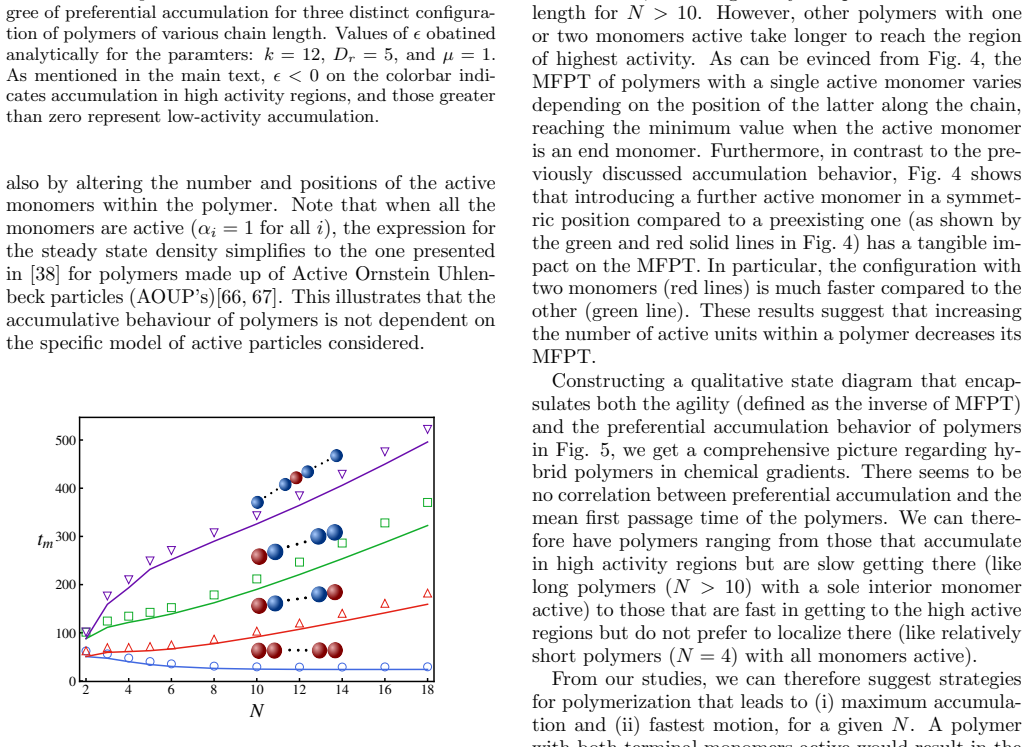
By marginalizing out the active degrees of freedom, the system yields an effective Fokker-Planck equation governing the Rouse modes of active-passive hybrid polymers. This equation is solved to obtain the steady-state distribution of the center of mass and the mean first passage time to a destination under chemical/activity gradients. The arrangement of active units within the polymer is varied to optimize steady-state behavior and dynamic transport properties.
Load-bearing premise
The active degrees of freedom can be integrated out to produce a closed effective Fokker-Planck equation for the Rouse modes that remains valid for center-of-mass motion in gradients.
Editorial extensions
If this is right
- The steady-state distribution of the center of mass shifts due to the gradient-induced drift.
- Mean first passage times to a target can be computed explicitly from the effective equation.
- Optimizing the positions of active units enhances accumulation at preferred locations or reduces passage times.
- Directed motility emerges without external forces, purely from the polymerization in gradients.
Reading between the lines
- If the effective description holds, it could guide design of synthetic polymers for targeted delivery in varying chemical environments.
- Similar marginalization might apply to other hybrid active systems where internal activity couples to external gradients.
- Testing the dependence on active unit arrangement in experiments would validate the optimization strategy.
Editorial analysis
A structured set of objections, weighed in public.
Referee Report
Summary. The paper proposes a mechanism for directed molecular transport in chemical gradients using active-passive hybrid polymers that polymerize. Active units are placed along the chain; their activity is modulated by the local chemical concentration. By marginalizing the active degrees of freedom, the authors derive an effective Fokker-Planck equation governing the Rouse modes of the hybrid polymer. They then compute the steady-state distribution of the center-of-mass coordinate and the mean first-passage time (MFPT) to a target location, and examine how the spatial arrangement of active monomers affects accumulation and motility.
Significance. If the marginalization step is valid and the resulting effective dynamics remain quantitatively accurate, the work supplies a concrete, Rouse-mode-based route to optimize polymer design for gradient-driven transport. This could be relevant to models of intracellular transport and to the design of synthetic active filaments. The explicit focus on MFPT and on the effect of active-unit placement provides falsifiable predictions that can be tested in simulation or experiment.
major comments (2)
- [§3] §3 (or wherever the marginalization is performed): the central claim that integrating out the active degrees of freedom yields a closed Fokker-Planck operator acting only on the Rouse modes (including the center of mass) is asserted but the explicit steps are not shown. Under a spatially varying chemical gradient the active noise or drift term becomes position-dependent; the marginalization generally produces non-local or higher-order terms in the polymer coordinates. The manuscript must demonstrate either that these terms vanish identically or that they remain negligible for the reported MFPT values (e.g., by an explicit small-parameter expansion or by direct comparison with the un-marginalized dynamics).
- [Results (MFPT)] Results section on MFPT: the reported MFPT values are obtained from the effective Fokker-Planck equation. Because the validity of that equation under position-dependent activity has not been established, the quantitative dependence of MFPT on active-unit arrangement cannot yet be taken as a robust prediction. A direct numerical check (e.g., comparison of the effective-model MFPT against Brownian-dynamics trajectories of the full active-passive chain) is required before the optimization conclusions can be considered load-bearing.
minor comments (2)
- Notation: the definition of the Rouse modes and the precise mapping from monomer activity to the effective drift/diffusion coefficients should be stated explicitly (including any averaging over the chemical gradient).
- Figure captions: several panels compare different active-unit placements; the precise parameter values (gradient strength, activity magnitude, chain length) used in each panel should be listed in the caption or a table for reproducibility.
Simulated Author's Rebuttal
We thank the referee for the careful reading and constructive comments on our manuscript. The points raised concerning the marginalization procedure and validation of the effective dynamics are well taken. We address each major comment below and will revise the manuscript to incorporate the requested clarifications and checks.
read point-by-point responses
-
Referee: [§3] §3 (or wherever the marginalization is performed): the central claim that integrating out the active degrees of freedom yields a closed Fokker-Planck operator acting only on the Rouse modes (including the center of mass) is asserted but the explicit steps are not shown. Under a spatially varying chemical gradient the active noise or drift term becomes position-dependent; the marginalization generally produces non-local or higher-order terms in the polymer coordinates. The manuscript must demonstrate either that these terms vanish identically or that they remain negligible for the reported MFPT values (e.g., by an explicit small-parameter expansion or by direct comparison with the un-marginalized dynamics).
Authors: We agree that the explicit steps of the marginalization were not presented in sufficient detail. In the revised manuscript we will add a dedicated appendix that carries out the integration over the active degrees of freedom in full. Starting from the joint Fokker-Planck equation for the Rouse modes and the active variables, we will perform the marginalization under the assumption of fast active relaxation (separation of timescales) and a linear expansion in the chemical gradient. This yields an effective closed operator on the Rouse coordinates; the non-local and higher-order terms appear only at O(∇²) and higher and are shown to be negligible for the weak-gradient regime used in the MFPT calculations. We will also state the precise conditions under which the effective description holds. revision: yes
-
Referee: [Results (MFPT)] Results section on MFPT: the reported MFPT values are obtained from the effective Fokker-Planck equation. Because the validity of that equation under position-dependent activity has not been established, the quantitative dependence of MFPT on active-unit arrangement cannot yet be taken as a robust prediction. A direct numerical check (e.g., comparison of the effective-model MFPT against Brownian-dynamics trajectories of the full active-passive chain) is required before the optimization conclusions can be considered load-bearing.
Authors: We concur that a direct numerical validation is necessary to confirm the quantitative accuracy of the effective model. In the revision we will add a new subsection that compares the MFPT obtained from the effective Fokker-Planck equation against Brownian-dynamics trajectories of the full (un-marginalized) active-passive chain for several representative placements of active units. The comparison will be performed in the same parameter regime as the analytic results, thereby establishing the regime of validity of the effective description and supporting the reported optimization trends. revision: yes
Circularity Check
No significant circularity; derivation uses standard marginalization
full rationale
The paper derives an effective Fokker-Planck equation for Rouse modes by marginalizing active degrees of freedom, then solves the resulting equation for the center-of-mass steady state and mean first passage time. This is a conventional procedure in polymer physics and nonequilibrium statistical mechanics; the reported distributions and times are outputs of the closed effective dynamics rather than quantities defined by construction from fitted inputs or prior self-citations. No load-bearing step reduces to a self-referential fit, ansatz smuggled via citation, or uniqueness theorem imported from the same authors. The approach is therefore self-contained against external benchmarks.
Assumptions & free parameters
free parameters (2)
- positions and strengths of active units
- gradient strength parameters
assumptions (2)
- domain assumption Rouse model remains applicable to hybrid active-passive polymers after marginalization.
- domain assumption Marginalization of active degrees of freedom yields a closed Markovian description for the passive modes.
Cite this review
Pith. "Pith review of Transport of molecules via polymerization in chemical gradients." pith.science (2026). https://pith.science/paper/2411.12325
@misc{pith2026241112325,
  author       = {Pith},
  title        = {Pith review of: Transport of molecules via polymerization in chemical gradients},
  year         = {2026},
  howpublished = {\url{https://pith.science/paper/2411.12325}},
  note         = {Machine review of arXiv:2411.12325}
}
read the original abstract
The transport of molecules for chemical reactions is critically important in various cellular biological processes. Despite thermal diffusion being prevalent in many biochemical processes, it is unreliable for any sort of directed transport or preferential accumulation of molecules. In this paper we propose a strategy for directed motion in which the molecules are transported by active carriers via polymerization. This transport is facilitated by chemical/activity gradients which generate an effective drift of the polymers. By marginalizing out the active degrees of freedom of the system, we obtain an effective Fokker-Planck equation for the Rouse modes of such active-passive hybrid polymers. In particular, we solve for the steady state distribution of the center of mass and its mean first passage time to reach an intended destination. We focus on how the arrangement of active units within the polymer affect its steady-state and dynamic behaviour and how they can be optimized to achieve high accumulation or rapid motility.
Figures


Figures from the paper (2 more)

Reference graph
Works this paper leans on
-
[1]
Kobayashi, Code for publication in Zenodo, 10.5281/zen- odo.21216656 (2026)
obtained via the transformation χi = P j φijXj, where φij is the diagonalizing matrix of Mij such that P jk φijMjk φ−1 kl = γi γ δil. γi’s are the relaxation rates of the individual Rouse modes and they are normalized by the relaxation rate due to the harmonic interactions γ = µζ. The coarse-grained Fokker-Planck equation for the probability density ρ(XCO...
-
[2]
M¨ uller,Ecological modelling, 1998, 108, 3–21
F. M¨ uller,Ecological modelling, 1998, 108, 3–21
work page 1998
-
[3]
T. M. Keenan and A. Folch, Lab on a Chip , 2008, 8, 34–57
work page 2008
-
[4]
M. Almonacid, W. W. Ahmed, M. Bussonnier, P. Mailly, T. Betz, R. Voituriez, N. S. Gov and M.-H. Verlhac, Na- ture cell biology , 2015, 17, 470–479
work page 2015
-
[5]
M. Guthold, X. Zhu, C. Rivetti, G. Yang, N. H. Thom- son, S. Kasas, H. G. Hansma, B. Smith, P. K. Hansma and C. Bustamante, Biophysical journal, 1999, 77, 2284– 2294
work page 1999
-
[6]
B. Alberts, A. Johnson, J. Lewis, M. Raff, K. Roberts and P. Walter, Bray D. Cell movements: from molecules to motility. 2nd ed: Garland Science , 2000
work page 2000
- [7]
-
[8]
S. C. Weber, A. J. Spakowitz and J. A. Theriot, Proceed- ings of the National Academy of Sciences , 2012, 109, 7338–7343
work page 2012
Show all 73 references
-
[9]
Zidovska, D
A. Zidovska, D. A. Weitz and T. J. Mitchison, Proceed- ings of the National Academy of Sciences , 2013, 110, 15555–15560
2013
-
[10]
Di Pierro, D
M. Di Pierro, D. A. Potoyan, P. G. Wolynes and J. N. Onuchic, Proceedings of the National Academy of Sci- ences, 2018, 115, 7753–7758
2018
-
[11]
S. F. Banani, H. O. Lee, A. A. Hyman and M. K. Rosen, Nature reviews Molecular cell biology , 2017, 18, 285–298
2017
-
[12]
Sommer, H
J.-U. Sommer, H. Merlitz and H. Schiessel, Macro- molecules, 2022, 55, 4841–4851
2022
-
[13]
Ramaswamy, Annu
S. Ramaswamy, Annu. Rev. Condens. Matter Phys. , 2010, 1, 323–345
2010
-
[14]
Ramaswamy, Journal of Statistical Mechanics: Theory and Experiment, 2017, 2017, 054002
S. Ramaswamy, Journal of Statistical Mechanics: Theory and Experiment, 2017, 2017, 054002
2017
-
[15]
De Magistris and D
G. De Magistris and D. Marenduzzo, Physica A: Statis- tical Mechanics and its Applications , 2015, 418, 65–77
2015
-
[16]
Fodor, C
´E. Fodor, C. Nardini, M. E. Cates, J. Tailleur, P. Visco and F. Van Wijland, Physical review letters , 2016, 117, 038103
2016
-
[17]
Gompper, R
G. Gompper, R. G. Winkler, T. Speck, A. Solon, C. Nar- dini, F. Peruani, H. L¨ owen, R. Golestanian, U. B. Kaupp, L. Alvarez et al. , Journal of Physics: Condensed Matter , 2020, 32, 193001
2020
-
[18]
J¨ ulicher, S
F. J¨ ulicher, S. W. Grill and G. Salbreux, Reports on Progress in Physics , 2018, 81, 076601
2018
-
[19]
M. C. Marchetti, J.-F. Joanny, S. Ramaswamy, T. B. Liverpool, J. Prost, M. Rao and R. A. Simha, Reviews of modern physics, 2013, 85, 1143–1189
2013
-
[20]
C. P. Brangwynne, G. H. Koenderink, F. C. MacKintosh and D. A. Weitz, The Journal of cell biology , 2008, 183, 583–587
2008
-
[21]
W. Lu, M. Winding, M. Lakonishok, J. Wildonger and V. I. Gelfand, Proceedings of the National Academy of Sciences, 2016, 113, E4995–E5004
2016
-
[22]
Ravichandran, G
A. Ravichandran, G. A. Vliegenthart, G. Saggiorato, T. Auth and G. Gompper, Biophysical journal , 2017, 113, 1121–1132
2017
-
[23]
C. A. Weber, R. Suzuki, V. Schaller, I. S. Aranson, A. R. Bausch and E. Frey,Proceedings of the National Academy of Sciences, 2015, 112, 10703–10707. I
2015
-
[24]
R. G. Winkler, J. Elgeti and G. Gompper, Journal of the Physical Society of Japan , 2017, 86, 101014
2017
-
[25]
R. G. Winkler and G. Gompper, The journal of chemical physics, 2020, 153,
2020
-
[26]
S. K. Anand and S. P. Singh, Physical Review E , 2018, 98, 042501
2018
-
[27]
R. E. Isele-Holder, J. Elgeti and G. Gompper, Soft mat- ter, 2015, 11, 7181–7190
2015
-
[28]
C. A. Philipps, G. Gompper and R. G. Winkler, The Journal of Chemical Physics , 2022, 157, 194904
2022
-
[29]
Locatelli, V
E. Locatelli, V. Bianco and P. Malgaretti, Physical Re- view Letters, 2021, 126, 097801
2021
-
[30]
Kaiser and H
A. Kaiser and H. L¨ owen, The Journal of chemical physics, 2014, 141, 044903
2014
-
[31]
Zhang, C
C. Zhang, C. Xie, W. Feng, H. Luo, Y. Liu and G. Jing, New Journal of Physics , 2023, 25, 043029
2023
-
[32]
C. J. Anderson, G. Briand, O. Dauchot and A. Fern´ andez-Nieves, Physical Review E , 2022, 106, 064606
2022
-
[33]
Harder, C
J. Harder, C. Valeriani and A. Cacciuto, Physical Review E, 2014, 90, 062312
2014
-
[34]
S. M. Mousavi, G. Gompper and R. G. Winkler, The journal of chemical physics , 2021, 155, 044902
2021
-
[35]
J. Shin, A. G. Cherstvy, W. K. Kim and R. Metzler, New Journal of Physics , 2015, 17, 113008
2015
-
[36]
Foglino, E
M. Foglino, E. Locatelli, C. Brackley, D. Michieletto, C. Likos and D. Marenduzzo, Soft matter , 2019, 15, 5995–6005
2019
-
[37]
Bianco, E
V. Bianco, E. Locatelli and P. Malgaretti, Physical review letters, 2018, 121, 217802
2018
-
[38]
H. D. Vuijk, H. Merlitz, M. Lang, A. Sharma and J.-U. Sommer, Physical Review Letters , 2021, 126, 208102
2021
-
[39]
P. L. Muzzeddu, A. Gambassi, J.-U. Sommer and A. Sharma, Physical Review Letters , 2024, 133, 118102
2024
-
[40]
L¨ owen,Europhysics Letters, 2018, 121, 58001
H. L¨ owen,Europhysics Letters, 2018, 121, 58001
2018
-
[41]
Elgeti, R
J. Elgeti, R. G. Winkler and G. Gompper, Reports on progress in physics , 2015, 78, 056601
2015
-
[42]
Bechinger, R
C. Bechinger, R. Di Leonardo, H. L¨ owen, C. Reichhardt, G. Volpe and G. Volpe,Reviews of Modern Physics, 2016, 88, 045006
2016
-
[43]
Dreyfus, J
R. Dreyfus, J. Baudry, M. L. Roper, M. Fermigier, H. A. Stone and J. Bibette, Nature, 2005, 437, 862–865
2005
-
[44]
Najafi and R
A. Najafi and R. Golestanian, Physical Review E—Statistical, Nonlinear, and Soft Matter Physics , 2004, 69, 062901
2004
-
[45]
Jiang, N
H.-R. Jiang, N. Yoshinaga and M. Sano, Physical review letters, 2010, 105, 268302
2010
-
[46]
Theurkauff, C
I. Theurkauff, C. Cottin-Bizonne, J. Palacci, C. Ybert and L. Bocquet, Physical review letters , 2012, 108, 268303
2012
-
[47]
L. F. Valadares, Y.-G. Tao, N. S. Zacharia, V. Kitaev, F. Galembeck, R. Kapral and G. A. Ozin, Small, 2010, 6, 565–572
2010
-
[48]
J. R. Howse, R. A. Jones, A. J. Ryan, T. Gough, R. Vafabakhsh and R. Golestanian, Physical review let- ters, 2007, 99, 048102
2007
-
[49]
M. J. Schnitzer, Physical Review E , 1993, 48, 2553
1993
-
[50]
Sharma and J
A. Sharma and J. M. Brader, Physical review E , 2017, 96, 032604
2017
-
[51]
H. C. Berg, E. coli in Motion , Springer, 2004
2004
-
[52]
Schnitzer, S
M. Schnitzer, S. Block and H. Berg, Biology of the chemo- tactic response, 1990, 46, 15
1990
-
[53]
H. C. Berg, Random walks in biology , Princeton Univer- sity Press, 1993
1993
-
[54]
I. R. Lapidus, Journal of theoretical biology , 1980, 86, 91–103
1980
-
[55]
F. Peng, Y. Tu, J. C. Van Hest and D. A. Wilson, Ange- wandte Chemie International Edition , 2015, 54, 11662– 11665
2015
-
[56]
P. K. Ghosh, Y. Li, F. Marchesoni and F. Nori, Physical Review E, 2015, 92, 012114
2015
-
[57]
H. D. Vuijk, A. Sharma, D. Mondal, J.-U. Sommer and H. Merlitz, Physical Review E , 2018, 97, 042612
2018
-
[58]
Merlitz, H
H. Merlitz, H. D. Vuijk, R. Wittmann, A. Sharma and J.-U. Sommer, Plos one , 2020, 15, e0230873
2020
-
[59]
H. D. Vuijk, S. Klempahn, H. Merlitz, J.-U. Sommer and A. Sharma, Physical Review E , 2022, 106, 014617
2022
-
[60]
P. L. Muzzeddu, H. D. Vuijk, H. L¨ owen, J.-U. Sommer and A. Sharma, The Journal of Chemical Physics , 2022, 157, 134902
2022
-
[61]
P. L. Muzzeddu, ´E. Rold´ an, A. Gambassi and A. Sharma, EPL, 2023, 142, 67001
2023
-
[62]
Valecha, P
B. Valecha, P. L. Muzzeddu, J.-U. Sommer and A. Sharma, arXiv:2409.18703, 2024
2024
-
[63]
Sommer and A
J.-U. Sommer and A. Blumen, Journal of Physics A: Mathematical and General , 1995, 28, 6669
1995
-
[64]
C. W. Gardiner, Springer series in synergetics , 1985
1985
-
[65]
Risken, The Fokker-Planck Equation , 1996
H. Risken, The Fokker-Planck Equation , 1996
1996
-
[66]
M. Doi, S. F. Edwards and S. F. Edwards, The theory of polymer dynamics, oxford university press, 1988, vol. 73
1988
-
[67]
Martin, J
D. Martin, J. O’Byrne, M. E. Cates, ´E. Fodor, C. Nar- dini, J. Tailleur and F. Van Wijland, Physical Review E , 2021, 103, 032607
2021
-
[68]
Caprini and U
L. Caprini and U. M. B. Marconi, Soft matter , 2018, 14, 9044–9054
2018
-
[69]
Straub, Stud
F. Straub, Stud. Inst. Med. Chem. Univ. Szeged , 1943, 3, 23–37
1943
-
[70]
S. Y. Khaitlina, Biochemistry (Moscow), 2014, 79, 917– 927
2014
-
[71]
Hamel and C
E. Hamel and C. M. Lin, Biochemistry, 1984, 23, 4173– 4184
1984
-
[72]
C. A. Weber, D. Zwicker, F. J¨ ulicher and C. F. Lee, Re- ports on Progress in Physics , 2019, 82, 064601. II Supplemental Material: Transport of molecules via polymerization in chemical gradients I. THE LANGEVIN EQUA TIONS, ROUSE MODES AND THE FOKKER-PLANCK EQUA TION The set ...
2019
-
[73]
To calculate J act,1 0 , we split the summation over l into terms with l = 0 and l ̸= 0
(see Ref [38]), which can be neglected for small gradients. To calculate J act,1 0 , we split the summation over l into terms with l = 0 and l ̸= 0. The latter gives − X j φ0jτ d Z Y h̸=0 dχhαjv(Xj) X l̸=0 ∇l · [φljαjv(Xj)ϱ] , (SI 30) = τ 2d X j,l̸=0 φ0j Z Y h̸=0 dχh √ N α2 j ...
Reviewed May 23, 2026 · model on record in the stance chip above.
Discussion (0). Continue with ORCID to comment.