REVIEW 2 major objections 5 minor 1 cited by
High-Efficiency and Low-Noise Detectors for the Upgraded CLASS 90 GHz Focal Plane
T0 review · 2 major / 5 minor · reviewed 2026-08-12 · deepseek-v4-flash
Pith's one-line read Redesigned TES bolometers nearly double the sensitivity of the CLASS 90 GHz camera and show detector efficiency above 90 percent.
desk verdict Solid detector-upgrade paper with credible measured gains; the '>0.90 detector efficiency' claim is the one number to treat with caution. read the letter →
The pith
A machine-rendered reading of the paper's core claim, the machinery that carries it, and where it could break.
The reading
What carries the argument
The central mechanism is a set of three coordinated changes to the TES bolometer pixel: (1) stepped-impedance Nb-to-PdAu terminations that replace the previous tapered gold terminations and avoid superconducting proximity effects; (2) a single contiguous palladium film that provides the bolometer heat capacity and is connected directly to the MoAu TES bilayer through a normal-metal contact, suppressing internal thermal fluctuation noise; and (3) revised bias-line filters that extend RF chokes onto the long support legs. These changes are what make the detectors both more efficient at absorbing incoming radiation and more stable in bias, and they carry the argument from design to measured performance.
What would settle it
Measure the receiver optics efficiency directly by placing a calibrated cryogenic blackbody source at the receiver window and comparing the detected power with that from a full-aperture source; if the product of spill and absorption/reflection efficiencies comes out significantly above 0.71, the inferred detector efficiency would drop below 0.90, whereas a lower product would push it higher.
Extended reading notes
Core claim
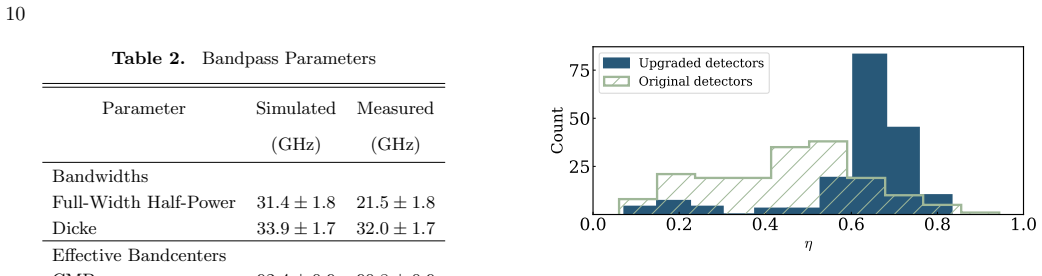
The paper establishes that the upgraded 90 GHz transition-edge-sensor (TES) bolometers achieve their design optical efficiency and much better stability than the original detectors. Based on observations of Jupiter and a modeled receiver optics efficiency (spill 0.78, absorption plus reflection 0.91), the measured telescope efficiency of 0.65 implies a detector efficiency exceeding 0.90. The upgrade also produced a wide, overlapping voltage bias range across each wafer, with 94 percent of detectors staying on their superconducting transition down to 15 percent of normal resistance, enabling nearly the entire array to be biased simultaneously. The array noise-equivalent temperature improved from 19 to 9.7 µK√s, a factor of two gain in sensitivity that the authors attribute mainly to lower dark NEP and higher optical efficiency.
Load-bearing premise
The claim that detector efficiency exceeds 0.90 rests on an assumed split of the telescope efficiency into a spill efficiency of 0.78 and an absorption/reflection efficiency of 0.91; if the real receiver optics efficiency differs from this scenario, the implied detector efficiency changes.
Editorial extensions
If this is right
- If the claimed detector efficiency above 0.90 holds, then the remaining loss in telescope efficiency sits in the receiver optics, so replacing or upgrading the three original detector wafers should push the full array toward the 0.65 efficiency level and further reduce the array NET.
- A wide common bias range across each wafer means nearly all detectors on a wafer can be biased at their optimal transition point, improving the effective yield and the fidelity of polarization maps without redesigning the readout.
- The observed uniformity of optical efficiency across upgraded wafers indicates the microwave circuit design is robust to fabrication variation, simplifying production of additional wafers.
- The lower dark NEP of the upgraded detectors, combined with higher optical efficiency, yields background-limited performance at lower optical loading, which is advantageous for observing the faint large-angular-scale CMB polarization.
- The authors suggest that yield (around 60 percent) can be improved by routing bias leads to multiple wafer edges, a straightforward change that would increase the number of working detectors in future modules.
Reading between the lines
- The inference that detector efficiency exceeds 0.90 is sensitive to the assumed spill (0.78) and absorption/reflection (0.91) efficiencies; if the true optics efficiency is higher, the detector efficiency would be correspondingly lower, and if it is lower, the detector efficiency would be even higher than claimed.
- The design choices validated here—stepped-impedance absorbing terminations and a direct normal-metal thermal link to the TES—are likely transferable to the 150/220 GHz CLASS detectors and to other kilopixel TES arrays that face the same proximity-effect and internal-fluctuation-noise issues.
- The paper's alternative scenarios for reconciling measured thermal parameters (a 10 mK higher critical temperature or a thermal conductance index of 3.77 instead of 4) could be tested by re-measuring Tc with a calibrated thermometer or by directly measuring the short silicon beam's conductance; such a test would refine thermal design rules for ballistic phonon beams.
- A direct calibration of the receiver optics throughput (e.g., placing a chopped source at the receiver window and comparing with a full-aperture source) would turn the inferred detector efficiency into a measured quantity and would also clarify whether the 0.78 spill estimate or the 0.91 absorption/reflection estimate needs revision.
Editorial analysis
A structured set of objections, weighed in public.
Referee Report
Summary. The paper reports the design, in-lab characterization, and on-sky performance of the upgraded CLASS 90 GHz focal plane, in which four of seven detector wafers were replaced during the 2022 austral winter. The design changes include revised magic-tee and crossover terminations, a direct normal-metal thermal contact between the MoAu TES and the Pd heat capacity, and revised bias-line filtering. The central reported results are: 94% of upgraded detectors are stable down to 15% of their normal resistance; the median telescope optical efficiency for the four upgraded wafers is 0.65 with a 68% interval of ±0.06; the full-array NET improved from 19 to 9.7 µK√s; and, under an assumed receiver optics efficiency, the implied detector efficiency exceeds 0.90. The paper also presents measurements of electrothermal parameters, bandpasses, noise, and yield, and discusses discrepancies with design targets.
Significance. If the results hold, this is a valuable instrument paper: the upgrade substantially improves the sensitivity and stability of a deployed CMB polarimeter, and the design changes are likely relevant to future TES bolometer arrays. The paper's strengths are its direct measurements: I-V curve stability statistics, laboratory and on-sky noise spectra, and Jupiter photometry. The 94% stability figure, the median telescope efficiency of 0.65 for the upgraded wafers, and the array NET of 9.7 µK√s are credible as reported. The main caveats are that the 'detector efficiency exceeding 0.90' headline is an inference resting on an assumed receiver-optics efficiency, and that the array-level improvement comparison includes a selection effect from replacing the poorest original wafers. These issues are fixable by reframing or additional analysis, and they do not undermine the directly measured performance gains.
major comments (2)
- [Section 6, Eq. (4), Abstract] The headline claim that detector efficiency exceeds 0.90 is not directly measured. The measured quantity is the telescope efficiency η = 0.65 from Jupiter observations. The detector efficiency is inferred as η_det = η / (ε_spill ε_abs) with ε_spill = 0.78 from Iuliano (2020) and ε_abs = 0.91, which the text in Section 6 explicitly calls 'a plausible scenario' and for which no independent measurement is presented. The result is highly sensitive to this assumption: if ε_abs = 1.0, then η_det ≈ 0.83, below the claimed threshold; if the older estimate ε_abs = 0.58 were used, the implied η_det would exceed unity, which is unphysical and indicates that either the older optics model or the measured telescope efficiency is biased. The Abstract and Conclusions should either present η = 0.65 as the direct measured result with the detector-efficiency value explicitly labeled as scenario-dependent, or provide a direct measurement of the optics absorption/reflection efficiency.
- [Abstract, Table 3, Section 7] The array-level improvements quoted in the Abstract compare the original seven-wafer array with a new array that contains the four upgraded wafers and only the three best original wafers. The paper itself notes in Section 7 that the retained originals have NEP ≈ 33 aW√s whereas the full original array had NEP ≈ 47 aW√s. Therefore the improvement from 19 µK√s to 9.7 µK√s, and similarly the telescope-efficiency improvement from 0.42 to 0.60, partly reflects the decision to replace the least-well-performing modules rather than the detector design change alone. The paper should separate the design improvement from the selection effect, for example by reporting the NET of the four replaced original wafers before and after the upgrade, or by stating plainly in the Abstract and Conclusions that the quoted array comparison includes replacement of the four poorest original wafers.
minor comments (5)
- [Section 4.4] In the sentence 'Setting n = 3.77 would shift the average measured κ from 15.2 nW/K4 to the target 10 nW/Kn', the final unit 'nW/Kn' should read 'nW/K4' (or 'nW/K^n').
- [Section 9] The statement that 'telescope optical efficiencies are nearly all above 60%' is stronger than the data support: Table 3 gives wafer 1 a median efficiency of 0.61 with a 68% interval extending down to 0.21, and Figure 7 shows a substantial tail of upgraded detectors with efficiencies below 0.4. A phrase such as 'the median telescope efficiency is above 60%' would be accurate.
- [Abstract vs Section 6] The Abstract says 'Given our efficiency estimate for the receiver optics,' while Section 6 describes the corresponding input as 'a plausible scenario.' The language should be consistent and should make clear that the detector-efficiency value is conditional on an assumed optics model.
- [Table 4] The fitted parameter Poffset introduced in Section 7 does not appear in the parameter index in Table 4; it should be included with its estimation method so that the index is complete.
- [Section 5 and Eq. (4)] The measured FTS bandpass shows a roughly 50% decrement above 100 GHz that the paper attributes to the test setup, and the simulated bandpass is preferred for the bandwidth Δν. This choice is stated in Section 5, but it is also load-bearing for Eq. (4) and Eq. (11); a cross-reference should be added at those points so that readers immediately see that the absolute efficiency calibration depends on the simulated bandwidth.
Circularity Check
The 'detector efficiency exceeding 0.90' claim is an assumed scenario restated as an implication; the directly measured performance claims are independent.
-
self definitional
[Section 6 (Optical Efficiency Improvements); Abstract; Section 9 (Conclusions)]
"A plausible scenario consistent with the upgraded detector telescope optical efficiency of 0.65 includes spill efficiency of 0.78, detector efficiency of 0.91, and telescope absorption and reflection efficiency of 0.91. ... Observations of Jupiter confirm that the telescope optical efficiencies are nearly all above 60%, implying detector efficiencies in excess of 90%."
Footnotes define eta_tel = eta_det * eps_spill * eps_abs, and Equation 4 gives eta_tel = A_obs/A_J. With measured eta_tel = 0.65 and eps_spill = 0.78 from Iuliano (2020), the claim eta_det > 0.90 requires eps_abs ~ 0.91. The paper does not measure eps_abs; it asserts a 'plausible scenario' that already contains eta_det = 0.91 and eps_abs = 0.91. Since 0.78*0.91*0.91 = 0.646 ~ 0.65, the scenario is constructed so the assumed eta_det reproduces the measured telescope efficiency. The abstract's 'implies a detector efficiency exceeding 0.90' and the conclusion's 'implying detector efficiencies in excess of 90%' restate the assumed scenario rather than derive it from data.
full rationale
The core experimental results are direct measurements and are not circular: 94% stability down to 15% R_N is read from I-V curves; median telescope efficiency 0.65 is measured from Jupiter amplitudes via Equation 4; array NET 9.7 uK sqrt(s) is computed from measured noise spectra. The NEP model in Section 7 has a fitted offset P_offset = 1.1 pW, but that parameter is not used to produce the reported NET, so no prediction reduces to that fit. The simulated bandpass used for calibration is checked against FTS data and is not derived from the efficiency target. The one circular step is the headline detector-efficiency inference: the paper's 'plausible scenario' in Section 6 already assumes a detector efficiency of 0.91 together with an absorption/reflection efficiency of 0.91, chosen so that the product 0.78 x 0.91 x 0.91 matches the measured telescope efficiency of 0.65. The abstract and conclusions then present this assumed value as an implication of the measurement. That is a partial, construction-level circularity for that specific claim, while the rest of the paper's quantitative claims are self-contained and externally grounded.
Assumptions & free parameters
free parameters (2)
- Poffset =
1.1 pW
- Receiver optics efficiency scenario =
spill 0.78, absorption/reflection 0.91
assumptions (5)
- domain assumption Thermal conductance power-law index n = 4 (ballistic phonon limit)
- domain assumption Jupiter brightness temperature TJ = 172.8 K at 90 GHz from WMAP
- domain assumption Simulated bandpass (FWHP 31 GHz) is more reliable than the measured FTS bandpass
- standard math Photon noise model (NEP_gamma)^2 = h nu0 Pgamma + Pgamma^2 / Delta nu
- ad hoc to paper Poffset arises from optical heating of the detector wafer rather than other systematic effects
Cite this review
Pith. "Pith review of High-Efficiency and Low-Noise Detectors for the Upgraded CLASS 90 GHz Focal Plane." pith.science (2026). https://pith.science/paper/FPDEZGMP
@misc{pith2026241112705,
  author       = {Pith},
  title        = {Pith review of: High-Efficiency and Low-Noise Detectors for the Upgraded CLASS 90 GHz Focal Plane},
  year         = {2026},
  howpublished = {\url{https://pith.science/paper/FPDEZGMP}},
  note         = {Machine review of arXiv:2411.12705}
}
abstract
We present the in-lab and on-sky performance for the upgraded 90 GHz focal plane of the Cosmology Large Angular Scale Surveyor (CLASS), which had four of its seven detector wafers updated during the austral winter of 2022. The update aimed to improve the transition-edge-sensor (TES) stability and bias range and to realize the high optical efficiency of the sensor design. Modifications included revised circuit terminations, electrical contact between the TES superconductor and the normal metal providing the bulk of the bolometer's heat capacity, and additional filtering on the TES bias lines. The upgrade was successful: 94% of detectors are stable down to 15% of the normal resistance, providing a wide overlapping range of bias voltages for all TESs on a wafer. The median telescope efficiency improved from $0.42^{+0.15}_{-0.22}$ to $0.60^{+0.10}_{-0.32}$ (68% quantiles). For the four upgraded wafers alone, median telescope efficiency increased to $0.65^{+0.06}_{-0.06}$. Given our efficiency estimate for the receiver optics, this telescope efficiency implies a detector efficiency exceeding $0.90$. The overall noise-equivalent temperature of the 90 GHz focal plane improved from 19 $\mu$K$\sqrt{s}$ to 9.7 $\mu$K$\sqrt{s}$.
Figures


Figures from the paper (8 more)




Forward citations
Cited by 1 Pith paper
-
A Measurement of the Largest-Scale CMB E-mode Polarization with CLASS
CLASS 90 GHz data cross-correlated with Planck give tau = 0.053 (+0.018, -0.019), the first ground-based reionization optical depth measurement, with reionization detected at 99.4% confidence.
Reference graph
Works this paper leans on
-
[1]
, " * write output.state after.block = add.period write newline
ENTRY address archivePrefix author booktitle chapter doi edition editor eprint howpublished institution journal key month number organization pages publisher school series title misctitle type volume year version url label extra.label sort.label short.list INTEGERS output.state before.all mid.sentence after.sentence after.block FUNCTION init.state.consts ...
-
[2]
write newline
" write newline "" before.all 'output.state := FUNCTION format.url url empty "" new.block "" url * "" * if FUNCTION format.eprint eprint empty "" archivePrefix empty "" archivePrefix "arXiv" = new.block " " eprint * " " * new.block " " eprint * " " * if if if FUNCTION format.doi doi empty "" " " doi * " " * if FUNCTION format.pid doi empty eprint empty ur...
-
[3]
The CLASS 150/220 GHz Polarimeter Array: Design, Assembly, and Characterization
thebibliography [1] 20pt to REFERENCES 6pt =0pt -12pt 10pt plus 3pt =0pt =0pt =1pt plus 1pt =0pt =0pt -12pt =13pt plus 1pt =20pt =13pt plus 1pt \@M =10000 =-1.0em =0pt =0pt 0pt =0pt =1.0em @enumiv\@empty 10000 10000 `\.\@m \@noitemerr \@latex@warning Empty `thebibliography' environment \@ifnextchar \@reference \@latexerr Missing key on reference command E...
work page Pith review arXiv 2021
-
[4]
Addamo , G., Ade , P. A. R., Baccigalupi , C., et al. 2021, , 2021, 008, 10.1088/1475-7516/2021/08/008
-
[5]
M., Essinger-Hileman , T., Marriage , T., et al
Ali , A. M., Essinger-Hileman , T., Marriage , T., et al. 2022, Review of Scientific Instruments, 93, 024503, 10.1063/5.0049526
-
[6]
W., Ali , A., Amiri , M., et al
Appel , J. W., Ali , A., Amiri , M., et al. 2014, in Society of Photo-Optical Instrumentation Engineers (SPIE) Conference Series, Vol. 9153, Millimeter, Submillimeter, and Far-Infrared Detectors and Instrumentation for Astronomy VII, 91531J, 10.1117/12.2056530
-
[7]
Appel , J. W., Xu , Z., Padilla , I. L., et al. 2019, , 876, 126, 10.3847/1538-4357/ab1652
-
[8]
Appel , J. W., Bennett , C. L., Brewer , M. K., et al. 2022, , 262, 52, 10.3847/1538-4365/ac8cf2
Show all 66 references
-
[9]
Arnold , K., Ade , P. A. R., Anthony , A. E., et al. 2012, in Society of Photo-Optical Instrumentation Engineers (SPIE) Conference Series, Vol. 8452, Millimeter, Submillimeter, and Far-Infrared Detectors and Instrumentation for Astronomy VI, ed. W. S. Holland & J. Zmuidzinas ,...
2012 doi
-
[10]
S., Amiri , M., Burger , B., et al
Battistelli , E. S., Amiri , M., Burger , B., et al. 2008, Journal of Low Temperature Physics, 151, 908, 10.1007/s10909-008-9772-z
2008 doi
-
[11]
L., Larson , D., Weiland , J
Bennett , C. L., Larson , D., Weiland , J. L., et al. 2013, , 208, 20, 10.1088/0067-0049/208/2/20
2013 doi
-
[12]
BICEP/Keck Collaboration , Ade , P. A. R., Ahmed , Z., et al. 2021, , 127, 151301, 10.1103/PhysRevLett.127.151301
2021 doi
-
[13]
S., & Rodgers , K
Boyle , W. S., & Rodgers , K. F., J. 1959, Journal of the Optical Society of America (1917-1983), 49, 66
1959
-
[14]
T., Ali , A., Amiri , M., et al
Chuss , D. T., Ali , A., Amiri , M., et al. 2016, Journal of Low Temperature Physics, 184, 759, 10.1007/s10909-015-1368-9
2016 doi
-
[15]
2023, PhD thesis, Johns Hopkins University
Cleary , J. 2023, PhD thesis, Johns Hopkins University
2023
-
[16]
E., et al
CMB-S4 Collaboration , Abazajian , K., Addison , G. E., et al. 2022, , 926, 54, 10.3847/1538-4357/ac1596
2022 doi
-
[17]
J., Bennett , C
Crowe , E. J., Bennett , C. L., Chuss , D. T., et al. 2013, IEEE Transactions on Applied Superconductivity, 23, 2500505, 10.1109/TASC.2012.2237211
2013
-
[18]
W., et al
Dahal , S., Ali , A., Appel , J. W., et al. 2018, in Society of Photo-Optical Instrumentation Engineers (SPIE) Conference Series, Vol. 10708, Society of Photo-Optical Instrumentation Engineers (SPIE) Conference Series, 107081Y, 10.1117/12.2311812
2018 doi
-
[19]
W., et al
Dahal , S., Amiri , M., Appel , J. W., et al. 2020, Journal of Low Temperature Physics, 199, 289, 10.1007/s10909-019-02317-0
2020 doi
-
[20]
W., Datta , R., et al
Dahal , S., Appel , J. W., Datta , R., et al. 2022, , 926, 33, 10.3847/1538-4357/ac397c
2022 doi
-
[21]
K., Couto , J
Datta , R., Brewer , M. K., Couto , J. D., et al. 2024, , 273, 26, 10.3847/1538-4365/ad50a0
2024 doi
-
[22]
2021, Physical Review Applied, 16, 044059, 10.1103/PhysRevApplied.16.044059
de Wit , M., Gottardi , L., Taralli , E., et al. 2021, Physical Review Applied, 16, 044059, 10.1103/PhysRevApplied.16.044059
2021 doi
-
[23]
L., Cao , N
Denis , K. L., Cao , N. T., Chuss , D. T., et al. 2009, in American Institute of Physics Conference Series, Vol. 1185, The Thirteenth International Workshop on Low Temperature Detectors - LTD13, ed. B. Young , B. Cabrera , & A. Miller , 371--374, 10.1063/1.3292355
2009 doi
-
[24]
B., Morgan , K
Doriese , W. B., Morgan , K. M., Bennett , D. A., et al. 2016, Journal of Low Temperature Physics, 184, 389, 10.1007/s10909-015-1373-z
2016 doi
-
[25]
R., Bennett , C
Eimer , J. R., Bennett , C. L., Chuss , D. T., et al. 2012, in Society of Photo-Optical Instrumentation Engineers (SPIE) Conference Series, Vol. 8452, Millimeter, Submillimeter, and Far-Infrared Detectors and Instrumentation for Astronomy VI, ed. W. S. Holland & J. Zmuidzinas ...
2012 doi
-
[26]
2014, in Society of Photo-Optical Instrumentation Engineers (SPIE) Conference Series, Vol
Essinger-Hileman , T., Ali , A., Amiri , M., et al. 2014, in Society of Photo-Optical Instrumentation Engineers (SPIE) Conference Series, Vol. 9153, Millimeter, Submillimeter, and Far-Infrared Detectors and Instrumentation for Astronomy VII, ed. W. S. Holland & J. Zmuidzinas ,...
2014 doi
-
[27]
2016, in Society of Photo-Optical Instrumentation Engineers (SPIE) Conference Series, Vol
Harrington , K., Marriage , T., Ali , A., et al. 2016, in Society of Photo-Optical Instrumentation Engineers (SPIE) Conference Series, Vol. 9914, Millimeter, Submillimeter, and Far-Infrared Detectors and Instrumentation for Astronomy VIII, ed. W. S. Holland & J. Zmuidzinas , 9...
2016 doi
-
[28]
T., et al
Harrington , K., Eimer , J., Chuss , D. T., et al. 2018, in Society of Photo-Optical Instrumentation Engineers (SPIE) Conference Series, Vol. 10708, Society of Photo-Optical Instrumentation Engineers (SPIE) Conference Series, 107082M, 10.1117/12.2313614
2018 doi
-
[29]
2013, , 208, 19, 10.1088/0067-0049/208/2/19
Hinshaw , G., Larson , D., Komatsu , E., et al. 2013, , 208, 19, 10.1088/0067-0049/208/2/19
2013 doi
-
[30]
Hui , H., Ade , P. A. R., Ahmed , Z., et al. 2016, in Society of Photo-Optical Instrumentation Engineers (SPIE) Conference Series, Vol. 9914, Millimeter, Submillimeter, and Far-Infrared Detectors and Instrumentation for Astronomy VIII, ed. W. S. Holland & J. Zmuidzinas , 99140...
2016 doi
-
[31]
D., & Hilton , G
Irwin , K. D., & Hilton , G. C. 2005, in Cryogenic Particle Detection, ed. C. Enss , Vol. 99, 63, 10.1007/10933596\_3
2005 doi
-
[32]
2020, PhD thesis, Johns Hopkins University
Iuliano , J. 2020, PhD thesis, Johns Hopkins University
2020
-
[33]
2018, in Society of Photo-Optical Instrumentation Engineers (SPIE) Conference Series, Vol
Iuliano , J., Eimer , J., Parker , L., et al. 2018, in Society of Photo-Optical Instrumentation Engineers (SPIE) Conference Series, Vol. 10708, Society of Photo-Optical Instrumentation Engineers (SPIE) Conference Series, 1070828, 10.1117/12.2312954
2018 doi
-
[34]
1996, Introduction to Solid State Physics, 7th edn
Kittel, C. 1996, Introduction to Solid State Physics, 7th edn. (New York: John Wiley & Sons)
1996
-
[35]
L., Bock , J
Kuo , C. L., Bock , J. J., Bonetti , J. A., et al. 2008, in Society of Photo-Optical Instrumentation Engineers (SPIE) Conference Series, Vol. 7020, Millimeter and Submillimeter Detectors and Instrumentation for Astronomy IV, ed. W. D. Duncan , W. S. Holland , S. Withington , &...
2008 doi
-
[36]
Lazear , J., Ade , P. A. R., Benford , D., et al. 2014, in Society of Photo-Optical Instrumentation Engineers (SPIE) Conference Series, Vol. 9153, Millimeter, Submillimeter, and Far-Infrared Detectors and Instrumentation for Astronomy VII, ed. W. S. Holland & J. Zmuidzinas , 9...
2014 doi
-
[37]
T., et al
Lee , K., Choi , J., G \'e nova-Santos , R. T., et al. 2020, Journal of Low Temperature Physics, 200, 384, 10.1007/s10909-020-02511-5
2020 doi
- [38]
-
[39]
L., Adler, A
May, J. L., Adler, A. E., Austermann, J. E., et al. 2024, in Ground-based and Airborne Telescopes X, ed. H. K. Marshall, J. Spyromilio, & T. Usuda, Vol. 13094, International Society for Optics and Photonics (SPIE), 1309432, 10.1117/12.3019051
2024 doi
-
[40]
A., & Pan, S.-K
Morgan, M. A., & Pan, S.-K. 2013, IEEE Transactions on Terahertz Science and Technology, 3, 72, 10.1109/TTHZ.2012.2235910
2013
-
[41]
C., Sadleir , J
Nagler , P. C., Sadleir , J. E., & Wollack , E. J. 2020, arXiv e-prints, arXiv:2012.06543. 2012.06543
2020 arXiv
-
[42]
D., Zhao , Y., Wollack , E., et al
Niemack , M. D., Zhao , Y., Wollack , E., et al. 2008, Journal of Low Temperature Physics, 151, 690, 10.1007/s10909-008-9729-2
2008 doi
-
[43]
W., Bruno , S
N \'u \ n ez , C., Appel , J. W., Bruno , S. M., et al. 2022, in Society of Photo-Optical Instrumentation Engineers (SPIE) Conference Series, Vol. 12190, Millimeter, Submillimeter, and Far-Infrared Detectors and Instrumentation for Astronomy XI, ed. J. Zmuidzinas & J.-R. Gao ,...
2022 doi
-
[44]
W., Brewer , M
N \'u \ n ez , C., Appel , J. W., Brewer , M. K., et al. 2023, IEEE Transactions on Applied Superconductivity, 33, 3262497, 10.1109/TASC.2023.3262497
2023
-
[45]
2019, , 58, 6257, 10.1364/AO.58.006257
Pan , Z., Liu , M., Basu Thakur , R., et al. 2019, , 58, 6257, 10.1364/AO.58.006257
2019 doi
-
[46]
Planck Collaboration , Ade , P. A. R., Aghanim , N., et al. 2016, , 594, A5, 10.1051/0004-6361/201526632
2016 doi
-
[47]
2020, , 641, A6, 10.1051/0004-6361/201833910
Planck Collaboration , Aghanim , N., Akrami , Y., et al. 2020, , 641, A6, 10.1051/0004-6361/201833910
2020 doi
-
[48]
M., Ade , P
Posada , C. M., Ade , P. A. R., Anderson , A. J., et al. 2016, in Society of Photo-Optical Instrumentation Engineers (SPIE) Conference Series, Vol. 9914, Millimeter, Submillimeter, and Far-Infrared Detectors and Instrumentation for Astronomy VIII, ed. W. S. Holland & J. Zmuidz...
2016 doi
-
[49]
D., Beyer , J., Nam , S
Reintsema , C. D., Beyer , J., Nam , S. W., et al. 2003, Review of Scientific Instruments, 74, 4500, 10.1063/1.1605259
2003 doi
-
[50]
L., Chuss , D
Rostem , K., Bennett , C. L., Chuss , D. T., et al. 2012, in Society of Photo-Optical Instrumentation Engineers (SPIE) Conference Series, Vol. 8452, Millimeter, Submillimeter, and Far-Infrared Detectors and Instrumentation for Astronomy VI, ed. W. S. Holland & J. Zmuidzinas , ...
2012 doi
-
[51]
T., Colazo , F
Rostem , K., Chuss , D. T., Colazo , F. A., et al. 2014, Journal of Applied Physics, 115, 124508, 10.1063/1.4869737
2014 doi
-
[52]
W., et al
Rostem , K., Ali , A., Appel , J. W., et al. 2016, in Society of Photo-Optical Instrumentation Engineers (SPIE) Conference Series, Vol. 9914, Millimeter, Submillimeter, and Far-Infrared Detectors and Instrumentation for Astronomy VIII, ed. W. S. Holland & J. Zmuidzinas , 99140...
2016 doi
-
[53]
A., Guidi , F., G \'e nova-Santos , R
Rubi \ n o-Mart \' n , J. A., Guidi , F., G \'e nova-Santos , R. T., et al. 2023, , 519, 3383, 10.1093/mnras/stac3439
2023 doi
-
[54]
E., Smith , S
Sadleir , J. E., Smith , S. J., Bandler , S. R., Chervenak , J. A., & Clem , J. R. 2010, , 104, 047003, 10.1103/PhysRevLett.104.047003
2010 doi
-
[55]
A., Bleem, L
Shirokoff, E., Benson, B. A., Bleem, L. E., et al. 2009, IEEE Transactions on Applied Superconductivity, 19, 517, 10.1109/TASC.2009.2018229
2009
-
[56]
2019, , 2019, 056, 10.1088/1475-7516/2019/02/056
Simons Observatory Collaboration , Ade , P., Aguirre , J., et al. 2019, , 2019, 056, 10.1088/1475-7516/2019/02/056
2019 doi
-
[57]
G., Benford , D
Staguhn , J. G., Benford , D. J., Chervenak , J. A., et al. 2004, in Society of Photo-Optical Instrumentation Engineers (SPIE) Conference Series, Vol. 5498, Z-Spec: a broadband millimeter-wave grating spectrometer: design, construction, and first cryogenic measurements, ed. C....
2004 doi
-
[58]
2012, Journal of Low Temperature Physics, 167, 852, 10.1007/s10909-012-0602-y
Suzuki , A., Arnold , K., Edwards , J., et al. 2012, Journal of Low Temperature Physics, 167, 852, 10.1007/s10909-012-0602-y
2012 doi
-
[59]
U-yen, K., & Wollack, E. J. 2008, in 2008 38th European Microwave Conference, 642--645, 10.1109/EUMC.2008.4751534
2008
-
[60]
J., Moseley, S
U-yen, K., Wollack, E. J., Moseley, S. H., et al. 2009, in 2009 IEEE MTT-S International Microwave Symposium Digest, 1029--1032, 10.1109/MWSYM.2009.5165875
2009
-
[61]
J., Papapolymerou , J., & Laskar , J
U-Yen , K., Wollack , E. J., Papapolymerou , J., & Laskar , J. 2008, IEEE Transactions on Microwave Theory Techniques, 56, 172, 10.1109/TMTT.2007.912213
2008
-
[62]
N., Doriese , W
Ullom , J. N., Doriese , W. B., Hilton , G. C., et al. 2004, Applied Physics Letters, 84, 4206, 10.1063/1.1753058
2004 doi
-
[63]
J., Larson , D., Marriage , T
Watts , D. J., Larson , D., Marriage , T. A., et al. 2015, , 814, 103, 10.1088/0004-637X/814/2/103
2015 doi
-
[64]
J., Wang , B., Ali , A., et al
Watts , D. J., Wang , B., Ali , A., et al. 2018, , 863, 121, 10.3847/1538-4357/aad283
2018 doi
-
[65]
2012, Bachelor's thesis, Johns Hopkins University, Maryland
Wei , T. 2012, Bachelor's thesis, Johns Hopkins University, Maryland
2012
-
[66]
L., Chuss , D
Zeng , L., Bennett , C. L., Chuss , D. T., & Wollack , E. J. 2010, in Society of Photo-Optical Instrumentation Engineers (SPIE) Conference Series, Vol. 7741, Millimeter, Submillimeter, and Far-Infrared Detectors and Instrumentation for Astronomy V, ed. W. S. Holland & J. Zmuid...
2010 doi
Reviewed August 12, 2026 · model on record in the stance chip above.
Discussion (0). Continue with ORCID to comment.