REVIEW 3 major objections 6 minor 4 cited by
Rapid eccentric spin-aligned binary black hole waveform generation based on deep learning
T0 review · 3 major / 6 minor · reviewed 2026-08-12 · deepseek-v4-flash
Pith's one-line read A deep-learning surrogate generates eccentric binary black hole waveforms in 4.3 ms with a mean mismatch of 1.02 × 10⁻³ against the SEOBNRE model, about 500 times faster than the original.
desk verdict A useful engineering contribution with a real mismatch-metric problem: the quoted 1.02e-3 is about half the standard mismatch, plus a training-set size inconsistency that needs fixing. read the letter →
The pith
A machine-rendered reading of the paper's core claim, the machinery that carries it, and where it could break.
The reading
What carries the argument
The load-bearing mechanism is the resample-and-recover pipeline: cubic-spline resampling of each SEOBNRE waveform to 1024 points, training separate amplitude and phase MLP-CNN models on the fixed-length sequences, and a small MLP that predicts the original waveform length from the source parameters so the output can be interpolated back to a physical time axis. This converts a variable-length sequence generation problem into a fixed-length regression problem, which deep networks handle far more stably, while preserving the waveform's true duration.
What would settle it
Re-run the overlap computation on the paper's test waveforms with a realistic aLIGO design-sensitivity PSD in place of Sn = 1, and check whether the mean mismatch stays below about 1 × 10⁻³; if it jumps by an order of magnitude or more, the claimed accuracy does not transfer to actual detector searches.
Extended reading notes
Core claim
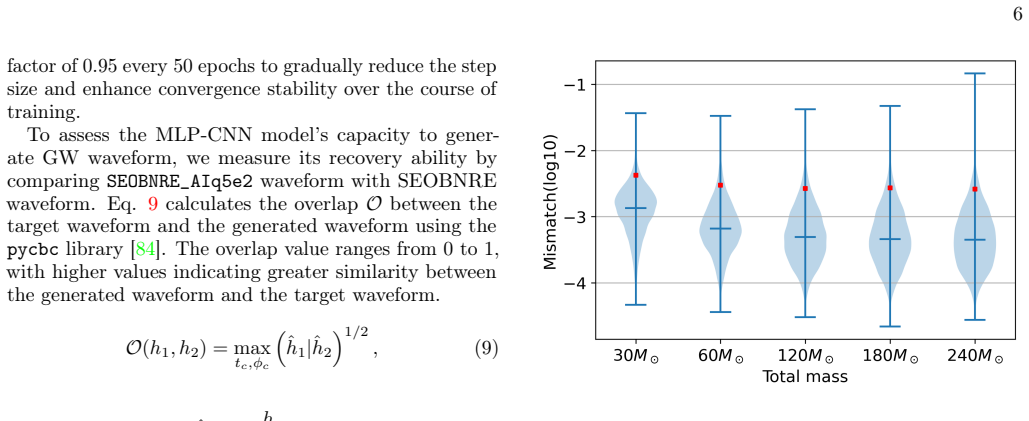
The authors claim that a hybrid MLP-CNN network that maps four source parameters directly to resampled amplitude and phase sequences, together with a separate MLP that predicts the original waveform duration, can stand in for the SEOBNRE eccentric model with negligible accuracy loss. The key innovation is an adaptive resampling step: waveforms of different physical lengths are interpolated to a common 1024-point grid before training, and the predicted length is used to interpolate back, avoiding both truncation and zero-padding artifacts. On a 10,000-waveform test set the mean mismatch is 1.02 × 10⁻³, with errors concentrated at high eccentricity, high spin, and extreme mass ratios.
Load-bearing premise
The reported mismatch is measured against SEOBNRE itself using a flat, white-noise power spectral density (Sn = 1); if a realistic detector noise spectrum or an independent numerical-relativity-validated eccentric model were used, the errors could be larger than 10⁻³.
Editorial extensions
If this is right
- Search pipelines that currently rely on circular-orbit templates can add eccentric template banks at affordable cost, since one million waveforms would take roughly an hour on a single GPU instead of weeks on CPU.
- Parallel-tempered and other samplers that need thousands of waveforms per likelihood evaluation see a roughly 48-fold speedup in end-to-end inference on a 64-core machine, per the paper's benchmark.
- The resampling-interpolation scheme is a reusable recipe for any variable-length waveform family, not just eccentric SEOBNRE signals.
- The model is portable to CPU-only machines with only about a factor of two slowdown, making the speedup available to groups without GPU clusters.
Reading between the lines
- Because the accuracy metric uses a flat PSD weighted equally across the band, the surrogate's real-detector performance is untested; a natural next step is to validate against aLIGO/Virgo noise curves, where merger-band errors dominate.
- The error concentration at high spin and high eccentricity suggests the current parameter space edges are the first places to break if the model is pushed; testing at q=5, e0=0.2, χ=0.6 against numerical relativity waveforms would bound the true error.
- The architecture is mode-agnostic, so extending from the (2,2) mode to higher harmonics would likely require only retraining on a richer dataset, not a structural redesign.
Signed reviews
Editorial analysis
A structured set of objections, weighed in public.
Referee Report
Summary. The paper presents SEOBNRE_AIq5e2, a deep-learning surrogate model intended to reproduce the time-domain waveforms of SEOBNRE for eccentric, spin-aligned binary black holes with mass ratio q in [1,5], eccentricity e0 in [0,0.2], spins |chi_z| up to 0.6, and reference frequency M f = 0.06. The model uses an adaptive resampling procedure to map variable-length waveforms to 1024 points, separate MLP-CNN networks to predict amplitude and phase, and a small MLP to predict the original waveform length, followed by cubic spline interpolation back to the physical time series. The authors report a mean mismatch of 1.02e-3 (maximum 3.31e-2) against SEOBNRE on a held-out test set of 10,000 waveforms, and a single-waveform generation time of 4.3 ms on an RTX 4090 GPU, corresponding to roughly a 500-fold speedup over SEOBNRE on one CPU core. They also examine mismatch for rescaled total masses and discuss batch-mode speedups for parallel parameter estimation.
Significance. If taken at face value, the model would be a practically useful fast surrogate for SEOBNRE in a parameter space relevant to eccentricity searches, and the adaptive resampling/length-prediction scheme is a plausible engineering solution to the variable-length problem in non-recurrent waveform generators. The paper is honest in using a held-out test set and in displaying parameter-space dependence of errors in Figure 5. However, the central accuracy claim rests on a nonstandard overlap definition and a white-noise PSD, which changes the reported numbers in a way that directly affects the abstract's headline mismatch. The discrepancy between the stated training-set sizes in Sections II C and IV B also needs clarification. The paper does not provide code or a reproducibility statement, which limits its immediate use by the community. Overall, the contribution is potentially valuable, but the accuracy and applicability claims need to be re-evaluated before the paper can be accepted.
major comments (3)
- [Section III C, Eq. (9)-(12)]
- [Section III C, Eq. (11)]
- [Section II C vs. Section IV B]
minor comments (6)
- [Section III C, Eq. (11)]
- [Section I and Table I]
- [Section IV heading]
- [Section IV A]
- [Section V]
- [General]
Circularity Check
No circular dependency found: the surrogate is a supervised fit to SEOBNRE and is validated on an independent held-out test set, so the reported mismatch is an out-of-sample closure test rather than a quantity forced by construction.
full rationale
The paper does not derive new gravitational-wave physics; it builds a supervised surrogate that maps (q, e0, chi1, chi2) to SEOBNRE amplitude, phase, and length. The network is trained with MSE loss on resampled amplitude and phase, while the reported mismatch is evaluated with Eqs. (9)-(12) on a separately generated 10,000-waveform test set (Sec. II C: 'A total of 500,000 waveforms were generated for the training set, while the additional 10,000 waveforms were generated for the test set'). The accuracy metric is not the training objective, so the 1.02e-3 mean mismatch is a genuine out-of-sample closure result, not a fitted input renamed as a prediction. References to SEOBNRE [35-37] do include the authors' own prior work, but the claim that SEOBNRE produces accurate waveforms is used only to motivate the choice of baseline; the surrogate's stated agreement is with SEOBNRE itself, not with NR, so no load-bearing argument reduces to a self-citation. The non-standard square-root definition of overlap in Eq. (9) and the Sn=1 weighting are metric choices that may affect the numerical value, and the inconsistency between the 500,000 training samples in Sec. II A and 50,000 in Sec. IV B should be corrected, but these are correctness issues rather than circularity. No step in the paper defines a fitted parameter in terms of the quantity it later predicts, and no uniqueness theorem is invoked.
Assumptions & free parameters
free parameters (3)
- Resampling length N=1024 =
1024 points
- Waveform duration factor 1.1 =
1.1
- Trained neural network weights =
not released
assumptions (5)
- domain assumption SEOBNRE provides sufficiently accurate eccentric spin-aligned BBH waveforms to serve as the surrogate target.
- domain assumption The (2,2) mode alone represents the signal well enough in the claimed parameter range.
- domain assumption Overlap computed with a flat PSD (Sn=1) reflects data-analysis accuracy.
- ad hoc to paper Resampling to 1024 points and cubic spline interpolation preserve the waveform information needed for the mismatch target.
- domain assumption Waveforms generated at Mf=0.06 and Mt=60 solar masses can be rescaled to other total masses without changing the model error.
Cite this review
Pith. "Pith review of Rapid eccentric spin-aligned binary black hole waveform generation based on deep learning." pith.science (2026). https://pith.science/paper/QRQE6AS6
@misc{pith2026241114893,
  author       = {Pith},
  title        = {Pith review of: Rapid eccentric spin-aligned binary black hole waveform generation based on deep learning},
  year         = {2026},
  howpublished = {\url{https://pith.science/paper/QRQE6AS6}},
  note         = {Machine review of arXiv:2411.14893}
}
abstract
Accurate waveform templates of binary black holes (BBHs) with eccentric orbits are essential for the detection and precise parameter estimation of gravitational waves (GWs). While SEOBNRE produces accurate time-domain waveforms for eccentric BBH systems, its generation speed remains a critical bottleneck in analyzing such systems. Accelerating template generation is crucial to data analysis improvement and valuable information extraction from observational data. We present SEOBNRE_AIq5e2, an innovative AI-based surrogate model that crafted to accelerate waveform generation for eccentric, spin-aligned BBH systems. SEOBNRE_AIq5e2 incorporates an advanced adaptive resampling technique during training, enabling the generation of eccentric BBH waveforms with mass ratios up to 5, eccentricities below 0.2, and spins $|\chi_z|$ up to 0.6. It achieves an impressive generation speed of 4.3 ms per waveform with a mean mismatch of $1.02 \times 10^{-3}$. With the exceptional accuracy and rapid performance, SEOBNRE_AIq5e2 emerges as a promising waveform template for future analysis of eccentric gravitational wave data.
Figures


Figures from the paper (2 more)


Forward citations
Cited by 4 Pith papers
-
Identifying lensed gravitational waves with physics-informed posterior learning
Fusing a simulation-trained common-source mass posterior with waveform features raises lensed-event detection efficiency from 20.8% to 35.2% at 1% false-positive rate and lowers the SNR for 50% efficiency from 45.3 to 33.5.
-
Chase Orbits, not Time: A Scalable Paradigm for Long-Duration Eccentric Gravitational-Wave Surrogates
Eccentric inspiral waveforms are modeled against mean anomaly rather than time, yielding an order-of-magnitude compression and a 2.77e6 M surrogate that is ~20x faster to evaluate.
-
Optimizing Neural Network Surrogate Models: Application to Black Hole Merger Remnants
A systematically optimized neural network surrogate for black-hole merger remnant properties, NRSur7dq4Remnant_NN, matches the accuracy of the GPR-based NRSur7dq4Remnant while evaluating up to 8 times faster on a CPU ...
-
Revisiting GW150914 with a non-planar, eccentric waveform model
Using a waveform model that includes both eccentricity and spin precession, the authors confirm GW150914 was a quasi-circular, slowly spinning black hole merger, with eccentricity below 0.08 at 15 Hz.
Reference graph
Works this paper leans on
-
[1]
B. P. Abbott, R. Abbott, T. D. Abbott, M. R. Abernathy, F. Acernese, K. Ackley, C. Adams, T. Adams, P. Ad- desso, R. X. Adhikari, et al., Physical Review Letters116, 061102 (2016)
2016
-
[2]
B. P. Abbott, R. Abbott, T. D. Abbott, M. R. Abernathy, F. Acernese, K. Ackley, C. Adams, T. Adams, P. Addesso, R. X. Adhikari, et al., Physical Review X6, 041015 (2016)
2016
-
[3]
B. P. Abbott, R. Abbott, T. D. Abbott, M. R. Abernathy, F. Acernese, K. Ackley, C. Adams, T. Adams, P. Addesso, R. X. Adhikari, et al., Physical Review D93, 122003 (2016)
2016
-
[4]
B. P. Abbott, R. Abbott, T. D. Abbott, S. Abraham, F. Acernese, K. Ackley, C. Adams, R. X. Adhikari, V. B. Adya, C. Affeldt, et al., Physical Review X9, 031040 (2019)
2019
-
[5]
Abbott, T
R. Abbott, T. D. Abbott, S. Abraham, F. Acernese, K. Ackley, A. Adams, C. Adams, R. X. Adhikari, V. B. Adya, C. Affeldt, et al., Physical Review X11, 021053 (2021)
2021
-
[6]
Abbott, T
R. Abbott, T. D. Abbott, F. Acernese, K. Ackley, C. Adams, N. Adhikari, R. X. Adhikari, V. B. Adya, C. Affeldt, D. Agarwal, et al., Physical Review X13, 041039 (2023)
2023
-
[7]
M. E. Lower, E. Thrane, P. D. Lasky, and R. Smith, Physical Review D98, 083028 (2018)
2018
-
[8]
B. P. Abbott, R. Abbott, T. D. Abbott, S. Abraham, F. Acernese, K. Ackley, C. Adams, R. X. Adhikari, V. B. Adya, C. Affeldt, et al., The Astrophysical Journal883, 10 149 (2019)
work page 2019
Show all 88 references
-
[9]
I. M. Romero-Shaw, P. D. Lasky, and E. Thrane, Monthly Notices of the Royal Astronomical Society 490, 5210 (2019)
2019
-
[10]
A. H. Nitz, A. Lenon, and D. A. Brown, The Astrophysical Journal 890, 1 (2020)
2020
-
[11]
Romero-Shaw, P
I. Romero-Shaw, P. D. Lasky, and E. Thrane, The Astro- physical Journal Letters921, L31 (2021)
2021
-
[12]
Favata, C
M. Favata, C. Kim, K. G. Arun, J. Kim, and H. W. Lee, Physical Review D105, 023003 (2022)
2022
-
[13]
Bonino, R
A. Bonino, R. Gamba, P. Schmidt, A. Nagar, G. Pratten, M. Breschi, P. Rettegno, and S. Bernuzzi, Physical Review D 107, 064024 (2023)
2023
-
[14]
Xu and E
Y. Xu and E. Hamilton, Physical Review D107, 103049 (2023)
2023
-
[15]
Abbott, T
R. Abbott, T. D. Abbott, S. Abraham, F. Acernese, K. Ackley, C. Adams, R. X. Adhikari, V. B. Adya, C. Af- feldt, M. Agathos, et al., Physical Review Letters125, 101102 (2020)
2020
-
[16]
Romero-Shaw, P
I. Romero-Shaw, P. D. Lasky, E. Thrane, and J. C. Bustillo, The Astrophysical Journal Letters 903, L5 (2020)
2020
-
[17]
Gayathri, J
V. Gayathri, J. Healy, J. Lange, B. O’Brien, M. Szczepańczyk, I. Bartos, M. Campanelli, S. Klimenko, C. O. Lousto, and R. O’Shaughnessy, Nature Astronomy 6, 344 (2022)
2022
-
[18]
H. L. Iglesias, J. Lange, I. Bartos, S. Bhaumik, R. Gamba, V. Gayathri, A. Jan, R. Nowicki, R. O’Shaughnessy, D. M. Shoemaker, et al., The Astrophysical Journal972, 65 (2024)
2024
-
[19]
Zevin, J
M. Zevin, J. Samsing, C. Rodriguez, C.-J. Haster, and E. Ramirez-Ruiz, The Astrophysical Journal 871, 91 (2019)
2019
-
[20]
Cardoso, C
V. Cardoso, C. F. B. Macedo, and R. Vicente, Physical Review D103, 023015 (2021)
2021
-
[21]
Zevin, I
M. Zevin, I. M. Romero-Shaw, K. Kremer, E. Thrane, and P. D. Lasky, The Astrophysical Journal Letters921, L43 (2021), arXiv:2106.09042 [astro-ph, physics:gr-qc]
2021 arXiv
-
[22]
A. M. Knee, I. M. Romero-Shaw, P. D. Lasky, J. McIver, and E. Thrane, The Astrophysical Journal 936, 172 (2022)
2022
-
[23]
Kumar, S
Divyajyoti, S. Kumar, S. Tibrewal, I. M. Romero-Shaw, and C. K. Mishra, Physical Review D109, 043037 (2024)
2024
-
[24]
Tagawa, B
H. Tagawa, B. Kocsis, Z. Haiman, I. Bartos, K. Omukai, and J. Samsing, The Astrophysical Journal Letters907, L20 (2021)
2021
-
[25]
Antonini, S
F. Antonini, S. Toonen, and A. S. Hamers, The Astro- physical Journal841, 77 (2017)
2017
-
[26]
Laser Interferometer Space Antenna,
P. Amaro-Seoane, H. Audley, S. Babak, J. Baker, E. Ba- rausse, P. Bender, E. Berti, P. Binetruy, M. Born, D. Bor- toluzzi, et al., “Laser Interferometer Space Antenna,” (2017), arxiv:1702.00786 [astro-ph]
2017 arXiv
-
[27]
Hu and Y.-L
W.-R. Hu and Y.-L. Wu, National Science Review4, 685 (2017)
2017
-
[28]
Luo, L.-S
J. Luo, L.-S. Chen, H.-Z. Duan, Y.-G. Gong, S. Hu, J. Ji, Q. Liu, J. Mei, V. Milyukov, M. Sazhin, et al., Classical and Quantum Gravity 33, 035010 (2016), arxiv:1512.02076 [astro-ph, physics:gr-qc]
2016 arXiv
-
[29]
Breivik, C
K. Breivik, C. L. Rodriguez, S. L. Larson, V. Kalogera, and F. A. Rasio, The Astrophysical Journal Letters830, L18 (2016)
2016
-
[30]
Nishizawa, A
A. Nishizawa, A. Sesana, E. Berti, and A. Klein, Monthly Notices of the Royal Astronomical Society 465, 4375 (2017)
2017
-
[31]
T. L. S. Collaboration, the Virgo Collaboration, B. P. Ab- bott, R. Abbott, T. D. Abbott, S. Abraham, F. Acernese, K. Ackley, C. Adams, V. B. Adya, et al., Classical and Quantum Gravity37, 055002 (2020), arXiv:1908.11170
2020 arXiv
-
[32]
Taracchini, A
A. Taracchini, A. Buonanno, Y. Pan, T. Hinderer, M. Boyle, D. A. Hemberger, L. E. Kidder, G. Lovelace, A. H. Mroué, H. P. Pfeiffer, et al., Physical Review D89, 061502 (2014)
2014
-
[33]
S. Husa, S. Khan, M. Hannam, M. Pürrer, F. Ohme, X. J. Forteza, and A. Bohé, Physical Review D93, 044006 (2016)
2016
-
[34]
S. Khan, S. Husa, M. Hannam, F. Ohme, M. Pürrer, X. J. Forteza, and A. Bohé, Physical Review D93, 044007 (2016)
2016
-
[35]
Cao and W.-B
Z. Cao and W.-B. Han, Physical Review D96, 044028 (2017)
2017
-
[36]
X. Liu, Z. Cao, and Z.-H. Zhu, Classical and Quantum Gravity 39, 035009 (2022)
2022
-
[37]
X. Liu, Z. Cao, and Z.-H. Zhu, Classical and Quantum Gravity 41, 195019 (2024)
2024
-
[38]
Khalil, A
M. Khalil, A. Buonanno, J. Steinhoff, and J. Vines, Phys- ical Review D104, 024046 (2021)
2021
-
[39]
Ramos-Buades, A
A. Ramos-Buades, A. Buonanno, M. Khalil, and S. Os- sokine, Physical Review D105, 044035 (2022)
2022
-
[40]
Chiaramello and A
D. Chiaramello and A. Nagar, Physical Review D101, 101501 (2020)
2020
-
[41]
Albertini, R
A. Albertini, R. Gamba, A. Nagar, and S. Bernuzzi, Phys- ical Review D109, 044022 (2024)
2024
-
[42]
Nagar, R
A. Nagar, R. Gamba, P. Rettegno, V. Fantini, and S. Bernuzzi, Physical Review D110, 084001 (2024)
2024
-
[43]
E. A. Huerta, C. J. Moore, P. Kumar, D. George, A. J. K. Chua, R. Haas, E. Wessel, D. Johnson, D. Glennon, A. Re- bei, et al., Physical Review D97, 024031 (2018)
2018
-
[44]
Z. Chen, E. A. Huerta, J. Adamo, R. Haas, E. O’Shea, P. Kumar, and C. Moore, Physical Review D103, 084018 (2021)
2021
-
[45]
Moore, M
B. Moore, M. Favata, K. G. Arun, and C. K. Mishra, Physical Review D93, 124061 (2016)
2016
-
[46]
Moore and N
B. Moore and N. Yunes, Classical and Quantum Gravity 36, 185003 (2019)
2019
-
[47]
Tanay, M
S. Tanay, M. Haney, and A. Gopakumar, Physical Review D 93, 064031 (2016)
2016
-
[48]
Tiwari, S
V. Tiwari, S. Klimenko, N. Christensen, E. A. Huerta, S. R. P. Mohapatra, A. Gopakumar, M. Haney, P. Ajith, S. T. McWilliams, G. Vedovato, et al., Physical Review D 93, 043007 (2016)
2016
-
[49]
LVK Algorithm Library - LAL- Suite,
LIGO Scientific Collaboration, Virgo Collaboration, and KAGRA Collaboration, “LVK Algorithm Library - LAL- Suite,” Free software (GPL) (2018)
2018
-
[50]
Wette, SoftwareX12, 100634 (2020)
K. Wette, SoftwareX12, 100634 (2020)
2020
-
[51]
M. L. Katz, S. Marsat, A. J. K. Chua, S. Babak, and S. L. Larson, Physical Review D102, 023033 (2020)
2020
-
[52]
M. L. Katz, J.-B. Bayle, A. J. K. Chua, and M. Vallisneri, Physical Review D106, 103001 (2022), arxiv:2204.06633 [astro-ph, physics:gr-qc]
2022 arXiv
-
[53]
S. H. Strub, L. Ferraioli, C. Schmelzbach, S. C. Stähler, and D. Giardini, Physical Review D108, 103018 (2023)
2023
-
[54]
M. L. Katz, Physical Review D105, 044055 (2022)
2022
-
[55]
S. E. Field, C. R. Galley, J. S. Hesthaven, J. Kaye, and M. Tiglio, Physical Review X4, 031006 (2014)
2014
-
[56]
Chatterjee, Current Science78, 808 (2000), 24103957
A. Chatterjee, Current Science78, 808 (2000), 24103957
2000
-
[57]
Tiglio and A
M. Tiglio and A. Villanueva, Living Reviews in Relativity 25, 2 (2022). 11
2022
-
[58]
Blackman, S
J. Blackman, S. E. Field, M. A. Scheel, C. R. Galley, D. A. Hemberger, P. Schmidt, and R. Smith, Physical Review D 95, 104023 (2017)
2017
-
[59]
Varma, S
V. Varma, S. E. Field, M. A. Scheel, J. Blackman, D. Gerosa, L. C. Stein, L. E. Kidder, and H. P. Pfeif- fer, Physical Review Research1, 033015 (2019)
2019
-
[60]
Islam, V
T. Islam, V. Varma, J. Lodman, S. E. Field, G. Khanna, M. A. Scheel, H. P. Pfeiffer, D. Gerosa, and L. E. Kidder, Physical Review D103, 064022 (2021)
2021
-
[61]
Yun, W.-B
Q. Yun, W.-B. Han, X. Zhong, and C. A. Benavides- Gallego, Physical Review D103, 124053 (2021)
2021
-
[62]
Dawn- ing of a New Era in Gravitational Wave Data Analysis: Unveiling Cosmic Mysteries via Artificial Intelligence – A Systematic Review,
T. Zhao, R. Shi, Y. Zhou, Z. Cao, and Z. Ren, “Dawn- ing of a New Era in Gravitational Wave Data Analysis: Unveiling Cosmic Mysteries via Artificial Intelligence – A Systematic Review,” (2023), arxiv:2311.15585 [astro-ph, physics:gr-qc]
2023 arXiv
-
[63]
George and E
D. George and E. Huerta, Physics Letters B778, 64 (2018)
2018
-
[64]
George and E
D. George and E. A. Huerta, Physical Review D97, 044039 (2018)
2018
-
[65]
Gabbard, M
H. Gabbard, M. Williams, F. Hayes, and C. Messenger, Physical Review Letters120, 141103 (2018)
2018
-
[66]
T. Zhao, Y. Zhou, R. Shi, Z. Cao, and Z. Ren, Physical Review D109, 084054 (2024)
2024
-
[67]
H. Wang, Y. Zhou, Z. Cao, Z. Guo, and Z. Ren, Machine Learning: Science and Technology5, 015046 (2024)
2024
-
[68]
T. Zhao, R. Lyu, H. Wang, Z. Cao, and Z. Ren, Commu- nications Physics6, 212 (2023)
2023
-
[69]
S. R. Green and J. Gair, Machine Learning: Science and Technology2, 03LT01 (2021)
2021
-
[70]
M. Dax, S. R. Green, J. Gair, J. H. Macke, A. Buonanno, and B. Schölkopf, Physical Review Letters127, 241103 (2021)
2021
-
[71]
H. Wang, Z. Cao, Y. Zhou, Z.-K. Guo, and Z. Ren, Big Data Mining and Analytics5, 53 (2022)
2022
-
[72]
A. J. K. Chua, C. R. Galley, and M. Vallisneri, Physical Review Letters 122, 211101 (2019), arXiv:1811.05491 [astro-ph, physics:gr-qc, stat]
2019 arXiv
-
[73]
Khan and R
S. Khan and R. Green, Physical Review D103, 064015 (2021), arXiv:2008.12932 [gr-qc]
2021 arXiv
-
[74]
Nousi, S.-C
P. Nousi, S.-C. Fragkouli, N. Passalis, P. Iosif, T. Apos- tolatos, G. Pappas, N. Stergioulas, and A. Tefas, Neuro- computing 491, 67 (2022)
2022
-
[75]
L. M. Thomas, G. Pratten, and P. Schmidt, Physical Review D106, 104029 (2022)
2022
-
[76]
Fragkouli, P
S.-C. Fragkouli, P. Nousi, N. Passalis, P. Iosif, N. Ster- gioulas, and A. Tefas, Applied Soft Computing 147, 110746 (2023)
2023
-
[77]
Liao and F.-L
C.-H. Liao and F.-L. Lin, Physical Review D103, 124051 (2021)
2021
-
[78]
J. Lee, S. H. Oh, K. Kim, G. Cho, J. J. Oh, E. J. Son, and H. M. Lee, Physical Review D103, 123023 (2021), arXiv:2101.05685 [astro-ph, physics:gr-qc]
2021 arXiv
-
[79]
A. Khan, E. A. Huerta, and H. Zheng, Physical Re- view D105, 024024 (2022), arXiv:2110.06968 [astro-ph, physics:gr-qc]
2022 arXiv
-
[80]
R. Shi, Y. Zhou, T. Zhao, Z. Cao, and Z. Ren, Physical Review D109, 084017 (2024)
2024
-
[81]
J. Yan, J. Luo, Y. Zeng, A. P. Leung, J. Feng, H.-H. Zhang, and W. Lin, The Astrophysical Journal973, 163 (2024)
2024
-
[82]
Instance Nor- malization: The Missing Ingredient for Fast Stylization,
D. Ulyanov, A. Vedaldi, and V. Lempitsky, “Instance Nor- malization: The Missing Ingredient for Fast Stylization,” (2017), arXiv:1607.08022
2017 arXiv
-
[83]
Adam: A method for stochastic optimization,
D. P. Kingma and J. Ba, “Adam: A method for stochastic optimization,” (2017), arxiv:1412.6980 [cs]
2017 arXiv
-
[84]
Gwastro/pycbc: V2.3.3 release of PyCBC,
A. Nitz, I. Harry, D. Brown, C. M. Biwer, J. Willis, T. D. Canton, C. Capano, T. Dent, L. Pekowsky, G. S. C. Davies, et al., “Gwastro/pycbc: V2.3.3 release of PyCBC,” Zenodo (2024)
2024
-
[85]
T. B. Littenberg and N. J. Cornish, Physical Review D 80, 063007 (2009)
2009
-
[86]
Z.-Q. J. Xu, Y. Zhang, T. Luo, Y. Xiao, and Z. Ma, Com- munications in Computational Physics28, 1746 (2020), arXiv:1901.06523 [cs, stat]
2020 arXiv
-
[87]
Bouffanais and E
Y. Bouffanais and E. K. Porter, Physical Review D100, 104023 (2019)
2019
-
[1024]
Interdisciplinary Research Funds of Beijing Normal University
This MLP model is trained separately to estimate the waveform length based on the waveform parameter, enabling the framework to subsequently apply interpola- tion. Specifically, we use the cubic spline interpolation, a method known for its smoothness and efficiency in approx- ...
Reviewed August 12, 2026 · model on record in the stance chip above.
Discussion (0). Continue with ORCID to comment.