REVIEW 4 major objections 4 minor 89 references
Cosmic Structure Formation in the Non-linear Regime: Beyond Gaussian Statistics and Standard Cosmologies
T0 review · 4 major / 4 minor · reviewed 2026-08-12 · deepseek-v4-flash
Pith's one-line read This thesis argues that the one-point probability distribution of the cosmic matter density, predicted by large deviations theory from Gaussian initial conditions and spherical collapse, stays accurate in modified gravity and dynamical…
desk verdict A solid, well-written PhD thesis that packages four published papers and one preprint; no new results beyond those papers, but a clear and honest entry point to LDT-based matter PDFs. read the letter →
The pith
A machine-rendered reading of the paper's core claim, the machinery that carries it, and where it could break.
The reading
What carries the argument
The load-bearing object is the large-deviations decay-rate function $\psi_\rho(\rho) = \tfrac{1}{2}\,\delta_L(\rho)^2\,\sigma_L^2(R,z)/\sigma_L^2(R\rho^{1/3},z)$, built from the Gaussian rate function for linear densities and contracted through the spherical-collapse mapping $F:\delta_L\mapsto\rho$; the log-density $\mu=\ln\rho$ is used as the transformed variable to extend convexity, and the PDF is recovered through a saddle-point approximation to the inverse Laplace transform. Its three ingredients are the linear variance $\sigma_L^2$, the spherical-collapse mapping (parametrised as $(1-\delta_L/\nu_{\mathrm{SC}})^{-\nu_{\mathrm{SC}}}$ in Einstein-de Sitter), and the non-linear log-density variance $\sigma^2_{\mathrm{NL},\ln\rho}$. For the dynamics chapters, the central mechanism is the Schrödinger wavefunction forward model whose stationary-phase 'unweaving' separates the wavefunction into stream components, with catastrophe theory providing universal scaling near caustics.
What would settle it
Take an f(R) or w0waCDM cosmology, compute the LDT PDF using only the lognormal-rescaled non-linear variance, and compare it against N-body measurements on $10\,h^{-1}\,\mathrm{Mpc}$ spheres at $z=0$ and $z=1$; if residuals exceed a few percent within two log-density standard deviations, the variance input is inadequate.
Extended reading notes
Core claim
The central claim is that non-Gaussian one-point statistics of the cosmic density field can be predicted accurately enough to serve as cosmological probes. For the matter PDF, the large-deviations construction—Gaussian linear density, spherical-collapse mapping, and linear variance—extends to modified gravity and dynamical dark energy with two substitutions: the Einstein-de Sitter spherical collapse mapping rescaled by the ratio of linear variances, and a lognormal rescaling for the non-linear log-density variance. The thesis validates this against N-body simulations for f(R) gravity, DGP gravity, and w0waCDM on $10\,h^{-1}\,\mathrm{Mpc}$ spheres, and shows that the PDF adds information to the matter power spectrum in Fisher forecasts. For dynamics, it claims a wavefunction forward model encodes the full Vlasov phase-space behaviour beyond the perfect-fluid closure, with interference patterns unwoven into streams and universal scaling near caustics. For covariances, it claims the joint two-cell PDF predicts the one-point PDF covariance, including density-dependent clustering and super-sample covariance.
Load-bearing premise
The prediction stands or falls on the non-linear variance of the log-density, which the theory does not derive from first principles: it must be measured from the same simulations being compared or approximated by a lognormal rescaling calibrated to a fiducial cosmology.
Editorial extensions
If this is right
- The matter PDF can be combined with the power spectrum in Fisher forecasts for Euclid-like survey volumes, halving the uncertainty on evolving dark energy parameters.
- The PDF increases the detection significance of departures from general relativity by up to six times compared with the power spectrum alone in models like F6 and DGPw.
- One-point PDF covariances, including super-sample covariance, can be obtained analytically from effective two-point PDF models, correcting a limitation of simulation-based covariances.
- The wave-based forward model captures multi-streaming phase-space dynamics that a perfect-fluid closure misses, and near caustics its statistics display universal scaling.
- Density statistics from wave dark matter forward models separate initial-condition effects from dynamical effects, sharpening predictions for wavelike dark matter candidates.
Reading between the lines
- Editorial inference: the same two-cell covariance machinery that predicts PDF covariances could be extended to build covariance matrices for counts-in-cells and weak-lensing PDFs in real surveys, where simulation-only covariances are prohibitively expensive.
- Editorial inference: if the universal caustic scalings of the wave model hold generally, they give an analytic handle on interference statistics in ultralight axion dark matter without resolving the full wavefunction numerically.
- Editorial inference: the weakest link in the PDF programme is the non-linear variance input; a first-principles calibration predicting this variance from the linear power spectrum would make the PDF a fully predictive cosmological probe, but this thesis does not establish such a calibration.
Editorial analysis
A structured set of objections, weighed in public.
Referee Report
Summary. This thesis (arXiv:2411.16500) develops and tests non-Gaussian one-point statistics of the cosmic matter field, with large deviations theory (LDT) as the central tool. Chapter 5 extends the LDT matter PDF to extended cosmologies — Hu-Sawicki f(R) gravity, nDGP, and w0waCDM — using modified linear growth, an Einstein-de Sitter spherical-collapse mapping rescaled by linear variances, and a lognormal rescaling of the fiducial non-linear log-density variance; the resulting PDF is compared with dedicated N-body simulations and used in Fisher forecasts for a Euclid-like survey. Chapter 6 derives covariance matrices of the one-point PDF from a two-cell joint PDF, including super-sample covariance and analytic bias functions in a minimal tree model. Chapters 7 and 8 develop a Schrödinger-Poisson forward model with an effective Planck constant as an alternative closure of the dark-matter Vlasov hierarchy, analysing interference, caustics, and density statistics. The thesis is compiled from four published papers and one preprint and is explicit about the author's contributions.
Significance. If the central claims are borne out, the LDT matter PDF is a survey-ready statistic that is sensitive to modified gravity and evolving dark energy in ways complementary to the power spectrum, and the wave-based model provides a useful tool for multi-streaming dynamics and fuzzy dark matter statistics. The thesis has concrete strengths: the pyLDT code is released, comparisons are made to dedicated simulations (including multiple realisations for f(R)), the Fisher forecasts are transparent about scale cuts and covariance assumptions, and several technical derivations are placed in appendices, making the work reproducible. The main limitation is that the headline PDF prediction depends on calibrated ingredients, so the 'accurately predicted' claim is conditional until those ingredients are independently validated or the claim is appropriately qualified.
major comments (4)
- [Section 5.3.3, Eq. (5.23)] The width and normalisation of the LDT matter PDF are controlled by the non-linear log-density variance sigma^2_NL,ln(rho). In this chapter that variance is either measured from the very simulation suites used for validation, or obtained from Eq. (5.23), which rescales the fiducial cosmology's measured variance by the ratio of linear variances. The quoted 0.2-1% accuracy of Eq. (5.23) is an a posteriori calibration on the same DGP/f(R)/w0waCDM runs used to produce Figures 5.2-5.3. Therefore the agreement in those figures, and the Fisher forecasts in Sections 5.6.2-5.6.3, do not by themselves establish a first-principles prediction. I ask the authors to validate Eq. (5.23) on an independent simulation suite or with an independently calibrated model for sigma^2_NL,ln(rho), and to qualify the abstract claim accordingly, or to show that the Fisher results are insensitive to plausible errors in this input.
- [Section 5.3.2, Eq. (5.20)] The spherical-collapse ingredient is also asserted rather than derived. The approximation delta_ext_L(rho) approximately (sigma_L^Lambda / sigma_L^ext) delta_EdS_L(rho) is described in the text as justified a posteriori by comparison with simulations. For f(R) gravity specifically, mass conservation and shell crossing are violated, so no exact mapping is available; the validation is indirect, via the reduced cumulants S3 and S4 in Eq. (5.22), rather than a direct test of the mapping. Because delta_L(rho) enters the rate function in Eq. (4.19), an error in this mapping propagates directly into the PDF shape. A sensitivity test (for example, using the exact DGP mapping for DGP, or an explicitly screened f(R) mapping) would show whether the claimed agreement is robust; if the mapping is only valid in the mildly non-linear regime, that limitation should be stated in the abstract.
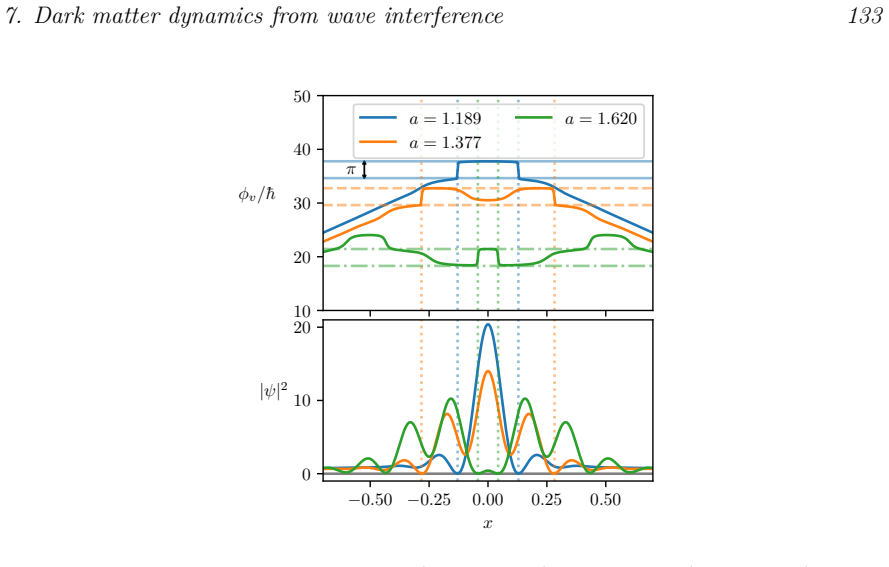
- [Abstract item 3 and Chapter 7] The claim that the wave-based forward model 'can encode the full phase-space dynamics beyond a perfect fluid' is stronger than what is demonstrated. The Schrödinger-Poisson model with an effective Planck constant is an alternative closure ansatz; the thesis shows that it reduces to Zel'dovich trajectories in the stationary-phase limit, produces interference patterns, and yields universal scaling near caustics, but it does not establish equivalence to the full Vlasov hierarchy. The Wigner representation in Appendix D.5 is a formal rewriting of the Schrödinger equation, not a proof that the closure captures all multi-stream moments. I recommend either adding a comparison against a full Vlasov-Poisson solution in a multi-streaming configuration beyond the simple examples used, or softening the 'full phase-space dynamics' wording to 'a wave-mechanical closure reproducing several multi-streaming effects'.
- [Section 5.6.1] The Fisher forecasts assume that the joint covariance of the PDF and power spectrum is independent of cosmology and gravity theory and is equal to the Quijote LambdaCDM covariance. The text acknowledges this and argues that the induced error is small because sigma8 changes by only 1.6% (F6) and 3.8% (DGPw). This is a reasonable first approximation, but the headline improvements (up to a factor of six in detection significance) are conditional on it. I would like to see a robustness check in which the covariance is rescaled by the sigma8-induced variance change, or a simple two-parameter covariance model is varied, demonstrating that the predicted complementarity is not an artifact of using the LambdaCDM covariance.
minor comments (4)
- [Section 5.6 heading] The heading 'Forecasting constrating power with the Fisher formalism' contains a typo; it should read 'constraining power'.
- [Section 2.4] The statement that dark energy refers to 'any component with equation of state w < 1/3' should read w < -1/3; the current inequality would include ordinary matter, which does not accelerate the expansion.
- [Equations (4.29) and (5.18)] The square-root symbols in these equations render as '/radicaltp/radicalvertex' artifacts in the present version; the final typeset version must use proper radical notation.
- [Section 5.6.1] The sentence '...potentially complemented with predictions for effects induced by variations in the local mean density (Jamie' is incomplete; the accompanying citation appears to be cut off and should be restored.
Circularity Check
Central PDF 'prediction' inputs the simulated non-linear variance: Eq. (5.23) merely rescales a fiducial simulation measurement, so the headline agreement is partly inherited from the validation suite.
-
fitted input called prediction
[Section 4.3.4; Section 5.3.3 Eq. (5.23); Section 5.4.1 footnote 5]
"The non-linear variance can either be viewed as a free parameter of this model, or can be measured from simulations. ... An effective approximation approximates the log-density non-linear variance at some arbitrary cosmology in terms of the linear variance and the non-linear variance at some fiducial cosmology ... σ2_lnρ(R,z )≃ ln[1+σ2_L(R,z )]/ln[1+σ2_L,fid(R,z )] σ2_lnρ,fid(R,z ). ... Because the linear theory normalisation cancels out the rate function, knowledge of σ8 is irrelevant for the LDT predictions when measurements of the variance of the simulated density field are available."
The LDT rate function for the matter PDF uses the non-linear variance of the log-density as a denominator and as the scale that sets the exponential width, so this single input controls the width and normalization of the predicted PDF. When that variance is measured from the same simulations used for validation, the agreement in the headline PDF comparisons is forced for the width rather than predicted from first principles. Equation (5.23) only transfers a fiducial measured value by ratios of linear variances; it does not derive the non-linear variance from linear theory. The abstract's claim that the PDF is 'accurately predicted' is therefore partly inherited from simulation calibration.
-
ansatz smuggled in via citation
[Section 5.3.2 Eq. (5.20)]
"We find that by neglecting non-linear screening mechanisms, in the mildly non-linear regime (R ≳ 10 h−1 Mpc) any modified gravity and dark energy effect on the spherical collapse/expansion can be accurately captured by the following approximation δext_L(ρ,z )≈ σΛ_L(Rρ1/3,z )/σext_L(Rρ1/3,z )δEdS_L(ρ). ... This approximation was already argued in the dark energy case in Codis et al. (2016a), and is justified a posteriori by comparison to simulations in Cataneo et al. (2022)."
The extended-cosmology spherical-collapse mapping is not derived from the modified-gravity field equations; it is the Einstein-de Sitter mapping rescaled by linear-variance ratios, and its only stated justification is a posteriori agreement with the simulation suites used in the same PDF validation. Because spherical collapse sets the density-dependent tilt and skewness of the predicted PDF, this component of the 'prediction' is calibrated rather than predicted. The validation is attributed to Cataneo et al. (2022), a paper with overlapping authorship, making the support partly self-citational.
full rationale
Most of the thesis is not circular. Chapters 6-8 develop covariance predictions from joint two-cell PDFs and wave-mechanics statistics from independent Schrödinger/LPT and catastrophe-theory calculations, with no fitted input of the kind that drives the headline PDF claim. The circularity is concentrated in Chapter 5: the LDT matter PDF is a shape-generating formalism whose three inputs are listed in Section 4.3.4, and for extended cosmologies two of those inputs—the non-linear variance and the effective spherical-collapse mapping—are either measured from the validating simulations or approximated by equations (5.23) and (5.20) whose accuracy is established a posteriori on those same simulations. The PDF width is therefore not predicted from first principles, and the spherical-collapse density dependence is an EdS ansatz rescaled by linear theory. The shape and skewness information beyond the width is not simply a fit, which keeps the score at 6 rather than 8-10, but the abstract's unqualified 'accurately predicted' overstates the first-principles content of the central demonstration. The Fisher forecasts inherit this calibration and do not add independent circularity.
Assumptions & free parameters
free parameters (3)
- Non-linear variance of log-density sigma^2_NL,ln(rho)(R,z) =
Measured from simulations; or approximated by Eq (5.23)
- Effective Planck constant hbar_PPT in wave forward model =
Chosen for numerical resolution; Appendix E tests a larger value
- Spherical collapse index nu_SC =
21/13
assumptions (8)
- standard math Gaertner-Ellis theorem, Varadhan's theorem, and the contraction principle hold for the matter density field.
- domain assumption Initial matter density fluctuations are Gaussian.
- domain assumption The dominant dynamical mapping from linear to non-linear densities for one-point statistics is spherical collapse.
- domain assumption Newtonian gravity and the Vlasov-Poisson equations describe structure formation on the scales considered.
- ad hoc to paper In modified gravity and dark energy cosmologies, the spherical collapse mapping can be approximated by rescaling the EdS collapse by the ratio of linear variances, Eq (5.20).
- ad hoc to paper The non-linear log-density variance at an arbitrary cosmology is related to the fiducial one by Eq (5.23).
- domain assumption The covariance of PDF and power spectrum from Quijote simulations is independent of cosmology and theory of gravity.
- ad hoc to paper The Schrodinger-Poisson system with an effective Planck constant provides a valid closure of the CDM Vlasov hierarchy.
Cite this review
Pith. "Pith review of Cosmic Structure Formation in the Non-linear Regime: Beyond Gaussian Statistics and Standard Cosmologies." pith.science (2026). https://pith.science/paper/GC6TJCO3
@misc{pith2026241116500,
  author       = {Pith},
  title        = {Pith review of: Cosmic Structure Formation in the Non-linear Regime: Beyond Gaussian Statistics and Standard Cosmologies},
  year         = {2026},
  howpublished = {\url{https://pith.science/paper/GC6TJCO3}},
  note         = {Machine review of arXiv:2411.16500}
}
read the original abstract
The cosmic large scale structure encodes the formation and evolution of a weblike network of dark matter and galaxies within the Universe. The cosmological information is wrapped up in non-Gaussian statistics requiring characterisation beyond two-point correlations. Accurate modelling of these non-Gaussian statistics and the underlying non-linear dynamics of gravitational collapse are key to extracting maximal information from ongoing and upcoming cosmological surveys. This thesis centres on questions relating to clustering statistics, dynamics, and fundamental physics: A. How can we efficiently characterise the statistics of the late time matter field? B. How can we capture the non-linear phase-space dynamics of gravitational collapse? C. How do changes to fundamental physics impact those clustering statistics and dynamics? Specifically we present four aspects addressing these questions: 1. We demonstrate the probability distribution function (PDF) of the matter density can be accurately predicted in modified gravity and dynamical dark energy models, and that it provides good complementarity to standard two-point analyses for detecting these features. 2. We demonstrate the joint PDF of densities in two cells can be used to predict the covariance of the one-point PDF in simple clustering models, providing estimates of the density dependent clustering and super-sample covariance missed in cosmological simulations. 3. We use a wave-based forward model of dark matter to demonstrate its capability to encode the full phase-space dynamics beyond a perfect fluid and determine certain universal scaling features in such models. 4. Using the wave dark matter forward model we analyse one-point statistics to complement existing analytic and numerical approaches in studying fundamentally wavelike dark matter.
Figures


Figures from the paper (53 more)




Reference graph
Works this paper leans on
-
[1]
Gravitational Waves and Gamma-Rays from a Binary Neutron Star Merger: GW170817 and GRB 170817A
Abbott, B. P. et al. (Oct. 2017). “Gravitational Waves and Gamma-Rays from a Binary Neutron Star Merger: GW170817 and GRB 170817A”. In:ApJ 848.2, L13, p. L13. arXiv:1710.05834 [astro-ph.HE]. Abbott, T. M. C. et al. (June 2019). “Dark Energy Survey year 1 results: Constraints on extended cosmological models from galaxy clustering and weak lensing”. In:Phys...
arXiv 2017
-
[2]
Hermann Hankel’s “On the general theory of motion of fluids
arXiv: 1909.05273 [astro-ph.CO]. Villone, Barbara and Cornelius Rampf (Dec. 2017). “Hermann Hankel’s “On the general theory of motion of fluids”. An essay including an English translation of the complete Preisschrift from 1861”. In: European Physical Journal H42.4. arXiv: 1707.01883 [math.HO]. Wagner, Christian et al. (Dec. 2014). “Separate universe simul...
arXiv 2012
-
[3]
arXiv:2112.05165 [astro-ph.CO]. Aragón-Calvo, Miguel A. et al. (Nov. 2010). “The Spine of the Cosmic Web”. In:The Astrophysical Journal 723, pp. 364–382. Armengaud, Eric et al. (Nov. 2017). “Constraining the mass of light bosonic dark matter using SDSS Lyman-α forest”. In:MNRAS 471.4, pp. 4606–4614. arXiv:1703.09126 [astro-ph.CO]. Armijo, Joaquín et al. (...
arXiv 2010
-
[4]
Vainshtein mechanism beyond the quasistatic approximation
arXiv:1403.7377 [gr-qc]. Winther, Hans A. and Pedro G. Ferreira (Sept. 2015). “Vainshtein mechanism beyond the quasistatic approximation”. In:Phys. Rev. D92.6, 064005, p. 064005. arXiv:1505.03539 [gr-qc]. Winther, Hans A. et al. (Dec. 2019). “Emulators for the nonlinear matter power spectrum beyond ΛCDM”. In:Phys. Rev. D100.12, 123540, p. 123540. arXiv:19...
arXiv 2015
-
[5]
Remarks on the stationary phase method and Coxeter numbers
Boston: Birkhäuser. Arnol’d, Vladimir I. (Oct. 1973). “Remarks on the stationary phase method and Coxeter numbers”. In: Russian Mathematical Surveys28.5. Publisher: IOP Publishing, p
1973
-
[7]
Arnold, Vladimir Igorevich (1978).Mathematical methods of classical mechanics. Springer New York, NY. Arvanitaki, Asimina et al. (June 2010). “String axiverse”. In:Phys. Rev. D81.12, 123530, p. 123530. arXiv: 0905.4720 [hep-th]. Asgari, Marika, Alexander J. Mead, and Catherine Heymans (Nov. 2023). “The halo model for cosmology: a pedagogical review”. In:T...
arXiv 1978
-
[8]
Semiclassical regularization of Vlasov equations and wavepackets for nonlinear Schrödinger equations
arXiv: 2303.08752 [astro-ph.CO]. 211 References 212 Athanassoulis, Agissilaos (Feb. 2018). “Semiclassical regularization of Vlasov equations and wavepackets for nonlinear Schrödinger equations”. In:Nonlinearity 31.3, pp. 1045–1072. Athanassoulis, Agissilaos G., Norbert J. Mauser, and Thierry Paul (2009). “Coarse-scale representations and smoothed Wigner t...
arXiv 2009
-
[9]
Non-perturbative probability distribution function for cosmological counts in cells
arXiv:1811.07913 [astro-ph.CO]. Ivezić, Željko, Steven M. Kahn, and J. Anthony Tysonet al.(Mar. 2019). “LSST: From Science Drivers to Reference Design and Anticipated Data Products”. In:ApJ 873.2, 111, p
work page Pith review arXiv 2019
Show all 89 references
-
[10]
A Dynamical Classification of the Cosmic Web
arXiv:1912.01132 [astro-ph.CO]. Forero-Romero, J. E. et al. (July 2009). “A Dynamical Classification of the Cosmic Web”. In:Monthly Notices of the Royal Astronomical Society396, pp. 1815–1824. Freeman, K. C. (June 1970). “On the Disks of Spiral and S0 Galaxies”. In:ApJ 160, p
1912 arXiv
-
[11]
Some Formal Properties of the Density Matrix
arXiv:2004.01188 [astro-ph.CO]. Husimi, Kôdi (1940). “Some Formal Properties of the Density Matrix”. In:Proceedings of the Physico- Mathematical Society of Japan. 3rd Series22.4, pp. 264–314. Iršič, Vid et al. (July 2017). “First Constraints on Fuzzy Dark Matter from Lyman-α F...
1940 arXiv
-
[14]
The Effects of Smoothing on the Statistical Properties of Large-Scale Cosmic Fields
arXiv:1909.01828 [astro-ph.CO]. Bender, C. M. and S. A. Orszag (1978).Advanced Mathematical Methods for Scientists and Engineers. Springer New York, NY. Bernardeau, F. (Nov. 1994). “The Effects of Smoothing on the Statistical Properties of Large-Scale Cosmic Fields.” In:Astron...
1978 arXiv
-
[15]
Gauge-invariant cosmological perturbations
Bardeen, James M. (Oct. 1980). “Gauge-invariant cosmological perturbations”. In:Phys. Rev. D22.8, pp. 1882–1905. Barreira, Alexandre, Sownak Bose, and Baojiu Li (2015). “Speeding up N-body simulations of modified gravity: Vainshtein screening models”. In:JCAP 12, p
2015
-
[16]
Skewness and Kurtosis in Large-Scale Cosmic Fields
— (Sept. 1994). “Skewness and Kurtosis in Large-Scale Cosmic Fields”. In:The Astrophysical Journal 433, p
1994
-
[17]
Covariances of Density Probability Distribution Functions. Lessons from Hierarchical Models
— (Dec. 2013).The Evolution of the Large-Scale Structure of the Universe: Beyond the Linear Regime. arXiv: 1311.2724 [astro-ph]. — (July 2022). “Covariances of Density Probability Distribution Functions. Lessons from Hierarchical Models”. In:Astronomy and Astrophysics663, A124...
2013 arXiv
-
[18]
Spherical collapse inf(R) gravity
arXiv:2003.12116 [astro-ph.CO]. Borisov, Alexander, Bhuvnesh Jain, and Pengjie Zhang (Mar. 2012). “Spherical collapse inf(R) gravity”. In:Phys. Rev. D85.6, 063518, p. 063518. arXiv:1102.4839 [astro-ph.CO]. Boruah, Supranta S., Eduardo Rozo, and Pier Fiedorowicz (Nov. 2022). “M...
2003 arXiv
-
[19]
Critical points of smooth functions and their normal forms
— (Oct. 1975). “Critical points of smooth functions and their normal forms”. In:Russian Mathematical Surveys 30.5. Publisher: IOP Publishing, p
1975
-
[22]
Structure formation in modified gravity scenarios
Brax, Philippe and Patrick Valageas (Sept. 2012). “Structure formation in modified gravity scenarios”. In: Phys. Rev. D86.6, 063512, p. 063512. arXiv:1205.6583 [astro-ph.CO]. Brenier, Y. et al. (Dec. 2003). “Reconstruction of the early Universe as a convex optimization problem...
2012 arXiv
-
[23]
ECOSMOG: An Efficient Code for Simulating Modified Gravity
arXiv: 1303.0008 [astro-ph.CO]. Li, Baojiu et al. (2012b). “ECOSMOG: An Efficient Code for Simulating Modified Gravity”. In:JCAP 01, p
2012 arXiv
-
[24]
Wigner Functions and Weyl Transforms for Pedestrians
arXiv:1601.07230 [astro-ph.CO]. Case, William B. (Oct. 2008). “Wigner Functions and Weyl Transforms for Pedestrians”. In:American Journal of Physics76, pp. 937–946. Cataneo, M. et al. (Sept. 2019). “On the road to percent accuracy: non-linear reaction of the matter power spect...
2008 arXiv
-
[25]
On the road to per cent accuracy IV: ReACT - computing the non-linear power spectrum beyondΛCDM
arXiv:1909.02504 [astro-ph.CO]. References 214 Bose, Benjamin et al. (Nov. 2020b). “On the road to per cent accuracy IV: ReACT - computing the non-linear power spectrum beyondΛCDM”. In:MNRAS 498.4, pp. 4650–4662. arXiv:2005.12184 [astro-ph.CO]. Bouchet, F. R. et al. (July 1992...
1909 arXiv
-
[26]
The Matter Density PDF for Modified Gravity and Dark Energy with Large Deviations Theory
arXiv: 1607.08788 [astro-ph.CO]. Cataneo, Matteo et al. (June 2022). “The Matter Density PDF for Modified Gravity and Dark Energy with Large Deviations Theory”. In:Monthly Notices of the Royal Astronomical Society513.2, pp. 1623–1641. arXiv:2109.02636 [astro-ph.CO]. Cautun, Ma...
2022 arXiv
-
[27]
Euclid preparation: IX. EuclidEmulator2 - power spectrum emulation with massive neutrinos and self-consistent dark energy perturbations
Euclid Collaboration and M. Knabenhans (Aug. 2021). “Euclid preparation: IX. EuclidEmulator2 - power spectrum emulation with massive neutrinos and self-consistent dark energy perturbations”. In: MNRAS 505.2, pp. 2840–2869. arXiv:2010.11288 [astro-ph.CO]. Euclid Collaboration e...
2021 arXiv
-
[28]
Big bang nucleosynthesis: Present status
arXiv:1712.02783 [astro-ph.CO]. Cyburt, Richard H. et al. (Jan. 2016). “Big bang nucleosynthesis: Present status”. In:Reviews of Modern Physics88.1, 015004, p. 015004. arXiv:1505.01076 [astro-ph.CO]. References 216 Dalal, Neal et al. (Mar. 2021). “Don’t cross the streams: caus...
2016 arXiv
-
[30]
Evolution of Density Perturbations in a Realistic Universe
arXiv:1002.4928 [gr-qc]. Demianski, Marek, Zdzisław A. Golda, and Andrzej Woszczyna (Dec. 2005). “Evolution of Density Perturbations in a Realistic Universe”. In:General Relativity and Gravitation37.12, pp. 2063–2082. DES Collaboration et al. (Jan. 2022). “Dark Energy Survey Y...
2005 arXiv
-
[31]
General relativistic weak-field limit and Newtonian N-body simulations
arXiv:1606.05588 [astro-ph.CO]. — (Dec. 2017a). “General relativistic weak-field limit and Newtonian N-body simulations”. In:J. Cosmology Astropart. Phys.2017.12, 022, p
2017 arXiv
-
[32]
Using the Schroedinger Equation to Simulate Collisionless Matter
arXiv:1909.04667 [astro-ph.IM]. Weisstein, Eric W. (2022).Cube Line Picking. From MathWorld—A Wolfram Web Resource. Last visited on 21/9/2022. Widrow, Lawrence M. and Nick Kaiser (Oct. 1993). “Using the Schroedinger Equation to Simulate Collisionless Matter”. In:ApJ 416, p. L7...
2022 arXiv
-
[34]
Ultra-light dark matter
arXiv:1703.09598 [astro-ph.CO]. Ferreira, Elisa G. M. (Dec. 2021). “Ultra-light dark matter”. In:A&A Rev. 29.1, 7, p
2021 arXiv
-
[35]
Cosmological Tests of Gravity
arXiv: 2005.03254 [astro-ph.CO]. Ferreira, Pedro G. (Aug. 2019). “Cosmological Tests of Gravity”. In:ARA&A 57, pp. 335–374. arXiv: 1902.10503 [astro-ph.CO]. Ferreira, Pedro G. (Aug. 2019). “Cosmological Tests of Gravity”. In:Annual Review of Astronomy and Astrophysics 57, pp. ...
2005 arXiv
-
[36]
Estimating cosmological parameter covariance
Taylor, Andy and Benjamin Joachimi (Aug. 2014). “Estimating cosmological parameter covariance”. In: MNRAS 442.3, pp. 2728–2738. arXiv:1402.6983 [astro-ph.CO]. Taylor, Andy, Benjamin Joachimi, and Thomas Kitching (July 2013). “Putting the precision in precision cosmology: How a...
2002 arXiv
-
[37]
Relativistic initial conditions for N-body simulations
arXiv:1708.07769 [astro-ph.CO]. — (June 2017b). “Relativistic initial conditions for N-body simulations”. In:J. Cosmology Astropart. Phys. 2017.6, 043, p
2017 arXiv
-
[39]
Cosmology and fundamental physics with the Euclid satellite
Amendola, Luca et al. (Apr. 2018). “Cosmology and fundamental physics with the Euclid satellite”. In: Living Reviews in Relativity21.1. Amon, A. et al. (Sept. 2018). “KiDS+2dFLenS+GAMA: testing the cosmological model with the EG statistic”. In:MNRAS 479.3, pp. 3422–3437. arXiv...
2018 arXiv
-
[40]
The Quijote Simulations
arXiv:1906.00409 [astro-ph.CO]. Villaescusa-Navarro, Francisco (Nov. 2018).Pylians: Python libraries for the analysis of numerical simulations. Astrophysics Source Code Library, record ascl:1811.008. ascl:1811.008. Villaescusa-Navarro, Francisco et al. (Sept. 2020). “The Quijo...
1906 arXiv
-
[41]
The Schrödinger-Poisson method for Large-Scale Structure
arXiv: 2208 . 13851 [astro-ph.CO]. Garny, Mathias, Thomas Konstandin, and Henrique Rubira (Apr. 2020). “The Schrödinger-Poisson method for Large-Scale Structure”. In:J. Cosmology Astropart. Phys.2020.4, 003, p
2020
-
[42]
Dark Energy Survey Year 3 results: cosmology with moments of weak lensing mass maps - validation on simulations
arXiv: 1911.04505 [astro-ph.CO]. References 218 Gatti, M. et al. (Nov. 2020). “Dark Energy Survey Year 3 results: cosmology with moments of weak lensing mass maps - validation on simulations”. In:MNRAS 498.3, pp. 4060–4087. arXiv: 1911.05568 [astro-ph.CO]. Gay, Christophe, Chr...
1911 arXiv
-
[43]
Big-Bang Nucleosynthesis after Planck
arXiv:1702.03221 [astro-ph.CO]. Fields, Brian D. et al. (Mar. 2020). “Big-Bang Nucleosynthesis after Planck”. In:J. Cosmology Astropart. Phys. 2020.3, 010, p
2020 arXiv
-
[44]
Making (Dark Matter) Waves: Untangling Wave Interference for Multi-Streaming Dark Matter
arXiv:1304.4840 [hep-th]. Gough, Alex and Cora Uhlemann (Sept. 2022a). “Making (Dark Matter) Waves: Untangling Wave Interference for Multi-Streaming Dark Matter”. In:The Open Journal of Astrophysics5, p
-
[45]
One-Point Statistics Matter in Extended Cosmologies
arXiv: 2206.11918 [astro-ph.CO]. — (Jan. 2022b). “One-Point Statistics Matter in Extended Cosmologies”. In:Universe 8.1, p
-
[49]
ORIGAMI: Delineating Halos Using Phase-space Folds
arXiv:1503.06673 [astro-ph.CO]. Falck, Bridget L., Mark C. Neyrinck, and Alexander S. Szalay (Aug. 2012). “ORIGAMI: Delineating Halos Using Phase-space Folds”. In:The Astrophysical Journal754, p
2012 arXiv
-
[50]
hi_class background evolution, initial conditions and approximation schemes
arXiv: 1404.3713 [astro-ph.CO]. Bellini, Emilio, Ignacy Sawicki, and Miguel Zumalacárregui (Feb. 2020). “hi_class background evolution, initial conditions and approximation schemes”. In:J. Cosmology Astropart. Phys.2020.2, 008, p
2020 arXiv
-
[51]
A nulling strategy for modelling lensing convergence in cones with large deviation theory
Barthelemy, A. et al. (Mar. 2020a). “A nulling strategy for modelling lensing convergence in cones with large deviation theory”. In:MNRAS 492.3, pp. 3420–3439. arXiv:1909.02615 [astro-ph.CO]. Barthelemy, Alexandre, Sandrine Codis, and Francis Bernardeau (May 2020b). “Post-Born...
1909 arXiv
-
[52]
When is the wigner quasi-probability density non-negative?
Hudson, R.L. (1974). “When is the wigner quasi-probability density non-negative?” In:Reports on Mathematical Physics6.2, pp. 249–252. Hui, Lam (Sept. 2021). “Wave Dark Matter”. In:ARA&A
1974
-
[53]
Ultralight scalars as cosmological dark matter
arXiv: 2101.11735 [astro-ph.CO]. Hui, Lam et al. (Feb. 2017). “Ultralight scalars as cosmological dark matter”. In:Phys. Rev. D95.4, 043541, p. 043541. arXiv:1610.08297 [astro-ph.CO]. Hui, Lam et al. (Jan. 2021). “Vortices and waves in light dark matter”. In:J. Cosmology Astro...
2017 arXiv
-
[54]
Non-perturbative probability distribution function for cosmological counts in cells
arXiv:1806.10122 [astro-ph.CO]. Ivanov, Mikhail M., Alexander A. Kaurov, and Sergey Sibiryakov (Mar. 2019). “Non-perturbative probability distribution function for cosmological counts in cells”. In:J. Cosmology Astropart. Phys. 2019.3, 009, p
2019 arXiv
-
[55]
When to interfere with dark matter? The impact of wave dynamics on statistics
arXiv: 2112.04428 [astro-ph.CO]. Gough, Alex and Cora Uhlemann (May 2024). “When to interfere with dark matter? The impact of wave dynamics on statistics”. In:arXiv e-prints. arXiv: 2405.15852 [astro-ph.CO]. Gross, E. P. (May 1961). “Structure of a quantized vortex in boson sy...
2015 arXiv
-
[56]
Axion Dark Matter
arXiv:0805.2366 [astro-ph]. References 220 Jaeckel, J., G. Rybka, and L. Winslow (Mar. 2022). “Axion Dark Matter”. In:arXiv e-prints. arXiv: 2203.14923 [hep-ex]. Jain, Bhuvnesh and Edmund Bertschinger (Aug. 1994). “Second-Order Power Spectrum and Nonlinear Evolution at High Re...
2022 arXiv
-
[57]
Solving the Vlasov equation in two spatial dimensions with the Schrödinger method
arXiv:1312.3638 [astro-ph.CO]. Kopp, Michael, Kyriakos Vattis, and Constantinos Skordis (Dec. 2017). “Solving the Vlasov equation in two spatial dimensions with the Schrödinger method”. In:Phys. Rev. D96.12, 123532, p. 123532. arXiv: 1711.00140 [astro-ph.CO]. Kopp, Michael et ...
2018 arXiv
-
[58]
Numerical and Perturbative Computations of the Fuzzy Dark Matter Model
arXiv:1110.1379 [astro-ph.CO]. Li, Xinyu, Lam Hui, and Greg L. Bryan (Mar. 2019). “Numerical and Perturbative Computations of the Fuzzy Dark Matter Model”. In:Physical Review D99, p. 063509. Li, Yin, Wayne Hu, and Masahiro Takada (Apr. 2014). “Super-sample covariance in simula...
2019 arXiv
-
[59]
Response approach to the matter power spectrum covariance
arXiv:1511.08200 [astro-ph.CO]. Barreira, Alexandre and Fabian Schmidt (Nov. 2017). “Response approach to the matter power spectrum covariance”. In:Journal of Cosmology and Astroparticle Physics2017.11, p
2017 arXiv
-
[60]
A Comparison of the Evolution of Density Fields in Perturbation Theory and Numerical Simulations - II. Counts-in-cells Analysis
arXiv:2307.09468 [astro-ph.CO]. Baugh, C. M., E. Gaztanaga, and G. Efstathiou (June 1995). “A Comparison of the Evolution of Density Fields in Perturbation Theory and Numerical Simulations - II. Counts-in-cells Analysis”. In: Monthly Notices of the Royal Astronomical Society27...
2022 arXiv
-
[61]
Tracing the Cosmic Web
arXiv: 1711.00018 [astro-ph.CO]. Libeskind, Noam I. et al. (Jan. 2018). “Tracing the Cosmic Web”. In:Monthly Notices of the Royal Astronomical Society473, pp. 1195–1217. Liddle, Andrew R. and David H. Lyth (2000).Cosmological Inflation and Large-Scale Structure. LIGO Scientifi...
2000 arXiv
-
[62]
Quantentheorie in hydrodynamischer Form
arXiv:astro-ph/9506072 [astro-ph]. Madelung, E. (Mar. 1927). “Quantentheorie in hydrodynamischer Form”. In:Zeitschrift fur Physik 40.3-4, pp. 322–326. Manouchehri Kousha, Hamed, Sina Hooshangi, and Aliakbar Abolhasani (Jan. 2024). “The Effective Field Theory of Large-scale Str...
1927 arXiv
-
[64]
Cosmological Perturbation Theory in 1+1 Dimensions
arXiv:1804.05866 [astro-ph.CO]. McQuinn, Matthew and Martin White (Jan. 2016). “Cosmological Perturbation Theory in 1+1 Dimensions”. In:Journal of Cosmology and Astroparticle Physics2016.01, pp. 043–043. arXiv: 1502.07389 [astro-ph]. Mead, A. J. (Jan. 2017). “Spherical collaps...
2016 arXiv
-
[66]
Nonlinear Approximations to Gravitational Instability: A Comparison in the Quasi-linear Regime
arXiv:1610.02956 [astro-ph.CO]. Munshi, Dipak, Varun Sahni, and Alexei A. Starobinsky (Dec. 1994). “Nonlinear Approximations to Gravitational Instability: A Comparison in the Quasi-linear Regime”. In:The Astrophysical Journal 436, p
1994 arXiv
-
[69]
Small-scale structure of fuzzy and axion-like dark matter
arXiv:hep-th/0404159 [hep-th]. Niemeyer, Jens C. (July 2020). “Small-scale structure of fuzzy and axion-like dark matter”. In:Progress in Particle and Nuclear Physics113, 103787, p. 103787. arXiv:1912.07064 [astro-ph.CO]. Nishimichi, Takahiro, Francis Bernardeau, and Atsushi T...
2020 arXiv
-
[70]
Distance between random points in a cube
arXiv:2206.01709 [astro-ph.CO]. Mathai, Arak M., Peter Moschopoulos, and Giorgio Pederzoli (1999). “Distance between random points in a cube”. In:Statistica 59, pp. 61–81. May, Simon and Volker Springel (Sept. 2021). “Structure formation in large-volume cosmological simulation...
1999 arXiv
-
[71]
Unified approach to cosmic acceleration
Park, Minjoon, Kathryn M. Zurek, and Scott Watson (June 2010). “Unified approach to cosmic acceleration”. In:Phys. Rev. D81.12, 124008, p. 124008. arXiv:1003.1722 [hep-th]. Peacock, J. A. and R. E. Smith (Feb. 2014).HALOFIT: Nonlinear distribution of cosmological mass and gala...
1999 arXiv
-
[72]
Adjustment of an Inverse Matrix Corresponding to a Change in One Element of a Given Matrix
Scott, Dodelson and Fabian Schmidt (2021).Modern Cosmology (Second Edition). Second Edition. Academic Press, pp. 157–194. Sherman, Jack and Winifred J. Morrison (1950). “Adjustment of an Inverse Matrix Corresponding to a Change in One Element of a Given Matrix”. In:The Annals ...
2021 arXiv
-
[73]
The imprint off(R) gravity on weak gravitational lensing - II. Information content in cosmic shear statistics
arXiv:1705.06863 [astro-ph.CO]. Shirasaki, Masato et al. (Apr. 2017). “The imprint off(R) gravity on weak gravitational lensing - II. Information content in cosmic shear statistics”. In:MNRAS 466.2, pp. 2402–2417. arXiv: 1610.03600 [astro-ph.CO]. Short, C. J. and P. Coles (Dec...
2017 arXiv
-
[74]
CFHTLenS: testing the laws of gravity with tomographic weak lensing and redshift-space distortions
arXiv:astro-ph/0605013 [astro-ph]. Simpson, Fergus et al. (Mar. 2013). “CFHTLenS: testing the laws of gravity with tomographic weak lensing and redshift-space distortions”. In:MNRAS 429.3, pp. 2249–2263. arXiv: 1212 . 3339 [astro-ph.CO]. Sirko, Edwin (Nov. 2005). “Initial Cond...
2013 arXiv
-
[76]
Changes of the topological charge of vortices
arXiv:2011.13141 [astro-ph.CO]. Damski, Bogdan and Krzysztof Sacha (Mar. 2003). “Changes of the topological charge of vortices”. In: Journal of Physics A Mathematical General36.9, pp. 2339–2345. arXiv:quant-ph/0202137 [quant-ph]. Dark Energy Survey Collaboration et al. (Nov. 2...
2011 arXiv
-
[77]
Power spectrum super-sample covariance
arXiv:hep-th/0605206 [hep-th]. Takada, Masahiro and Wayne Hu (June 2013). “Power spectrum super-sample covariance”. In:Phys. Rev. D87 (12), p. 123504. Takahashi, K. (Jan. 1989). “Distribution Functions in Classical and Quantum Mechanics”. In:Progress of Theoretical Physics Sup...
2013 arXiv
-
[79]
Schrödinger method as N-body double and UV completion of dust
arXiv:1807.07274 [astro-ph.CO]. Uhlemann, Cora, Michael Kopp, and Thomas Haugg (July 2014). “Schrödinger method as N-body double and UV completion of dust”. In:Phys. Rev. D90.2, 023517, p. 023517. arXiv:1403.5567 [astro-ph.CO]. Uhlemann, Cora et al. (June 2018c). “Cylinders ou...
2014 arXiv
-
[80]
To the problem of nonvanishing gravitation mass
arXiv: 2210.07819 [astro-ph.CO]. Vainshtein, A. I. (May 1972). “To the problem of nonvanishing gravitation mass”. In:Physics Letters B 39.3, pp. 393–394. Valageas, P. (Feb. 2002). “Dynamics of gravitational clustering. II. Steepest-descent method for the quasi-linear regime”. ...
2010 arXiv
-
[85]
The Stokes set of the cusp diffraction catastrophe
Wright, F. J. (Sept. 1980). “The Stokes set of the cusp diffraction catastrophe”. In:Journal of Physics A Mathematical General13.9, pp. 2913–2928. Wyatt, Robert E. and Corey J. Trahan (2005).Quantum dynamics with trajectories: introduction to quantum hydrodynamics. Interdiscip...
2005
-
[86]
HydrodynamicalSimulationsofCoupledandUncoupledQuintessence Models - I. Halo Properties and the Cosmic Web
arXiv: 2307.07061 [hep-ph]. Carlesi,Edoardoetal.(Apr.2014).“HydrodynamicalSimulationsofCoupledandUncoupledQuintessence Models - I. Halo Properties and the Cosmic Web”. In:Monthly Notices of the Royal Astronomical Society 439, pp. 2943–2957. Carroll, Sean M. et al. (Dec. 2006)....
2014 arXiv
-
[87]
Improving lognormal models for cosmological fields
New York: Springer. Xavier, H. S., F. B. Abdalla, and B. Joachimi (July 2016). “Improving lognormal models for cosmological fields”. In:MNRAS 459, pp. 3693–3710. arXiv:1602.08503. Yahalom, Asher (Oct. 2018). “The fluid dynamics of spin”. In:Molecular Physics116.19-20, pp. 2698–
2016 arXiv
-
[88]
The Limit from the Schrödinger-Poisson to the Vlasov-Poisson Equations with General Data in One Dimension
Zhang, Ping, Yuxi Zheng, and Norbert J. Mauser (May 2002). “The Limit from the Schrödinger-Poisson to the Vlasov-Poisson Equations with General Data in One Dimension”. In:Communications on Pure and Applied Mathematics55.5, pp. 582–632. Zhao, Gong-Bo (Apr. 2014). “Modeling the ...
2002
-
[89]
Making Sense of the Legendre Transform
arXiv: 1312.1291 [astro-ph.CO]. Zia, R. K. P., Edward F. Redish, and Susan R. McKay (July 2009). “Making Sense of the Legendre Transform”. In:American Journal of Physics77, pp. 614–622. Zimmermann, Tim et al. (Apr. 2021). “One-dimensional fuzzy dark matter models: Structure gr...
2009 arXiv
-
[111]
Hierarchical clustering in chameleonf(R) gravity
arXiv:1304.7849 [astro-ph.CO]. Heller, Eric J. (2018).The Semiclassical Way to Dynamics and Spectroscopy. Princeton University Press. References 219 Hellwing, Wojciech A. et al. (Nov. 2013). “Hierarchical clustering in chameleonf(R) gravity”. In: MNRAS 435.4, pp. 2806–2821. ar...
2018 arXiv
-
[126]
New Probe of Departures from General Relativity Using Minkowski Functionals
References 217 Fang, Wenjuan, Baojiu Li, and Gong-Bo Zhao (May 2017). “New Probe of Departures from General Relativity Using Minkowski Functionals”. In:Phys. Rev. Lett.118.18, 181301, p. 181301. arXiv: 1704.02325 [astro-ph.CO]. Feldbrugge, Job, Johan Hidding, and Rien van de W...
2017 arXiv
-
[131]
Nonlinear Hydrodynamics of Axion Dark Matter: Relative Velocity Effects and Quantum Forces
Mariño, Marcos (2021).Advanced Topics in Quantum Mechanics. Cambridge: Cambridge University Press. Marsh, David J. E. (June 2015). “Nonlinear Hydrodynamics of Axion Dark Matter: Relative Velocity Effects and Quantum Forces”. In:Physical Review D91, p. 123520. — (July 2016). “A...
2021 arXiv
-
[148]
On a new limit theorem in probability theory (Translation of ’Sur un nouveau théorème-limite de la théorie des probabilités’)
arXiv:1607.03900 [astro-ph.CO]. Cramér, Harald and Hugo Touchette (Feb. 2018). “On a new limit theorem in probability theory (Translation of ’Sur un nouveau théorème-limite de la théorie des probabilités’)”. In:arXiv e-prints. arXiv: 1802.05988 [math.HO]. Crisostomi, Marco, Ma...
2018 arXiv
-
[152]
Post-collapse perturbation theory in 1D cosmology - beyond shell-crossing
arXiv:1208.2701 [astro-ph.CO]. Taruya, Atsushi and Stéphane Colombi (Oct. 2017). “Post-collapse perturbation theory in 1D cosmology - beyond shell-crossing”. In:MNRAS 470.4, pp. 4858–4884. arXiv:1701.09088 [astro-ph.CO]. References 226 Taruya, Atsushi and Shohei Saga (Nov. 202...
2017 arXiv
-
[204]
Axions in string theory
Svrcek, Peter and Edward Witten (June 2006). “Axions in string theory”. In:Journal of High Energy Physics 2006.6, 051, p
2006
-
[211]
The Zel’dovich approximation: key to understanding cosmic web complexity
Hidding, Johan, Sergei F. Shandarin, and Rien van de Weygaert (Feb. 2014). “The Zel’dovich approximation: key to understanding cosmic web complexity”. In:MNRAS 437.4, pp. 3442–3472. arXiv: 1311.7134 [astro-ph.CO]. Hložek, Renée, David J. E. Marsh, and Daniel Grin (May 2018). “...
1929 arXiv
-
[323]
Extending the Coyote emulator to dark energy models with standard w0-wa parametrization of the equation of state
Casarini, L. et al. (Aug. 2016). “Extending the Coyote emulator to dark energy models with standard w0-wa parametrization of the equation of state”. In:J. Cosmology Astropart. Phys.2016.8, 008, p
2016
-
[379]
Cold dark matter protohalo structure around collapse: Lagrangian cosmological perturbation theory versus Vlasov simulations
Saga, Shohei, Atsushi Taruya, and Stéphane Colombi (Aug. 2022). “Cold dark matter protohalo structure around collapse: Lagrangian cosmological perturbation theory versus Vlasov simulations”. In: A&A 664, A3, A3. arXiv:2111.08836 [astro-ph.CO]. Sahlén, Martin (Mar. 2019). “Clus...
1998 arXiv
-
[386]
The large scale structure of the universe I. General properties. One-and two-dimensional models
arXiv:1907.02977 [astro-ph.CO]. Arnold, V. I., S. F. Shandarin, and Ia. B. Zeldovich (Jan. 1982). “The large scale structure of the universe I. General properties. One-and two-dimensional models”. In:Geophysical and Astrophysical Fluid Dynamics20.1, pp. 111–130. Arnold, V.I., ...
2012 arXiv
-
[479]
The statistics of Rayleigh-Levy flight extrema
arXiv:astro-ph/9403028 [astro-ph]. Bernardeau, Francis and Christophe Pichon (Feb. 2024). “The statistics of Rayleigh-Levy flight extrema”. In:arXiv e-prints. arXiv: 2402.15915 [astro-ph.CO]. Bernardeau, Francis and Paulo Reimberg (Sept. 2016). “Large deviation principle at pl...
2008 arXiv
-
[495]
Position-dependent matter density probability distribution function
Jamieson, Drew and Marilena Loverde (Dec. 2020). “Position-dependent matter density probability distribution function”. In:Physical Review D102.12. Jarrett, Thomas (Jan. 2004). “Large Scale Structure in the Local Universe - The 2MASS Galaxy Catalog”. In:PASA 21.4, pp. 396–403....
1967 arXiv
-
[517]
MiSTree: a Python package for constructing and analysing Minimum Spanning Trees
References 223 Naidoo, Krishna (Oct. 2019). “MiSTree: a Python package for constructing and analysing Minimum Spanning Trees”. In:The Journal of Open Source Software4.42, 1721, p
2019
-
[575]
Nuw CDM cosmology from the weak-lensing convergence PDF
arXiv:astro-ph/9406013 [astro-ph]. Boyle, Aoife et al. (Aug. 2021). “Nuw CDM cosmology from the weak-lensing convergence PDF”. In: MNRAS 505.2, pp. 2886–2902. arXiv:2012.07771 [astro-ph.CO]. Boyle, Aoife et al. (July 2023). “The Cumulant Generating Function as a Novel Observab...
2021 arXiv
-
[626]
Accurate Initial Conditions for Cosmological N-body Simulations: Minimizing Truncation and Discreteness Errors
arXiv:astro-ph/9312044 [astro-ph]. Michaux, Michaël et al. (Jan. 2021). “Accurate Initial Conditions for Cosmological N-body Simulations: Minimizing Truncation and Discreteness Errors”. In:Monthly Notices of the Royal Astronomical Society 500, pp. 663–683. Milillo, Irene et al...
2005 arXiv
-
[641]
Cosmic Shear Covariance Matrix inwCDM: Cosmology Matters
Harnois-Deraps, Joachim, Benjamin Giblin, and Benjamin Joachimi (2019). “Cosmic Shear Covariance Matrix inwCDM: Cosmology Matters”. In:Astron. Astrophys.631, A160. arXiv: 1905.06454 [astro-ph.CO]. Hartlap, J., P. Simon, and P. Schneider (Dec. 2006). “Why your model parameter c...
2019 arXiv
-
[811]
Branch point problem in adaptive optics
Fried, David L. (Oct. 1998). “Branch point problem in adaptive optics”. In:Journal of the Optical Society of America A15.10, pp. 2759–2768. Friedrich, O. et al. (July 2018). “Density split statistics: Joint model of counts and lensing in cells”. In: Physical Review D98.2. Frie...
1998 arXiv
-
[1308]
Discrete time and frequency Wigner-Ville distribution: Moyal’s formula and aliasing
Chassande-Mottin, E. and A. Pai (2005). “Discrete time and frequency Wigner-Ville distribution: Moyal’s formula and aliasing”. In:IEEE Signal Processing Letters12.7, pp. 508–511. Chevallier, Michel and David Polarski (Jan. 2001). “Accelerating Universes with Scaling Dark Matte...
2005 arXiv
-
[1721]
Classical and Quantum Consistency of the DGP Model
Nicolis, Alberto and Riccardo Rattazzi (June 2004). “Classical and Quantum Consistency of the DGP Model”. In:Journal of High Energy Physics2004.6, 059, p
2004
-
[2618]
The Halo Mass Function and Filaments in Full Cosmological Simulations with Fuzzy Dark Matter
arXiv: 2101.01828 [astro-ph.CO]. May, Simon and Volker Springel (Sept. 2023). “The Halo Mass Function and Filaments in Full Cosmological Simulations with Fuzzy Dark Matter”. In:Monthly Notices of the Royal Astronomical Society 524, pp. 4256–4274. McClintock, Thomas et al. (Feb...
2023 arXiv
-
[2708]
Constraining modified theories of gravity with the galaxy bispectrum
Yamauchi, Daisuke, Shuichiro Yokoyama, and Hiroyuki Tashiro (Dec. 2017). “Constraining modified theories of gravity with the galaxy bispectrum”. In:Phys. Rev. D96.12, 123516, p. 123516. arXiv: 1709.03243 [astro-ph.CO]. Zagorac,J.Lunaetal.(May2022).“Schrödinger-Poissonsolitons:...
2019 arXiv
Reviewed August 12, 2026 · model on record in the stance chip above.
Discussion (0). Continue with ORCID to comment.