REVIEW 3 major objections 5 minor 106 references
Perturbative black-hole and horizon solutions in gravity with explicit spacetime-symmetry breaking
T0 review · 3 major / 5 minor · reviewed 2026-08-12 · deepseek-v4-flash
Pith's one-line read This paper derives four static, spherically symmetric black-hole metric families to linear order in explicit spacetime-symmetry-breaking coefficients, and shows that combining two nonzero coefficients produces a three-horizon spacetime.
desk verdict New explicit first-order black hole metrics for a two-tensor SME coefficient in explicit-breaking gravity, but the central consistency claim with the full field equations is asserted, not shown, and the perturbative expansion is not uniform at the horizon. read the letter →
The pith
A machine-rendered reading of the paper's core claim, the machinery that carries it, and where it could break.
The reading
What carries the argument
The engine is the reduced-action method (Palais symmetric criticality): insert the static spherically symmetric ansatz $ds^2=-N^2(r)dt^2+f^{-1}(r)dr^2+r^2d\Omega^2$ with a diagonal constant $s^{\mu\nu}$ into the Lagrangian $S=\frac{1}{2\kappa}\int d^4x\sqrt{-g}(R+s_{\mu\nu}R^{\mu\nu})$, vary the reduced one-dimensional action with respect to $N$ and $f$, and solve order by order around the Schwarzschild seed $f_0=N_0^2=1+k/r$. Spherical symmetry forces $s^{22}=s^{33}=0$, leaving $s^{00}$ and $s^{11}$ as the switches that generate the four families. The method relies on the perturbative identity $N^2=f+O(s^2)$ at first order, and on an exact Lambert-$W$ solution $f(r)=1+2W(C/r)+W(C/r)^2$ over $s_{00}$ which contains the perturbative Case 1 metric as its linear subset.
What would settle it
Substitute the explicit metrics (17), (24), (26), and (27) into the full modified Einstein equations (4) and the Bianchi identity (5), keeping all terms linear in the coefficients and using $\partial_\mu s^{\alpha\beta}=0$; if any component of (5) fails to vanish at first order, the solutions are not consistent vacuum solutions of this theory. A concrete first check is to evaluate $\nabla_\nu(s^{\mu\nu}R^{\beta}{}_{\mu})$ for $\beta=t$ and $\beta=r$ on the Case 1 metric near $r=-k$ and see whether the constraint is identically satisfied.
Extended reading notes
Core claim
The paper claims that, in an effective field theory where particle diffeomorphisms are broken explicitly by a fixed, constant, diagonal background tensor $s^{\mu\nu}$ coupled to the Ricci tensor, static and spherically symmetric vacuum solutions exist as first-order perturbations around Schwarzschild. With only $s^{00}\neq 0$, the metric functions are $N(r)=\sqrt{1+k/r}-\frac{s_{00}k^2}{8r^2}(1+k/r)^{-1/2}$ and $f(r)=1+k/r-\frac{s_{00}k^2}{4r^2}$ (Eq. 17); the trace-subset version (Eq. 24), the $s^{11}$ case (Eq. 26), and the combined case (Eq. 27) follow the same order-by-order scheme. The paper reports that these linearized metrics satisfy the modified Einstein equations and the traced Bianchi identities at the same order, that Case 1 has an inner and an outer horizon similar to Reissner-Nordström, and that Case 3, with both coefficients nonzero, develops three horizons. It then computes the consequences a reader would test: horizon radii, Hawking temperatures and entropies obtained from the first law, curvature scalars, radial photon geodesics, massive-particle effective potentials, periastron precession, and the unstable light-ring radius, which shifts to $-\frac{3k}{2}(1+s_{00}/27)$. The paper therefore supplies a family of perturbative, observationally addressable spacetimes for explicit diffeomorphism breaking.
Load-bearing premise
The load-bearing premise is that the reduced-action, order-by-order solutions with a fixed constant diagonal background tensor satisfy the full modified Einstein equations and the full Bianchi identity (5) at first order — not merely the traced version — so that the metrics are genuine solutions of the explicitly broken theory.
Editorial extensions
If this is right
- The Case 1 metric predicts horizons at $r_{\star,\pm}=-\frac{k}{2}(1\pm\sqrt{1+s_{00}})$, with the outer horizon close to Schwarzschild and the inner horizon near the singularity.
- With both $s^{00}$ and $s^{11}$ nonzero, the horizon condition is cubic and admits three real roots for $s^{11}<0$, so a single static spherically symmetric spacetime can carry three horizons.
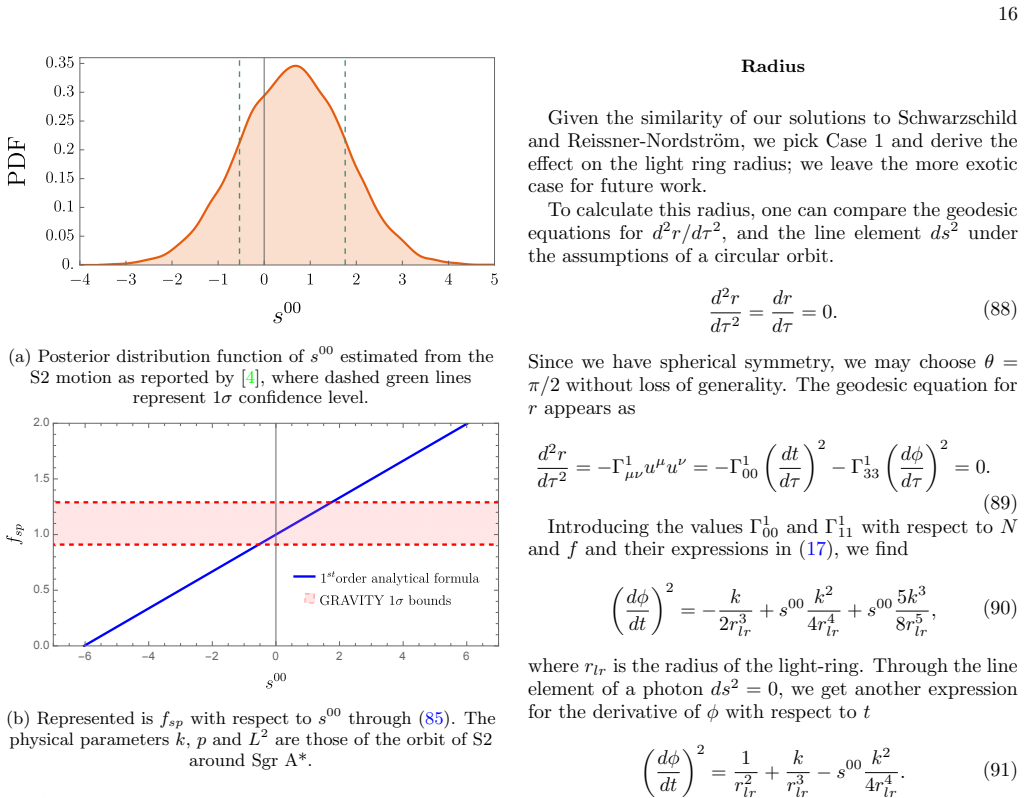
- Periastron precession acquires a symmetry-breaking term $\Delta\phi\approx -3\pi k/p + s_{00}\pi k^2/(4L_0^2 p)$; matching the S2 orbit data yields $s_{00}=0.62^{+1.14}_{-1.16}$ at 1$\sigma$, a weak but direct constraint.
- Case 2 and Case 3 are not asymptotically Minkowski: $f\to 1-s_{11}$ as $r\to\infty$, leaving an angular-deficit signature in radial photon geodesics with $ct/r\to 1+s_{11}/2$.
- The light ring remains unstable and its radius shifts to $r_{\text{lr}}=-\frac{3k}{2}(1+s_{00}/27)$ relative to Schwarzschild.
Reading between the lines
- If the three-horizon root $r_{\star,3}=k s_{00}/4$ is physical rather than a linearization artifact, multi-horizon structure becomes a generic signature of multi-component explicit symmetry breaking; the paper's own discontinuity analysis indicates that quadratic terms are needed to settle the question within the same EFT.
- A natural extension the paper leaves open is the black-hole shadow: because the light-ring radius shifts at first order in $s_{00}$, shadow-size measurements could yield competitive constraints once the photon orbits are integrated to asymptotic infinity.
- The S2-precession bound on $s_{00}$ is far weaker than the gravitational-wave speed bound on the same coefficient, suggesting that the coefficient is better probed by strong-field geometry than by weak-field orbits; computing ringdown frequencies for these metrics would be a sharper test.
- If the full Bianchi identity (5) is enforced beyond the traced version, the constant-diagonal ansatz may impose additional conditions that select among the four cases; a direct check would either confirm the paper's consistency claim or point to spontaneous breaking as the viable completion.
Editorial analysis
A structured set of objections, weighed in public.
Referee Report
Summary. The paper studies a gravitational effective field theory with explicit diffeomorphism breaking by a fixed background two-tensor s^mu nu coupled to the Ricci tensor, plus a scalar trace subset. Using the reduced-action method with a Schwarzschild seed, the authors derive static, spherically symmetric vacuum solutions to linear order in the symmetry-breaking coefficients. They present solutions for a single nonzero component s00 (Case 1), a trace model, a single s11 (Case 2), and the combined s00 and s11 case (Case 3), and they analyze horizons, Hawking temperature, entropy, curvature singularities, photon radial geodesics, timelike orbits, periastron precession (including an application to the S2 star), and the light ring. The central claim is that the metrics in Eqs. (17), (24), (26), and (27) satisfy the modified Einstein equations (4) and the traced Bianchi identity (5) at linear order in the symmetry-breaking coefficients.
Significance. If the central claim is correct, the paper supplies new, explicit, and testable black-hole spacetimes for a class of explicit diffeomorphism-breaking EFTs, with concrete observables such as modified periastron precession, horizon structure, and light-ring radii. The authors include many explicit computations, a numerical integration of the reduced equations, an exact Lambert-function solution, and coordinate transformations for Killing horizons in the Appendix, which are valuable for follow-up work. However, the main consistency statement is asserted rather than demonstrated, and the perturbative expansion appears not to be uniformly valid at the horizon, so the significance of the results depends on whether these gaps can be closed in a revision.
major comments (3)
- [Section III, Eqs. (12), (17), (19)] The claim that the metric functions (17), (24), (26), and (27) satisfy the full covariant field equations (4) and the Bianchi identity (5) is not demonstrated. The authors solve only the reduced Euler-Lagrange equations (12) and (23) for the two functions N(r) and f(r), with g_{theta theta}=r^2 fixed in the ansatz (9). In a theory with a fixed background tensor s^{mu nu} that is constant in these coordinates, radial reparametrizations are not symmetries, so the theta-theta component of (4) is an independent constraint that the reduced-action method with this ansatz does not enforce. Moreover, the exact N^2=f solution (19) of the reduced equations is explicitly admitted not to satisfy the non-linearised Einstein equations (text after Eq. (19)); this shows that a stationary point of the reduced action is not automatically a solution of the full action. I request an explicit component-by-component verification of (4) and the full (non-traced) Bianchi identity for each of the four metrics at O(s), or a clear argument that Palais symmetric criticality applies to this non-covariant theory with the fixed background tensor and fixes the theta-theta equation.
- [Section IV, Eqs. (16), (29)-(32)] The linearized solution (17) is not uniformly valid near the Schwarzschild horizon. The first-order correction N1 in Eq. (16) contains the factor (1+k/r)^{-1/2}, which diverges as r approaches -k, so the ratio N1/N0 grows without bound in that region. The horizon radii computed in Eqs. (29)-(30) and the Hawking temperatures in Eqs. (32)-(33) are evaluated at r_star approximately -k, precisely where the perturbative expansion breaks down. The numerical comparison in Figure 2 integrates the reduced equations (12) rather than the full covariant equations, so it does not justify the near-horizon results. The authors should either establish the validity of the linearized approximation near r=-k with a more careful expansion, or restrict the claims about horizons and thermodynamics to regions where the expansion is controlled.
- [Section II.A and III, Eqs. (6)-(8), (24)] The trace-subset model is distinguished from the model of ref. [73] by which components of s^{mu nu} are held fixed, as the authors note. Nevertheless, the paper does not apply the no-go results for explicit diffeomorphism breaking reported in [73] to the ansatz (9). These no-go constraints are directly relevant to whether consistent solutions with explicit breaking can exist, and the trace solution (24) should be checked against the full equations (7) and (8), not only the reduced Euler-Lagrange equations. A direct substitution of (24) into the full covariant equations would resolve whether this solution is physically admissible.
minor comments (5)
- [Section VII, Eq. (87) and Discussion] The statement that the S2 data 'constrain' s00 to -0.54 < s00 < 1.76 is overstated, because the 1-sigma posterior in Eq. (87) is s00 = 0.62^{+1.14}_{-1.16}, which includes zero and is consistent with no symmetry breaking. The wording should be softened to an 'estimated' value with large uncertainty.
- [Section V, Eq. (51)] In the photon geodesic section, the metric is written as ds^2 = -c^2 N^2 dt^2 + (1/f) dr^2, but the angular part is omitted; for clarity, the full metric (9) should be stated, or the section should explicitly restrict to radial motion.
- [Section IV, Eq. (31)] The Hawking temperature formula (31) is written as a square root of a product of derivatives; the notation should clarify that the expression is evaluated at the outer horizon and that absolute values are taken as in Eq. (32), to avoid ambiguity.
- [Throughout] The spelling of 'Kretschmann' is inconsistent (it appears as 'Kretchmann' in several places, including the captions of Figures 3 and 5); please correct this.
- [Section III, after Eq. (25)] The condition (25) for the existence of a solution (f', N') to the system (12) is stated without derivation; adding a brief derivation or a reference would help the reader assess the numerical integration.
Circularity Check
No significant circularity: the metrics are obtained by solving the stated reduced-action equations, and the self-citations are non-load-bearing.
full rationale
The derivation chain is self-contained: the central results (Eqs. (17), (24), (26), (27)) are obtained by substituting the stated metric ansatz (9) into the action (3)/(6), deriving the reduced Euler-Lagrange equations (12)/(23), expanding around the Schwarzschild seed, and solving for the first-order corrections in the EFT coefficients. The coefficients s00 and s11 are free inputs, not fitted parameters used to produce the metrics. The later S2 precession analysis fits s00 to GRAVITY data via Eqs. (83)-(87), which is parameter estimation from an externally measured precession, not a prediction constructed from the metric, and it does not feed back into the derivation of the solutions. Self-citations are present ([56] and [73]) but are not load-bearing: [73] is invoked to note a vDVZ-type discontinuity and to distinguish the trace model as a 'different model', while the actual boundary condition c2 -> 0 is independently motivated by the smooth-GR-limit requirement; [56] is cited only as an FLRW consistency example and is not used in the black-hole derivation. The manuscript itself flags a limitation after Eq. (19), stating that the exact reduced solution with N^2 = f 'does not respect the (non-linearised) Einstein equations', and the verification mentions only the traced Bianchi identity (5), not the full set of Bianchi constraints. These are correctness/consistency risks, not circular reductions: no equation is equivalent by construction to its input, and no fitted parameter is renamed as a prediction. The central derivation therefore does not reduce to its own assumptions or to a self-citation chain.
Assumptions & free parameters
free parameters (5)
- s00 =
0.62+1.14/-1.16 (1 sigma) from S2 precession
- s11
- k =
-2M for Schwarzschild comparison
- Integration constants c1, c2 =
0
- S0
assumptions (5)
- domain assumption Palais symmetric criticality and the Fels-Torre principle apply to the explicitly broken action, so reduced-action solutions solve the covariant field equations.
- domain assumption s^{mu nu} is a fixed, constant, diagonal background tensor in the chosen coordinate system.
- domain assumption The modified Einstein equations (4) and the traced Bianchi identities (5) are the correct field equations for the action (3).
- ad hoc to paper The linear-order perturbative expansion around Schwarzschild is a reliable approximation, including near the horizon.
- domain assumption The first law dk = TH dS and the Hawking temperature formula (31) apply to these solutions.
Cite this review
Pith. "Pith review of Perturbative black-hole and horizon solutions in gravity with explicit spacetime-symmetry breaking." pith.science (2026). https://pith.science/paper/TNXTEG3P
@misc{pith2026241118255,
  author       = {Pith},
  title        = {Pith review of: Perturbative black-hole and horizon solutions in gravity with explicit spacetime-symmetry breaking},
  year         = {2026},
  howpublished = {\url{https://pith.science/paper/TNXTEG3P}},
  note         = {Machine review of arXiv:2411.18255}
}
abstract
In this paper, we present static and spherically symmetric vacuum solutions to the mass-dimension $d\leq 4$ action of an effective-field theory, choosing the diffeomorphism symmetry to be broken explicitly. By using the reduced-action method with a Schwarzschild seed-solution, we find static and spherically symmetric black hole solutions to the field equations to linear order in the symmetry-breaking coefficients, which are consistent solutions to the modified Einstein equations at the same order. Using several ans\"atze for the symmetry-breaking coefficient we classify the allowed solutions, and we compute standard consequences and observables, including horizons, thermodynamics, photon geodesics, and perihelion precession. We find that the horizon structure of some of our solutions are similar to the Reissner-Nordstr\"om case, and that several of them exhibit physical singularities at $r=2M$. We note in particular that introducing more than one non-zero coefficient for spacetime-symmetry breaking coefficient leads to a solution with three horizons; the aim is to obtain observables that can be confronted to black holes observational data.
Figures


Figures from the paper (6 more)



Reference graph
Works this paper leans on
-
[73]
Explicit Lorentz violation in a static and spherically-symmetric spacetime
Y. Bonder and C. Peterson, Explicit Lorentz violation in a static and spherically-symmetric spacetime, Phys. Rev. D 101, 064056 (2020), arXiv:2001.09217 [gr-qc]
work page Pith review arXiv 2020
-
[1]
Trace subset solution Plugging in the same metric ansatz as in the previous sections into the Lagrangian (6) and setting the matter sector to zero, we arrive at the following reduced action Strace = 1 2κ Z dr 1√f h 2 s00N 2 − 1 (2N (f + rf ′ − 1) + r(rf ′N ′ + 2f (2N ′ + rN ′′))) i , (22) from which we find the Euler-Lagrange equations for N (r) and f (r)...
-
[2]
Thermodynamics In order to establish the Hawking temperature TH , we may use either the quantum tunneling method or the Euclidean method 7, as shown in [79]; both methods lead to TH = 1 4π p (N 2(r))′f ′(r) r→r⋆ . (31) We compute the Hawking temperature for the solution (17) to Case 1 and find that TH,1 = |k| 4πr2⋆ − k|k| 8πr3⋆ s00 + O((s00)2) TH,trace = ...
-
[3]
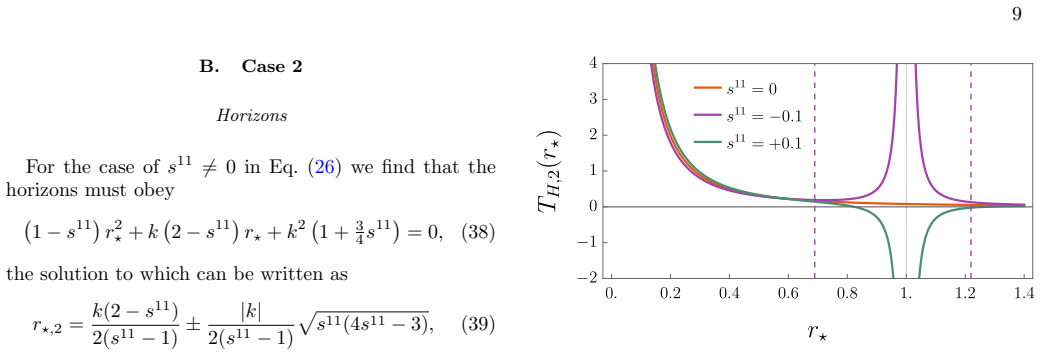
Horizons Starting from Eq. (17) we find the horizon radius r = r⋆ by solving f (r⋆) = 06., which reads r2 ⋆ + kr⋆ − s00 k2 4 = 0, (28) 6 For this case, we have N 2 = f to linear order in s00, and so we can equivalently solve N 2(r⋆) = 0 7 which has two real roots sinces00 ≪ 1 and can be written as r⋆,1 = −k 2 1 ± p 1 + s00 , (29) or, using that s00 ≪ 1 r⋆...
-
[4]
R. Abuter et al. (GRA VITY), Detection of the gravita- tional redshift in the orbit of the star S2 near the Galactic centre massive black hole, Astron. Astrophys. 615, L15 (2018), arXiv:1807.09409 [astro-ph.GA]
arXiv 2018
-
[5]
discontinuity
As can be seen in Figure 6a, no horizons appear for s11 > 0, and both singularities are therefore naked, where we notice that the manifold is not Ricci flat outside the horizon except asymptotically. 12 We also examine the Kretschmann scalar in the same way in Figure 6b, where the extra singularity at the Schwarzschild horizon (which is naked for s11 > 0)...
-
[6]
Black hole solutions with more than two horizons are known in the literature, where they, for example, appear as Reissner-Nordstr¨ om de Sitter solutions [89], as well in the context of Loop Quantum Gravity [90] and gravity with non-linear electrodynamics [91]. Although such so- lutions have the same number of horizons as our Case 3, they bear little rese...
-
[7]
(A3) This new metric is regular on the roots of N 2(r) = 0 in its covariant and contravariant components, and reduces to Eddington-Finkelstein coordinates when s00 → 0
Case 1 Using the transformation t → ¯t = t + h1(r), h1(r) = −k ln r k + 1 + k s00 4 r k + 1 −1 , (A2) we find the metric as ds2 = − 1 + k r − s00 k2 r2 d¯t2 − 2k r − s00 k2 2r2 d¯tdr + 1 − k r + s00 k2 4r2 dr2 + r2 dθ2 + sin2 θdφ2 . (A3) This new metric is regular on the roots of N 2(r) = 0 in its covariant and contravariant components, and reduces to Edd...
Show all 106 references
-
[8]
Case 2 Let us consider the coordinate change t → ¯t = t + h2(r), h2(r) = − k 1 − s11 11 16 ln r 2M − 1 − s11 k 2 r k + 1 −1 + s11 k 16 r k + 1 −2 . (A7) In this new coordinate system the line element ds2 reads ds2 = − 1 + k r + s11 k 8r 4 + 5k r 1 + k r −1! d¯t2 − 2k r 1 − s11...
-
[9]
Case 3 Since our construct is linear in the coefficients sµν, the appropriate coordinate transformation for Case 3 is the sum of Case 1 and Case 2, which reads t → ¯t = t + h3(r), h3(r) = − k 1 + s00 − 11 16 s11 ln r 2M − 1 + k 2 s00 − s11 r k + 1 −1 + k 16 s11 r k + 1 −2 . (A...
-
[10]
(12) which are non- linear differential equations, we take N = const., plug it in (12) and find that we necessarily must havef = N = 1
Case 1 Looking for trivial solutions of Eq. (12) which are non- linear differential equations, we take N = const., plug it in (12) and find that we necessarily must havef = N = 1. If we instead take f = const., there are still two non- linear differential equations for N that ...
-
[11]
If α = 0 then N is completely undetermined, but for α ̸= 0 then the solution N = −1/s00 is forced by the equation
Case 1 T race When N is taken to be constant in (24), we obtain the solution f (r) = 1 + α r , (B1) where α is an integration constant. If α = 0 then N is completely undetermined, but for α ̸= 0 then the solution N = −1/s00 is forced by the equation. As in Case 1, when f is ta...
-
[12]
Case 2 The Euler-Lagrange equations for N and f read 0 = 4f 3 + 3r2s11f ′2 + 4f 2 −1 + s11 + rf ′ − 2rs11f (2f ′ + rf ′′) 0 = N −1 + f + s11 + r 2f N′ + 2s11N ′ + rs11N ′′ (B2) If we impose the condition f ′ = f ′′ = 0, we find im- mediately that f = 1 − s11. Plugging this res...
-
[13]
Weinberg, Effective Field Theory, Past and Future, PoS CD09, 001 (2009), arXiv:0908.1964 [hep-th]
S. Weinberg, Effective Field Theory, Past and Future, PoS CD09, 001 (2009), arXiv:0908.1964 [hep-th]
2009 arXiv
-
[14]
C. M. Will, The Confrontation between General Rela- tivity and Experiment, Living Rev. Rel. 17, 4 (2014), arXiv:1403.7377 [gr-qc]
2014 arXiv
-
[15]
Genzel, F
R. Genzel, F. Eisenhauer, and S. Gillessen, Experimen- tal studies of black holes: status and future prospects, Astron. Astrophys. Rev. 32, 3 (2024), arXiv:2404.03522 [astro-ph.GA]
2024 arXiv
-
[16]
Akiyama et al
K. Akiyama et al. (Event Horizon Telescope), First Sagit- tarius A* Event Horizon Telescope Results. VII. Polar- ization of the Ring, Astrophys. J. Lett. 964, L25 (2024)
2024
-
[17]
Abd El Dayem et al
K. Abd El Dayem et al. (GRA VITY), Improving con- straints on the extended mass distribution in the Galac- tic Center with stellar orbits, (2024), arXiv:2409.12261 [astro-ph.GA]
2024 arXiv
-
[18]
Grould, F
M. Grould, F. Vincent, T. Paumard, and G. Perrin, Gen- eral relativistic effects on the orbit of the s2 star with gravity, Astronomy & Astrophysics 608, A60 (2017)
2017
-
[19]
Abuter et al
R. Abuter et al. (GRA VITY), Detection of the Schwarzschild precession in the orbit of the star S2 near the Galactic centre massive black hole, Astron. Astro- phys. 636, L5 (2020), arXiv:2004.07187 [astro-ph.GA]
2020 arXiv
-
[20]
A. Einstein, Explanation of the perihelion motion of mer- cury by means of the general theory of relativity, in A Source Book in Astronomy and Astrophysics, 1900–1975 (Harvard University Press, 1979) pp. 820–825
1900
-
[21]
V. L. Fish, K. Akiyama, K. L. Bouman, A. A. Chael, M. D. Johnson, S. S. Doeleman, L. Blackburn, J. F. C. Wardle, and W. T. Freeman (Event Horizon Telescope), Observing—and Imaging—Active Galactic Nuclei with 21 the Event Horizon Telescope, Galaxies 4, 54 (2016), arXiv:1607.030...
2016 arXiv
-
[22]
Akiyama et al
K. Akiyama et al. (Event Horizon Telescope), First Sagittarius A* Event Horizon Telescope Results. I. The Shadow of the Supermassive Black Hole in the Center of the Milky Way, Astrophys. J. Lett. 930, L12 (2022), arXiv:2311.08680 [astro-ph.HE]
2022 arXiv
-
[23]
Akiyama et al
K. Akiyama et al. (Event Horizon Telescope), First Sagit- tarius A* Event Horizon Telescope Results. II. EHT and Multiwavelength Observations, Data Processing, and Calibration, Astrophys. J. Lett. 930, L13 (2022), arXiv:2311.08679 [astro-ph.HE]
2022 arXiv
-
[24]
Akiyama et al
K. Akiyama et al. (Event Horizon Telescope), First Sagit- tarius A* Event Horizon Telescope Results. III. Imaging of the Galactic Center Supermassive Black Hole, Astro- phys. J. Lett. 930, L14 (2022), arXiv:2311.09479 [astro- ph.HE]
2022 arXiv
-
[25]
Akiyama et al
K. Akiyama et al. (Event Horizon Telescope), First Sagit- tarius A* Event Horizon Telescope Results. IV. Vari- ability, Morphology, and Black Hole Mass, Astrophys. J. Lett. 930, L15 (2022), arXiv:2311.08697 [astro-ph.HE]
2022 arXiv
-
[26]
Akiyama et al
K. Akiyama et al. (Event Horizon Telescope), First Sagit- tarius A* Event Horizon Telescope Results. V. Testing Astrophysical Models of the Galactic Center Black Hole, Astrophys. J. Lett. 930, L16 (2022), arXiv:2311.09478 [astro-ph.HE]
2022 arXiv
-
[27]
Akiyama et al
K. Akiyama et al. (Event Horizon Telescope), First Sagit- tarius A* Event Horizon Telescope Results. VI. Test- ing the Black Hole Metric, Astrophys. J. Lett. 930, L17 (2022), arXiv:2311.09484 [astro-ph.HE]
2022 arXiv
-
[28]
Amaro-Seoane et al
P. Amaro-Seoane et al. (LISA), Laser Interferometer Space Antenna, (2017), arXiv:1702.00786 [astro-ph.IM]
2017 arXiv
-
[29]
Akiyama et al
K. Akiyama et al. (Event Horizon Telescope), First Sagit- tarius A* Event Horizon Telescope Results. VIII. Phys- ical Interpretation of the Polarized Ring, Astrophys. J. Lett. 964, L26 (2024)
2024
-
[30]
Akiyama et al
K. Akiyama et al. (Event Horizon Telescope), First M87 Event Horizon Telescope Results. IX. Detection of Near- horizon Circular Polarization, Astrophys. J. Lett. 957, L20 (2023), arXiv:2311.10976 [astro-ph.HE]
2023 arXiv
-
[31]
Akiyama et al
K. Akiyama et al. (Event Horizon Telescope), First M87 Event Horizon Telescope Results. I. The Shadow of the Supermassive Black Hole, Astrophys. J. Lett. 875, L1 (2019), arXiv:1906.11238 [astro-ph.GA]
2019 arXiv
-
[32]
Akiyama et al
K. Akiyama et al. (Event Horizon Telescope), First M87 Event Horizon Telescope Results. II. Array and Instrumentation, Astrophys. J. Lett. 875, L2 (2019), arXiv:1906.11239 [astro-ph.IM]
2019 arXiv
-
[33]
Akiyama et al
K. Akiyama et al. (Event Horizon Telescope), First M87 Event Horizon Telescope Results. III. Data Processing and Calibration, Astrophys. J. Lett. 875, L3 (2019), arXiv:1906.11240 [astro-ph.GA]
2019 arXiv
-
[34]
Akiyama et al
K. Akiyama et al. (Event Horizon Telescope), First M87 Event Horizon Telescope Results. IV. Imaging the Cen- tral Supermassive Black Hole, Astrophys. J. Lett. 875, L4 (2019), arXiv:1906.11241 [astro-ph.GA]
2019 arXiv
-
[35]
Akiyama et al
K. Akiyama et al. (Event Horizon Telescope), First M87 Event Horizon Telescope Results. V. Physical Origin of the Asymmetric Ring, Astrophys. J. Lett. 875, L5 (2019), arXiv:1906.11242 [astro-ph.GA]
2019 arXiv
-
[36]
Akiyama et al
K. Akiyama et al. (Event Horizon Telescope), First M87 Event Horizon Telescope Results. VI. The Shadow and Mass of the Central Black Hole, Astrophys. J. Lett. 875, L6 (2019), arXiv:1906.11243 [astro-ph.GA]
2019 arXiv
-
[37]
Akiyama et al
K. Akiyama et al. (Event Horizon Telescope), First M87 Event Horizon Telescope Results. VII. Polariza- tion of the Ring, Astrophys. J. Lett. 910, L12 (2021), arXiv:2105.01169 [astro-ph.HE]
2021 arXiv
-
[38]
Akiyama et al
K. Akiyama et al. (Event Horizon Telescope), First M87 Event Horizon Telescope Results. VIII. Magnetic Field Structure near The Event Horizon, Astrophys. J. Lett. 910, L13 (2021), arXiv:2105.01173 [astro-ph.HE]
2021 arXiv
-
[39]
Colleoni, N
M. Colleoni, N. V. Krishnendu, P. Mourier, S. Bera, and X. Jim´ enez-Forteza, Testing Gravity with Binary Black Hole Gravitational Waves, (2024), arXiv:2403.07682 [gr- qc]
2024 arXiv
-
[40]
Addazi et al., Quantum gravity phenomenology at the dawn of the multi-messenger era—A review, Prog
A. Addazi et al., Quantum gravity phenomenology at the dawn of the multi-messenger era—A review, Prog. Part. Nucl. Phys. 125, 103948 (2022), arXiv:2111.05659 [hep- ph]
2022 arXiv
-
[41]
Maggiore et al
M. Maggiore et al. , Science Case for the Einstein Tele- scope, JCAP 03, 050, arXiv:1912.02622 [astro-ph.CO]
1912 arXiv
-
[42]
Reitze et al
D. Reitze et al. , Cosmic Explorer: The U.S. Contribu- tion to Gravitational-Wave Astronomy beyond LIGO, Bull. Am. Astron. Soc. 51, 035 (2019), arXiv:1907.04833 [astro-ph.IM]
2019 arXiv
-
[43]
Abbott et al
R. Abbott et al. (LIGO Scientific, Virgo), GWTC-2: Compact Binary Coalescences Observed by LIGO and Virgo During the First Half of the Third Observing Run, Phys. Rev. X 11, 021053 (2021), arXiv:2010.14527 [gr- qc]
2021 arXiv
-
[44]
Abbott et al
R. Abbott et al. (LIGO Scientific, VIRGO), GWTC-2.1: Deep extended catalog of compact binary coalescences observed by LIGO and Virgo during the first half of the third observing run, Phys. Rev. D 109, 022001 (2024), arXiv:2108.01045 [gr-qc]
2024 arXiv
-
[45]
Abbott et al
R. Abbott et al. (KAGRA, VIRGO, LIGO Scien- tific), GWTC-3: Compact Binary Coalescences Observed by LIGO and Virgo during the Second Part of the Third Observing Run, Phys. Rev. X 13, 041039 (2023), arXiv:2111.03606 [gr-qc]
2023 arXiv
-
[46]
V. A. Kostelecky and S. Samuel, Spontaneous Breaking of Lorentz Symmetry in String Theory, Phys. Rev. D 39, 683 (1989)
1989
-
[47]
V. A. Kostelecky and R. Potting, CPT and strings, Nucl. Phys. B 359, 545 (1991)
1991
-
[48]
Colladay and V
D. Colladay and V. A. Kostelecky, CPT violation and the standard model, Phys. Rev. D 55, 6760 (1997), arXiv:hep-ph/9703464
1997 arXiv
-
[49]
Colladay and V
D. Colladay and V. A. Kostelecky, Lorentz violating ex- tension of the standard model, Phys. Rev. D 58, 116002 (1998), arXiv:hep-ph/9809521
1998 arXiv
-
[50]
Gambini and J
R. Gambini and J. Pullin, Nonstandard optics from quantum space-time, Phys. Rev. D 59, 124021 (1999), arXiv:gr-qc/9809038
1999 arXiv
-
[51]
S. M. Carroll, J. A. Harvey, V. A. Kostelecky, C. D. Lane, and T. Okamoto, Noncommutative field theory and Lorentz violation, Phys. Rev. Lett. 87, 141601 (2001), arXiv:hep-th/0105082
2001 arXiv
-
[52]
Skordis and T
C. Skordis and T. Zlosnik, New Relativistic Theory for Modified Newtonian Dynamics, Phys. Rev. Lett. 127, 161302 (2021), arXiv:2007.00082 [astro-ph.CO]
2021 arXiv
-
[53]
Mariz, J
T. Mariz, J. R. Nascimento, and A. Petrov, Lorentz Symmetry Breaking—Classical and Quantum As- pects, SpringerBriefs in Physics (Springer, 2023) arXiv:2205.02594 [hep-th]
2023 arXiv
-
[54]
Horava, Quantum Gravity at a Lifshitz Point, Phys
P. Horava, Quantum Gravity at a Lifshitz Point, Phys. Rev. D 79, 084008 (2009), arXiv:0901.3775 [hep-th]. 22
2009 arXiv
-
[55]
Q. G. Bailey, J. L. James, J. R. Slone, and K. O’Neal- Ault, Short-range forces due to Lorentz-symmetry violation, Class. Quant. Grav. 40, 045006 (2023), arXiv:2210.00605 [gr-qc]
2023 arXiv
-
[56]
independent
that a homogeneous coefficient ( ∂isµν = 0) with a modified continuity equation of state for radiation and cosmological constant allowed for a consistent solution using the flat FLR W metric. A. A trace subset We also investigate a scalar-type correction to GR of the form Stra...
-
[57]
Petrov, J
A. Petrov, J. R. Nascimento, and P. Porfirio,Introduction to Modified Gravity , SpringerBriefs in Physics (Springer,
-
[58]
M. S. Safronova, D. Budker, D. DeMille, D. F. J. Kimball, A. Derevianko, and C. W. Clark, Search for New Physics with Atoms and Molecules, Rev. Mod. Phys. 90, 025008 (2018), arXiv:1710.01833 [physics.atom-ph]
2018 arXiv
-
[59]
J. D. Tasson, What Do We Know About Lorentz Invariance?, Rept. Prog. Phys. 77, 062901 (2014), arXiv:1403.7785 [hep-ph]
2014 arXiv
-
[60]
Liberati, Tests of Lorentz invariance: a 2013 update, Class
S. Liberati, Tests of Lorentz invariance: a 2013 update, Class. Quant. Grav. 30, 133001 (2013), arXiv:1304.5795 [gr-qc]
2013 arXiv
-
[61]
V. A. Kostelecky and N. Russell, Data Tables for Lorentz and CPT Violation, Rev. Mod. Phys.83, 11 (2011), (2024 update), arXiv:0801.0287 [hep-ph]
2011
-
[62]
Amelino-Camelia, Quantum-Spacetime Phenomenol- ogy, Living Rev
G. Amelino-Camelia, Quantum-Spacetime Phenomenol- ogy, Living Rev. Rel. 16, 5 (2013), arXiv:0806.0339 [gr- qc]
2013 arXiv
-
[63]
Mattingly, Modern tests of Lorentz invariance, Living Rev
D. Mattingly, Modern tests of Lorentz invariance, Living Rev. Rel. 8, 5 (2005), arXiv:gr-qc/0502097
2005 arXiv
-
[64]
Wang, Hoˇ rava gravity at a Lifshitz point: A progress report, Int
A. Wang, Hoˇ rava gravity at a Lifshitz point: A progress report, Int. J. Mod. Phys. D 26, 1730014 (2017), arXiv:1701.06087 [gr-qc]
2017 arXiv
-
[65]
Uniyal, S
A. Uniyal, S. Kanzi, and I. Sakallı, Some observable phys- ical properties of the higher dimensional dS/AdS black holes in Einstein-bumblebee gravity theory, Eur. Phys. J. C 83, 668 (2023), arXiv:2207.10122 [hep-th]
2023 arXiv
-
[66]
Bluhm, Explicit versus Spontaneous Diffeomorphism Breaking in Gravity, Phys
R. Bluhm, Explicit versus Spontaneous Diffeomorphism Breaking in Gravity, Phys. Rev. D 91, 065034 (2015), arXiv:1401.4515 [gr-qc]
2015 arXiv
-
[67]
V. A. Kostelecky, Gravity, Lorentz violation, and the standard model, Phys. Rev. D 69, 105009 (2004), arXiv:hep-th/0312310
2004 arXiv
-
[68]
V. A. Kosteleck´ y and Z. Li, Backgrounds in gravitational effective field theory, Phys. Rev. D 103, 024059 (2021), arXiv:2008.12206 [gr-qc]
2021 arXiv
-
[69]
O’Neal-Ault, Q
K. O’Neal-Ault, Q. G. Bailey, and N. A. Nilsson, 3+1 formulation of the standard model extension gravity sec- tor, Phys. Rev. D 103, 044010 (2021), arXiv:2009.00949 [gr-qc]
2021 arXiv
-
[70]
N. A. Nilsson, Explicit spacetime-symmetry breaking and the dynamics of primordial fields, Phys. Rev. D 106, 104036 (2022), arXiv:2205.00496 [gr-qc]
2022 arXiv
-
[71]
Khodadi and M
M. Khodadi and M. Schreck, Hubble tension as a guide for refining the early Universe: Cosmologies with explicit local Lorentz and diffeomorphism violation, Phys. Dark Univ. 39, 101170 (2023), arXiv:2301.03883 [gr-qc]
2023 arXiv
-
[72]
C. M. Reyes and M. Schreck, Modified-gravity theories with nondynamical background fields, Phys. Rev. D 106, 044050 (2022), arXiv:2202.11881 [hep-th]
2022 arXiv
-
[74]
R. Xu, D. Liang, and L. Shao, Static spherical vacuum solutions in the bumblebee gravity model, Phys. Rev. D 107, 024011 (2023), arXiv:2209.02209 [gr-qc]
2023 arXiv
-
[75]
Casana, A
R. Casana, A. Cavalcante, F. P. Poulis, and E. B. Santos, Exact Schwarzschild-like solution in a bumble- bee gravity model, Phys. Rev. D 97, 104001 (2018), arXiv:1711.02273 [gr-qc]
2018 arXiv
-
[76]
L. A. Lessa, J. E. G. Silva, R. V. Maluf, and C. A. S. Almeida, Modified black hole solution with a background Kalb–Ramond field, Eur. Phys. J. C 80, 335 (2020), arXiv:1911.10296 [gr-qc]
2020 arXiv
-
[77]
A. A. Ara´ ujo Filho, J. R. Nascimento, A. Y. Petrov, and P. J. Porf ´ ırio, An exact stationary axisymmetric vacuum solution within a metric-affine bumblebee gravity, JCAP 07, 004, arXiv:2402.13014 [gr-qc]
-
[78]
Li and X
M. Li and X. Zhang, Cosmological CPT violating effect on CMB polarization, Phys. Rev. D 78, 103516 (2008), arXiv:0810.0403 [astro-ph]
2008 arXiv
-
[79]
Liang, R
D. Liang, R. Xu, X. Lu, and L. Shao, Polarizations of gravitational waves in the bumblebee gravity model, Phys. Rev. D 106, 124019 (2022), arXiv:2207.14423 [gr- qc]
2022 arXiv
-
[80]
Khodadi, G
M. Khodadi, G. Lambiase, and A. Sheykhi, Constrain- ing the Lorentz-violating bumblebee vector field with big bang nucleosynthesis and gravitational baryogenesis, Eur. Phys. J. C 83, 386 (2023), arXiv:2211.07934 [gr-qc]
2023 arXiv
-
[81]
G. Y. Tuleganova, R. K. Karimov, R. N. Izmailov, A. A. Potapov, A. Bhadra, and K. K. Nandi, Gravitational time advancement effect in Bumblebee gravity for Earth bound systems, Eur. Phys. J. Plus 138, 94 (2023)
2023
-
[82]
R. Xu, D. Liang, and L. Shao, Bumblebee Black Holes in Light of Event Horizon Telescope Observations, Astro- phys. J. 945, 148 (2023), arXiv:2302.05671 [gr-qc]
2023 arXiv
-
[83]
Bonder and C
Y. Bonder and C. Peterson, Spontaneous Lorentz viola- tion and asymptotic flatness, Phys. Rev. D 103, 104016 (2021), arXiv:2103.07611 [gr-qc]
2021 arXiv
-
[84]
Bertolami and J
O. Bertolami and J. Paramos, The Flight of the bumble- bee: Vacuum solutions of a gravity model with vector- induced spontaneous Lorentz symmetry breaking, Phys. Rev. D 72, 044001 (2005), arXiv:hep-th/0504215
2005 arXiv
-
[85]
Khodadi and G
M. Khodadi and G. Lambiase, Probing Lorentz symme- try violation using the first image of Sagittarius A*: Con- straints on standard-model extension coefficients, Phys. Rev. D 106, 104050 (2022), arXiv:2206.08601 [gr-qc]
2022 arXiv
-
[86]
Q. G. Bailey, K. O’Neal-Ault, and N. A. Nilsson, You shall not pass! – explicit diffeomorphism viola- tion ”no-go” results, Phys. Rev. D 110, 084066 (2024), arXiv:2407.04918 [gr-qc]
2024 arXiv
-
[87]
V. A. Kosteleck´ y and Z. Li, Searches for beyond- Riemann gravity, Phys. Rev. D 104, 044054 (2021), arXiv:2106.11293 [gr-qc]
2021 arXiv
-
[88]
R. S. Palais, The principle of symmetric criticality, Com- mun. Math. Phys. 69, 19 (1979)
1979
-
[89]
M. E. Fels and C. G. Torre, The Principle of symmetric criticality in general relativity, Class. Quant. Grav. 19, 641 (2002), arXiv:gr-qc/0108033
2002 arXiv
-
[90]
C. E. Siewert and E. E. Burniston, Exact analytical so- lutions of zez = a, J. Math. Anal. Appl. 43, 626–632 (1973)
1973
-
[91]
Nojiri and S
S. Nojiri and S. D. Odintsov, Regular multihorizon black holes in modified gravity with nonlinear electrodynamics, Phys. Rev. D 96, 104008 (2017), arXiv:1708.05226 [hep- th]
2017 arXiv
-
[92]
D. A. Gomes, R. V. Maluf, and C. A. S. Almeida, Ther- modynamics of Schwarzschild-like black holes in modi- fied gravity models, Annals Phys. 418, 168198 (2020), arXiv:1811.08503 [gr-qc]
2020 arXiv
-
[93]
Park, Can Hawking temperatures be negative?, Phys
M.-I. Park, Can Hawking temperatures be negative?, Phys. Lett. B 663, 259 (2008), arXiv:hep-th/0610140
2008 arXiv
-
[94]
Nozari and B
K. Nozari and B. Fazlpour, UV/IR Mixing and Black Hole Thermodynamics, Int. J. Mod. Phys. D 17, 55 23 (2008), arXiv:0708.1220 [gr-qc]
2008 arXiv
-
[95]
S. H. Mehdipour and M. H. Ahmadi, Black Hole Rem- nants in Hayward Solutions and Noncommutative Ef- fects, Nucl. Phys. B 926, 49 (2018), arXiv:1604.08584 [gr-qc]
2018 arXiv
-
[96]
Tsallis and L
C. Tsallis and L. J. L. Cirto, Black hole thermodynamical entropy, Eur. Phys. J. C73, 2487 (2013), arXiv:1202.2154 [cond-mat.stat-mech]
2013 arXiv
-
[97]
Z.-F. Mai, R. Xu, D. Liang, and L. Shao, Extended ther- modynamics of the bumblebee black holes, Phys. Rev. D 108, 024004 (2023), arXiv:2304.08030 [gr-qc]
2023 arXiv
-
[98]
S. W. Hawking and D. N. Page, Thermodynamics of Black Holes in anti-De Sitter Space, Commun. Math. Phys. 87, 577 (1983)
1983
-
[99]
Raju, Lessons from the information paradox, Phys
S. Raju, Lessons from the information paradox, Phys. Rept. 943, 1 (2022), arXiv:2012.05770 [hep-th]
2022 arXiv
-
[100]
P. V. P. Cunha and C. A. R. Herdeiro, Shadows and strong gravitational lensing: a brief review, Gen. Rel. Grav. 50, 42 (2018), arXiv:1801.00860 [gr-qc]
2018 arXiv
-
[101]
P. V. P. Cunha, J. A. Font, C. Herdeiro, E. Radu, N. Sanchis-Gual, and M. Zilh˜ ao, Lensing and dynamics of ultracompact bosonic stars, Phys. Rev. D 96, 104040 (2017), arXiv:1709.06118 [gr-qc]
2017 arXiv
-
[102]
L. J. Romans, Supersymmetric, cold and lukewarm black holes in cosmological Einstein-Maxwell theory, Nucl. Phys. B 383, 395 (1992), arXiv:hep-th/9203018
1992 arXiv
-
[103]
Kumar, S
J. Kumar, S. U. Islam, and S. G. Ghosh, Loop Quan- tum Gravity motivated multihorizon rotating black holes, JCAP 11, 032, arXiv:2209.13562 [gr-qc]
-
[105]
Penrose, Gravitational Collapse: the Role of General Relativity, Nuovo Cimento Rivista Serie 1, 252 (1969)
R. Penrose, Gravitational Collapse: the Role of General Relativity, Nuovo Cimento Rivista Serie 1, 252 (1969)
1969
-
[106]
Bakopoulos, C
A. Bakopoulos, C. Charmousis, P. Kanti, N. Lecoeur, and T. Nakas, Black holes with primary scalar hair, Phys. Rev. D 109, 024032 (2024), arXiv:2310.11919 [gr-qc]
2024 arXiv
-
[2020]
arXiv:2004.12758 [gr-qc]
2004 arXiv
Reviewed August 12, 2026 · model on record in the stance chip above.
Discussion (0). Continue with ORCID to comment.