REVIEW 3 major objections 3 minor 93 references
Detecting dilute axion stars constrained by fast radio bursts in the Solar System via stimulated decay
T0 review · 3 major / 3 minor · reviewed 2026-08-12 · deepseek-v4-flash
Pith's one-line read The paper claims that beaming 50 MW of radio power at a dilute axion star within 1000 AU can trigger stimulated decay and produce a detectable echo.
desk verdict A well-constructed rate-equation study undermined by an unphysical beam assumption and an overstated abundance; the detectability claim does not hold. read the letter →
The pith
A machine-rendered reading of the paper's core claim, the machinery that carries it, and where it could break.
The reading
What carries the argument
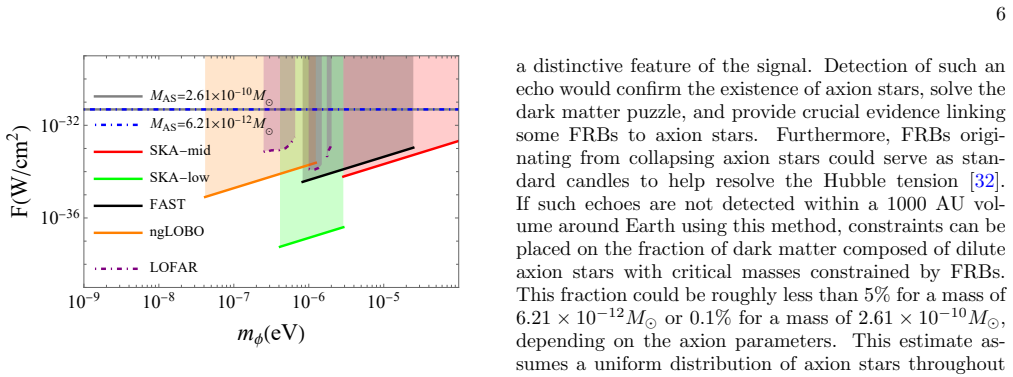
The machinery is the stimulated decay rate of axions in a dilute axion star. The core identity $N_{\gamma0} \simeq 2 P R_{\mathrm{AS}}/m_\phi$ converts beam power into photon number inside the star; it enters the coupled Boltzmann equations (Eqs. 15 and 16) through the product $N_\phi(N_\gamma+N_{\gamma0})$, so stimulated decay dominates whenever $6\pi(N_\gamma+N_{\gamma0})/(m_\phi^3 v R_{\mathrm{AS}}^3)>1$. The escape rate $\Gamma_e = 1/R_{\mathrm{AS}}$ turns the steady-state photon number into the luminosity and then into the Earth flux $F_\phi = m_\phi N_\gamma \Gamma_e/(8\pi d^2)$, the quantity compared with telescope sensitivities.
What would settle it
Use SKA, FAST, ngLOBO, or LOFAR to stare for one hour at the predicted frequency $f \simeq 1.21\,(m_\phi/10^{-5}\,\mathrm{eV})$ GHz toward a candidate axion star within 1000 AU; a null result down to a flux of roughly $10^{-32}\,\mathrm{W/cm^2}$ would falsify the claimed combination of axion-star abundance, critical mass, and full-beam deposition.
Extended reading notes
Core claim
The central claim is that a dilute axion star, a gravitationally bound Bose-Einstein condensate of axions with radius of order $10^2$ km, can be made to radiate by a radio beam. The beam injects $N_{\gamma0} \simeq 2 P R_{\mathrm{AS}}/m_\phi$ photons into the star; for $P=50$ MW this makes stimulated decay dominate over spontaneous decay by roughly $10^{15}$. Solving the coupled Boltzmann equations with the escape rate $\Gamma_e = 1/R_{\mathrm{AS}}$ gives a steady-state photon number $N_\gamma \sim 10^{21}$ and an Earth flux $F_\phi \simeq 4.86\times 10^{-32}$ W/cm$^2$ at 1000 AU for the FRB-constrained mass range. The paper concludes this flux is detectable by SKA, FAST, ngLOBO, and LOFAR within one hour, and that a null search would bound the dark-matter fraction in such stars to below roughly 5% at the low-mass end and 0.1% at the high-mass end.
Load-bearing premise
The load-bearing premise is that the full 50 MW beam actually lands on an axion star only $\sim 10$ km across at distances up to 1000 AU, with no beam-focusing or pointing analysis, so if the beam spreads wider than the star the echo flux shrinks by the ratio of their areas.
Editorial extensions
If this is right
- A successful echo would arrive as a nearly monochromatic line at $f \simeq 1.21\,(m_\phi/10^{-5}\,\mathrm{eV})$ GHz, giving the signal a unique spectral fingerprint.
- A null search over the 1000 AU volume would constrain the dark-matter fraction in FRB-constrained dilute axion stars to less than roughly 5% at $6.21\times10^{-12}M_\odot$ and 0.1% at $2.61\times10^{-10}M_\odot$, assuming a uniform distribution.
- Detecting the echo would strengthen the case that some fast radio bursts are collapsing axion stars, making those bursts usable as standard candles for the Hubble tension.
- The required 50 MW beam power is within the demonstrated capability of current high-power klystron amplifiers, so the experiment is feasible with existing transmitter technology.
- Because the local number density of axion stars scales as $1/M_{\mathrm{AS}}$, low-mass stars near $6.21\times10^{-12}M_\odot$ are the most likely to lie within the beam's reach.
Reading between the lines
- Beyond the paper's beam-deposition assumption, a natural extension is to compute the diffraction-limited spot size of a 50 MW beam at about 1 GHz from a realistic aperture at 1000 AU; if the spot exceeds the roughly 10 km star radius, the effective beam-photon number and echo flux decrease by the geometric cross-section ratio.
- A blind sky survey that sweeps the 1000 AU volume while transmitting could relax the need to know where an axion star is, at the cost of shorter effective integration time per pointing.
- The same echo mechanism could be applied to axion miniclusters or dense axion stars, whose different critical masses would shift the optimal beam frequency and the telescope sensitivity required.
- The link to FRBs is conditional on the FRB-collapse interpretation; if future FRB data rule out that origin for most bursts, the allowed parameter band changes, but the beam-echo search remains a valid probe of axion dark matter in the Solar System.
Editorial analysis
A structured set of objections, weighed in public.
Referee Report
Summary. The paper proposes an experimental search for dilute axion stars in the Solar System by transmitting a powerful (50 MW) radio beam at a candidate star and detecting the radio echo produced by stimulated axion decay. The authors adopt the mass range 6.21e-12 M_sun to 2.61e-10 M_sun for critical dilute axion stars from their earlier FRB-collapse interpretation [32], assume that 75% of dark matter is in such stars, and compute the echo flux at Earth using a coupled Boltzmann/rate-equation treatment. They conclude that the echo flux, of order 1e-32 W/cm2 at 1000 AU, exceeds the sensitivities of SKA, FAST, ngLOBO, and LOFAR, making the signal detectable and providing a way to confirm axion stars or constrain their abundance.
Significance. The paper's methodology is transparent: the rate equations (10)-(11) and their beam-modified counterparts (15)-(16) are standard, and the numerical evolution in Fig. 2 is clearly presented. The proposed mass range is tied to a specific, if unconventional, FRB model, and the paper includes concrete telescope sensitivities. If the mechanism worked as stated, it would offer a new probe of axion dark matter in the Solar System. However, the central detectability claim rests on the assumption that the entire 50 MW beam is intercepted by an axion star of radius ~10 km at distances up to 1000 AU, an assumption that is inconsistent with basic radio diffraction. Once a realistic beam footprint is accounted for, the echo flux is suppressed by many orders of magnitude, so the proposed experiment would be undetectable. The abundance assumption (75% of dark matter in critical axion stars) is also not adequately justified. The paper would require major revision or replacement of its central feasibility estimate.
major comments (3)
- [Sec. V, Eq. (17)] The claim that a 50 MW radio beam can trigger stimulated decay of a dilute axion star assumes that all of the beam power P is deposited inside the star, as encoded in N_gamma0 = 2 P R_AS / m_phi. No beam-focusing, diffraction, or pointing analysis is provided. For the representative parameters m_phi = 5e-5 eV (frequency about 6 GHz, wavelength about 5 cm), an axion star radius R_AS ~ 10 km, and a distance d = 1000 AU, a diffraction-limited beam of aperture D produces a spot radius r_beam ~ 1.22 lambda d / D. Focusing onto the star would require D ~ lambda d / R_AS ~ 7.5e8 m, a planet-scale aperture. Realistic radio apertures (D <= 500 m) give r_beam ~ 1.5e10 m, so the fraction of power intercepted by the star is only (R_AS / r_beam)^2 ~ 1e-10 or smaller. Replacing P in Eq. (17) by the intercepted power lowers N_gamma0 by this factor, and since N_gamma and the resulting F_phi in Eq. (22) are approximately proportional to N_gamma0 in the regime considered, the echo flux drops from ~4.9e-32 W/cm2 to ~1e-42 W/cm2, far below any quoted telescope sensitivity. The paper therefore does not support the central claim that a detectable echo can be produced by any physically realizable transmitter.
- [Sec. IV, Eq. (14)] The estimate that a 1000 AU sphere contains 605 (or 14) axion stars relies on the assumption that 75% of dark matter is in critical or subcritical dilute axion stars, i.e., Omega_AS = 0.75 Omega_DM. The cited simulation [87] reports that about 75% of axion dark matter is in minicluster halos, not that this fraction is in the form of gravitationally bound dilute axion stars at their critical mass. The paper states 'For simplicity, we will assume that dilute axion stars are in a critical state' but does not justify the conversion from minicluster fraction to axion-star fraction. If only a small fraction of miniclusters condense into axion stars, the expected number of targets within 1000 AU could be substantially lower, further weakening the proposal. This is a load-bearing assumption for the prospective constraints in the final paragraph of Sec. V.
- [Sec. V, Eq. (19)] The flux estimate F_phi = L_phi / (4 pi d^2) treats the echo as isotropic. However, as the paper itself notes, stimulated decay photons propagate predominantly in the same or opposite direction as the incoming beam, with only a small angular spread from the axion velocity dispersion. For a beam transmitted from Earth, the backward-propagating photons are the ones that can return to Earth; the relevant solid angle is set by the velocity spread of the axions, not 4 pi. The paper does not compute this angular distribution, so Eq. (19) may over- or under-estimate the observed flux depending on the geometry. A correct treatment is necessary before the detectability claim can be evaluated, even aside from the beam-coupling problem in Eq. (17).
minor comments (3)
- [Fig. 3 caption] The caption reads 'F AST' with an unnecessary space; it should be 'FAST'.
- [Sec. V, final paragraph] The statement that a null search would constrain the axion-star fraction to be less than roughly 5% (for 6.21e-12 M_sun) or 0.1% (for 2.61e-10 M_sun) appears without derivation. The relationship between the expected number of targets, the observation volume, and the resulting abundance upper limit should be spelled out.
- [Sec. III, Eq. (12)] The definition of the critical radius R_cr is given as R_cr ~ 24 pi Gamma_phi M_max / m_phi^3, but the derivation of this expression is not provided; a brief explanation or reference to the derivation in Ref. [32] would improve readability.
Circularity Check
No circularity found: the echo flux calculation is a self-contained application of stimulated-decay equations to an imported (not re-derived) FRB-constrained parameter window.
full rationale
Walked the paper's derivation chain. The echo flux F_phi in Eqs. (19)-(23) follows from the coupled Boltzmann equations (8)-(11), extended by the injected photon number N_gamma0 = 2 P R_AS / m_phi (Eq. 17), with N_gamma obtained by numerically evolving Eqs. (15)-(16). No parameter is fitted to the echo output and then renamed as a prediction. The target mass range 6.21e-12 to 2.61e-10 M_sun is imported from the authors' earlier collapsing-axion-star FRB analysis [32] and from the cosmological-abundance line; it is an input constraint, not a quantity re-derived from or defined in terms of the echo calculation. The 75% abundance estimate is taken from external minicluster simulations [87]. The telescope sensitivities are attributed to Ref. [46], but those are external instrument characteristics rather than outputs of this paper's model, so citing them is not circular. The beam-diffraction and pointing objection raised by the reviewer is a physical-correctness issue, not a circularity issue: it challenges whether Eq. (17) overstates the intercepted power for a real antenna, but it does not make any equation in the paper equivalent to an input by construction. No load-bearing step reduces to a self-citation chain. Score 0.
Assumptions & free parameters
free parameters (4)
- dark matter fraction in critical dilute axion stars (Omega_AS/Omega_DM) =
0.75
- axion potential parameter kappa =
1
- axion-photon coupling constant K =
1
- transmitted beam power P =
50 MW
assumptions (6)
- domain assumption Dilute axion stars exist and can sit at the critical mass.
- standard math Stimulated decay Boltzmann equations (10)-(11) correctly describe axion star photon evolution.
- domain assumption The axion star maximum mass formula Eq. (6) from Chavanis applies.
- domain assumption FRB constraints from Ref. [32] (same authors) are correct.
- ad hoc to paper 75% of dark matter in miniclusters equals 75% in critical dilute axion stars.
- ad hoc to paper A 50 MW radio beam can be focused onto a km-scale object at up to 1000 AU.
Cite this review
Pith. "Pith review of Detecting dilute axion stars constrained by fast radio bursts in the Solar System via stimulated decay." pith.science (2026). https://pith.science/paper/SN4LO3QS
@misc{pith2026241118378,
  author       = {Pith},
  title        = {Pith review of: Detecting dilute axion stars constrained by fast radio bursts in the Solar System via stimulated decay},
  year         = {2026},
  howpublished = {\url{https://pith.science/paper/SN4LO3QS}},
  note         = {Machine review of arXiv:2411.18378}
}
abstract
Fast radio bursts (FRBs) can be explained by collapsing axion stars, imposing constraints on the axion parameter space and providing valuable guidance for experimental axion searches. In the traditional post-inflationary model, axion stars could constitute up to $75\%$ of the dark matter component, suggesting that some axion stars may exist within the Solar System. Photons with energy half the axion mass can stimulate axion decay. Thus, directing a powerful radio beam at an axion star could trigger its stimulated decay, producing a detectable echo. Using this method, we find it is possible to test the existence of dilute axion stars with maximum masses ranging from $6.21\times10^{-12}M_\odot$ to $2.61\times10^{-10}M_\odot$, as constrained by FRBs, within the Solar System. The resulting echo from axion stars constrained by FRBs could be detectable by terrestrial telescopes. Detecting such an echo would confirm the existence of axion stars, unravel the mystery of dark matter, and provide key evidence that some FRBs originate from collapsing axion stars. Furthermore, FRBs produced by axion star collapses could serve as standard candles, aiding in the resolution of the Hubble tension. If no echo is detected using this method, it would place constraints on the abundance of dark matter in the form of dilute axion stars with maximum masses in the range of $6.21\times10^{-12}M_\odot$ to $2.61\times10^{-10}M_\odot$.
Figures


Reference graph
Works this paper leans on
-
[32]
Di, Stimulated decay of collapsing axion stars and fast radio bursts, Eur
H. Di, Stimulated decay of collapsing axion stars and fast radio bursts, Eur. Phys. J. C 84, 283 (2024)
work page 2024
-
[87]
E. W. Kolb and I. I. Tkachev, Femtolensing and picolens- ing by axion miniclusters, Astrophys. J. Lett. 460, L25 (1996)
work page 1996
-
[1]
Weinberg, A new light boson?, Phys
S. Weinberg, A new light boson?, Phys. Rev. Lett. 40, 223 (1978)
1978
-
[2]
Wilczek, Problem of strong P and T invariance in the presence of instantons, Phys
F. Wilczek, Problem of strong P and T invariance in the presence of instantons, Phys. Rev. Lett. 40, 279 (1978)
1978
-
[3]
R. D. Peccei and H. R. Quinn, Constraints imposed by CP conservation in the presence of pseudoparticles, Phys. Rev. D 16, 1791 (1977)
1977
-
[4]
R. D. Peccei and H. R. Quinn, CP conservation in the presence of pseudoparticles, Phys. Rev. Lett. 38, 1440 (1977)
1977
-
[5]
Arvanitaki, S
A. Arvanitaki, S. Dimopoulos, S. Dubovsky, N. Kaloper and J. March-Russell, String axiverse, Phys. Rev. D 81, 123530 (2010)
2010
-
[6]
Preskill, M
J. Preskill, M. B. Wise and F. Wilczek, Cosmology of the invisible axion, Phys. Lett. B 120, 127 (1983)
1983
Show all 93 references
-
[7]
L. F. Abbott and P. Sikivie, A cosmological Bbound on the invisible axion, Phys. Lett. B 120, 133 (1983)
1983
-
[8]
Dine and W
M. Dine and W. Fischler, The not so harmless axion, Phys. Lett. B 120, 137 (1983)
1983
-
[9]
R. T. Co, L. J. Hall and K. Harigaya, Axion kinetic misalignment mechanism, Phys. Rev. Lett. 124, 251802 (2020)
2020
-
[10]
M. S. Turner, Early-universe thermal production of not- so-invisible axions, Phys. Rev. Lett. 59, 2489 (1987); Er- ratum, Phys. Rev. Lett. 60, 1101 (1988)
1987
-
[11]
Salvio, A
A. Salvio, A. Strumia and W. Xue, Thermal axion pro- duction, JCAP 01, 011 (2014)
2014
-
[12]
R. L. Davis, Cosmic axions from cosmic strings, Phys. Lett. B 180, 225 (1986)
1986
-
[13]
Gorghetto, E
M. Gorghetto, E. Hardy and G. Villadoro, More axions from strings, SciPost Phys. 10, 050 (2021)
2021
-
[14]
Schiavone, D
F. Schiavone, D. Montanino, A. Mirizzi and F. Capozzi, Axion-like particles from primordial black holes shining through the Universe, JCAP 08, 063 (2021)
2021
-
[15]
Li and R
T. Li and R. J. Zhang, Axionlike particles from primor- dial black hole evaporation and their detection in neu- trino experiments, Phys. Rev. D 106, 095034 (2022)
2022
-
[16]
Mazde and L
K. Mazde and L. Visinelli, The interplay between the dark matter axion and primordial black holes, JCAP 01, 021 (2023)
2023
-
[17]
Sikivie and Q
P. Sikivie and Q. Yang, Bose-Einstein condensation of dark matter axions, Phys. Rev. Lett. 103, 111301 (2009)
2009
-
[18]
Braaten and H
E. Braaten and H. Zhang, Colloquium : The physics of axion stars, Rev. Mod. Phys. 91, 041002 (2019)
2019
-
[19]
Visinelli, Boson stars and oscillatons: A review, Int
L. Visinelli, Boson stars and oscillatons: A review, Int. J. Mod. Phys. D 30, 2130006 (2021)
2021
-
[20]
Gorghetto, E
M. Gorghetto, E. Hardy and G. Villadoro, More axion stars from strings, JHEP 08, 126 (2024)
2024
-
[21]
J. H. Chang, P. J. Fox and H. Xiao, Axion stars: mass functions and constraints, JCAP 08, 023 (2024)
2024
-
[22]
H. Y. Zhang, Unified view of scalar and vector dark mat- ter solitons, arXiv:2406.05031
-
[23]
M. E. Brown, C. Trujillo and D. Rabinowitz, Discovery of a candidate inner Oort cloud planetoid, Astrophys. J. 617, 645 (2004)
2004
-
[24]
Trujillo, and S
C. Trujillo, and S. S. Sheppard, A Sedna-like body with a perihelion of 80 astronomical units, Nature 507, 471 (2014)
2014
-
[25]
Batygin and M
K. Batygin and M. E. Brown, Evidence for a distant giant planet in the Solar System, Astron. J. 151, 22 (2016)
2016
-
[26]
P. Mroz, A. Udalski, J. Skowron, R. Poleski, S. Ko- zlowski, M. K. Szymanski, I. Soszynski, L. Wyrzykowski, P. Pietrukowicz, K. Ulaczyk et al., No large population of unbound or wide-orbit Jupiter-mass planets, Nature 548, 183 (2017)
2017
-
[27]
Niikura, M
H. Niikura, M. Takada, S. Yokoyama, T. Sumi and S. Masaki, Constraints on Earth-mass primordial black holes from OGLE 5-year microlensing events, Phys. Rev. D 99, 083503 (2019)
2019
-
[28]
Sugiyama, M
S. Sugiyama, M. Takada and A. Kusenko, Possible ev- idence of axion stars in HSC and OGLE microlensing events, Phys. Lett. B 840, 137891 (2023)
2023
-
[29]
Batygin, F
K. Batygin, F. C. Adams, M. E. Brown, J. C. Becker, The planet nine hypothesis, Phys. Rep. 805, 1 (2019)
2019
-
[30]
that was captured by the Solar System. Addition- ally, collapsing axion stars with specific parameters may emit millisecond-long radio bursts with peak luminosities of approximately 10 42 erg/s, which are consistent with the characteristics of observed non-repeating fast radio...
2025 arXiv
-
[31]
Di and H
H. Di and H. Shi, Can planet 9 be an axion star?, Phys. Rev. D 108, 103038 (2023)
2023
-
[33]
H. Di, L. Shao, Z. Yi and S. B. Kong, Novel standard candle: Collapsing axion stars, Phys. Rev. D 110, 103031 (2024)
2024
-
[34]
Iwazaki, Axion stars and fast radio bursts, Phys
A. Iwazaki, Axion stars and fast radio bursts, Phys. Rev. D 91, 023008 (2015)
2015
-
[35]
I. I. Tkachev, Fast radio bursts and axion miniclusters, JETP Lett. 101, 1 (2015)
2015
-
[36]
Raby, Axion star collisions with neutron stars and fast radio bursts, Phys
S. Raby, Axion star collisions with neutron stars and fast radio bursts, Phys. Rev. D 94, 103004 (2016)
2016
-
[37]
J. H. Buckley, P. S. B. Dev, F. Ferrer and F. P. Huang, Fast radio bursts from axion stars moving through pulsar magnetospheres, Phys. Rev. D 103, 043015 (2021)
2021
-
[38]
T. W. Kephart and T. J. Weiler, Stimulated radiation from axion cluster evolution, Phys. Rev. D 52, 3226 (1995)
1995
-
[39]
J. G. Rosa and T. W. Kephart, Stimulated axion decay in superradiant clouds around primordial black holes, Phys. Rev. Lett. 120, 231102 (2018)
2018
-
[40]
Caputo, M
A. Caputo, M. Regis, M. Taoso and S. J. Witte, Detect- ing the stimulated decay of axions at radio frequencies, JCAP 03, 027 (2019)
2019
-
[41]
P. S. B. Dev, F. Ferrer and T. Okawa, On the Galactic radio signal from stimulated decay of axion dark matter, JCAP 04, 045 (2024)
2024
-
[42]
Arza and P
A. Arza and P. Sikivie, Production and detection of an axion dark matter echo, Phys. Rev. Lett. 123, 131804 (2019)
2019
-
[43]
Arza and E
A. Arza and E. Todarello, Axion dark matter echo: A detailed analysis, Phys. Rev. D 105, 023023 (2022)
2022
-
[44]
A. Arza, A. Kryemadhi and K. Zioutas, Searching for axion streams with the echo method, Phys. Rev. D 108, 083001 (2023). 8
2023
-
[45]
A. Arza, Q. Guo, L. Wu, Q. Yang, X. Yang, Q. Yuan and B. Zhu, Listening for echo from the stimulated axion decay with the 21 centimeter array, Sci. Bull. 69, 2971 (2024)
2024
-
[46]
Y. Gong, X. Liu, L. Wu, Q. Yang and B. Zhu, Detecting quadratically coupled ultralight dark matter with stimu- lated annihilation, Phys. Rev. D 109, 055026 (2024)
2024
-
[47]
H. Di, H. Shi and Z. Yi, Detection of dilute axion stars with stimulated decay, Phys. Rev. D 111, 023011 (2025)
2025
-
[48]
Scholtz and J
J. Scholtz and J. Unwin, What if planet 9 is a primordial black hole?, Phys. Rev. Lett. 125, 051103 (2020)
2020
-
[49]
Di Vecchia and G
P. Di Vecchia and G. Veneziano, Chiral dynamics in the large n limit, Nucl. Phys. B 171, 253 (1980)
1980
-
[50]
Grilli di Cortona, E
G. Grilli di Cortona, E. Hardy, J. Pardo Vega and G. Vil- ladoro, The QCD axion, precisely, JHEP 01, 034 (2016)
2016
-
[51]
Fujikura, M
K. Fujikura, M. P. Hertzberg, E. D. Schiappacasse and M. Yamaguchi, Microlensing constraints on axion stars including finite lens and source size effects, Phys. Rev. D 104, 123012 (2021)
2021
-
[52]
E. D. Schiappacasse and M. P. Hertzberg, Analysis of dark matter axion clumps with spherical symmetry, JCAP 01, 037 (2018); Erratum, JCAP 03, E01 (2018)
2018
-
[53]
P. H. Chavanis, Phase transitions between dilute and dense axion stars, Phys. Rev. D 98, 023009 (2018)
2018
-
[54]
Visinelli, S
L. Visinelli, S. Baum, J. Redondo, K. Freese and F. Wilczek, Dilute and dense axion stars, Phys. Lett. B 777, 64 (2018)
2018
-
[55]
J. Eby, M. Leembruggen, L. Street, P. Suranyi and L. C. R. Wijewardhana, Global view of QCD axion stars, Phys. Rev. D 100, 063002 (2019)
2019
-
[56]
Seidel and W
E. Seidel and W. M. Suen, Oscillating soliton stars, Phys. Rev. Lett. 66, 1659 (1991)
1991
-
[57]
M. P. Hertzberg, Quantum radiation of oscillons, Phys. Rev. D 82, 045022 (2010)
2010
-
[58]
J. Eby, P. Suranyi and L. C. R. Wijewardhana, The life- time of axion stars, Mod. Phys. Lett. A 31, 1650090 (2016)
2016
-
[59]
Z. Wang, L. Shao and L. X. Li, Resonant instability of axionic dark matter clumps, JCAP 07, 038 (2020)
2020
-
[60]
P. H. Chavanis, Mass-radius relation of Newtonian self- gravitating Bose-Einstein condensates with short-range interactions: I. Analytical results, Phys. Rev. D 84, 043531 (2011)
2011
-
[61]
P. H. Chavanis and L. Delfini, Mass-radius relation of Newtonian self-gravitating Bose-Einstein condensates with short-range interactions: II. Numerical results, Phys. Rev. D 84, 043532 (2011)
2011
-
[62]
B. C. Mundim, A numerical study of boson star binaries, arXiv:1003.0239
-
[63]
Cotner, Collisional interactions between self- interacting nonrelativistic boson stars: Effective poten- tial analysis and numerical simulations, Phys
E. Cotner, Collisional interactions between self- interacting nonrelativistic boson stars: Effective poten- tial analysis and numerical simulations, Phys. Rev. D94, 063503 (2016)
2016
-
[64]
Schwabe, J
B. Schwabe, J. C. Niemeyer and J. F. Engels, Simulations of solitonic core mergers in ultralight axion dark matter cosmologies, Phys. Rev. D 94, 043513 (2016)
2016
-
[65]
J. Eby, M. Leembruggen, J. Leeney, P. Suranyi and L. C. R. Wijewardhana, Collisions of dark matter axion stars with astrophysical sources, JHEP 04, 099 (2017)
2017
-
[66]
M. P. Hertzberg, Y. Li and E. D. Schiappacasse, Merger of dark matter axion clumps and resonant photon emis- sion, JCAP 07, 067 (2020)
2020
-
[67]
X. Du, D. J. E. Marsh, M. Escudero, A. Benson, D. Blas, C. K. Pooni and M. Fairbairn, Soliton merger rates and enhanced axion dark matter decay, Phys. Rev. D 109, 043019 (2024)
2024
-
[68]
Maseizik and G
D. Maseizik and G. Sigl, Distributions and collision rates of ALP stars in the Milky Way, Phys. Rev. D110, 083015 (2024)
2024
-
[69]
J. Chen, X. Du, E. W. Lentz, D. J. E. Marsh and J. C. Niemeyer, New insights into the formation and growth of boson stars in dark matter halos, Phys. Rev. D 104, 083022 (2021)
2021
-
[70]
J. H. H. Chan, S. Sibiryakov and W. Xue, Condensation and evaporation of boson stars, JHEP 01, 071 (2024)
2024
-
[71]
A. S. Dmitriev, D. G. Levkov, A. G. Panin and I. I. Tkachev, Self-similar growth of bose stars, Phys. Rev. Lett. 132, 091001 (2024)
2024
-
[72]
D. G. Levkov, A. G. Panin and I. I. Tkachev, Relativistic axions from collapsing Bose stars, Phys. Rev. Lett. 118, 011301 (2017)
2017
-
[73]
P. H. Chavanis, Collapse of a self-gravitating Bose- Einstein condensate with attractive self-interaction, Phys. Rev. D 94, 083007 (2016)
2016
-
[74]
J. Eby, M. Leembruggen, P. Suranyi and L. C. R. Wije- wardhana, Collapse of axion stars, JHEP 12, 066 (2016)
2016
-
[75]
P. J. Fox, N. Weiner and H. Xiao, Recurrent axion stars collapse with dark radiation emission and their cosmo- logical constraints, Phys. Rev. D 108, 095043 (2023)
2023
-
[76]
Caloni, M
L. Caloni, M. Gerbino, M. Lattanzi and L. Visinelli, Novel cosmological bounds on thermally-produced axion- like particles, JCAP 09, 021 (2022)
2022
-
[77]
Springmann, M
K. Springmann, M. Stadlbauer, S. Stelzl and A. Weiler, A universal bound on QCD axions from supernovae, arXiv:2410.19902
-
[78]
Balkin, J
R. Balkin, J. Serra, K. Springmann, S. Stelzl and A. Weiler, White dwarfs as a probe of exceptionally light QCD axions, Phys. Rev. D 109, 095032 (2024)
2024
-
[79]
G´ omez-Ba˜ n´ on, K
A. G´ omez-Ba˜ n´ on, K. Bartnick, K. Springmann and J. A. Pons, Constraining light QCD axions with iso- lated neutron star cooling, Phys. Rev. Lett. 133, 251002 (2024)
2024
-
[80]
D. R. Lorimer, M. Bailes, M. A. Mclaughlin, D. J. Narke- vic, and F. Crawford, A bright millisecond radio burst of extragalactic origin, Science, 318, 777 (2007)
2007
-
[81]
E. F. Keane, B. W. Stappers, M. Kramer and A. G. Lyne, On the origin of a highly-dispersed coherent radio burst, Mon. Not. Roy. Astron. Soc. 425, 71 (2012)
2012
-
[82]
Thornton, B
D. Thornton, B. Stappers, M. Bailes, B. R. Barsdell, S. D. Bates, N. D. R. Bhat, M. Burgay, S. Burke-Spolaor, D. J. Champion, P. Coster et al., A population of fast radio bursts at cosmological distances, Science 341, 53 (2013)
2013
-
[83]
Petroff, J
E. Petroff, J. W. T. Hessels and D. R. Lorimer, Fast radio bursts, Astron. Astrophys. Rev. 27, 4 (2019)
2019
-
[84]
L. G. Spitler, J. M. Cordes, J. W. T. Hessels, D. R. Lorimer, M. A. McLaughlin, S. Chatterjee, F. Crawford, J. S. Deneva, V. M. Kaspi, R. S. Wharton et al., Fast radio burst discovered in the arecibo pulsar ALF A survey, Astrophys. J.790, 101 (2014)
2014
-
[85]
C. J. Hogan and M. J. Rees, Axion miniclusters, Phys. Lett. B 205, 228 (1988)
1988
-
[86]
E. W. Kolb and I. I. Tkachev, Axion miniclusters and bose stars, Phys. Rev. Lett. 71, 3051 (1993)
1993
-
[88]
Eggemeier, J
B. Eggemeier, J. Redondo, K. Dolag, J. C. Niemeyer and 9 A. Vaquero, First simulations of axion minicluster halos, Phys. Rev. Lett. 125, 041301 (2020)
2020
-
[89]
J. I. Read, The local dark matter density, J. Phys. G 41, 063101 (2014)
2014
-
[90]
P. J. McMillan, The mass distribution and gravitational potential of the Milky Way, Mon. Not. Roy. Astron. Soc. 465, 76 (2016)
2016
-
[91]
N. W. Evans, C. A. J. O’Hare and C. McCabe, Refine- ment of the standard halo model for dark matter searches in light of the Gaia Sausage, Phys. Rev. D 99, 023012 (2019)
2019
-
[92]
P. F. de Salas and A. Widmark, Dark matter local density determination: recent observations and future prospects, Rept. Prog. Phys. 84, 104901 (2021)
2021
-
[93]
Sun et al., Compact, stable, repetitive GW-level S- band multibeam relativistic klystron amplifier operating over a longer period in a lower magnetic field, IEEE Trans
L. Sun et al., Compact, stable, repetitive GW-level S- band multibeam relativistic klystron amplifier operating over a longer period in a lower magnetic field, IEEE Trans. Electron Devices 70, 6571 (2023)
2023
Reviewed August 12, 2026 · model on record in the stance chip above.
Discussion (0). Continue with ORCID to comment.