REVIEW 2 major objections 5 minor 96 references
Construction and analysis of guiding center distributions for tokamak plasmas with ambient radial electric field
T0 review · 2 major / 5 minor · reviewed 2026-08-12 · deepseek-v4-flash
Pith's one-line read A midplane-based coordinate system for guiding-center orbits is both simpler and more accurate than constants of motion when a radial electric field is present.
desk verdict Solid methods paper with genuinely new content; the abstract overstates the 'superior' claim against absolute CoM, but the body is honest and the core material holds up. read the letter →
The pith
A machine-rendered reading of the paper's core claim, the machinery that carries it, and where it could break.
The reading
What carries the argument
The load-bearing object is the magnetic midplane, defined by $B \cdot \nabla B = 0$ at the guiding-center position. Each ordinary guiding-center orbit crosses this surface twice, so the entire orbit space can be parameterized by the coordinates at the crossing: initial kinetic energy $K_I$, pitch $\alpha_I$ (or $\Lambda_I \equiv \mu B_0/K_I$), and midplane radius $X_I$. The Jacobian for this parameterization is computed explicitly, and the volume element carries a factor $1/2$ to correct for double counting of the two crossings. The second essential mechanism is the term $E_\nabla = (u/\omega_B)\,\mathbf{v}_E \cdot \nabla B$ in the parallel equation of motion, the electric modulation of the mirror force, which accelerates and decelerates the guiding center periodically and produces the reference-point bias in electric frequency shifts.
What would settle it
Run the same orbit database construction on the paper's worst-case test equilibrium with a full-orbit or random-launch Monte Carlo sampler that does not assume midplane crossings, including orbits near the trapped-passing boundary and any external divertor midplane, and compare flux-surface-averaged density and flow moments.
Extended reading notes
Core claim
The paper's central claim is that when an ambient radial electric field $E_r$ is present, sampling the guiding-center orbit space with midplane-based relative constants of motion — kinetic energy $K$, pitch coordinate $\Lambda$ (or pitch angle $\alpha$), and midplane radius $X$ — is not only equivalent but numerically superior to slicing with conventional absolute constants of motion $\{E, \mu, P_\zeta\}$. The superiority comes from the shape of the valid-domain boundary: in relative coordinates the boundary $u = 0$ (where the parallel velocity vanishes) is a straight line, so rectangular mesh cells and their volumes are evaluated accurately; in absolute coordinates the same boundary is a curved line that depends on the potential profile $\Phi(X)$, so a simple implementation either discards or miscounts boundary cells near deeply trapped and barely passing orbits. In the paper's worst-case test with $E_{r0} = 30$ kV/m, absolute-CoM slicing underestimated the mid-radius density by roughly 40% at moderate resolution and left a spurious deficit of particles near $u = 0$, while relative-CoM meshes converged quickly. The paper also establishes that $E_r$ modulates the mirror force through a parallel electric acceleration term that averages to zero over a poloidal transit but makes electric transit-frequency shifts reference-point dependent; for passing orbits the toroidal component of this bias cancels when launch points are summed.
Load-bearing premise
Every guiding-center orbit that matters crosses the magnetic midplane exactly twice, with a single midplane height for each radius; if not, the double-counting factor and the mesh omit or mis-weight orbits.
Editorial extensions
If this is right
- A rectangular mesh over midplane kinetic energy, pitch, and radius gives converged moments (density, flows, temperature) with $E_r$, whereas absolute-CoM meshes at similar resolution can lose a large fraction of the density in the paper's worst-case test.
- $E_r$ scans of transit frequencies should be interpreted as launch-point-dependent; single-launch-point scans for passing orbits can report toroidal shifts of either sign with magnitude up to $|\Delta u_{\rm orb}|/2$, so resonance analyses should use orbit-averaged or multi-launch-point frequencies.
- The method captures the $E_r$-induced shift of the trapped-passing boundary, which in turn explains the multi-peaked toroidal flow structure seen in the peaked-temperature test case.
- Under weakly varying $E_r$, the electric precession Doppler shift of a trapped orbit agrees with the relaxed plasma toroidal rotation speed to about 10%, supporting the common assumption that precessional resonances can be analyzed in the rotating plasma frame.
- With $E_r$ present, orbit weights should be assigned using orbit-averaged kinetic energy $\langle K \rangle$ and radius $\langle r \rangle$ to minimize bias from the electric modulation of the mirror force.
Reading between the lines
- The same midplane-relative-CoM trick could be adapted to other axisymmetric or quasisymmetric magnetic configurations whenever a unique $B \cdot \nabla B = 0$ surface exists; in configurations with multiple midplanes, the double-counting factor would need to be replaced by a sum over crossing points.
- The reference-point bias implies that any numerical resonance code that scans $E_r$ while launching at one fixed phase-space point may mis-estimate the electric Doppler shift; a direct test would compare single-launch-point frequency scans against launch-point-averaged frequencies for the same orbit.
- Because the $1/2$ double-counting and the Jacobian assume exactly two midplane crossings, orbit databases near the trapped-passing boundary, stagnation orbits, and divertor-region orbits are the natural failure candidates; local mesh refinement or a hybrid full-orbit check would bound the error.
- For sharp $E_r$ layers, the guiding-center model's neglect of gyroaveraging becomes questionable, and a full-orbit simulation with the same fields would show whether the midplane-based method's accuracy persists where orbit squeezing is strong.
Editorial analysis
A structured set of objections, weighed in public.
Referee Report
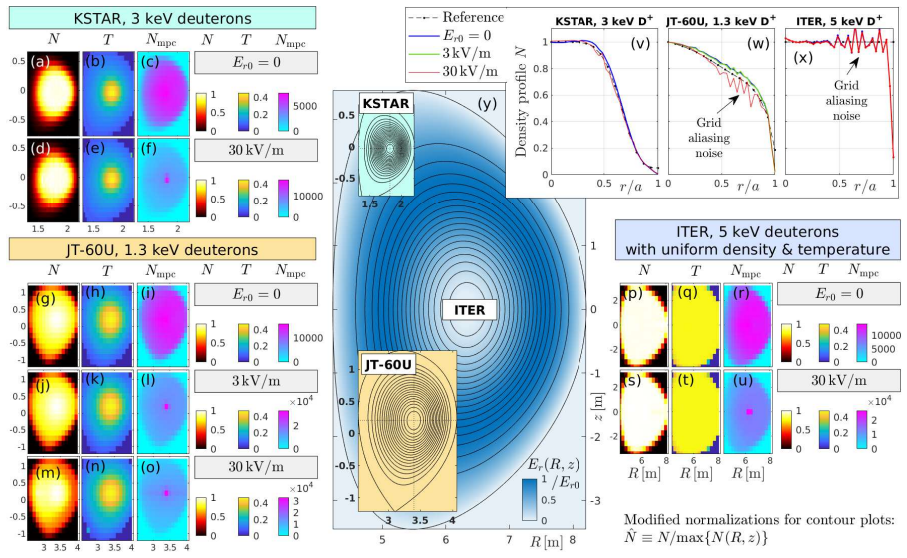
Summary. This paper describes an extension of the VisualStart guiding-center (GC) code that includes a stationary, toroidally symmetric radial electric field Er. The authors sample GC orbit space on the magnetic midplane using relative constants of motion (midplane kinetic energy, pitch, radius) and compare this with slicing using absolute constants of motion (energy, invariant pitch, canonical toroidal momentum). The method is exercised on KSTAR, JT-60U, and ITER equilibria, with a Maxwellian-like CoM distribution used for weighting. The paper also analyzes the Er-induced modification of individual GC orbits, including the shift of the trapped-passing boundary, the reference-point bias in electric frequency shifts, and the validity of approximating the electric Doppler shift by bulk rotation. The central claim is that midplane-based relative CoM are equivalent but superior to absolute CoM in the presence of Er, allowing high accuracy with a simple mesh.
Significance. The potential value of the work is substantial: if robust, it provides a practical recipe for constructing GC orbit databases in rotating tokamak plasmas, which is relevant for low-frequency instabilities and resonance analyses. The paper ships extensive numerical validation: convergence tests in time step (Fig. 6), resolution studies for relative vs absolute CoM (Appendix B), analytic orbit-width estimates agreeing within 2-30% (Section 5.4), a quantitative continuity check (Eq. (53)), and reconstruction of the input Er from computed flow fields (Section 4.3). The demonstration that relative and absolute CoM are equivalent when the relative-CoM mesh is accurate is well supported, and the reference-point bias analysis in Section 5.5 identifies a subtle and important ambiguity. However, the paper's headline claim of superiority over absolute CoM is not established by the benchmark presented, as detailed in the major comments.
major comments (2)
- [Abstract; §3.6; Appendix B.1] The load-bearing claim that midplane-based relative CoM are 'not only equivalent but superior' to absolute constants of motion is not established by the evidence provided. The benchmark in Appendix B compares the relative-CoM slicing against an absolute-CoM implementation that uses deliberately simple AND/OR filters (Table B.1) and does not compute boundary cell sizes near the u=0 constraint (B.1) accurately; the paper itself concedes in Appendix B.1 that 'in principle, all this could be done accurately if one invests more effort into the meshing algorithm'. Thus the documented performance gap reflects the choice of a naive comparator, not an intrinsic property of the coordinate system. The 'equivalent' part of the claim is supported; the unqualified 'superior' part is not. The authors should either soften the claim to state that relative CoM are equivalent and much simpler to implement, or add a benchmark with a boundary-fitted absolute-CoM mesh that respects the curved u=0 surface.
- [§3.4; §3.8; Abstract] The method's accuracy and efficiency presuppose that each relevant GC orbit crosses a unique, single-valued magnetic midplane z_mid(R) exactly twice. Section 3.4 acknowledges that additional midplanes exist (e.g., in the JT-60U divertor region, Fig. A.2) and Section 3.8 warns that stagnation and potato orbits near the trapped-passing boundary may be missed or corrupted by the midplane polynomial fit and grid. The unqualified claim in the abstract of attaining 'high numerical accuracy and efficiency with a relatively simple mesh' in the presence of Er therefore holds only for configurations satisfying this premise. The conditions under which the method is applicable should be stated in the abstract or conclusions, and it would be useful to quantify how large a fraction of orbit space is affected in the JT-60U edge region where the extra midplane exists.
minor comments (5)
- [§4.1] There is a typo in the third paragraph: 'vales up to ±10 kV/m' should read 'values up to ±10 kV/m'.
- [§4.3] The marker density is referred to as Nmk in the text of Section 4.3 but as Nmpc in the figure captions and elsewhere; please unify the notation.
- [Eq. (47)] The notation 'Maxw. − →' in Eq. (47c) is nonstandard and likely a LaTeX artifact; please replace it with a conventional equality or arrow.
- [Figure 15] The caption of Fig. 15 contains 'Top[59]' in the line listing launch-point coordinates, which appears to be a stray citation tag; please correct or remove.
- [General] Given the paper's length and its role as a methods-reference for VisualStart, a short 'code and data availability' statement (whether the code will be released, and on what platform) would be helpful.
Circularity Check
No load-bearing circularity: the relative-CoM mesh and Er implementation are self-contained, with only a minor internal-consistency caveat in the Appendix C verification and a non-circular benchmark limitation affecting the 'superior' claim.
-
other
[Section 5.4 and Appendix C.1 (Eqs. C.6a-C.11b)]
"Conservation of total energy E in Eq. (32a) and conservation of toroidal momentum Pζ in Eq. (32b) imply that, at an arbitrary point along the GC orbit, the parallel energy gain ∆u2 and the parallel momentum gain ∆u relative to the initial value uI are ..."
The GC equations of motion in Section 3.3 are Hamiltonian and conserve the same E and Pζ; Section 3.5 states: 'The motion of a GC in the ambient fields given by Eq. (14) conserves the total energy E and the canonical toroidal angular momentum Pζ in Eq. (13).' The analytical estimates in Appendix C are therefore derived from the same invariants that the numerical integrator enforces by construction, so agreement in Section 5.4 is partly an internal consistency check rather than an independent test. This caveat is localized to the verification methodology; the central mesh construction is benchmarked self-containedly in Appendix B and checked against independent physical expectations (uniform flows in ITER, continuity, Er reconstruction from moments), so it is not load-bearing.
full rationale
The central construction is not circular. The relative-CoM sampling and Jacobian mapping in Eqs. (31)-(37) are derived from the GC Hamiltonian and the midplane condition (25), and the benchmark in Appendix B compares two concrete mesh implementations without fitting any parameter to force agreement. Independent physical checks support the numerical results: uniform-flow expectations in Section 4.2, the continuity check in Eq. (53), and the reconstruction of the input Er from the computed flow moments in Eqs. (50)-(51). The only circularity-like caveat is that the analytic verification in Section 5.4 and Appendix C uses formulas derived from the same E and Pζ conservation laws embedded in the Hamiltonian integrator, so agreement is partly an internal consistency check; this is a minor verification circularity, not a load-bearing flaw. Self-citations to Ref. [16] provide code provenance and prior verification of the Er=0 mesh, but the Er=0 mesh verification is supporting evidence and Appendix B independently tests the Er case, so the self-citation is not load-bearing. The categorical 'superior' claim is weakened by the admission in Appendix B.1 that the absolute-CoM implementation was deliberately kept simple ('in principle, all this could be done accurately if one invests more effort into the meshing algorithm, which we did not do'), but that is an evidence-completeness limitation, not circularity.
Assumptions & free parameters
free parameters (2)
- Er0 (peak radial electric field) =
0, 3, +/-30 kV/m
- Electrostatic potential shape Phi(psi_P) =
sinusoidal profile, Eq. (15), Er(0)=Er(1)=0, Er(0.5)=Er0
assumptions (7)
- standard math Littlejohn guiding-center equations of motion with mu exact by construction and E, P_zeta conserved
- domain assumption Extended banana regime: scattering is negligible on poloidal transit time and weak resonant interactions only
- domain assumption GC model validity: rho_L grad ln Phi << 1, no gyroaveraging, no ponderomotive potential, E_parallel approx 0, stationary fields
- domain assumption Unique magnetic midplane: each GC orbit crosses B*gradB = 0 exactly twice and z_mid(R) is single-valued in the domain
- domain assumption Orbit weights and Er are externally specified and not self-consistent with the constructed distribution
- ad hoc to paper Isotropic CoM Maxwellian f_mdl(<r>,<K>) with orbit-averaged coordinates is a valid test distribution
- ad hoc to paper Analytic estimates assume Er approx constant along the orbit, B approx B_tor, Delta I/I approx 0, and small inverse-aspect-ratio terms omitted
Cite this review
Pith. "Pith review of Construction and analysis of guiding center distributions for tokamak plasmas with ambient radial electric field." pith.science (2026). https://pith.science/paper/TNOLEWHD
@misc{pith2026241119288,
  author       = {Pith},
  title        = {Pith review of: Construction and analysis of guiding center distributions for tokamak plasmas with ambient radial electric field},
  year         = {2026},
  howpublished = {\url{https://pith.science/paper/TNOLEWHD}},
  note         = {Machine review of arXiv:2411.19288}
}
abstract
The contribution of a time-independent toroidally-symmetric radial electric field $E_r$ is implemented in VisualStart [Comp. Phys. Comm. 275 (2022) 108305; arXiv:2111.08224], a code whose purposes include the construction of guiding center (GC) drift orbit databases for the study of plasma instabilities in tokamaks. $E_r$ is important for the thermal part of the velocity distribution and for fast particle resonances in the kHz frequency range. KSTAR, JT-60U and ITER tokamak cases are used as working examples to test our methods and discuss practical issues connected with $E_r$. Two points are worth noting: First, the GC orbit space is sampled in the magnetic midplane as before, and we find that in the presence of $E_r$, midplane-based coordinates are not only equivalent but superior to conventional constants of motion, allowing to attain high numerical accuracy and efficiency with a relatively simple mesh. Second, the periodic parallel acceleration and deceleration of GCs via the mirror force is modulated by $E_r$. Although this parallel electric acceleration averages to zero during a poloidal transit (or bounce) period, it has important consequences, one being the known shift of the trapped-passing boundary. Another consequence is that electric frequency shifts depend on the chosen reference point, so that some care is required when evaluating the $E_r$-dependence of transit frequencies for resonance analyses.
Figures


Figures from the paper (11 more)




Reference graph
Works this paper leans on
-
[1]
Jr. L. Spitzer. Physics of fully ionized gases . Wiley, New Y ork, 2nd edition, 1956. See page 30, Section 2.3
1956
-
[2]
H. Qin, W.M. Tang, G. Rewoldt, and W.W. Lee. On the gyrokinetic equilibrium. Phys. Plasmas , 7:991, 2000. https://doi.org/10.1063/1.873898
-
[3]
Helander and D.J
P . Helander and D.J. Sigmar. Collisional Transport in Mag- netized Plasmas . Cambridge Monographs on Plasma Physics. Cambridge University Press, London, 2005
2005
-
[4]
A.Y Aydemir. A unified Monte Carlo interpreta- tion of particle simulations and applications to non- neutral plasmas. Phys. Plasmas , 1(4):822, 1994. https://doi.org/10.1063/1.870740
doi:10.1063/1.870740 1994
-
[5]
R.G. Littlejohn. V ariational principles of guiding centre motion. J. Plasma Physics , 29:111, 1983. https://doi.org/10.1017/S002237780000060X
-
[6]
F.L. Hinton and R.D. Hazeltine. Theory of plasma transpo rt in toroidal confinement systems. Rev. Mod. Phys. , 48:239, 1976. https://doi.org/10.1103/Re/v1ModPhys.48.239
-
[7]
Morozov and L.S
A.I. Morozov and L.S. Solov’ev. Motion of charged partic les in electromagnetic fields. In Reviews in Plasma Physics, volume 2. Consultants Bureau, New Y ork, 1966
1966
-
[8]
F. Zonca, L. Chen, J.Q. Dong, and R.A. Santoro. Exis- tence of ion temperature gradient driven shear Alfv´ en in- stabilities in tokamaks. Phys. Plasmas , 6:1917, 1999. https://doi.org/10.1063/1.873449
Show all 96 references
-
[9]
Chen and F
L. Chen and F. Zonca. Physics of Alfv´ en waves and energet ic particles in burning plasmas. Rev. Mod. Phys., 88:015008, 2016. https://doi.org/10.1103/Re/v1ModPhys.88.015008
2016 doi
-
[10]
Heidbrink, M.A
W.W. Heidbrink, M.A. V an Zeeland, M.E. Austin, A. Bier- wage, Liu Chen, G.J. Choi, P . Lauber, Z. Lin, G.R. Mc- Kee, and D.A. Spong. ‘BAAE’ instabilities observed without fast ion drive. Nucl. Fusion , 61:016029, 2021. https://doi.org/10.1088/1741-4326/abc4c3
2021 doi
-
[11]
Heidbrink, G.J
W.W. Heidbrink, G.J. Choi, M.A. V an Zeeland, M.E. Austin, G.H. Degrandchamp, D.A. Spong, A. Bierwage, N.A. Crocker, X.D. Du, P . Lauber, Z. Lin, and G.R. McKee. Isotope dependence of beta-induced Alfv´ en eigenmode (BAE) and low frequency mode (LFM) stability in DIII-D. Nucl....
2021 doi
-
[12]
X.D. Du, R.J. Hong, W.W. Heidbrink, X. Jian, H. Wang, N.W. Eidietis, M.A. V an Zeeland, M.E. Austin, Y . Liu, N.A. Crocker, T.L. Rhodes, K. S¨ arkim¨ aki, A. Snicker, W. Wu, and M. Knolker. Multiscale chirping modes driven by thermal ions in a plasma with reactor-relevant ion ...
2021 doi
-
[13]
Hirshman and D.J
S.P . Hirshman and D.J. Sigmar. Neoclassical transport of im- purities in tokamak plasmas. Nucl. Fusion , 21:1079, 1981. https://doi.org/10.1088/0029-5515/21/9/003
1981 doi
-
[14]
K. Ida. Experimental studies of the physical mechanism de- termining the radial electric field and its radial structure in a toroidal plasma. Plasma Phys. Control. Fusion , 40:1429, 1998. https://doi.org/10.1088/0741-3335/40/8/002
1998 doi
-
[15]
Callen, A.J
J.D. Callen, A.J. Cole, and C.C. Hegna. Toroidal rota- tion in tokamak plasmas. Nucl. Fusion , 49:085021, 2009. https://doi.org/10.1088/0029-5515/49/8/085021
2009 doi
-
[16]
Bierwage, M
A. Bierwage, M. Fitzgerald, Ph. Lauber, M. Salewski, Y . Kazakov, and ˇZiga ˇStancar. Representation and modeling of charged particle distributions in toka- maks. Comp. Phys. Comm. , 275:108305, 2022. https://doi.org/10.1016/j.cpc.2022.108305
2022
-
[17]
Benjamin, H
S. Benjamin, H. J¨ arleblad, M. Salewski, L. Stagner, 44 M. Hole, and D. Pfe fferl´ e. Distribution transforms for guiding center orbit coordinates in axisymmetric toka- mak equilibria. Comp. Phys. Comm. , 292:108893, 2023. https://doi.org/10.1016/j.cpc.2023.108893
2023
-
[18]
Imbeaux, S.D
F. Imbeaux, S.D. Pinches, J.B. Lister, Y . Buravand, T. C asper, B. Duval, B. Guillerminet, M. Hosokawa, W. Houlberg, P . Huynh, S.H. Kim, G. Manduchi, M. Owsiak, B. Palak, M. Plociennik, G. Rouault, O. Sauter, and P . Strand. De- sign and first applications of the ITER integra...
2015 doi
-
[19]
Zonca, L
F. Zonca, L. Chen, S. Briguglio, G. Fogaccia, G. Vlad, and X. Wang. Nonlinear dynamics of phase space zonal structures and energetic particle physics in fu- sion plasmas. New J. Phys. , 17:013052, 2015. https://doi:10.1088/1367-2630/17/1/013052
2015 doi
-
[20]
Falessi and F
M.V . Falessi and F. Zonca. Transport theory of phase space zonal structures. Phys. Plasmas , 26:022305, 2019. https://doi.org/10.1063/1.5063874
2019 doi
-
[21]
Falessi, L
M.V . Falessi, L. Chen, Z. Qiu, and F. Zonca. Non- linear equilibria and transport processes in burn- ing plasmas. New. J. Phys. , 25:123035, 2023. https://doi.org/10.1088/1367-2630/ad127d
2023 doi
-
[22]
Lauber, M
Ph. Lauber, M. Falessi, G. Meng, T. Hayward-Schneider, V .-A. Popa, F. Zonca, and M. Schneider. A TEP: an advanced transport model for energetic particles. Nucl. Fusion , 64:096010, 2024. https://doi.org/10.1088/1741-4326/ad6336
2024 doi
-
[23]
Meng, Ph
G. Meng, Ph. Lauber, Z. Lu, A. Bergmann, and M. Schneider . Energetic particles transport in constants of motion space due to collisions in tokamak plasmas. Nucl. Fusion, 64:096009, 2024. https://doi.org/10.1088/1741-4326/ad5190
2024 doi
-
[24]
Hezaveh, Z.S
H. Hezaveh, Z.S. Qu, M.J. Hole, and R.L. Dewar. Theo- retical description of chirping waves using phase-space wa - terbags. Plasma Phys. Control. Fusion , 63:065008, 2022. https://doi.org/10.1088/1361-6587/abf574
2022 doi
-
[25]
Brochard
G. Brochard. Dynamics of ion-driven fishbones in tokamaks: theory and nonlinear full scale simulations . PhD thesis, Plasma Physics [physics.plasm-ph], Institut Polytechnique de Pa ris, France, 2019. English. NNT : 2019IPPAX002. tel-02495955. https://theses.hal.science/tel-02495955/v11
2019
-
[26]
Carlsson
J. Carlsson. Breakdown of adiabatic invariance in spherical tokamaks. Phys. Plasmas , 8(11):4725, 2001. https://doi.org/10.1063/1.1412008
2001 doi
-
[27]
D.F Escande and F. Sattin. Breakdown of adiabatic invar iance of fast ions in spherical tokamaks. Nucl. Fusion, 61(10):106025,
-
[28]
M. Rud, D. Moseev, F. Jaulmes, K. Bogar, Y . Dong, P .C. Hansen, J. Eriksson, H. J¨ arleblad, M. Nocente, G. Prechel, B.C.G. Reman, B.S. Schmidt, A. Snicker, L. Stagner, A. V alen- tini, and M. Salewski. Orbit tomography in constants- of-motion phase-space. Nucl. Fusion , 64:0...
2024 doi
-
[29]
Bierwage, C
A. Bierwage, C. Di Troia, S. Briguglio, and G. Vlad. Orbit-based representation of equilibrium distribution f unc- tions for low-noise initialization of kinetic simulations of toroidal plasmas. Comp. Phys. Comm. , 183:1107, 2015. http://dx.doi.org/10.1016/j.cpc.2012.01.013
2015 doi
-
[30]
Bierwage and K
A. Bierwage and K. Shinohara. Orbit-based analy- sis of nonlinear energetic ion dynamics in tokamaks. I. E ffective mode number profile and resonant fre- quency tracking. Phys. Plasmas , 23:042511, 2016. http://dx.doi.org/10.1063/1.4947033
2016 doi
-
[31]
Bierwage and K
A. Bierwage and K. Shinohara. Orbit-based anal- ysis of nonlinear energetic ion dynamics in toka- maks. II. Mechanisms for rapid chirping and convec- tive amplification. Phys. Plasmas , 23:042512, 2016. http://dx.doi.org/10.1063/1.4947034
2016 doi
-
[32]
Stagner and W
L. Stagner and W. W. Heidbrink. Action-angle for- mulation of generalized, orbit-based, fast-ion diagnosti c weight functions. Phys. Plasmas , 24:092505, 2017. https://doi.org/10.1063/1.4990391
2017 doi
-
[33]
Stagner, W.W
L. Stagner, W.W. Heidbrink, M. Salewski, A.S. Jacob- sen, B. Geiger, and the DIII-D and ASDEX Upgrade Teams. Orbit tomography of energetic particle dis- tribution functions. Nucl. Fusion , 62:026033, 2022. https://doi.org/10.1088/1741-4326/ac3ed2
2022 doi
-
[34]
J¨ arleblad, L
H. J¨ arleblad, L. Stagner, M. Salewski, J. Eriksson, M. No- cente, B.S. Schmidt, and M. Rud Larsen. A frame- work for synthetic diagnostics using energetic-particle o r- bits in tokamaks. Comp. Phys. Comm. , 294:108930, 2024. https://doi.org/10.1016/j.cpc.2023.108930
2024
-
[35]
J. Wesson. Tokamaks. Oxford University Press, New Y ork, 4th edition, 2011. Section 1.5, page 10
2011
-
[36]
Brochard
G. Brochard. Generation of constants of motion distrib utions for energetic particles in ITER Integrated Modelling Analy sis Suite. 50th EPS Conference on Plasma Physics, July 8-12, 2024, Salamanca, Spain. Poster P3-082. Paper in preparation
2024
-
[37]
H. Chen, L. Chen, F. Zonca, J. Li, and M. Xu. V alidity of gy - rokinetic theory in magnetized plasmas. Comm. Phys. , 7:261,
-
[38]
Cary and A.J
J.R. Cary and A.J. Brizard. Hamiltonian theory of guiding-center motion. Rev. Mod. Phys. , 81(2):693, 2009. http://dx.doi.org/10.1103/Re/v1ModPhys.81.693
2009 doi
-
[39]
Bierwage and K
A. Bierwage and K. Shinohara. Testing the conserva- tive character of particle simulations: II. Spurious heat- ing of guiding centers and full orbits subject to fluctu- ations expressed in terms of e and b. Phys. Plasmas , 29:113906, 2022. https://doi.org/10.1063/5.0106395. Err...
2023 doi
-
[40]
Berger, W.A
J.M. Berger, W.A. Newcomb, J.M. Dawson, E.A. Frieman, R .M. Kulsrud, and A. Lenard. Heating of a confined plasma by os- cillating electromagnetic fields. Phys. Fluids , 1(4):301, 1958. https://doi.org/10.1063/1.1705888
1958 doi
-
[41]
Rosenbluth, R.D
M.N. Rosenbluth, R.D. Hazeltine, and F.L. Hinton. Plas ma transport in toroidal confinement systems. Phys. Fluids, 15:116,
-
[42]
T.H. Stix. Decay of poloidal rotation in a toka- mak plasma. Phys. Fluids , 16:1260, 1973. https://doi.org/10.1063/1.1694506
1973 doi
-
[43]
Novakovskii, C.S
S.V . Novakovskii, C.S. Liu, R.Z. Sagdeev, and M.N. Rosenbluth. The radial electric field dynamics in the neoclassical plasmas. Phys. Plasmas , 4:4272, 1997. https://doi.org/10.1063/1.872590
1997 doi
-
[44]
Winsor, J.L
N. Winsor, J.L. Johnson, and J.M. Dawson. Geodesic acou stic waves in hydromagnetic systems. Phys. Fluids, 11:2448, 1968. https://doi.org/10.1063/1.169183513
1968 doi
-
[45]
Lee, J.W
W.J. Lee, J.W. Kim, S.M. Joung, G.J. Choi, J.G. Bak, J.S. Kang, and Y .-C. Ghim. Non-monotonic radial structures of fluctuating temperatures and densities associated with fish - bone activities in KSTAR. Phys. Plasmas , 30:022502, 2023. https://doi.org/10.1063/5.0134354
2023 doi
-
[46]
Landreman and P .J
M. Landreman and P .J. Catto. Omnigenity as general- ized quasisymmetry. Phys. Plasmas , 19:056103, 2012. https://doi.org/10.1063/1.3693187
2012 doi
-
[47]
Helander and A.N
P . Helander and A.N. Simakov. Intrinsic ambipolarity a nd rotation in stellarators. Phys. Rev. Lett. , 101:145003, 2008. https://doi.org/10.1103/PhysRe/v1Lett.101.145003
2008 doi
-
[48]
Simakov and P
A.N. Simakov and P . Helander. Plasma rota- tion in a quasi-symmetric stellarator. Plasma 45 Phys. Control. Fusion , 53:024005, 2011. http://dx.doi.org/10.1088/0741-3335/53/2/024005
2011 doi
-
[49]
Cooper, M
G.A. Cooper, M. Jucker, W.A. Cooper, J.P . Graves, and M.Y u. Isaev. Exact canonical drift hamilto- nian formalism with pressure anisotropy and finite perturbed fields. Phys. Plasmas , 14:102506, 2007. http://dx.doi.org/10.1063/1.2786061. See also M. Jucker et al., Single partic...
2007 doi
-
[50]
Porcelli, R
F. Porcelli, R. Stankiewicz, W. Kerner, and H.L. Berk. S o- lution of the drift-kinetic equation for global plasma mode s and finite particle orbit widths. Phys. Plasmas , 1:470, 1994. https://doi.org/10.1063/1.870792
1994 doi
-
[51]
Hinton and Y .-B
F.L. Hinton and Y .-B. Kim. Poloidal rotation in tokamak s with large electric field gradients. Phys. Plasmas, 2:159, 1995. https://doi.org/10.1063/1.871105
1995 doi
-
[52]
Shinohara, M
K. Shinohara, M. Takechi, M. Ishikawa, Y . Kusama, A. Morioka, N. Oyama, K. Tobita, T. Ozeki, the JT-60 Team, N.N. Gorelenkov, C.Z. Cheng, G.J. Kramer, and R. Nazikian. Recent progress of Alfv´ en eigenmode experiments using N- NB in JT-60U tokamak. Nucl. Fusion , 42:942, 2002...
2002 doi
-
[53]
Bierwage, K
A. Bierwage, K. Shinohara, Y . Todo, N. Aiba, M. Ishikawa , G. Matsunaga, M. Takechi, and M. Y agi. Self-consistent long-time simulation of chirping and beating energetic par ti- cle modes in JT-60U plasmas. Nucl. Fusion, 57:016036, 2017. http://dx.doi.org/10.1088/1741-4326/57...
2017 doi
-
[54]
Bierwage, K
A. Bierwage, K. Shinohara, Y . Todo, N. Aiba, M. Ishikawa , Go Matsunaga, M. Takechi, and M. Y agi. Simulations tackle abrupt massive migrations of energetic beam ions in a tokamak plasma. Nature Commun. , 9:3282, 2018. https://doi.org/10.1038/s41467-018-05779-0
2018 doi
-
[55]
K. Tani, M. Honda, T. Oikawa, K. Shinohara, Y . Kusama, an d T. Sugie. E ffects of the radial electric field on the confine- ment of fast ions in ITER. Nucl. Fusion , 55:053010, 2015. http://dx.doi.org/10.1088/0029-5515/55/5/053010
2015 doi
-
[56]
Zhang, G.Y
R.B. Zhang, G.Y . Fu, R.B. White, and X.G. Wang. Local wave particle resonant interaction causing energetic part icle prompt loss in DIII-D plasmas. Nucl. Fusion, 55:122002, 2015. http://dx.doi.org/10.1088/0029-5515/55/12/122002
2015 doi
-
[57]
Heidbrink and G
W.W. Heidbrink and G. Sager. The fishbone instability in the DIII-D tokamak. Nucl. Fusion , 30:1015, 1990. https://doi.org/10.1088/0029-5515/30/6/004
1990 doi
-
[58]
Matsunaga, N
G. Matsunaga, N. Aiba, K. Shinohara, Y . Sakamoto, A. Isayama, M. Takechi, T. Suzuki, N. Oyama, N. Asakura, Y . Kamada, T. Ozeki, and JT-60 Team. Observation of an energetic- particle-driven instability in the wall-stabilized high- β plasmas in the JT-60U tokamak. Phys. Rev. L...
2009 doi
-
[59]
Matsunaga, K
G. Matsunaga, K. Shinohara, N. Aiba, Y . Sakamoto, A. Isayama, N. Asakura, T. Suzuki, M. Takechi, N. Oyama, H. Urano, and the JT-60 Team. Energetic particle driven instability in wa ll- stabilized high-β plasmas. Nucl. Fusion , 50:084003, 2010. http://dx.doi.org/10.1088/0029-5...
2010 doi
-
[60]
Okabayashi, G
M. Okabayashi, G. Matsunaga, J.S. deGrassie, W.W. Heid - brink, Y . In, 5 Y . Q. Liu, H. Reimerdes, W.M. Solomon, E.J. Strait, M. Takechi, N. Asakura, R.V . Budny, G.L. Jack- son, J.M. Hanson, R.J. La Haye, M.J. Lanctot, J. Man- ickam, K. Shinohara, and Y .B. Zhu. O ff-axis fish...
2011 doi
-
[61]
Heidbrink, M.E
W.W. Heidbrink, M.E. Austin, R.K. Fisher, M. Garc´ ıa-M u noz, G. Matsunaga, G.R. McKee, R.A. Moyer, C.M. Muscatello, M. Okabayashi, D.C. Pace, K. Shinohara, W.M. Solomon, E.J. Strait, M.A. V an Zeeland, and Y .B. Zhu. Characterization ofoff- axis fishbones. Plasma Phys. Control...
2011 doi
-
[62]
L. Chen. Theory of magnetohydrodynamic instabilities excited by energetic particles in tokamaks. Phys. Plasmas , 1:1519,
-
[63]
Brochard, C
G. Brochard, C. Liu, X. Wei, W. Heidbrink, Z. Lin, N. Gore - lenkov, C. Chrystal, X. Du, J. Bao, A.R. Polevoi, M. Schneide r, S.H. Kim, S.D. Pinches, P . Liu, J.H. Nicolau, and H. L ¨ utjens . Saturation of fishbone instability by self-generated zonal flows in tokamak plasmas. P...
2024 doi
-
[64]
Brochard, C
G. Brochard, C. Liu, X. Wei, W.W. Heidbrink, Z. Lin, M.V . Fa- lessi, F. Zonca, Z. Qiu, N.N. Gorelenkov, C. Chrystal, X. Du, J. Bao, A.R. Polevoi, M. Schneider, S.H. Kim, S.D. Pinches, P . Liu, J.H. Nicolau, and H. L ¨ utjens. Saturation of fish- bone instability through zonal ...
2024 doi
-
[65]
Bierwage, K
A. Bierwage, K. Shinohara, Y e.O. Kazakov, V .G. Kiptily , Ph. Lauber, M. Nocente, ˇZ. ˇStancar, S. Sumida, M. Y agi, J. Gar- cia, S. Ide, and JET Contributors. Energy-selective con- finement of fusion-born alpha particles during internal rel ax- ations in a tokamak plasma. Nat...
2022 doi
-
[66]
MA TLAB version: 24.1.0 (r2024a), 20 24
The MathWorks Inc. MA TLAB version: 24.1.0 (r2024a), 20 24
-
[67]
Parallel Processing Toolbox: 24.1
The MathWorks Inc. Parallel Processing Toolbox: 24.1. 0 (r2024a), 2024
2024
-
[68]
Brizard and T.S
A.J. Brizard and T.S. Hahm. Foundations of nonlinear gy roki- netic theory. Rev. Mod. Phys. , 79:421, 2007. See p.461, top right. http://dx.doi.org/10.1103/Re/v1ModPhys.79.421
2007 doi
-
[69]
H. Sugama. Modern gyrokinetic formulation of col- lisional and turbulent transport in toroidally rotat- ing plasmas. Rev. Mod. Plasma Phys. , 1(9):1, 2017. https://doi.org/10.1007/s41614-017-0010-5
2017 doi
-
[70]
Honda, T
M. Honda, T. Takizuka, A. Fukuyama, M. Y oshida, and T. Ozeki. Self-consistent simulation of torque generation by ra- dial current due to fast particles. Nucl. Fusion, 49:035009, 2009. http://dx.doi.org/10.1088/0029-5515/49/3/035009
2009 doi
-
[71]
Honda, S
M. Honda, S. Ide, T. Takizuka, N. Hayashi, M. Y oshida, M. Y agi, and T. Fujita. Development of the transport- code framework for self-consistent predictions of rotatio n and the radial electric field. Nucl. Fusion , 53:073050, 2013. http://dx.doi.org/10.1088/0029-5515/53/7/073050
2013 doi
-
[72]
Honda and A
M. Honda and A. Fukuyama. Development of the fluid-type transport code on the flux coordinates in a tokamak. Comp. Phys. Comm. , 208:117, 2016. http://dx.doi.org/10.1016/j.cpc.2016.08.008
2016 doi
-
[73]
Belova, N.N
E.V . Belova, N.N. Gorelenkov, and C.Z. Cheng. Self-con sistent equilibrium model of low aspect-ratio toroidal plasma with en- ergetic beam ions. Phys. Plasmas, 10(8):3240, 2003
2003
-
[74]
Shinohara, M
K. Shinohara, M. Takechi, M. Ishikawa, Y . Kusama, K. Tsuzuki, K. Urata, H. Kawashima, K. Tobita, A. Fukuyama, C.Z. Cheng, D.S. Darrow, G.J. Kramer, N.N. Gorelenkov, R. Nazikian, Y . Todo, Y . Miura, and T. Ozeki. Energetic particle physics i n JT-60U and JFT-2M. Plasma Phys. ...
-
[75]
Ishikawa, M
M. Ishikawa, M. Takechi, K. Shinohara, Y . Kusama, C.Z. Cheng, G. Matsunaga, Y . Todo, N.N. Gorelenkov, G.J. Kramer, R. Nazikian, A. Fukuyama, V .A. Krasilnikov, Y u. Kashuck, T. Nishitani, A. Morioka, M. Sasao, M. Isobe, and the JT-60 team. Energetic ion transport by abrupt l...
2005 doi
-
[76]
Salewski, B
M. Salewski, B. Geiger, A.S. Jacobsen, I. Abramovic, S. B. Korsholm, F. Leipold, B. Madsen, J. Madsen, R.M. McDer- mott, D. Moseev, S.K. Nielsen, M. Nocente, J. Rasmussen, M. Stejner, M. Weiland, The EUROfusion MST1 team, and The ASDEX Upgrade team. Deuterium temperature, drif...
2018 doi
-
[77]
Madsen, J
B. Madsen, J. Huang, M. Salewski, H. J¨ arleblad, P .C. Ha nsen, L. Stagner, J. Su, J.F. Chang, J. Fu, J.F. Wang, L.Z. Liang, G.Q. Zhong, Y .Y . Li, B. Lyu, H.Q. Liu, Q. Zang, Z.P . Luo, M. Nocente, D. Moseev, T.S. Fan, Y .M. Zhang, D. Y ang, J.Q. Sun, L.Y . Liao, and the EAST...
2020 doi
-
[78]
Kim, P .H
Y .B. Kim, P .H. Diamond, and R.J. Groeb- ner. Neoclassical poloidal and toroidal rota- tion in tokamaks. Phys. Fluids B , 3:2050, 1991. https://doi.org/10.1063/1.859671. Erratum: Phys. Flu- ids B 4 (1992) 2996 https://doi.org/10.1063/1.860488
1992 doi
-
[79]
V alanju, M.D
P .M. V alanju, M.D. Calvin, R.D. Hazeltine, and E.R. Sol ano. The effect of charge exchange on plasma flows. Phys. Fluids B , 4:2675, 1992. https://doi.org/10.1063/1.860187
1992 doi
-
[81]
Baylor, K.H
L.R. Baylor, K.H. Burrell, R.J. Groebner, W.A. Houlber g, D.P . Ernst, M. Murakami, and M.R. Wade. Comparison of toroidal rotation velocities of di fferent impurity ions in the DIII-D tokamak. Phys. Plasmas , 11(6):3100, 2004. https://doi.org/10.1063/1.1710900
2004 doi
-
[82]
N. Aiba, C. Giroud, M. Honda, E. Delabie, S. Saarelma, L. Frassinetti, I. Lupelli, F.J. Casson, S. Pamela, H. Urano , C.F. Maggi, and JET Contributors. Numerical analy- sis of ELM stability with rotation and ion diamagnetic drift e ffects in JET. Nucl. Fusion , 57:126001, 2017....
2017 doi
-
[83]
Plank, D
U. Plank, D. Brida, G.D. Conway, T. Happel, A.E. Hub- bard, T. P¨ utterich, C. Angioni, M. Cavedon, R. Dux, T. Eich, R. Fischer, P . Hennequin, and ASDEX Upgrade Team. Ex- perimental study of the edge radial electric field in di ffer- ent drift configurations and its role in the ...
2023 doi
-
[84]
Viezzer, T
E. Viezzer, T. P¨ utterich, C. Angioni, A. Bergmann, R. D ux, E. Fable, R.M. McDermott, U. Stroth, E. Wolfrum, and the ASDEX Upgrade Team. Evidence for the neoclassical na- ture of the radial electric field in the edge transport bar- rier of ASDEX Upgrade. Nucl. Fusion , 54:012...
2014 doi
-
[85]
S.G. Lee, J. Seol, and H.H. Lee. Toroidal rotation dynam ics in KSTAR ohmic plasmas. Nucl. Fusion , 62:106018, 2022. https://doi.org/10.1088/1741-4326/ac8a5e
2022 doi
-
[86]
Coenen, B
J.W. Coenen, B. Schweer, M. Clever, S. Freutel, O. Schmi tz, H. Stoschus, U. Samm, B. Unterberg, and the TEX- TOR Team. Charge exchange recombination spectroscopy on a diagnostic hydrogen beam—measuring impurity ro- tation and radial electric field at the tokamak TEX- TOR. J. P...
2010 doi
-
[87]
X. Xu, Y . Xu, X. Zhang, and Y . Hu. Simulations of the radial electric field induced by neutral beam in- jection in a tokamak. Nucl. Fusion , 61:086002, 2021. https://doi.org/10.1088/1741-4326/ac054d
2021 doi
-
[88]
K. Kim, J. Kang, H. Kim, S. Yi, J. Y oo, M. Choi, T. Rhee, J. Kim, M. Lee, W.-H. Ko, and J. Kwon. Ob- servation of improved confinement by nonaxisymmetric mag- netic field in KSTAR. Nucl. Fusion , 44:066003, 2023. https://doi.org/10.1088/1741-4326/acc3ad
2023 doi
-
[89]
Cary; C.L
J.R. Cary; C.L. Hedrick and J.S. Tolliver. Orbits in asy mmet- ric toroidal magnetic fields. Phys. Fluids , 31(6):1586, 1988. https://doi.org/10.1063/1.866698
1988 doi
-
[90]
Todoroki
J. Todoroki. Theory of longitudinal adiabatic invaria nt in the helical torus. J. Phys. Soc. Japan , 62:1562, 1993. https://doi.org/10.1143/JPSJ.62.1562
1993 doi
-
[91]
Brizard and B.C
A.J. Brizard and B.C. Hodgeman. Faithful guiding-cent er orbits in an axisymmetric magnetic field. Phys. Plasmas, 30:042115,
-
[1972]
https://doi.org/10.1063/1.1693728
-
[1994]
https://doi.org/10.1063/1.870702
-
[2004]
https://doi.org/10.1088/0741-3335/46/7/S03
-
[2022]
https://doi.org/10.1088/1741-4326/ac21fb
-
[2023]
https://doi.org/10.1063/5.0145035. 47
-
[2024]
https://doi.org/10.1038/s42005-024-01756-w
Reviewed August 12, 2026 · model on record in the stance chip above.
Discussion (0). Continue with ORCID to comment.