REVIEW 3 major objections 5 minor 1 cited by
Neural Network Potential with Multi-Resolution Approach Enables Accurate Prediction of Reaction Free Energies in Solution
T0 review · 3 major / 5 minor · reviewed 2026-08-12 · deepseek-v4-flash
Pith's one-line read A trained neural network potential can replace the expensive quantum-mechanical Hamiltonian inside an explicit-solvent simulation and reproduce experimental reaction free energies within a few kJ/mol across very different chemical systems.
desk verdict A practical ML/MM workflow with real experimental grounding; the DFT-proxy caveat and two Ni misclassifications keep it from being a clean sweep, but it deserves serious referee time. read the letter →
The pith
A machine-rendered reading of the paper's core claim, the machinery that carries it, and where it could break.
The reading
What carries the argument
The central object is the AMP (anisotropic message passing) neural network potential, an equivariant graph neural network that places atomic multipoles (monopole, dipole, quadrupole) on each atom and uses multipole-interaction coefficients to make the messages directionally sensitive. The model is embedded in a QM/MM-style total energy $V_{\text{total}} = V_{\text{QM}} + V_{\text{QM-MM}} + V_{\text{MM}}$, with a Coulomb monopole-monopole term inside the QM zone for interactions beyond the graph cutoff, Lennard-Jones plus multipole-electrostatic coupling to MM point charges, and an MM-charge-induced polarization term added to the QM multipoles. This machinery does two jobs at once: it keeps the description of long-range and directional electrostatics physical enough to stabilize charged and metal-containing solutes in explicit solvent, and it is cheap enough to run umbrella sampling with tens of thousands of solvent atoms for hundreds of nanoseconds.
What would settle it
Compute the dissociation free energy of one challenging dimer, such as 7f or 6l, using explicit-solvent QM/MM umbrella sampling directly at the omegaB97M-D4/def2-TZVPP level of theory without any neural network, and compare the result with the AMP/MM prediction; if the directly sampled value differs from the AMP/MM value by more than the reported few kJ/mol, the network is not faithfully replacing the QM Hamiltonian for that system.
Extended reading notes
Core claim
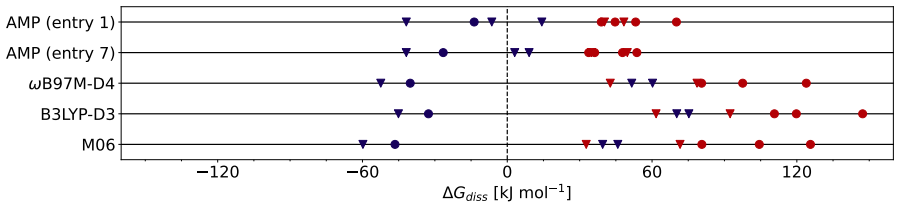
The central claim is that substituting a QM Hamiltonian with the AMP neural network potential in an electrostatic-embedding ML/MM scheme preserves the accuracy of the underlying DFT reference while making long enhanced-sampling molecular dynamics tractable, and that the resulting free energies match experiment. Evidence includes a two-dimensional alanine dipeptide free-energy surface whose minima match DFT and NMR-derived expectations even when the network was trained on only a narrow slice of the torsional space; dissociation free energies for nickel phosphine complexes that rank experimentally mono- and bisligated states correctly, including large complexes absent from the training set; and dissociation free energies for a series of charged pyridine and quinoline dimers with a median absolute error of 2.63 kJ/mol, with static DFT plus implicit solvent off by seven to eleven times more. The paper further shows the approach scales to systems with more than 350 solute atoms embedded in tens of thousands of solvent atoms, and that inference is fast enough to run on a single CPU for small systems.
Load-bearing premise
The central premise is that the DFT reference used for training (B2-PLYP for alanine dipeptide and omegaB97M-D4 for the nickel and pyridine systems), evaluated with fixed MM point charges, is accurate enough to stand in for the experimentally measured free energies once explicit solvent and sampling are included; if that DFT-plus-charges model carries systematic error, the trained network inherits it and so do all three benchmark predictions.
Editorial extensions
If this is right
- For reaction free energies in solution, long enhanced-sampling MD becomes feasible at near-DFT accuracy because the neural network Hamiltonian is cheap enough to evaluate for hundreds of nanoseconds with explicit solvent.
- The same trained model can be applied to chemically related molecules that were absent from the training set, so one training dataset can cover a family of ligands or substituted dimers without per-molecule retraining.
- Static DFT with implicit solvent and semi-empirical QM/MM can be wrong by up to an order of magnitude in free energy and sometimes rank the wrong state; replacing the QM Hamiltonian with the trained network removes most of that error.
- Free-energy differences between bound and unbound states can be computed with median absolute errors around 2-3 kJ/mol, at or below the usual chemical-accuracy threshold of 4.184 kJ/mol.
- The approach extends to transition-metal complexes, charged species, and large ligands where analytical Hessian calculations become impractical, so mechanistic questions that static methods cannot address become accessible.
Reading between the lines
- If the central claim is right, a substantial share of the error in static QM free energies comes from missing sampling and explicit solvent rather than from the DFT functional itself, which suggests that other ML/MM potentials could inherit this accuracy improvement without architectural changes.
- The paper hints that a globally trained foundational potential fine-tuned on a few dozen examples per target could replace per-system training; that is a natural next step the authors describe but do not demonstrate.
- Because the solvent is represented by fixed MM point charges, the method's accuracy is ultimately capped by that point-charge description of the environment; testing a polarizable MM model or a larger QM zone would show whether remaining outliers are due to the embedding or to Lennard-Jones parameters.
- The authors note that a larger network did not meaningfully improve free-energy predictions, which implies that for these observables the DFT label error, not network capacity, may dominate; retraining the same architecture on a different high-level functional would test that interpretation directly.
Signed reviews
Editorial analysis
A structured set of objections, weighed in public.
Referee Report
Summary. The paper presents an extended version of the anisotropic message passing (AMP) neural network architecture for ML/MM simulations with electrostatic embedding, and applies it to compute free energies for three systems: alanine dipeptide conformational sampling, ligation states of nickel phosphine complexes, and dissociation free energies of charged pyridine/quinoline dimers. The model is trained on DFT energies and gradients evaluated in the field of fixed MM point charges, then used as the QM Hamiltonian in umbrella-sampling MD with explicit solvent. The authors report training errors below chemical accuracy, stable trajectories in prospective simulations, and computed free energies that are compared with experimental data and with static DFT/implicit-solvent and GFN2-xTB QM/MM calculations.
Significance. If the claims are validated, the approach is a significant methodological advance: it demonstrates electrostatic-embedding ML/MM simulations of explicitly solvated systems with hundreds of QM atoms over hundreds of nanoseconds, including quantitative free-energy predictions for challenging charged dimers and transition-metal complexes. The paper's strengths include independent experimental benchmarks (NMR ligation states in Ref. [102], experimental dissociation free energies in Ref. [119]) rather than validation only against training labels, explicit discussion of limitations (footnote 4 on the absence of a double-hybrid explicit-solvent ground truth; the LJ-parameter hypothesis for 5b), and releases of training data and code. The experimental agreement provides an independent grounding of the central claim, although the nickel application shows partial misclassifications that temper the 'excellent agreement' wording.
major comments (3)
- [Section 3.2 (Nickel complex application), Figure 7] The abstract's claim of 'excellent agreement with experimental data' is overstated for the nickel phosphine application: two of ten complexes are misclassified by the AMP models (CataCXium A in both entries, CyJohnPhos in entry 7), and the value for Pt-Bu3 is set arbitrarily to 41.84 kJ/mol because the bisligated complex dissociated in simulation. This post hoc assignment directly influences the classification success rate and should not be counted as a quantitative prediction. Please report classification accuracy and confidence intervals on ΔGdiss, treat Pt-Bu3 as a qualitative dissociation event, and either exclude it from numerical error statistics or justify why the arbitrary value is not biasing the conclusion.
- [Section 5.3 and footnote 4] All training labels are DFT energies evaluated in a fixed-charge QM/MM embedding (B2-PLYP/def2-QZVPP for alanine dipeptide; ωB97M-D4/def2-TZVPP for the other systems), with no explicit-solvent CCSD(T)- or double-hybrid-level reference. The experimental benchmarks therefore validate the combined pipeline (DFT reference + explicit solvent + NNP sampling), not the NNP substitution in isolation. This limitation is acknowledged in footnote 4, but the abstract's statement that the NNP has 'the same accuracy' as the QM Hamiltonian should be qualified. A small explicit-solvent high-level benchmark (e.g., a few pyridine dimers at DLPNO-CCSD(T) level) would directly quantify the systematic error of the reference labels and materially strengthen the central claim.
- [Section 2.3.2, Eq. (16)] The expression for the MM-induced multipoles contains a sum over all QM atoms i on the right-hand side for a quantity indexed by i on the left-hand side. As written, the equation suggests a nonlocal polarization term that redistributes multipoles across the entire QM zone, which is inconsistent with the per-atom polarizability description in the text. Please clarify the summation limits (presumably only over MM atoms j for each fixed i) or explain the intended global contribution. This is a technical description that directly affects the reproducibility of the method.
minor comments (5)
- [Section 3.1, Table 2] The comparison between AMP free-energy minima and static B2-PLYP minima mixes two different definitions of 'minimum': free-energy surface local minima from umbrella sampling versus optimized geometries with quasi-RRHO corrections. A direct comparison using the same state definition (e.g., same integration regions on the free-energy surface) would make the quantitative agreement for alanine dipeptide more transparent.
- [Section 3.2, Figure 10] The phrase 'up to ten times higher deviation' for static QM methods is an overstatement; the reported medAE values are about 5-8 times higher than the AMP medAE. Please rephrase to 'roughly five to eight times higher' or provide the maximum ratio explicitly.
- [Section 3.2, discussion after Eq. (19)] The arbitrary assignment of the Pt-Bu3 dissociation free energy is mentioned in a note in the text but should be highlighted in the main body of the results because it is a central caveat for interpreting the nickel classification numbers.
- [Section 2.3.3, Figure 2] The scaling claim O(N^1.24) is based on CPU inference steps per second, while the GPU scaling is described only qualitatively. Please report error bars or confidence intervals for the fitted scaling exponents and specify the system sizes used for each point on the GPU curve.
- [Throughout (Eqs. (6), (14), (15))] There are several formatting artifacts (e.g., 'bracehtipupleft' in Eq. (6), the limits in Eq. (14), and the placement of summation indices in Eq. (15)). Please ensure the equations are typeset cleanly so that the summation ranges and tensor indices are unambiguous.
Circularity Check
No significant circularity: the free-energy predictions are benchmarked against independent experimental datasets (NMR ligation states, experimental dissociation free energies), and the NNP's agreement with its DFT training reference is a fidelity check, not the claimed experimental validation.
full rationale
The paper's derivation chain is: train AMP to reproduce DFT energies and gradients in an electrostatic embedding, then use the trained model as a Hamiltonian in explicit-solvent enhanced-sampling MD, and compare the resulting free energies to experiment. Each leg is externally grounded: the DFT labels are fixed references (B2-PLYP or omegaB97M-D4), not derived from the experimental targets; the free-energy predictions for nickel set 4 and for pyridine/quinoline dimers are checked against independent NMR and thermodynamic data rather than against training labels; and the dissociation free energies are emergent from umbrella-sampling reweighting, not fitted parameters. The main self-citations (AMP architecture, Ref. 14, and prior ML/MM work, Refs. 66-67) are descriptive: the present paper re-implements, modifies, and independently tests the architecture, so no load-bearing claim reduces to a self-citation. The acknowledged limitations (Section 2.2's presupposition that a QM-reference-trained model recovers experiment, and footnote 4's lack of an explicit-solvent double-hybrid ground truth) are accuracy caveats about the DFT proxy, not circular steps. The alanine-dipeptide comparison to B2-PLYP static minima is a consistency check at the training level of theory, but it is supplemented by experimental and literature comparison, so it does not make the central claim circular.
Assumptions & free parameters
free parameters (6)
- QM graph cutoff r_cutoff =
5.0 A
- QM/MM polarization cutoff =
9.0 A (600k) / 10.0 A (2.7M)
- QM/MM electrostatics cutoff =
14.0 A
- Multipole channels =
32 (600k) / 64 (2.7M)
- Loss balancing prefactors =
alpha=0.99, beta=100, gamma=100
- Nickel Lennard-Jones parameters =
epsilon=23.6 kJ/mol, sigma=2.27 A
assumptions (4)
- domain assumption DFT reference energies are an adequate proxy for experimental free energies in solution.
- domain assumption GFN2-xTB biased trajectories cover the configuration space visited by prospective ML/MM sampling.
- domain assumption Classical fixed-charge MM and LJ parameters accurately describe MM and QM-MM non-electrostatic interactions.
- domain assumption WHAM/MBAR reweighting and the chosen bound/unbound definitions give unbiased free energies.
invented entities (1)
-
Learned per-atom polarizability alpha_i and MM-induced multipoles M^k_{i,QM-MM}
Cite this review
Pith. "Pith review of Neural Network Potential with Multi-Resolution Approach Enables Accurate Prediction of Reaction Free Energies in Solution." pith.science (2026). https://pith.science/paper/3X76HQY2
@misc{pith2026241119728,
  author       = {Pith},
  title        = {Pith review of: Neural Network Potential with Multi-Resolution Approach Enables Accurate Prediction of Reaction Free Energies in Solution},
  year         = {2026},
  howpublished = {\url{https://pith.science/paper/3X76HQY2}},
  note         = {Machine review of arXiv:2411.19728}
}
read the original abstract
We present design and implementation of a novel neural network potential (NNP) and its combination with an electrostatic embedding scheme, commonly used within the context of hybrid quantum-mechanical/molecular-mechanical (QM/MM) simulations. Substitution of a computationally expensive QM Hamiltonian by a NNP with the same accuracy largely reduces the computational cost and enables efficient sampling in prospective MD simulations, the main limitation faced by traditional QM/MM set-ups. The model relies on the recently introduced anisotropic message passing (AMP) formalism to compute atomic interactions and encode symmetries found in QM systems. AMP is shown to be highly efficient in terms of both data and computational costs, and can be readily scaled to sample systems involving more than 350 solute and 40'000 solvent atoms for hundreds of nanoseconds using umbrella sampling. The performance and broad applicability of our approach are showcased by calculating the free-energy surface of alanine dipeptide, the preferred ligation states of nickel phosphine complexes, and dissociation free energies of charged pyridine and quinoline dimers. Results with this ML/MM approach show excellent agreement with experimental data. In contrast, free energies calculated with static high-level QM calculations paired with implicit solvent models or QM/MM MD simulations using cheaper semi-empirical methods show up to ten times higher deviation from the experimental ground truth and sometimes even fail to reproduce qualitative trends.
Figures


Figures from the paper (7 more)




Forward citations
Cited by 1 Pith paper
-
NepoIP/MM: Towards Accurate Biomolecular Simulation with a Machine Learning/Molecular Mechanics Model Incorporating Polarization Effects
A machine-learning force field that takes the surrounding electrostatic potential as input reproduces QM/MM-quality peptide dynamics and transfers across water and protein environments.
Reference graph
Works this paper leans on
-
[102]
S. H. Newman-Stonebraker, S. R. Smith, J. E. Borowski, E. Peters, T. Gensch, H. C. Johnson, M. S. Sigman, A. G. Doyle,Science 2021, 374, 301–308
work page 2021
-
[119]
R. Pollice, M. Bot, I. J. Kobylianskii, I. Shenderovich, P. Chen,J. Am. Chem. Soc. 2017, 139, 13126–13140
work page 2017
-
[1]
Vennelakanti, A
V. Vennelakanti, A. Nazemi, R. Mehmood, A. H. Steeves, H. J. Kulik,Curr. Opin. Struct. Biol. 2022, 72, 9–17
2022
-
[2]
Bursch, J
M. Bursch, J. Mewes, A. Hansen, S. Grimme,Angew. Chem. Int. Ed. 2022, 61, e202205735
2022
-
[3]
Seritan, C
S. Seritan, C. Bannwarth, B. S. Fales, E. G. Hohenstein, C. M. Isborn, S. I. L. Kokkila-Schumacher, X. Li, F. Liu, N. Luehr, J. W. Snyder, C. Song, A. V. Titov, I. S. Ufimtsev, L. Wang, T. J. Martínez, Wiley Interdiscip. Rev.: Comput. Mol. Sci. 2020, 11, e1523
2020
-
[4]
Kussmann, H
J. Kussmann, H. Laqua, C. Ochsenfeld,J. Chem. Theory Comput. 2021, 17, 1512–1521
2021
-
[5]
Neese, F
F. Neese, F. Wennmohs, U. Becker, C. Riplinger,J. Chem. Phys. 2020, 152, 224108
2020
-
[6]
Neese, Wiley Interdiscip
F. Neese, Wiley Interdiscip. Rev.: Comput. Mol. Sci. 2022, 12, e1606
2022
Show all 172 references
-
[7]
J. A. Keith, V. Vassilev-Galindo, B. Cheng, S. Chmiela, M. Gastegger, K.-R. Müller, A. Tkatchenko, Chem. Rev. 2021, 121, 9816–9872
2021
-
[8]
O. T. Unke, S. Chmiela, H. E. Sauceda, M. Gastegger, I. Poltavsky, K. T. Schütt, A. Tkatchenko, K.-R. Müller, Chem. Rev. 2021, 121, 10142–10186
2021
-
[9]
Warshel, M
A. Warshel, M. Karplus, J. Am. Chem. Soc. 1972, 94, 5612–5625
1972
-
[10]
Warshel, M
A. Warshel, M. Levitt, J. Mol. Biol. 1976, 103, 227–249
1976
-
[11]
U. C. Singh, P. A. Kollman,J. Comput. Chem. 1986, 7, 718–730
1986
-
[12]
H. M. Senn, W. Thiel, Angew. Chem. Int. Ed. 2009, 48, 1198–1229
2009
-
[13]
Brunk, U
E. Brunk, U. Rothlisberger, Chem. Rev. 2015, 115, 6217–6263
2015
-
[14]
Thürlemann, S
M. Thürlemann, S. Riniker,The Eleventh International Conference on Learning Representations 2023
2023
-
[15]
Bannwarth, S
C. Bannwarth, S. Ehlert, S. Grimme,J. Chem. Theory Comput. 2019, 15, 1652–1671
2019
-
[16]
Bannwarth, E
C. Bannwarth, E. Caldeweyher, S. Ehlert, A. Hansen, P. Pracht, J. Seibert, S. Spicher, S. Grimme, Wiley Interdiscip. Rev.: Comput. Mol. Sci. 2021, 11, e1493
2021
-
[17]
W. Kohn, L. J. Sham, Phys. Rev. 1965, 140, A1133–A1138
1965
-
[18]
Møller, M
C. Møller, M. S. Plesset, Phys. Rev. 1934, 46, 618–622
1934
-
[19]
Riniker, J
S. Riniker, J. Chem. Inf. Model. 2018, 58, 565–578
2018
-
[20]
W. F. van Gunsteren, H. J. C. Berendsen,Angew. Chem. Int. Ed. 1990, 29, 992–1023
1990
-
[21]
Gelpi, A
J. Gelpi, A. Hospital, R. Goñi, M. Orozco,Adv. Appl. Bioinform. Chem. 2015, 37–47
2015
-
[22]
W. F. van Gunsteren, C. Oostenbrink,J. Chem. Inf. Model. 2024, 64, 6281–6304
2024
-
[23]
L. Hu, U. Ryde, J. Chem. Theory Comput. 2011, 7, 2452–2463
2011
-
[24]
Šebesta, V
F. Šebesta, V. Sláma, J. Melcr, Z. Futera, J. V. Burda,J. Chem. Theory Comput. 2016, 12, 3681–3688
2016
-
[25]
A. C. T. van Duin, S. Dasgupta, F. Lorant, W. A. Goddard,J. Phys. Chem. A 2001, 105, 9396–9409
2001
-
[26]
Y. Guo, C. Riplinger, U. Becker, D. G. Liakos, Y. Minenkov, L. Cavallo, F. Neese,J. Chem. Phys. 2018, 148, 011101
2018
-
[27]
J. J. P. Stewart, J. Mol. Model. 2012, 19, 1–32
2012
-
[28]
M. Gaus, Q. Cui, M. Elstner,J. Chem. Theory Comput. 2011, 7, 931–948. 26
2011
-
[29]
Schmid, A
N. Schmid, A. P. Eichenberger, A. Choutko, S. Riniker, M. Winger, A. E. Mark, W. F. van Gunsteren, Eur. Biophys. J. 2011, 40, 843–856
2011
-
[30]
Boothroyd, P
S. Boothroyd, P. K. Behara, O. C. Madin, D. F. Hahn, H. Jang, V. Gapsys, J. R. Wagner, J. T. Horton, D. L. Dotson, M. W. Thompson, J. Maat, T. Gokey, L.-P. Wang, D. J. Cole, M. K. Gilson, J. D. Chodera, C. I. Bayly, M. R. Shirts, D. L. Mobley,J. Chem. Theory Comput. 2023, 19, ...
2023
-
[31]
Behler, J
J. Behler, J. Chem. Phys 2011, 134, 074106
2011
-
[32]
Gilmer, S
J. Gilmer, S. S. Schoenholz, P. F. Riley, O. Vinyals, G. E. Dahl,Proceedings of the 34th International Conference on Machine Learning 2017, 1263–1272
2017
-
[33]
A. P. Bartók, S. De, C. Poelking, N. Bernstein, J. R. Kermode, G. Csányi, M. Ceriotti,Sci. Adv. 2017, 3, e1701816
2017
-
[34]
Chmiela, A
S. Chmiela, A. Tkatchenko, H. E. Sauceda, I. Poltavsky, K. T. Schütt, K.-R. Müller, Sci. Adv. 2017, 3, e1603015
2017
-
[35]
K. T. Schütt, H. E. Sauceda, P.-J. Kindermans, A. Tkatchenko, K.-R. Müller, J. Chem. Phys. 2018, 148, 241722
2018
-
[36]
K. T. Schütt, O. T. Unke, M. Gastegger,Proceedings of the 38th International Conference on Machine Learning 2021, 9377–9388
2021
-
[37]
O. T. Unke, S. Chmiela, M. Gastegger, K. T. Schütt, H. E. Sauceda, K.-R. Müller, Nat. Commun. 2021, 12, 7273
2021
-
[38]
Batzner, A
S. Batzner, A. Musaelian, L. Sun, M. Geiger, J. P. Mailoa, M. Kornbluth, N. Molinari, T. E. Smidt, B. Kozinsky, Nat. Commun. 2022, 13, 2453
2022
-
[39]
Musaelian, S
A. Musaelian, S. Batzner, A. Johansson, L. Sun, C. J. Owen, M. Kornbluth, B. Kozinsky,arXiv 2022, arXiv:2204.05249
2022 arXiv
-
[40]
Batatia, D
I. Batatia, D. P. Kovács, G. N. Simm, C. Ortner, G. Csányi,arXiv 2022, arXiv:2206.07697
2022 arXiv
-
[41]
S. N. Pozdnyakov, M. Ceriotti,arXiv 2022, arXiv:2201.07136
2022 arXiv
-
[42]
T. S. Cohen, M. Welling,Proceedings of The 33rd International Conference on Machine Learning 2016, 2990–2999
2016
-
[43]
Weiler, M
M. Weiler, M. Geiger, M. Welling, W. Boomsma, T. S. Cohen,Adv. Neural Inf. Process Syst. 2018, 31
2018
-
[44]
V. G. Satorras, E. Hoogeboom, M. Welling,2021, 9323–9332
2021
-
[45]
Grisafi, D
A. Grisafi, D. M. Wilkins, M. J. Willatt, M. Ceriotti,Atomic-Scale Representation and Statistical Learning of Tensorial Properties , Chapter 1, pp. 1–21
-
[46]
Thürlemann, L
M. Thürlemann, L. Böselt, S. Riniker,J. Chem. Theory Comput. 2022, 18, 1701–1710
2022
-
[47]
J. A. Rackers, L. Tecot, M. Geiger, T. E. Smidt,Mach. Learn.: Sci. Technol. 2023, 4, 015027
2023
-
[48]
B. K. Miller, M. Geiger, T. E. Smidt, F. Noé,arXiv 2020, arXiv:2008.08461
2020 arXiv
-
[49]
Batatia, S
I. Batatia, S. Batzner, D. P. Kovács, A. Musaelian, G. N. Simm, R. Drautz, C. Ortner, B. Kozinsky, G. Csányi, arXiv 2022, arXiv:2205.06643
2022 arXiv
-
[50]
W. F. van Gunsteren, A. E. Mark,J. Chem. Phys. 1998, 108, 6109–6116
1998
-
[51]
Roßbach, C
S. Roßbach, C. Ochsenfeld, J. Chem. Theory Comput. 2017, 13, 1102–1107
2017
-
[52]
U. Ryde, J. Chem. Theory Comput. 2017, 13, 5745–5752
2017
-
[53]
X. Fu, Z. Wu, W. Wang, T. Xie, S. Keten, R. Gomez-Bombarelli, T. S. Jaakkola,Transact. Mach. Learn. Res. 2023
2023
-
[54]
D. P. Kovács, J. H. Moore, N. J. Browning, I. Batatia, J. T. Horton, V. Kapil, W. C. Witt, I.-B. Magdău, D. J. Cole, G. Csányi,arXiv 2023, arXiv:2312.15211. 27
2023 arXiv
-
[55]
K. T. Schütt, S. S. P. Hessmann, N. W. A. Gebauer, J. Lederer, M. Gastegger,J. Chem. Phys. 2023, 158
2023
-
[56]
R. P. Pelaez, G. Simeon, R. Galvelis, A. Mirarchi, P. Eastman, S. Doerr, P. Thölke, T. E. Markland, G. De Fabritiis,J. Chem. Theory Comput. 2024, 20, 4076–4087
2024
-
[57]
J. S. Smith, O. Isayev, A. E. Roitberg,Chem. Sci. 2017, 8, 3192–3203
2017
-
[58]
Devereux, J
C. Devereux, J. S. Smith, K. K. Huddleston, K. Barros, R. Zubatyuk, O. Isayev, A. E. Roitberg, J. Chem. Theory Comput. 2020, 16, 4192–4202
2020
-
[59]
I. G. Tironi, R. Sperb, P. E. Smith, W. F. van Gunsteren,J. Chem. Phys. 1995, 102, 5451–5459
1995
-
[60]
Eastman, B
P. Eastman, B. P. Pritchard, J. D. Chodera, T. E. Markland,arXiv 2024, arXiv:2406.13112
2024 arXiv
-
[61]
B. A. C. Horta, P. T. Merz, P. F. J. Fuchs, J. Dolenc, S. Riniker, P. H. Hünenberger,J. Chem. Theory Comput. 2016, 12, 3825–3850
2016
-
[62]
O. T. Unke, M. Meuwly, J. Chem. Theory Comput. 2019, 15, 3678–3693
2019
-
[63]
Bereau, R
T. Bereau, R. A. DiStasio, A. Tkatchenko, O. A. von Lilienfeld,J. Chem. Phys. 2018, 148, 241706
2018
-
[64]
Thürlemann, L
M. Thürlemann, L. Böselt, S. Riniker,J. Chem. Theory Comput. 2023, 19, 562–579
2023
-
[65]
Thürlemann, S
M. Thürlemann, S. Riniker, Chem. Sci. 2023, 14, 12661–12675
2023
-
[66]
Böselt, M
L. Böselt, M. Thürlemann, S. Riniker,J. Chem. Theory Comput. 2021, 17, 2641–2658
2021
-
[67]
Hofstetter, L
A. Hofstetter, L. Böselt, S. Riniker,Phys. Chem. Chem. Phys. 2022, 24, 22497–22512
2022
-
[68]
Csizi, M
K.-S. Csizi, M. Reiher, Wiley Interdiscip. Rev.: Comput. Mol. Sci. 2022, e1656
2022
-
[69]
L. W. Chung, W. M. C. Sameera, R. Ramozzi, A. J. Page, M. Hatanaka, G. P. Petrova, T. V. Harris, X. Li, Z. Ke, F. Liu, H.-B. Li, L. Ding, K. Morokuma,Chem. Rev. 2015, 115, 5678–5796
2015
-
[70]
S.-L. J. Lahey, C. N. Rowley,Chem. Sci. 2020, 11, 2362–2368
2020
-
[71]
Galvelis, A
R. Galvelis, A. Varela-Rial, S. Doerr, R. Fino, P. Eastman, T. E. Markland, J. D. Chodera, G. De Fabritiis, J. Chem. Inf. Model. 2023, 63, 5701–5708
2023
-
[72]
K. Song, S. Käser, K. Töpfer, L. I. Vazquez-Salazar, M. Meuwly,J. Chem. Phys. 2023, 159, 024125
2023
-
[73]
Ramakrishnan, P
R. Ramakrishnan, P. O. Dral, M. Rupp, O. A. von Lilienfeld,J. Chem. Theory Comput. 2015, 11, 2087–2096
2015
-
[74]
P. W. Battaglia, J. B. Hamrick, V. Bapst, A. Sanchez-Gonzalez, V. F. Zambaldi, M. Malinowski, A. Tacchetti, D. Raposo, A. Santoro, R. Faulkner, Ç. Gülçehre, H. F. Song, A. J. Ballard, J. Gilmer, G. E. Dahl, A. Vaswani, K. R. Allen, C. Nash, V. Langston, C. Dyer, N. Heess, D. W...
2018 arXiv
- [75]
-
[76]
C. J. Burnham, N. J. English,Int. J. Mol. Sci. 2020, 21, 277
2020
-
[77]
D. Lin, J. Chem. Phys. 2015, 143, 114115
2015
-
[78]
Guenot, P
J. Guenot, P. A. Kollman,J. Comp. Chem. 1993, 14, 295–311
1993
-
[79]
Head-Gordon, M
T. Head-Gordon, M. Head-Gordon, M. J. Frisch, C. Brooks, J. Pople,Int. J. Quantum Chem. 2009, 36, 311–322
2009
-
[80]
Torrie, J
G. Torrie, J. Valleau, J. Comput. Phys. 1977, 23, 187–199
1977
-
[81]
Kästner, Wiley Interdiscip
J. Kästner, Wiley Interdiscip. Rev.: Comput. Mol. Sci. 2011, 1, 932–942
2011
-
[82]
Weigend, R
F. Weigend, R. Ahlrichs, Phys. Chem. Chem. Phys. 2005, 7, 3297–3305
2005
-
[83]
Grimme, J
S. Grimme, J. Chem. Phys. 2006, 124, 034108
2006
-
[84]
Grimme, J
S. Grimme, J. Antony, S. Ehrlich, H. Krieg,J. Chem. Phys. 2010, 132, 154104. 28
2010
-
[85]
Grimme, S
S. Grimme, S. Ehrlich, L. Goerigk,J. Comput. Chem. 2011, 32, 1456–1465
2011
-
[86]
Rubner, C
Y. Rubner, C. Tomasi, L. Guibas,Sixth International Conference on Computer Vision (IEEE Cat. No.98CH36271) 1998
1998
-
[87]
M. R. Shirts, J. D. Chodera,J. Chem. Phys. 2008, 129, 124105
2008
-
[88]
Grdadolnik, S
J. Grdadolnik, S. Golič Grdadolnik, F. Avbelj,J. Phys. Chem. B 2008, 112, 2712–2718
2008
-
[89]
Parchaňský, J
V. Parchaňský, J. Kapitán, J. Kaminský, J. Šebestík, P. Bouř,J. Phys. Chem. Lett. 2013, 4, 2763–2768
2013
-
[90]
Schweitzer-Stenner, Phys
R. Schweitzer-Stenner, Phys. Chem. Chem. Phys. 2023, 25, 11908–11933
2023
-
[91]
S. C. Lovell, I. W. Davis, W. B. Arendall, P. I. W. de Bakker, J. M. Word, M. G. Prisant, J. S. Richardson, D. C. Richardson,Proteins: Struct. Funct. Bioinf. 2003, 50, 437–450
2003
-
[92]
G. d. M. Seabra, R. C. Walker, M. Elstner, D. A. Case, A. E. Roitberg,J. Phys. Chem. A 2007, 111, 5655–5664
2007
-
[93]
Mironov, Y
V. Mironov, Y. Alexeev, V. K. Mulligan, D. G. Fedorov,J. Comput. Chem. 2018, 40, 297–309
2018
-
[94]
Barone, M
V. Barone, M. Cossi, J. Phys. Chem. A 1998, 102, 1995–2001
1998
-
[95]
Grimme, Chem
S. Grimme, Chem. Eur. J. 2012, 18, 9955–9964
2012
-
[96]
GitHub Issue on the Treatment of External Point Charges by xtb, https://github.com/grimme- lab/xtb/issues/820
-
[97]
Kumar, P
A. Kumar, P. R. Arantes, A. Saha, G. Palermo, B. M. Wong,Molecules 2023, 28, 1277
2023
-
[98]
Kubař, K
T. Kubař, K. Welke, G. Groenhof,J. Comput. Chem. 2015, 36, 1978–1989
2015
-
[99]
de Meijere, F
A. de Meijere, F. Diederich, Metal-Catalyzed Cross-Coupling Reactions , Wiley, 2004
2004
-
[100]
J. F. Hartwig, Organotransition Metal Chemistry , University Science Books,2010
2010
-
[101]
C. C. C. Johansson Seechurn, M. O. Kitching, T. J. Colacot, V. Snieckus,Angew. Chem. Int. Ed. 2012, 51, 5062–5085
2012
-
[103]
Z. L. Niemeyer, A. Milo, D. P. Hickey, M. S. Sigman,Nat. Chem. 2016, 8, 610–617
2016
-
[104]
J. E. Borowski, S. H. Newman-Stonebraker, A. G. Doyle,ACS Catal. 2023, 13, 7966–7977
2023
-
[105]
K. D. Vogiatzis, M. V. Polynski, J. K. Kirkland, J. Townsend, A. Hashemi, C. Liu, E. A. Pidko, Chem. Rev. 2018, 119, 2453–2523
2018
-
[106]
Nandy, C
A. Nandy, C. Duan, M. G. Taylor, F. Liu, A. H. Steeves, H. J. Kulik,Chem. Rev. 2021, 121, 9927–10000
2021
-
[107]
Bursch, A
M. Bursch, A. Hansen, P. Pracht, J. T. Kohn, S. Grimme,Phys. Chem. Chem. Phys. 2021, 23, 287–299
2021
-
[108]
T. J. Giese, J. Zeng, L. Lerew, E. McCarthy, Y. Tao, c. Ekesan, D. M. York,J. Phys. Chem. B 2024, 128, 6257–6271
2024
-
[109]
D. G. Brown, J. Boström, J. Med. Chem. 2015, 59, 4443–4458
2015
-
[110]
Mardirossian, M
N. Mardirossian, M. Head-Gordon, J. Chem. Phys. 2016, 144, 214110
2016
-
[111]
Najibi, L
A. Najibi, L. Goerigk, J. Comput. Chem. 2020, 41, 2562–2572
2020
-
[112]
Caldeweyher, C
E. Caldeweyher, C. Bannwarth, S. Grimme,J. Chem. Phys. 2017, 147, 034112
2017
-
[113]
Caldeweyher, S
E. Caldeweyher, S. Ehlert, A. Hansen, H. Neugebauer, S. Spicher, C. Bannwarth, S. Grimme,J. Chem. Phys. 2019, 150, 154122
2019
-
[114]
Santra, J
G. Santra, J. M. L. Martin,AIP Conference Proceedings 2019, 2186, 030004
2019
-
[115]
Grimme, Angew
S. Grimme, Angew. Chem. Int. Ed. 2013, 52, 6306–6312. 29
2013
-
[116]
A. V. Marenich, C. J. Cramer, D. G. Truhlar,J. Phys. Chem. B 2009, 113, 6378–6396
2009
-
[117]
Peverati, D
R. Peverati, D. G. Truhlar,J. Phys. Chem. Lett. 2012, 3, 117–124
2012
-
[118]
M. A. Iron, T. Janes, J. Phys. Chem. A 2019, 123, 3761–3781
2019
-
[120]
J. S. Hub, B. L. de Groot, H. Grubmüller, G. Groenhof,J. Chem. Theory Comput. 2014, 10, 381–390
2014
-
[121]
Klamt, Wiley Interdiscip
A. Klamt, Wiley Interdiscip. Rev.: Comput. Mol. Sci. 2011, 1, 699–709
2011
-
[122]
Y. Zhao, D. G. Truhlar,Theor. Chem. Acc. 2008, 120, 215–241
2008
-
[123]
Katzberger, S
P. Katzberger, S. Riniker, Chem. Sci. 2024, 15, 10794–10802
2024
-
[124]
Paszke, S
A. Paszke, S. Gross, F. Massa, A. Lerer, J. Bradbury, G. Chanan, T. Killeen, Z. Lin, N. Gimelshein, L. Antiga, A. Desmaison, A. Köpf, E. Yang, Z. DeVito, M. Raison, A. Tejani, S. Chilamkurthy, B. Steiner, L. Fang, J. Bai, S. Chintala,arXiv 2019, arXiv:1912.01703
2019 arXiv
-
[125]
K. He, X. Zhang, S. Ren, J. Sun,2015 IEEE International Conference on Computer Vision (ICCV) 2015, 1026–1034
2015
- [126]
-
[127]
D. P. Kingma, J. Ba,arXiv 2017, arXiv:1412.6980
2017 arXiv
- [128]
-
[129]
Schmid, C
N. Schmid, C. D. Christ, M. Christen, A. P. Eichenberger, W. F. Van Gunsteren,Comput. Phys. Commun. 2012, 183, 890–903
2012
-
[130]
Meier, N
K. Meier, N. Schmid, W. F. Van Gunsteren,J. Comput. Chem. 2012, 33, 2108–2117
2012
-
[131]
Poliak, P
P. Poliak, P. Bleiziffer, F. Pultar, S. Riniker, C. Oostenbrink,J. Comput. Chem. 2024, accepted
2024
-
[132]
Landrum, P
G. Landrum, P. Tosco, B. Kelley, Ric, D. Cosgrove, sriniker, gedeck, R. Vianello, NadineSchneider, E. Kawashima, D. N, G. Jones, A. Dalke, B. Cole, M. Swain, S. Turk, AlexanderSavelyev, A. Vaucher, M. Wójcikowski, I. Take, D. Probst, K. Ujihara, V. F. Scalfani, guillaume godin...
2023
-
[133]
Riniker, G
S. Riniker, G. A. Landrum, J. Chem. Inf. Model. 2015, 55, 2562–2574
2015
-
[134]
S. Wang, J. Witek, G. A. Landrum, S. Riniker,J. Chem. Inf. Model. 2020, 60, 2044–2058
2020
-
[135]
Chemcraft - Graphical Software for Visualization of Quantum Chemistry Computations , version 1.8, build 682
-
[136]
A. K. Malde, L. Zuo, M. Breeze, M. Stroet, D. Poger, P. C. Nair, C. Oostenbrink, A. E. Mark,J. Chem. Theory Comput. 2011, 7, 4026–4037
2011
-
[137]
K. B. Koziara, M. Stroet, A. K. Malde, A. E. Mark,J. Comput. Aided Mol. Des. 2014, 28, 221–233
2014
-
[138]
Heinz, R
H. Heinz, R. A. Vaia, B. L. Farmer, R. R. Naik,J. Phys. Chem. C 2008, 112, 17281–17290
2008
-
[139]
S. Nosé, J. Chem. Phys. 1984, 81, 511–519
1984
-
[140]
W. G. Hoover, Phys. Rev. A 1985, 31, 1695–1697
1985
-
[141]
H. J. C. Berendsen, J. P. M. Postma, W. F. van Gunsteren, A. DiNola, J. R. Haak,J. Chem. Phys. 1984, 81, 3684–3690
1984
-
[142]
Rumble, T
J. Rumble, T. Bruno, M. Doa,CRC Handbook of Chemistry and Physics , CRC Press,2023
2023
-
[143]
Ryckaert, G
J.-P. Ryckaert, G. Ciccotti, H. J. Berendsen,J. Comput. Phys. 1977, 23, 327–341
1977
-
[144]
Bakowies, W
D. Bakowies, W. Thiel, J. Phys. Chem. 1996, 100, 10580–10594
1996
-
[145]
H. J. C. Berendsen, J. P. M. Postma, W. F. van Gunsteren, J. Hermans inIntermolecular Forces, Springer Netherlands, 1981, pp. 331–342. 30
1981
-
[146]
N. D. Mermin, Phys. Rev. 1965, 137, A1441–A1443
1965
-
[147]
Feyereisen, G
M. Feyereisen, G. Fitzgerald, A. Komornicki,Chem. Phys. Lett. 1993, 208, 359–363
1993
-
[148]
Neese, F
F. Neese, F. Wennmohs, A. Hansen, U. Becker,Chem. Phys. 2009, 356, 98–109
2009
-
[149]
Weigend, Phys
F. Weigend, Phys. Chem. Chem. Phys. 2006, 8, 1057
2006
-
[150]
A. D. Becke, J. Chem. Phys. 1993, 98, 5648–5652
1993
-
[151]
W. Kohn, A. D. Becke, R. G. Parr,J. Phys. Chem. 1996, 100, 12974–12980
1996
-
[152]
C. Lee, W. Yang, R. G. Parr,Phys. Rev. B 1988, 37, 785–789
1988
-
[153]
Ditchfield, W
R. Ditchfield, W. J. Hehre, J. A. Pople,J. Chem. Phys. 1971, 54, 724–728
1971
-
[154]
P. C. Hariharan, J. A. Pople,Theor. Chim. Acta 1973, 28, 213–222
1973
-
[155]
M. M. Francl, W. J. Pietro, W. J. Hehre, J. S. Binkley, M. S. Gordon, D. J. DeFrees, J. A. Pople, J. Chem. Phys. 1982, 77, 3654–3665
1982
-
[156]
W. J. Hehre, R. Ditchfield, J. A. Pople,J. Chem. Phys. 1972, 56, 2257–2261
1972
-
[157]
M. Dolg, U. Wedig, H. Stoll, H. Preuss,J. Chem. Phys. 1987, 86, 866–872
1987
-
[158]
J. M. L. Martin, A. Sundermann,J. Chem. Phys. 2001, 114, 3408–3420
2001
-
[159]
B. P. Pritchard, D. Altarawy, B. Didier, T. D. Gibson, T. L. Windus,J. Chem. Inf. Model. 2019, 59, 4814–4820
2019
-
[160]
Feller, J
D. Feller, J. Comput. Chem. 1996, 17, 1571–1586
1996
-
[161]
K. L. Schuchardt, B. T. Didier, T. Elsethagen, L. Sun, V. Gurumoorthi, J. Chase, J. Li, T. L. Windus, J. Chem. Inf. Model. 2007, 47, 1045–1052
2007
-
[162]
A. P. Eichenberger, J. R. Allison, J. Dolenc, D. P. Geerke, B. A. C. Horta, K. Meier, C. Oostenbrink, N. Schmid, D. Steiner, D. Wang, W. F. van Gunsteren,J. Chem. Theory Comput. 2011, 7, 3379–3390
2011
-
[163]
Kumar, J
S. Kumar, J. M. Rosenberg, D. Bouzida, R. H. Swendsen, P. A. Kollman,J. Comput. Chem. 1992, 13, 1011–1021
1992
-
[164]
Grossfield, WHAM: The Weighted Histogram Analysis Method , version 2.0.11
A. Grossfield, WHAM: The Weighted Histogram Analysis Method , version 2.0.11
-
[165]
Efron in Breakthroughs in Statistics , Springer New York,1992, pp
B. Efron in Breakthroughs in Statistics , Springer New York,1992, pp. 569–593
1992
-
[166]
D. R. Herschbach, H. S. Johnston, D. Rapp,J. Chem. Phys. 1959, 31, 1652–1661
1959
-
[167]
Boresch, F
S. Boresch, F. Tettinger, M. Leitgeb, M. Karplus,J. Phys. Chem. B 2003, 107, 9535–9551
2003
-
[168]
M. R. Shirts, D. L. Mobley, S. P. Brown inDrug Design, Cambridge University Press,2010, pp. 61–86
2010
-
[169]
Y. Deng, B. Roux, J. Phys. Chem. B 2009, 113, 2234–2246
2009
-
[170]
I. J. General, J. Chem. Theory Comput. 2010, 6, 2520–2524
2010
-
[171]
Flamary, N
R. Flamary, N. Courty, A. Gramfort, M. Z. Alaya, A. Boisbunon, S. Chambon, L. Chapel, A. Corenflos, K. Fatras, N. Fournier, L. Gautheron, N. T. Gayraud, H. Janati, A. Rakotomamonjy, I. Redko, A. Rolet, A. Schutz, V. Seguy, D. J. Sutherland, R. Tavenard, A. Tong, T. Vayer,J. Ma...
2021
-
[172]
van der Walt, J
S. van der Walt, J. L. Schönberger, J. Nunez-Iglesias, F. Boulogne, J. D. Warner, N. Yager, E. Gouillart, T. Yu, the scikit-image contributors,PeerJ 2014, 2, e453. 31
2014
Reviewed August 12, 2026 · model on record in the stance chip above.
Discussion (0). Continue with ORCID to comment.