REVIEW 3 major objections 5 minor 76 references
Semiclassical Backreaction: A Qualitative Assessment
T0 review · 3 major / 5 minor · reviewed 2026-08-12 · deepseek-v4-flash
Pith's one-line read In a two-oscillator toy model with biquadratic coupling, both the mean-field and truncated Wigner approximations extend the time for which a classical background description matches full quantum evolution, and which method works better is…
desk verdict A clean, honest benchmark of mean-field versus truncated Wigner backreaction in a two-oscillator toy model, with the caveat that the unstable-regime comparison may be measuring dephasing of a delocalized wavefunction rather than true semiclassical validity. read the letter →
The pith
A machine-rendered reading of the paper's core claim, the machinery that carries it, and where it could break.
The reading
What carries the argument
The load-bearing object is the classical stability analysis of the background: linearizing the $y$ oscillator around $x = x_0 \cos t$ gives the Mathieu equation $\delta\ddot{y} + [(\Omega/\omega)^2 + \lambda x_0^2 \cos^2 t]\,\delta y = 0$, whose instability bands are centered at $\lambda x_0^2 = 2(n^2 - (\Omega/\omega)^2)$. The paper uses these bands to organize the entire parameter scan: quantum and semiclassical break times drop near the bands because the interaction rapidly entangles $x$ and $y$. The two semiclassical schemes are the mean-field equations, in which $x$ couples to $|z|^2 = \langle \hat{y}^2 \rangle$, and the truncated Wigner ensemble, in which $y$ and $p_y$ are sampled from the initial Wigner distribution and each pair is evolved classically before averaging over realizations. The comparison is made quantitative by the integrated relative error $\delta(t)$ and by the threshold $0.05$ that defines the break times.
What would settle it
Compute the reduced density matrix of $x$ in an unstable parameter region such as $\lambda = 0.1$, $x_0 = 5$, $\Omega/\omega = 0.4$, and test whether the $x$ probability density becomes bimodal or its purity collapses before the truncated Wigner break time; if the background becomes multi-modal before the claimed break time, then the benchmark $\langle \hat{x}(t) \rangle$ itself is not a classical trajectory and the break-time comparison would need to be re-evaluated.
Extended reading notes
Core claim
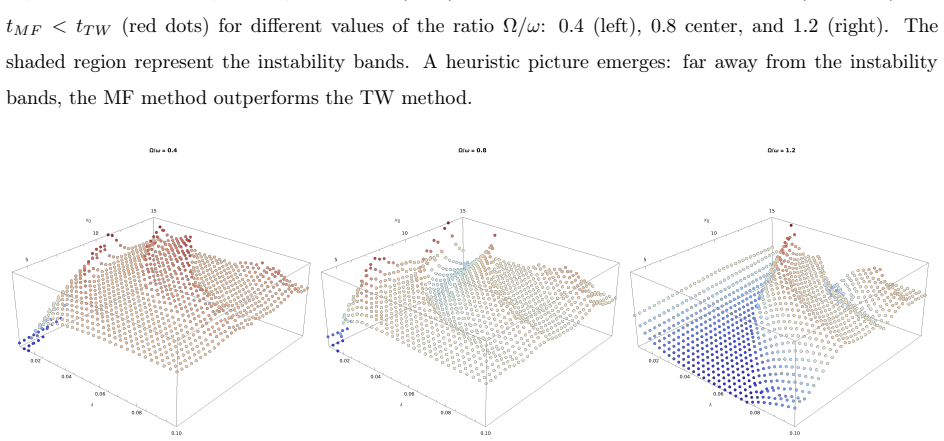
On the paper's own terms, the central result is an assessment rather than a theorem: in the parameter range studied, the semiclassical break times $t_{\mathrm{MF}}$ and $t_{\mathrm{TW}}$ both exceed the quantum break time $t_q$, meaning each method extends the time over which $x(t)$ is a good classical stand-in by a measurable amount. Generically $t_{\mathrm{MF}} > t_{\mathrm{TW}}$ for parameters lying away from the classical instability bands of the Mathieu equation, sometimes by orders of magnitude, while inside the bands $t_{\mathrm{TW}} > t_{\mathrm{MF}}$ but only marginally. For classically stable parameters and weak collective coupling, the mean-field method reproduces the full quantum evolution essentially exactly at the perturbative level, including the frequency shift $\lambda \omega/4\Omega$, whereas truncated Wigner eventually dissipates the amplitude because its random phases decorrelate. The paper reads these patterns through the lens of entanglement: instability bands generate strong entanglement, and strong entanglement shortens every break time and reverses the ranking of the two methods.
Load-bearing premise
The comparison assumes that the expectation value $\langle \hat{x}(t) \rangle$ from the full quantum simulation is a faithful description of the classical background, which holds only while the $x$ wavefunction stays localized and approximately monomodal; the authors check this for some parameter choices but do not establish it rigorously, especially in the strongly entangled unstable regimes where the qualitative conclusions matter most.
Editorial extensions
If this is right
- In the two-oscillator model, both semiclassical methods give $t_{\mathrm{MF}}, t_{\mathrm{TW}} > t_q$ generically, so even approximate backreaction is better than no backreaction for describing the background.
- Far from instability bands, the mean-field method is generally more accurate than truncated Wigner, sometimes by orders of magnitude, and for weak collective coupling it reproduces the full quantum evolution including the frequency shift.
- Inside instability bands, both methods fail sooner, but truncated Wigner performs marginally better and is the only one of the two that captures the dissipative decay of the background amplitude.
- Break-time scaling with occupation number $N$ changes from linear to logarithmic when the system is classically unstable, showing that classical instability spoils the standard quantum break-time heuristic.
- In the cosmological setting that motivates the model, the results indicate that truncated Wigner is the appropriate semiclassical method for parametric-resonance-driven preheating, while a mean-field approach should be more suitable for the stable analogue, reheating.
Reading between the lines
- A practical decision rule is implicit in the results: scan the classical stability bands of the background first, then choose the mean-field method far from resonance and truncated Wigner near resonance; this could save considerable computational cost in applications.
- The failure mechanism suggests that entanglement entropy, not just the break-time error, could serve as a predictive diagnostic: break times appear to shrink as entanglement grows, and tracking both quantities together might give an early warning of semiclassical breakdown.
- The three-mode extension in the paper hints that in field theory a single unstable resonant mode may be enough to shorten global semiclassical break times, but whether many stable modes can wash out that effect remains an open question that could be tested by adding more modes numerically.
- The authors' 'amusing side project' of inverting the logic---designing interactions that classicalize a quantum state---is a concrete testable extension: one could search for Hamiltonians under which a highly excited number state evolves into a coherent state, which would clarify the boundaries of the backreaction picture.
Editorial analysis
A structured set of objections, weighed in public.
Referee Report
Summary. The paper examines two semiclassical backreaction schemes, the mean-field (MF) approximation and the stochastic truncated Wigner (TW) method, in a toy model of two bi-quadratically coupled harmonic oscillators. The authors compare the background expectation value ⟨x̂(t)⟩ obtained from a fully quantum Schrödinger evolution with the predictions of the two semiclassical methods, defining semiclassical break times via an L1 error functional. They map break times over parameter space and relate their qualitative findings to the stability structure of the Mathieu equation and to the entanglement entropy between the two oscillators. The central claims are that both methods generically extend the validity of a classical description beyond the purely classical solution, that MF is more accurate far from classical instability bands, and that TW performs somewhat better inside the instability bands while capturing dissipative amplitude decay.
Significance. If the central claims hold, the paper would provide a valuable quantitative benchmark for semiclassical backreaction methods used widely in cosmology and quantum field theory, where fully quantum computations are usually unavailable. The paper has clear strengths: Appendix A gives a clean analytic demonstration that MF reproduces the weak-coupling frequency shift while TW necessarily dephases; Appendix C documents convergence tests and energy conservation for the Schrödinger solver; and the break-time definition is explicit and used consistently across parameter scans. The work also advances a falsifiable heuristic linking method performance to entanglement and classical instability. However, the significance of the unstable-regime conclusions is conditional on the validity of ⟨x̂(t)⟩ as a proxy for a classical background, and the authors explicitly acknowledge in Sec. V that this validity is questionable exactly in the regimes where their sharpest conclusions are drawn.
major comments (3)
- [Sec. V] The central comparison in Sec. IV uses Eq. (16), which measures the L1 distance from the full quantum expectation value ⟨x̂(t)⟩. The manuscript itself states in Sec. V that this quantity is a valid benchmark only while ψ(x,y) is well localized and approximately monomodal in x, and that only a partial Gaussianity check was performed. In the unstable-regime cases of Table I (e.g., λ=0.1, x0=5, Ω/ω=0.4), the entanglement entropy at t=25 is S_e≈1.86 while the reported MF break time is t_MF=9 and the TW break time is t_TW=17; such a large entropy indicates a highly mixed x marginal, so ⟨x̂⟩ may cease to represent any single classical background before t_TW. Consequently, the claim that TW outperforms MF inside instability bands is not yet established as a statement about the validity of a classical description of x; the L1 metric may instead reward whichever method best tracks the centroid of a delocalized wavefunction. I recommend computing a quantitative localization diagnostic for the x marginal (e.g., the variance or inverse participation ratio of the position distribution, or a time-dependent Gaussianity measure) and reporting whether the benchmark remains classically meaningful up to the claimed break times.
- [Sec. IV, Fig. 1] The interpretation that TW captures dissipative amplitude decay in unstable cases rests on the same benchmark. The decay of ⟨x̂(t)⟩ in the right panels of Fig. 1 can originate either from genuine dissipation of a localized background or from phase randomization across a broad or multimodal x distribution. Without monitoring the x probability density, the apparent agreement of x_TW(t) with ⟨x̂(t)⟩ does not demonstrate that TW gives the correct classical background trajectory. Please add explicit evidence on localization of the x marginal (for example, snapshots of the x probability density at representative times or a time-dependent Gaussianity measure) before making the dissipation claim.
- [Table I] The entanglement entropy S_e in Table I is evaluated at the fixed fiducial time t=25 for all parameter sets, while the reported break times for the unstable cases are much shorter (e.g., t_MF=9 and t_TW=17 for the first row). This makes the stated causal ordering 'unstable modes result in larger entanglement, which in turn reduces the break times' difficult to assess, because S_e at t=25 is evaluated after one or both semiclassical methods have already broken down. Reporting S_e at the respective break times, or plotting S_e(t) for each row, would provide direct support for the proposed link between entanglement growth and break-time reduction.
minor comments (5)
- [Sec. IV / Fig. 2-4 captions] The text states that the instability bands shown in the figures are the shifted bands with n^2 → n^2(1+λω/4Ω)^2, but the captions refer only to Eq. (18). Please state the shift explicitly in the captions to avoid ambiguity.
- [Sec. III.A.2] The TW variant fixes the x initial conditions while sampling y and p_y; this is a nontrivial modification of the standard TW prescription. The text says it 'corresponds to the assumption of classicality for the x degree of freedom,' but a brief discussion of the range of validity or prior use of this variant would help.
- [Eqs. (21)-(22)] The heuristic formulas for t_MF and t_TW involve α, β, 'Entanglement', and 'Diffusion', none of which are defined quantitatively. Since the text itself describes them as schematic, a sentence indicating how (if at all) these quantities could be extracted from the numerics would improve reproducibility.
- [Sec. IV, threshold choice] The paper asserts that qualitative conclusions are insensitive to the 0.05 threshold, but no threshold-scan result is shown. A supplementary plot varying the threshold for a prototypical parameter point would make this assertion verifiable.
- [Appendix A.3] Typographical issues: the heading 'Trunctated Wigner' should be 'Truncated Wigner'; Sec. I contains 'ocurrences' and 'an a posteriori'; footnote 7 contains 'bonna fide' instead of 'bona fide'.
Circularity Check
No significant circularity: the semiclassical methods are benchmarked against an independent Schrödinger-equation solution.
full rationale
The central claim, that mean-field and truncated-Wigner methods extend the useful classical description of x beyond the quantum break time, is benchmarked against a fully quantum mechanical solution of the Schrödinger equation. The break-time definition in Eq. (16) compares each semiclassical x(t) and the classical solution x_cl(t) to the independently computed expectation value ⟨x̂(t)⟩; no parameter of either semiclassical method is fitted to that benchmark, and neither method's equations are derived from the quantity being predicted. The mean-field equations (10)-(11) and the truncated-Wigner sampling of Eq. (12) followed by classical evolution of Eqs. (7)-(8) are standard implementations, and no uniqueness theorem or ansatz is imported from the authors' prior work to force the comparison. The self-citations to Refs. [43,44] are background formalism citations for the mean-field method, not load-bearing evidence for the numerical results, and the perturbative analysis in Appendix A follows Ref. [66] as an independent consistency check. The heuristic formulas (21)-(22) are explicitly schematic and are not used to generate any figure. The paper's own stated limitation, that ⟨x̂(t)⟩ is only a faithful classical-background proxy while the x wavefunction remains localized and approximately monomodal, is a validity caveat rather than a circularity: it concerns whether the chosen benchmark is physically interpretable in the unstable regime, which is a correctness risk, not an identification of the prediction with the input. Because the comparisons are self-contained against an external numerical benchmark and no central step reduces to a fit or to a self-citation chain, the circularity score is 0.
Assumptions & free parameters
free parameters (2)
- break-time threshold =
0.05
- entanglement entropy truncation m_max =
28
assumptions (6)
- domain assumption The two-oscillator model is a faithful minisuperspace reduction of the two-field Lagrangian (1).
- domain assumption The initial wavefunction (6), a displaced coherent state for x and zeroth-order adiabatic vacuum for y, is the correct semiclassical state to order lambda.
- domain assumption The quantum expectation value of x is a valid classical variable for assessing method accuracy.
- domain assumption Classical parametric instability of the Mathieu equation (17) controls the growth of quantum entanglement and hence break times.
- standard math Standard properties of Glauber coherent states and Wick factorization for the initial state.
- standard math The instability bands of the Mathieu equation are given by lambda x0^2 = 2(n^2 - (Omega/omega)^2).
Cite this review
Pith. "Pith review of Semiclassical Backreaction: A Qualitative Assessment." pith.science (2026). https://pith.science/paper/YW5SHMHT
@misc{pith2026241119825,
  author       = {Pith},
  title        = {Pith review of: Semiclassical Backreaction: A Qualitative Assessment},
  year         = {2026},
  howpublished = {\url{https://pith.science/paper/YW5SHMHT}},
  note         = {Machine review of arXiv:2411.19825}
}
read the original abstract
The backreaction of quantum degrees of freedom on classical backgrounds is a poorly understood topic in theoretical physics. Most often it is treated within the semiclassical approximation with the help of various ad hoc prescriptions accounting for the effect of quantum excitations on the dynamics of the background. We focus on two popular ones: (i) the mean-field approximation whereby quantum degrees of freedom couple to the classical background via their quantum expectation values; (ii) the (stochastic) Truncated Wigner method whereby the fully coupled system is evolved using classical equations of motion for various randomly sampled initial conditions of the quantum degree of freedom, and a statistical average is performed a posteriori. We evaluate the performance of each method in a simple toy model against a fully quantum mechanical treatment, and identify its regime of validity. We interpret the results in terms of quantum entanglement and loss of classicality of the background.
Figures


Figures from the paper (6 more)




Reference graph
Works this paper leans on
-
[1]
Quantum Mechanics As discussed at the beginning of the section, the Schrödinger picture state att = 0 is prepared in such a way that its wavefunction can be written (to first-order inλ) as ψ0(x, y) = N0e−(x−x0)2/2e−((Ω/ω)2+λx2 0) 1/2 y2/2, (6) where N0 is a normalization factor. This corresponds to the tensor product of a coherent state with a large occup...
-
[2]
Semiclassical approximations The starting point of any semiclassical method is the classical equations of motion stemming from Hamiltonian (5), ¨x + 1 + λy2 x = 0, (7) ¨y + h (Ω/ω)2 + λx2 i y = 0. (8) As mentioned in Sec. II and at the beginning of Sec. III, we have prepared our quantum system in such a way that its dynamics yield ⟨ˆx(t)⟩ = x0 cos t and ⟨...
-
[3]
Mean Field approximation While keepingx classical we promotey to a quantum operatorˆy. Working in the Heisenberg picture we can expand it as ˆy(t) = z(t)ˆa† + z∗(t)ˆa, where the creation and annihilation operators are defined with respect to the initial adiabatic ground state such thatˆa |0⟩ = 0 (see Refs. [43, 44] for details). The dynamics of the comple...
-
[4]
Truncated Wigner method: 12 The Wigner function of our initial state (6) is given by W0(x, y, px, py) = 1 π Z dx′dy′ψ∗ 0(x + x′, y+ y′)ψ0(x − x′, y− y′)e2i(pxx′+pyy′) = N 2 0 e−(x−x0)2 e−p2 xe−((Ω/ω)2+λx2 0) 1/2 y2 e−((Ω/ω)2+λx2 0) −1/2 p2 y , (12) and can be interpreted as a joint probability distribution for the initial phase space variables of our syst...
-
[5]
Measure of correctness and semiclassical break time Each of the two semiclassical methods described above gives a value forx(t). We would like to know at what point in time this value deviates significantly from the true value,⟨ˆx(t)⟩, obtained by evolving the wavefunction with the Schrödinger equation. For this purpose, we first need to introduce an appr...
work page 2021
-
[6]
Quantum Mechanics In this derivation, we closely follow Ref. [66]. We start by writing the quantum state of the coupled system as |ψ⟩ = ∞X n,m=0 cn,m(t)fn(t) |n⟩x |m⟩y , (A1) 26 where |n⟩x and |m⟩y are eigenstates of the free Hamiltonians forx and y in Eq. (5) respectively. The functions fn(t) are introduced for future convenience and correspond to the ex...
-
[7]
(10) and (11) and we wish to find a perturbative solution with the appropriate initial conditions
Mean-Field The MF equations of motion are Eqs. (10) and (11) and we wish to find a perturbative solution with the appropriate initial conditions. Previously, we saw that in the limit of small couplings, the main correction to the classical solutionx(t) = x0 cos t was a change in the frequency, proportional to λ. With this in mind, we perform a two-timing ...
-
[8]
T runctated Wigner It is significantly more difficult to derive an analytic estimate for the results of the TW method. However, here we will argue that after some time it will necessarily deviate from the weak collective coupling behavior of quantum mechanics. The best way to see this is to inspect one of the many classical realizations obtained in the TW...
Show all 76 references
-
[9]
Gerlach and O
W. Gerlach and O. Stern, Der experimentelle nachweis der richtungsquantelung im magnetfeld, Zeitschrift für Physik9, 349–352 (1922)
1922
-
[10]
ZEEMAN, The effect of magnetisation on the nature of light emitted by a substance, Nature55, 347–347 (1897)
P. ZEEMAN, The effect of magnetisation on the nature of light emitted by a substance, Nature55, 347–347 (1897)
-
[11]
Stark, Beobachtungen über den effekt des elektrischen feldes auf spektrallinien
J. Stark, Beobachtungen über den effekt des elektrischen feldes auf spektrallinien. i. quereffekt, Annalen der Physik 348, 965–982 (1914)
1914
-
[12]
Mandel and E
L. Mandel and E. Wolf,Optical Coherence and Quantum Optics(Cambridge University Press, 1995)
1995
-
[13]
Grynberg, A
G. Grynberg, A. Aspect, and C. Fabre, Introduction to Quantum Optics: From the Semi-classical Approach to Quantized Light(Cambridge University Press, 2010)
2010
-
[14]
Schwinger, On gauge invariance and vacuum polarization, Phys
J. Schwinger, On gauge invariance and vacuum polarization, Phys. Rev.82, 664 (1951)
1951
-
[15]
C. J. Pethick and H. Smith,Bose–Einstein Condensation in Dilute Gases, 2nd ed. (Cambridge Univer- sity Press, 2008)
2008
-
[16]
Rajaraman, Solitons and Instantons: An Introduction to Solitons and Instantons in Quantum Field Theory, North-Holland personal library (North-Holland Publishing Company, 1982)
R. Rajaraman, Solitons and Instantons: An Introduction to Solitons and Instantons in Quantum Field Theory, North-Holland personal library (North-Holland Publishing Company, 1982)
1982
-
[17]
S. R. Coleman, Q-balls, Nucl. Phys. B262, 263 (1985), [Addendum: Nucl.Phys.B 269, 744 (1986)]
1985
-
[18]
R. F. Dashen, B. Hasslacher, and A. Neveu, Nonperturbative Methods and Extended Hadron Models 34 0 20 40 60 80 10010-7 10-6 10-5 10-4 0.001 time x ΔH Figure 9. The degree of conservation of the expectation value ofH for the benchmark simulations of the previous three choices o...
1974
-
[19]
R. F. Dashen, B. Hasslacher, and A. Neveu, Nonperturbative Methods and Extended Hadron Models in Field Theory 2. Two-Dimensional Models and Extended Hadrons, Phys. Rev. D10, 4130 (1974)
1974
-
[20]
R. F. Dashen, B. Hasslacher, and A. Neveu, The Particle Spectrum in Model Field Theories from Semiclassical Functional Integral Techniques, Phys. Rev. D11, 3424 (1975)
1975
-
[21]
M. P. Hertzberg, Quantum radiation of oscillons, Physical Review D82, 10.1103/physrevd.82.045022 (2010)
2010 doi
-
[22]
Tranberg and D
A. Tranberg and D. J. Weir, On the quantum stability of q-balls, Journal of High Energy Physics2014, 10.1007/jhep04(2014)184 (2014)
2014 doi
-
[23]
N. D. Birrell and P. C. W. Davies, Quantum Fields in Curved Space, Cambridge Monographs on Mathematical Physics (Cambridge University Press, Cambridge, UK, 1982)
1982
-
[24]
L. H. Ford, Gravitational Particle Creation and Inflation, Phys. Rev. D35, 2955 (1987)
1987
-
[25]
L. H. Ford, Cosmological particle production: a review, Reports on Progress in Physics84, 116901 (2021)
2021
-
[26]
S. W. Hawking, Black hole explosions, Nature248, 30 (1974)
1974
-
[27]
S. W. Hawking, Particle Creation by Black Holes, Commun. Math. Phys.43, 199 (1975), [Erratum: Commun.Math.Phys. 46, 206 (1976)]
1975
-
[28]
Braden, M
J. Braden, M. C. Johnson, H. V. Peiris, A. Pontzen, and S. Weinfurtner, New semiclassical picture of vacuum decay, Physical Review Letters123, 10.1103/physrevlett.123.031601 (2019)
2019 doi
-
[29]
D. G. Figueroa, A. Florio, F. Torrenti, and W. Valkenburg, The art of simulating the early universe. part i. integration techniques and canonical cases, Journal of Cosmology and Astroparticle Physics 35 2021 (04), 035
2021
-
[30]
G. W. Ford, J. T. Lewis, and R. F. O’Connell, Quantum Langevin equation, Phys. Rev. A37, 4419 (1988)
1988
-
[31]
B. L. Hu and A. Matacz, Back reaction in semiclassical cosmology: The Einstein-Langevin equation, Phys. Rev. D51, 1577 (1995), arXiv:gr-qc/9403043
1995 arXiv
-
[32]
J. R. Klauder, Coherent State Langevin Equations for Canonical Quantum Systems With Applications to the Quantized Hall Effect, Phys. Rev. A29, 2036 (1984)
1984
-
[33]
Goldstone, A
J. Goldstone, A. Salam, and S. Weinberg, Broken symmetries, Phys. Rev.127, 965 (1962)
1962
-
[34]
J. F. Donoghue, General relativity as an effective field theory: The leading quantum corrections, Phys. Rev. D 50, 3874 (1994), arXiv:gr-qc/9405057
1994 arXiv
-
[35]
Calzetta and B
E. Calzetta and B. L. Hu, Closed Time Path Functional Formalism in Curved Space-Time: Application to Cosmological Back Reaction Problems, Phys. Rev. D35, 495 (1987)
1987
-
[36]
B. L. Hu and E. Verdaguer, Stochastic Gravity: Theory and Applications, Living Rev. Rel.11, 3 (2008), arXiv:0802.0658 [gr-qc]
2008 arXiv
-
[37]
Evslin and H
J. Evslin and H. Liu, Reflection coefficient of a reflectionless kink, Phys. Rev. D109, 085019 (2024)
2024
-
[38]
Dvali, C
G. Dvali, C. Gómez, and S. Zell, Quantum break-time of de sitter, Journal of Cosmology and Astropar- ticle Physics 2017 (06), 028–028
2017
-
[39]
Dvali and S
G. Dvali and S. Zell, Classicality and quantum break-time for cosmic axions, Journal of Cosmology and Astroparticle Physics 2018 (07), 064–064
2018
-
[40]
Dvali, C
G. Dvali, C. Gomez, and S. Zell, Quantum breaking bound on de sitter and swampland, Fortschritte der Physik 67, 10.1002/prop.201800094 (2018)
2018 doi
-
[41]
Dvali and L
G. Dvali and L. Eisemann, Perturbative understanding of nonperturbative processes and quantumiza- tion versus classicalization, Physical Review D106, 10.1103/physrevd.106.125019 (2022)
2022 doi
-
[42]
Michel and S
M. Michel and S. Zell, The timescales of quantum breaking (2023), arXiv:2306.09410 [quant-ph]
2023 arXiv
-
[43]
Berezhiani, G
L. Berezhiani, G. Cintia, and M. Zantedeschi, Background-field method and initial-time singularity for coherent states, Physical Review D105, 10.1103/physrevd.105.045003 (2022)
2022 doi
-
[44]
R. J. Glauber, The quantum theory of optical coherence, Phys. Rev.130, 2529 (1963)
1963
-
[45]
R. J. Glauber, Coherent and incoherent states of the radiation field, Phys. Rev.131, 2766 (1963)
1963
-
[46]
Berezhiani and M
L. Berezhiani and M. Zantedeschi, Evolution of coherent states as quantum counterpart of classical dynamics, Physical Review D104, 10.1103/physrevd.104.085007 (2021)
2021 doi
-
[47]
Ilderton and D
A. Ilderton and D. Seipt, Backreaction on background fields: A coherent state approach, Physical Review D 97, 10.1103/physrevd.97.016007 (2018)
2018 doi
-
[48]
Copinger, J
P. Copinger, J. P. Edwards, A. Ilderton, and K. Rajeev, Pair creation, backreaction, and resummation in strong fields (2024), arXiv:2411.06203 [hep-ph]
2024 arXiv
-
[49]
Berezhiani, G
L. Berezhiani, G. Cintia, and M. Zantedeschi, Perturbative construction of coherent states (2023), arXiv:2311.18650 [hep-th]
2023 arXiv
-
[50]
Horodecki, P
R. Horodecki, P. Horodecki, M. Horodecki, and K. Horodecki, Quantum entanglement, Rev. Mod. Phys. 36 81, 865 (2009), arXiv:quant-ph/0702225
2009 arXiv
-
[51]
Vachaspati and G
T. Vachaspati and G. Zahariade, Classical-quantum correspondence and backreaction, Physical Review D 98, 10.1103/physrevd.98.065002 (2018)
2018 doi
-
[52]
Vachaspati and G
T. Vachaspati and G. Zahariade, Classical-quantum correspondence for fields, Journal of Cosmology and Astroparticle Physics2019 (09), 015–015
-
[53]
Mukhopadhyay, E
M. Mukhopadhyay, E. I. Sfakianakis, T. Vachaspati, and G. Zahariade, Kink-antikink scattering in a quantum vacuum, Journal of High Energy Physics2022, 10.1007/jhep04(2022)118 (2022)
2022 doi
-
[54]
J. Ollé, O. Pujolàs, T. Vachaspati, and G. Zahariade, Quantum evaporation of classical breathers, Physical Review D100, 10.1103/physrevd.100.045011 (2019)
2019 doi
-
[55]
Sinatra, C
A. Sinatra, C. Lobo, and Y. Castin, The truncated wigner method for bose-condensed gases: limits of validity and applications, Journal of Physics B: Atomic, Molecular and Optical Physics35, 3599–3631 (2002)
2002
-
[56]
Eberhardt, A
A. Eberhardt, A. Zamora, M. Kopp, and T. Abel, The classical field approximation of ultra light dark matter: quantum breaktimes, corrections, and decoherence (2023), arXiv:2310.07119 [astro-ph.CO]
2023 arXiv
-
[57]
M. A. Amin, M. P. Hertzberg, D. I. Kaiser, and J. Karouby, Nonperturbative dynamics of reheating after inflation: A review, International Journal of Modern Physics D24, 1530003 (2014)
2014
-
[58]
Dvali, D
G. Dvali, D. Flassig, C. Gomez, A. Pritzel, and N. Wintergerst, Scrambling in the black hole portrait, Physical Review D88, 10.1103/physrevd.88.124041 (2013)
2013 doi
-
[59]
W. H. Zurek and J. P. Paz, Decoherence, chaos, and the second law, Physical Review Letters72, 2508–2511 (1994)
1994
-
[60]
Bianchi, L
E. Bianchi, L. Hackl, and N. Yokomizo, Linear growth of the entanglement entropy and the kolmogorov- sinai rate, Journal of High Energy Physics2018, 10.1007/jhep03(2018)025 (2018)
2018 doi
-
[61]
Bojowald and A
M. Bojowald and A. Skirzewski, Effective equations of motion for quantum systems, Rev. Math. Phys. 18, 713 (2006), arXiv:math-ph/0511043
2006 arXiv
-
[62]
Bojowald, D
M. Bojowald, D. Brizuela, H. H. Hernandez, M. J. Koop, and H. A. Morales-Tecotl, High-order quantum back-reaction and quantum cosmology with a positive cosmological constant, Phys. Rev. D84, 043514 (2011), arXiv:1011.3022 [gr-qc]
2011 arXiv
-
[63]
Baytaş, M
B. Baytaş, M. Bojowald, and S. Crowe, Effective potentials from semiclassical truncations, Phys. Rev. A 99, 042114 (2019), arXiv:1811.00505 [quant-ph]
2019 arXiv
-
[64]
Baytas, M
B. Baytas, M. Bojowald, and S. Crowe, Faithful realizations of semiclassical truncations, Annals Phys. 420, 168247 (2020), arXiv:1810.12127 [math-ph]
2020 arXiv
-
[65]
Bojowald and D
M. Bojowald and D. Ding, Canonical description of cosmological backreaction, Journal of Cosmology and Astroparticle Physics2021 (03), 083
-
[66]
Bojowald, Canonical description of quantum dynamics*, Journal of Physics A: Mathematical and Theoretical 55, 504006 (2022)
M. Bojowald, Canonical description of quantum dynamics*, Journal of Physics A: Mathematical and Theoretical 55, 504006 (2022)
2022
-
[67]
Kofman, A
L. Kofman, A. Linde, and A. A. Starobinsky, Towards the theory of reheating after inflation, Physical Review D 56, 3258–3295 (1997). 37
1997
-
[68]
Dvali, Entropy bound and unitarity of scattering amplitudes, Journal of High Energy Physics2021, 10.1007/jhep03(2021)126 (2021)
G. Dvali, Entropy bound and unitarity of scattering amplitudes, Journal of High Energy Physics2021, 10.1007/jhep03(2021)126 (2021)
2021 doi
-
[69]
J. L. Gervais, A. Jevicki, and B. Sakita, Perturbation expansion around extended-particle states in quantum field theory, Phys. Rev. D12, 1038 (1975)
1975
-
[70]
Evslin, T
J. Evslin, T. Romańczukiewicz, and A. Wereszczyński, Quantum oscillons may be long-lived, JHEP 08, 182, arXiv:2305.18056 [hep-th]
-
[71]
Ogundipe and J
K. Ogundipe and J. Evslin, Perturbative approach to time-dependent quantum solitons, JHEP06, 174, arXiv:2403.13232 [hep-th]
-
[72]
Dvali, J
G. Dvali, J. S. Valbuena-Bermúdez, and M. Zantedeschi, Memory burden effect in black holes and solitons: Implications for pbh (2024), arXiv:2405.13117 [hep-th]
2024 arXiv
-
[73]
Zahariade and F
G.-A. Zahariade and F. van Dissel, Semiclassical Backreaction: A Qualitative Assessment - replication data. (2025)
2025
-
[74]
Vachaspati, Quantum backreaction on classical dynamics, Physical Review D95, 10.1103/phys- revd.95.125002 (2017)
T. Vachaspati, Quantum backreaction on classical dynamics, Physical Review D95, 10.1103/phys- revd.95.125002 (2017)
2017 doi
-
[75]
Yoshida, Construction of higher order symplectic integrators, Physics Letters A150, 262 (1990)
H. Yoshida, Construction of higher order symplectic integrators, Physics Letters A150, 262 (1990)
1990
-
[76]
Levkov, A
D. Levkov, A. Panin, and I. Tkachev, Gravitational bose-einstein condensation in the kinetic regime, Physical Review Letters121, 10.1103/physrevlett.121.151301 (2018)
2018 doi
Reviewed August 12, 2026 · model on record in the stance chip above.
Discussion (0). Continue with ORCID to comment.