REVIEW 4 major objections 5 minor 1 cited by
Helicity correlation of neighboring dihadron
T0 review · 4 major / 5 minor · reviewed 2026-08-12 · deepseek-v4-flash
Pith's one-line read This paper argues that the helicity correlation of two neighboring hadrons from the same parton is generated by perturbative QCD evolution even when the correlated dihadron fragmentation function starts at zero, and that this correlation…
desk verdict A genuinely new observable for spin transfer, but the numerical predictions rest on an unexamined factorization assumption that should be flagged and tested. read the letter →
The pith
A machine-rendered reading of the paper's core claim, the machinery that carries it, and where it could break.
The reading
What carries the argument
The load-bearing object is Eq. (11), the QCD evolution equation for the correlated dihadron fragmentation function $D^{h_1h_2}_{1LL}$. It has a diagonal term in which the correlated DiFF splits like an ordinary fragmentation function, plus a source term in which parton $i$ splits into $j$ and $k$, each fragmenting independently into one of the two hadrons; the source is the product of two $G_{1L}$ functions times the real-diagram correlated splitting functions. The signs of those splitting functions, same-sign for $q\to qg$, $gq\leftarrow q$, and $gg\leftarrow g$, but opposite for $g\to q\bar q$, control the sign pattern of the observable.
What would settle it
Measure the helicity correlation $C_{LL}$ for neighboring $\Lambda\bar\Lambda$ pairs in unpolarized $e^+e^-$ annihilation near a scale of 100 GeV, where the evolution-only prediction with zero initial correlated DiFF at 1 GeV and the adopted $G_{1L}$ parametrization predicts a specific negative gluon contribution and a z-dependent sign for quarks; a null result at the predicted few-percent level, or a sign pattern opposite to the correlated splitting functions, would falsify the central claim.
Extended reading notes
Core claim
The paper's central claim is that the correlated dihadron fragmentation function $D^{h_1h_2}_{1LL}$ obeys a DGLAP-type evolution equation that is not self-closed: its source term feeds single-hadron longitudinal spin transfer into the dihadron channel. Consequently, even starting from $D^{h_1h_2}_{1LL}(z_1,z_2,\mu_0^2)=0$, the helicity correlation $C_{LL}=D^{h_1h_2}_{1LL}/D^{h_1h_2}_1$ accumulates from the convolution of the correlated splitting function with $G_{1L}^{h_1}G_{1L}^{h_2}$. For $\Lambda\bar\Lambda$ production, the numerical solutions show a negative gluon correlation driven by the $g\to q\bar q$ channel and a scenario-dependent sign pattern for quarks, making $C_{LL}$ a discriminating observable for models of longitudinal spin transfer.
Load-bearing premise
The evolution source term treats the two hadrons as fragmenting independently after the perturbative splitting, so the correlation is the product of two single-hadron spin-transfer functions; if fragmentation of the two partons is itself correlated beyond this factorized form, the mapping to $G_{1L}$ breaks down.
Editorial extensions
If this is right
- A measurement of $C_{LL}$ for neighboring hadron pairs in unpolarized $e^+e^-$, $pp$, or $ep$ collisions can probe $G_{1L}$ without polarized beams.
- The gluon channel is especially informative because current knowledge of the gluon longitudinal spin transfer is nearly absent, and the predicted negative correlation offers a clear test.
- The sign and flavor dependence of $C_{LL}$ can distinguish different parametrization scenarios for $G_{1L}$, such as a naive quark-model assumption versus an $SU(3)$-symmetric one.
- In relativistic heavy-ion collisions, the neighboring-dihadron helicity correlation provides a new spin-sensitive handle on jet quenching.
- Because the numerical results set the correlated DiFF to zero at the initial scale, the entire predicted correlation at higher scales is an evolution effect; data can therefore test whether the perturbative source alone accounts for the observed signal.
Reading between the lines
- If the factorized source term holds, $C_{LL}$ at moderate momentum fractions is essentially determined by known single-hadron fragmentation functions, so a global comparison across scales and hadron species could sharpen the extraction of $G_{1L}$.
- The same evolution mechanism should apply to other baryon pairs and to meson pairs; a measurement with same-sign baryons would provide a different sign test of the $g\to q\bar q$ correlated splitting function.
- A deviation between data and the evolution-only prediction would signal non-factorizing correlations in the fragmentation of the two partons, turning the observable into a direct probe of that assumption.
Editorial analysis
A structured set of objections, weighed in public.
Referee Report
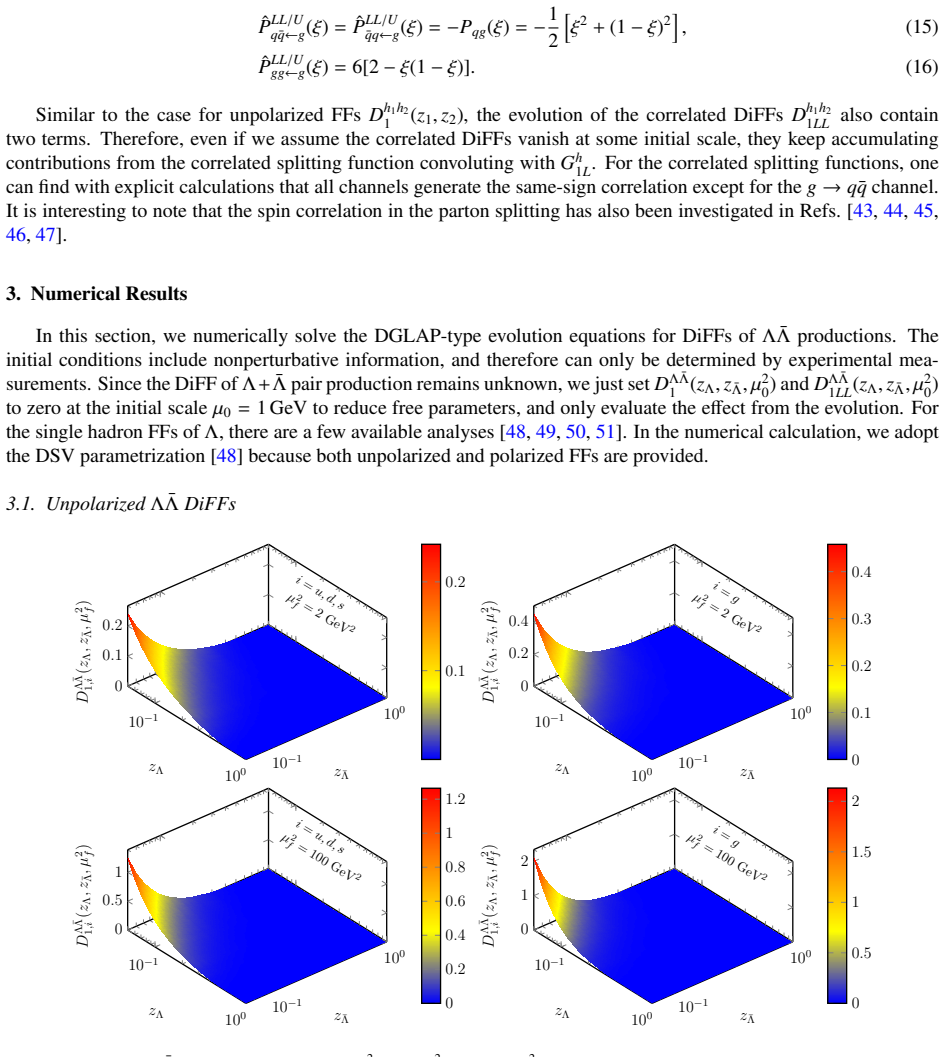
Summary. The paper investigates the helicity correlation of two neighboring hadrons produced from the same parton, described by the dihadron fragmentation function D_1LL. In Section II, the authors write a DGLAP-type evolution equation for D_1LL, Eq. (11), whose second term is a source term built from the correlated splitting function P^LL/U convolved with a product of two single-hadron longitudinal spin-transfer functions G_1L. They then set the initial D_1 and D_1LL to zero at μ0 = 1 GeV and, using the DSV parametrization for Λ fragmentation, compute D_1LL and the ratio C_LL = D_1LL/D_1 for ΛΛbar pairs at μ_f^2 = 2 and 100 GeV^2. Section III presents the resulting correlations for two DSV flavor scenarios and argues that the gluon channel, in particular, provides a new window onto the poorly known gluon longitudinal spin transfer. The central claim is that even with a zero initial condition, perturbative evolution generates a sizable D_1LL, making the helicity correlation a sensitive probe of G_1L in unpolarized collisions.
Significance. If Eq. (11) is justified, the idea is attractive: it connects a parity-conserving helicity correlation in an unpolarized process to the polarized fragmentation function G_1L, complementing measurements with polarized beams and targets. The numerical protocol is transparent: the initial conditions are stated, the DSV fits are identified, and the figures cover two scenarios. The central claim is also falsifiable in principle: a measurement of C_LL would test whether the evolution-generated correlation has the predicted sign and magnitude. The main weakness is that the source term of Eq. (11) is introduced without a derivation, and the numerical predictions inherit the DSV assumptions without uncertainty propagation; the plots should therefore be read as a demonstration of a mechanism rather than as a calibrated quantitative prediction.
major comments (4)
- [Sec. II, Eq. (11)] The evolution equation for D_1LL is introduced with the phrase 'According to the number density interpretation' but no derivation is given from the operator definition of the interference dihadron fragmentation function. The source term is a product G_1L,j(z1/ξ) G_1L,k(z2/(1−ξ)), which assumes that after the splitting i → j + k the fragmentations of j and k are independent, with all correlation carried by the parton helicities. This assumption is load-bearing: since D_1LL(μ0)=0, every numerical result in Figs. 3–5 is generated solely by this product convolved with P^LL/U. The authors should either derive Eq. (11), or state the independent-fragmentation assumption explicitly and discuss its validity. If non-factorizing two-parton fragmentation contributes, the predicted size and sign of C_LL can change, and the central mapping between the measured helicity correlation and G_1L is not established.
- [Sec. II, Eqs. (12)–(16)] The relation between P^LL/U and the helicity-dependent splitting functions in Eq. (12) is stated, but the handling of virtual corrections and the normalization of the source term are not shown. The first term of Eq. (11) uses the unpolarized splitting function P_ji; the authors should clarify why the same P_ji applies in the D_1LL channel and how the plus-prescription and delta-function pieces are treated in the source term. A consistency check, for example against charge conjugation or against the z1+z2 → 1 limit, would increase confidence in the evolution kernel.
- [Sec. III, initial conditions] Setting both D_1 and D_1LL to zero at μ0 = 1 GeV is a legitimate exploratory choice, but the resulting C_LL in Eq. (17) is not a parameter-free prediction. The results depend on the DSV parametrization, on the choice of scenarios 1 and 3, and on the functional form of the extrapolation below z = 0.05. No uncertainties from the DSV fits are propagated, so the spread between scenarios in Fig. 5 illustrates sensitivity but does not provide a quantitative uncertainty band. The authors should at least comment on how the conclusions change under scenario 2 or under a variation of μ0.
- [Sec. III.3 and Abstract] The claim that the helicity correlation is a 'sensitive observable' to G_1L should be qualified. Because D_1LL is constructed from G_1L through Eq. (11), the plotted C_LL is a re-expression of the fitted G_1L rather than an independent prediction that can falsify the DSV extraction. The paper would be strengthened by stating explicitly what information a future measurement of C_LL would add beyond existing G_1L constraints, and by identifying kinematic regions where the generated correlation is robust to variations of the nonperturbative initial conditions.
minor comments (5)
- [Introduction] The term 'neighboring dihadron' is used throughout but never defined precisely; please specify the kinematic region, for example by stating that the invariant mass of the pair is much smaller than the hard scale while the relative transverse momentum is integrated over.
- [Sec. II, Eq. (10)] The sentence after Eq. (10) writes P_jk←i(ξ) = P_kj←i(1−ξ), but the relevant quantities in that paragraph are the real-diagram splitting functions Phat_jk←i; the notation should be unified.
- [Sec. III.2] The text says the first two DSV scenarios are similar but only scenarios 1 and 3 are shown; a sentence explaining why scenario 2 is omitted would help the reader.
- [Sec. III, Figs. 2–5] The figures would be easier to interpret if the extrapolation region z < 0.05 were clearly marked, since the DSV parametrization is only valid for z ≥ 0.05 and the authors restrict the results to this region in the text.
- [Sec. III.3] The paper would benefit from a brief representative cross-section formula showing how C_LL, as defined in Eq. (17), appears in a measurable asymmetry, for example in e+e− → h1 h2 X; this would make the connection between the abstract's 'observable' and the computed ratio explicit.
Circularity Check
No significant circularity: C_LL is a genuine derived prediction from externally fitted G_1L, not a re-expression of the target observable.
full rationale
The paper does not fit anything to the helicity-correlation observable C_LL or to the correlated DiFF D_1LL. The input G_1L is taken from the independent DSV parametrization (Ref. [48]), which was extracted from single-hadron Lambda polarization data, and the numerical calculation merely evolves that external input through the standard DGLAP-type equations (Eqs. (2) and (11)) with zero initial D_1LL. The claim that C_LL is sensitive to G_1L follows from the structure of the evolution equation, but that is a physical derivation, not a definitional identity: D_1LL is not defined as a product of G_1L functions, nor is any parameter fitted to the predicted ratio. The factorized source term in Eq. (11) is an unvalidated modeling assumption about independent fragmentation of the two partons, which is a correctness risk rather than a circular reduction. No load-bearing argument reduces to a self-citation, and the correlated splitting functions are cited to external work (Ref. [42]). The calculation is therefore self-contained against its external inputs and constitutes a genuine prediction.
Assumptions & free parameters
free parameters (3)
- Initial scale mu0 =
1 GeV
- Initial unpolarized DiFF D_1 =
0
- Initial correlated DiFF D_1LL =
0
assumptions (5)
- domain assumption Collinear factorization for dihadron fragmentation in the neighboring regime
- domain assumption DGLAP-type evolution applies to DiFFs, with the 'number density interpretation' for the correlated DiFF
- domain assumption Correlated splitting functions P_hat^{LL/U} from Ref. [42]
- ad hoc to paper Independent fragmentation in the source term: D_1LL receives contributions from a product G_1L(j) times G_1L(k)
- standard math Parity conservation in hadronization restricts the helicity-dependent DiFF to D1 + lambda1 lambda2 D1LL
Cite this review
Pith. "Pith review of Helicity correlation of neighboring dihadron." pith.science (2026). https://pith.science/paper/FWPS7A2O
@misc{pith2026241200394,
  author       = {Pith},
  title        = {Pith review of: Helicity correlation of neighboring dihadron},
  year         = {2026},
  howpublished = {\url{https://pith.science/paper/FWPS7A2O}},
  note         = {Machine review of arXiv:2412.00394}
}
abstract
The spin correlation of final-state hadrons provides a novel platform to explore the hadronization mechanism of polarized partons in unpolarized high-energy collisions. In this work, we investigate the helicity correlation of two hadrons originating from the same single parton. The production of such a dihadron system is formally described by the interference dihadron fragmentation function, in which the helicity correlation between the two hadrons arise from both the long-distance nonperturbative physics and the perturbative QCD evolution. Beyond the extraction of the dihadron fragmentation function, we demonstrate that it is also a sensitive observable to the longitudinal spin transfer, characterized by the single hadron fragmentation function $G_{1L}$. This intriguing connection opens up new opportunities for understanding the spin dynamics of hadronization and provides a complementary approach to corresponding studies using polarized beams and targets.
Figures


Figures from the paper (2 more)


Forward citations
Cited by 1 Pith paper
-
Bell Inequality Violation of Light Quarks in Back-to-Back Dihadron Pair Production at Lepton Colliders
Using dihadron fragmentation functions as spin analyzers, the paper shows that Bell inequality violation in massless quark pairs can be probed through azimuthal correlations, with projected discovery significance from...
Reference graph
Works this paper leans on
- [1]
- [2]
-
[3]
Z. X. Chen, H. Dong and S. Y . Wei, Phys. Rev. D110 (2024) no.5, 5 doi:10.1103/PhysRevD.110.056040 [arXiv:2404.19202 [hep-ph]]
work page Pith review arXiv 2024
- [4]
-
[5]
W. Gong, G. Parida, Z. Tu and R. Venugopalan, Phys. Rev. D 106 (2022) no.3, L031501 doi:10.1103 /PhysRevD.106.L031501 [arXiv:2107.13007 [hep-ph]]
arXiv 2022
- [6]
- [7]
- [8]
Show all 57 references
-
[9]
D. Shao, B. Yan, S. R. Yuan and C. Zhang, Sci. China Phys. Mech. Astron. 67 (2024) no.8, 281062 doi:10.1007 /s11433-024-2389-y [arXiv:2310.14153 [hep-ph]]
2024 arXiv
-
[10]
J. p. Lv, Z. h. Yu, Z. t. Liang, Q. Wang and X. N. Wang, Phys. Rev. D 109 (2024) no.11, 114003 doi:10.1103 /PhysRevD.109.114003 [arXiv:2402.13721 [hep-ph]]
2024 arXiv
-
[11]
S. Wu, C. Qian, Y . G. Yang and Q. Wang, Chin. Phys. Lett. 41 (2024) no.11, 110301 doi:10.1088 /0256-307X/41/11/110301 [arXiv:2402.16574 [hep-ph]]
2024 arXiv
-
[12]
S. Wu, C. Qian, Q. Wang and X. R. Zhou, Phys. Rev. D 110 (2024) no.5, 054012 doi:10.1103 /PhysRevD.110.054012 [arXiv:2406.16298 [hep-ph]]
2024 arXiv
-
[13]
D. Shen, J. Chen and A. Tang, [arXiv:2407.21291 [nucl-th]]
-
[14]
L. Yang, Y . K. Song and S. Y . Wei, [arXiv:2410.20917 [hep-ph]]
-
[15]
Konishi, A
K. Konishi, A. Ukawa and G. Veneziano, Phys. Lett. B 78 (1978), 243-248 doi:10.1016/0370-2693(78)90015-1
1978 doi
-
[16]
Konishi, A
K. Konishi, A. Ukawa and G. Veneziano, Nucl. Phys. B 157 (1979), 45-107 doi:10.1016/0550-3213(79)90053-1
1979 doi
-
[17]
J. C. Collins, S. F. Heppelmann and G. A. Ladinsky, Nucl. Phys. B 420 (1994), 565-582 doi:10.1016 /0550-3213(94)90078-7 [arXiv:hep- ph/9305309 [hep-ph]]
1994
-
[18]
J. C. Collins and G. A. Ladinsky, [arXiv:hep-ph /9411444 [hep-ph]]
-
[19]
R. L. Ja ffe, X. m. Jin and J. Tang, Phys. Rev. Lett.80 (1998), 1166-1169 doi:10.1103/PhysRevLett.80.1166 [arXiv:hep-ph/9709322 [hep-ph]]
1998 arXiv
-
[20]
Bianconi, S
A. Bianconi, S. Bo ffi, R. Jakob and M. Radici, Phys. Rev. D 62 (2000), 034008 doi:10.1103/PhysRevD.62.034008 [arXiv:hep-ph/9907475 [hep-ph]]
2000 arXiv
-
[21]
Radici, R
M. Radici, R. Jakob and A. Bianconi, Phys. Rev. D 65 (2002), 074031 doi:10.1103/PhysRevD.65.074031 [arXiv:hep-ph/0110252 [hep-ph]]
2002 arXiv
-
[22]
Bacchetta and M
A. Bacchetta and M. Radici, Phys. Rev. D 67 (2003), 094002 doi:10.1103/PhysRevD.67.094002 [arXiv:hep-ph/0212300 [hep-ph]]
2003 arXiv
-
[23]
D. Boer, R. Jakob and M. Radici, Phys. Rev. D 67 (2003), 094003 [erratum: Phys. Rev. D 98 (2018) no.3, 039902] doi:10.1103/PhysRevD.67.094003 [arXiv:hep-ph/0302232 [hep-ph]]
2003 arXiv
-
[24]
Majumder and X
A. Majumder and X. N. Wang, Phys. Rev. D 70 (2004), 014007 doi:10.1103/PhysRevD.70.014007 [arXiv:hep-ph/0402245 [hep-ph]]
2004 arXiv
-
[25]
Bacchetta and M
A. Bacchetta and M. Radici, Phys. Rev. D 74 (2006), 114007 doi:10.1103/PhysRevD.74.114007 [arXiv:hep-ph/0608037 [hep-ph]]
2006 arXiv
-
[26]
F. A. Ceccopieri, M. Radici and A. Bacchetta, Phys. Lett. B 650 (2007), 81-89 doi:10.1016/j.physletb.2007.04.065 [arXiv:hep-ph/0703265 [hep-ph]]
2007 arXiv
-
[27]
Bacchetta and M
A. Bacchetta and M. Radici, Phys. Rev. D 70 (2004), 094032 doi:10.1103/PhysRevD.70.094032 [arXiv:hep-ph/0409174 [hep-ph]]
2004 arXiv
-
[28]
Bacchetta, F
A. Bacchetta, F. A. Ceccopieri, A. Mukherjee and M. Radici, Phys. Rev. D 79 (2009), 034029 doi:10.1103 /PhysRevD.79.034029 [arXiv:0812.0611 [hep-ph]]
2009 arXiv
-
[29]
Zhou and A
J. Zhou and A. Metz, Phys. Rev. Lett. 106 (2011), 172001 doi:10.1103/PhysRevLett.106.172001 [arXiv:1101.3273 [hep-ph]]
2011 arXiv
-
[30]
Courtoy, A
A. Courtoy, A. Bacchetta, M. Radici and A. Bianconi, Phys. Rev. D 85 (2012), 114023 doi:10.1103/PhysRevD.85.114023 [arXiv:1202.0323 [hep-ph]]
2012 arXiv
-
[31]
Radici and A
M. Radici and A. Bacchetta, Phys. Rev. Lett. 120 (2018) no.19, 192001 doi:10.1103/PhysRevLett.120.192001 [arXiv:1802.05212 [hep-ph]]
2018 arXiv
-
[32]
H. H. Matevosyan, A. Bacchetta, D. Boer, A. Courtoy, A. Kotzinian, M. Radici and A. W. Thomas, Phys. Rev. D 97 (2018) no.7, 074019 doi:10.1103/PhysRevD.97.074019 [arXiv:1802.01578 [hep-ph]]
2018 arXiv
-
[33]
W. Yang, X. Wang, Y . Yang and Z. Lu, Phys. Rev. D99 (2019) no.5, 054003 doi:10.1103/PhysRevD.99.054003 [arXiv:1902.07889 [hep-ph]]
2019 arXiv
-
[34]
X. Luo, H. Sun, J. Li, Y . L. Xie and Tichouk, Phys. Rev. D 100 (2019) no.9, 094036 doi:10.1103/PhysRevD.100.094036 [arXiv:1906.05674 [hep-ph]]
2019 arXiv
-
[35]
Pitonyak, C
D. Pitonyak, C. Cocuzza, A. Metz, A. Prokudin and N. Sato, Phys. Rev. Lett. 132 (2024) no.1, 011902 doi:10.1103/PhysRevLett.132.011902 [arXiv:2305.11995 [hep-ph]]
2024 arXiv
-
[36]
Bacchetta, M
A. Bacchetta, M. Radici and L. Rossi, Phys. Rev. D 108 (2023) no.1, 014005 doi:10.1103/PhysRevD.108.014005 [arXiv:2303.04314 [hep- ph]]
2023 arXiv
-
[37]
X. K. Wen, B. Yan, Z. Yu and C. P. Yuan, [arXiv:2408.07255 [hep-ph]]
-
[38]
Majumder, E
A. Majumder, E. Wang and X. N. Wang, Phys. Rev. Lett. 99 (2007), 152301 doi:10.1103 /PhysRevLett.99.152301 [arXiv:nucl-th/0412061 [nucl-th]]
2007 arXiv
-
[39]
X. Li, Z. X. Chen, S. Cao and S. Y . Wei, Phys. Rev. D 109 (2024) no.1, 014035 doi:10.1103 /PhysRevD.109.014035 [arXiv:2309.09487 [hep-ph]]
2024 arXiv
-
[40]
U. P. Sukhatme and K. E. Lassila, Phys. Rev. D 22 (1980), 1184 doi:10.1103/PhysRevD.22.1184
1980 doi
-
[41]
de Florian and L
D. de Florian and L. Vanni, Phys. Lett. B 578 (2004), 139-149 doi:10.1016/j.physletb.2003.10.047 [arXiv:hep-ph/0310196 [hep-ph]]
2004 arXiv
-
[42]
A. J. Larkoski, J. J. Lopez-Villarejo and P. Skands, Phys. Rev. D87 (2013) no.5, 054033 doi:10.1103/PhysRevD.87.054033 [arXiv:1301.0933 [hep-ph]]
2013 arXiv
-
[43]
J. C. Collins, Nucl. Phys. B 304 (1988), 794-804 doi:10.1016/0550-3213(88)90654-2 8
1988 doi
-
[44]
H. Chen, I. Moult and H. X. Zhu, Phys. Rev. Lett. 126 (2021) no.11, 112003 doi:10.1103 /PhysRevLett.126.112003 [arXiv:2011.02492 [hep-ph]]
2021 arXiv
-
[45]
H. Chen, I. Moult and H. X. Zhu, JHEP 08 (2022), 233 doi:10.1007/JHEP08(2022)233 [arXiv:2104.00009 [hep-ph]]
2022 arXiv
-
[46]
Karlberg, G
A. Karlberg, G. P. Salam, L. Scyboz and R. Verheyen, Eur. Phys. J. C 81 (2021) no.8, 681 doi:10.1140 /epjc/s10052-021-09378-0 [arXiv:2103.16526 [hep-ph]]
2021 arXiv
-
[47]
Hamilton, A
K. Hamilton, A. Karlberg, G. P. Salam, L. Scyboz and R. Verheyen, JHEP 03 (2022), 193 doi:10.1007/JHEP03(2022)193 [arXiv:2111.01161 [hep-ph]]
2022 arXiv
-
[48]
de Florian, M
D. de Florian, M. Stratmann and W. V ogelsang, Phys. Rev. D57 (1998), 5811-5824 doi:10.1103/PhysRevD.57.5811 [arXiv:hep-ph/9711387 [hep-ph]]
1998 arXiv
-
[49]
B. Q. Ma, I. Schmidt and J. J. Yang, Phys. Lett. B 477 (2000), 107-113 doi:10.1016/S0370-2693(00)00167-2 [arXiv:hep-ph/9906424 [hep- ph]]
2000 arXiv
-
[50]
B. Q. Ma, I. Schmidt and J. J. Yang, Phys. Rev. D 61 (2000), 034017 doi:10.1103/PhysRevD.61.034017 [arXiv:hep-ph/9907224 [hep-ph]]
2000 arXiv
-
[51]
Albino, B
S. Albino, B. A. Kniehl and G. Kramer, Nucl. Phys. B 803 (2008), 42-104 doi:10.1016/j.nuclphysb.2008.05.017 [arXiv:0803.2768 [hep-ph]]
2008 arXiv
-
[52]
Buskulic et al
D. Buskulic et al. [ALEPH], Phys. Lett. B 374 (1996), 319-330 doi:10.1016/0370-2693(96)00300-0
1996 doi
-
[53]
Ackersta ff et al
K. Ackersta ff et al. [OPAL], Eur. Phys. J. C2 (1998), 49-59 doi:10.1007/s100520050123 [arXiv:hep-ex/9708027 [hep-ex]]
1998 arXiv
-
[54]
R. C. Hwa and C. B. Yang, Phys. Rev. C 70 (2004), 054902 doi:10.1103/PhysRevC.70.054902 [arXiv:nucl-th/0407081 [nucl-th]]
2004 arXiv
-
[55]
Majumder and X
A. Majumder and X. N. Wang, Phys. Rev. D 72 (2005), 034007 doi:10.1103/PhysRevD.72.034007 [arXiv:hep-ph/0411174 [hep-ph]]
2005 arXiv
-
[56]
Airapetian et al
A. Airapetian et al. [HERMES], Phys. Rev. Lett. 96 (2006), 162301 doi:10.1103/PhysRevLett.96.162301 [arXiv:hep-ex/0510030 [hep-ex]]
2006 arXiv
- [57]
Reviewed August 12, 2026 · model on record in the stance chip above.
Discussion (0). Continue with ORCID to comment.