REVIEW 4 major objections 5 minor 37 references
Noisy Cyclic Quantum Random Walk
T0 review · 4 major / 5 minor · reviewed 2026-08-12 · deepseek-v4-flash
Pith's one-line read For a cyclic quantum walk with static site noise, the participation ratio of the step operator's eigenstates predicts localization before and after a full traversal, and a sharp crossover in both spectral and dynamical indicators occurs…
desk verdict Solid noiseless spectral analysis; the numerical diagnostic claim is undercut by an MSD definition error and by the fact that PR and dynamics come from the same diagonalization. read the letter →
The pith
A machine-rendered reading of the paper's core claim, the machinery that carries it, and where it could break.
The reading
What carries the argument
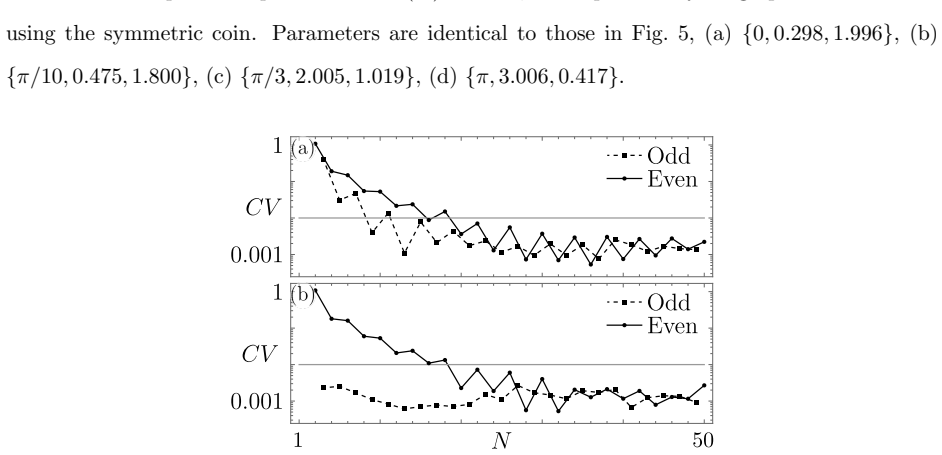
The central object is the noisy step operator $\hat{S}_{\mathrm{noise}}=(\hat{D}_{\mathrm{noise}}\otimes\hat{1})\hat{S}_N$, where $\hat{D}_{\mathrm{noise}}$ adds independent random site phases in $[-\phi_s,\phi_s]$. The noiseless step operator $\hat{S}_N$ is diagonalized by the quantum Fourier transform, giving eigenstates $|\zeta_k\rangle$ whose eigenvalues sit on two arcs of the unit circle, separated by a gap set by $\gamma$ and rotated by $(\theta+\phi)/2$. The diagnostic that carries the argument is the participation ratio $\mathrm{PR}(\zeta_j)=(\sum_s P(s))^2/\sum_s P(s)^2$ of the marginal site distribution of each step eigenstate, a number between $1$ and $N$ that measures how many sites an eigenstate effectively occupies. Dynamically, the paper uses the step-resolved mean squared displacement $\Delta x^2(m)$, a power-law fit $\Delta x^2(m)\approx\alpha m^\beta$ to extract the spreading exponent in the walk-on-the-line regime, and a bias-corrected coefficient of variation of $\Delta x^2$ to define saturation in the walk-on-the-cycle regime.
What would settle it
Compute the spreading exponent on the same cycle before and after adding buffer sites so the walk cannot feel the boundary within the fit window; if the exponents diverge for different buffer sizes near $\phi_s=\pi/3$, the line-cycle equivalence that underpins the crossover is broken. Independently, search for a noisy realization with a high participation ratio whose dynamics are sub-diffusive; one such case would refute the proposed diagnostic.
Extended reading notes
Core claim
The paper establishes that, for a discrete-time quantum walk on a cyclic graph with static site phase noise, the eigenstate participation ratio of the step operator is a reliable spectral proxy for localization in both dynamical regimes. Before the walker has traversed the whole ring, low participation ratios predict sub-diffusive spread ($\beta<1$) and high participation ratios predict ballistic or super-diffusive spread ($\beta>1$); after a full traversal, low participation ratios predict early saturation of the mean squared displacement at a low level, while high ratios correspond to persistent oscillations. A sharp crossover between these behaviours occurs near $\phi_s=\pi/3$, where the participation ratio drops. The three-parameter coin controls the noiseless spectrum: $\gamma$ opens two spectral bands, the half-sum $(\theta+\phi)/2$ rotates the spectrum and produces twofold degeneracy when $(\theta+\phi)/2=m\pi/N$, and degenerate spectra give sinusoidal marginal distributions while non-degenerate spectra give flat ones. The authors conclude that the participation ratio is a fast static diagnostic, complementary to full dynamical simulations, for analysing noisy quantum devices.
Load-bearing premise
The load-bearing premise is that the early-time portion of the walk on the cycle is indistinguishable from a walk on an unbounded line, and that the 'initial steps' window used to fit $\beta$ lies entirely inside that portion for every noise level and graph size.
Editorial extensions
If this is right
- For a fixed coin and graph size, one can scan noise levels by computing participation ratios of the noisy step operator and identify the localization crossover without propagating the walk.
- The crossover at $\phi_s=\pi/3$ appears for both the Hadamard and symmetric coins and across different graph sizes, indicating a coin-independent feature of this static phase-noise model.
- In the walk-on-the-cycle regime, the coefficient-of-variation convergence criterion supplies a quantitative saturation level that can be used as a localization measure on finite graphs, where the spreading exponent is no longer defined.
- The proposed gate-based circuits for the step operator and noise mean the model, and the spectral diagnostic, can be tested on small quantum processors.
Reading between the lines
- The paper tests two coin settings; whether the crossover at $\phi_s=\pi/3$ persists for other values of $\gamma$ or for other phase combinations is left untested and is a natural next check.
- The same participation-ratio diagnostic could plausibly extend to dynamic disorder or to two-dimensional lattice walks, but those extensions are outside the paper's scope.
- A practical implementation would likely need a measurable proxy for the participation ratio, since reconstructing step-eigenstate probabilities may be as expensive as running the dynamics.
Signed reviews
Editorial analysis
A structured set of objections, weighed in public.
Referee Report
Summary. The paper studies discrete-time quantum walks on a cyclic graph with a three-parameter unitary coin, adding static diagonal phase noise at the sites. It derives the noiseless spectral structure of the step operator, finding two spectral bands controlled by one coin parameter and degeneracies controlled by the half-sum of the two phases. The paper then divides the noisy dynamics into a walk-on-the-line regime and a walk-on-the-cycle regime, extracts a spreading exponent from the mean squared displacement in the former, and uses a coefficient-of-variation convergence criterion in the latter. The central claim is that the eigenstate participation ratio of the step operator is a computationally efficient static diagnostic that anticipates localization in both regimes, with a crossover near noise strength phi_s = pi/3.
Significance. If established, the participation-ratio diagnostic could be practically useful for predicting localization without long-time simulations, and the noiseless spectral analysis is a clean contribution: the paper explicitly shows how the coin parameters control spectral bands, gaps, and degeneracies, and it provides explicit eigenstates and eigenvalues of the noiseless walk. The main numerical claims, however, rest on limited simulations: two coin families, essentially one graph size in the walk-on-the-line regime, unspecified fit windows, and no reported disorder-realization statistics. The advertised computational-efficiency argument is also not supported as written because the participation ratio is computed from the same noisy step-operator diagonalization that would already provide the full dynamics. The crossover at phi_s = pi/3 is an interesting falsifiable numerical finding, but it needs a much more detailed statistical and finite-size analysis before it can be regarded as a general result.
major comments (4)
- [Sec. IV, Eqs. (13)-(15)] Equation (13) is not a mean squared displacement as written. The quantity Dx(m) defined in Eq. (14) is the distance between the mean position x(m) and the initial site, independent of the summation index s, so summing [Dx(m)]^2 P(s,m) over s merely gives [Dx(m)]^2. For the symmetric coin starting at a localized site, the mean position remains at the initial site and this quantity is identically zero, which contradicts the nonzero curves in Fig. 5. Since the spreading exponent beta in Eq. (15) is the central dynamical observable, please replace Eq. (13) with a proper cycle-distance mean squared displacement, such as sum_s d(s,s0)^2 P(s,m), or clearly define the estimator being used.
- [Secs. IV-V and Sec. VIII] The claim that the participation ratio is a computationally efficient alternative to full dynamical simulations is not supported by the computations described. The participation ratio in Sec. V is evaluated on eigenstates of the noisy step operator S_noise = D_noise S_N from Eq. (12), which requires diagonalizing the full 2N-by-2N unitary; the same diagonalization provides arbitrary powers U^m and therefore the complete dynamics. No runtime comparison, no independent estimator of the participation ratio from the noise amplitude and noiseless spectrum, and no held-out or out-of-sample validation are provided. Please either benchmark the diagnostic against direct simulation, provide a way to obtain it without full diagonalization, or restate the conclusion as a correlational static indicator rather than an alternative to dynamical simulation.
- [Sec. V, Figs. 4-6] The numerical extraction of beta is under-specified. The text says the power-law fit is restricted to 'the initial steps where the system resembles a quantum walk on a line,' but no concrete fit window is given. The figures show mean squared displacement curves and participation-ratio boxplots without stating the number of independent disorder realizations, the graph sizes used in the line-regime analysis, or any error bars or confidence intervals on the reported beta values. Because the crossover at phi_s = pi/3 is identified numerically from beta, this missing statistical information is load-bearing for the paper's central claim.
- [Secs. V-VI] The claimed robustness of the crossover and of the participation-ratio correlation is not demonstrated. In the walk-on-the-line regime, results are shown for N=128 and two coin parameter sets, while the text states the trend 'appears robust for graphs with diverse size N' without presenting that data. The walk-on-the-cycle regime likewise shows saturation levels for several N, but the connection between the participation ratio and the saturation level is discussed qualitatively rather than quantified. Please provide the finite-size scaling and parameter scans, or explicitly limit the claim to the reported cases.
minor comments (5)
- [Sec. VII, Eq. (17) and Fig. 11] The phase gate definition contains a typo: it should be P_j = |0><0| + e^{i pi/2^j}|1><1|, not |0><0|+|0><1|+|1><0|+e^{i pi/2^j}|1><1|.
- [Sec. II, Eq. (2)] The eigenvalue expression for c_j is garbled in the typesetting, with a missing radicand; please re-typeset this equation so the square root structure is clear.
- [Secs. I and IV] There are minor language issues: 'finite-size effects become dominate' should be 'become dominant,' and 'the effects of the cyclic topology are null' should be 'are zero' or 'vanish.'
- [Sec. VI] The convergence criterion CV <= 0.01 and the moving window size n = max{10, N/4} are introduced without a sensitivity analysis; a short discussion of how the saturation levels depend on these choices would strengthen the walk-on-the-cycle analysis.
- [Data availability] The paper states that data may be obtained upon reasonable request, but no code or data are provided. Given the centrality of the numerical crossover and the PR-dynamics correlation, a supplementary package with simulation scripts and fit details would substantially aid reproducibility.
Circularity Check
No significant circularity: the participation ratio and spreading exponent are independent functionals, and the crossover is identified from dynamics and only then checked against the spectrum.
full rationale
The paper's central correlation is between the eigenstate participation ratio PR(ζ_j) of Eq. (10) and the spreading exponent β obtained by fitting Eq. (15) to the step-resolved mean squared displacement. These are distinct functionals: PR is computed from the step-operator eigenstates, while β is extracted from the dynamical trajectory, and no equation defines either in terms of the other. The crossover at φ_s = π/3 is explicitly identified from the dynamics ('This value is not derived from an analytical expression, but obtained numerically from the behavior of the spreading exponent β', Sec. V) and then observed as a simultaneous drop in PR and saturation level, which is an independent consistency check rather than a construction. The self-citations [32,33] are used for the standard Fourier diagonalization of the noiseless cyclic step operator; they are not load-bearing uniqueness claims and they do not smuggle in the central result. The 'fast static diagnostic' assertion is a computational-efficiency claim that is not demonstrated — computing PR for a noisy realization requires diagonalizing the same 2N×2N noisy unitary that generates the dynamics, and Eq. (13) as written is problematic because Δx(m) is site-independent, so the displayed sum collapses to [Δx(m)]^2. These are correctness and overclaim concerns, not circularity: no result in the paper is equivalent to its input by definition, so no circular step is established.
Assumptions & free parameters
free parameters (4)
- spreading exponent beta =
0.419 to 1.996 across noise levels
- spreading rate alpha =
0.297 to 3.006
- crossover noise strength phi_s = pi/3 =
pi/3 (about 1.047)
- convergence threshold and window for CV =
CV <= 0.01, window n = max(10, N/4)
assumptions (5)
- standard math The noiseless cyclic step operator is diagonalized by the quantum Fourier transform with eigenvalues lambda_k = exp(-i 2 pi (k-1)/N).
- domain assumption Site phase noise is static and applied as an N-site diagonal unitary with phases in [-phi, phi].
- domain assumption Before the walker completes a full traversal, dynamics on the cycle are equivalent to a quantum walk on an unbounded line.
- ad hoc to paper Low participation ratio of step-operator eigenstates predicts dynamical localization on cyclic graphs.
- domain assumption After a full traversal, finite-size effects dominate and the coefficient-of-variation criterion is the right way to define localization.
Cite this review
Pith. "Pith review of Noisy Cyclic Quantum Random Walk." pith.science (2026). https://pith.science/paper/NASKD22M
@misc{pith2026241200536,
  author       = {Pith},
  title        = {Pith review of: Noisy Cyclic Quantum Random Walk},
  year         = {2026},
  howpublished = {\url{https://pith.science/paper/NASKD22M}},
  note         = {Machine review of arXiv:2412.00536}
}
abstract
We explore static noise in a discrete quantum random walk over a homogeneous cyclic graph, focusing on spectral and dynamical properties. Using a three-parameter unitary coin, we control the spectral structure of the noiseless step operator on the unit circle. One parameter induces two spectral bands separated by a gap proportional to its value, while the half-sum of the two phase parameters rotates the spectrum and enables twofold degeneracy under specific conditions. Degenerate spectra yield sinusoidal probability distributions; non-degenerate ones produce flat profiles. We introduce static phase noise on the sites and analyze its effects in two propagation regimes. In the walk-on-the-line regime, preceding a full graph traversal, we extract the spreading exponent $\beta$ from the step-resolved mean squared displacement. Low participation ratios correlate with sub-diffusive spread; high ratios indicate ballistic or super-diffusive evolution. Once the walker completes a cycle, finite-size effects dominate. In this walk-on-the-cycle regime, $\beta$ no longer characterizes the dynamics. Instead, we quantify localization using the coefficient of variation of the mean squared displacement. In both regimes, we observe a sharp crossover near static site noise $\phi_s = \pi/3$, marked by a drop in participation ratio, a transition from diffusive to sub-diffusive spread in the walk-on-the-line regime, and a reduced saturation level in the walk-on-the-cycle regime. Our results show that the eigenstate participation ratio is an efficient spectral diagnostic that anticipates localization across both regimes, offering an alternative to full dynamical simulations.
Figures


Figures from the paper (12 more)




Reference graph
Works this paper leans on
-
[1]
Anderson localization and nonlinearity in one dimensional disordered photonic lattices
Y. Lahini, A. Avidan, F. Pozzi, M. Sorel, R. Morandotti, D. N. Christodoulides, and Y. Silber- berg, Anderson localization and nonlinearity in one-dimensional disordered photonic lattices, Phys. Rev. Lett. 100, 013906 (2008), arXiv:0704.3788 [quant-ph]
work page Pith review arXiv 2008
-
[2]
Anderson localization of entangled photons in an integrated quantum walk
A. Crespi, R. Osellame, R. Ramponi, V. Giovannetti, R. Fazio, L. Sansoni, F. De Nicola, F. Sciarrino, and P. Mataloni, Anderson localization of entangled photons in an integrated quantum walk, Nat. Photon. 7, 322 (2013), arXiv:1304.1012 [quant-ph]
work page Pith review arXiv 2013
- [3]
-
[4]
Anderson localization in generalized discrete time quantum walks
I. Vakulchyk, M. V. Fistul, P. Qin, and S. Flach, Anderson localization in generalized discrete- time quantum walks, Phys. Rev. B 96, 144204 (2017), arXiv:1708.08194 [quant-ph]
work page Pith review arXiv 2017
-
[5]
S. Weidemann, M. Kremer, S. Longhi, and A. Szameit, Coexistence of dynamical delocalization and spectral localization through stochastic dissipation, Nat. Photon. 15, 576 (2021)
work page 2021
-
[6]
Anderson localization in dissipative lattices
S. Longhi, Anderson localization in dissipative lattices, Ann. Phys. 535, 2200658 (2023), arXiv:2304.07710 [quant-ph]
work page Pith review arXiv 2023
-
[7]
C. A. Condat and T. R. Kirkpatrick, Resonant scattering and Anderson localization of acoustic waves, Phys. Rev. B 36, 6782 (1987)
work page 1987
-
[8]
R. L. Weaver, Anderson localization of ultrasound, Wave Motion 12, 129 (1990). 19
work page 1990
Show all 37 references
-
[9]
Billy, V
J. Billy, V. Josse, Z. Zuo, A. Bernard, B. Hambrecht, P. Lugan, D. Cl´ ement, L. Sanchez- Palencia, P. Bouyer, and A. Aspect, Direct observation of Anderson localization of matter- waves in a controlled disorder, Nature 453, 891 (2008), arXiv:0804.1621 [quant-ph]
2008 arXiv
-
[10]
Piraud, L
M. Piraud, L. Sanchez-Palencia, and B. van Tiggelen, Anderson localization of matter waves in three-dimensional anisotropic disordered potentials, Phys. Rev. A 90, 063639 (2014)
2014
-
[11]
Y. Ye, M. Ke, J. Feng, M. Wang, C. Qiu, and Z. Liu, Transversal Anderson localization of sound in acoustic waveguide arrays, J. Phys. Condens. Matter 27, 155402 (2015)
2015
-
[12]
Schreiber, K
A. Schreiber, K. N. Cassemiro, V. Potoˇ cek, A. G´ abris, I. Jex, and C. Silberhorn, Decoherence and disorder in quantum walks: from ballistic spread to localization, Phys. Rev. Lett. 106, 180403 (2011), arXiv:1101.2638 [quant-ph]
2011 arXiv
-
[13]
Nosrati, A
F. Nosrati, A. Laneve, M. K. Shadfar, A. Geraldi, K. Mahdavipour, F. Pegoraro, P. Mataloni, and R. Lo Franco, Readout of quantum information spreading using a disordered quantum walk, J. Opt. Soc. Am. B 38, 2570 (2021), arXiv:2010.10592 [quant-ph]
2021 arXiv
-
[14]
A. R. C. Buarque, F. S. Passos, W. S. Dias, and E. P. Raposo, Discrete-time quantum walk dispersion control through long-range correlations, Phys. Rev. E 107, 064139 (2023), arXiv:2303.01608 [quant-ph]
2023 arXiv
-
[15]
G. R. M. de Almeida, N. Amaral, A. R. C. Buarque, and W. S. Dias, Noise correlations behind superdiffusive quantum walks, Phys. Rev. E 109, 064151 (2024), arXiv:2207.13145 [quant-ph]
2024
-
[16]
Derevyanko, Anderson localization of a one-dimensional quantum walker, Sci
S. Derevyanko, Anderson localization of a one-dimensional quantum walker, Sci. Rep. 8, 1795 (2018)
2018
-
[17]
Wang, X.-Y
Q.-Q. Wang, X.-Y. Xu, W.-W. Pan, K. Sun, J.-S. Xu, G. Chen, Y.-J. Han, C.-F. Li, and G.- C. Guo, Dynamic-disorder-induced enhancement of entanglement in photonic quantum walks, Optica 5, 1136 (2018), arXiv:1808.09298 [quant-ph]
2018 arXiv
-
[18]
Rebentrost, M
P. Rebentrost, M. Mohseni, I. Kassal, S. Lloyd, and A. Aspuru-Guzik, Environment-assisted quantum transport, New J. Phys. 11, 033003 (2009)
2009
-
[19]
Sapienza, H
L. Sapienza, H. Thyrrestrup, S. Stobbe, P. D. Garcia, S. Smolka, and P. Lodahl, Cavity quantum electrodynamics with Anderson-localized modes, Science 327, 1352 (2010)
2010
-
[20]
Obuse and N
H. Obuse and N. Kawakami, Topological phases and delocalization of quantum walks in ran- dom environments, Phys. Rev. B 84, 195139 (2011)
2011
-
[21]
J. Asch, O. Bourget, and A. Joye, Dynamical localization of the Chalker-Coddington model far from transition, J. Stat. Phys. 147, 194 (2012). 20
2012
-
[22]
J. H. Bardarson, F. Pollmann, and J. E. Moore, Unbounded growth of entanglement in models of many-body localization, Phys. Rev. Lett. 109, 017202 (2012)
2012
-
[23]
Agarwal, S
K. Agarwal, S. Gopalakrishnan, M. Knap, M. M¨ uller, and E. Demler, Anomalous diffusion and Griffiths effects near the many-body localization transition, Phys. Rev. Lett. 114, 160401 (2015)
2015
-
[24]
C. M. Chandrashekar and T. Busch, Localized quantum walks as secured quantum memory, Europhys. Lett. 110, 10005 (2015)
2015
-
[25]
J. M. Edge and J. K. Asboth, Localization, delocalization, and topological transitions in disordered two-dimensional quantum walks, Phys. Rev. B 91, 104202 (2015)
2015
-
[26]
Q. Lin, T. Li, L. Xiao, and et al., Observation of non-Hermitian topological Anderson insulator in quantum dynamics, Nat. Commun. 13, 3229 (2022)
2022
-
[27]
S. Pu, G. J. Sreejith, and J. K. Jain, Anderson localization in the fractional quantum Hall effect, Phys. Rev. Lett. 128, 116801 (2022)
2022
-
[28]
T. A. Brun, H. A. Carteret, and A. Ambainis, Quantum random walks with decoherent coins, Phys. Rev. A 67, 032304 (2003)
2003
-
[29]
Nayak and A
A. Nayak and A. Vishwanath, Quantum walk on the line (2012), arXiv:0010117 [quant-ph]
2012
-
[30]
C. M. Chandrashekar, R. Srikanth, and S. Banerjee, Symmetries and noise in quantum walk, Phys. Rev. A 76, 022316 (2007)
2007
-
[31]
Y. S. Weinstein, M. A. Pravia, E. M. Fortunato, S. Lloyd, and D. G. Cory, Implementation of the quantum Fourier transform, Phys. Rev. Lett. 86, 1889 (2001)
2001
-
[32]
D. J. Nodal Stevens, B. Jaramillo ´Avila, and B. M. Rodr ´ ıguez-Lara, Necklaces of PT- symmetric dimers, Photon. Res. 6, A31 (2018), arXiv:1709.00498 [quant-ph]
2018 arXiv
-
[33]
Jaramillo ´Avila, J
B. Jaramillo ´Avila, J. Naya Hern´ andez, S. M. Toxqui Rodr ´ ıguez, and B. M. Rodr ´ ıguez-Lara, Symmetric supermodes in cyclic multicore fibers, OSA Continuum 2, 515 (2019)
2019
-
[34]
Koˇ s ´ ık, V
J. Koˇ s ´ ık, V. Buˇ zek, and M. Hillery, Quantum walks with random phase shifts, Phys. Rev. A 74, 022310 (2006)
2006
-
[35]
Sassetti, H
M. Sassetti, H. Schomerus, and U. Weiss, Subdiffusive and superdiffusive quantum transport and generalized duality, Phys. Rev. B 53, R2914 (1996)
1996
-
[36]
R. R. Sokal and F. J. Rohlf, Biometry: the principles and practice of statistics in biological research, 3rd ed. (W.H. Freeman and Company, New York, 1995). 21
1995
-
[37]
M. A. Nielsen and I. L. Chuang, Quantum Computation and Quantum Information: 10th Anniversary Edition (Cambridge University Press, 2010). 22
2010
Reviewed August 12, 2026 · model on record in the stance chip above.
Discussion (0). Continue with ORCID to comment.