REVIEW 3 major objections 4 minor 3 cited by
Non-Perturbative Contributions to Low Transverse Momentum Drell-Yan Pair Production Using the Parton Branching Method
T0 review · 3 major / 4 minor · reviewed 2026-08-12 · deepseek-v4-flash
Pith's one-line read This paper argues that the intrinsic transverse-momentum width extracted from Drell-Yan pair spectra is independent of the pair invariant mass at LHC energies, because the non-perturbative Sudakov form factor is only weakly scale dependent.
desk verdict A useful null result with a load-bearing interpretation that the paper asserts rather than proves. read the letter →
The pith
A machine-rendered reading of the paper's core claim, the machinery that carries it, and where it could break.
The reading
What carries the argument
The key object is the Sudakov form factor of the Parton Branching method, split into a perturbative and a non-perturbative part, $\Delta(\mu^2,\mu_0^2) = \Delta^{(\mathrm{P})}(\mu^2,\mu_0^2,q_0^2) \cdot \Delta^{(\mathrm{NP})}(\mu^2,\mu_0^2,q_0^2)$, where the separation is set by the dynamic-$z$ scale $z_{\mathrm{dyn}} = 1 - q_0/q'$ defined by the transverse-momentum cutoff $q_0$. In the PB method $z_M \to 1$, so all soft gluons are included, while shower generators use $z_M = z_{\mathrm{dyn}}$, which drops $\Delta^{(\mathrm{NP})}$. Applying a $q_0$ cut in CASCADE3 mimics the shower generators, and the fitted width $q_s$ absorbs the missing soft-gluon contribution; the paper's quantitative evidence is the ratio of integrated TMD parton densities with and without the $q_0$ cut, which is nearly $\mu$-independent in the LHC range but not at low scales.
What would settle it
A concrete experiment would be to measure the Drell-Yan transverse-momentum spectrum for pair masses around 4 to 20 GeV at a low-energy facility; the paper's own Figure 5 predicts the $q_0$-induced change in integrated PDFs varies rapidly with $\mu$ there, so $q_s$ should show a visible mass dependence. If $q_s$ stays flat in that region, the weak-scale-dependence explanation would be falsified.
Extended reading notes
Core claim
The central discovery is that the fitted width $q_s$ -- related to the Gaussian intrinsic-$k_T$ width by $\sigma = \sqrt{2}q_s$ -- is flat as a function of the Drell-Yan pair invariant mass $m_{\ell\ell}$ across the LHC measurements, for both $q_0 = 1$ GeV and $q_0 = 2$ GeV. The paper explains this flatness by showing that the change in the integrated parton densities induced by the $q_0$ cut is nearly identical at evolution scales $\mu = 100$ GeV and $\mu = 500$ GeV, whereas at $\mu = 4$ GeV and $\mu = 20$ GeV the change differs strongly. Since the pair mass is identified with the evolution scale $\mu$ of the Sudakov form factor, the flatness of $q_s$ reflects the insensitivity of the non-perturbative Sudakov factor $\Delta^{(\mathrm{NP})}(\mu^2,\mu_0^2,q_0^2)$ over the LHC-accessible scale range. The paper therefore concludes that the relative soft-gluon contribution to low-$p_T$ Drell-Yan production is similar across mass bins, and that the energy dependence seen in shower generators is caused by neglecting $\Delta^{(\mathrm{NP})}$ through the truncation of the $z$ integral at $z_{\mathrm{dyn}} = 1 - q_0/q'$.
Load-bearing premise
The argument assumes that a shower generator's cutoff on the soft-gluon momentum fraction is exactly equivalent to omitting the non-perturbative part of the Sudakov form factor, and that the pair mass is the evolution scale.
Editorial extensions
If this is right
- If the flat $q_s$ is right, the intrinsic-$k_T$ width at $q_0 \to 0$ (about $1.04 \pm 0.08$ GeV) is a genuine hadronic property, not a scale-dependent artifact.
- The energy dependence of intrinsic-$k_T$ seen in shower-based generators and in CMS data would be understood as a missing non-perturbative Sudakov contribution, not as new physics in the proton.
- The relative soft-gluon fraction contributing to the lowest pair transverse momenta is the same in all measured LHC mass bins, so one set of non-perturbative parameters describes the whole mass range from about 50 to 1000 GeV.
- At pair masses of a few GeV, where the evolution scale is small, the paper's integrated-PDF analysis predicts a visible change of $q_s$ with mass once such measurements become available.
Reading between the lines
- Beyond the paper: if the weak scale dependence of $\Delta^{(\mathrm{NP})}$ is the real mechanism, a low-energy fixed-target Drell-Yan experiment at pair masses of a few GeV would be a direct discriminating test, since the paper's Figure 5 predicts $q_s$ should visibly rise with $m_{\ell\ell}$ there, unlike at the LHC.
- Beyond the paper: the same logic suggests parton-shower generators could be made consistent with the PB results by restoring the non-perturbative Sudakov term rather than by tuning the intrinsic-$k_T$ distribution; a concrete check would be to run a shower generator with $z_M \to 1$ and see if the fitted width flattens with collision energy.
- Beyond the paper: the ratio of integrated PDFs with and without the $q_0$ cut could itself be treated as a quantitative observable $\mathcal{R}(\mu,q_0)$ and mapped over $\mu$; the full curve would let other approaches compare their soft-gluon treatments directly.
Editorial analysis
A structured set of objections, weighed in public.
Referee Report
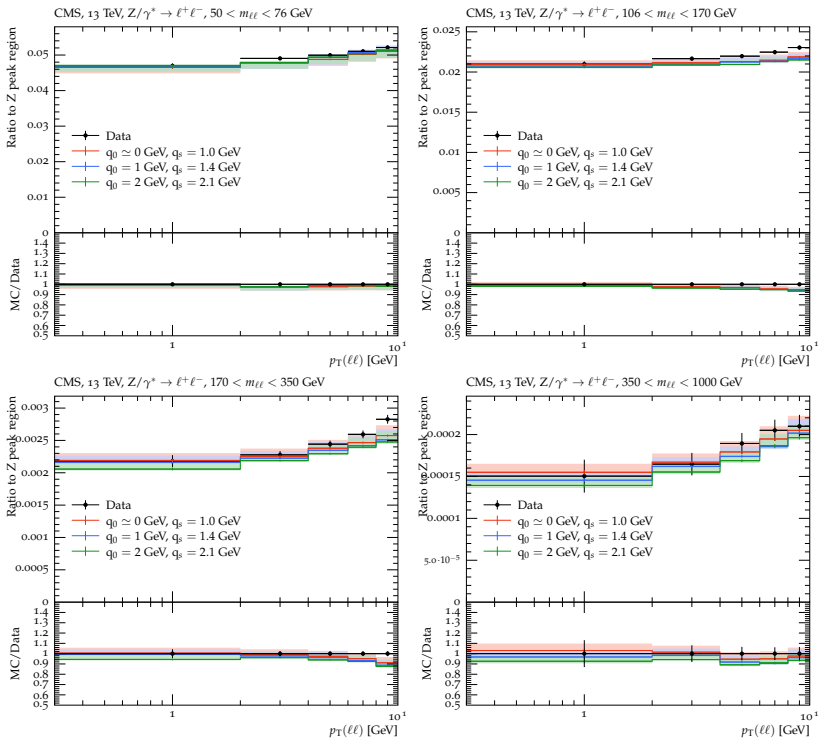
Summary. The paper investigates the interplay between intrinsic transverse momentum and soft gluon emission in low-transverse-momentum Drell-Yan production using the Parton Branching (PB) method implemented in CASCADE3. By imposing a lower cutoff q0 on the transverse momentum of partons emitted in branchings, the authors mimic shower-based Monte Carlo generators and determine the optimal intrinsic-kT width qs via chi-squared fits to DY measurements at sqrt(s)=8 and 13 TeV. Section 3 reports that qs is independent of the DY pair invariant mass within uncertainties for q0 up to 2 GeV, and uses integrated-PDF ratios with and without the q0 cut to argue that the non-perturbative Sudakov form factor changes only slowly with the evolution scale between about 100 and 500 GeV. The paper also examines final-state QED radiation and concludes that it affects the pair-pT distribution only for pT above about 8 GeV and therefore does not interfere with the extraction of qs.
Significance. If the central interpretation holds, the result provides a coherent explanation for the absence of center-of-mass energy dependence of the intrinsic-kT width in CASCADE3, attributing the energy dependence seen in PYTHIA/HERWIG to the neglected non-perturbative part of the Sudakov form factor. The paper is transparent about the null character of the mass-dependence result and about the large uncertainties at low collision energies. The QED part of the study cleanly separates final-state radiation effects from the non-perturbative low-pT region. A particular strength is the use of direct data comparisons with several experiments and the consistency check via the ratio to the Z peak. The main caveat is that the interpretation relies on an equivalence between a Monte Carlo cutoff and an analytic Sudakov-form-factor modification that is asserted rather than proven in this manuscript.
major comments (3)
- [Section 2, Eq. (3)] The statement that "when mimicking shower-based MC event generators, the non-perturbative part of the Sudakov form factor ... is neglected through the integral in z" is the load-bearing premise of the paper, but it is presented as an implication without a derivation or numerical verification. Setting zM=zdyn in the analytic Sudakov exponent removes the second factor in Eq. (3), yet the actual implementation in CASCADE3 applies a qT>q0 cutoff on generated branchings. These are not obviously identical operations: a veto on real emissions below q0 does not by itself remove the corresponding virtual contributions from the TMD normalization. The manuscript should either provide a derivation that the q0 cut in CASCADE3 realizes zM=zdyn in the exponent, or validate the equivalence by comparing CASCADE3 with q0>0 against a shower-based generator (the paper itself lists this as a future step in Section 5). Without such support, the flatness of qs(m_ll) in Fig. 2 cannot be uniquely attributed to the scale dependence of the non-perturbative Sudakov form factor.
- [Section 3, Figure 2] The main quantitative result, namely the absence of qs dependence on m_ll within uncertainties, rests entirely on the chi-squared minimization and on the quoted error bars, but neither the minimization procedure nor the uncertainty derivation is documented here; the reader is referred to references [1,3]. Since Figures 2 and 6 present new results, the paper should at least summarize the fitting procedure, the definition of the uncertainties (for example, Delta chi-squared = 1 or scale-variation bands), and whether the same qs value is used for all mass bins in the ratio predictions of Figure 3. This information is necessary to judge whether the flatness is a genuine null result or an artifact of the fitting procedure.
- [Section 3, Figures 4 and 5] There is a direct inconsistency between the text and the figures: the text states that the integrated PDFs are shown for mu = 100 and 500 GeV, while the Figure 4 caption and axes show mu = 70 and 400 GeV; Figure 5 is described in the text as showing mu = 4 and 20 GeV, but its caption says mu = 70 and 400 GeV. The argument that the relative change of the PDFs is nearly scale-independent over the LHC range and differs at low mu depends on the correct scales. Please correct the captions and axis labels, and ensure the text matches the figures.
minor comments (4)
- [Throughout] There are numerous typographical errors, including "pronaunced", "Comparisson", "od the", "ilustrate", and "resovable". A careful proofreading pass is needed.
- [Section 4, Figure 8] The text says "transverse momentum distribution in 4.2 < m(ll) < 8 GeV measured at 38.8 GeV [22]", but the right panel of Figure 8 is labeled "E605 sqrt(s)=38.8 GeV, Z/gamma* -> l+l-, 7 < m_ll < 8 GeV", while the middle panel is at sqrt(s)=200 GeV with 4.8 < m_mu+mu- < 8.2 GeV. Please clarify which mass interval and dataset correspond to each panel.
- [Section 3, Figure 6] The E605 panel shows a visible trend of qs with m_ll, while the text says only a "weak dependence" and that no firm conclusion can be drawn. It would be helpful to state explicitly whether this trend is seen for q0 = 1 GeV, q0 = 2 GeV, or both, and whether it is consistent with the quoted uncertainties.
- [Section 4, Figure 9] The left panel of Figure 9 is described as showing the invariant mass distribution, but the axis label appears to read "M (GeV)" with a ratio panel; please verify that the labels and captions correctly identify the plotted quantities.
Circularity Check
One definitional identification (q0 veto = deleting Δ_NP) is load-bearing for the interpretation; the core mass-flatness result is however an externally anchored fit comparison, so circularity is partial, not total.
-
self definitional
[Section 2, Eqs. (1)-(3) and following paragraph]
"In the PB Method zM → 1 while in shower-based event generators zM = zdyn. This implies that when mimicking shower-based MC event generators, the non-perturbative part of the Sudakov form factor, Δ(NP), is neglected through the integral in z."
Eq. (3) defines Δ(NP) as the second factor, i.e. the z-integral from zdyn to zM. So 'setting zM=zdyn neglects Δ(NP)' is true by definition, not by physical derivation. The paper's identification of a q0 veto in CASCADE3 with deleting this factor is assumed; no test shows a hard real-emission cutoff is equivalent to truncating the virtual Sudakov exponent. Hence the growth of fitted qs with q0 and its flatness in m_ll measure Δ(NP) only if this definitional identification is accepted.
full rationale
Apart from the definitional zM/zdyn identification, the paper's central comparison is not circular. qs is admittedly fitted to the DY pT data for each q0 choice (Section 2, Figure 1), but the mass-independence claim is then cross-checked in Figure 3 using a single optimal qs per q0 applied to all mass bins and compared with external CMS data, so the flatness is not an artifact of per-bin fits. The TMD ratio check of Figures 4-5 uses PB-NLO-2018 Set2, which was fitted to DIS data in earlier (self-cited) work; using it to show the scale insensitivity of the Sudakov is model-dependent but anchored to external fits, not a forced reduction. The self-citations [1,3,4,8,9,10,19] supply the framework and previous interpretations, but they are supported by published code and data comparisons rather than by an unverified uniqueness theorem. The main caveat is that the load-bearing premise equating a q0 veto with neglecting Δ(NP) is assumed, and the conclusion about the non-perturbative Sudakov's weak µ-dependence is not independently established outside the PB framework. That warrants a partial-circularity score of 4 rather than 0-2, but not higher, because the headline result (qs independent of m_ll) is a fit to external data and is cross-checked with a global fitting procedure.
Assumptions & free parameters
free parameters (3)
- qs (intrinsic-kT Gaussian width) =
1.04 +/- 0.08 GeV for q0 ~ 0; 1.4 GeV for q0 = 1 GeV; 2.1 GeV for q0 = 2 GeV (13 TeV Z-peak), refitted per mass bin…
- q0 (minimum transverse momentum cutoff in branchings) =
0.01, 1, 2 GeV
- epsilon (via zM = 1 - epsilon) =
epsilon -> 0
assumptions (6)
- domain assumption The PB method with angular-ordered branchings and TMD Set2 correctly describes DY pT spectra across energies and masses.
- domain assumption Intrinsic-kT is Gaussian with width sigma = sqrt(2)*qs at the starting scale; the same Gaussian ansatz applies in every mass bin and energy.
- standard math Angular ordering relates the emitted parton transverse momentum to the branching variable as q_perp = (1-z)|q'|.
- ad hoc to paper Shower-based generators set zM = zdyn, so they effectively drop the non-perturbative Sudakov factor; the PB q0-cut therefore reproduces their soft-gluon truncation.
- domain assumption The DY pair invariant mass acts as the evolution scale mu of the Sudakov form factor.
- domain assumption The change of the integrated (collinear) PDF under the q0 cut is a faithful proxy for the sensitivity of the DY pT cross section and of the fitted qs to the Sudakov scale.
Cite this review
Pith. "Pith review of Non-Perturbative Contributions to Low Transverse Momentum Drell-Yan Pair Production Using the Parton Branching Method." pith.science (2026). https://pith.science/paper/OKX2HGFW
@misc{pith2026241200892,
  author       = {Pith},
  title        = {Pith review of: Non-Perturbative Contributions to Low Transverse Momentum Drell-Yan Pair Production Using the Parton Branching Method},
  year         = {2026},
  howpublished = {\url{https://pith.science/paper/OKX2HGFW}},
  note         = {Machine review of arXiv:2412.00892}
}
read the original abstract
The non-perturbative processes - the internal transverse motion of partons inside hadrons, which gives rise to their intrinsic transverse momentum (intrinsic-kT) - and multiple soft gluon emissions that need to be resummed, are dominant contributions to the low transverse momentum of the Drell-Yan (DY) pair cross section. Therefore, this part of the DY spectra serves as a powerful tool for a better understanding of such processes, which is the focus of the study presented here. The study is conducted using the Parton Branching Method, which describes Transverse Momentum Dependent (TMD) Parton Densitity Functions (PDF) and provides a very precise description of DY pair transverse momentum distributions across a wide range of collision energies and pair invariant masses. In contrast to the energy dependence of intrinsic kT observed in shower-based Monte Carlo event generators, the CASCADE3 event generator - based on the Parton Branching Method - has provided an intrinsic-kT distribution that is independent of the center of mass energy. Further studies conducted within the Parton Branching Method have sought to understand the origin of this energy dependence, indicating that the dependence is mainly a consequence of the interplay between two main processes: internal transverse motion and soft gluon emission. The latter has been reduced in shower-based event generators, primarily due to the non-perturbative Sudakov form factor, which is often neglected. Since the Sudakov form factor depends on the evolution scale, this paper explores this dependence through the interplay of the two processes and attempts to explain it. Additionally, since QED final state radiation affects the profile of the DY pair transverse momentum distribution, we investigate its impact in both the high and low DY pair invariant mass regions.
Figures


Figures from the paper (4 more)


Forward citations
Cited by 3 Pith papers
-
Coarse-grained binning in Drell-Yan transverse momentum spectra
A coarse two-bin ratio of Drell-Yan transverse momentum cross sections can determine the intrinsic kT width with sensitivity comparable to fine binned spectra, as shown by pseudo-data and CMS data.
-
Non-perturbative effects and soft-gluon dynamics in low-$p_T$ Drell-Yan production
With a remnant-only recoil scheme, the PDF2ISR shower reproduces PB-TMD Drell-Yan predictions and data from sqrt(s)=38.8 GeV to 13 TeV using one energy-independent intrinsic-kT width (q_s=1.04 GeV); low-pT spectra exp...
-
Interplay of intrinsic motion of partons and soft gluon emissions in Drell-Yan production studied with PYTHIA
The sqrt(s)-dependent intrinsic-kT width in PYTHIA 8 is traced to soft gluon emissions controlled by the ISR cutoff pT0Ref, with the fitted width increasing nearly linearly with pT0Ref.
Reference graph
Works this paper leans on
-
[1]
I. Bubanja et al., “The small kT region in Drell-Yan production at next-to-leading order with the Parton Branching Method”, Eur.Phys.J.C 84 (2024) 2, arXiv:2312.08655
arXiv 2024
-
[2]
CMS Collaboration, ”Energy-scaling behavior of intrinsic transverse momentum parameters in Drell–Yan simulation”, CMS-PAS-GEN-22-001 (2024), arXiv.2409.17770
arXiv 2024
-
[3]
I. Bubanja, H. Jung, A. Lelek, N. Raicevic and S. Taheri Monfared, ”Center-of-mass energy dependence of intrinsic-kT distributions obtained from Drell-Yan production”, arXiv:2404.04088
-
[4]
M. Mendizabal, F. Guzman, H. Jung, S. Taheri Monfared, ”On the role of soft gluons in collinear parton densities”. arXiv:2309.11802
-
[5]
Rai ˇcevi´c, ”Study of intrinsic-kT in the Parton Branching Method”, Nucl.Part.Phys.Proc
N. Rai ˇcevi´c, ”Study of intrinsic-kT in the Parton Branching Method”, Nucl.Part.Phys.Proc. 347 (2024) 12-18
work page 2024
-
[6]
The role of the intrinsic-$k_{\rm T}$ and soft gluon contributions in Drell-Yan production
N. Rai ˇcevi´c, The role of the intrinsic- kT and soft gluon contributions in Drell-Yan production arXiv.2408.11013
-
[7]
CASCADE3 A Monte Carlo event generator based on TMDs
S. Baranov et al., “CASCADE3 A Monte Carlo event generator based on TMDs”, Eur. 605 Phys. J. C 81 (2021) 425, arXiv:2101.10221
arXiv 2021
-
[8]
Soft-gluon resolution scale in QCD evolution equations
F. Hautmann et al., “Soft-gluon resolution scale in QCD evolution equations”, Phys. Lett. B 772 (2017) 446, arXiv:1704.01757
arXiv 2017
Show all 23 references
-
[9]
Collinear and TMD quark and gluon densities from Parton Branching solution of QCD evolution equations
F. Hautmann et al., “Collinear and TMD quark and gluon densities from Parton Branching solution of QCD evolution equations”, JHEP 01 (2018) 070, arXiv:1708.03279. 12
2018 arXiv
-
[10]
Bermudez Martinez, P
A. Bermudez Martinez, P . Connor, F. Hautmann, H. Jung, A. Lelek, V . Radescu et al., ”Collinear and TMD parton densities from fits to precision DIS measurements in the parton branching method”, Phys. Rev. D99 (2019) 074008 , arXiv:1804.11152
2019 arXiv
-
[11]
J. Alwall et al., ”The automated computation of tree-level and next-to-leading order differential cross sections, and their matching to parton shower simulations”, JHEP 07, (2014) 079, arXiv:1405.0301
2014 arXiv
-
[12]
Sj ¨ostrand, S
T. Sj ¨ostrand, S. Ask, J. R. Christiansen, R. Corke, N. Desai, P . Ilten, S. Mrenna, S. Prestel, C. O. Rasmussen, and P . Z. Skands, An introduction to PYTHIA 8.2, Comput. Phys. Commun. 191, 159 (2015), arXiv:1410.3012
2015 arXiv
-
[13]
Gieseke, M
S. Gieseke, M. H. Seymour, A. Siodmok, ”A Model of non-perturbative gluon emission in an initial state parton shower”. JHEP 06 (2008) 001, arXiv:0712.1199
2008 arXiv
-
[14]
Sj ¨ostrand, P
T. Sj ¨ostrand, P . Skands, ”Multiple interactions and the structure of beam remnants”, JHEP 03 (2004) 053, arXiv:hep-ph/0402078
2004 arXiv
-
[15]
Catani, B.R
S. Catani, B.R. Webber, G. Marchesini, QCD coherent branching and semiinclusive processes at large x. Nucl. Phys. B 349, 635 (1991)
1991
-
[16]
Buckley et al., ”Rivet user manual”
A. Buckley et al., ”Rivet user manual”. Comput. Phys. Commun. 184, 2803 (2013), arXiv:1003.0694
2013 arXiv
-
[17]
Measurement of the mass dependence of the transverse momentum of lepton pairs in Drell-Yan production in proton-proton collisions at√s =13 TeV
CMS Collaboration, “Measurement of the mass dependence of the transverse momentum of lepton pairs in Drell-Yan production in proton-proton collisions at√s =13 TeV”, Eur. Phys. J. C 83 (2023) 628, arXiv:2205.04897
2023 arXiv
-
[18]
Measurement of the transverse momentum and Φ∗ η distributions of Drell–Yan lepton pairs in proton–proton collisions at √s = 8 TeV with the ATLAS detector
ATLAS Collaboration, “Measurement of the transverse momentum and Φ∗ η distributions of Drell–Yan lepton pairs in proton–proton collisions at √s = 8 TeV with the ATLAS detector”, Eur. Phys. J. C 76 (2016) 291, arXiv.1512.02192
2016 arXiv
-
[19]
The Parton Branching evolution package uPDFevolv2,
H. Jung, A. Lelek, K. M. Figueroa, and S. Taheri Monfared, “The Parton Branching evolution package uPDFevolv2,” arXiv:2405.20185
-
[20]
TMDlib2 and TMDplotter: a platform for 3D hadron structure studies
N. A. Abdulov et al., “TMDlib2 and TMDplotter: a platform for 3D hadron structure studies”, Eur. Phys. J. C 81 (2021) 752, arXiv.2103.09741
2021 arXiv
-
[21]
Measurement of the Continuum of Dimuons Produced in High-Energy Proton - Nucleus Collisions
A. S. Ito et al., “Measurement of the Continuum of Dimuons Produced in High-Energy Proton - Nucleus Collisions”, Phys. Rev. D 23 (1981) 604
1981
-
[22]
Dimuon production in proton - copper collisions at√s = 38.8 GeV
G. Moreno et al., “Dimuon production in proton - copper collisions at√s = 38.8 GeV”, Phys. Rev. D 43 (1991) 2815
1991
-
[23]
Measurements of µµ pairs from open heavy flavor and Drell-Yan in p + p collisions at √s = 200 GeV
PHENIX Collaboration, “Measurements of µµ pairs from open heavy flavor and Drell-Yan in p + p collisions at √s = 200 GeV”, Phys. Rev. D 99 (2019) 072003, arXiv.1805.02448. 13
2019
Reviewed August 12, 2026 · model on record in the stance chip above.
Discussion (0). Continue with ORCID to comment.