REVIEW 4 major objections 4 minor 70 references
Effect of 2009 major SSW event on the mesospheric CO2 cooling
T0 review · 4 major / 4 minor · reviewed 2026-08-12 · deepseek-v4-flash
Pith's one-line read During the 2009 sudden stratospheric warming, mesospheric carbon dioxide density and its infrared cooling moved in opposite directions, with temperature and atomic oxygen, not CO2 abundance, controlling the cooling.
desk verdict The paper's headline anti-correlation is likely a conversion artifact, not a real geophysical finding, but the case study is worth referee attention. read the letter →
The pith
A machine-rendered reading of the paper's core claim, the machinery that carries it, and where it could break.
The reading
What carries the argument
The $\mathrm{CO_2}(0110)/\mathrm{CO_2}(0000)$ population ratio—the fraction of CO2 molecules in the first excited bending vibrational state that emits at 15 µm—carries the argument. The paper evaluates this ratio with a two-level collisional excitation model using rate coefficients $k_1$ for O2/N2 and $k_2$ for O taken from the non-LTE literature. During the SSW, mesospheric temperature and O density fall at peak warming and rise at recovery, and those changes lower and raise the population ratio even though CO2 density changes in the opposite direction; the population ratio tracks the observed cooling pattern. The same calculation is then used to isolate the separate contributions of temperature, O, and O2 changes, showing temperature first and O second.
What would settle it
Recompute the CO2 number-density anomaly at 0.003 hPa using ACE-FTS mixing ratios with an independent temperature–pressure profile (for example, from a reanalysis or a model run that does not assimilate SABER) and repeat the correlation with SABER cooling; if the correlation coefficient falls well below 0.865 in magnitude, the anti-correlation is an artifact of the shared temperature field. A second check is to rerun the population-ratio calculation with CO2 density held at pre-SSW values and see whether the temperature- and O-driven cooling pattern still reproduces the observed anomaly.
Extended reading notes
Core claim
During the 2008–2009 Arctic winter, a major SSW with an elevated stratopause reversed the residual mean meridional circulation over 60–70°N: upwelling during the main phase lifted CO2-rich air upward, increasing mesospheric CO2 density by roughly 10–12%, while downwelling during recovery brought CO2-poor air down, reducing density by about 15%. Despite the larger CO2 density, SABER observed roughly 20% weaker 15 µm cooling at 0.003 hPa during the warming peak, and despite the lower CO2 density, roughly 120% stronger cooling during recovery. The correlation analysis gives $R = -0.865$ between CO2 density and cooling, $R = 0.927$ with temperature, and $R = 0.905$ with atomic oxygen density. The paper concludes that the temperature decrease during upwelling and the temperature increase during downwelling, amplified by O density changes through collisional excitation of the CO2 ν2 mode, control the cooling, making CO2 abundance changes dynamically secondary.
Load-bearing premise
The paper converts ACE-FTS CO2 mixing ratios to density but does not state which temperature and pressure data it uses for that conversion; if those come from the same SABER 15-µm retrieval that defines the cooling, the density and cooling anomalies share a common source and the reported anti-correlation could be inflated.
Editorial extensions
If this is right
- During a major SSW, mesospheric CO2 density is a poor proxy for CO2 infrared cooling on sub-seasonal timescales.
- The roughly 20 K mesospheric cooling at the warming peak is the dominant driver of the reduced cooling, and the comparable warming during recovery drives the enhanced cooling.
- Atomic oxygen variations ranging from about −97% to +500% act as a secondary control by changing the collisional excitation of CO2 into the emitting state.
- The same qualitative anti-correlation appears in the specified-dynamics model output, suggesting the upwelling/downwelling mechanism is robust, not a single-satellite artifact.
Reading between the lines
- One testable extension is to check other major SSWs (for example, 2013 and 2018) with the same SABER and ACE-FTS datasets to see whether the anti-correlation is a generic SSW signature or unique to the 2009 elevated-stratopause event.
- Because SABER temperature is retrieved from the same 15 µm emission that defines the cooling, the high temperature–cooling correlation is partly self-referential; an independent temperature dataset would strengthen the causal attribution.
- The large O density enhancement during recovery implies SSW downwelling delivers atomic oxygen from the thermosphere into the mesosphere, which could affect ozone chemistry and nightglow emissions in addition to CO2 cooling.
Editorial analysis
A structured set of objections, weighed in public.
Referee Report
Summary. This manuscript studies the 2009 major sudden stratospheric warming (SSW) and its effect on mesospheric CO2 15 µm radiative cooling. Using SABER temperature, CO2 cooling, and O density; ACE-FTS CO2 volume mixing ratio (VMR) converted to number density; and SD-WACCM-X winds, O2, and CO2 fields, the authors report a strong anti-correlation (R = -0.865) between CO2 density and CO2 IR cooling at 0.003 hPa (~85 km) in the 60-70°N zonal mean during January-February 2009. They interpret this in terms of circulation-driven upwelling/downwelling: during the SSW main phase, reduced temperature and atomic oxygen depress CO2 IR cooling despite increased CO2 density, while the recovery phase shows enhanced cooling despite reduced CO2 density. The paper concludes that temperature changes dominate the CO2 IR cooling variability, followed by atomic oxygen, with the CO2 density change itself insignificant.
Significance. The science question is timely and relevant: short-term, event-driven variability in mesospheric CO2 15 µm cooling bears directly on the MLT energy budget and on interpretations of long-term upper-atmosphere contraction. The study combines multiple observational data sets (ACE-FTS, SABER) with a specified-dynamics model run, uses no fitted parameters, and adopts rate coefficients from prior literature. If the central anti-correlation and attribution survive scrutiny, the paper would be a useful observational case study of dynamical control of mesospheric CO2 cooling during an SSW. However, the headline result as presented is not yet trustworthy: the VMR-to-density conversion is underspecified, the printed CO2 densities are unphysical, and the temperature-cooling correlation is partly non-independent. These issues affect the quantitative claims in Figures 4, 6, and 7 and the attribution in Section 3.4.
major comments (4)
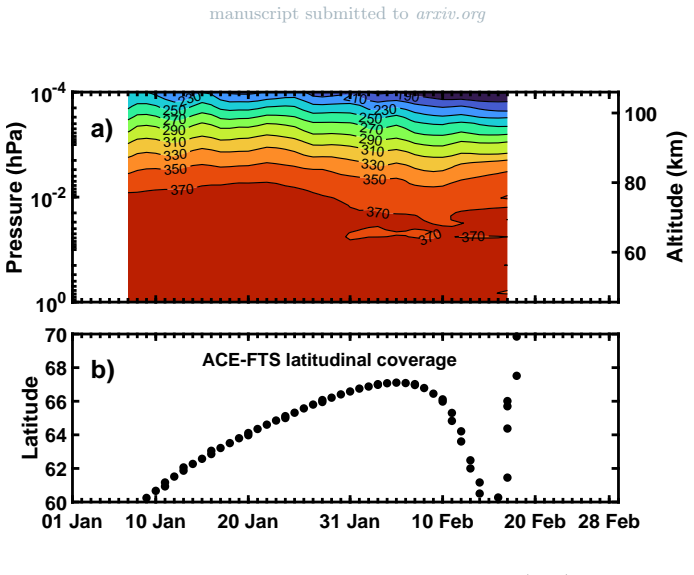
- [Section 2 and Figure 4a] The VMR-to-density conversion is not specified beyond a citation to Finlayson-Pitts and Pitts Jr (1999). The authors must state exactly which temperature and pressure fields are used. If SABER temperature is used at the fixed 0.003 hPa surface, then n_CO2 = VMR * P / (k_B T), so the density anomalies become a 1/T transform of the temperature anomalies. Since SABER temperature and SABER CO2 cooling are both retrieved from the same 15 µm radiance, an anti-correlation between this 1/T proxy and the cooling would arise even for a perfectly constant CO2 VMR. Please redo the conversion with an independent temperature field (e.g., ACE-FTS or WACCM-X) and state the fields explicitly.
- [Section 3.2 and Figure 4a] The printed CO2 density values, approximately 2.5-4.5 × 10^13 cm^-3 at 0.003 hPa (~85 km), are physically implausible. At ~200 K and 0.003 hPa the air number density is about 1.1 × 10^14 cm^-3, so a VMR of 370 ppm corresponds to about 4 × 10^10 cm^-3, not 10^13 cm^-3. This implies a conversion or unit error of roughly three orders of magnitude. Because Section 3.2 and Section 3.4 use these densities to compute percentage anomalies and the O/CO2 and O2/CO2 ratios, the quantitative results and the attribution are directly affected. The authors must correct the conversion and recompute Figures 3, 4, 6, and 7.
- [Section 3.4 and Figure 8] The attribution model is a simplified two-level collisional excitation formula based on reactions R1 and R2 only. It omits radiative absorption, spontaneous emission, and the non-LTE exchange terms that determine the actual 15 µm cooling rate. The decomposition of the cooling variability into temperature, O, and O2 contributions in Figure 8 is therefore not a demonstrated decomposition of the cooling rate itself. Please justify this simplified population-ratio model against a non-LTE cooling calculation, or explicitly reframe the attribution as qualitative rather than quantitative.
- [Section 3.2 and Figures 3-4] The correlation coefficients (-0.865, 0.927, 0.905) are quoted without confidence intervals, significance tests, or a statement of effective sample size. The daily-mean time series are strongly autocorrelated, so the number of independent samples is much smaller than the number of days. In addition, the R = 0.927 between SABER temperature and SABER CO2 cooling is not an independent check, because both quantities are derived from the same 15 µm broadband radiance. Please provide uncertainty estimates and clearly identify which correlations are physically independent.
minor comments (4)
- [Abstract] There are typographical and grammatical errors: 'mesosphere and lower thermospher' should be 'mesosphere and lower thermosphere', and 'such a dramatic events' should be 'such dramatic events'.
- [Figure 4] The axis labels use '#1013' and '#10-8' instead of proper superscript notation. They should be rendered as '×10^13 cm^-3' and '×10^-8 W m^-3' for clarity.
- [Section 3.2] The sentence defining anomalies, 'Δ CO2 = CO2 − CO2', uses the same symbol for the daily value and the pre-SSW mean. Please use an overbar or a distinct symbol for the mean value to avoid ambiguity.
- [Section 3.2] The text states that CO2 density increased during the SSW main phase and decreased during recovery, while Figure 3 shows cooling anomalies of opposite sign. A short table of phase-mean anomalies for CO2 density, temperature, O density, and CO2 IR cooling would make the anti-correlation easier to follow and would help the reader judge the magnitudes.
Circularity Check
The cooling-temperature correlation in Fig. 4b is partly self-referential because both quantities come from the same 15-µm retrieval, and the ACE-FTS CO2 density conversion in Section 2 uses unspecified T/P fields, so the headline anti-correlation may be partly constructed from the temperature field rather than from actual CO2 abundance changes.
-
self definitional
[Section 2 (Data and Methodology); Figure 4b]
"The temperature data is retrieved from the CO 2 15 µm emission and is available from nearly 15 km to 110 km, whereas, the O density data is available from 80 km to 100 km in the SABER database. The CO 2 cooling data available between 30-140 km in the level 2B database has been used. Figure 4: ... SABER-derived CO 2 IR cooling and temperature (b) ... R = 0.927."
Both SABER temperature and SABER CO2 15-µm cooling are derived from the same 15-µm CO2 emission channel. The R = 0.927 in Fig. 4b is therefore not an independent test of the claim that temperature controls the cooling; the two fields share a common radiance source by construction. The Section 4 conclusion that temperature is the major contributing factor is consequently partly built into the retrieval identity rather than being an independent empirical finding.
-
other
[Section 2 (Data and Methodology); Figure 4a]
"The CO 2 mixing ratio in parts per million (ppm) derived from the ACE-FTS Level 2 version 4.1/ 4.2 dataset in the polar region (60 ◦ - 70 ◦ N) has also been converted to density (cm −3) as per the scheme described in Finlayson-Pitts and Pitts Jr (1999)."
The standard conversion n_CO2 = VMR * P/(k_B T) requires temperature and pressure fields, but the paper does not state which fields are used. If SABER temperature, or any temperature field that covaries with SABER 15-µm cooling, was used, then at the fixed 0.003 hPa level the CO2 density anomaly is approximately -ΔT/T plus the VMR anomaly; the Fig. 4a anti-correlation (R = -0.865) would then be largely an ideal-gas transform of the same temperature signal already correlated with the cooling. The printed density values in Fig. 4a (2.5-4.5 × 10^13 cm^-3 at ~370 ppm, 0.003 hPa, ~200 K) are also about three orders of magnitude too large, indicating a conversion or unit inconsistency.
full rationale
The paper is an observational correlation study rather than a parameter-fitting derivation, and no circular self-citation chain is load-bearing: Kumar et al. (2024) is used only for SSW background, and the population-ratio rate coefficients are taken from the external literature (Lopez-Puertas & Taylor, 2001). The ACE-FTS CO2 VMR data and the WACCM-X simulation provide independent support for circulation-driven CO2 changes, so the central claim is not wholly forced. However, two built-in dependencies weaken the causal attribution. First, SABER temperature and SABER CO2 IR cooling are retrieved from the same 15-µm emission, making the Fig. 4b correlation partly self-referential. Second, the conversion of ACE-FTS VMR to density is described only by a textbook citation with no statement of the temperature and pressure fields; if SABER temperature was used, the anti-correlation in Fig. 4a would be partly constructed rather than physically independent. The implausible magnitude of the reported CO2 densities in Fig. 4a reinforces the concern that the conversion is not transparent. These issues do not prove the conclusion false, but they prevent the headline anti-correlation and the 'temperature controls cooling' attribution from being accepted as fully independent observational results.
Assumptions & free parameters
assumptions (4)
- domain assumption SABER temperature and CO2 cooling are accurate retrievals from the 15 um emission, and can be treated as independent enough for the correlation analysis.
- domain assumption The ACE-FTS CO2 VMR to number density conversion uses a temperature/pressure field that does not itself induce the anti-correlation.
- domain assumption The simplified two-level population-ratio model with O and O2 collisional excitation rates from Lopez-Puertas and Taylor (2001) captures the essential physics of CO2 15 um non-LTE emission.
- domain assumption Daily zonal means between 60-70N from sparse ACE-FTS occultation sampling are representative of the polar mesosphere.
Cite this review
Pith. "Pith review of Effect of 2009 major SSW event on the mesospheric CO2 cooling." pith.science (2026). https://pith.science/paper/XC3L4BIN
@misc{pith2026241201081,
  author       = {Pith},
  title        = {Pith review of: Effect of 2009 major SSW event on the mesospheric CO2 cooling},
  year         = {2026},
  howpublished = {\url{https://pith.science/paper/XC3L4BIN}},
  note         = {Machine review of arXiv:2412.01081}
}
read the original abstract
Carbon dioxide (CO2), an important trace species that is gradually increasing in the atmosphere due to anthropogenic activities, causes enhanced warming in the lower atmosphere. The increased concentration of CO2 in the upper atmosphere results in enhanced radiative cooling rates leading to the contraction of the upper atmosphere. Due to its long lifetime and large vertical gradient, CO2 concentration is also influenced by large dynamic events. We report a startling case of variability in CO2 density and its infrared radiative cooling rates in the mesosphere and lower thermospher during a major sudden stratospheric warming (SSW) event. A counter-intuitive connection between CO2 density and resulting CO2 radiative cooling has been observed during the 2009 major SSW event. The behaviour of CO2 cooling rates during such a dramatic events draw attention to our current understanding of CO2 infrared cooling variation and its connection to changes in CO2 concentration. The significance of temperature and atomic oxygen variability in the observed cooling patterns despite changes in CO2 concentration, is also highlighted.
Figures


Figures from the paper (5 more)


Reference graph
Works this paper leans on
-
[1]
apacite url apacite =6pt Acknowledgments. 6pt 1sp \@dates Received \@recvdate\@empty\@rcvaccrule \@recvdate \@revisedate\@empty ; revised \@revisedate; \@accptdate\@empty \@revisedate\@empty; accepted \@accptdate \@pubdate\@empty. ; published \@pubdate. -2pt \@authaddrs @list\@empty =.15in @list 1sp @list =9pt plus 2pt minus 6pt \@sluginfo width 4pc =3000...
2001
-
[2]
\@ifstar \@figbox \@figbox \@figbox#1#2#3 to !#1! #3 [#1][c] !#2!#3 \@tempdima#2 \@tempdima by2 \@tempdima by- \@tempdima by- \@height\@tempdima\@depth\@tempdima\@width @ to @ #3 Bib ??? ??? ??? =0 =0 = @figure=0 @table=0 #1 --#1 -24pt -2ex #1 0= #1 to 0 #1 I NDEX T ERMS: #1 #1 Citation: #1 Feb 9, 2009 Changed name and references to name from agu2001 to a...
work page 2009
-
[3]
ACEFTS APACrefauthors ACE-FTS-Team. APACrefauthors \ 2003 . Atmospheric Chemistry Experiment Fourier Transform Spectrometer Dataet . Atmospheric Chemistry Experiment Fourier Transform Spectrometer Dataet . Canadian Space Agency [Dataset] . APACrefURL http://www.ace.uwaterloo.ca/data.php APACrefURL
work page 2003
-
[4]
akmaev2006impact APACrefauthors Akmaev, R. , Fomichev, V. \ Zhu, X. APACrefauthors \ 2006 . Impact of middle-atmospheric composition changes on greenhouse cooling in the upper atmosphere Impact of middle-atmospheric composition changes on greenhouse cooling in the upper atmosphere . Journal of atmospheric and solar-terrestrial physics 68 17 1879--1889 . A...
-
[5]
, Holton, J R
andrews1987middle APACrefauthors Andrews, D G. , Holton, J R. \ Leovy, C B. APACrefauthors \ 1987 . Middle atmosphere dynamics Middle atmosphere dynamics \ ( 40). Academic press
1987
-
[6]
bailey2014multi APACrefauthors Bailey, S. , Thurairajah, B. , Randall, C. , Holt, L. , Siskind, D. , Harvey, V. Russell, J. APACrefauthors \ 2014 . A multi tracer analysis of thermosphere to stratosphere descent triggered by the 2013 Stratospheric Sudden Warming A multi tracer analysis of thermosphere to stratosphere descent triggered by the 2013 stratosp...
-
[7]
baldwin2021sudden APACrefauthors Baldwin, M P. , Ayarzag \"u ena, B. , Birner, T. , Butchart, N. , Butler, A H. , Charlton-Perez, A J. others APACrefauthors \ 2021 . Sudden stratospheric warmings Sudden stratospheric warmings . Reviews of Geophysics 59 1 e2020RG000708 . APACrefDOI doi:https://doi.org/10.1029/2020RG000708 APACrefDOI
-
[8]
butler2018optimizing APACrefauthors Butler, A H. \ Gerber, E P. APACrefauthors \ 2018 . Optimizing the definition of a sudden stratospheric warming Optimizing the definition of a sudden stratospheric warming . Journal of Climate 31 6 2337--2344 . APACrefDOI doi:https://doi.org/10.1175/JCLI-D-17-0648.1 APACrefDOI
Show all 70 references
-
[9]
, Seidel, D J
butler2015defining APACrefauthors Butler, A H. , Seidel, D J. , Hardiman, S C. , Butchart, N. , Birner, T. \ Match, A. APACrefauthors \ 2015 . Defining sudden stratospheric warmings Defining sudden stratospheric warmings . Bulletin of the American Meteorological Society 96 11 ...
2015 doi
-
[10]
, Black, L A
castle2012vibrational APACrefauthors Castle, K J. , Black, L A. , Simione, M W. \ Dodd, J A. APACrefauthors \ 2012 . Vibrational Relaxation of CO2 ( 2) by O (3P) in the 142--490 K Temperature Range Vibrational relaxation of co2 ( 2) by o (3p) in the 142--490 k temperature rang...
2012 doi
-
[11]
, Kleissas, K M
castle2006vibrational APACrefauthors Castle, K J. , Kleissas, K M. , Rhinehart, J M. , Hwang, E S. \ Dodd, J A. APACrefauthors \ 2006 . Vibrational relaxation of CO2 ( 2) by atomic oxygen Vibrational relaxation of co2 ( 2) by atomic oxygen . Journal of Geophysical Research: Sp...
2006 doi
-
[12]
, Kockarts, G
chabrillat2002impact APACrefauthors Chabrillat, S. , Kockarts, G. , Fonteyn, D. \ Brasseur, G. APACrefauthors \ 2002 . Impact of molecular diffusion on the CO2 distribution and the temperature in the mesosphere Impact of molecular diffusion on the co2 distribution and the temp...
2002 doi
-
[13]
, Collins, R
chandran2014stratosphere APACrefauthors Chandran, A. , Collins, R. \ Harvey, V. APACrefauthors \ 2014 . Stratosphere-mesosphere coupling during stratospheric sudden warming events Stratosphere-mesosphere coupling during stratospheric sudden warming events . Advances in Space R...
2014 doi
-
[14]
\ Polvani, L M
charlton2007new APACrefauthors Charlton, A J. \ Polvani, L M. APACrefauthors \ 2007 . A new look at stratospheric sudden warmings. Part I: Climatology and modeling benchmarks A new look at stratospheric sudden warmings. part i: Climatology and modeling benchmarks . Journal of ...
2007 doi
-
[15]
APACrefauthors \ 1984
dickinson1984infrared APACrefauthors Dickinson, R E. APACrefauthors \ 1984 . Infrared radiative cooling in the mesosphere and lower thermosphere Infrared radiative cooling in the mesosphere and lower thermosphere . Journal of atmospheric and terrestrial physics 46 11 995--1008...
1984 doi
-
[16]
, Mlynczak, M G
esplin2023sounding APACrefauthors Esplin, R. , Mlynczak, M G. , Russell, J. , Gordley, L. \ Team, S. APACrefauthors \ 2023 . Sounding of the Atmosphere using Broadband Emission Radiometry (SABER): Instrument and science measurement description Sounding of the atmosphere using ...
2023 doi
-
[17]
\ Pitts Jr, J N
finlayson1999chemistry APACrefauthors Finlayson-Pitts, B J. \ Pitts Jr, J N. APACrefauthors \ 1999 . Chemistry of the upper and lower atmosphere: theory, experiments, and applications Chemistry of the upper and lower atmosphere: theory, experiments, and applications . Elsevier
1999
-
[18]
, Ch \'e din, A
foucher2011carbon APACrefauthors Foucher, P. , Ch \'e din, A. , Armante, R. , Boone, C. , Crevoisier, C. \ Bernath, P. APACrefauthors \ 2011 . Carbon dioxide atmospheric vertical profiles retrieved from space observation using ACE-FTS solar occultation instrument Carbon dioxid...
2011 doi
-
[19]
, L \'o pez-Puertas, M
funke2010evidence APACrefauthors Funke, B. , L \'o pez-Puertas, M. , Bermejo-Pantale \'o n, D. , Garc \' a-Comas, M. , Stiller, G. , Von Clarmann, T. Linden, A. APACrefauthors \ 2010 . Evidence for dynamical coupling from the lower atmosphere to the thermosphere during a major...
2010 doi
-
[20]
gao2011temporal APACrefauthors Gao, H. , Xu, J. , Ward, W. \ Smith, A K. APACrefauthors \ 2011 . Temporal evolution of nightglow emission responses to SSW events observed by TIMED/SABER Temporal evolution of nightglow emission responses to ssw events observed by timed/saber . ...
2011 doi
-
[21]
, L \'o pez-Puertas, M
garcia2016secular APACrefauthors Garcia, R R. , L \'o pez-Puertas, M. , Funke, B. , Kinnison, D E. , Marsh, D R. \ Qian, L. APACrefauthors \ 2016 . On the secular trend of COx and CO2 in the lower thermosphere On the secular trend of cox and co2 in the lower thermosphere . Jou...
2016 doi
-
[22]
, L \'o pez-Puertas, M
garcia2014distribution APACrefauthors Garcia, R R. , L \'o pez-Puertas, M. , Funke, B. , Marsh, D R. , Kinnison, D E. , Smith, A K. \ Gonz \'a lez-Galindo, F. APACrefauthors \ 2014 . On the distribution of CO2 and CO in the mesosphere and lower thermosphere On the distribution...
2014 doi
-
[23]
, Smith, A K
garcia2017modification APACrefauthors Garcia, R R. , Smith, A K. , Kinnison, D E. , de la C \'a mara, \'A . \ Murphy, D J. APACrefauthors \ 2017 . Modification of the gravity wave parameterization in the Whole Atmosphere Community Climate Model: Motivation and results Modifica...
2017 doi
-
[24]
APACrefauthors \ 2019
WACCMX2023 APACrefauthors Gasperini, F. APACrefauthors \ 2019 . CCSM run SD-WACCM-X Version 1 Daily Averaged Atmosphere History Data. Ccsm run sd-waccm-x version 1 daily averaged atmosphere history data. Earthsystemgrid [Dataset] . APACrefURL https://www.earthsystemgrid.org/da...
2019 doi
-
[25]
\ Alexander, M J
holton2000role APACrefauthors Holton, J R. \ Alexander, M J. APACrefauthors \ 2000 . The role of waves in the transport circulation of the middle atmosphere The role of waves in the transport circulation of the middle atmosphere . Washington DC American Geophysical Union Geoph...
2000 doi
-
[26]
APACrefauthors \ 1969
houghton1969absorption APACrefauthors Houghton, J. APACrefauthors \ 1969 . Absorption and emission by carbon-dioxide in the mesosphere Absorption and emission by carbon-dioxide in the mesosphere . Quarterly Journal of the Royal Meteorological Society 95 403 1--20 . APACrefDOI ...
1969 doi
-
[27]
, Mukougawa, H
kodera2016absorbing APACrefauthors Kodera, K. , Mukougawa, H. , Maury, P. , Ueda, M. \ Claud, C. APACrefauthors \ 2016 . Absorbing and reflecting sudden stratospheric warming events and their relationship with tropospheric circulation Absorbing and reflecting sudden stratosphe...
2016 doi
-
[28]
\ London, J
kuhn1969infrared APACrefauthors Kuhn, W R. \ London, J. APACrefauthors \ 1969 . Infrared radiative cooling in the middle atmosphere (30--110 km) Infrared radiative cooling in the middle atmosphere (30--110 km) . Journal of the Atmospheric Sciences 26 2 189--204 . APACrefDOI ht...
1969 doi
-
[29]
, Krishna, M S
kumar2024influence APACrefauthors Kumar, A. , Krishna, M S. , Ranjan, A K. , Bender, S. , Sinnhuber, M. \ Sarkhel, S. APACrefauthors \ 2024 . Influence of temperature changes and vertically transported trace species on the structure of MLT region during major SSW events Influe...
2024
-
[30]
\ Ahuja, D R
lashof1990relative APACrefauthors Lashof, D A. \ Ahuja, D R. APACrefauthors \ 1990 . Relative contributions of greenhouse gas emissions to global warming Relative contributions of greenhouse gas emissions to global warming . Nature 344 6266 529--531 . APACrefDOI doi:https://do...
1990 doi
-
[31]
APACrefauthors \ 2023
lavstovivcka2023progress APACrefauthors La s tovi c ka, J. APACrefauthors \ 2023 . Progress in investigating long-term trends in the mesosphere, thermosphere, and ionosphere Progress in investigating long-term trends in the mesosphere, thermosphere, and ionosphere . Atmospheri...
2023 doi
-
[32]
, Orsolini, Y J
limpasuvan2016composite APACrefauthors Limpasuvan, V. , Orsolini, Y J. , Chandran, A. , Garcia, R R. \ Smith, A K. APACrefauthors \ 2016 . On the composite response of the MLT to major sudden stratospheric warming events with elevated stratopause On the composite response of t...
2016 doi
-
[33]
, Richter, J H
limpasuvan2012roles APACrefauthors Limpasuvan, V. , Richter, J H. , Orsolini, Y J. , Stordal, F. \ Kvissel, O K. APACrefauthors \ 2012 . The roles of planetary and gravity waves during a major stratospheric sudden warming as characterized in WACCM The roles of planetary and gr...
2012 doi
-
[34]
, Bardeen, C G
liu2018development APACrefauthors Liu, H L. , Bardeen, C G. , Foster, B T. , Lauritzen, P. , Liu, J. , Lu, G. others APACrefauthors \ 2018 . Development and validation of the Whole Atmosphere Community Climate Model with thermosphere and ionosphere extension (WACCM-X 2.0) Deve...
2018
-
[35]
\ Roble, R
liu2002study APACrefauthors Liu, H L. \ Roble, R. APACrefauthors \ 2002 . A study of a self-generated stratospheric sudden warming and its mesospheric--lower thermospheric impacts using the coupled TIME-GCM/CCM3 A study of a self-generated stratospheric sudden warming and its ...
2002 doi
-
[36]
\ Roble, R
liu2005dynamical APACrefauthors Liu, H L. \ Roble, R. APACrefauthors \ 2005 . Dynamical coupling of the stratosphere and mesosphere in the 2002 Southern Hemisphere major stratospheric sudden warming Dynamical coupling of the stratosphere and mesosphere in the 2002 southern hem...
2005 doi
-
[37]
, L \'o pez-Valverde, M \'A
lopez2000review APACrefauthors L \'o pez-Puertas, M. , L \'o pez-Valverde, M \'A . , Garcia, R R. \ Roble, R G. APACrefauthors \ 2000 . A review of CO2 and CO abundances in the middle atmosphere A review of co2 and co abundances in the middle atmosphere . Washington DC America...
-
[38]
\ Taylor, F W
lopez2001non APACrefauthors L \'o pez-Puertas, M. \ Taylor, F W. APACrefauthors \ 2001 . Non-LTE radiative transfer in the Atmosphere Non-lte radiative transfer in the atmosphere \ ( 3). World Scientific . APACrefDOI doi:https://doi.org/10.1142/4650 APACrefDOI
2001 doi
-
[39]
, Schwartz, M J
manney2009aura APACrefauthors Manney, G L. , Schwartz, M J. , Kr \"u ger, K. , Santee, M L. , Pawson, S. , Lee, J N. Livesey, N J. APACrefauthors \ 2009 . Aura Microwave Limb Sounder observations of dynamics and transport during the record-breaking 2009 Arctic stratospheric ma...
2009
-
[40]
APACrefauthors \ 1971
matsuno1971dynamical APACrefauthors Matsuno, T. APACrefauthors \ 1971 . A dynamical model of the stratospheric sudden warming A dynamical model of the stratospheric sudden warming . Journal of Atmospheric Sciences 28 8 1479--1494 . APACrefDOI doi:https://doi.org/10.1175/1520-0...
1971 doi
-
[41]
APACrefauthors \ 2000
mlynczak2000contemporary APACrefauthors Mlynczak, M G. APACrefauthors \ 2000 . A contemporary assessment of the mesospheric energy budget A contemporary assessment of the mesospheric energy budget . Washington DC American Geophysical Union Geophysical Monograph Series 123 37--...
2000 doi
-
[42]
, Hunt, L A
mlynczak2022cooling APACrefauthors Mlynczak, M G. , Hunt, L A. , Garcia, R R. , Harvey, V L. , Marshall, B T. , Yue, J. Russell III, J M. APACrefauthors \ 2022 . Cooling and Contraction of the Mesosphere and Lower Thermosphere from 2002 to 2021 Cooling and contraction of the m...
2022 doi
-
[43]
, Hunt, L A
mlynczak2018updated APACrefauthors Mlynczak, M G. , Hunt, L A. , Russell III, J M. \ Marshall, B T. APACrefauthors \ 2018 . Updated SABER night atomic oxygen and implications for SABER ozone and atomic hydrogen Updated saber night atomic oxygen and implications for saber ozone...
2018 doi
-
[44]
, Hunt, L A
mlynczak2010observations APACrefauthors Mlynczak, M G. , Hunt, L A. , Thomas Marshall, B. , Martin-Torres, F J. , Mertens, C J. , Russell III, J M. others APACrefauthors \ 2010 . Observations of infrared radiative cooling in the thermosphere on daily to multiyear timescales fr...
2010
-
[45]
, Zhang, J
orsolini2022abrupt APACrefauthors Orsolini, Y J. , Zhang, J. \ Limpasuvan, V. APACrefauthors \ 2022 . Abrupt change in the lower thermospheric mean meridional circulation during sudden stratospheric warmings and its impact on trace species Abrupt change in the lower thermosphe...
2022 doi
-
[46]
, Burns, A G
qian2017carbon APACrefauthors Qian, L. , Burns, A G. , Solomon, S C. \ Wang, W. APACrefauthors \ 2017 . Carbon dioxide trends in the mesosphere and lower thermosphere Carbon dioxide trends in the mesosphere and lower thermosphere . Journal of Geophysical Research: Space Physic...
2017 doi
-
[47]
, Harvey, V L
randall2009nox APACrefauthors Randall, C. , Harvey, V L. , Siskind, D. , France, J. , Bernath, P. , Boone, C. \ Walker, K. APACrefauthors \ 2009 . NOx descent in the Arctic middle atmosphere in early 2009 Nox descent in the arctic middle atmosphere in early 2009 . Geophysical ...
2009 doi
-
[48]
Greenhouse cooling
roble1993greenhouse APACrefauthors Roble, R. APACrefauthors \ 1993 . “Greenhouse cooling” of the upper atmosphere. “greenhouse cooling” of the upper atmosphere. Wiley Online Library . APACrefDOI doi:https://doi.org/10.1029/93EO00233 APACrefDOI
1993 doi
-
[49]
\ Dickinson, R
roble1989will APACrefauthors Roble, R. \ Dickinson, R. APACrefauthors \ 1989 . How will changes in carbon dioxide and methane modify the mean structure of the mesosphere and thermosphere? How will changes in carbon dioxide and methane modify the mean structure of the mesospher...
1989 doi
-
[50]
, Mlynczak, M G
russell1999overview APACrefauthors Russell III, J M. , Mlynczak, M G. , Gordley, L L. , Tansock Jr, J J. \ Esplin, R W. APACrefauthors \ 1999 . Overview of the SABER experiment and preliminary calibration results Overview of the saber experiment and preliminary calibration res...
1999
-
[51]
APACrefauthors \ 2002
SABER2023 APACrefauthors SABER-Team. APACrefauthors \ 2002 . Sounding of the Atmosphere using Broadband Emission Radiometry (SABER) Data from TIMED . Sounding of the Atmosphere using Broadband Emission Radiometry (SABER) Data from TIMED . SABER [Dataset] . APACrefURL http://ga...
2002
-
[52]
APACrefauthors \ 1960
scherhag1960stratospheric APACrefauthors Scherhag, R. APACrefauthors \ 1960 . Stratospheric temperature changes and the associated changes in pressure distribution Stratospheric temperature changes and the associated changes in pressure distribution . Journal of Atmospheric Sc...
1960 doi
-
[53]
APACrefauthors \ 1978
schoeberl1978stratospheric APACrefauthors Schoeberl, M R. APACrefauthors \ 1978 . Stratospheric warmings: Observations and theory Stratospheric warmings: Observations and theory . Reviews of Geophysics 16 4 521--538 . APACrefDOI doi:https://doi.org/10.1029/RG016i004p00521 APACrefDOI
1978 doi
-
[54]
\ Wintersteiner, P P
sharma1990role APACrefauthors Sharma, R D. \ Wintersteiner, P P. APACrefauthors \ 1990 . Role of carbon dioxide in cooling planetary thermospheres Role of carbon dioxide in cooling planetary thermospheres . Geophysical Research Letters 17 12 2201--2204 . APACrefDOI doi:https:/...
1990 doi
-
[55]
, Beagley, S
shepherd2014stratospheric APACrefauthors Shepherd, M. , Beagley, S. \ Fomichev, V. APACrefauthors \ 2014 . Stratospheric warming influence on the mesosphere/lower thermosphere as seen by the extended CMAM Stratospheric warming influence on the mesosphere/lower thermosphere as ...
2014 doi
-
[56]
, Khvorostovskaya, L E
shved2003measurement APACrefauthors Shved, G M. , Khvorostovskaya, L E. , Potekhin, I Y. , Ogibalov, V P. \ Uzyukova, T V. APACrefauthors \ 2003 . Measurement of rate constant for quenching CO2 (0110) by atomic oxygen at low temperatures: reassessment of the population of CO2 ...
2003
-
[57]
, Coy, L
siskind2005observations APACrefauthors Siskind, D E. , Coy, L. \ Espy, P. APACrefauthors \ 2005 . Observations of stratospheric warmings and mesospheric coolings by the TIMED SABER instrument Observations of stratospheric warmings and mesospheric coolings by the timed saber in...
2005 doi
-
[58]
, Eckermann, S D
siskind2007recent APACrefauthors Siskind, D E. , Eckermann, S D. , Coy, L. , McCormack, J P. \ Randall, C E. APACrefauthors \ 2007 . On recent interannual variability of the Arctic winter mesosphere: Implications for tracer descent On recent interannual variability of the arct...
2007 doi
-
[59]
APACrefauthors \ 2012
smith2012global APACrefauthors Smith, A K. APACrefauthors \ 2012 . Global dynamics of the MLT Global dynamics of the mlt . Surveys in Geophysics 33 6 1177--1230 . APACrefDOI doi:https://doi.org/10.1007/s10712-012-9196-9 APACrefDOI
2012 doi
-
[60]
, Garcia, R R
smith2011waccm APACrefauthors Smith, A K. , Garcia, R R. , Marsh, D R. \ Richter, J H. APACrefauthors \ 2011 . WACCM simulations of the mean circulation and trace species transport in the winter mesosphere Waccm simulations of the mean circulation and trace species transport i...
2011 doi
-
[61]
, Plattner, G K
solomon2009irreversible APACrefauthors Solomon, S. , Plattner, G K. , Knutti, R. \ Friedlingstein, P. APACrefauthors \ 2009 . Irreversible climate change due to carbon dioxide emissions Irreversible climate change due to carbon dioxide emissions . Proceedings of the national a...
2009 doi
-
[62]
, Chateauneuf, F
soucy2002ace APACrefauthors Soucy, M A A. , Chateauneuf, F. , Deutsch, C. \ Etienne, N. APACrefauthors \ 2002 . ACE-FTS instrument detailed design Ace-fts instrument detailed design . Earth Observing Systems VII Earth observing systems vii \ ( \ 4814, \ 70--81). APACrefDOI doi...
2002 doi
-
[63]
, Qian, L
wang2022climatology APACrefauthors Wang, N. , Qian, L. , Yue, J. , Wang, W. , Mlynczak, M G. \ Russell III, J M. APACrefauthors \ 2022 . Climatology of Mesosphere and Lower Thermosphere Residual Circulations and Mesopause Height Derived From SABER Observations Climatology of m...
2022 doi
-
[64]
, Shulga, V
wang2019winter APACrefauthors Wang, Y. , Shulga, V. , Milinevsky, G. , Patoka, A. , Evtushevsky, O. , Klekociuk, A. others APACrefauthors \ 2019 . Winter 2018 major sudden stratospheric warming impact on midlatitude mesosphere from microwave radiometer measurements Winter 2018...
2019 doi
-
[65]
\ Fomichev, V I
ward1993role APACrefauthors Ward, W E. \ Fomichev, V I. APACrefauthors \ 1993 . On the role of atomic oxygen in the dynamics and energy budget of the mesosphere and lower thermosphere On the role of atomic oxygen in the dynamics and energy budget of the mesosphere and lower th...
1993 doi
-
[66]
, Picard, R H
wintersteiner1992line APACrefauthors Wintersteiner, P P. , Picard, R H. , Sharma, R D. , Winick, J R. \ Joseph, R A. APACrefauthors \ 1992 . Line-by-line radiative excitation model for the non-equilibrium atmosphere: Application to CO2 15- m emission Line-by-line radiative exc...
1992 doi
-
[67]
, Smith, A
xu2003numerical APACrefauthors Xu, J. , Smith, A. \ Ma, R. APACrefauthors \ 2003 . A numerical study of the effect of gravity-wave propagation on minor species distributions in the mesopause region A numerical study of the effect of gravity-wave propagation on minor species di...
2003 doi
-
[68]
, Kn \' z ov \'a , P K
yiugit2016review APACrefauthors Yi g it, E. , Kn \' z ov \'a , P K. , Georgieva, K. \ Ward, W. APACrefauthors \ 2016 . A review of vertical coupling in the Atmosphere--Ionosphere system: Effects of waves, sudden stratospheric warmings, space weather, and of solar activity A re...
2016
-
[69]
, Russell III, J
yue2015increasing APACrefauthors Yue, J. , Russell III, J. , Jian, Y. , Rezac, L. , Garcia, R. , L \'o pez-Puertas, M. \ Mlynczak, M G. APACrefauthors \ 2015 . Increasing carbon dioxide concentration in the upper atmosphere observed by SABER Increasing carbon dioxide concentra...
2015 doi
-
[70]
\ Becker, E
zulicke2013structure APACrefauthors Z \"u licke, C. \ Becker, E. APACrefauthors \ 2013 . The structure of the mesosphere during sudden stratospheric warmings in a global circulation model The structure of the mesosphere during sudden stratospheric warmings in a global circulat...
2013 doi
Reviewed August 12, 2026 · model on record in the stance chip above.
Discussion (0). Continue with ORCID to comment.