REVIEW 5 major objections 5 minor 43 references
Neural Network-Based Frequency Optimization for Superconducting Quantum Chips
T0 review · 5 major / 5 minor · reviewed 2026-08-12 · deepseek-v4-flash
Pith's one-line read A neural network that predicts gate errors from a full frequency configuration can pick operating frequencies that beat Google's snake optimizer on single-qubit and two-qubit benchmarks.
desk verdict A useful, incremental engineering method for frequency allocation on tunable superconducting qubits, with genuine hardware benchmarks but missing stability checks and experimental details. read the letter →
The pith
A machine-rendered reading of the paper's core claim, the machinery that carries it, and where it could break.
The reading
What carries the argument
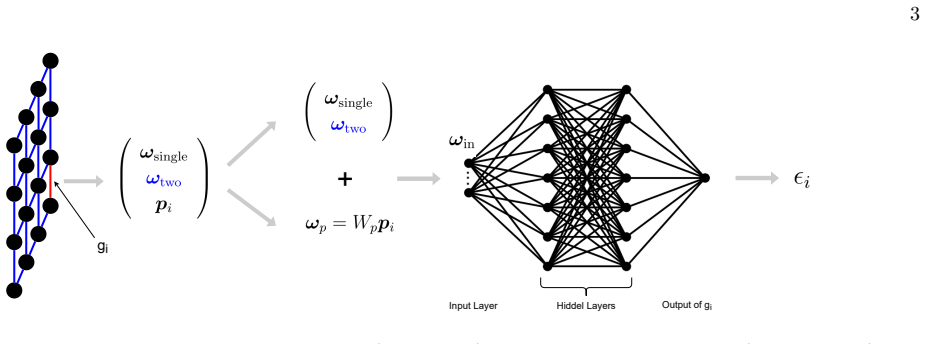
The load-bearing object is a multilayer perceptron used as a gate-error estimator. Its input concatenates the normalized frequencies of every single-qubit and two-qubit gate with a learned position-embedding vector that marks which gate's error the network is predicting; the output is that gate's predicted error under the given configuration. Because the network learns from measured errors rather than analytical formulas, it can absorb nonlinear error mechanisms like stray coupling, microwave crosstalk, and gate distortion without explicit calibration of T1, T2, or coupling strengths. The companion optimization machinery is windowed iterative search: compute predicted errors over the whole chip, select the fixed-radius window S with the highest average error, re-optimize frequencies inside that window, and repeat until convergence. Larger window radii give lower converged average errors but require more computation, so S is a practical trade-off parameter.
What would settle it
Run the same randomized benchmarking and cross-entropy benchmarking at successive times after the optimization, for example every few hours across a day, and check whether the advantage over Google's snake configuration persists. If the error rates of the neural-network configuration rise to match or exceed the snake baseline as defects or flux conditions drift, the central claim of landscape-stable optimization fails.
Extended reading notes
Core claim
The central claim is that frequency assignment for frequency-tunable superconducting chips is best treated as a learned optimization problem, not as fitting a linear error model. The network takes all single-qubit and two-qubit gate frequencies, normalized to (0,1), adds a trainable position embedding for the target gate, and outputs a predicted error; training on measured errors lets it capture nonlinear mechanisms such as stray coupling, microwave crosstalk, and gate distortion. Optimization starts from a random configuration, identifies the local window S with the highest predicted average error, re-optimizes frequencies inside S, and iterates roughly 40 times to push the predicted global average below $10^{-2}$. Measured results on the chip are average single-qubit RB errors of 0.49%, two-qubit XEB errors of 1.31%, with the snake baseline at 0.78% and 1.45% and random two-qubit errors at 23.3%. For VQE, optimized frequencies yield lower H4 potential energy surfaces than random configurations under the same ansatz.
Load-bearing premise
The whole scheme assumes the chip's error landscape stays the same from the calibration runs that train the network through the later benchmarks; the paper does not test how quickly defects, magnetic-flux conditions, or dephasing drift invalidate the chosen frequencies.
Editorial extensions
If this is right
- Hardware control can stay simple: frequency optimization substitutes for compensation pulses and two-tone flux modulation, so fewer control-system modifications are needed to suppress crosstalk and decoherence.
- The windowed search scales to larger chips because it avoids the exponential brute-force search over O(|F|^{3MN}) configurations, trading global optimality for tractable local improvements.
- Frequency configuration and circuit compilation become coupled: the crosstalk-aware HEA results show that ansatz design and frequency selection should be co-optimized for good VQE energies.
- The neural network needs far fewer calibration configurations than Google's approach (500 test configurations versus 6500) to predict errors at comparable accuracy, lowering the calibration cost of deploying the method on a new chip.
Reading between the lines
- Because the network is trained per chip, cross-chip transfer is the obvious next test: a small calibration set on a second chip might be enough to fine-tune the estimator and re-optimize, which the paper does not attempt.
- The 94.4% two-qubit improvement over random is mostly a statement about how bad random configurations are; the meaningful comparison is the 9.7% gain over snake, and a stronger test would run many snake restarts and compare best-of-N outcomes.
- If the error landscape is stable on the timescale of a VQE run, the same surrogate could be used inside the optimizer loop to re-tune frequencies on the fly between variational iterations, something the authors list only as future work.
- The four-group ABCD/EFGH pattern fixes one parallelization scheme; allowing the optimizer to choose among multiple patterns per layer would enlarge the search space and could further lower crosstalk-limited errors.
Signed reviews
Editorial analysis
A structured set of objections, weighed in public.
Referee Report
Summary. The paper proposes a neural-network-based frequency allocation method for frequency-tunable superconducting quantum processors. A multilayer perceptron with position embedding predicts per-gate error rates from a full frequency configuration, and a local 'window' optimization iteratively adjusts the worst-performing region of the chip. The authors validate the approach on real hardware: optimized configurations are compared against Google's snake optimizer and random configurations using single-qubit randomization benchmarking (RB) and two-qubit cross-entropy benchmarking (XEB), reporting average error reductions of 37.1% and 52.0% for single-qubit gates and 9.7% and 94.4% for two-qubit gates. They also demonstrate improved H4 potential-energy curves in a variational quantum eigensolver (VQE) with a crosstalk-aware hardware-efficient ansatz. The manuscript is concise (8 pages with figures) but omits several experimental details that are important for reproducibility.
Significance. The central direction is plausible and the validation uses genuine measured RB and XEB data, which is a strength; the headline claim does not rely circularly on the network's own predictions. If the results hold with proper statistical and temporal controls, the method would be a useful addition to calibration strategies for frequency-tunable chips, particularly because it avoids hand-crafted error models. However, the paper currently lacks the experimental reporting needed to support the quantitative claims: no error bars or sample sizes, no description of the baseline implementation, no stability check, and an underspecified local optimization procedure. The neural-network test error (22.8% median relative error) is presented without discussion of how it propagates to the optimized configurations.
major comments (5)
- [Experimental validation (Fig. 6)] The claimed error reductions lack statistical support. The differences between the neural-network and snake configurations are small (0.49% vs 0.78% for single-qubit; 1.31% vs 1.45% for two-qubit), and the paper provides no error bars, confidence intervals, or number of independent experimental runs. For example, the 9.7% two-qubit reduction could be within run-to-run fluctuation. The authors should report standard deviations or confidence intervals for each configuration and state how many shots and repetitions were used. This is load-bearing because the main claim is that the optimized configuration reduces errors relative to the snake baseline.
- [Error Mechanisms (Fig. 1a) and experimental section] The paper assumes the error landscape is stationary from the calibration measurements used to train the neural network through the subsequent RB/XEB/VQE runs. The paper itself notes that T1 drops sharply at TLS defect points and that dephasing grows with dω/dϕ; both are time-dependent in real devices. No timestamps, no repeated measurements of the same configuration over time, and no test of whether the optimized configuration remains low-error after the training campaign are provided. Without a stability check, the measured improvements could be confounded by drift of TLS defects or flux conditions. The authors should either provide evidence of stability (e.g., repeated benchmarking over several days) or explicitly qualify the results as single-time-slice observations.
- [Frequency Configuration Strategy (Fig. 5)] The local window optimization is underspecified. The text states that for each window the frequencies are 'optimized' but does not describe the inner optimization procedure (e.g., exhaustive search over discretized frequencies, gradient-based, or heuristic), the window radius in terms of gates, the frequency step δf, or the number of iterations. This makes the method impossible to reproduce and leaves open the possibility that the success depends on an ad hoc choice of S or δf. The figure shows results for S radius 1–4, but the actual value used in the experiments is not stated.
- [Comparison with Google's snake baseline] The Google snake baseline is not described. The paper cites refs. [24] and [19] but does not say how the baseline was implemented on the authors' chip, what parameters or error model the snake optimizer used, or whether the same calibration data and gate set were used. Without this, the 37.1% and 9.7% improvement claims cannot be independently assessed, and the comparison may be unfair.
- [Neural Network Error Estimator (Fig. 3)] The training set size and hardware specifications are missing. The paper reports only the test set of 500 configurations and the median relative error of 22.8%, but does not state how many configurations were used for training, how many gates the chip has, or how the data were split. Since the optimization may search over configurations far from the training distribution, the paper should discuss whether the optimized configurations lie within the NN's validated input region and how the 22.8% relative error propagates to the final configuration selection.
minor comments (5)
- [Fig. 2] The label 'Hiddel Layers' should be 'Hidden Layers'.
- [Fig. 3] The axis labels 'relav inacc' and 'relev inacc' are typos; use 'relative error' and 'absolute error'.
- [Section heading] The heading 'F requency configuration for HEA' contains a stray space; it should read 'Frequency configuration for HEA'.
- [Eq. (1) and surrounding text] The description of the network input is inconsistent: the text says the input vector is (ωsingle, ωtwo, pi) but Eq. (1) defines ωin = (ωsingle, ωtwo) and then adds ωp = Wp pi. Please clarify that the final input is ω = ωin + ωp.
- [Experimental setup] The manuscript does not specify the chip size, qubit architecture, or coherence times; for a paper on a specific experimental platform, this information is necessary for context and reproducibility.
Circularity Check
No circularity: the central claim is validated by fresh RB/XEB measurements, not by the neural network's own predictions.
full rationale
The derivation chain is: (i) train an MLP on measured single- and two-qubit gate errors across sampled frequency configurations, with a held-out test set; (ii) use the trained network as a surrogate cost model in an iterative local-window optimizer to choose a frequency configuration; (iii) independently measure RB/XEB errors on the chosen configuration and compare with Google's snake optimizer and random configurations. Step (iii) is real hardware measurement, not the network's output, so the central claim does not reduce to the fit. The VQE comparison is likewise a fresh measurement of energies under optimized vs random configurations. The only self-citation, [16] (CAMEL, same group), supports the physical statement that crosstalk arises when qubit frequencies come into resonance; this is a standard mechanism and is not load-bearing for the NN-based optimization or for the benchmark comparison. The paper's own caveat about TLS defects and flux sensitivity is a stability assumption, not a circular definition. No equation equates the predicted error with the measured benchmark, and no fitted parameter is renamed as a prediction. Hence no significant circularity.
Assumptions & free parameters
free parameters (4)
- Neural network weights (MLP and position embedding) =
not reported
- Window radius S =
1, 2, 3, 4 explored; final value not explicitly reported
- Frequency discretization step delta_f =
not reported
- Hidden layer sizes, activation function, and training hyperparameters =
not reported
assumptions (3)
- domain assumption Each gate's error rate is a deterministic, learnable function of the full frequency configuration
- domain assumption The four-group coupler activation pattern is representative enough that optimizing for it improves the circuits actually run
- domain assumption RB and XEB error rates measured after optimization are representative of the errors occurring in the VQE circuit
Cite this review
Pith. "Pith review of Neural Network-Based Frequency Optimization for Superconducting Quantum Chips." pith.science (2026). https://pith.science/paper/RWJ65YKW
@misc{pith2026241201183,
  author       = {Pith},
  title        = {Pith review of: Neural Network-Based Frequency Optimization for Superconducting Quantum Chips},
  year         = {2026},
  howpublished = {\url{https://pith.science/paper/RWJ65YKW}},
  note         = {Machine review of arXiv:2412.01183}
}
read the original abstract
Optimizing the frequency configuration of qubits and quantum gates in superconducting quantum chips presents a complex NP-complete optimization challenge. This process is critical for enabling practical control while minimizing decoherence and suppressing significant crosstalk. In this paper, we propose a neural network-based frequency configuration approach. A trained neural network model estimates frequency configuration errors, and an intermediate optimization strategy identifies optimal configurations within localized regions of the chip. The effectiveness of our method is validated through randomized benchmarking and cross-entropy benchmarking. Furthermore, we design a crosstalk-aware hardware-efficient ansatz for variational quantum eigensolvers, achieving improved energy computations.
Figures


Figures from the paper (4 more)


Reference graph
Works this paper leans on
-
[24]
Y. Ding, P. Gokhale, S. F. Lin, R. Rines, T. P. Propson, and F. T. Chong, Systematic crosstalk mitigation for su- perconducting qubits via frequency-aware compilation, 2020 53rd Annual IEEE/ACM International Symposium on Microarchitecture (MICRO) , 201 (2020)
work page 2020
-
[19]
P. V. Klimov, J. Kelly, J. M. Martinis, and H. Neven, The snake optimizer for learning quantum processor control parameters, arXiv preprint arXiv:2006.04594 (2020)
arXiv 2020
-
[1]
Horsman, A
D. Horsman, A. G. Fowler, S. Devitt, and R. Van Meter, Surface code quantum computing by lattice surgery, New Journal of Physics 14, 123011 (2012)
2012
-
[2]
C. Chamberland, G. Zhu, T. J. Yoder, J. B. Hertzberg, and A. W. Cross, Topological and subsystem codes on low-degree graphs with flag qubits, Physical Review X 10, 011022 (2020)
work page 2020
-
[3]
T. Jochym-O’Connor and R. Laflamme, Using concate- nated quantum codes for universal fault-tolerant quan- tum gates, Physical review letters 112, 010505 (2014)
work page 2014
-
[4]
A. Paetznick and B. W. Reichardt, Universal fault- tolerant quantum computation with only transversal gates¡? format?¿ and error correction, Physical review letters 111, 090505 (2013)
work page 2013
-
[5]
Boixo, S
S. Boixo, S. V. Isakov, V. N. Smelyanskiy, R. Babbush, N. Ding, Z. Jiang, M. J. Bremner, J. M. Martinis, and H. Neven, Characterizing quantum supremacy in near- term devices, Nature Physics 14, 595 (2018)
2018
- [6]
Show all 43 references
-
[7]
P. Zhao, K. Linghu, Z. Li, P. Xu, R. Wang, G. Xue, Y. Jin, and H. Yu, Quantum crosstalk analysis for simul- taneous gate operations on superconducting qubits, PRX quantum 3, 020301 (2022)
2022
-
[8]
Krinner, S
S. Krinner, S. Lazar, A. Remm, C. K. Andersen, N. Lacroix, G. J. Norris, C. Hellings, M. Gabureac, C. Eichler, and A. Wallraff, Benchmarking coherent er- rors in controlled-phase gates due to spectator qubits, Physical Review Applied 14, 024042 (2020)
2020
-
[9]
S. Seo, J. Seong, and J. Bae, Mitigation of crosstalk errors in a quantum measurement and its applications, arXiv preprint arXiv:2112.10651 (2021)
2021 arXiv
-
[10]
P. Zhao, Y. Zhang, X. Li, J. Han, H. Xu, G. Xue, Y. Jin, and H. Yu, Spurious microwave crosstalk in floating su- perconducting circuits, arXiv preprint arXiv:2206.03710 (2022)
2022 arXiv
-
[11]
F. Yan, P. Krantz, Y. Sung, M. Kjaergaard, D. L. Camp- bell, T. P. Orlando, S. Gustavsson, and W. D. Oliver, Tunable coupling scheme for implementing high-fidelity two-qubit gates, Physical Review Applied 10, 054062 (2018)
2018
-
[12]
Y. Xu, J. Chu, J. Yuan, J. Qiu, Y. Zhou, L. Zhang, X. Tan, Y. Yu, S. Liu, J. Li, et al. , High-fidelity, high- scalability two-qubit gate scheme for superconducting qubits, Physical review letters 125, 240503 (2020)
2020
-
[13]
Y. Sung, L. Ding, J. Braum¨ uller, A. Veps¨ al¨ ainen, B. Kan- nan, M. Kjaergaard, A. Greene, G. O. Samach, C. Mc- Nally, D. Kim, et al. , Realization of high-fidelity cz and zz-free iswap gates with a tunable coupler, Physical Re- view X 11, 021058 (2021)
2021
-
[14]
Tian, Cavity cooling of a mechanical resonator in the presence of a two-level-system defect, Physical Review B—Condensed Matter and Materials Physics 84, 035417 (2011)
L. Tian, Cavity cooling of a mechanical resonator in the presence of a two-level-system defect, Physical Review B—Condensed Matter and Materials Physics 84, 035417 (2011)
2011
-
[15]
Krantz, M
P. Krantz, M. Kjaergaard, F. Yan, T. P. Orlando, S. Gus- tavsson, and W. D. Oliver, A quantum engineer’s guide to superconducting qubits, Applied physics reviews 6 (2019)
2019
-
[16]
han Lu, P
B. han Lu, P. Wang, Z. yun Chen, H. yu Liu, T. ping Sun, P. Duan, Y. chun Wu, and G. ping Guo, Camel: Physically inspired crosstalk-aware mapping and gate scheduling for frequency-tunable quantum chips (2024), arXiv:2311.18160 [quant-ph]
2024 arXiv
-
[17]
Brink, J
M. Brink, J. M. Chow, J. Hertzberg, E. Magesan, and S. Rosenblatt, Device challenges for near term super- conducting quantum processors: frequency collisions, in 2018 IEEE International Electron Devices Meeting (IEDM) (IEEE, 2018) pp. 6–1
2018
-
[18]
Klimov, J
P. Klimov, J. Kelly, K. Satzinger, Z. Chen, H. Neven, and J. Martinis, Optimizing quantum gate frequencies for google’s quantum processors, Bulletin of the American Physical Society 65 (2020)
2020
-
[20]
However, these methods inevitably increase the complexity of the control system
and two-tone flux modulation to suppress decoher- ence [21]. However, these methods inevitably increase the complexity of the control system. Given the strong dependence of errors on frequency, a more direct ap- proach involves identifying frequency configurations that circumv...
2024 arXiv
-
[21]
Krinner, N
S. Krinner, N. Lacroix, A. Remm, A. Di Paolo, E. Genois, C. Leroux, C. Hellings, S. Lazar, F. Swiadek, J. Her- rmann, et al. , Realizing repeated quantum error correc- tion in a distance-three surface code, Nature 605, 669 (2022)
2022
-
[22]
J. A. Valery, S. Chowdhury, G. Jones, and N. Didier, Dy- namical sweet spot engineering via two-tone flux modula- tion of superconducting qubits, PRX Quantum 3, 020337 (2022)
2022
-
[23]
Versluis, S
R. Versluis, S. Poletto, N. Khammassi, B. Tarasinski, N. Haider, D. J. Michalak, A. Bruno, K. Bertels, and L. DiCarlo, Scalable quantum circuit and control for a superconducting surface code, Physical Review Applied 8, 034021 (2017)
2017
-
[25]
P. V. Klimov, A. Bengtsson, C. Quintana, A. Bourassa, S. Hong, A. Dunsworth, K. J. Satzinger, W. P. Liv- ingston, V. Sivak, M. Y. Niu, et al., Optimizing quantum gates towards the scale of logical qubits, Nature Commu- nications 15, 2442 (2024)
2024
-
[26]
Ai and Y.-x
H. Ai and Y.-x. Liu, Graph Neural Networks-based Pa- rameter Design towards Large-Scale Superconducting Quantum Circuits for Crosstalk Mitigation, arxiv (2024), arXiv:2411.16354 [quant-ph]
2024 arXiv
-
[27]
Morvan, L
A. Morvan, L. Chen, J. M. Larson, D. I. Santiago, and I. Siddiqi, Optimizing frequency allocation for fixed- frequency superconducting quantum processors, Physical Review Research 4, 023079 (2022)
2022
-
[28]
Zhang, P
Z. Zhang, P. Gokhale, and J. M. Larson, Efficient fre- quency allocation for superconducting quantum pro- cessors using improved optimization techniques, arXiv preprint arXiv:2410.20283 (2024)
2024 arXiv
-
[29]
Knill, D
E. Knill, D. Leibfried, R. Reichle, J. Britton, R. B. Blakestad, J. D. Jost, C. Langer, R. Ozeri, S. Seidelin, and D. J. Wineland, Randomized benchmarking of quan- tum gates, Physical Review A—Atomic, Molecular, and Optical Physics 77, 012307 (2008)
2008
-
[30]
Arute, K
F. Arute, K. Arya, R. Babbush, D. Bacon, J. C. Bardin, R. Barends, R. Biswas, S. Boixo, F. G. Brandao, D. A. Buell, et al., Quantum supremacy using a programmable superconducting processor, Nature 574, 505 (2019)
2019
-
[31]
Kandala, A
A. Kandala, A. Mezzacapo, K. Temme, M. Takita, M. Brink, J. M. Chow, and J. M. Gambetta, Hardware- efficient variational quantum eigensolver for small molecules and quantum magnets, nature549, 242 (2017)
2017
-
[32]
Leone, S
L. Leone, S. F. Oliviero, L. Cincio, and M. Cerezo, On the practical usefulness of the hardware efficient ansatz, arXiv preprint arXiv:2211.01477 (2022)
2022 arXiv
-
[33]
X. Wang, B. Qi, Y. Wang, and D. Dong, Eha: Entanglement-variational hardware-efficient ansatz for eigensolvers, arXiv preprint arXiv:2311.01120 (2023)
2023 arXiv
-
[34]
Y. Du, Y. Qian, and D. Tao, Accelerating variational quantum algorithms with multiple quantum processors, arXiv preprint arXiv:2106.12819 (2021)
2021 arXiv
-
[35]
D. Wang, O. Higgott, and S. Brierley, Accelerated varia- tional quantum eigensolver, Physical review letters 122, 140504 (2019)
2019
-
[36]
Peruzzo, J
A. Peruzzo, J. McClean, P. Shadbolt, M.-H. Yung, X.-Q. Zhou, P. J. Love, A. Aspuru-Guzik, and J. L. O’brien, A variational eigenvalue solver on a photonic quantum processor, Nature communications 5, 4213 (2014)
2014
-
[37]
Wu and J.-w
Y.-c. Wu and J.-w. Feng, Development and application of artificial neural network, Wireless Personal Communi- cations 102, 1645 (2018)
2018
-
[38]
Dongare, R
A. Dongare, R. Kharde, A. D. Kachare, et al. , Introduc- tion to artificial neural network, International Journal of 8 Engineering and Innovative Technology (IJEIT) 2, 189 (2012)
2012
-
[39]
Huang, D
Z. Huang, D. Liang, P. Xu, and B. Xiang, Improve trans- former models with better relative position embeddings, arXiv preprint arXiv:2009.13658 (2020)
2020 arXiv
-
[40]
Popescu, V
M.-C. Popescu, V. E. Balas, L. Perescu-Popescu, and N. Mastorakis, Multilayer perceptron and neural net- works, WSEAS Transactions on Circuits and Systems 8, 579 (2009)
2009
-
[41]
M. W. Gardner and S. Dorling, Artificial neural networks (the multilayer perceptron)—a review of applications in the atmospheric sciences, Atmospheric environment 32, 2627 (1998)
1998
-
[42]
Samotij, Counting independent sets in graphs, Euro- pean journal of combinatorics 48, 5 (2015)
W. Samotij, Counting independent sets in graphs, Euro- pean journal of combinatorics 48, 5 (2015)
2015
-
[43]
Jou and G
M.-J. Jou and G. J. Chang, The number of maximum independent sets in graphs, Taiwanese Journal of Math- ematics 4, 685 (2000)
2000
Reviewed August 12, 2026 · model on record in the stance chip above.
Discussion (0). Continue with ORCID to comment.