REVIEW 4 major objections 5 minor 15 references
Divergent Ensemble Networks: Enhancing Uncertainty Estimation with Shared Representations and Independent Branching
T0 review · 4 major / 5 minor · reviewed 2026-08-12 · deepseek-v4-flash
Pith's one-line read The paper claims that sharing one representation layer across ensemble branches preserves uncertainty while cutting inference time by roughly sixfold.
desk verdict A familiar shared-trunk ensemble with a plausible speedup, but the diversity claim is untested and the evaluation is too thin to support the paper's novelty. read the letter →
The pith
A machine-rendered reading of the paper's core claim, the machinery that carries it, and where it could break.
The reading
What carries the argument
The shared-to-branching architecture: one input layer and one shared representation layer compute features used by all branches, and multiple branches with separate weights, biases, and dropout layers then produce independent predictions. The shared layer is the speed mechanism, because the common feature computation runs once per input instead of once per ensemble member; the independently trained branches are the diversity mechanism, because they average over distinct hypotheses. Branch count and layer widths are hyperparameters, and each branch is trained with a task-specific loss, cross-entropy for classification and mean squared error for regression.
What would settle it
Take a trained DEN and shrink the shared representation layer from its original width down to about 16 units, then measure the variance of branch predictions on an out-of-distribution set such as NotMNIST. If branch variance collapses toward zero while accuracy changes little, the shared layer is an information bottleneck; if branch variance and OOD entropy stay high even at small widths, the independent branches carry the diversity themselves.
Extended reading notes
Core claim
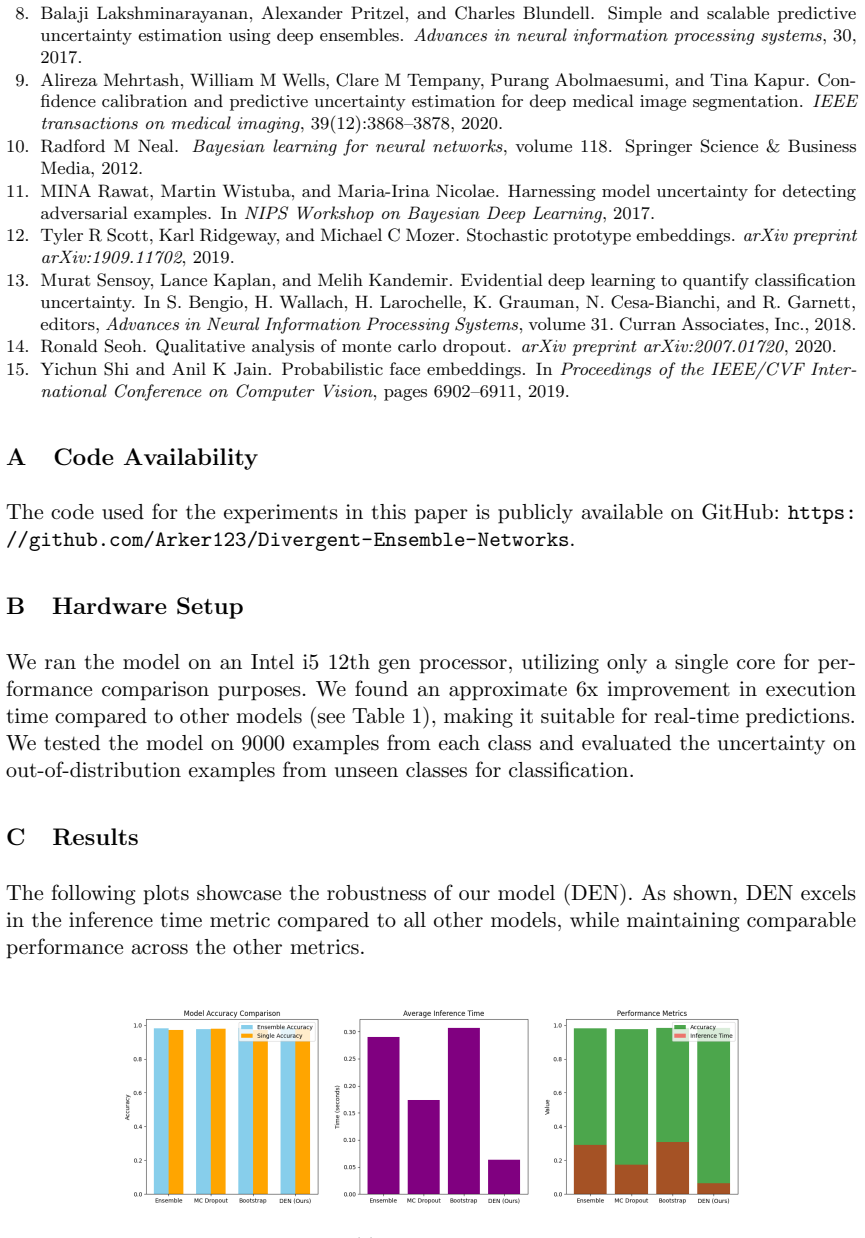
The central discovery is architectural: a single shared representation layer followed by divergent branches produces the variance of a deep ensemble at a fraction of the inference cost. The paper demonstrates this by measuring accuracy, error metrics, and the entropy or variance of predictions on in-distribution and out-of-distribution data. On MNIST, DEN reaches 98.78 percent ensemble accuracy with an average inference time of 0.056 seconds against 0.263 seconds for the deep ensemble; on the toy regression, its R-squared is 0.9059 against 0.9088 and inference time drops from 0.299 to 0.066 seconds. On NotMNIST, DEN matches the out-of-distribution entropy and variance of bootstrap and ensemble methods rather than the overconfident pattern the paper attributes to MC Dropout. The conclusion is that the redundancy in fully independent ensemble training is avoidable without sacrificing predictive diversity.
Load-bearing premise
The load-bearing premise is that one shared representation layer can supply every branch with all the features it needs; if that layer becomes an information bottleneck, the branches will make correlated predictions and the ensemble uncertainty will start to resemble a single model's confidence.
Editorial extensions
If this is right
- If DEN holds up, ensemble uncertainty estimation can run about five to six times faster on a single CPU core, making it usable in real-time settings where running several full networks is too slow.
- On out-of-distribution inputs, DEN behaves like a full ensemble rather than like MC Dropout, which the paper reports as overconfident on some unseen classes, so it is a safer drop-in where wrong confident predictions are costly.
- Because the shared computation runs once, adding branches to increase diversity is cheaper than adding full ensemble members, letting practitioners scale the uncertainty estimate more affordably.
- The speed gain does not require an accuracy trade-off on the tested benchmarks: accuracy, MSE, MAE, and R-squared stay comparable between DEN and the comparison methods.
Reading between the lines
- Beyond the paper, the shared layer is the unexamined bottleneck: ablating its width or depth against inter-branch variance would show whether the observed diversity comes from the branching or simply from the shared representation being large enough.
- Beyond the paper, comparisons with matched total parameter count would isolate the efficiency claim from any capacity advantage, since DEN and a conventional ensemble are not matched for total parameters in the reported tables.
- Beyond the paper, the same shared-to-branching design should transfer to convolutional or transformer trunks, where the shared backbone dominates computation and the expected speedup is larger than in the small MLPs tested here.
Signed reviews
Editorial analysis
A structured set of objections, weighed in public.
Referee Report
Summary. The paper proposes Divergent Ensemble Networks (DEN), an architecture with a single shared input/representation layer followed by multiple independently trainable branches, intended to reduce parameter redundancy while preserving the diversity needed for ensemble uncertainty estimation. The authors report experiments on MNIST classification, NotMNIST out-of-distribution classification, and a toy sine regression, claiming roughly 4-6x faster inference than deep ensembles, MC Dropout, and bootstrap while maintaining comparable accuracy and uncertainty. The manuscript includes a code availability statement, a hardware description, and a limitations section acknowledging sensitivity to the shared representation choice.
Significance. If substantiated, the core idea is attractive: a shared-to-branching ensemble could make deep-ensemble-style uncertainty estimation practical in real-time settings. The paper's strengths are its simple and clear architectural proposal, the direct comparison against standard baselines, a reproducible toy regression setup with known noise, public code, and an explicit statement of the single-core hardware setup. These are useful starting points. However, the significance is currently limited by the evidential gap between the two-part central claim ('reduces parameter redundancy while maintaining ensemble diversity') and what the experiments actually measure. The efficiency part rests on uncontrolled timing comparisons, and the diversity part is not directly measured at all. The paper would be substantially strengthened by matched-capacity comparisons, inter-branch diversity metrics, error bars, and a proper regression uncertainty evaluation.
major comments (4)
- [Section 3.3, Tables 1-2] The central claim that DEN 'maintains ensemble diversity' is not supported by the evidence presented. No metric directly measures inter-branch diversity (e.g., pairwise KL divergence, prediction disagreement, or rank correlation of branch errors). In Table 2, all methods are at chance accuracy on NotMNIST (~10%), and DEN's reported average variance (0.0375) is actually lower than the deep ensemble's (0.0406). With no error bars, this does not even establish that DEN's variance is comparable, let alone that diversity is maintained. The paper needs a matched-capacity comparison and a direct diversity metric to substantiate the central claim.
- [Section 3.3 and Appendix B] The efficiency comparison is not properly controlled. The paper does not report parameter counts, FLOPs, layer widths, or number of branches for DEN or any baseline; the timing measurements on a single CPU core therefore cannot isolate the effect of the shared representation from the effect of simply using a smaller network. The claimed 6x speedup in Table 1 and 5x speedup in Table 3 could be an artifact of model size differences. The authors should report model capacities and compare against ensembles with matched total parameter count or matched per-branch capacity.
- [Section 3.2 and Table 3] The regression experiment does not evaluate uncertainty at all, despite Section 3.2 describing entropy-based uncertainty evaluation and out-of-domain testing. Table 3 reports only MSE, MAE, R², and inference time; there is no predictive variance, entropy, confidence interval, or any out-of-domain uncertainty metric. Consequently, the claim that DEN 'achieves similar or superior uncertainty estimation' for regression is unsupported.
- [Sections 3.3 and Appendix B] All empirical results appear to be single-run point estimates without error bars, standard deviations, or a description of hyperparameters (e.g., optimizer, learning rate, batch size, epochs, dropout rate, activation functions, number of branches, and branch widths). Given the small reported differences (e.g., DEN MNIST accuracy 98.78% vs. Ensemble 98.56%), the reader cannot assess whether any accuracy or uncertainty difference is statistically meaningful, and the experiments are difficult to reproduce from the text alone.
minor comments (5)
- [Sections 2.2 and 2.3] The text of Section 2.2 and Section 2.3 is essentially identical; the 'Shared Input and Common Representation Layer' and 'Divergent Branches for Independent Predictions' subsections appear to be duplicated and should be merged or rewritten.
- [Throughout] There are several typos and formatting issues, including 'F unction' in the Section 2.4 heading, 'T est' in Section 3.2, 'V ariance' above the variance equation, and 'F uture W ork' in Section 5.2.
- [Section 3.2] The equations for entropy and variance are not numbered, and the entropy equation is introduced with a dangling phrase 'where ˆyi is the predicted probability or confidence score for each sample' that belongs to the variance formula; these need to be cleaned up.
- [Section 3.3] The sentence 'All of the methods show low entropy as expected' is confusing, because the stated goal is to see high entropy on unseen classes; the authors should clarify what is being compared and why low entropy is expected in that context.
- [Appendix B] The statement 'We tested the model on 9000 examples from each class' is ambiguous: it could mean 9000 examples per class or 9000 total; please specify the exact evaluation protocol.
Circularity Check
No circularity found: the paper's efficiency and uncertainty claims are empirical comparisons against external baselines, with no fitted parameter disguised as a prediction and no load-bearing self-citation.
full rationale
This paper is empirical rather than derivational. It proposes an architecture (shared input/representation layer plus independent branches), trains it on MNIST, NotMNIST, and a toy regression function, and reports accuracy, uncertainty statistics, and measured inference times against deep ensembles, MC Dropout, and Bootstrap. The central efficiency claim rests on wall-clock inference time comparisons in Tables 1–3, which are external measurements, not quantities defined by construction. No equation in the paper defines its output in terms of a fitted parameter, and no result is obtained by renaming a known pattern in new coordinates. The claim that DEN 'maintains ensemble diversity' is supported only by the architectural design and by variance/entropy numbers on NotMNIST; that evidence may be weak or incomplete, but under the hard rules, unsupported evidence is not circularity. The paper contains no load-bearing self-citation: references are to standard external prior work, and no uniqueness theorem or prior result by the same authors is invoked to forbid alternatives. Section 5.1 openly states that DEN depends on the choice of shared representations and may require substantial hyperparameter tuning; this is a declared assumption and limitation, not a circular step. Because the manuscript is self-contained against external benchmarks and its claims are not forced by definition or self-citation, the appropriate finding is no significant circularity, score 0.
Assumptions & free parameters
free parameters (5)
- number of branches =
not reported
- shared representation layer width =
not reported
- branch width and depth =
not reported
- dropout rate =
not reported
- training hyperparameters (optimizer, learning rate, batch size, epochs) =
not reported
assumptions (4)
- ad hoc to paper A single shared representation layer is sufficient to capture all features needed by every branch.
- domain assumption Entropy of the predictive distribution is an adequate measure of uncertainty quality for classification.
- domain assumption Benchmarks on MNIST, NotMNIST, and toy sine regression are representative for general uncertainty estimation.
- ad hoc to paper Inference times measured on a single CPU core with unspecified model sizes are directly comparable across methods.
Cite this review
Pith. "Pith review of Divergent Ensemble Networks: Enhancing Uncertainty Estimation with Shared Representations and Independent Branching." pith.science (2026). https://pith.science/paper/O6FOF5SN
@misc{pith2026241201193,
  author       = {Pith},
  title        = {Pith review of: Divergent Ensemble Networks: Enhancing Uncertainty Estimation with Shared Representations and Independent Branching},
  year         = {2026},
  howpublished = {\url{https://pith.science/paper/O6FOF5SN}},
  note         = {Machine review of arXiv:2412.01193}
}
read the original abstract
Ensemble learning has proven effective in improving predictive performance and estimating uncertainty in neural networks. However, conventional ensemble methods often suffer from redundant parameter usage and computational inefficiencies due to entirely independent network training. To address these challenges, we propose the Divergent Ensemble Network (DEN), a novel architecture that combines shared representation learning with independent branching. DEN employs a shared input layer to capture common features across all branches, followed by divergent, independently trainable layers that form an ensemble. This shared-to-branching structure reduces parameter redundancy while maintaining ensemble diversity, enabling efficient and scalable learning.
Figures


Figures from the paper (1 more)

Reference graph
Works this paper leans on
-
[1]
Bagging predictors
Leo Breiman. Bagging predictors. Machine learning, 24:123–140, 1996
1996
-
[2]
Predictive uncertainty estimation using deep learning for soft robot multimodal sensing
Ze Yang Ding, Junn Yong Loo, Vishnu Monn Baskaran, Surya Girinatha Nurzaman, and Chee Pin Tan. Predictive uncertainty estimation using deep learning for soft robot multimodal sensing. IEEE Robotics and Automation Letters , 6(2):951–957, 2021
work page 2021
-
[3]
Dropout as a bayesian approximation: Representing model un- certainty in deep learning
Yarin Gal and Zoubin Ghahramani. Dropout as a bayesian approximation: Representing model un- certainty in deep learning. In international conference on machine learning , pages 1050–1059. PMLR, 2016
2016
-
[4]
Ensemble deep learning: A review
Mudasir A Ganaie, Minghui Hu, Ashwani Kumar Malik, Muhammad Tanveer, and Ponnuthurai N Suganthan. Ensemble deep learning: A review. Engineering Applications of Artificial Intelligence , 115:105151, 2022
work page 2022
-
[5]
Aleatoric and epistemic uncertainty in machine learning: an introduction to concepts and methods
Eyke H¨ ullermeier and Willem Waegeman. Aleatoric and epistemic uncertainty in machine learning: an introduction to concepts and methods. Machine Learning, 110(3):457–506, Mar 2021
work page 2021
-
[6]
Heinrich Jiang, Been Kim, Maya Gupta, and Melody Y. Guan. To trust or not to trust a classifier. In Advances in Neural Information Processing Systems (NeurIPS) , volume 31, pages 5541–5552, 2018. Cited by: 264
work page 2018
-
[7]
Michael Klas, Adam Trendowicz, Yasushi Ishigai, and Haruka Nakao. Handling estimation uncertainty with bootstrapping: Empirical evaluation in the context of hybrid prediction methods. In 2011 In- ternational Symposium on Empirical Software Engineering and Measurement , pages 245–254. IEEE, 2011
work page 2011
-
[8]
Simple and scalable predictive uncertainty estimation using deep ensembles
Balaji Lakshminarayanan, Alexander Pritzel, and Charles Blundell. Simple and scalable predictive uncertainty estimation using deep ensembles. Advances in neural information processing systems , 30, 2017
2017
Show all 15 references
-
[9]
Con- fidence calibration and predictive uncertainty estimation for deep medical image segmentation
Alireza Mehrtash, William M Wells, Clare M Tempany, Purang Abolmaesumi, and Tina Kapur. Con- fidence calibration and predictive uncertainty estimation for deep medical image segmentation. IEEE transactions on medical imaging , 39(12):3868–3878, 2020
2020
-
[10]
Bayesian learning for neural networks , volume 118
Radford M Neal. Bayesian learning for neural networks , volume 118. Springer Science & Business Media, 2012
2012
-
[11]
Harnessing model uncertainty for detecting adversarial examples
MINA Rawat, Martin Wistuba, and Maria-Irina Nicolae. Harnessing model uncertainty for detecting adversarial examples. In NIPS Workshop on Bayesian Deep Learning , 2017
2017
-
[12]
Stochastic prototype embeddings
Tyler R Scott, Karl Ridgeway, and Michael C Mozer. Stochastic prototype embeddings. arXiv preprint arXiv:1909.11702, 2019
1909 arXiv
-
[13]
Evidential deep learning to quantify classification uncertainty
Murat Sensoy, Lance Kaplan, and Melih Kandemir. Evidential deep learning to quantify classification uncertainty. In S. Bengio, H. Wallach, H. Larochelle, K. Grauman, N. Cesa-Bianchi, and R. Garnett, editors, Advances in Neural Information Processing Systems, volume 31. Curran ...
2018
-
[14]
Qualitative analysis of monte carlo dropout
Ronald Seoh. Qualitative analysis of monte carlo dropout. arXiv preprint arXiv:2007.01720 , 2020
2007 arXiv
-
[15]
Probabilistic face embeddings
Yichun Shi and Anil K Jain. Probabilistic face embeddings. In Proceedings of the IEEE/CVF Inter- national Conference on Computer Vision , pages 6902–6911, 2019. A Code Availability The code used for the experiments in this paper is publicly available on GitHub: https: //github...
2019
Reviewed August 12, 2026 · model on record in the stance chip above.
Discussion (0). Continue with ORCID to comment.