REVIEW 4 major objections 4 minor 75 references
Accuracy of time-dependent GGE under weak dissipation
T0 review · 4 major / 4 minor · reviewed 2026-08-12 · deepseek-v4-flash
Pith's one-line read Dissipation opens integrable models to a time-dependent GGE that becomes exact as the decay rate goes to zero.
desk verdict A careful numerical benchmark of t-GGE for hardcore bosons with gain and loss, with real analytic extension and strong finite-gamma evidence, but the claimed gamma-to-0 exactness rests on an uncontrolled adiabatic limit that needs a scaling check. read the letter →
The pith
A machine-rendered reading of the paper's core claim, the machinery that carries it, and where it could break.
The reading
What carries the argument
The central object is the time-dependent Generalized Gibbs Ensemble (t-GGE), parameterized by the rapidity distribution ρ(t, k) of the Jordan-Wigner fermions that diagonalize the hardcore boson Hamiltonian. The key identity is Eq. (19), the closed nonlinear evolution equation for ρ(t, k) whose dissipation functional F[ρ] is expressed in terms of a Hilbert transform of the rapidity distribution. This functional captures the nonlocal-in-rapidity effect of the bosonic dissipators, which carry Jordan-Wigner strings that prevent Gaussianity from being preserved exactly. The t-GGE assumption—that between rare dissipative events the system locally relaxes to a GGE—turns the open dynamics into a closed equation for the GGE parameters.
What would settle it
A direct test would be to run the same MPO simulation at a much larger system size and longer time, and look for a deviation between the exact rapidity distribution and the t-GGE prediction as γt grows, at fixed small γ. If the error Δρ(t)/n(t) does not continue to shrink with decreasing γ, or if the collapse onto the γt scaling breaks down at any fixed γt, the exactness claim would be falsified. On the experimental side, measuring the rapidity distribution of a lossy 1D Bose gas prepared in a thermal state and comparing to Eq. (21) would be a decisive check.
Extended reading notes
Core claim
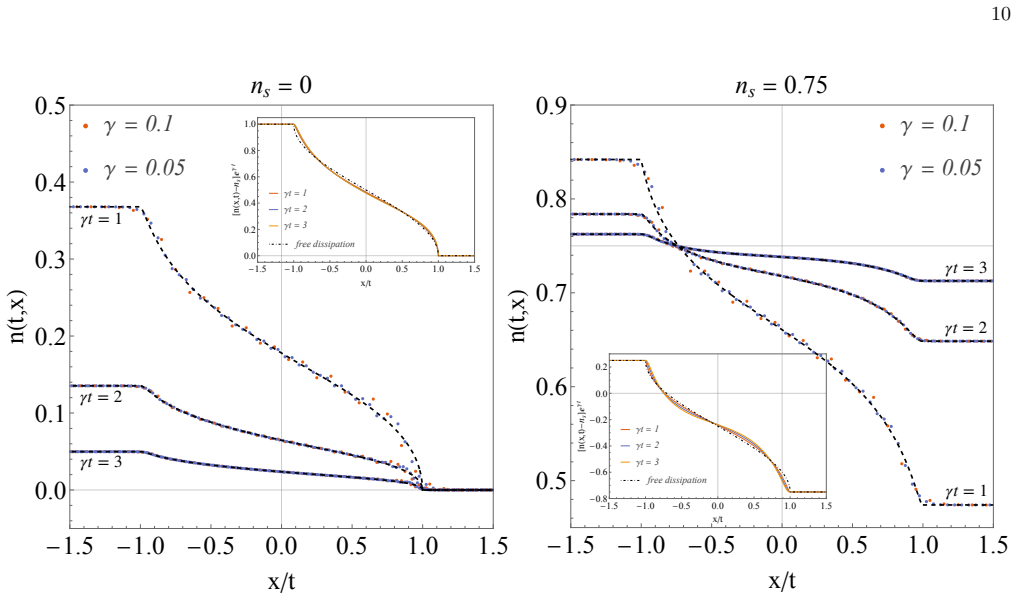
The central claim is that for a one-dimensional hardcore boson gas subject to weak one-body gain and loss, the t-GGE approximation—where the density matrix is taken to remain a Gaussian state of Jordan-Wigner fermions—becomes exact in the limit γ → 0 with γt fixed, and quantitatively accurate for weak but finite γ. This is established by deriving a closed evolution equation, Eq. (19), for the rapidity distribution, solving it analytically, and then benchmarking it against numerically exact MPO simulations. The same approximation, combined with Generalized Hydrodynamics, reproduces the emergent Euler-scale transport of a domain-wall initial state. The paper's evidence includes collapse of the rapidity distributions to a universal curve at fixed γt, agreement of the non-Gaussianity measure showing that the state becomes increasingly Gaussian as γ decreases, and matching density profiles in the inhomogeneous case.
Load-bearing premise
The adiabatic separation of timescales: after each rare dissipative event, the system locally relaxes to a GGE before the next event, which is nontrivial because local relaxation in integrable systems is algebraic rather than exponential, so the relaxation time is formally infinite.
Editorial extensions
If this is right
- If the t-GGE equation is exact in the adiabatic limit, then the entire dissipative dynamics of the gas is captured by a single scalar function ρ(γt, k), computable in closed form for any initial state.
- The analytic solution, Eq. (21), provides a fast and parameter-free prediction for rapidity distributions and two-point functions in cold-atom experiments with loss and gain, without needing full simulation.
- Combining t-GGE with Generalized Hydrodynamics yields a dissipative GHD equation, Eq. (24), that correctly predicts large-scale density profiles in inhomogeneous settings.
- The accuracy improves when loss and gain are balanced (ns = 1/2), because many terms in the master equation cancel, which may guide experimental choices to maximize predictability.
Reading between the lines
- The t-GGE framework likely extends to other integrable models with one-body dissipation where a closed equation for the rapidity distribution can be derived, such as the Lieb-Liniger gas with losses, where analogous formulas are already known.
- The numerical evidence suggests that the algebraic relaxation problem does not invalidate the adiabatic assumption for this model at the studied scales; a rigorous proof might come from a modified ETH-like argument that accounts for the slow algebraic tails without requiring true exponential relaxation.
- A testable extension would be to measure higher-order correlation functions (beyond the non-Gaussianity proxy) in a cold-atom experiment and compare their decay to the t-GGE prediction, which would probe the Gaussian approximation beyond two-point functions.
- The observed cancellation at balanced gain and loss hints that there may be an exact hidden symmetry of the Lindbladian when ns = 1/2, which could be proven and used to simplify other open integrable models.
Signed reviews
Editorial analysis
A structured set of objections, weighed in public.
Referee Report
Summary. The paper benchmarks the time-dependent GGE (t-GGE) approximation for a one-dimensional gas of hardcore bosons subject to weak one-body loss and gain, against tensor-network MPO simulations of the full Lindblad dynamics. It derives closed-form loss and gain functionals for the rapidity distribution, presents an analytic solution of the resulting evolution equation (Eq. (21)), and compares it with numerics in both homogeneous and inhomogeneous settings. In the homogeneous case the comparison uses the rapidity distribution and a Rényi-2 non-Gaussianity measure; in the inhomogeneous case the t-GGE assumption is combined with Generalized Hydrodynamics to describe a domain-wall quench. The paper's central claims are that the t-GGE equation (19) becomes exact as γ → 0 with γt fixed, that it is accurate for weak finite dissipation, and that dissipative GHD captures Euler-scale transport.
Significance. If the claims hold, this is a valuable and much-needed benchmark of an approximation that is widely used but rarely tested beyond small systems. The paper's strengths are the explicit analytic derivation of the dissipation functionals, the closed-form solution (21), the direct parameter-free comparison with MPO data, and the use of a non-Gaussianity measure to go beyond two-point functions. The homogeneous data (Fig. 1, Fig. 3) are visually convincing across several γ values, and the inhomogeneous GHD comparison (Fig. 5) is suggestive. The principal weakness is that the central exactness claim in the γ → 0 limit is not supported by any scaling or extrapolation analysis, a gap that is especially significant because the paper itself notes that local relaxation in integrable systems is algebraic rather than exponential.
major comments (4)
- [§I, §V.A, Figs. 1 and 3] The claim that Eq. (19) becomes exact as γ → 0 at fixed γt is the central result, but the paper provides no scaling analysis in γ. The authors themselves state in Sec. I that local relaxation towards a GGE is algebraic, so the adiabatic separation argument is not a proof; the numerical data in Fig. 3 reach only γ = 0.05. I request a systematic extrapolation: compute Δρ(t)/n(t) at fixed γt for a decreasing sequence of γ (e.g., 0.1, 0.05, 0.025, 0.0125) and fit to Δ ~ γ^α, reporting the exponent and its stability with L. Without this, the observed agreement cannot be distinguished from a small but nonzero residual error, and the word 'exact' is stronger than the evidence supports.
- [§IV] The MPO simulations are described as 'numerically exact', but no convergence checks or error bars are reported for the bond dimension. The text states in Sec. IV that 'the convergence with respect to the bond dimension is immediate', yet no maximum χ, discarded weight, or χ-dependence is shown for any of the data in Figs. 1, 3, 4, or 5. Because the reported discrepancies are small at small γ, it is important to exclude the possibility that part of the agreement comes from truncation of the operator entanglement. Please provide convergence data for representative parameters (for instance ns = 0, γ = 0.05, γt = 2, and the inhomogeneous case ns = 0.75, γ = 0.05, t = L/2).
- [§V.B, Eq. (35), Appendix B] The non-Gaussianity measure used in Fig. 4 relies on the replacement tr(ρ log ρ_GGE) ≈ tr(ρ_GGE log ρ_GGE). The paper openly acknowledges in Appendix B that this is justified only under the assumption that the largest component of the error is non-Gaussianity. That assumption is plausible, but Fig. 4 is then used as evidence that the t-GGE is accurate beyond two-point functions, so the measure's own approximation weakens the conclusion. I ask the authors to quantify the error in this replacement for the studied system sizes, for instance by computing tr(ρ log ρ_GGE) directly for a few representative states, or to state more carefully that the non-Gaussianity plot is a proxy rather than a direct distance.
- [§VI.B, Fig. 5] The inhomogeneous test uses only two pairs (L, γ) = (100, 0.1) and (200, 0.05), so the finite-size and finite-γ effects are varied simultaneously and cannot be separated. The collapse in Fig. 5 is visually convincing, but the claim that dissipative GHD becomes exact in the combined Euler and weak-dissipation limit would be considerably strengthened by adding a third point (or by fixing L and varying γ, and fixing γ and varying L, separately) and by reporting the quantitative deviation from the theoretical profile. This is a load-bearing issue because the inhomogeneous setting is one of the two main advertised results.
minor comments (4)
- [Appendix C] There is a typo: 'collpase' should be 'collapse'.
- [Eq. (21) and surrounding text] The notation is confusing because the analytic solution is written in terms of f(t) and g(t) inside an equation expressed in the rescaled time τ = γt. Please clarify whether t in f(t) and g(t) means the physical time or the rescaled time, and align the notation accordingly.
- [Fig. 5 caption] The label 'free dissipation' is used for the non-interacting fermion comparison; the caption should explain in one sentence that this refers to the model of Refs. [56,58] where gain/loss acts on free fermions and each mode relaxes independently, since the term is otherwise ambiguous.
- [General] The manuscript contains no data or code availability statement. Providing the numerical data for the curves in Figs. 1, 3, 4, and 5 would improve reproducibility and would allow independent verification of the claimed collapse.
Circularity Check
No significant circularity: Eq. (19) is an ansatz-based reduction of the Lindblad equation, benchmarked against independent MPO simulations rather than fitted.
full rationale
The derivation chain is: (i) the Lindblad equation (4) for hardcore bosons with loss and gain; (ii) the t-GGE/Gaussian ansatz, stated explicitly in Sec. III A (“In the t-GGE approach, the effective dynamics is restricted to the manifold of Gaussian states. This is only an approximation”), which converts the exact relation ∂tρ = tr[^n(k)∂tρ] into the closed nonlinear equation (19); (iii) the analytic solution (21); (iv) comparison with tensor-network MPO integration of the original Lindblad equation (Figs. 1, 3, 4, 5). No parameter is fitted to the MPO data: the initial states are thermal at T = 0.1 or a domain wall, the rates γ and ns are fixed a priori, and the t-GGE curves are computed from the initial rapidity profile. The overlap with earlier loss-only work (Refs. [28,34], including coauthor J. Dubail) is explicit (“we follow the discussion of Ref. [34]”), but the gain functional is rederived in Appendix A and the central validation is an independent numerical benchmark, so these self-citations are not load-bearing. The paper also flags its own main limitation in Sec. I: local relaxation in integrable models is algebraic rather than exponential, so τ is formally infinite and “it is not obvious that γ can ever be taken small enough”; no rigorous bound on the residual non-GGE component is provided. That is a correctness/rigor gap, not a circular reduction, because the claim is tested against exact numerics rather than derived from the assumption. The non-Gaussianity proxy in Sec. V B is an approximate diagnostic, and the replacement step discussed in footnote 67 is justified conditionally in Appendix B, but the plotted Rényi-2 quantity is computed directly from purities, and the central two-point-function test does not depend on that proxy. No step in the paper equates a prediction to an input by construction.
Assumptions & free parameters
assumptions (5)
- domain assumption The density matrix remains in the generalized Gibbs ensemble (Gaussian fermionic) manifold during the dissipative evolution.
- domain assumption Separation of timescales: local relaxation to a GGE happens much faster than 1/gamma even though relaxation is algebraic in integrable systems.
- domain assumption Combined Euler scaling limit and slow dissipation limit can be taken simultaneously for the dissipative GHD equation (24).
- standard math Wick's theorem applies to GGE expectation values in the loss and gain functionals.
- domain assumption The error in replacing tr(rho log rho_GGE) by tr(rho_GGE log rho_GGE) is small because non-Gaussianity dominates the distance to Gaussian states.
Cite this review
Pith. "Pith review of Accuracy of time-dependent GGE under weak dissipation." pith.science (2026). https://pith.science/paper/EXQ7WZ3X
@misc{pith2026241201896,
  author       = {Pith},
  title        = {Pith review of: Accuracy of time-dependent GGE under weak dissipation},
  year         = {2026},
  howpublished = {\url{https://pith.science/paper/EXQ7WZ3X}},
  note         = {Machine review of arXiv:2412.01896}
}
read the original abstract
Unitary integrable models typically relax to a stationary Generalized Gibbs Ensemble (GGE), but in experimental realizations dissipation often breaks integrability. In this work, we use the recently introduced time-dependent GGE (t-GGE) approach to describe the open dynamics of a gas of bosons subject to atom losses and gains. We employ tensor network methods to provide numerical evidence of the exactness of the t-GGE in the limit of adiabatic dissipation, and of its accuracy in the regime of weak but finite dissipation. That accuracy is tested for two-point functions via the rapidity distribution, and for more complicated correlations through a non-Gaussianity measure. We combine this description with Generalized Hydrodynamics and we show that it correctly captures transport at the Euler scale. Our results demonstrate that the t-GGE approach is robust in both homogeneous and inhomogeneous settings.
Figures


Figures from the paper (3 more)


Reference graph
Works this paper leans on
-
[34]
D. Rossini, A. Ghermaoui, M. B. Aguilera, R. Vatr´ e, R. Bouganne, J. Beugnon, F. Gerbier, and L. Mazza, Strong correlations in lossy one-dimensional quantum gases: From the quantum zeno effect to the generalized gibbs ensemble, Physical Review A 103, L060201 (2021)
work page 2021
-
[1]
Diagonalization of hardcore bosons The Hamiltonian of hopping hardcore bosons ˆH = − 1 2 LX j=1 ˆσ+ j ˆσ− j+1 + ˆσ− j ˆσ+ j+1 , (A1) 12 under the Jordan-Wigner mapping ˆcj = Q i<j ˆσz i ˆσ+ j is transformed into a free fermionic model ˆHJW = − 1 2 LX j=1 ˆc† j ˆcj+1 + ˆc† j+1ˆcj . (A2) The boundary terms are mapped to ˆ σ+ L ˆσ− 1 + ˆσ+ 1 ˆσ− L → −eiπ ˆN ...
-
[2]
the superoperators L and [ ˆN ,· ] commute
Derivation of the functional First, we notice that the Lindbladian L satisfies [ ˆN ,L ˆρ ] = L ([ ˆN , ρ]) , (A7) i.e. the superoperators L and [ ˆN ,· ] commute. This property is called a weak symmetry: ˆN is not conserved in time but L is still block diagonal and d dt [ ˆN ,ˆρ ] = L ([ ˆN ,ˆρ ]) , (A8) therefore, a state with an initially defined numbe...
-
[3]
Solving the master equation This appendix will shortly present a method to solve the evolution equation of the rapidity distribution Eq. (19). Following the same procedure described in [34], we can simplify the master equation by shifting the prob- lem to Q(t, z), the signal function associated with ρ(t, k). This analytic function is constructed by adjoin...
-
[4]
(24), as we have discussed in Sec
Numerical evaluation of the functional The dissipation functional must be evaluated numer- ically to solve the effective equation with transport Eq. (24), as we have discussed in Sec. VI. Below, we explain an efficient approach to perform the calculation. The previous expression Eq. (A16) provides the natural lattice discretization of the Hilbert transfor...
-
[5]
Rivas and S
A. Rivas and S. F. Huelga, Open quantum systems , Vol. 10 (Springer, 2012)
2012
-
[6]
Breuer and F
H.-P. Breuer and F. Petruccione, The theory of open quantum systems (Oxford University Press, USA, 2002)
2002
-
[7]
Schlosshauer, Decoherence, the measurement prob- lem, and interpretations of quantum mechanics, Reviews of Modern physics 76, 1267 (2004)
M. Schlosshauer, Decoherence, the measurement prob- lem, and interpretations of quantum mechanics, Reviews of Modern physics 76, 1267 (2004)
2004
Show all 75 references
-
[8]
Vinjanampathy and J
S. Vinjanampathy and J. Anders, Quantum thermody- namics, Contemporary Physics 57, 545 (2016)
2016
-
[9]
Weiner, V
J. Weiner, V. S. Bagnato, S. Zilio, and P. S. Julienne, Experiments and theory in cold and ultracold collisions, Reviews of Modern Physics 71, 1 (1999)
1999
-
[10]
Bouchoule and J
I. Bouchoule and J. Dubail, Generalized hydrodynam- ics in the one-dimensional bose gas: theory and experi- ments, Journal of Statistical Mechanics: Theory and Ex- periment 2022, 014003 (2022)
2022
-
[11]
Diehl, A
S. Diehl, A. Micheli, A. Kantian, B. Kraus, H. B¨ uchler, and P. Zoller, Quantum states and phases in driven open quantum systems with cold atoms, Nature Physics 4, 878 16 γt=0.5 γt=1 γt=2 nk-gauss th-gauss 0 1 2 3 4 0.00 0.02 0.04 0.06 0.08 γt ns=0.5, T =0.1 γ=0.5 γ=0.1 ̂ρGGE...
2008
-
[12]
Verstraete, M
F. Verstraete, M. M. Wolf, and J. Ignacio Cirac, Quan- tum computation and quantum-state engineering driven by dissipation, Nature physics 5, 633 (2009)
2009
-
[13]
P. M. Harrington, E. J. Mueller, and K. W. Murch, Engi- neered dissipation for quantum information science, Na- ture Reviews Physics 4, 660 (2022)
2022
-
[14]
Cohen and M
J. Cohen and M. Mirrahimi, Dissipation-induced contin- uous quantum error correction for superconducting cir- cuits, Physical Review A 90, 062344 (2014)
2014
-
[15]
Lebreuilly, K
J. Lebreuilly, K. Noh, C.-H. Wang, S. M. Girvin, and L. Jiang, Autonomous quantum error correction and quantum computation, arXiv preprint arXiv:2103.05007 (2021)
2021 arXiv
-
[16]
Reiter, A
F. Reiter, A. S. Sørensen, P. Zoller, and C. Muschik, Dissipative quantum error correction and application to quantum sensing with trapped ions, Nature communica- tions 8, 1822 (2017)
2017
-
[17]
Str¨ umpfer and K
J. Str¨ umpfer and K. Schulten, Open quantum dynamics calculations with the hierarchy equations of motion on parallel computers, Journal of chemical theory and com- putation 8, 2808 (2012)
2012
-
[18]
Nitzan, Chemical dynamics in condensed phases: re- laxation, transfer, and reactions in condensed molecular systems (Oxford university press, 2024)
A. Nitzan, Chemical dynamics in condensed phases: re- laxation, transfer, and reactions in condensed molecular systems (Oxford university press, 2024)
2024
-
[19]
May and O
V. May and O. K¨ uhn, Charge and energy transfer dy- namics in molecular systems(John Wiley & Sons, 2023)
2023
-
[20]
A. W. Schlimgen, K. Head-Marsden, L. M. Sager, P. Narang, and D. A. Mazziotti, Quantum simulation of open quantum systems using a unitary decomposition of operators, Physical Review Letters 127, 270503 (2021)
2021
-
[21]
R. E. Blankenship, Molecular mechanisms of photosyn- thesis (John Wiley & Sons, 2021)
2021
-
[22]
Dalibard, Y
J. Dalibard, Y. Castin, and K. Mølmer, Wave-function approach to dissipative processes in quantum optics, Physical review letters 68, 580 (1992)
1992
-
[23]
A. J. Daley, Quantum trajectories and open many-body quantum systems, Advances in Physics 63, 77 (2014)
2014
-
[24]
Verstraete, J
F. Verstraete, J. J. Garcia-Ripoll, and J. I. Cirac, Ma- trix product density operators: Simulation of finite- temperature and dissipative systems, Physical review let- ters 93, 207204 (2004)
2004
-
[25]
Zwolak and G
M. Zwolak and G. Vidal, Mixed-state dynamics in one-dimensional quantum lattice systems:¡? format?¿ a time-dependent superoperator renormalization algo- rithm, Physical review letters 93, 207205 (2004)
2004
-
[26]
Verstraete, V
F. Verstraete, V. Murg, and J. I. Cirac, Matrix prod- uct states, projected entangled pair states, and varia- tional renormalization group methods for quantum spin systems, Advances in physics 57, 143 (2008)
2008
-
[27]
M. J. Hartmann and G. Carleo, Neural-network approach to dissipative quantum many-body dynamics, Physical review letters 122, 250502 (2019)
2019
-
[28]
Weimer, A
H. Weimer, A. Kshetrimayum, and R. Or´ us, Simulation methods for open quantum many-body systems, Reviews of Modern Physics 93, 015008 (2021)
2021
-
[29]
Lange, Z
F. Lange, Z. Lenarˇ ciˇ c, and A. Rosch, Pumping approx- imately integrable systems, Nature communications 8, 15767 (2017)
2017
-
[30]
Lange, Z
F. Lange, Z. Lenarˇ ciˇ c, and A. Rosch, Time-dependent generalized gibbs ensembles in open quantum systems, Physical Review B 97, 165138 (2018)
2018
-
[31]
Lenarˇ ciˇ c, F
Z. Lenarˇ ciˇ c, F. Lange, and A. Rosch, Perturbative ap- proach to weakly driven many-particle systems in the presence of approximate conservation laws, Physical Re- view B 97, 024302 (2018). 17
2018
-
[32]
Bouchoule, B
I. Bouchoule, B. Doyon, and J. Dubail, The effect of atom losses on the distribution of rapidities in the one- dimensional bose gas, SciPost Physics 9, 044 (2020)
2020
-
[33]
Bouchoule and J
I. Bouchoule and J. Dubail, Breakdown of tan’s relation in lossy one-dimensional bose gases, Physical Review Let- ters 126, 160603 (2021)
2021
-
[35]
Rosso, D
L. Rosso, D. Rossini, A. Biella, and L. Mazza, One- dimensional spin-1/2 fermionic gases with two-body losses: Weak dissipation and spin conservation, Physical Review A 104, 053305 (2021)
2021
-
[36]
Reiter, F
F. Reiter, F. Lange, S. Jain, M. Grau, J. P. Home, and Z. Lenarˇ ciˇ c, Engineering generalized gibbs ensembles with trapped ions, Physical Review Research 3, 033142 (2021)
2021
-
[37]
Rosso, A
L. Rosso, A. Biella, and L. Mazza, The one-dimensional bose gas with strong two-body losses: the effect of the harmonic confinement, SciPost Physics 12, 044 (2022)
2022
-
[38]
Riggio, L
F. Riggio, L. Rosso, D. Karevski, and J. Dubail, Effects of atom losses on a one-dimensional lattice gas of hard-core bosons, Physical Review A 109, 023311 (2024)
2024
-
[39]
J. Maki, L. Rosso, L. Mazza, and A. Biella, Loss in- duced collective mode in one-dimensional bose gases, arXiv preprint arXiv:2402.05824 (2024)
2024 arXiv
-
[40]
Gerbino, I
F. Gerbino, I. Lesanovsky, and G. Perfetto, Large-scale universality in quantum reaction-diffusion from keldysh field theory, Physical Review B 109, L220304 (2024)
2024
-
[41]
Gerbino, I
F. Gerbino, I. Lesanovsky, and G. Perfetto, Kinetics of quantum reaction-diffusion systems, arXiv preprint arXiv:2406.20028 (2024)
2024 arXiv
-
[42]
Rowlands, I
S. Rowlands, I. Lesanovsky, and G. Perfetto, Quantum reaction-limited reaction–diffusion dynamics of noninter- acting bose gases, New Journal of Physics 26, 043010 (2024)
2024
-
[43]
Z¨ undel, L
M. Z¨ undel, L. Mazza, L. Canet, and A. Minguzzi, Space- time first-order correlations of an open bose-hubbard model with incoherent pump and loss, arXiv preprint arXiv:2405.19972 (2024)
2024 arXiv
-
[44]
Ulˇ cakar and Z
I. Ulˇ cakar and Z. Lenarˇ ciˇ c, Generalized gibbs ensem- bles in weakly interacting dissipative systems and digi- tal quantum computers, arXiv preprint arXiv:2406.17033 (2024)
2024
-
[45]
Perfetto, F
G. Perfetto, F. Carollo, J. P. Garrahan, and I. Lesanovsky, Reaction-limited quantum reaction- diffusion dynamics, Phys. Rev. Lett. 130, 210402 (2023)
2023
-
[46]
Perfetto, F
G. Perfetto, F. Carollo, J. P. Garrahan, and I. Lesanovsky, Quantum reaction-limited reaction- diffusion dynamics of annihilation processes, Phys. Rev. E 108, 064104 (2023)
2023
-
[47]
Rigol, V
M. Rigol, V. Dunjko, V. Yurovsky, and M. Olshanii, Re- laxation in a completely integrable many-body quantum system: an ab initio study of the dynamics of the highly excited states of 1d lattice hard-core bosons, Physical re- view letters 98, 050405 (2007)
2007
-
[48]
Rigol, V
M. Rigol, V. Dunjko, and M. Olshanii, Thermalization and its mechanism for generic isolated quantum systems, Nature 452, 854 (2008)
2008
-
[49]
Vidmar and M
L. Vidmar and M. Rigol, Generalized gibbs ensemble in integrable lattice models, Journal of Statistical Mechan- ics: Theory and Experiment 2016, 064007 (2016)
2016
-
[50]
F. H. Essler and M. Fagotti, Quench dynamics and relax- ation in isolated integrable quantum spin chains, Journal of Statistical Mechanics: Theory and Experiment 2016, 064002 (2016)
2016
-
[51]
Fagotti and F
M. Fagotti and F. H. Essler, Reduced density matrix af- ter a quantum quench, Physical Review B—Condensed Matter and Materials Physics 87, 245107 (2013)
2013
-
[52]
J. Lux, J. M¨ uller, A. Mitra, and A. Rosch, Hydrodynamic long-time tails after a quantum quench, Physical Review A 89, 053608 (2014)
2014
-
[53]
F. H. Essler, A short introduction to generalized hydro- dynamics, Physica A: Statistical Mechanics and its Ap- plications 631, 127572 (2023)
2023
-
[54]
Bertini, M
B. Bertini, M. Collura, J. De Nardis, and M. Fagotti, Transport in out-of-equilibrium xxz chains: exact pro- files of charges and currents, Physical review letters 117, 207201 (2016)
2016
-
[55]
O. A. Castro-Alvaredo, B. Doyon, and T. Yoshimura, Emergent hydrodynamics in integrable quantum systems out of equilibrium, Physical Review X 6, 041065 (2016)
2016
-
[56]
Wellnitz, G
D. Wellnitz, G. Preisser, V. Alba, J. Dubail, and J. Schachenmayer, Rise and fall, and slow rise again, of operator entanglement under dephasing, Physical Review Letters 129, 170401 (2022)
2022
-
[57]
Preisser, D
G. Preisser, D. Wellnitz, T. Botzung, and J. Schachen- mayer, Comparing bipartite entropy growth in open- system matrix-product simulation methods, Physical Re- view A 108, 012616 (2023)
2023
-
[58]
J. P. Ronzheimer, M. Schreiber, S. Braun, S. S. Hodg- man, S. Langer, I. P. McCulloch, F. Heidrich-Meisner, I. Bloch, and U. Schneider, Expansion dynamics of in- teracting bosons in homogeneous lattices in one and two dimensions, Physical review letters 110, 205301 (2013)
2013
-
[59]
Vidmar, J
L. Vidmar, J. P. Ronzheimer, M. Schreiber, S. Braun, S. S. Hodgman, S. Langer, F. Heidrich-Meisner, I. Bloch, and U. Schneider, Dynamical quasicondensation of hard- core bosons at finite momenta, Physical review letters 115, 175301 (2015)
2015
-
[60]
Alba and F
V. Alba and F. Carollo, Spreading of correlations in markovian open quantum systems, Physical Review B 103, L020302 (2021)
2021
-
[61]
Carollo and V
F. Carollo and V. Alba, Dissipative quasiparticle picture for quadratic markovian open quantum systems, Physical Review B 105, 144305 (2022)
2022
-
[62]
Alba and F
V. Alba and F. Carollo, Logarithmic negativity in out-of- equilibrium open free-fermion chains: An exactly solvable case, SciPost Physics 15, 124 (2023)
2023
-
[63]
Vidal, Efficient simulation of one-dimensional quan- tum many-body systems, Phys
G. Vidal, Efficient simulation of one-dimensional quan- tum many-body systems, Phys. Rev. Lett. 93, 040502 (2004)
2004
-
[64]
S. R. White and A. E. Feiguin, Real-time evolution us- ing the density matrix renormalization group, Physical Review Letters 93 (2004)
2004
-
[65]
A. H. Werner, D. Jaschke, P. Silvi, M. Kliesch, T. Calarco, J. Eisert, and S. Montangero, Positive tensor network approach for simulating open quantum many- body systems, Phys. Rev. Lett. 116, 237201 (2016)
2016
-
[66]
Lumia, E
L. Lumia, E. Tirrito, R. Fazio, and M. Collura, Measurement-induced transitions beyond gaussianity: A single particle description, Phys. Rev. Res. 6, 023176 (2024)
2024
-
[67]
M. G. Genoni, M. G. A. Paris, and K. Banaszek, Quan- tifying the non-gaussian character of a quantum state by quantum relative entropy, Phys. Rev. A 78, 060303 18 (2008)
2008
-
[68]
M. G. Genoni and M. G. A. Paris, Quantifying non- gaussianity for quantum information, Phys. Rev. A 82, 052341 (2010)
2010
-
[69]
Vedral, The role of relative entropy in quantum infor- mation theory, Rev
V. Vedral, The role of relative entropy in quantum infor- mation theory, Rev. Mod. Phys. 74, 197 (2002)
2002
-
[70]
Marian and T
P. Marian and T. A. Marian, Relative entropy is an ex- act measure of non-gaussianity, Phys. Rev. A 88, 012322 (2013)
2013
-
[71]
Notice that the replacement tr(ˆ ρ log ˆρGGE) → tr(ˆρGGE log ˆρGGE) is not exact for S(ˆρ||ˆρGGE), be- cause ˆρ and ˆρGGE have different two-point functions. Nevertheless, the error that is made in the replacement is under control and we can still make it within our approximat...
-
[72]
Peschel and V
I. Peschel and V. Eisler, Reduced density matrices and entanglement entropy in free lattice models, Journal of physics a: mathematical and theoretical 42, 504003 (2009)
2009
-
[73]
Surace and L
J. Surace and L. Tagliacozzo, Fermionic Gaussian states: an introduction to numerical approaches, SciPost Phys. Lect. Notes , 54 (2022)
2022
-
[74]
Antal, Z
T. Antal, Z. R´ acz, A. R´ akos, and G. M. Sch¨ utz, Trans- port in the XX chain at zero temperature: Emergence of flat magnetization profiles, Phys. Rev. E 59, 4912 (1999)
1999
-
[75]
Grafakos, Classical Fourier Analysis (Springer NY, 2010)
L. Grafakos, Classical Fourier Analysis (Springer NY, 2010)
2010
Reviewed August 12, 2026 · model on record in the stance chip above.
Discussion (0). Continue with ORCID to comment.