REVIEW 4 major objections 5 minor 1 cited by
Comparing Dynamics, Pinning and Ratchet Effects for Skyrmionium, Skyrmions, and Antiskyrmions
T0 review · 4 major / 5 minor · reviewed 2026-08-11 · deepseek-v4-flash
Pith's one-line read This paper establishes a speed-versus-robustness trade-off among magnetic textures: skyrmionium is twice as fast and straight-moving, while skyrmions and antiskyrmions resist pinning and ratchet twice as efficiently through the Magnus…
desk verdict Useful head-to-head comparison of three magnetic textures, but the ratchet-efficiency claim conflates transverse Hall drift with directed transport and should be revised. read the letter →
The pith
A machine-rendered reading of the paper's core claim, the machinery that carries it, and where it could break.
The reading
What carries the argument
The load-bearing object is the topological charge $Q$ (skyrmionium $Q=0$, skyrmion and antiskyrmion $|Q|=1$) and the Magnus force it produces in the atomistic spin dynamics. A texture with nonzero $Q$ converts part of any confining or substrate force into a velocity component perpendicular to that force; that is the mechanism behind the line-defect boost, the deflection around circular defects, the reduced pinning, and the enhanced two-dimensional ratchet. The skyrmionium has $Q=0$, so it lacks this conversion and instead behaves like an overdamped particle: it follows the drive direction, is slowed by obstacles, and ratchets in one dimension. The antiskyrmion is modeled with an anisotropic Dzyaloshinskii-Moriya interaction so that its Hall angle varies with drive direction, while the skyrmion has a constant Hall angle; the simulations choose drive angles that make the absolute motion direction identical across textures, which is what makes the comparison fair.
What would settle it
Run the same three textures on the periodic asymmetric substrate at finite temperature or with a different damping constant and measure the net ratchet displacement per ac cycle; if skyrmionium's displacement approaches or exceeds that of skyrmions, or if the skyrmionium-to-skyrmion conversion occurs without the reported velocity drop, the central ranking fails. A second check: drive skyrmionium in a disordered film above the reported breakup current and track its topological charge in real time—the claim predicts a sharp velocity drop exactly when $Q$ changes from 0 to 1.
Extended reading notes
Core claim
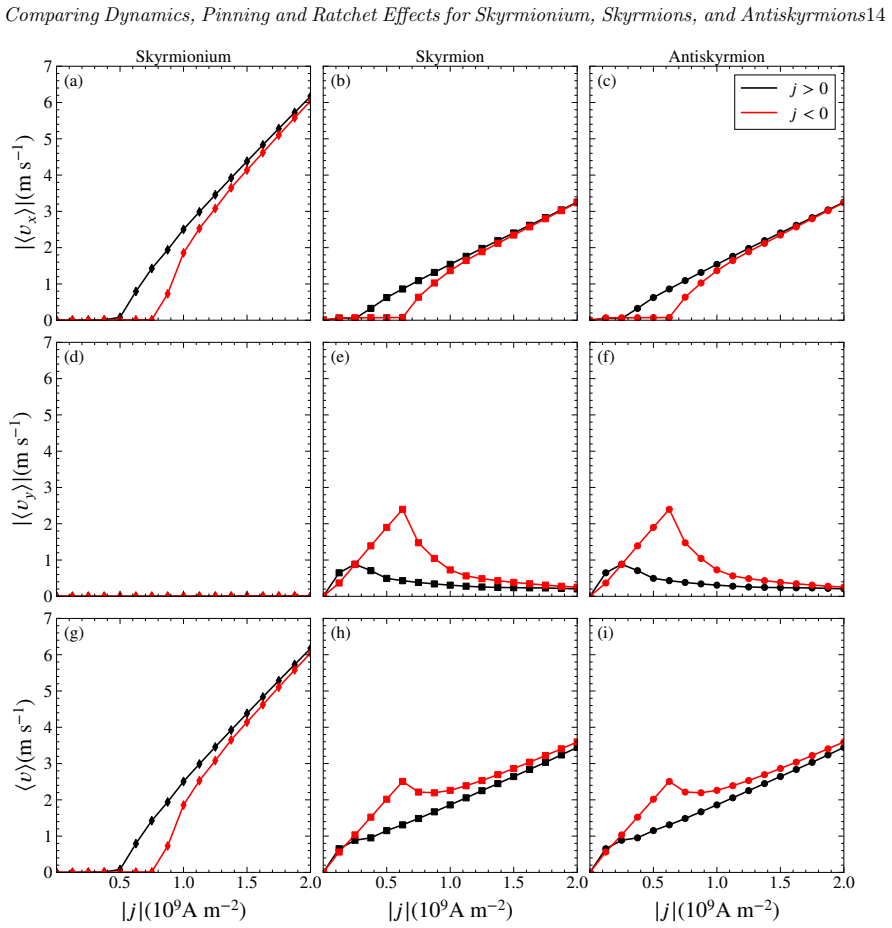
The paper establishes that for a fixed drive, skyrmionium moves without a Hall angle (no sideways deflection relative to the applied current) and at roughly twice the velocity of skyrmions and antiskyrmions in free space, yet it has the highest depinning threshold on random disorder and is temporarily pinned by circular defects. When driven along a line defect, skyrmionium slows down, while skyrmions and antiskyrmions speed up through a Magnus-force boost; at the drive where each texture can cross the barrier, skyrmionium's velocity jumps upward while the boosted velocity of skyrmions and antiskyrmions drops. Above a critical current in a disordered background, skyrmionium transforms into a skyrmion, producing a sudden velocity drop, whereas skyrmions and antiskyrmions remain stable to much higher drives. On an asymmetric periodic substrate all three textures show a diode effect, and under ac driving they all ratchet; skyrmionium does so in one dimension along the drive, while skyrmions and antiskyrmions follow two-dimensional orbits and achieve roughly twice the net displacement due to the Magnus force.
Load-bearing premise
The load-bearing premise is that the zero-temperature atomistic simulations with one set of material parameters capture the relevant physics; at finite temperature or with different material parameters, thermal fluctuations could lower depinning thresholds, shift the skyrmionium-to-skyrmion breakup to lower currents, and change the measured velocity and ratchet ratios.
Editorial extensions
If this is right
- At fixed drive and in clean space, skyrmionium offers approximately twice the velocity of skyrmions and antiskyrmions, so speed-critical racetrack designs would favor it.
- Engineered line and circular defects can act as accelerators for skyrmions and antiskyrmions through the Magnus boost, so defect rails could push these textures above skyrmionium's free-space speed.
- Skyrmionium's operating current range is capped: beyond a critical drive, especially with disorder, it collapses into a skyrmion and the texture velocity drops.
- All three textures can function as diodes on an asymmetric substrate; skyrmions and antiskyrmions also exhibit transverse motion and a two-dimensional ratchet with roughly double the net efficiency.
- Dense arrays of skyrmionium would be limited by long-range repulsion and fusion at larger inter-texture separations, favoring skyrmions or antiskyrmions for high-density storage.
Reading between the lines
- A practical implication the paper leaves implicit: current magnitude could act as a switch, with low drive keeping skyrmionium straight and fast and a high-drive pulse converting it into a skyrmion whose Hall angle and pinning response are different, providing a topology-change readout or write mechanism.
- The antiskyrmion's drive-angle-dependent Hall angle could be exploited for direction-selective routing: because its deflection changes with the angle of the applied current, a fixed asymmetric pattern might steer antiskyrmions along chosen paths without moving parts, at the cost of more complex drive protocols.
- Since the paper compares textures at one damping value, a natural next test is to vary damping: the Magnus-derived boosts and ratchet gains should shrink as damping rises, and the crossover drive at which skyrmionium breaks up should shift, which would show whether the rank ordering is robust.
- The paper notes it did not study antiferromagnetic skyrmions, whose dynamics are expected to resemble skyrmionium's; if those are more stable at high drive, the speed-versus-robustness trade-off could be resolved by a texture that keeps skyrmionium's properties without its breakup limit.
Editorial analysis
A structured set of objections, weighed in public.
Referee Report
Summary. This manuscript reports atomistic LLG simulations at zero temperature comparing the driven dynamics of skyrmionium (Q=0), skyrmion (Q=1), and antiskyrmion (Q=1) in ultrathin ferromagnetic films. The authors study motion under dc drives in free space, interaction with line defects, circular defects, random disorder, and an asymmetric periodic substrate, and also compute pairwise interaction energies. They find that skyrmionium has zero Hall angle and moves about twice as fast as skyrmions and antiskyrmions in free space, but is more susceptible to pinning; they identify a high-drive transition in which skyrmionium transforms into a skyrmion, accompanied by a velocity drop; and they report diode and ratchet effects for all three textures. The abstract emphasizes a trade-off: skyrmionium offers speed and straight motion, while skyrmions and antiskyrmions offer robustness, Magnus-force boosts, and stronger ratchet response.
Significance. If the results hold, this is a useful direct comparison of three topologically distinct magnetic textures under identical disorder and substrate environments, with implications for racetrack memories and other skyrmion-based devices. The simulation setup is clearly specified and the qualitative contrasts (zero vs finite Hall angle, wall-induced acceleration vs deceleration, higher free-space speed of skyrmionium) are consistent with previous work cited in the manuscript. The paper does not, however, release code or data, and the central ratchet claim is metric-dependent: the x-directed ratchet displacement is identical across textures, while the claimed factor-of-two advantage relies on including the transverse y-displacement. In addition, the skyrmionium-to-skyrmion transformation is inferred from a velocity drop rather than directly demonstrated. These issues are fixable but they qualify the strength of the abstract's central claims.
major comments (4)
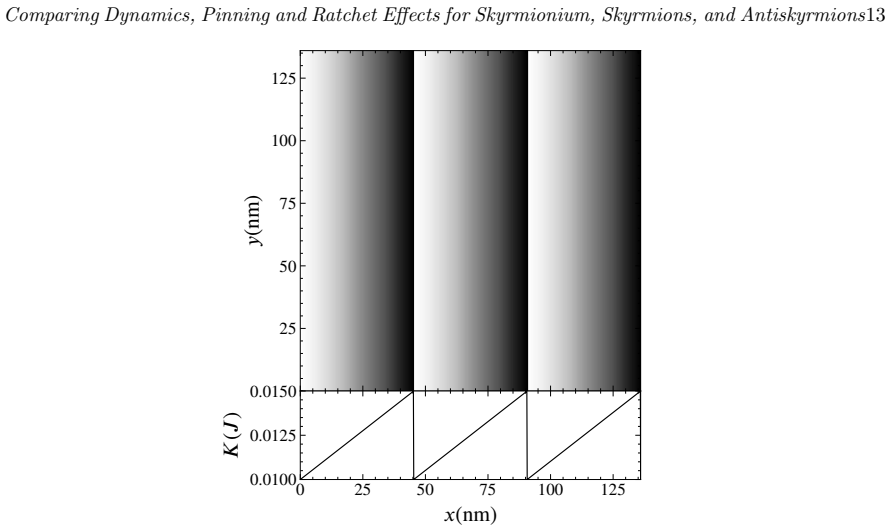
- [§8, Fig. 13] The claim that skyrmions and antiskyrmions have a stronger ratchet effect than skyrmionium is based on Δr = (Δx^2 + Δy^2)^(1/2), but Fig. 13(a–c) shows that Δx, the displacement along the substrate asymmetry direction, increases at the same rate for all three textures. Since K(x,y) in Eq. (3) depends only on x, the relevant ratchet transport along x is identical. The factor-of-two advantage comes entirely from the negative Δy accumulated by the finite-Magnus textures. Please present the x-directed ratchet displacement as the efficiency metric, or explicitly distinguish total path length from transport in the intended direction; the current wording overstates the device-relevant advantage.
- [§7, Fig. 8] The skyrmionium-to-skyrmion transformation is inferred solely from the drop in ⟨v⟩ for j > 4 × 10^9 A m^-2. A velocity drop could also result from temporary pinning or strong deformation of the Q = 0 texture. Please provide direct evidence, such as the time evolution of the topological charge Q(t) from Eq. (2) or magnetization snapshots, to confirm the transformation. This is a load-bearing part of the paper because the transformation is used to define the usable current range for skyrmionium.
- [§5, Figs. 5 and 6] The drive angles used to enforce θ_abs = 0 are reported inconsistently. The text states ϕ = 0 for skyrmionium, ϕ = 5π/8 for skyrmion, and ϕ = −3π/8 for antiskyrmion, while the Fig. 5 caption reproduces the wall-case angles (ϕ = π/4, −3π/8, −5π/8) and the Fig. 6 caption lists ϕ = −5π/8 for the skyrmion. Since the comparison protocol depends on these angles, the correct values must be stated consistently in text and captions.
- [§7] The random-disorder results are based on a single disorder realization, as stated by 'we used the same random arrangement of defects for all three textures.' Depinning thresholds are known to depend on the specific realization. To support the general quantitative claim that skyrmionium is more strongly pinned than skyrmions and antiskyrmions, the authors should show results for several independent disorder realizations or explicitly state the single-realization limitation in the text. This is particularly important because the disorder section also introduces the transformation claim.
minor comments (5)
- [§9] The sentence 'Skyrmionium is not as strongly pinned or slowed down by circular defects compared to skyrmions and antiskyrmions' contradicts Sec. 5, where skyrmionium is temporarily pinned for 26 ns while skyrmions and antiskyrmions deflect and speed up. Please correct this sentence.
- [§4] In the text near Fig. 2, 'the initial value of vy and vy is 1.3 m s^-1' should read 'the initial value of vx and vy is 1.3 m s^-1.' There is also a typo 'skrymionium' in the discussion of Fig. 4.
- [§8] The sentence 'combining the potential of Eq. (4)' should refer to Eq. (3), which defines the asymmetric substrate potential.
- [General] No code or data release is mentioned. For a numerical study of this type, making the simulation code or raw trajectory data available would substantially improve reproducibility and reader confidence.
- [Abstract and Sec. 9] The zero-temperature nature of the simulations is acknowledged in Sec. 9, but the abstract and summary could state it explicitly, since thermal effects may alter pinning thresholds, the transformation onset, and ratchet efficiencies.
Circularity Check
No significant circularity: direct atomistic LLG simulations; the ratchet-metric caveat is an interpretive concern, not a circular derivation.
full rationale
This is a numerical simulation study rather than a derivation chain. All central claims (free-space velocity ratio, wall boost, temporary pinning, depinning thresholds, skyrmionium-to-skyrmion transformation, diode thresholds, and x-directed ratchet displacement) are direct outputs of the atomistic LLG integration for fixed model parameters; no parameter is fitted to these outputs, and no target result is assumed in the Hamiltonian. The asymmetric substrate of Eq. (3) is taken from prior work (Refs. 68 and 15) but functions as an input potential, not as a justification of the conclusions. The self-citations (e.g., Ref. 15 for Magnus-induced ratchet orbits, Ref. 55 for skyrmionium instability at high drives) are background or corroboration, not the sole load-bearing evidence. The one interpretive caveat is the 'stronger ratcheting' claim in Sec. 8, which is based on total displacement Delta_r rather than the x-displacement Delta_x; the text itself reports Delta_x is the same for all textures, so the factor-of-two is a metric/definitional choice about how to count transverse Hall drift. That is a correctness or interpretation concern, not a circular derivation. The explicit deferral of thermal effects in Sec. 9 is a scope limitation, not a circularity. Therefore no circular step is identified.
Assumptions & free parameters
free parameters (1)
- per-texture current angle phi =
phi = 0 for skyrmionium, phi = -5 pi / 8 for skyrmion (Figs. 6-8) or 5 pi / 8 (Sec.
assumptions (5)
- domain assumption The Landau-Lifshitz-Gilbert equation with spin-orbit torque describes current-driven dynamics of the textures.
- domain assumption Isotropic interfacial DMI applies to skyrmionium and skyrmions, while anisotropic interfacial DMI applies to antiskyrmions.
- domain assumption Zero temperature and periodic boundary conditions are representative for comparing pinning and ratchet behavior.
- domain assumption Dipolar interactions can be absorbed into an effective anisotropy for ultrathin films.
- domain assumption The periodic asymmetric anisotropy pattern of Eq. (3) is a suitable model for diode and ratchet studies.
Cite this review
Pith. "Pith review of Comparing Dynamics, Pinning and Ratchet Effects for Skyrmionium, Skyrmions, and Antiskyrmions." pith.science (2026). https://pith.science/paper/AIZ5OZYK
@misc{pith2026241202001,
  author       = {Pith},
  title        = {Pith review of: Comparing Dynamics, Pinning and Ratchet Effects for Skyrmionium, Skyrmions, and Antiskyrmions},
  year         = {2026},
  howpublished = {\url{https://pith.science/paper/AIZ5OZYK}},
  note         = {Machine review of arXiv:2412.02001}
}
read the original abstract
We compare the driven dynamics of skyrmions, antiskyrmions, and skyrmionium interacting with random disorder, circular defects, and asymmetric potentials. When interacting with a line defect at a constant drive, skyrmions and antiskyrmions show an acceleration effect for motion along the wall and a drop in velocity when they can cross the barrier. In contrast, skyrmionium travels at a reduced velocity when moving along a wall, and exhibits an increase in velocity once it can cross the barrier. For point defects, skyrmionium can be pinned for a finite fixed period of time, while for skyrmions and antiskyrmions, the Magnus force creates a deflection from the defect and an acceleration effect. For a given drive, skyrmionium moves twice as fast as skyrmions; however, skyrmionium is more susceptible to pinning effects than skyrmions and antiskyrmions. Additionally, there is a critical threshold where the skyrmionium transforms to a skyrmion that is associated with a drop in the velocity of the texture. We show that all three textures exhibit diode and ratchet effects when interacting with an asymmetric substrate, but skyrmions and antiskyrmions show a stronger ratcheting effect than skyrmionium due to the Magnus force.
Figures


Figures from the paper (10 more)




Forward citations
Cited by 1 Pith paper
-
Skyrmion-Skyrmionium Phase Separation and Laning Transitions via Spin-Orbit Torque Currents
Atomistic simulations show that current-driven mixtures of skyrmions and skyrmioniums form tilted lanes and eventually all skyrmioniums collapse into skyrmions, giving a three-phase dynamic diagram.
Reference graph
Works this paper leans on
-
[1]
S. M¨ uhlbauer, B. Binz, F. Jonietz, C. Pfleiderer, A. Rosch, A. Neubauer, R. Georgii, and P. B¨ oni. Skyrmion lattice in a chiral magnet. Science, 323(5916):915–919, 2009
work page 2009
-
[2]
X. Z. Yu, Y. Onose, N. Kanazawa, J. H. Park, J. H. Han, Y. Matsui, N. Nagaosa, and Y. Tokura. Real-space observation of a two-dimensional skyrmion crystal. Nature (London), 465(7300):901–904, 2010
work page 2010
-
[3]
N. Nagaosa and Y. Tokura. Topological properties and dynamics of magnetic skyrmions. Nature Nanotechnol., 8(12):899–911, 2013
work page 2013
-
[4]
F. Jonietz, S. M¨ uhlbauer, C. Pfleiderer, A. Neubauer, W. M¨ unzer, A. Bauer, T. Adams, R. Georgii, P. B¨ oni, R. A. Duine, K. Everschor, M. Garst, and A. Rosch. Spin transfer torques in MnSi at ultralow current densities. Science, 330(6011):1648–1651, 2010
work page 2010
-
[5]
X. Z. Yu, N. Kanazawa, W. Z. Zhang, T. Nagai, T. Hara, K. Kimoto, Y. Matsui, Y. Onose, and Y. Tokura. Skyrmion flow near room temperature in an ultralow current density. Nature Commun., 3:988, 2012
work page 2012
-
[6]
U. Ritzmann, S. von Malottki, J.-V. Kim, S. Heinze, J. Sinova, and B. Dup´ e. Trochoidal motion and pair generation in skyrmion and antiskyrmion dynamics under spin-orbit torques. Nature Electron., 1(8):451– 457, 2018
work page 2018
- [7]
-
[8]
Z. Wang, M. Guo, H.-A. Zhou, L. Zhao, T. Xu, R. Tomasello, H. Bai, Y. Dong, S.-G. Je, W. Chao, H.-S. Han, S. Lee, K.-S. Lee, Y. Yao, W. Han, C. Song, H. Wu, Carpentieri M., G. Finocchio, M.-Y. Im, S.-Z. Lin, and W. Jiang. Thermal generation, manipulation and thermoelectric detection of skyrmions. Nature Electron., 3:672, 2020
work page 2020
Show all 70 references
-
[9]
S.-Z. Lin, C. Reichhardt, C. D. Batista, and A. Saxena. Particle model for skyrmions in metallic chiral magnets: Dynamics, pinning, and creep. Phys. Rev. B , 87:214419, 2013
2013
-
[10]
Hanneken, A
C. Hanneken, A. Kubetzka, K. von Bergmann, and R. Wiesendanger. Pinning and movement of individual nanoscale magnetic skyrmions via defects. New J. Phys. , 18:055009, 2016
2016
-
[11]
I. L. Fernandes, J. Bouaziz, S. Bl¨ ugel, and S. Lounis. Universality of defect-skyrmion interaction profiles. Nature Commun., 9:4395, 2018
2018
-
[12]
Navau, N
C. Navau, N. Del-Valle, and A. Sanchez. Interaction of isolated skyrmions with point and linear defects. J. Mag. Mag. Mater. , 465:709–715, 2018
2018
-
[13]
Toscano, S
D. Toscano, S. A. Leonel, P. Z. Coura, and F. Sato. Building traps for skyrmions by the incorporation of magnetic defects into nanomagnets: Pinning and scattering traps by magnetic properties engineering. J. Mag. Mag. Mater. , 480:171–185, 2019
2019
-
[14]
I. G. Arjana, I. L. Fernandes, J. Chico, and S. Lounis. Sub-nanoscale atom-by-atom crafting of skyrmion-defect interaction profiles. Sci. Rep., 10:14655, 2020. Comparing Dynamics, Pinning and Ratchet Effects for Skyrmionium, Skyrmions, and Antiskyrmions19
2020
-
[15]
Reichhardt, C
C. Reichhardt, C. J. O. Reichhardt, and M. Milosevic. Statics and dynamics of skyrmions interacting with disorder and nanostructures. Rev. Mod. Phys. , 94:035005, 2022
2022
-
[16]
N. P. Vizarim, C. Reichhardt, C. J. O. Reichhardt, and P. A. Venegas. Skyrmion dynamics and topological sorting on periodic obstacle arrays. New J. Phys. , 22:053025, 2020
2020
-
[17]
R. Juge, K. Bairagi, K. G. Rana, J. Vogel, M. Sall, D. Mailly, V. T. Pham, Q. Zhang, N. Sisodia, M. Foerster, L. Aballe, M. Belmeguenai, Y. Roussign´ e, S. Auffret, L. D. Buda-Prejbeanu, G. Gaudin, D. Ravelosona, and O. Boulle. Helium ions put magnetic skyrmions on the track. ...
2021
-
[18]
A. Fert, V. Cros, and J. Sampaio. Skyrmions on the track. Nature Nanotechnol., 8(3):152–156, 2013
2013
-
[19]
Finocchio, F
G. Finocchio, F. B¨ uttner, R. Tomasello, M. Carpentieri, and M. Kl¨ aui. Magnetic skyrmions: from fundamental to applications. J. Phys. D: Appl. Phys. , 49(42):423001, 2016
2016
-
[20]
Grollier, D
J. Grollier, D. Querlioz, K. Y. Camsari, K. Everschor-Sitte, S. Fukami, and M. D. Stiles. Neuromorphic spintronics. Nature Electron., 3(7):360–370, 2020
2020
-
[21]
Litzius, I
K. Litzius, I. Lemesh, B. Kr¨ uger, P. Bassirian, L. Caretta, K. Richter, F. B¨ uttner, K. Sato, O. A. Tretiakov, J. F¨ orster, R. M. Reeve, M. Weigand, I. Bykova, H. Stoll, G. Sch¨ utz, G. S. D. Beach, and M. Kl¨ aui. Skyrmion Hall effect revealed by direct time-resolved X-ra...
2017
-
[22]
Jiang, X
W. Jiang, X. Zhang, G. Yu, W. Zhang, X. Wang, M. B. Jungfleisch, J. E. Pearson, X. Cheng, O. Heinonen, K. L. Wang, Y. Zhou, A. Hoffmann, and S. G. E. te Velthuis. Direct observation of the skyrmion Hall effect. Nature Phys., 13(2):162–169, 2017
2017
-
[23]
Reichhardt and C
C. Reichhardt and C. J. O. Reichhardt. Plastic flow and the skyrmion Hall effect. Nature Commun., 11:738, 2020
2020
-
[24]
Del-Valle, J
N. Del-Valle, J. Castell-Queralt, L. Gonz´ alez-G´ omez, and C. Navau. Defect modeling in skyrmionic ferromagnetic systems. APL Mater. , 10:010702, 2022
2022
-
[25]
Tretiakov, Motohiko Ezawa, Guoping Zhao, Yan Zhou, Xiaoxi Liu, and Masahito Mochizuki
Xichao Zhang, Jing Xia, Oleg A. Tretiakov, Motohiko Ezawa, Guoping Zhao, Yan Zhou, Xiaoxi Liu, and Masahito Mochizuki. Laminar and transiently disordered dynamics of magnetic-skyrmion pipe flow. Physical Review B, 108:144428, 2023
2023
-
[26]
R. C. Silva, R. L. Silva, J. C. Moreira, W. A. Moura-Melo, and A. R. Pereira. Channeling skyrmions: Suppressing the skyrmion hall effect in ferrimagnetic nanostripes. Journal of Applied Physics , 135:183902, 2024
2024
-
[27]
M¨ uller and A
J. M¨ uller and A. Rosch. Capturing of a magnetic skyrmion with a hole. Phys. Rev. B , 91:054410, 2015
2015
-
[28]
I. L. Fernandes, J. Chico, and S. Lounis. Impurity-dependent gyrotropic motion, deflection and pinning of current-driven ultrasmall skyrmions in PdFe/Ir(111) surface. J. Phys.: Condens. Matter , 32:425802, 2020
2020
-
[29]
Iwasaki, W
J. Iwasaki, W. Koshibae, and N. Nagaosa. Colossal spin transfer torque effect on skyrmion along the edge. Nano Lett., 14:4432–4437, 2014
2014
-
[30]
Reichhardt and C
C. Reichhardt and C. J. Olson Reichhardt. Magnus-induced dynamics of driven skyrmions on a quasi-one- dimensional periodic substrate. Phys. Rev. B , 94:094413, 2016
2016
-
[31]
Navau, N
C. Navau, N. Del-Valle, and A. Sanchez. Analytical trajectories of skyrmions in confined geometries: Skyrmionic racetracks and nano-oscillators. Phys. Rev. B , 94:184104, 2016
2016
-
[32]
X. Chen, W. Kang, D. Zhu, X. Zhang, N. Lei, Y. Zhang, Y. Zhou, and W. Zhao. Skyrmion dynamics in width-varying nanotracks and implications for skyrmionic applications. Appl. Phys. Lett. , 111:202406, 2017
2017
-
[33]
Castell-Queralt, L
J. Castell-Queralt, L. Gonzalez-Gomez, N. Del-Valle, A. Sanchez, and C. Navau. Accelerating, guiding, and compressing skyrmions by defect rails. Nanoscale, 11(26):12589–12594, 2019
2019
-
[34]
J. Wang, J. Xia, X. Zhang, X. Zheng, G. Li, L. Chen, Y. Zhou, J. Wu, H. Yin, R. Chantrell, and Y. Xu. Magnetic skyrmionium diode with a magnetic anisotropy voltage gating. Appl. Phys. Lett. , 117(20):202401, 2020
2020
-
[35]
Jung, H.-S
D.-H. Jung, H.-S. Han, N. Kim, G. Kim, S. Jeong, S. Lee, M. Kang, M.-Y. Im, and K.-S. Lee. Magnetic skyrmion diode: Unidirectional skyrmion motion via symmetry breaking of potential energy barriers. Phys. Rev. B, 104:L060408, 2021
2021
-
[36]
Y. Shu, Q. Li, J. Xia, P. Lai, Z. Hou, Y. Zhao, D. Zhang, Y. Zhou, X. Liu, and G. Zhao. Realization of the skyrmionic logic gates and diodes in the same racetrack with enhanced and modified edges. Appl. Phys. Lett., 121:042402, 2022
2022
-
[37]
Y. Feng, X. Zhang, G. Zhao, and G. Xiang. A skyrmion diode based on skyrmion Hall effect. IEEE Trans. Electron Devices, 69:1293, 2022
2022
-
[38]
J. C. Bellizotti Souza, N. P. Vizarim, C. J. O. Reichhardt, C. Reichhardt, and P. A. Venegas. Magnus induced diode effect for skyrmions in channels with periodic potentials. Journal of Physics: Condensed Matter , 35:015804, 2022
2022
-
[39]
Yamaguchi, K
R. Yamaguchi, K. Yamada, and Y. Nakatani. Control of current-induced skyrmion motion in ratchet-type skyrmion-based racetrack memory with a loop structure. Japan. J. Appl. Phys. , 60:010904, 2020
2020
-
[40]
G¨ obel and I
B. G¨ obel and I. Mertig. Skyrmion ratchet propagation: utilizing the skyrmion Hall effect in AC racetrack storage devices. Sci. Rep., 11:3020, 2021. Comparing Dynamics, Pinning and Ratchet Effects for Skyrmionium, Skyrmions, and Antiskyrmions20
2021
-
[41]
J. C. Bellizotti Souza, N. P. Vizarim, C. J. O. Reichhardt, C. Reichhardt, and P. A. Venegas. Skyrmion ratchet in funnel geometries. Phys. Rev. B , 104:054434, 2021
2021
-
[42]
V´ elez, S
S. V´ elez, S. Ruiz-G´ omez, J. Schaab, E. Gradauskaite, M. S. W¨ ornle, P. Welter, B. J. Jacot, C. L. Degen, M. Trassin, M. Fiebig, and P. Gambardella. Current-driven dynamics and ratchet effect of skyrmion bubbles in a ferrimagnetic insulator. Nature Nanotechnol., 17:834–841, 2022
2022
-
[43]
A. K. Nayak, V. Kumar, T. Ma, P. Werner, E. Pippel, R. Sahoo, F. Damay, U. K. Roessler, C. Felser, and S. S. P. Parkin. Magnetic antiskyrmions above room temperature in tetragonal Heusler materials. Nature (London), 548(7669):561–566, 2017
2017
-
[44]
Schmid, Kai Liu, and Yizheng Wu
Siying Huang, Chao Zhou, Gong Chen, Hongyi Shen, Andreas K. Schmid, Kai Liu, and Yizheng Wu. Stabilization and current-induced motion of antiskyrmion in the presence of anisotropic dzyaloshinskii-moriya interaction. Physical Review B , 96:144412, 2017
2017
-
[45]
Hoffmann, B
M. Hoffmann, B. Zimmermann, G. P. M¨ uller, D. Sch¨ urhoff, N. S. Kiselev, C. Melcher, and S. Bl¨ ugel. Antiskyrmions stabilized at interfaces by anisotropic Dzyaloshinskii-Moriya interactions. Nature Commun., 8:308, 2017
2017
-
[46]
A. A. Kovalev and S. Sandhoefner. Skyrmions and antiskyrmions in quasi-two-dimensional magnets. Front. Phys., 6:98, 2018
2018
-
[47]
Serha, Khrystyna V
Mariam Hassan, Sabri Koraltan, Aladin Ullrich, Florian Bruckner, Rostyslav O. Serha, Khrystyna V. Levchenko, Gaspare Varvaro, Nikolai S. Kiselev, Michael Heigl, Claas Abert, Dieter Suess, and Manfred Albrecht. Dipolar skyrmions and antiskyrmions of arbitrary topological charge...
2024
-
[48]
Kovalev, and Evgeny Y
Kai Huang, Edward Schwartz, Ding-Fu Shao, Alexey A. Kovalev, and Evgeny Y. Tsymbal. Magnetic antiskyrmions in two-dimensional van der Waals magnets engineered by layer stacking. Physical Review B, 109:024426, 2024
2024
-
[49]
Experimental observation of current-driven antiskyrmion sliding in stripe domains
Zhidong He, Zhuolin Li, Zhaohui Chen, Zhan Wang, Jun Shen, Shouguo Wang, Cheng Song, Tongyun Zhao, Jianwang Cai, Shi-Zeng Lin, Ying Zhang, and Baogen Shen. Experimental observation of current-driven antiskyrmion sliding in stripe domains. Nature Materials, 23:1048–1054, 2024
2024
-
[50]
Bogdanov and A
A. Bogdanov and A. Hubert. The stability of vortex-like structures in uniaxial ferromagnets. Journal of Magnetism and Magnetic Materials , 195:182–192, 1999
1999
-
[51]
Finazzi, M
M. Finazzi, M. Savoini, A. R. Khorsand, A. Tsukamoto, A. Itoh, L. Du` o, A. Kirilyuk, Th. Rasing, and M. Ezawa. Laser-induced magnetic nanostructures with tunable topological properties. Physical Review Letters, 110:177205, 2013
2013
-
[52]
Ultrafast generation of skyrmionic defects with vortex beams: Printing laser profiles on magnets
Hiroyuki Fujita and Masahiro Sato. Ultrafast generation of skyrmionic defects with vortex beams: Printing laser profiles on magnets. Physical Review B , 95:054421, 2017
2017
-
[53]
Kolesnikov, Maksim E
Alexander G. Kolesnikov, Maksim E. Stebliy, Alexander S. Samardak, and Alexey V. Ognev. Skyrmionium – high velocity without the skyrmion hall effect. Scientific Reports, 8:16966, 2018
2018
-
[54]
S. L. Zhang, W. W. Wang, D. M. Burn, H. Peng, H. Berger, A. Bauer, C. Pfleiderer, G. van der Laan, and T. Hesjedal. Manipulation of skyrmion motion by magnetic field gradients. Nature Commun., 9:2115, 2018
2018
-
[55]
J. Xia, X. Zhang, M. Ezawa, Q. Shao, X. Liu, and Y. Zhou. Dynamics of an elliptical ferromagnetic skyrmion driven by the spin-orbit torque. Appl. Phys. Lett. , 116:022407, 2020
2020
-
[56]
Theoretical comparison between skyrmion and skyrmionium motions for spintronics applications
Yuichi Ishida and Kenji Kondo. Theoretical comparison between skyrmion and skyrmionium motions for spintronics applications. Japanese Journal of Applied Physics , 59:SGGI04, 2020
2020
-
[57]
R. F. L. Evans. Atomistic Spin Dynamics. In W. Andreoni and S. Yip, editors, Handbook of Materials Modeling: Applications: Current and Emerging Materials , pages 1–23. Springer International Publishing, 2018
2018
-
[58]
Iwasaki, M
J. Iwasaki, M. Mochizuki, and N. Nagaosa. Universal current-velocity relation of skyrmion motion in chiral magnets. Nature Commun., 4(1):1463, February 2013
2013
-
[59]
Iwasaki, M
J. Iwasaki, M. Mochizuki, and N. Nagaosa. Current-induced skyrmion dynamics in constricted geometries. Nature Nanotechnol., 8(10):742–747, October 2013
2013
-
[60]
Schmid, Kai Liu, and Yizheng Wu
Siying Huang, Chao Zhou, Gong Chen, Hongyi Shen, Andreas K. Schmid, Kai Liu, and Yizheng Wu. Stabilization and current-induced motion of antiskyrmion in the presence of anisotropic dzyaloshinskii-moriya interaction. Phys. Rev. B , 96:144412, 2017
2017
-
[61]
X. S. Wang, H. Y. Yuan, and X. R. Wang. A theory on skyrmion size. Communications Physics, 1(1):31, 2018
2018
-
[62]
Seki and M
S. Seki and M. Mochizuki. Skyrmions in Magnetic Materials . Springer International Publishing, 2016
2016
-
[63]
T. L. Gilbert. A phenomenological theory of damping in ferromagnetic materials. IEEE Trans. Mag. , 40(6):3443–3449, 2004
2004
-
[64]
See supplemental material for animations showing the textures motion
-
[65]
Reichhardt, D
C. Reichhardt, D. Ray, and C. J. Olson Reichhardt. Quantized transport for a skyrmion moving on a two- dimensional periodic substrate. Phys. Rev. B , 91:104426, 2015
2015
-
[66]
Iwasaki, M
J. Iwasaki, M. Mochizuki, and N. Nagaosa. Universal current-velocity relation of skyrmion motion in chiral Comparing Dynamics, Pinning and Ratchet Effects for Skyrmionium, Skyrmions, and Antiskyrmions21 magnets. Nature Commun., 4:1463, 2013
2013
-
[67]
S. L. Zhang, A. Bauer, H. Berger, C. Pfleiderer, G. van der Laan, and T. Hesjedal. Imaging and manipulation of skyrmion lattice domains in Cu 2OSeO3. Appl. Phys. Lett. , 109(19):192406, 2016
2016
-
[68]
Reichhardt and C
C. Reichhardt and C. J. Olson Reichhardt. Shapiro steps for skyrmion motion on a washboard potential with longitudinal and transverse ac drives. Phys. Rev. B , 92:224432, 2015
2015
-
[69]
Zhang, J.-N
C.-L. Zhang, J.-N. Wang, C.-K. Song, N. Mehmood, Z.-Z. Zeng, Y.-X. Ma, J.-B. Wang, and Q.-F. Liu. Edge- guided heart-shaped skyrmion. Rare Metals, 41:865–870, 2022
2022
-
[70]
D ´ ıaz, Stephan Kessler, Tobias Meng, Matteo Rizzi, Kjetil M
Jonas Nothhelfer, Sebasti´ an A. D ´ ıaz, Stephan Kessler, Tobias Meng, Matteo Rizzi, Kjetil M. D. Hals, and Karin Everschor-Sitte. Steering majorana braiding via skyrmion-vortex pairs: A scalable platform. Physical Review B, 105:224509, 2022
2022
Reviewed August 11, 2026 · model on record in the stance chip above.
Discussion (0). Continue with ORCID to comment.