REVIEW 4 major objections 4 minor 64 references
Ptychographic estimation of pure multiqubit states in a quantum device
T0 review · 4 major / 4 minor · reviewed 2026-08-11 · deepseek-v4-flash
Pith's one-line read Quantum ptychography estimates pure multiqubit states on real quantum hardware, and an approximate Fourier transform pushes reliable reconstruction to four entangled qubits.
desk verdict A genuine first circuit-based demonstration of quantum ptychography on real hardware, with an honest but unexplained state-dependent failure; the core empirical claim holds, but the tuning and missing data make it a conditional accept. read the letter →
The pith
A machine-rendered reading of the paper's core claim, the machinery that carries it, and where it could break.
The reading
What carries the argument
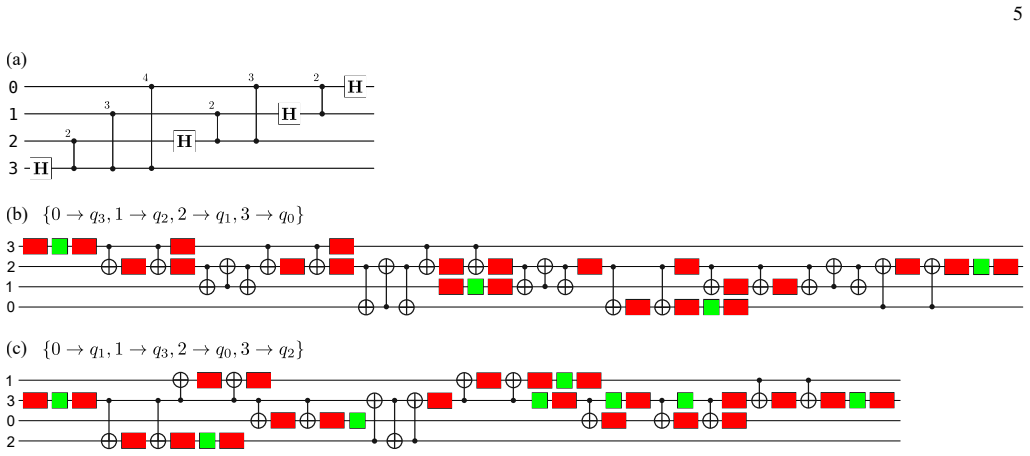
The load-bearing object is the ptychographic iterative engine (PIE), an iterative phase-retrieval loop that starts from a random estimate, applies each overlapping projector, changes basis with the final unitary, corrects amplitudes with measured data, transforms back, and updates the estimate with a feedback parameter. The paper's key algorithmic modification is a decreasing feedback parameter, which acts like a learning-rate schedule and significantly improves convergence over a constant parameter. The second piece of machinery is the family of final unitaries: exact QFT, approximate QFT of degree m (which removes controlled-phase gates beyond distance m), and random separable unitaries. The approximate QFT of degree 2 reduces the transpiled circuit's two-qubit gate count enough to make the method viable on noisy hardware.
What would settle it
Run a noise-free simulation for n=6 with a random entangled state, use the degree-2 AQFT final basis and a very large number of shots (for example $10^{6}$), and check whether the PIE algorithm from many random starting estimates converges to fidelity above 0.99; if it does not, the method fails to estimate arbitrary pure states with those circuits.
Extended reading notes
Core claim
The central claim is that the ptychographic protocol, originally proposed as a concept, works in practice on a noisy quantum computer when the overlapping projections are implemented through single-qubit Pauli measurements and the final basis is generated by a unitary operation. The authors show experimentally that the exact QFT yields median fidelities near 0.986 for two-qubit states and near 0.95 for three-qubit states, while a degree-2 AQFT improves three-qubit results (median 0.974) and makes four-qubit entangled state estimation reliable (GHZ fidelity 0.894, W fidelity 0.879). They also find that random separable final unitaries provide good estimations only for separable states, not for entangled states. Noise-free simulations up to ten qubits show average fidelities above 0.98 for both separable and arbitrary states, and in the same simulations the ptychographic method outperforms a recent scalable pure-state estimator for more than five qubits.
Load-bearing premise
The PIE algorithm converges to the true pure state from any random initial estimate for the chosen projectors and final unitary, which is demonstrated only empirically for the tested states and noise levels, not proven.
Editorial extensions
If this is right
- Quantum ptychography can serve as a practical pure-state verification tool on current NISQ processors, needing only 3n circuits rather than 3^n.
- Substituting low-degree AQFT for exact QFT improves estimation fidelity on noisy hardware, suggesting a general noise-versus-accuracy trade-off in phase-retrieval state estimation.
- In noise-free simulations, ptychography matches or outperforms a recent scalable pure-state estimator beyond five qubits, indicating good scaling as system size grows.
- Separable final measurement bases are insufficient for entangled states within this protocol, so scalability for entangled states requires nonseparable bases or nonseparable intermediate projections.
- The variable-feedback PIE modification improves convergence and can be adopted in other implementations of quantum ptychography.
Reading between the lines
- The success of degree-2 AQFT suggests that any low-depth unitary sufficiently biased away from product bases might serve as an effective final measurement basis; this could be probed systematically with random low-depth circuits.
- A rigorous proof or counterexample for PIE convergence with the chosen projectors would determine whether the method is reliable for all pure states or only for the empirically tested families.
- Combining nonseparable intermediate projections (such as Bell-state projectors between connected qubits) with a separable final basis is a concrete next step toward a fully low-depth, scalable ptychographic scheme, and is testable on existing hardware.
- The observed advantage of AQFT echoes known decoherence-resilience results for approximate Fourier transforms, suggesting that optimizing the approximation degree m per device noise level could further improve fidelities.
Editorial analysis
A structured set of objections, weighed in public.
Referee Report
Summary. The paper reports an experimental and numerical implementation of quantum ptychography for estimating pure multiqubit states on an IBM superconducting processor. The protocol uses 3n circuits, each consisting of a single-qubit Pauli measurement followed by a final projective measurement in a basis generated by the quantum Fourier transform (QFT) or its approximation (AQFT). The authors present numerical simulations for up to 10 qubits and experiments on 2–5 qubits, reporting high fidelities for QFT up to n=3 and for AQFT of degree m=2 up to n=4. They also test separable unitary operations, which yield good estimates only for separable states. The paper introduces a variable-feedback modification to the ptychographic iterative engine (PIE) and a simple measurement-error-mitigation technique, and it compares the results with the PZD pure-state estimation method.
Significance. If the findings hold, this is a useful demonstration: quantum ptychography is implemented on a gate-based device and the AQFT is shown to be a more noise-robust measurement basis than the full QFT. The numerical simulations with random states for the QFT protocol are a strength, as are the high experimental fidelities for the tested states and the linear scaling of the number of circuits. However, the general reliability claim is weakened by the absence of a convergence proof for the PIE algorithm, an unexplained state-dependence observed for the Hadamard transform, and a non-matched cross-device comparison with the PZD method. The paper is likely to be of interest to the quantum characterization and NISQ benchmarking community, but the load-bearing points need clarification.
major comments (4)
- [Sec. V A 1 and Eq. (7)] The text states that the AQFT of degree m is obtained by removing controlled-phase gates with index k > m and that for m=1 the transform reduces to the Hadamard product H^{⊗n}. However, Eq. (7) restricts the phase sum to n−m ≤ a+b, so for m=1 the sum includes the terms with a+b = n−1, which correspond to controlled-phase (controlled-Z) gates, not to H^{⊗n}. For example, for n=3 and m=1, Eq. (7) retains phases involving pairs (0,2) and (1,1), which is not the Hadamard transform. Since the PIE algorithm in Algorithm 1 uses the matrix U explicitly, this discrepancy changes the unitary assumed in the reconstruction and may explain the odd W-state behavior reported in Sec. V A 2. Please clarify which definition was implemented in the simulations and experiments and make Eq. (7) consistent with the textual description.
- [Sec. IV B, Figs. 4(c) and 4(d)] The performance comparison of ptychography with PZD is made between the average fidelity of ptychography and the median fidelity of PZD. Mean and median are not interchangeable unless the fidelity distribution is symmetric, which is not demonstrated; if the PZD distribution is left-skewed, this comparison can overstate the advantage of ptychography. For a fair comparison, either both statistics should be reported or the full distributions should be shown. This is load-bearing because the claim that ptychography outperforms PZD for n ≥ 6 is based on this comparison.
- [Sec. V A 2, Fig. 8(a)] The authors report that for the Hadamard transform (AQFT m=1) the W state is correctly estimated only for odd numbers of qubits, and add 'we cannot explain this behavior.' This is direct evidence that the PIE algorithm's convergence is state- and basis-dependent in an uncontrolled way. The general claim in Sec. I that 'the algorithm will make an initial random guess converge to the true pure state that generated the data' is therefore not supported. A convergence analysis or at least a random-state stress test for the QFT and AQFT m=2 protocols would be needed to establish that the high fidelities are not an artifact of the specific five target states.
- [Sec. VI A and Table V] The experimental comparison with the PZD method is performed on a different IBM device (ibm_perth vs ibmq_montreal) with different CNOT error rates and numbers of shots. Although the authors acknowledge these differences, the claim that the ptychographic results 'compare favorably' with PZD is confounded by the hardware generation gap. A more convincing comparison would use the same device or a noise-matched simulation. As written, the comparison in Table V should be interpreted only as an indicative benchmark, not a head-to-head evaluation.
minor comments (4)
- [Algorithm 1] The update step '|˜φ_corr⟩ ← √Ω_ℓ' is a shorthand: the algorithm must replace the moduli of the amplitudes of U|φ_ℓ⟩ with the square roots of the measured probabilities while preserving their phases. The notation should say this explicitly, as written it is not a well-defined vector assignment.
- [Sec. IV A 2] The variable feedback schedule (β0=2, Δβ=0.04 or 0.1) was chosen 'after several tests' on the same data. The paper would be stronger with a sensitivity analysis showing that the reported fidelities are stable over a range of schedules, rather than optimized for the displayed states.
- [Data Availability] The statement that data are available upon reasonable request is not as useful as a public repository. Given the many free parameters (shuffling, transpilation, PIE runs, β schedule), releasing the Qiskit code and the experimental data would greatly improve reproducibility.
- [Fig. 8(a)] The W-state anomaly for odd vs even n is reported but not analyzed; at minimum, the authors could compute the exact unitary for m=1 and check whether the odd-even pattern is consistent with the phase structure of the reconstructed state. Adding this would help readers assess whether the failure is fundamental or an artifact of Eq. (7).
Circularity Check
No circular derivation: the paper is an empirical benchmark of an existing estimation method against known prepared states, and no prediction reduces to its fitted inputs.
full rationale
The central claim is a demonstration: with QFT and AQFT(m=2), the ptychographic pipeline yields high fidelities for specific separable and entangled states (abstract; Secs. IV C and V A 3). The evaluation is external to the method: target states are independently defined (Table III; random states in Sec. IV B), and the reported fidelities are computed against those known states (Eq. 6). The PIE update rule (Algorithm 1) is the standard classical ptychographic engine (Rodenburg and Faulkner, Refs. 43-44), not a fit of the target amplitudes, and no parameter fitted to the target states is later relabeled as a prediction. The self-citations to the original quantum ptychography proposal (Ref. 36, Fernandes and Neves) and to Ref. 54 are used to motivate the projector/unitary choice and the variable-feedback modification, but those citations do not carry the paper's quantitative claims; the measured fidelities do. Moreover, Ref. 36 is a peer-reviewed result whose stated assumptions (projectors of Eq. 3 and QFT) do not include the present device results, so it counts as independent support under the review rules. The paper explicitly flags its own limitations, which are robustness issues, not circularity: Sec. V A 2 reports that for AQFT m=1 the W state 'was correctly estimated only for an odd number of qubits, but we cannot explain this behavior'; Sec. VI B concedes 'our limited set of results prevents us from drawing conclusions about this behavior'; and PIE convergence is assumed rather than proven (Sec. IV A). None of these admissions involves an equation being equivalent to its input by construction or a fitted parameter being renamed as a prediction. Therefore no circular step is present and the score is 0.
Assumptions & free parameters
free parameters (3)
- Initial PIE feedback parameter beta_0 =
2
- PIE feedback decrement delta_beta =
0.1 (20 iterations) or 0.04 (50 iterations)
- AQFT degree m =
2 (experiments)
assumptions (3)
- domain assumption PIE algorithm converges to the true pure state from random initializations for the chosen projectors and unitary operations.
- domain assumption The prepared states are the nominal pure states listed in Table III, up to preparation errors that are acknowledged.
- domain assumption The measurement error mitigation matrix inversion accurately corrects readout noise.
Cite this review
Pith. "Pith review of Ptychographic estimation of pure multiqubit states in a quantum device." pith.science (2026). https://pith.science/paper/XBVQFUSN
@misc{pith2026241202120,
  author       = {Pith},
  title        = {Pith review of: Ptychographic estimation of pure multiqubit states in a quantum device},
  year         = {2026},
  howpublished = {\url{https://pith.science/paper/XBVQFUSN}},
  note         = {Machine review of arXiv:2412.02120}
}
abstract
Quantum ptychography is a method for estimating an unknown pure quantum state by subjecting it to overlapping projections, each one followed by a projective measurement on a single prescribed basis. Here, we present a comprehensive study of this method applied for estimating $n$-qubit states in a circuit-based quantum computer, including numerical simulations and experiments carried out on an IBM superconducting quantum processor. The intermediate projections are implemented through Pauli measurements on one qubit at a time, which sets the number of ptychographic circuits to $3n$ (in contrast to the $3^n$ circuits for standard Pauli tomography); the final projective measurement in the computational basis is preceded by the quantum Fourier transform (QFT). Due to the large depth and number of two-qubit gates of the QFT circuit, which is unsuitable for noisy devices, we also test the approximate QFT (AQFT) and separable unitary operations. Using the QFT and AQFT of degree $2$, we obtained high estimation fidelities in all tests with separable and entangled states for up to three and four qubits, respectively; on the other hand, the separable unitaries in this scenario provided good estimations only for separable states, in general. Our results compare favorably with recent results in the literature and we discuss further alternatives to make the ptychographic method scalable for the current noisy devices.
Figures


Figures from the paper (7 more)


Reference graph
Works this paper leans on
-
[1]
merlin.mbs aapmrev4-1.bst 2010-07-25 4.21a (PWD, AO, DPC) hacked
FUNCTION id.bst "merlin.mbs aapmrev4-1.bst 2010-07-25 4.21a (PWD, AO, DPC) hacked" ENTRY address archive archivePrefix author bookaddress booktitle chapter collaboration doi edition editor eid eprint howpublished institution isbn issn journal key language month note number organization pages primaryClass publisher school SLACcitation series title translat...
2010
-
[2]
merlin.mbs aipauth4-1.bst 2010-07-25 4.21a (PWD, AO, DPC) hacked
FUNCTION id.bst "merlin.mbs aipauth4-1.bst 2010-07-25 4.21a (PWD, AO, DPC) hacked" ENTRY address archive archivePrefix author bookaddress booktitle chapter collaboration doi edition editor eid eprint howpublished institution isbn issn journal key language month note number organization pages primaryClass publisher school SLACcitation series title translat...
2010
-
[3]
merlin.mbs aipnum4-1.bst 2010-07-25 4.21a (PWD, AO, DPC) hacked
FUNCTION id.bst "merlin.mbs aipnum4-1.bst 2010-07-25 4.21a (PWD, AO, DPC) hacked" ENTRY address archive archivePrefix author bookaddress booktitle chapter collaboration doi edition editor eid eprint howpublished institution isbn issn journal key language month note number organization pages primaryClass publisher school SLACcitation series title translati...
2010
-
[4]
merlin.mbs apsrev4-1.bst 2010-07-25 4.21a (PWD, AO, DPC) hacked
FUNCTION id.bst "merlin.mbs apsrev4-1.bst 2010-07-25 4.21a (PWD, AO, DPC) hacked" ENTRY address archive archivePrefix author bookaddress booktitle chapter collaboration doi edition editor eid eprint howpublished institution isbn issn journal key language month note number organization pages primaryClass publisher school SLACcitation series title translati...
2010
-
[5]
merlin.mbs apsrmp4-1.bst 2010-07-25 4.21a (PWD, AO, DPC) hacked
FUNCTION id.bst "merlin.mbs apsrmp4-1.bst 2010-07-25 4.21a (PWD, AO, DPC) hacked" ENTRY address archive archivePrefix author bookaddress booktitle chapter collaboration doi edition editor eid eprint howpublished institution isbn issn journal key language month note number organization pages primaryClass publisher school SLACcitation series title translati...
2010
-
[6]
author author C. H. \ Bennett \ and\ author D. P. \ DiVincenzo ,\ title title Quantum information and computation ,\ https://doi.org/10.1038/35005001 journal journal Nature \ volume 404 ,\ pages 247 ( year 2000 ) NoStop
-
[7]
author author M. A. \ Nielsen \ and\ author I. L. \ Chuang ,\ @noop title Quantum Computation and Quantum Information \ ( publisher Cambridge University Press, Cambridge ,\ year 2000 ) NoStop
work page 2000
-
[8]
author author P. Schindler , author D. Nigg , author T. Monz , author J. T. \ Barreiro , author E. Martinez , author S. X. \ Wang , author S. Quint , author M. F. \ Brandl , author V. Nebendahl , author C. F. \ Roos , et al. ,\ title title A quantum information processor with trapped ions ,\ https://doi.org/10.1088/1367-2630/15/12/123012 journal journal N...
Show all 64 references
-
[9]
author author C. D. \ Bruzewicz , author J. Chiaverini , author R. McConnell ,\ and\ author J. M. \ Sage ,\ title title Trapped-ion quantum computing: Progress and challenges ,\ https://doi.org/10.1063/1.5088164 journal journal Appl. Phys. Rev. \ volume 6 ,\ pages 021314 ( yea...
-
[10]
author author J. M. \ Pino , author J. M. \ Dreiling , author C. Figgatt , author J. P. \ Gaebler , author S. A. \ Moses , author M. Allman , author C. Baldwin , author M. Foss-Feig , author D. Hayes , author K. Mayer , et al. ,\ title title Demonstration of the trapped-ion qu...
-
[11]
author author S. A. \ Moses , author C. H. \ Baldwin , author M. S. \ Allman , author R. Ancona , author L. Ascarrunz , author C. Barnes , author J. Bartolotta , author B. Bjork , author P. Blanchard , author M. Bohn , et al. ,\ title title A race-track trapped-ion quantum pro...
-
[12]
Saffman ,\ title title Quantum computing with atomic qubits and R ydberg interactions: P rogress and challenges ,\ https://doi.org/10.1088/0953-4075/49/20/202001 journal journal J
author author M. Saffman ,\ title title Quantum computing with atomic qubits and R ydberg interactions: P rogress and challenges ,\ https://doi.org/10.1088/0953-4075/49/20/202001 journal journal J. Phys. B \ volume 49 ,\ pages 202001 ( year 2016 ) NoStop
-
[13]
Henriet , author L
author author L. Henriet , author L. Beguin , author A. Signoles , author T. Lahaye , author A. Browaeys , author G.-O. \ Reymond ,\ and\ author C. Jurczak ,\ title title Quantum computing with neutral atoms ,\ https://doi.org/10.22331/q-2020-09-21-327 journal journal Quantum ...
-
[14]
Barnes , author P
author author K. Barnes , author P. Battaglino , author B. J. \ Bloom , author K. Cassella , author R. Coxe , author N. Crisosto , author J. P. \ King , author S. S. \ Kondov , author K. Kotru , author S. C. \ Larsen , et al. ,\ title title Assembly and coherent control of a r...
-
[15]
Takeda \ and\ author A
author author S. Takeda \ and\ author A. Furusawa ,\ title title Toward large-scale fault-tolerant universal photonic quantum computing ,\ https://doi.org/10.1063/1.5100160 journal journal APL Photonics \ volume 4 ,\ pages 060902 ( year 2019 ) NoStop
-
[16]
Slussarenko \ and\ author G
author author S. Slussarenko \ and\ author G. J. \ Pryde ,\ title title Photonic quantum information processing: A concise review ,\ https://doi.org/10.1063/1.5115814 journal journal Appl. Phys. Rev. \ volume 6 ,\ pages 041303 ( year 2019 ) NoStop
-
[17]
author author J. M. \ Arrazola , author V. Bergholm , author K. Br \'a dler , author T. R. \ Bromley , author M. J. \ Collins , author I. Dhand , author A. Fumagalli , author T. Gerrits , author A. Goussev , author L. G. \ Helt , et al. ,\ title title Quantum circuits with man...
-
[18]
Clarke \ and\ author F
author author J. Clarke \ and\ author F. K. \ Wilhelm ,\ title title Superconducting quantum bits ,\ https://doi.org/10.1038/nature07128 journal journal Nature \ volume 453 ,\ pages 1031 ( year 2008 ) NoStop
2008 doi
-
[19]
author author J. M. \ Gambetta , author J. M. \ Chow ,\ and\ author M. Steffen ,\ title title Building logical qubits in a superconducting quantum computing system ,\ https://doi.org/10.1038/s41534-016-0004-0 journal journal npj Quantum Inf. \ volume 3 ,\ pages 2 ( year 2017 ) NoStop
-
[20]
Kjaergaard , author M
author author M. Kjaergaard , author M. E. \ Schwartz , author J. Braum \"u ller , author P. Krantz , author J. I.-J. \ Wang , author S. Gustavsson ,\ and\ author W. D. \ Oliver ,\ title title Superconducting qubits: Current state of play ,\ https://doi.org/10.1146/annurev-con...
-
[21]
Preskill ,\ title title Quantum computing in the NISQ era and beyond ,\ https://doi.org/10.22331/q-2018-08-06-79 journal journal Quantum \ volume 2 ,\ pages 79 ( year 2018 ) NoStop
author author J. Preskill ,\ title title Quantum computing in the NISQ era and beyond ,\ https://doi.org/10.22331/q-2018-08-06-79 journal journal Quantum \ volume 2 ,\ pages 79 ( year 2018 ) NoStop
2018 doi
-
[22]
Arute , author K
author author F. Arute , author K. Arya , author R. Babbush , author D. Bacon , author J. C. \ Bardin , author R. Barends , author R. Biswas , author S. Boixo , author F. G. \ Brand\ ao , author D. A. \ Buell , et al. ,\ title title Quantum supremacy using a programmable super...
-
[23]
\ Zhong , author H
author author H.-S. \ Zhong , author H. Wang , author Y.-H. \ Deng , author M.-C. \ Chen , author L.-C. \ Peng , author Y.-H. \ Luo , author J. Qin , author D. Wu , author X. Ding , author Y. Hu , et al. ,\ title title Quantum computational advantage using photons ,\ https://d...
-
[24]
Ippoliti , author K
author author M. Ippoliti , author K. Kechedzhi , author R. Moessner , author S. Sondhi ,\ and\ author V. Khemani ,\ title title Many-body physics in the NISQ era: Quantum programming a discrete time crystal ,\ https://doi.org/10.1103/PRXQuantum.2.030346 journal journal PRX Qu...
-
[25]
Eddins , author M
author author A. Eddins , author M. Motta , author T. P. \ Gujarati , author S. Bravyi , author A. Mezzacapo , author C. Hadfield ,\ and\ author S. Sheldon ,\ title title Doubling the size of quantum simulators by entanglement forging ,\ https://doi.org/10.1103/PRXQuantum.3.01...
-
[26]
Motta , author G
author author M. Motta , author G. O. \ Jones , author J. E. \ Rice , author T. P. \ Gujarati , author R. Sakuma , author I. Liepuoniute , author J. M. \ Garcia ,\ and\ author Y.-y. \ Ohnishi ,\ title title Quantum chemistry simulation of ground- and excited-state properties o...
-
[27]
Magesan , author J
author author E. Magesan , author J. M. \ Gambetta , author B. R. \ Johnson , author C. A. \ Ryan , author J. M. \ Chow , author S. T. \ Merkel , author M. P. \ da Silva , author G. A. \ Keefe , author M. B. \ Rothwell , author T. A. \ Ohki , author M. B. \ Ketchen ,\ and\ aut...
-
[28]
Helsen , author I
author author J. Helsen , author I. Roth , author E. Onorati , author A. Werner ,\ and\ author J. Eisert ,\ title title General framework for randomized benchmarking ,\ https://doi.org/10.1103/PRXQuantum.3.020357 journal journal PRX Quantum \ volume 3 ,\ pages 020357 ( year 20...
-
[29]
author author M. P. \ da Silva , author O. Landon-Cardinal ,\ and\ author D. Poulin ,\ title title Practical characterization of quantum devices without tomography ,\ https://doi.org/10.1103/PhysRevLett.107.210404 journal journal Phys. Rev. Lett. \ volume 107 ,\ pages 210404 (...
-
[30]
author author S. T. \ Flammia \ and\ author Y.-K. \ Liu ,\ title title Direct fidelity estimation from few P auli measurements ,\ https://doi.org/10.1103/PhysRevLett.106.230501 journal journal Phys. Rev. Lett. \ volume 106 ,\ pages 230501 ( year 2011 ) NoStop
-
[31]
Banaszek , author M
author author K. Banaszek , author M. Cramer ,\ and\ author D. Gross ,\ title title Focus on quantum tomography ,\ https://doi.org/10.1088/1367-2630/15/12/125020 journal journal New J. Phys. \ volume 15 ,\ pages 125020 ( year 2013 ) NoStop
-
[32]
author author Y. S. \ Teo ,\ @noop title Introduction to Q uantum- S tate E stimation \ ( publisher World Scientific, Singapore ,\ year 2015 ) NoStop
2015
-
[33]
author author D. F. V. \ James , author P. G. \ Kwiat , author W. J. \ Munro ,\ and\ author A. G. \ White ,\ title title Measurement of qubits ,\ https://doi.org/10.1103/PhysRevA.64.052312 journal journal Phys. Rev. A \ volume 64 ,\ pages 052312 ( year 2001 ) NoStop
-
[34]
Shang , author Z
author author J. Shang , author Z. Zhang ,\ and\ author H. K. \ Ng ,\ title title Superfast maximum-likelihood reconstruction for quantum tomography ,\ https://doi.org/10.1103/PhysRevA.95.062336 journal journal Phys. Rev. A \ volume 95 ,\ pages 062336 ( year 2017 ) NoStop
-
[35]
Gross , author Y.-K
author author D. Gross , author Y.-K. \ Liu , author S. T. \ Flammia , author S. Becker ,\ and\ author J. Eisert ,\ title title Quantum state tomography via compressed sensing ,\ https://doi.org/10.1103/PhysRevLett.105.150401 journal journal Phys. Rev. Lett. \ volume 105 ,\ pa...
-
[36]
T\'oth , author W
author author G. T\'oth , author W. Wieczorek , author D. Gross , author R. Krischek , author C. Schwemmer ,\ and\ author H. Weinfurter ,\ title title Permutationally invariant quantum tomography ,\ https://doi.org/10.1103/PhysRevLett.105.250403 journal journal Phys. Rev. Lett...
-
[37]
Ferrie ,\ title title Self-guided quantum tomography ,\ https://doi.org/10.1103/PhysRevLett.113.190404 journal journal Phys
author author C. Ferrie ,\ title title Self-guided quantum tomography ,\ https://doi.org/10.1103/PhysRevLett.113.190404 journal journal Phys. Rev. Lett. \ volume 113 ,\ pages 190404 ( year 2014 ) NoStop
2014 doi
-
[38]
Goyeneche , author G
author author D. Goyeneche , author G. Ca\ nas , author S. Etcheverry , author E. S. \ G\'omez , author G. B. \ Xavier , author G. Lima ,\ and\ author A. Delgado ,\ title title Five measurement bases determine pure quantum states on any dimension ,\ https://doi.org/10.1103/Phy...
-
[39]
Ma , author T
author author X. Ma , author T. Jackson , author H. Zhou , author J. Chen , author D. Lu , author M. D. \ Mazurek , author K. A. G. \ Fisher , author X. Peng , author D. Kribs , author K. J. \ Resch , author Z. Ji , author B. Zeng ,\ and\ author R. Laflamme ,\ title title Pure...
-
[40]
Pears Stefano , author L
author author Q. Pears Stefano , author L. Reb\'on , author S. Ledesma ,\ and\ author C. Iemmi ,\ title title Determination of any pure spatial qudits from a minimum number of measurements by phase-stepping interferometry ,\ https://doi.org/10.1103/PhysRevA.96.062328 journal j...
-
[41]
author author M. F. \ Fernandes \ and\ author L. Neves ,\ title title Ptychography of pure quantum states ,\ https://doi.org/10.1038/s41598-019-52415-y journal journal Sci. Rep. \ volume 9 ,\ pages 16066 ( year 2019 ) NoStop
2019 doi
-
[42]
Zambrano , author L
author author L. Zambrano , author L. Pereira , author D. Mart\' nez , author G. Ca\ nas , author G. Lima ,\ and\ author A. Delgado ,\ title title Estimation of pure states using three measurement bases ,\ https://doi.org/10.1103/PhysRevApplied.14.064004 journal journal Phys. ...
-
[43]
Pereira , author L
author author L. Pereira , author L. Zambrano ,\ and\ author A. Delgado ,\ title title Scalable estimation of pure multi-qubit states ,\ https://doi.org/10.1038/s41534-022-00565-9 journal journal npj Quantum Inf. \ volume 8 ,\ pages 57 ( year 2022 ) NoStop
-
[44]
Zambrano , author L
author author L. Zambrano , author L. Pereira ,\ and\ author A. Delgado ,\ title title Minimal orthonormal bases for pure quantum state estimation ,\ https://doi.org/10.22331/q-2024-02-08-1244 journal journal Quantum \ volume 8 ,\ pages 1244 ( year 2024 ) NoStop
2024 doi
-
[45]
Tariq , author A
author author S. Tariq , author A. Farooq , author J. U. \ Rehman , author T. Q. \ Duong ,\ and\ author H. Shin ,\ title title Efficient quantum state estimation with low-rank matrix completion ,\ https://doi.org/10.1140/epjqt/s40507-024-00261-x journal journal EPJ Quantum Tec...
-
[46]
Thibault , author M
author author P. Thibault , author M. Dierolf , author A. Menzel , author O. Bunk , author C. David ,\ and\ author F. Pfeiffer ,\ title title High-resolution scanning x-ray diffraction microscopy ,\ https://doi.org/10.1126/science.1158573 journal journal Science \ volume 321 ,...
-
[47]
Humphry , author B
author author M. Humphry , author B. Kraus , author A. Hurst , author A. Maiden ,\ and\ author J. Rodenburg ,\ title title Ptychographic electron microscopy using high-angle dark-field scattering for sub-nanometre resolution imaging ,\ https://doi.org/10.1038/ncomms1733 journa...
-
[48]
author author H. M. L. \ Faulkner \ and\ author J. M. \ Rodenburg ,\ title title Movable aperture lensless transmission microscopy: A novel phase retrieval algorithm ,\ https://journals.aps.org/prl/abstract/10.1103/PhysRevLett.93.023903 journal journal Phys. Rev. Lett. \ volum...
-
[49]
author author J. M. \ Rodenburg \ and\ author H. M. L. \ Faulkner ,\ title title A phase retrieval algorithm for shifting illumination ,\ https://doi.org/10.1063/1.1823034 journal journal Appl. Phys. Lett. \ volume 85 ,\ pages 4795 ( year 2004 ) NoStop
- [50]
-
[51]
Altepeter , author E
author author J. Altepeter , author E. Jeffrey ,\ and\ author P. Kwiat ,\ title title Photonic S tate T omography \ ( publisher Academic Press ,\ year 2005 )\ pp.\ pages 105--159 NoStop
2005
-
[52]
note The probabilities that build c_j from operators including I can be determined from the measurements in the other 3^n bases. Stop
-
[53]
However, this approach is less favorable for noisy devices and achieved poor performance in comparison to the use of separable bases (see Ref
note The PZD method can also be implemented from measurements on nonseparable bases plus the computational basis. However, this approach is less favorable for noisy devices and achieved poor performance in comparison to the use of separable bases (see Ref. Pereira2022 ). Stop
-
[54]
author author J. L. \ Weaver \ and\ author F. J. \ Harkins ,\ @noop title Qiskit Pocket Guide \ ( publisher O'Reilly Media, Inc. ,\ year 2022 ) NoStop
2022
-
[55]
Abhijith et al
author author J. Abhijith et al. ,\ title title Quantum algorithm implementations for beginners ,\ https://doi.org/10.1145/3517340 journal journal ACM Trans. Quantum Comp. \ volume 3 ,\ pages 18 ( year 2022 ) NoStop
2022 doi
-
[56]
Bravyi , author S
author author S. Bravyi , author S. Sheldon , author A. Kandala , author D. C. \ Mckay ,\ and\ author J. M. \ Gambetta ,\ title title Mitigating measurement errors in multiqubit experiments ,\ https://doi.org/10.1103/PhysRevA.103.042605 journal journal Phys. Rev. A \ volume 10...
-
[57]
author author P. D. \ Nation , author H. Kang , author N. Sundaresan ,\ and\ author J. M. \ Gambetta ,\ title title Scalable mitigation of measurement errors on quantum computers ,\ https://doi.org/10.1103/PRXQuantum.2.040326 journal journal PRX Quantum \ volume 2 ,\ pages 040...
-
[58]
Kim , author A
author author Y. Kim , author A. Eddins , author S. Anand , author K. X. \ Wei , author E. Van Den Berg , author S. Rosenblatt , author H. Nayfeh , author Y. Wu , author M. Zaletel , author K. Temme ,\ and\ author A. Kandala ,\ title title Evidence for the utility of quantum c...
-
[59]
author author M. F. \ Fernandes , author M. A. \ Sol\' i s-Prosser ,\ and\ author L. Neves ,\ title title Ptychographic reconstruction of pure quantum states ,\ https://doi.org/10.1364/OL.401832 journal journal Opt. Lett. \ volume 45 ,\ pages 6002 ( year 2020 ) NoStop
-
[60]
Bunk , author M
author author O. Bunk , author M. Dierolf , author S. Kynde , author I. Johnson , author O. Marti ,\ and\ author F. Pfeiffer ,\ title title Influence of the overlap parameter on the convergence of the ptychographical iterative engine ,\ https://doi.org/https://doi.org/10.1016/...
-
[61]
author author A. M. \ Maiden \ and\ author J. M. \ Rodenburg ,\ title title An improved ptychographical phase retrieval algorithm for diffractive imaging ,\ https://doi.org/https://doi.org/10.1016/j.ultramic.2009.05.012 journal journal Ultramicroscopy \ volume 109 ,\ pages 125...
2009 doi
-
[62]
Maiden , author D
author author A. Maiden , author D. Johnson ,\ and\ author P. Li ,\ title title Further improvements to the ptychographical iterative engine ,\ https://doi.org/10.1364/OPTICA.4.000736 journal journal Optica \ volume 4 ,\ pages 736 ( year 2017 ) NoStop
-
[63]
Barenco , author A
author author A. Barenco , author A. Ekert , author K.-A. \ Suominen ,\ and\ author P. T\"orm\"a ,\ title title Approximate quantum F ourier transform and decoherence ,\ https://doi.org/10.1103/PhysRevA.54.139 journal journal Phys. Rev. A \ volume 54 ,\ pages 139 ( year 1996 ) NoStop
-
[64]
Cruz , author R
author author D. Cruz , author R. Fournier , author F. Gremion , author A. Jeannerot , author K. Komagata , author T. Tosic , author J. Thiesbrummel , author C. L. \ Chan , author N. Macris , author M.-A. \ Dupertuis ,\ and\ author C. Javerzac-Galy ,\ title title Efficient qua...
Reviewed August 11, 2026 · model on record in the stance chip above.
Discussion (0). Continue with ORCID to comment.