REVIEW 2 major objections 6 minor 1 cited by
Anomalous Hall and Nernst effect switching via staggered rotation in a kagome antiferromagnetic semimetal
T0 review · 2 major / 6 minor · reviewed 2026-08-11 · deepseek-v4-flash
Pith's one-line read A small "staggered rotation" of two manganese spins in the direct antiferromagnetic phase of Mn3Sn turns a normally silent material into one with switchable anomalous Hall and Nernst signals.
desk verdict A clean symmetry-based prediction that a small staggered spin rotation in the direct AFM phase of Mn3Sn can switch on and tune the anomalous Hall and Nernst responses, computed with two DFT codes, though experimental control of the rotation angle remains unproven. read the letter →
The pith
A machine-rendered reading of the paper's core claim, the machinery that carries it, and where it could break.
The reading
What carries the argument
The central object is the staggered rotation: a rigid twist of spins S1 and S2 by angle θ in opposite senses around their mutual center, with S3 fixed, superimposed on the "direct" (κ = +1) 120° AFM order of Mn3Sn. This operation breaks the C3z rotational symmetry that would otherwise make the Berry curvature antisymmetric over the Brillouin zone and thereby cancel the anomalous Hall and Nernst conductivities. With C3z removed, the surviving mirror symmetries Mx, MyT and MzT restrict the anomalous conductivity to the x-component, and the spin–orbit-coupling-induced gap of the electronic nodal ring near the K point generates the finite Berry curvature that carries the effect. The vector chirality κ = 1 of the parent state and the sign of θ together determine the direction of the induced in-plane magnetization, which reverses the Berry curvature distribution when θ changes sign.
What would settle it
Measure the anomalous Hall conductivity of a Mn3Sn sample in the direct (κ = +1) phase while applying a strain or field that imposes a known staggered rotation: the paper predicts that σx jumps from exactly zero to a finite value whose sign follows the rotation sense and whose magnitude grows up to about ±15°. If the experiment shows no such onset, or if the signal does not reverse with the sign of θ, the central claim is falsified.
Extended reading notes
Core claim
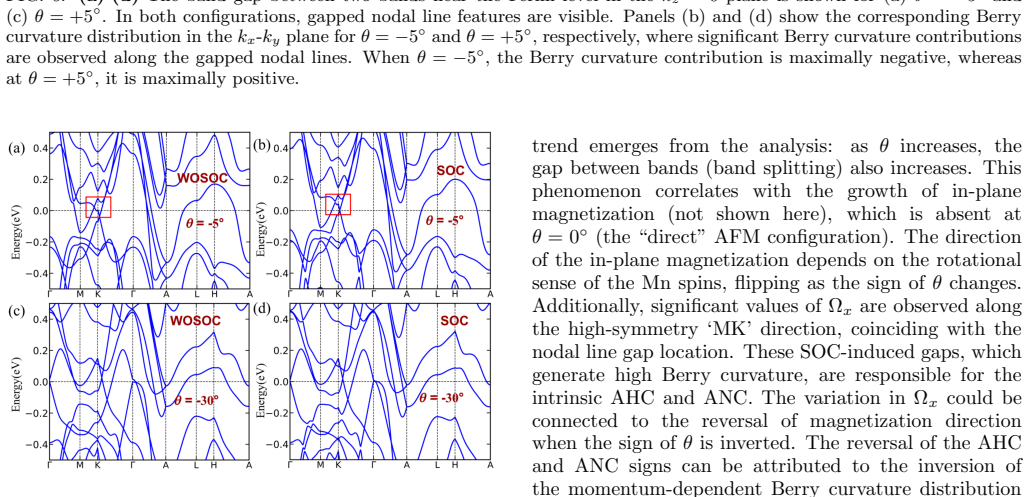
On the authors' own terms, the central claim is that a tunable anomalous Hall conductivity and anomalous Nernst conductivity emerge in the "direct" (κ = +1) 120° AFM configuration of Mn3Sn once a small staggered rotation θ is introduced. At θ = 0 the C3z rotational symmetry forces the Berry curvature to cancel, leaving σ and α exactly zero; any finite θ removes C3z while preserving Mx, MyT and MzT, so the only surviving component is σx (σyz), which jumps from zero to a finite value whose sign follows the rotation sense. Ab initio calculations give a maximum σx of −310 S·cm⁻¹ and αx of −1.90 A·m⁻¹·K⁻¹ at θ = −15°, with positive and negative θ producing opposite signs and asymmetric magnitudes. The physical origin is a spin–orbit-coupling-induced gap on an elliptical nodal ring near the K point; the momentum-dependent Berry curvature along the gapped ring flips sign when θ changes sign, which reverses the Hall and Nernst responses. Very large rotations (θ ≳ 20°) are counterproductive because they disrupt the nodal ring and suppress the effect.
Load-bearing premise
The direct (κ = +1) AFM configuration of Mn3Sn can be prepared and its two Mn spins coherently rotated by a controllable angle θ — via strain, magnetic field, or another knob — while leaving the third spin and all moment magnitudes unchanged, with the achieved θ large enough to produce a measurable signal.
Editorial extensions
If this is right
- A finite θ of either sign converts the transport-silent direct phase of Mn3Sn into one with a nonzero anomalous Hall conductivity σx and anomalous Nernst conductivity αx (σyz and αyz), with the sign fixed by the sense of rotation.
- The magnitude of both coefficients can be adjusted continuously by varying θ between roughly −15° and +15°, reaching −310 S·cm⁻¹ and −1.90 A·m⁻¹·K⁻¹ at θ = −15°.
- Because both coefficients depend sharply on energy, chemical-potential shifts (doping or gating) at fixed θ provide a second tuning knob for the same effect.
- The effect works only while the SOC-induced gap on the nodal ring near the K point survives; once θ exceeds about 20° the nodal ring is destroyed and the anomalous transport is lost, setting a useful operating window.
Reading between the lines
- The symmetry logic is not Mn3Sn-specific: the same "C3z removal by staggered rotation" recipe should generate anomalous transverse transport in other 120° kagome antiferromagnets (for example the Mn3X family), so the paper effectively proposes a general switching mechanism for a whole material class.
- A measurable prediction the authors do not spell out is that the induced in-plane magnetization should mirror the sign of θ; detecting it, for instance by magnetometry or x-ray magnetic circular dichroism, would give a non-electrical confirmation of the rotation sense.
- If strain or field can set θ continuously and reversibly, the AHC/ANC sign change becomes a mechanical or magnetic switch, suggesting spintronic readout and energy-harvesting (Nernst) applications that do not require moving a net magnetization.
- The asymmetry between +θ and −θ (larger |σx| for negative angles) points to antisymmetric exchange interactions as a possible route to stabilize one rotation sense, which the authors note but do not exploit quantitatively.
Signed reviews
Editorial analysis
A structured set of objections, weighed in public.
Referee Report
Summary. The manuscript proposes that a small 'staggered rotation' of two Mn spins in the κ = +1 'direct' antiferromagnetic phase of Mn3Sn, with the third spin held fixed, breaks the C3z rotational symmetry and thereby activates Berry-curvature-driven anomalous Hall and Nernst conductivities. Using FLEUR (FLAPW) and VASP (PAW) DFT calculations combined with Wannier interpolation, the authors compute σ_x and α_x for θ between -15° and +15°, reporting sign reversal and approximately linear tuning with θ, extrema of σ_x = -310 S·cm⁻¹ and α_x = -1.90 A·m⁻¹·K⁻¹ at θ = -15°, and attribute the effect to SOC-induced gapping of a nodal ring near the Fermi energy. The paper also presents a symmetry analysis identifying Mx, MyT, and MzT as the surviving symmetries after C3z is broken, leaving σ_x as the only nonzero transverse component.
Significance. If the required spin configuration is experimentally stabilizable, the prediction is conceptually clean: a noncollinear antiferromagnet with zero net magnetization at θ = 0 develops a switchable transverse response whose sign follows the rotation sense, and the microscopic mechanism is tied to a specific SOC-gapped nodal ring. The use of two independent DFT codes, the explicit symmetry argument, and the θ-resolved Berry-curvature visualization are strengths, and the predicted AHC amplitude is material-realistic and comparable to values measured in the inverse-phase Mn3Sn. However, the paper does not yet demonstrate a practical control knob for θ, and the transport numbers are presented without convergence tests. The significance is therefore conditional on both the experimental preparation of the staggered-rotated direct phase and the numerical robustness of the computed transport coefficients.
major comments (2)
- [Section III.A, Fig. 1(d), and Conclusion] The central claim of 'tunable AHC and ANC' hinges on the staggered rotation angle θ being a physically preparable, sign-definite parameter, but the manuscript provides no quantitative stability analysis for this state. The energy curves in Fig. 1(d) show that finite-θ configurations lie above θ = 0, and the inverse (κ = -1) phase is lower in energy by a few meV according to ref. [31]; an external field or strain must overcome this stiffness while leaving S3 and the moment magnitudes fixed. The cited control mechanisms (refs. [35,36]) are not shown to produce a coherent two-spin staggered rotation specifically in the κ = +1 phase. I recommend adding a quantitative estimate, such as the Zeeman or strain energy needed to stabilize a given θ against the energy landscape of Fig. 1(d), or explicitly reframing the paper as a transport prediction for a hypothetical magnetic configuration rather than an experimentally demonstrated switching mechanism. As written, the conclusion's phrase 'a tunable AHC and ANC emerge through staggered rotation' is stronger than what the calculations establish.
- [Section II and Fig. 2(a)] The AHC and ANC values are presented without convergence tests or numerical-error estimates. The transport integrals use a 300×300×300 k-mesh, but there is no comparison with coarser meshes, no stated smearing parameter, and no discussion of how the Wannier interpolation and the WannierBerri mapping affect the results. Because the Berry curvature is strongly concentrated along the gapped nodal lines (Fig. 6), the quantitative claims, including the magnitude -310 S·cm⁻¹ and the near-cancellation at small θ, require a check that they are converged with respect to k-mesh density and smearing. Adding a convergence panel or a brief numerical-error statement would materially strengthen the paper.
minor comments (6)
- [Section II] The Methods section states that total energy, band structure, and density-of-states results from FLEUR and VASP were compared, but no such comparison is shown; a figure or table would substantiate the claim.
- [Section II] The 300×300×300 k-mesh is reported for transport, but no smearing width or convergence criterion is given for the Wannier-interpolated AHC/ANC integrals.
- [Equation (2) and Section III.C] The notation for the Hall tensor is inconsistent: Eq. (2) defines σ^AH_ij, while the text and Fig. 2(a) refer to σ_x and σ_yz; the relation between these labels should be stated explicitly.
- [Section III.A, Fig. 1(d)] The energy curves in Fig. 1(d) are not labeled with the DFT code/functional used, and the energy of the inverse phase is not shown; adding a horizontal line for the κ = -1 energy would make the stability discussion quantitative.
- [Section III.C] The phrase 'a result of the NR topological band structure' is unclear; the paper should define NR (nodal ring) and clarify that the zero AHC/ANC at θ = 0 follows from C3z symmetry rather than from the absence of Berry curvature.
- [Section III.C] The ANC coefficient α_x is quoted with units of A·m⁻¹·K⁻¹, but the sign convention for α is not defined; specifying the transport formula used (e.g., J_i = α_ij (-∂T/∂r_j)) would remove ambiguity.
Circularity Check
No significant circularity: the AHC and ANC are freshly computed from ab initio electronic structure, and the sole self-citation (ref. 31) supplies the spin-rotation deformation concept rather than the predicted transport values.
full rationale
The paper's central result is a set of transport coefficients (AHC and ANC) computed as functions of the staggered rotation angle θ through DFT, Wannier interpolation, and the Kubo formula, with no parameter fitted to the target AHC/ANC values. The symmetry analysis (Sec. III.B) only constrains which Cartesian component may be nonzero; the magnitudes, signs, and θ-dependence in Fig. 2(a) are outputs of the calculation, not inputs. The only self-citation, ref. [31], is used to introduce the staggered-rotation deformation that connects κ = +1 and κ = −1 configurations and to motivate the geometry of rotating two spins while fixing the third; the present paper independently computes the θ-dependent energies shown in Fig. 1(d) and the θ-dependent band structures, so the citation does not carry the transport prediction. Skeptical concerns about whether finite θ can be stabilized experimentally (energy penalties, competition with the inverse phase, absence of a quantitative strain/field estimate) are matters of experimental feasibility and energetics, not circular derivation. Accordingly, no circular step can be quoted and the paper is best described as self-contained against its own first-principles computation.
Assumptions & free parameters
assumptions (4)
- domain assumption PBE and LDA exchange-correlation functionals without Hubbard U or hybrid corrections describe the electronic structure of Mn3Sn accurately enough for transport calculations.
- domain assumption The intrinsic Berry curvature (Kubo) contribution dominates the AHC and ANC; extrinsic contributions (skew scattering, side jump) and disorder are negligible.
- domain assumption The magnetic configuration is well described by a rigid rotation of two spins with fixed moment magnitudes, enforced via constrained DFT (I-CONSTRAINED-M).
- domain assumption The 'direct' AFM phase can be stabilized as a bulk state in Mn3Sn.
Cite this review
Pith. "Pith review of Anomalous Hall and Nernst effect switching via staggered rotation in a kagome antiferromagnetic semimetal." pith.science (2026). https://pith.science/paper/YTFYBIHP
@misc{pith2026241202324,
  author       = {Pith},
  title        = {Pith review of: Anomalous Hall and Nernst effect switching via staggered rotation in a kagome antiferromagnetic semimetal},
  year         = {2026},
  howpublished = {\url{https://pith.science/paper/YTFYBIHP}},
  note         = {Machine review of arXiv:2412.02324}
}
abstract
The intricate interplay between magnetism and the topology of electronic structures provides a rich avenue for tailoring materials with unique and potent anomalous transport properties. In this paper, we present a strategy for inducing robust Berry curvature and anomalous transverse conductivity in noncollinear antiferromagnets through an unconventional approach termed ``small \textit{staggered rotation} of spin". Considering noncollinear Mn$_3$Sn, we demonstrate that the positive vector chirality antiferromagnetic configuration, typically associated with a vanishing anomalous Hall effect and Nernst effect, can be manipulated to exhibit finite anomalous Hall conductivity (AHC) and anomalous Nernst conductivity (ANC) through \textit{staggered rotation}. Furthermore, we illustrate that the value and sign of both the AHC and ANC can be tuned through \textit{staggered rotation}. This tuning is intricately influenced by the spin-orbit coupling (SOC) induced gapped nodal line, revealing the critical role of electronic structure modifications in achieving precise control over transport properties.
Figures


Figures from the paper (4 more)


Forward citations
Cited by 1 Pith paper
-
Tunable phase transitions from semimetals to Chern insulators in two-dimensional quadratic-band-crossing materials
For quadratic-band-crossing semimetals, a static sigma-2 mass gives Chern number +-sgn(tx tz), while elliptically polarized light gives Chern number +-sgn(phi); the claimed linear-polarization trivial insulator is act...
Reference graph
Works this paper leans on
-
[31]
S. Pradhan, K. Samanta, K. Saha, and A. K. Nandy, Communications Physics 6, 10.1038/s42005-023-01385-9 (2023)
-
[1]
C. Fang, H. Weng, X. Dai, and Z. Fang, Chinese Physics B 25, 117106 (2016)
2016
-
[2]
H. Weng, Y. Liang, Q. Xu, R. Yu, Z. Fang, X. Dai, and Y. Kawazoe, Phys. Rev. B 92, 045108 (2015)
work page 2015
-
[3]
S. Bera, S. Chatterjee, S. Pradhan, S. K. Pradhan, S. Kalimuddin, A. Bera, A. K. Nandy, and M. Mondal, Phys. Rev. B 108, 115122 (2023)
work page 2023
-
[4]
Yan and C
B. Yan and C. Felser, Annual Review of Condensed Mat- ter Physics 8, 337 (2017)
2017
-
[5]
N. P. Armitage, E. J. Mele, and A. Vishwanath, Rev. Mod. Phys. 90, 015001 (2018)
2018
-
[6]
S. A. Yang, SPIN 06, 1640003 (2016)
work page 2016
-
[7]
X. Wan, A. M. Turner, A. Vishwanath, and S. Y. Savrasov, Phys. Rev. B 83, 205101 (2011). 9
work page 2011
Show all 54 references
-
[8]
P. Li, J. Koo, W. Ning, J. Li, L. Miao, L. Min, Y. Zhu, N. Alem, C.-X. Liu, Z. Mao, and B. Yan, Nature Com- munications 11, 3476 (2020)
2020
-
[9]
J. Noky, Q. Xu, C. Felser, and Y. Sun, Phys. Rev. B 99, 165117 (2019)
2019
-
[10]
Baltz, A
V. Baltz, A. Manchon, M. Tsoi, T. Moriyama, T. Ono, and Y. Tserkovnyak, Rev. Mod. Phys.90, 015005 (2018)
2018
-
[11]
Salemi, M
L. Salemi, M. Berritta, A. K. Nandy, and P. M. Oppe- neer, Nature Communications 10, 10.1038/s41467-019- 13367-z (2019)
2019 doi
-
[12]
Jungwirth, X
T. Jungwirth, X. Marti, P. Wadley, and J. Wunderlich, Nature Nanotechnology 11, 231–241 (2016)
2016
-
[13]
Feng, G.-Y
W. Feng, G.-Y. Guo, J. Zhou, Y. Yao, and Q. Niu, Phys. Rev. B 92, 144426 (2015)
2015
-
[14]
H. Chen, Q. Niu, and A. H. MacDonald, Phys. Rev. Lett. 112, 017205 (2014)
2014
-
[15]
K¨ ubler and C
J. K¨ ubler and C. Felser, EPL (Europhysics Letters)120, 47002 (2017)
2017
-
[16]
H. Yang, Y. Sun, Y. Zhang, W.-J. Shi, S. S. P. Parkin, and B. Yan, New Journal of Physics 19, 015008 (2017)
2017
-
[17]
X. Wang, H. Yan, X. Zhou, H. Chen, Z. Feng, P. Qin, Z. Meng, L. Liu, and Z. Liu, Materials Today Physics28, 100878 (2022)
2022
-
[18]
P. Park, J. Oh, K. Uhl ´ ıˇ rov´ a, J. Jackson, A. De´ ak, L. Szunyogh, K. H. Lee, H. Cho, H.-L. Kim, H. C. Walker, D. Adroja, V. Sechovsk´ y, and J.-G. Park, npj Quantum Materials 3, 10.1038/s41535-018-0137-9 (2018)
2018 doi
-
[19]
Singh, S
C. Singh, S. Jamaluddin, S. Pradhan, A. K. Nandy, M. Tokunaga, M. Avdeev, and A. K. Nayak, npj Quan- tum Materials 9, 10.1038/s41535-024-00657-z (2024)
2024 doi
-
[20]
Bhattacharya, A
K. Bhattacharya, A. K. Bharatwaj, C. Singh, R. Gupta, R. Khasanov, S. Kanungo, A. K. Nayak, and M. Ma- jumder, Phys. Rev. B 110, 094432 (2024)
2024
-
[21]
K¨ ubler and C
J. K¨ ubler and C. Felser, EPL (Europhysics Letters)108, 67001 (2014)
2014
-
[22]
Nakatsuji, N
S. Nakatsuji, N. Kiyohara, and T. Higo, Nature 527, 212 (2015)
2015
-
[23]
A. K. Nayak, J. E. Fischer, Y. Sun, B. Yan, J. Karel, A. C. Komarek, C. Shekhar, N. Kumar, W. Schnelle, J. K¨ ubler, C. Felser, and S. S. P. Parkin, Science Ad- vances 2, e1501870 (2016)
2016
-
[24]
Zhang, Y
Y. Zhang, Y. Sun, H. Yang, J. ˇZelezn´ y, S. P. P. Parkin, C. Felser, and B. Yan, Phys. Rev. B 95, 075128 (2017)
2017
-
[25]
Ikhlas, T
M. Ikhlas, T. Tomita, T. Koretsune, M.-T. Suzuki, D. Nishio-Hamane, R. Arita, Y. Otani, and S. Nakatsuji, Nature Physics 13, 1085 (2017)
2017
-
[26]
X. Li, L. Xu, L. Ding, J. Wang, M. Shen, X. Lu, Z. Zhu, and K. Behnia, Phys. Rev. Lett. 119, 056601 (2017)
2017
-
[27]
Sharma, R
V. Sharma, R. Nepal, and R. C. Budhani, Phys. Rev. B 108, 144435 (2023)
2023
-
[28]
J. Dong, X. Li, G. Gurung, M. Zhu, P. Zhang, F. Zheng, E. Y. Tsymbal, and J. Zhang, Phys. Rev. Lett. 128, 197201 (2022)
2022
-
[29]
T. Yu, H. Wu, H. He, C. Guo, C. Fang, P. Zhang, K. L. Wong, S. Xu, X. Han, and K. L. Wang, APL Materials 9, 041111 (2021), https://pubs.aip.org/aip/apm/article- pdf/doi/10.1063/5.0045627/14566673/041111 1 online.pdf
2021 doi
-
[30]
Kawamura, Canadian Journal of Physics 79, 1447 (2001)
H. Kawamura, Canadian Journal of Physics 79, 1447 (2001)
2001
-
[32]
T. Chen, T. Tomita, S. Minami, M. Fu, T. Koretsune, M. Kitatani, I. Muhammad, D. Nishio-Hamane, R. Ishii, F. Ishii, et al., Nature communications 12, 1 (2021)
2021
-
[33]
Singh, V
C. Singh, V. Singh, G. Pradhan, V. Srihari, H. K. Poswal, R. Nath, A. K. Nandy, and A. K. Nayak, Phys. Rev. Research 2, 043366 (2020)
2020
-
[34]
Zhang, H
H. Zhang, H. Feng, X. Xu, W. Hao, and Y. Du, Advanced Quantum Technologies 4, 2100073 (2021)
2021
-
[35]
Ikhlas, S
M. Ikhlas, S. Dasgupta, F. Theuss, T. Higo, S. Kit- taka, B. J. Ramshaw, O. Tchernyshyov, C. W. Hicks, and S. Nakatsuji, Nature Physics 18, 1086–1093 (2022)
2022
-
[36]
S. Miwa, S. Iihama, T. Nomoto, T. Tomita, T. Higo, M. Ikhlas, S. Sakamoto, Y. Otani, S. Mizukami, R. Arita, and S. Nakatsuji, Small Science 1, 10.1002/smsc.202000062 (2021)
2021 doi
-
[37]
X. Li, S. Jiang, Q. Meng, H. Zuo, Z. Zhu, L. Balents, and K. Behnia, Phys. Rev. B 106, L020402 (2022)
2022
-
[39]
Kresse and D
G. Kresse and D. Joubert, Phys. Rev. B 59, 1758 (1999)
1999
-
[40]
J. P. Perdew, K. Burke, and M. Ernzerhof, Phys. Rev. Lett. 77, 3865 (1996)
1996
-
[41]
P. E. Bl¨ ochl, Phys. Rev. B50, 17953 (1994)
1994
-
[42]
H. J. Monkhorst and J. D. Pack, Phys. Rev. B 13, 5188 (1976)
1976
-
[43]
S. H. Vosko, L. Wilk, and M. Nusair, Canadian Journal of Physics 59, 1200 (1980)
1980
-
[44]
Marzari, A
N. Marzari, A. A. Mostofi, J. R. Yates, I. Souza, and D. Vanderbilt, Rev. Mod. Phys. 84, 1419 (2012)
2012
-
[45]
A. A. Mostofi, J. R. Yates, G. Pizzi, Y.-S. Lee, I. Souza, D. Vanderbilt, and N. Marzari, Computer Physics Com- munications 185, 2309 (2014)
2014
-
[46]
X. Wang, J. R. Yates, I. Souza, and D. Vanderbilt, Phys. Rev. B 74, 195118 (2006)
2006
-
[47]
Freimuth, Y
F. Freimuth, Y. Mokrousov, D. Wortmann, S. Heinze, and S. Bl¨ ugel, Phys. Rev. B78, 035120 (2008)
2008
-
[48]
Y. Yao, L. Kleinman, A. H. MacDonald, J. Sinova, T. Jungwirth, D.-s. Wang, E. Wang, and Q. Niu, Phys. Rev. Lett. 92, 037204 (2004)
2004
-
[49]
D. Xiao, Y. Yao, Z. Fang, and Q. Niu, Phys. Rev. Lett. 97, 026603 (2006)
2006
-
[50]
Xiao, M.-C
D. Xiao, M.-C. Chang, and Q. Niu, Rev. Mod. Phys. 82, 1959 (2010)
2010
-
[51]
S. S. Tsirkin, npj Computational Materials 7, 10.1038/s41524-021-00498-5 (2021)
2021 doi
-
[52]
Nagaosa, J
N. Nagaosa, J. Sinova, S. Onoda, A. H. MacDonald, and N. P. Ong, Rev. Mod. Phys. 82, 1539 (2010)
2010
-
[53]
C. Le, C. Felser, and Y. Sun, Phys. Rev. B 104, 125145 (2021)
2021
-
[54]
Suzuki, T
M.-T. Suzuki, T. Koretsune, M. Ochi, and R. Arita, Phys. Rev. B 95, 094406 (2017)
2017
-
[55]
S. N. Guin, K. Manna, J. Noky, S. J. Watzman, C. Fu, N. Kumar, W. Schnelle, C. Shekhar, Y. Sun, J. Gooth, and C. Felser, NPG Asia Materials 11, 10.1038/s41427- 019-0116-z (2019)
2019 doi
Reviewed August 11, 2026 · model on record in the stance chip above.
Discussion (0). Continue with ORCID to comment.