REVIEW 2 major objections 4 minor 4 cited by
Lefschetz thimble-inspired weight regularizations for complex Langevin simulations
T0 review · 2 major / 4 minor · reviewed 2026-08-11 · deepseek-v4-flash
Pith's one-line read The paper claims that complex Langevin simulations converge correctly when the system has a single relevant compact Lefschetz thimble, and that a weight regularization plus Dyson-Schwinger bias correction can create that structure and…
desk verdict A genuinely useful bias-correction idea and the cleanest numerical evidence yet for the single-compact-thimble criterion, with a real but non-fatal formal gap around the non-holomorphic periodic regularization. read the letter →
The pith
A machine-rendered reading of the paper's core claim, the machinery that carries it, and where it could break.
The reading
What carries the argument
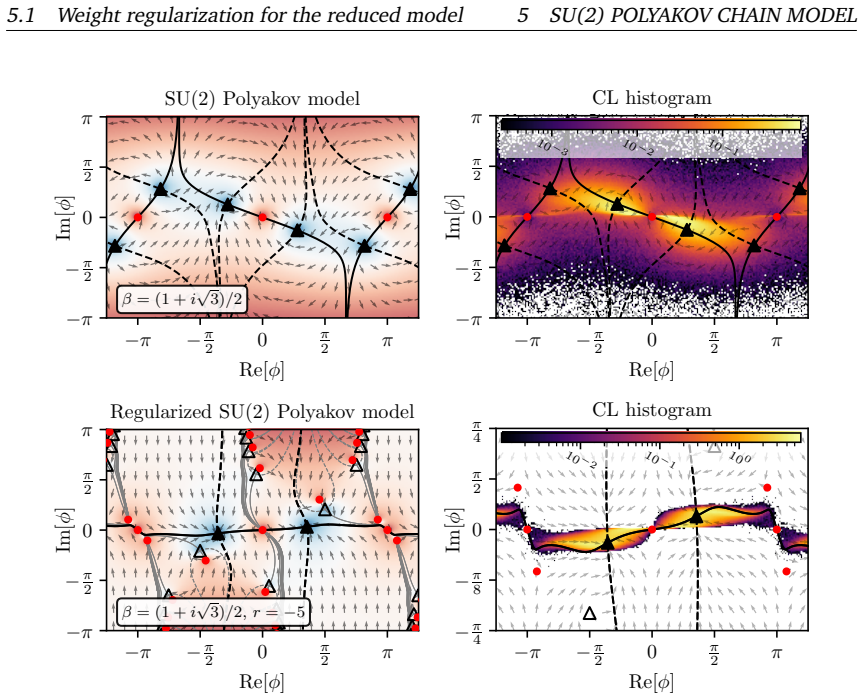
The load-bearing object is the Lefschetz thimble: for a critical point $z_\sigma$ of the action, the thimble is the contour of steepest ascent along which the imaginary part of the action stays constant, and it is called compact when it does not escape to imaginary infinity but terminates at zeros or singularities of the weight. The regularization is the additive modification $\tilde{\rho}(z)=\rho(z)+r\,G(z)+R_0$, with $G$ positive on the real integration domain and chosen so that the regularized weight has exactly one relevant compact thimble for sufficiently large $|r|$. The bias it introduces is removed through the affine identity $\langle O\rangle_\rho = \langle O\rangle_{\tilde{\rho}} + Q\,(\langle O\rangle_{\tilde{\rho}} - \langle O\rangle_R)$, where the ratio $Q=Z_R/Z_\rho$ is extracted without computing the problematic partition function by using Dyson-Schwinger equations, which provide observables whose expectation values vanish in the original theory. Correctness of the regularized simulations is checked with the criterion that the distribution $p(u)$ of the drift magnitude decays faster than any power law.
What would settle it
Take the regularized cosine model of Eq. (34), change the periodic continuation so that the singularities of the effective action lie inside the integration box rather than on its boundary, and measure both the drift-magnitude distribution $p(u)$ and the expectation values against exact integration: a power-law tail in $p(u)$ together with correct expectation values, or exponential decay with wrong values, would show that the single-compact-thimble condition is neither necessary nor sufficient.
Extended reading notes
Core claim
The central claim, stated in Section 7, is that complex Langevin tends to converge correctly when the system has a single relevant, attractive critical point and the relevant thimble extending from it is compact; the authors offer this as a conjecture supported by all their simulations. They test it by manually regularizing the weight of systems that violate the condition, producing modified models whose thimble structure is single and compact, and then correcting for the modification. The correction works because the regularized expectation value is an affine function of the original one, and the only unknown, the ratio of the two partition functions, is fixed by the Dyson-Schwinger equations of the original theory. The numerical results show that the bias-corrected expectation values agree with exact integration for the complex cosine model and for SU(2) and SU(3) Polyakov chains in parameter regions where unregularized complex Langevin diverges or gives wrong values.
Load-bearing premise
The argument depends on the criterion that complex Langevin converges correctly whenever the distribution of drift magnitudes $p(u)$ decays faster than any power law, and on that criterion remaining valid when the regularized effective action is not holomorphic because the regularization is periodically continued; if that criterion is not sufficient in these non-holomorphic settings, the conclusion of correct convergence is not established.
Editorial extensions
If this is right
- CL can be made to converge correctly in models where it previously failed by constructing a regularization whose thimble structure is a single compact relevant thimble and then bias-correcting with Dyson-Schwinger equations.
- The bias-correction formula removes the old obstacle of computing the partition function of the original theory; only regularized expectation values and the ratio $Q$ from Dyson-Schwinger equations are needed.
- A single compact relevant thimble can be used as a design principle: positive-definite regularization terms that vanish on the boundary of the integration domain, often tied to zeros of the Haar measure, produce such structures in gauge models.
- Direct additive regularization for full lattice field theories is impractical because it becomes non-local or the bias correction requires exponentially many subset terms, so the practical route lies in kernels or multiplicative regularizations.
- Multiple compact relevant thimbles are still not enough: the paper's Appendix A shows that CL fails even when all contributing thimbles are compact, strengthening the single-thimble condition.
Reading between the lines
- If the single-compact-thimble condition holds beyond the toy models, it provides an a priori diagnostic: one could scan the thimble structure of a proposed kernel or regularization before running expensive CL simulations.
- The DSE-based bias correction is not limited to the additive scheme; any modification whose expectation values relate affinely to the original theory, including multiplicative reweightings when overlap permits, could use the same $Q$-extraction strategy.
- A testable next step is to apply the same construction to a genuinely higher-dimensional model, such as a complex $\phi^4$ theory in one spatial dimension, where the thimble structure can still be computed numerically, to see whether the compact-single-thimble criterion remains sufficient outside zero-dimensional integrals.
- Because the paper's correctness checks rely on the Nagata criterion, which is trusted in the non-holomorphic periodic setting, the strongest version of the claim is only as solid as that criterion in that setting.
Editorial analysis
A structured set of objections, weighed in public.
Referee Report
Summary. The paper proposes an additive weight-regularization scheme for complex Langevin (CL) simulations: an extra term R(z) is added to the original weight so that the regularized theory develops a single relevant compact Lefschetz thimble, which the authors argue restores correct CL convergence. A bias-correction formula, Eq. (26), relates expectation values of the regularized theory to those of the original theory through an observable-independent ratio Q, which is extracted using Dyson-Schwinger equations of the original theory. The method is applied to the complex cosine model and to SU(2) and SU(3) Polyakov chain models, with exact integration as a benchmark. The authors find that direct CL fails in the unregularized cases, that regularized CL reproduces the exact regularized expectation values, and that the bias-corrected values agree with the original exact values, typically at the sub-percent level. They also examine the Nagata et al. drift-magnitude criterion p(u) and report exponential decay for the regularized one-dimensional models.
Significance. If the results hold, the paper offers a constructive remedy for a known failure mode of CL and provides some of the clearest numerical evidence to date connecting thimble structure to CL convergence. The main technical novelty is the Dyson-Schwinger-based bias correction, which addresses a limitation of the earlier weight-regularization proposals in Refs. [68-70]. Strengths of the manuscript include exact benchmarks for every model, Fokker-Planck checks for the one-dimensional models, explicit p(u) diagnostics, and a candid discussion of limitations, including the argument in Appendix B that additive regularization is impractical for lattice field theories. The central conjecture, that a single relevant compact thimble is sufficient for correct convergence, is appropriately presented as numerical evidence rather than as a theorem. The main weaknesses are the uncritical use of a holomorphic correctness criterion for the non-holomorphic periodic regularization and an erroneous table in the SU(2) link-model results.
major comments (2)
- [Sec. 4, Eq. (35); Sec. 4.2, Fig. 5] The periodic continuation in Eq. (35) makes the regularized weight and hence the drift discontinuous across the lines Re z = ±π for Im z ≠ 0, not merely non-differentiable. The correctness criterion of Ref. [57] is stated in Sec. 2.2 for holomorphic actions, where boundary terms can be controlled through the decay of p(u). The paper applies this criterion to the non-holomorphic regularized cosine model without an argument that the criterion remains sufficient when the drift has such discontinuities. The observation that the boundary segments are repulsive is empirical and parameter-dependent. This matters because Section 7 and the abstract use the p(u) criterion as a principal justification that the regularized CL is correct. I recommend either supplying a boundary-flux or Fokker-Planck check for the discontinuous drift, or explicitly demoting the p(u) check to supportive evidence and relying on the exact-value comparisons of Fig. 4 and Table 2 as the primary correctness test.
- [Appendix E, Table 11] Table 11, titled "Bias-corrected results for the regularized SU(2) Polyakov chain link model," lists the exact values of the original theory as 0.275920, 0.268989, 0.142204, etc., which are identical to the regularized exact values in Table 10. The original-theory exact values from Table 9 are 0.339351, 0.212100, 0.147098, etc. As printed, the table contradicts the claim in Fig. 14 that the bias correction recovers the original theory, and it undermines one of the central numerical benchmarks. The exact column must be corrected, and the bias-corrected CL column should be checked to ensure it was not accidentally copied from Table 10.
minor comments (4)
- [Sec. 4, after Eq. (35)] The sentence "It appears that the solution seems to be unaffected by these results" should refer to "these discontinuities" rather than "these results," and the text should state explicitly that R is discontinuous, not merely non-differentiable, at the periodicity boundaries for nonzero imaginary part.
- [Sec. 4.2, Fig. 5] The dashed line ∝ u^{-2} is presented as a power-law reference, but no fitting range is given for the unregularized tail, and the regularized case is described only visually as exponential; please specify the range and, if possible, a fitted decay rate.
- [Sec. 6] For the SU(3) model the p(u) criterion is not shown; the conclusion of correct convergence there rests entirely on the exact-value comparisons in Tables 14-15. This is acceptable, but it should be stated explicitly so the reader does not infer that the criterion was checked in the non-Abelian case.
- [Sec. 7 and Abstract] The statement that CL converges correctly when a single relevant compact thimble contributes should be qualified as holding for the models and parameter sets studied, since the paper itself presents this as an empirical conjecture rather than a proven criterion.
Circularity Check
No circularity: bias correction is an exact DSE-based identity with external exact-value checks; the single-thimble claim is an explicitly conjectural numerical correlation, not a derived input.
full rationale
The paper's central chain is not circular. The regularized expectation values are defined by Eq. (21), and the bias-correction formula Eq. (26) is an exact algebraic identity expressing the original expectation value in terms of regularized expectation values and an observable-independent ratio Q = Z_R/Z_rho. Q is not fitted to the predicted observables: Section 3.1 constructs O* from the Dyson-Schwinger equations of the original action (Eqs. (30)-(31)) and solves Eq. (29); the same Q is then applied to all powers of the observable, and the results are checked against independently computed exact values (Figs. 4, 10, 14, 16, 17 and the corresponding tables). The claim that CL converges correctly under a single compact relevant thimble is presented as a conjecture ('Our numerical studies suggest that the complex Langevin process tends to correctly converge if there exists a single relevant, attractive critical point and if the relevant thimble extending from the relevant critical point is compact'), not as a theorem derived from the definition of the thimble. The regularization parameter r is manually chosen to realize the desired thimble structure and is not fitted to target observables. The p(u) criterion of Nagata et al. is an external diagnostic; the paper's extension to the non-holomorphic periodic regularization of Eq. (35) is acknowledged as a limitation ('Imposing periodicity in Eq. (34) leads to a non-holomorphic effective action... It appears that the solution seems to be unaffected by these results'), which is a correctness risk rather than a circular reduction. Self-citations [52,53] appear only as background references on kernels and are not load-bearing for the regularization or bias-correction argument.
Assumptions & free parameters
free parameters (5)
- Regularization strength r =
0.5 (cosine), -5 (SU(2)), -25 (SU(3))
- Regularization offset R0 =
-exp(i beta) in Eq. (34); implicit in Eq. (43)
- Adaptive step-size parameters =
epsilon=1e-5 (cosine), 1e-4 (gauge); alpha=1e-2; max drift 1e3
- Cutoffs for unregularized divergent simulations =
|z|<6pi, |Tr[P]|<8 (SU(2)), |Tr[P]|<9 (SU(3))
- Number of trajectories and thermalization =
2^16 processes (cosine), 10^4 (SU(2)/SU(3)), theta_therm=100, samples at Delta theta=1 or 0.1
assumptions (4)
- domain assumption Exponential decay of the drift-magnitude distribution p(u) is sufficient for correct complex Langevin convergence [57].
- standard math The action and observables can be extended holomorphically (or meromorphically) so that Picard-Lefschetz thimble decomposition applies.
- domain assumption Dyson-Schwinger equations hold for the original theory with vanishing boundary terms.
- domain assumption Gauge cooling and adaptive time stepping do not bias the CL process.
Cite this review
Pith. "Pith review of Lefschetz thimble-inspired weight regularizations for complex Langevin simulations." pith.science (2026). https://pith.science/paper/Y2YT2GSZ
@misc{pith2026241202396,
  author       = {Pith},
  title        = {Pith review of: Lefschetz thimble-inspired weight regularizations for complex Langevin simulations},
  year         = {2026},
  howpublished = {\url{https://pith.science/paper/Y2YT2GSZ}},
  note         = {Machine review of arXiv:2412.02396}
}
read the original abstract
Complex Langevin (CL) is a computational method to circumvent the numerical sign problem with applications in finite-density quantum chromodynamics and the real-time dynamics of quantum field theories. It has long been known that, depending on the simulated system, CL does not always converge correctly. In this work, we provide numerical evidence that the success or failure of the complex Langevin method is deeply tied to the Lefschetz thimble structure of the simulated system. This is demonstrated by constructing weight function regularizations that deform the thimbles of systems with compact domains. Our results indicate that CL converges correctly when the regularized system exhibits a single relevant compact thimble. We introduce a bias correction to retrieve the values of the original theory for parameter sets where a direct complex Langevin approach fails. The effectiveness of this method is illustrated using several toy models, including the cosine model and the SU(2) and SU(3) Polyakov chains. Finally, we discuss the opportunities and limitations of this regularization approach for lattice field theories.
Figures


Figures from the paper (15 more)




Forward citations
Cited by 4 Pith papers
-
Designing weight regularizations based on Lefschetz thimbles to stabilize complex Langevin
A regularization inspired by Lefschetz thimbles stabilizes complex Langevin simulations in toy models, with a bias-correction step that restores the original expectation values.
-
The Role of Integration Cycles in Complex Langevin Simulations
Complex Langevin results in one- and two-dimensional toy models match a linear combination of integration cycles when boundary terms vanish, and the kernel choice controls which cycles contribute.
-
On the negative coupling O(N) model in 2d at high temperature
For the 2d negative-coupling O(N) model at large N, the correct vacuum is a saddle point on a non-principal Riemann sheet, giving a real free energy and dynamical stability at all temperatures.
-
Combining complex Langevin dynamics with score-based and energy-based diffusion models
Energy-based diffusion models trained on complex Langevin data produce an explicit energy function for the sampled distribution, enabling MCMC without re-simulation.
Reference graph
Works this paper leans on
- [57]
-
[1]
P . de Forcrand, Simulating QCD at finite density , PoS LAT2009, 010 (2009), doi:10.22323/1.091.0010, 1005.0539
arXiv 2009
-
[2]
M. C. Bañuls and K. Cichy , Review on Novel Methods for Lattice Gauge Theories , Rept. Prog. Phys. 83(2), 024401 (2020), doi:10.1088 /1361-6633/ab6311, 1910.00257
arXiv 2020
-
[3]
M. Troyer and U.-J. Wiese, Computational complexity and fundamental limitations to fermionic quantum Monte Carlo simulations , Phys. Rev. Lett. 94, 170201 (2005), doi:10.1103/PhysRevLett.94.170201, cond-mat/0408370
arXiv 2005
-
[4]
Z. Fodor and S. D. Katz,Critical point of QCD at finite T and mu, lattice results for physical quark masses, JHEP 04, 050 (2004), doi:10.1088 /1126-6708/2004/04/050, hep-lat/ 0402006
work page 2004
-
[5]
C. R. Allton, S. Ejiri, S. J. Hands, O. Kaczmarek, F . Karsch, E. Laermann, C. Schmidt and L. Scorzato, The QCD thermal phase transition in the presence of a small chemical potential, Phys. Rev. D66, 074507 (2002), doi:10.1103 /PhysRevD.66.074507, hep-lat/0204010
arXiv 2002
-
[6]
R. V . Gavai and S. Gupta,Pressure and nonlinear susceptibilities in QCD at finite chemical potentials, Phys. Rev. D68, 034506 (2003), doi:10.1103/PhysRevD.68.034506, hep-lat/ 0303013
-
[7]
M. G. Alford, A. Kapustin and F . Wilczek, Imaginary chemical potential and finite fermion density on the lattice , Phys. Rev. D 59, 054502 (1999), doi:10.1103/PhysRevD.59.054502, hep-lat/9807039
arXiv 1999
Show all 76 references
-
[8]
D’Elia and M.-P
M. D’Elia and M.-P . Lombardo,Finite density QCD via imaginary chemical potential, Phys. Rev. D67, 014505 (2003), doi:10.1103 /PhysRevD.67.014505, hep-lat/0209146
2003 arXiv
-
[9]
Bellwied, S
R. Bellwied, S. Borsanyi, Z. Fodor, J. Günther, S. D. Katz, C. Ratti and K. K. Szabo, The QCD phase diagram from analytic continuation , Phys. Lett. B 751, 559 (2015), doi:10.1016/j.physletb.2015.11.011, 1507.07510
2015 arXiv
-
[10]
Hasenfratz and D
A. Hasenfratz and D. Toussaint, Canonical ensembles and nonzero density quantum chro- modynamics, Nucl. Phys. B 371, 539 (1992), doi:10.1016 /0550-3213(92)90247-9. 37 REFERENCES REFERENCES
1992
-
[11]
Alexandru, M
A. Alexandru, M. Faber, I. Horvath and K.-F . Liu, Lattice QCD at finite density via a new canonical approach, Phys. Rev. D72, 114513 (2005), doi:10.1103/PhysRevD.72.114513, hep-lat/0507020
2005 arXiv
-
[12]
H. B. Meyer, A Calculation of the bulk viscosity in SU(3) gluodynamics , Phys. Rev. Lett. 100, 162001 (2008), doi:10.1103 /PhysRevLett.100.162001, 0710.3717
2008 arXiv
-
[13]
H. B. Meyer, A Calculation of the shear viscosity in SU(3) gluodynamics, Phys. Rev. D 76, 101701 (2007), doi:10.1103 /PhysRevD.76.101701, 0704.1801
2007 arXiv
-
[14]
Lawrence, Model-free spectral reconstruction via Lagrange duality(2024), 2408.11766
S. Lawrence, Model-free spectral reconstruction via Lagrange duality(2024), 2408.11766
2024 arXiv
-
[15]
Chandrasekharan and U.-J
S. Chandrasekharan and U.-J. Wiese, Meron cluster solution of a fermion sign prob- lem, Phys. Rev. Lett. 83, 3116 (1999), doi:10.1103 /PhysRevLett.83.3116, cond-mat/ 9902128
1999
-
[16]
Pichler, M
T . Pichler, M. Dalmonte, E. Rico, P . Zoller and S. Montangero, Real-time Dynamics in U(1) Lattice Gauge Theories with Tensor Networks , Phys. Rev. X 6(1), 011023 (2016), doi:10.1103/PhysRevX.6.011023, 1505.04440
2016 arXiv
-
[17]
M. C. Bañuls et al., Simulating Lattice Gauge Theories within Quantum Technologies, Eur. Phys. J. D 74(8), 165 (2020), doi:10.1140 /epjd/e2020-100571-8, 1911.00003
2020 arXiv
-
[18]
N. Klco, J. R. Stryker and M. J. Savage, SU(2) non-Abelian gauge field theory in one dimension on digital quantum computers , Phys. Rev. D 101(7), 074512 (2020), doi:10.1103/PhysRevD.101.074512, 1908.06935
2020 arXiv
-
[19]
C. W . Baueret al., Quantum Simulation for High-Energy Physics , PRX Quantum 4(2), 027001 (2023), doi:10.1103 /PRXQuantum.4.027001, 2204.03381
2023 arXiv
-
[20]
Fodor, S
Z. Fodor, S. D. Katz and C. Schmidt, The Density of states method at non-zero chemi- cal potential, JHEP 03, 121 (2007), doi:10.1088 /1126-6708/2007/03/121, hep-lat/ 0701022
2007
-
[21]
Langfeld, B
K. Langfeld, B. Lucini and A. Rago,The density of states in gauge theories, Phys. Rev. Lett. 109, 111601 (2012), doi:10.1103 /PhysRevLett.109.111601, 1204.3243
2012 arXiv
-
[22]
Witten, Analytic Continuation Of Chern-Simons Theory, AMS /IP Stud
E. Witten, Analytic Continuation Of Chern-Simons Theory, AMS /IP Stud. Adv. Math. 50, 347 (2011), 1001.2933
2011 arXiv
-
[23]
Cristoforetti, F
M. Cristoforetti, F . Di Renzo and L. Scorzato,New approach to the sign problem in quantum field theories: High density QCD on a Lefschetz thimble, Phys. Rev. D 86, 074506 (2012), doi:10.1103/PhysRevD.86.074506, 1205.3996
2012 arXiv
-
[24]
Di Renzo, S
F . Di Renzo, S. Singh and K. Zambello,Taylor expansions on Lefschetz thimbles, Phys. Rev. D 103(3), 034513 (2021), doi:10.1103 /PhysRevD.103.034513, 2008.01622
2021 arXiv
-
[25]
Alexandru, G
A. Alexandru, G. Basar, P . F . Bedaque and N. C. Warrington,Complex paths around the sign problem, Rev. Mod. Phys.94(1), 015006 (2022), doi:10.1103/RevModPhys.94.015006, 2007.05436
2022 arXiv
-
[26]
J. M. Pawlowski, M. Scherzer, C. Schmidt, F . P . G. Ziegler and F . Ziesché, Simulat- ing Yang-Mills theories with a complex coupling , Phys. Rev. D 103(9), 094505 (2021), doi:10.1103/PhysRevD.103.094505, 2101.03938
2021 arXiv
-
[27]
Parisi, ON COMPLEX PROBABILITIES , Phys
G. Parisi, ON COMPLEX PROBABILITIES , Phys. Lett. B 131, 393 (1983), doi:10.1016/0370-2693(83)90525-7. 38 REFERENCES REFERENCES
1983 doi
-
[28]
Aarts, F
G. Aarts, F . A. James, E. Seiler and I.-O. Stamatescu,Complex Langevin: Etiology and Di- agnostics of its Main Problem, Eur. Phys. J. C71, 1756 (2011), doi:10.1140/epjc/s10052- 011-1756-5, 1101.3270
2011 arXiv
-
[29]
Abe and K
Y. Abe and K. Fukushima, Analytic studies of the complex Langevin equation with a Gaus- sian ansatz and multiple solutions in the unstable region , Phys. Rev. D 94(9), 094506 (2016), doi:10.1103 /PhysRevD.94.094506, 1607.05436
2016 arXiv
-
[30]
Nishimura and S
J. Nishimura and S. Shimasaki, Combining the complex Langevin method and the gener- alized Lefschetz-thimble method, JHEP 06, 023 (2017), doi:10.1007/JHEP06(2017)023, 1703.09409
2017 arXiv
-
[31]
Bluecher, J
S. Bluecher, J. M. Pawlowski, M. Scherzer, M. Schlosser, I.-O. Stamatescu, S. Syrkowski and F . P . G. Ziegler, Reweighting Lefschetz Thimbles , SciPost Phys. 5(5), 044 (2018), doi:10.21468/SciPostPhys.5.5.044, 1803.08418
2018 arXiv
-
[32]
Alexandru, G
A. Alexandru, G. Basar and P . Bedaque, Monte Carlo algorithm for simu- lating fermions on Lefschetz thimbles , Phys. Rev. D 93(1), 014504 (2016), doi:10.1103/PhysRevD.93.014504, 1510.03258
2016 arXiv
-
[33]
Alexandru, G
A. Alexandru, G. Basar, P . F . Bedaque, G. W . Ridgway and N. C. Warrington,Monte Carlo calculations of the finite density Thirring model , Phys. Rev. D 95(1), 014502 (2017), doi:10.1103/PhysRevD.95.014502, 1609.01730
2017 arXiv
-
[34]
Alexandru, G
A. Alexandru, G. Basar, P . F . Bedaque, S. Vartak and N. C. Warrington, Monte Carlo Study of Real Time Dynamics on the Lattice , Phys. Rev. Lett. 117(8), 081602 (2016), doi:10.1103/PhysRevLett.117.081602, 1605.08040
2016 arXiv
-
[35]
Zambello and F
K. Zambello and F . Di Renzo, Towards Lefschetz thimbles regularization of heavy-dense QCD, PoS LATTICE2018, 148 (2018), doi:10.22323 /1.334.0148, 1811.03605
2018 arXiv
-
[36]
Di Renzo, S
F . Di Renzo, S. Singh and K. Zambello, Thimble regularisation of YM fields: crunching a hard problem, PoS LATTICE2021, 233 (2022), doi:10.22323 /1.396.0233, 2112.00062
2022
-
[37]
Parisi and Y.-s
G. Parisi and Y.-s. Wu, Perturbation Theory Without Gauge Fixing , Sci. Sin. 24, 483 (1981)
1981
-
[38]
Berges and I
J. Berges and I. O. Stamatescu, Simulating nonequilibrium quantum fields with stochastic quantization techniques , Phys. Rev. Lett. 95, 202003 (2005), doi:10.1103/PhysRevLett.95.202003, hep-lat/0508030
2005 arXiv
-
[39]
Alvestad, R
D. Alvestad, R. Larsen and A. Rothkopf, Stable solvers for real-time Complex Langevin , JHEP 08, 138 (2021), doi:10.1007 /JHEP08(2021)138, 2105.02735
2021 arXiv
-
[40]
Alvestad, R
D. Alvestad, R. Larsen and A. Rothkopf, Towards learning optimized kernels for complex Langevin, JHEP 04, 057 (2023), doi:10.1007 /JHEP04(2023)057, 2211.15625
2023 arXiv
-
[41]
N. M. Lampl and D. Sexty , Real time evolution of scalar fields with kernelled Complex Langevin equation (2023), 2309.06103
2023 arXiv
-
[42]
Alvestad, A
D. Alvestad, A. Rothkopf and D. Sexty ,Lattice real-time simulations with learned optimal kernels, Phys. Rev. D 109(3), L031502 (2024), doi:10.1103 /PhysRevD.109.L031502, 2310.08053
2024 arXiv
-
[43]
Aarts, Can stochastic quantization evade the sign problem? The relativis- tic Bose gas at finite chemical potential , Phys
G. Aarts, Can stochastic quantization evade the sign problem? The relativis- tic Bose gas at finite chemical potential , Phys. Rev. Lett. 102, 131601 (2009), doi:10.1103/PhysRevLett.102.131601, 0810.2089. 39 REFERENCES REFERENCES
2009 arXiv
-
[44]
Aarts, Complex Langevin dynamics at finite chemical potential: Mean field analysis in the relativistic Bose gas, JHEP 05, 052 (2009), doi:10.1088 /1126-6708/2009/05/052, 0902.4686
G. Aarts, Complex Langevin dynamics at finite chemical potential: Mean field analysis in the relativistic Bose gas, JHEP 05, 052 (2009), doi:10.1088 /1126-6708/2009/05/052, 0902.4686
2009 arXiv
-
[45]
Aarts, F
G. Aarts, F . Attanasio, B. Jäger and D. Sexty , The QCD phase diagram in the limit of heavy quarks using complex Langevin dynamics , JHEP 09, 087 (2016), doi:10.1007/JHEP09(2016)087, 1606.05561
2016 arXiv
-
[46]
Sexty , Simulating full QCD at nonzero density using the complex Langevin equation , Phys
D. Sexty , Simulating full QCD at nonzero density using the complex Langevin equation , Phys. Lett. B 729, 108 (2014), doi:10.1016 /j.physletb.2014.01.019, 1307.7748
2014 arXiv
-
[47]
Fodor, S
Z. Fodor, S. D. Katz, D. Sexty and C. Török, Complex Langevin dynamics for dynamical QCD at nonzero chemical potential: A comparison with multiparameter reweighting, Phys. Rev. D92(9), 094516 (2015), doi:10.1103 /PhysRevD.92.094516, 1508.05260
2015 arXiv
-
[48]
J. B. Kogut and D. K. Sinclair,Applying Complex Langevin Simulations to Lattice QCD at Fi- nite Density, Phys. Rev. D 100(5), 054512 (2019), doi:10.1103/PhysRevD.100.054512, 1903.02622
2019 arXiv
-
[49]
Attanasio, B
F . Attanasio, B. Jäger and F . P . G. Ziegler,QCD equation of state via the complex Langevin method (2022), 2203.13144
2022 arXiv
-
[50]
Berges, S
J. Berges, S. Borsanyi, D. Sexty and I. O. Stamatescu, Lattice simulations of real-time quantum fields, Phys. Rev. D 75, 045007 (2007), doi:10.1103 /PhysRevD.75.045007, hep-lat/0609058
2007 arXiv
-
[51]
Berges and D
J. Berges and D. Sexty , Real-time gauge theory simulations from stochas- tic quantization with optimized updating , Nucl. Phys. B 799, 306 (2008), doi:10.1016/j.nuclphysb.2008.01.018, 0708.0779
2008 arXiv
-
[52]
Boguslavski, P
K. Boguslavski, P . Hotzy and D. I. Müller, Stabilizing complex Langevin for real-time gauge theories with an anisotropic kernel , JHEP 06, 011 (2023), doi:10.1007/JHEP06(2023)011, 2212.08602
2023 arXiv
-
[53]
Boguslavski, P
K. Boguslavski, P . Hotzy and D. I. Müller, Real-time correlators in 3 +1D thermal lattice gauge theory, Phys. Rev. D109(9), 094518 (2024), doi:10.1103/PhysRevD.109.094518, 2312.03063
2024 arXiv
-
[54]
Aarts, E
G. Aarts, E. Seiler and I.-O. Stamatescu, The Complex Langevin method: When can it be trusted?, Phys. Rev. D 81, 054508 (2010), doi:10.1103 /PhysRevD.81.054508, 0912. 3360
2010
-
[55]
Aarts, P
G. Aarts, P . Giudice and E. Seiler,Localised distributions and criteria for correctness in com- plex Langevin dynamics, Annals Phys. 337, 238 (2013), doi:10.1016/j.aop.2013.06.019, 1306.3075
2013 arXiv
-
[56]
Nagata, J
K. Nagata, J. Nishimura and S. Shimasaki, Justification of the complex Langevin method with the gauge cooling procedure , PTEP 2016(1), 013B01 (2016), doi:10.1093/ptep/ptv173, 1508.02377
2016 arXiv
-
[58]
Scherzer, E
M. Scherzer, E. Seiler, D. Sexty and I.-O. Stamatescu, Complex Langevin and boundary terms, Phys. Rev. D 99(1), 014512 (2019), doi:10.1103 /PhysRevD.99.014512, 1808. 05187
2019
-
[59]
Scherzer, E
M. Scherzer, E. Seiler, D. Sexty and I. O. Stamatescu,Controlling Complex Langevin simu- lations of lattice models by boundary term analysis, Phys. Rev. D 101(1), 014501 (2020), doi:10.1103/PhysRevD.101.014501, 1910.09427
2020 arXiv
-
[60]
Seiler, D
E. Seiler, D. Sexty and I.-O. Stamatescu, Complex Langevin: Correctness cri- teria, boundary terms, and spectrum , Phys. Rev. D 109(1), 014509 (2024), doi:10.1103/PhysRevD.109.014509, 2304.00563
2024 arXiv
-
[61]
Okamoto, K
H. Okamoto, K. Okano, L. Schulke and S. Tanaka,The Role of a Kernel in Complex Langevin Systems, Nucl. Phys. B 324, 684 (1989), doi:10.1016 /0550-3213(89)90526-9
1989
-
[62]
Okano, L
K. Okano, L. Schulke and B. Zheng, Kernel controlled complex Langevin simulation: Field dependent kernel, Phys. Lett. B 258, 421 (1991), doi:10.1016 /0370-2693(91)91111-8
1991
-
[63]
Aarts, F
G. Aarts, F . A. James, J. M. Pawlowski, E. Seiler, D. Sexty and I.-O. Stamatescu, Stability of complex Langevin dynamics in effective models , JHEP 03, 073 (2013), doi:10.1007/JHEP03(2013)073, 1212.5231
2013 arXiv
-
[64]
Aarts, Lefschetz thimbles and stochastic quantization: Complex actions in the complex plane, Phys
G. Aarts, Lefschetz thimbles and stochastic quantization: Complex actions in the complex plane, Phys. Rev. D 88(9), 094501 (2013), doi:10.1103 /PhysRevD.88.094501, 1308. 4811
2013
-
[65]
Aarts, L
G. Aarts, L. Bongiovanni, E. Seiler and D. Sexty , Some remarks on Lefschetz thimbles and complex Langevin dynamics, JHEP 10, 159 (2014), doi:10.1007/JHEP10(2014)159, 1407.2090
2014 arXiv
-
[66]
Hayata, Y
T . Hayata, Y. Hidaka and Y. Tanizaki, Complex saddle points and the sign problem in complex Langevin simulation , Nucl. Phys. B 911, 94 (2016), doi:10.1016/j.nuclphysb.2016.07.031, 1511.02437
2016 arXiv
-
[67]
L. L. Salcedo, Does the complex Langevin method give unbiased results? , Phys. Rev. D 94(11), 114505 (2016), doi:10.1103 /PhysRevD.94.114505, 1611.06390
2016 arXiv
-
[68]
Tsutsui and T
S. Tsutsui and T . M. Doi, Improvement in complex Langevin dynamics from a view point of Lefschetz thimbles , Phys. Rev. D 94(7), 074009 (2016), doi:10.1103/PhysRevD.94.074009, 1508.04231
2016 arXiv
-
[69]
Tsutsui and T
S. Tsutsui and T . M. Doi,On a modification method of Lefschetz thimbles, EPJ Web Conf. 175, 11016 (2018), doi:10.1051 /epjconf/201817511016, 1710.06553
2018
-
[70]
T . M. Doi and S. Tsutsui, Modifying partition functions: a way to solve the sign problem , Phys. Rev. D96(9), 094511 (2017), doi:10.1103 /PhysRevD.96.094511, 1709.05806
2017 arXiv
-
[71]
Risken and T
H. Risken and T . Frank, The Fokker-Planck Equation: Methods of Solution and Applica- tions, Springer Series in Synergetics. Springer Berlin Heidelberg, ISBN 9783540615309 (1996)
1996
-
[72]
Chang and G
J. Chang and G. Cooper, A practical difference scheme for fokker-planck equations , Journal of Computational Physics 6(1), 1 (1970), doi:https: //doi.org/10.1016/0021- 9991(70)90001-X. 41 REFERENCES REFERENCES
1970 doi
-
[73]
Aarts, L
G. Aarts, L. Bongiovanni, E. Seiler, D. Sexty and I.-O. Stamatescu, Control- ling complex Langevin dynamics at finite density , Eur. Phys. J. A 49, 89 (2013), doi:10.1140/epja/i2013-13089-4, 1303.6425
2013 arXiv
-
[74]
Montvay and G
I. Montvay and G. Munster, Quantum fields on a lattice , Cambridge Monographs on Mathematical Physics. Cambridge University Press, ISBN 978-0-521-59917-7, 978-0- 511-87919-7, doi:10.1017 /CBO9780511470783 (1997)
1997
-
[75]
Aarts and I.-O
G. Aarts and I.-O. Stamatescu, Stochastic quantization at finite chemical potential, JHEP 09, 018 (2008), doi:10.1088 /1126-6708/2008/09/018, 0807.1597
2008 arXiv
-
[76]
Mandl, M
M. Mandl, M. W . Hansen, E. Seiler and D. Sexty ,Kernels and integration cycles in complex Langevin simulations, In 41st International Symposium on Lattice Field Theory (2024), 2410.13423. 42
2024 arXiv
Reviewed August 11, 2026 · model on record in the stance chip above.
Discussion (0). Continue with ORCID to comment.