REVIEW 3 major objections 7 minor 69 references
Turbulent aspects of BMN membrane dynamics
T0 review · 3 major / 7 minor · reviewed 2026-08-11 · deepseek-v4-flash
Pith's one-line read A single unstable quadrupole wobble of a spherical membrane cascades into dipole and octupole instabilities at the next perturbative order, and the paper argues the cascade continues to all multipoles.
desk verdict The LO stability analysis and configuration classification are solid and publishable; the all-orders cascade claim is supported by one explicit NLO example, not a proof. read the letter →
The pith
A machine-rendered reading of the paper's core claim, the machinery that carries it, and where it could break.
The reading
What carries the argument
The load-bearing machinery is the spherical ansatz (24)-(29), (33)-(34), which reduces the infinite-dimensional membrane configuration space to a finite SO(3)$\times$SO(6) sector by assigning every coordinate to one of the three spherical harmonics $e_i$ with rigid-rotation time dependence; the paper cites the result that SO(3) is the only finite subalgebra of SDiff($S^2$) as justification. Perturbations are expanded in spherical harmonics $Y_{jm}$, and the leading-order fluctuation operator is diagonalized by three orthogonal projectors $P$, $R_\pm$ built from the orbit-spin coupling $Q=-L_i\otimes J_i$, giving the eigenvalues (146)-(147). The next-to-leading-order calculation uses the structure constants $f^\gamma_{\alpha\beta}$ of the SDiff($S^2$) algebra: unstable leading-order modes enter a bilinear forcing term $H^{(1)}K H^{(1)}$ that drives the second-order system (226), and the explicit $j=2$, $m=0$ example shows how the selection rules transfer the instability to $j''=1$ and $j''=3$.
What would settle it
Numerically evolve the full BMN membrane equations from $x_i=\mu\,u_0\,e_i$ with $u_0=1/6$ plus the small $j=2$, $m=0$ perturbation whose profile is given by (241); if the $j''=1$ and $j''=3$ components do not grow like $\mathrm{e}^{\sqrt{2}\,t/3}$ with the amplitudes (253) and (247), the claimed cascade does not occur. A complementary check is to compute the third-order forcing for the same initial mode and see whether new $j''=4$ (and $j''=2$) modes receive growing order-$\epsilon^3$ terms; if the SDiff($S^2$) triangle inequality halts the growth at a finite order, the claim that the cascade reaches all multipoles is false.
Extended reading notes
Core claim
On the paper's own terms, the central discovery is that angular/multipole instabilities of the static SO(3) dielectric membrane do not stay at leading order. Working at the critical radius $u_0=1/6$, where the effective potential is a saddle, the leading-order spectrum has two unstable sectors: $j=1$ (degeneracy 2) and $j=2$ (degeneracy 6) in the $R_-$ subspace. The paper shows that a single leading-order unstable mode with $j=2$, $m=0$ generates, at order $\epsilon^2$, growing modes with $j''=1$ and $j''=3$ whose amplitudes are fixed by the SDiff($S^2$) structure constants (equations 247 and 253); the selection rules $m+m'=m''$, $j+j'+j''$ odd, and the triangle inequalities then allow these instabilities to be fed to all higher multipoles at successive perturbative orders. The mechanism is called a turbulent cascade of instabilities, in analogy with hydrodynamic weak turbulence.
Load-bearing premise
The load-bearing premise is the spherical ansatz: every membrane coordinate is proportional to one of the three functions $e_i$ with rigid-rotation time dependence, a truncation justified by the fact that SO(3) is the only finite subalgebra of SDiff($S^2$); the cascade is established only for perturbations of these special backgrounds, and a dynamically relevant configuration outside the ansatz class could behave differently.
Editorial extensions
If this is right
- A small dipole or quadrupole perturbation of the $u_0=1/6$ membrane does not saturate: its energy leaks into higher multipoles at exponential rates set by the leading-order unstable eigenvalues.
- The cascade is controlled by the SDiff($S^2$) selection rules, so at each perturbative order $n$ the maximum multipole that can be destabilized grows to at least twice the maximum multipole present in the previous order, giving a definite wave-number progression rather than a simultaneous instability of all modes.
- In a quantum treatment, the classical growing higher-multipole modes would appear as spontaneous emission of higher-spin states from the membrane, a concrete signature of the cascade.
- The energy-multipole diffusion rate becomes the natural input for a scrambling-time estimate for black-hole horizon degrees of freedom in the BMN description.
- The mechanism supplies a dictionary between membrane multipole dynamics and two-dimensional hydrodynamic turbulence, suggesting that Kolmogorov-type scaling laws could be derived from the structure constants.
Reading between the lines
- If the cascade survives beyond the spherical ansatz, one would expect generic membrane configurations in the plane-wave background to be weakly turbulent, with all finite multipoles eventually excited; this is testable by numerically integrating the full membrane equations with a $j=2$, $m=0$ initial perturbation.
- The same SDiff($S^2$) selection rules govern two-dimensional ideal fluid flow on the sphere, so the paper's explicit structure constants (281)-(284) could be used to build discrete models of enstrophy cascades.
- The paper leaves open the role of multi-membrane configurations and fermions; if those also cascade, the scrambling time of the BMN matrix model could be shorter than the single-membrane estimate.
- A sharper testable extension would be to truncate the spherical-harmonic expansion at increasing maximum $j$ and check numerically that the Lyapunov spectrum converges; if it does, the finite-ansatz result is evidence for a genuine infinite-dimensional turbulent attractor.
Editorial analysis
A structured set of objections, weighed in public.
Referee Report
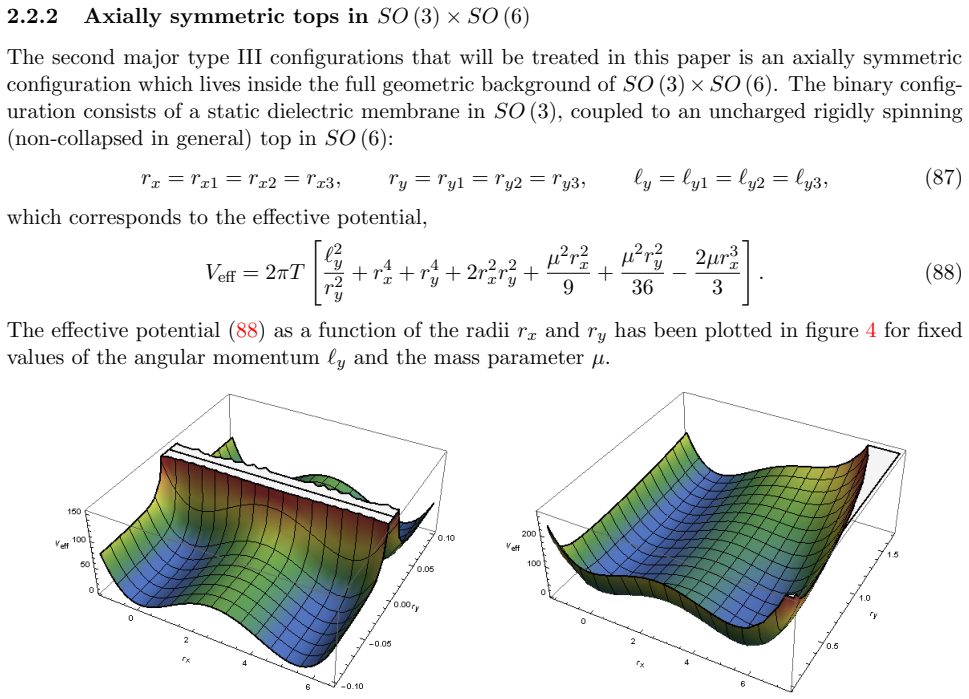
Summary. This paper studies classical bosonic M2-brane configurations of spherical topology moving in the 11-dimensional maximally supersymmetric plane-wave background, viewed as the large-N limit of the BMN matrix model. The authors adopt the rigid-rotor 'spherical' ansatz (24)-(29), (33)-(34), classify configurations into types I-III, and concentrate on two type-III cases: the static dielectric membrane in SO(3) (Section 2.2.1) and the axially symmetric top in SO(3)xSO(6) (Section 2.2.2). Section 3 computes the leading-order (LO) radial and angular/multipole stability spectra of both, with closed-form eigenvalues (146)-(150) and (208)-(212). Section 4 sets up the recursive higher-order perturbation system (219)-(220) and studies next-to-leading-order (NLO) angular perturbations of the SO(3) membrane at the saddle point u0 = 1/6, where the LO j = 1, 2 modes are unstable. The central result is an explicit example: a single LO j = 2, m = 0 instability drives exponentially growing NLO responses at j'' = 1 and j'' = 3, with amplitudes stated in (247) and (253), which the authors interpret as a turbulent cascade of instabilities from long to short wavelengths. The paper further claims that this cascade propagates to all multipoles at all perturbative orders.
Significance. If the advertised cascade claim holds, the paper provides a concrete, parameter-free mechanism for instability transfer between multipoles in membrane dynamics: the LO spectra are derived directly from the membrane Hamiltonian via SU(2) representation theory, and the NLO forcing is computed from explicit SDiff(S^2) structure constants, with all amplitudes given and no fitted parameters. The LO analysis is a genuine strength: I checked the radial eigenvalues of Table 1 against the fluctuation matrix (118) and the angular eigenvalues (146)-(150) against the projector decomposition (142)-(145), and the arithmetic is consistent, including the j = 1 angular sector reproducing the radial eigenvalue magnitudes (up to the sign-convention difference between the e^{lambda t} and e^{i lambda t} ansatze). The NLO example is internally consistent: the particular solutions (247) and (253) satisfy (2/9 + K)zeta = f~ with the correct sector eigenvalues, and the recursion (219)-(220) supplies the machinery for higher orders.
major comments (3)
- [Section 4.2 (closing paragraph), Section 5, abstract] The all-orders cascade claim is asserted, not proven. Section 4.2 computes one NLO example - a single LO (n = 1) j = 2, m = 0 mode at u0 = 1/6 drives exponentially growing n = 2 responses at j'' = 1 and j'' = 3, with amplitudes (247) and (253) - and then states 'It is then clear that this avalanche/cascade of perturbative instabilities carries over to higher perturbative orders as well.' That sentence is an unproven induction step: the selection rules (285)-(286) are kinematic (they say which j'' are admissible), and they do not guarantee that the dynamical driving coefficients in (229)-(230) are non-vanishing in the unstable sectors at every order, nor do they settle the resonance issue that the section itself acknowledges only qualitatively ('a complete discussion of resonances would have to include a thorough analysis of the Gauss law constraint at both the LO and the NLO'). No third-order computation or inductive argument is supplied, yet the conclusions state that the authors 'have also demonstrated the instability cascade phenomenon by which dipole (j = 1) and quadrupole (j = 2) instabilities propagate from leading order (n = 1) towards all higher multipoles (j = 1, 2, ...) of higher-order perturbation theory (n = 2, 3, ...)'. The authors should either supply the induction (the recursive system (219)-(220) already provides the framework) or explicitly reformulate the abstract, introduction, and conclusions so that the all-orders statement is presented as a conjecture supported by the NLO computation.
- [Section 3.2.2, eqs. (209)-(211), Table 2] The j >= 3 stability classification of the axially symmetric top rests on assertions about functions that are not displayed. The characteristic polynomial of A+/- is given in (209) with coefficients a+/-, b+/-, c+/- described as 'too complicated to be included here', and the text then asserts a+/- < 0, b+/- > 0, c+/- < 0 for all j >= 3 in the interval (177), together with Delta > 0 for all j >= 1. The Descartes-rule conclusion (three real positive roots for j >= 3, hence stability) depends entirely on these unshown inequalities, and Table 2 records the resulting classification as a definitive result. Because the stability of the j >= 3 sectors is part of the advertised LO classification and the rest of the paper is commendably explicit, the polynomials (or a numerical evaluation supporting (210)-(211)) should be made available, or the j >= 3 entries of Table 2 should be marked as numerically verified rather than analytically established.
- [Section 4.2, eqs. (226)-(230), (247), (253)] The general NLO claim is supported by a single seed mode in a truncated sector. The paragraph preceding the example asserts that coupling unstable j = 1 LO modes to stable modes j' makes all j'' = j' modes at NLO unstable, and that j = 2 LO modes make all j'' = j' +/- 1 modes unstable; however, the only seed actually evaluated is (j = 2, m = 0) at u0 = 1/6, and the analysis sets the SO(6) modes to zero (theta_i = 0 in (226)-(228)). Whether the bilinear coefficients K^gamma_{ikl;alpha beta} in (229)-(230) have non-vanishing projections onto the unstable (R-) sectors for every admissible (j'', m'') and every LO seed is not shown. The closed-form structure constants (281)-(284) make this checkable, and I would like to see either the general non-vanishing argument or a second explicit example (e.g., a j = 1 seed) before 'all multipoles at NLO' is stated as established. As it stands, the general statement is a plausible extrapolation from one example.
minor comments (7)
- [Eq. (127)] The term '52/182' in the discriminant should presumably read 52/18^2 (i.e., 52/324), matching the same combination as written in (212) and (279); as printed, the fraction is misleading.
- [Eq. (139)] The (3,2) entry of T is printed as 'JzJx + 2iJx'; from the definition (137) it should be J_z J_y + 2i J_x.
- [Eq. (36)] The summation upper limit in the definition of r^2_y3 is printed as 23; it should be s_3 (which is at most 6).
- [Section 3.2.1, after Eq. (150)] The statement that for j = 1 the angular spectrum (148)-(150) 'becomes identical to the radial spectrum (see table 1)' is loose: the eigenvalue magnitudes match (up to the sign-convention difference between the e^{lambda t} and e^{i lambda t} ansatze), but the multiplicities differ (e.g., d_theta = 18 for the angular theta-sector versus the six -1/12 modes of Table 1). Suggest rewording to 'reproduces the radial eigenvalue magnitudes'.
- [Section 4.2, near Eq. (245)] The remark 'recall that lambda^2_- < 0, for j = 3 in (149)' is incorrect: (149) gives lambda^2_- = j(j-3)/36, which vanishes for j = 3. The j'' = 3 R- sector is a zero mode at LO, and the NLO growth of that mode is driven by the forcing, so the remark should read lambda^2_- = 0.
- [Section 4.2, after Eq. (249)] The verification that the NLO solution (245) obeys the NLO Gauss law constraint (235) is asserted ('it can be demonstrated') rather than shown; given the careful treatment of the LO constraint (169)-(170), the corresponding NLO verification should be displayed at least briefly.
- [Sections 1 and 5] The black-hole fast-scrambling discussion is properly hedged in footnote 8 (no quantum effects, no multimembrane configurations), but the closing claims (e.g., that the cascade results 'can be used to construct a concrete model for the quantum chaotic dynamics of the BH degrees of freedom') outrun what the classical, single-membrane analysis supports; suggest tightening these statements.
Circularity Check
No significant circularity: the stability spectra and the NLO cascade example are derived from the membrane Hamiltonian and SDiff(S^2) structure constants, not from fitted inputs or self-referential definitions.
full rationale
The paper's central derivations are self-contained. The LO fluctuation equations (136)-(147) are obtained by substituting the spherical-harmonic expansion into the membrane equations of motion and solving the resulting eigenvalue problem with SU(2) projectors; no parameter is fitted to the stability output. The NLO forcing (227)-(230) is constructed from the same first-order modes and the explicit structure constants of SDiff(S^2) from appendix C, which are external to any fit. The example in section 4.2 uses a single LO j=2 mode and computes the NLO response at j=1 and j=3; the claim that instabilities cascade to all higher multipoles is an inductive extrapolation, but it is not circular because the kinematic selection rules (285)-(286) do not by themselves force nonzero dynamical coefficients. The paper cites prior work by the same authors [35,36,47] for the cascade claim, but here the mechanism is re-derived, not merely reused. No fitted parameter is renamed as a prediction, and no definition is circular. Thus the score is 0.
Assumptions & free parameters
assumptions (4)
- domain assumption The light-cone membrane Hamiltonian (17)-(18) is the correct continuum description of the BMN matrix model in the large-N limit.
- ad hoc to paper The rigid-rotor spherical ansatz (24)-(29), (33)-(34), in which each membrane coordinate is proportional to one of the three functions e_i(σ) with overall SO(3)xSO(6) rotation, captures the configurations of interest.
- standard math The closed-form structure constants f^γ_{αβ} of the spherical-harmonic Poisson algebra from [52] are correct and are used to compute the NLO forcing.
- domain assumption Perturbation theory to order epsilon^2 with the LO Gauss-law constraint is sufficient to conclude the existence of an instability cascade.
Cite this review
Pith. "Pith review of Turbulent aspects of BMN membrane dynamics." pith.science (2026). https://pith.science/paper/DKAZN576
@misc{pith2026241202496,
  author       = {Pith},
  title        = {Pith review of: Turbulent aspects of BMN membrane dynamics},
  year         = {2026},
  howpublished = {\url{https://pith.science/paper/DKAZN576}},
  note         = {Machine review of arXiv:2412.02496}
}
read the original abstract
We investigate the large-N limit of the BMN matrix model with classical bosonic membranes which have spherical topologies and spin inside the 11-dimensional maximally supersymmetric plane-wave background. First we classify all possible M2-brane configurations based on the distribution of their components inside the SO(3)xSO(6) symmetric plane-wave spacetime. We then formulate a number of simple but very representative ansatzes of dielectric tops that rotate in this space. We examine the leading-order radial and angular/multipole stability for a wide range of these configurations. By analyzing perturbations at the next-to-leading order, we find that they exhibit the phenomenon of turbulent cascading of instabilities. Thereby, long-wavelength perturbations generate higher-order multipole instabilities through their nonlinear couplings.
Figures


Figures from the paper (11 more)


Reference graph
Works this paper leans on
-
[1]
H. W. Brinkmann, Einstein spaces which are mapped conformally on each other , Math. Ann. 94 (1925) 119
work page 1925
-
[2]
J. Ehlers and W. Kundt, Exact solutions of the gravitational field equations , in Gravitation: An introduction to current research (L. Witten, ed.), p. 49. John Wiley & Sons, 1962
work page 1962
-
[3]
Penrose, Any space-time has a plane wave as a limit , in Differential geometry and relativity
R. Penrose, Any space-time has a plane wave as a limit , in Differential geometry and relativity. A volume in honour of Andr´ e Lichnerowicz on his 60th birthday (M. Cahen and M. Flato, eds.), vol. 3 of Mathematical Physics and Applied Mathematics , p. 271. Springer Netherlands, 1976
work page 1976
-
[4]
G¨ uven,Plane-wave limits and T-duality , Phys
R. G¨ uven,Plane-wave limits and T-duality , Phys. Lett. B482 (2000) 255, [ hep-th/0005061]
arXiv 2000
-
[5]
Penrose, A remarkable property of plane waves in general relativity , Rev
R. Penrose, A remarkable property of plane waves in general relativity , Rev. Mod. Phys. 37 (1965) 215
work page 1965
-
[6]
V. E. Hubeny and M. Rangamani, No horizons in pp waves , JHEP 11 (2002) 021, [hep-th/0210234]
arXiv 2002
-
[7]
J. M. Maldacena, The large-N limit of superconformal field theories and supergravity , Adv. Theor. Math. Phys. 2 (1998) 231, [ hep-th/9711200]
arXiv 1998
-
[8]
R. R. Metsaev, Type IIB Green-Schwarz superstring in plane wave Ramond-Ramond background, Nucl. Phys. B625 (2002) 70, [ hep-th/0112044]. • R. R. Metsaev and A. A. Tseytlin, Exactly solvable model of superstring in plane wave Ramond-Ramond background , Phys. Rev. D65 (2002) 126004, [ hep-th/0202109]
arXiv 2002
Show all 69 references
-
[9]
Berenstein, J
D. Berenstein, J. Maldacena, and H. Nastase, Strings in flat space and pp waves from N = 4 super Yang-Mills, JHEP 04 (2002) 013, [ hep-th/0202021]
2002 arXiv
-
[10]
Pankiewicz, Strings in Plane Wave Backgrounds , Fortsch
A. Pankiewicz, Strings in Plane Wave Backgrounds , Fortsch. Phys. 51 (2003) 1139, [hep-th/0307027]. • J. C. Plefka, Lectures on the plane-wave string/gauge theory duality , Fortsch. Phys. 52 (2004) 264, [ hep-th/0307101]. • D. Sadri and M. M. Sheikh-Jabbari, The 48 Plane-Wave/...
2003 arXiv
-
[11]
Amati and C
D. Amati and C. Klimˇ c ´ ık,Strings in a shock wave background and generation of curved geometry from flat space string theory , Phys. Lett. B210 (1988) 92. • G. T. Horowitz and A. R. Steif, Spacetime singularities in string theory , Phys. Rev. Lett. 64 (1990) 260
1988
-
[12]
J. M. Figueroa-O’Farrill and G. Papadopoulos, Maximally supersymmetric solutions of ten-dimensional and eleven-dimensional supergravities , JHEP 03 (2003) 048, [hep-th/0211089]
2003 arXiv
-
[13]
Floratos and A
E. Floratos and A. Kehagias, Penrose limits of orbifolds and orientifolds , JHEP 07 (2002) 031, [hep-th/0203134]
2002 arXiv
-
[14]
Kowalski-Glikman, Vacuum states in supersymmetric Kaluza-Klein theory , Phys
J. Kowalski-Glikman, Vacuum states in supersymmetric Kaluza-Klein theory , Phys. Lett. B134 (1984) 194
1984
-
[15]
Banks, W
T. Banks, W. Fischler, S. H. Shenker, and L. Susskind, M-theory as a matrix model: A conjecture, Phys. Rev. D55 (1997) 5112, [ hep-th/9610043]
1997 arXiv
-
[16]
R. C. Myers, Dielectric branes, JHEP 12 (1999) 022, [ hep-th/9910053]
1999 arXiv
-
[17]
Dasgupta, M
K. Dasgupta, M. M. Sheikh-Jabbari, and M. Van Raamsdonk, Matrix perturbation theory for M-theory on a pp-wave , JHEP 05 (2002) 56, [ hep-th/0205185]
2002 arXiv
-
[18]
de Wit, J
B. de Wit, J. Hoppe, and H. Nicolai, On the quantum mechanics of supermembranes , Nucl. Phys. B305 (1988) 545
1988
-
[19]
Bak, Supersymmetric branes in the matrix model of a pp-wave background , Phys
D. Bak, Supersymmetric branes in the matrix model of a pp-wave background , Phys. Rev. D67 (2003) 045017, [ hep-th/0204033]. • A. Mikhailov, Nonspherical giant gravitons and matrix theory, hep-th/0208077. • J.-H. Park, Supersymmetric objects in the M-theory on a pp-wave , JHEP...
2003 arXiv
-
[20]
Arnlind and J
J. Arnlind and J. Hoppe, Classical solutions in the BMN matrix model , hep-th/0312166. • J. Arnlind, J. Hoppe, and S. Theisen, Spinning membranes, Phys. Lett. B599 (2004) 118. • D. Berenstein, E. Dzienkowski, and R. Lashof-Regas, Spinning the fuzzy sphere , JHEP 08 (2015) 134,...
2004 arXiv
-
[21]
S. H. Shenker and D. Stanford, Black holes and the butterfly effect , JHEP 03 (2014) 067, [arXiv:1306.0622]. • S. W. Hawking, Information preservation and weather forecasting for black holes , arXiv:1401.5761. • J. Maldacena, S. H. Shenker, and D. Stanford, A bound on chaos, J...
2014 arXiv
-
[22]
Susskind and J
L. Susskind and J. Lindesay, An Introduction to black holes, information and the string theory revolution: The holographic universe . World Scientific, Singapore, 2005. • K. Papadodimas and S. Raju, An infalling observer in AdS/CFT , JHEP 10 (2013) 212, [ arXiv:1211.6767]
2013 arXiv
-
[23]
Carney, L
D. Carney, L. Chaurette, D. Neuenfeld, and G. W. Semenoff, Infrared quantum information, Phys. Rev. Lett. 119 (2017) 180502, [ arXiv:1706.03782]. • A. Strominger, Black hole 49 information revisited, in Jacob Bekenstein: The conservative revolutionary (L. Brink, V. Mukhanov, E...
2017 arXiv
-
[24]
Sekino and L
Y. Sekino and L. Susskind, Fast scramblers, JHEP 10 (2008) 065, [ arXiv:0808.2096]
2008 arXiv
-
[25]
Damour, Black hole eddy currents , Phys
T. Damour, Black hole eddy currents , Phys. Rev. D18 (1978) 3598. • K. S. Thorne, R. H. Price, and D. A. Macdonald, eds., Black holes: The membrane paradigm . Yale University Press, New Haven and London, 1986
1978
-
[26]
Hayden and J
P. Hayden and J. Preskill, Black holes as mirrors: Quantum information in random subsystems, JHEP 09 (2007) 120, [ arXiv:0708.4025]
2007 arXiv
-
[27]
Gur-Ari, M
G. Gur-Ari, M. Hanada, and S. H. Shenker, Chaos in classical D0-brane mechanics , JHEP 02 (2016) 091, [ arXiv:1512.00019]
2016 arXiv
-
[28]
Asano, D
Y. Asano, D. Kawai, and K. Yoshida, Chaos in the BMN matrix model , JHEP 06 (2015) 191, [arXiv:1503.04594]
2015 arXiv
-
[29]
Axenides and E
M. Axenides and E. Floratos, Euler top dynamics of Nambu-Goto p-branes , JHEP 03 (2007) 093, [hep-th/0608017]
2007 arXiv
-
[30]
Linardopoulos, Classical strings and membranes in the AdS/CFT correspondence
G. Linardopoulos, Classical strings and membranes in the AdS/CFT correspondence . PhD thesis, National and Kapodistrian University of Athens, June 2015
2015
-
[31]
Axenides, E
M. Axenides, E. Floratos, and G. Linardopoulos, Stringy membranes in AdS/CFT , JHEP 08 (2013) 089, [ arXiv:1306.0220]
2013 arXiv
-
[32]
Axenides, E
M. Axenides, E. Floratos, and G. Linardopoulos, The omega-infinity limit of single spikes , Nucl. Phys. B907 (2016) 323, [ arXiv:1511.03587]
2016 arXiv
-
[33]
A. A. Tseytlin, Quantum supermembranes and AdS/CFT duality , J. Exp. Theor. Phys. 137 (2023) 846. • S. Giombi, S. A. Kurlyand, and A. A. Tseytlin, Non-planar corrections in ABJM theory from quantum M2 branes , arXiv:2408.10070
2023 arXiv
-
[34]
Axenides, E
M. Axenides, E. Floratos, D. Katsinis, and G. Linardopoulos, M-theory as a dynamical system generator, in 13th chaotic modeling and simulation international conference (C. H. Skiadas and Y. Dimotikalis, eds.), Springer Proceedings in Complexity, p. 73. Springer, 2021. arXiv:2007.07028
2021 arXiv
-
[35]
Axenides, E
M. Axenides, E. Floratos, and G. Linardopoulos, M2-brane dynamics in the classical limit of the BMN matrix model , Phys. Lett. B773 (2017) 265, [ arXiv:1707.02878]
2017 arXiv
-
[36]
Axenides, E
M. Axenides, E. Floratos, and G. Linardopoulos, Multipole stability of spinning M2 branes in the classical limit of the BMN matrix model , Phys. Rev. D97 (2018) 126019, [arXiv:1712.06544]
2018 arXiv
-
[37]
Maldacena, The BFSS conjecture, a review , (CERN, Geneva), 2024
J. Maldacena, The BFSS conjecture, a review , (CERN, Geneva), 2024. Talk in Strings 2024 conference
2024
-
[38]
Nicolai and R
H. Nicolai and R. Helling, Supermembranes and M(atrix) theory , in ICTP spring school on nonperturbative aspects of string theory and supersymmetric gauge theories , p. 29, 1998. hep-th/9809103
1998 arXiv
-
[39]
P. A. Collins and R. W. Tucker, Classical and quantum mechanics of free relativistic membranes, Nucl. Phys. B112 (1976) 150. 50
1976
-
[40]
Contopoulos and M
G. Contopoulos and M. Harsoula, Periodic orbits in a near Yang-Mills potential , Phys. Scripta 98 (2023) 085203, [ arXiv:2302.12071]. • G. Contopoulos and M. Harsoula, Periodic orbits in a galactic potential , Celest. Mech. Dyn. Astron. 136 (2024) 20
2023 arXiv
-
[41]
Hoppe, Quantum theory of a massless relativistic surface and a two-dimensional bound state problem
J. Hoppe, Quantum theory of a massless relativistic surface and a two-dimensional bound state problem. PhD thesis, Massachusetts Institute of Technology, 1982
1982
-
[42]
Banyaga, Sur la structure du groupe des diff´ eomorphismes qui pr´ eservent une forme symplectique, Commentarii mathematici Helvetici 53 (1978) 174
A. Banyaga, Sur la structure du groupe des diff´ eomorphismes qui pr´ eservent une forme symplectique, Commentarii mathematici Helvetici 53 (1978) 174
1978
-
[43]
Efstathiou and D
K. Efstathiou and D. Sadovski ´ ı,Perturbations of the 1:1:1 resonance with tetrahedral symmetry: a three degree of freedom analogue of the two degree of freedom H´ enon–Heiles hamiltonian, Nonlinearity 17 (2004) 415
2004
-
[44]
A. J. Brizard and M. C. Westland, Motion in an asymmetric double well , Communications in Nonlinear Science and Numerical Simulations 42 (2017) 351, [ arXiv:1602.07239]
2017 arXiv
-
[45]
Hoppe, Membranes and integrable systems , Phys
J. Hoppe, Membranes and integrable systems , Phys. Lett. B250 (1990) 44. • J. Hoppe, Square-roots and Lax-pairs for supersymmetrizable systems , arXiv:2101.01803. • J. Hoppe, Dual variables for M-branes , arXiv:2101.04495. • J. Hoppe, On the r-matrix of m(embrane)-theory, arXi...
1990 arXiv
-
[46]
Harmark and K
T. Harmark and K. G. Savvidy, Ramond-Ramond field radiation from rotating ellipsoidal membranes, Nucl. Phys. B585 (2000) 567, [ hep-th/0002157]
2000 arXiv
-
[47]
Axenides, E
M. Axenides, E. Floratos, D. Katsinis, and G. Linardopoulos, Cascade of instabilities in the classical limit of the BMN matrix model , Phys. Rev. D104 (2021) 106002, [arXiv:2109.01088]
2021 arXiv
-
[48]
Axenides, E
M. Axenides, E. G. Floratos, and L. Perivolaropoulos, Metastability of spherical membranes in supermembrane and matrix theory , JHEP 11 (2000) 020, [ hep-th/0007198]. • M. Axenides, E. G. Floratos, and L. Perivolaropoulos, Quadrupole instabilities of relativistic rotating memb...
2000 arXiv
-
[49]
Lefschetz, Differential equations: Geometric theory
S. Lefschetz, Differential equations: Geometric theory . Interscience Publishers, New York, 1957
1957
-
[50]
M. E. Rose, Elementary theory of angular momentum . John Wiley & Sons, New York, 1957
1957
-
[51]
Schwarz, Noncommutative algebraic equations and noncommutative eigenvalue problem , Lett
A. Schwarz, Noncommutative algebraic equations and noncommutative eigenvalue problem , Lett. Math. Phys. 52 (2000) 177, [ hep-th/0004088]. • B. Cerchiai and B. Zumino, Properties of perturbative solutions of unilateral matrix equations , Lett. Math. Phys. 54 (2000) 33, [hep-th...
2000 arXiv
-
[52]
T. A. Arakelian and G. K. Savvidy, Geometry of a group of area-preserving diffeomorphisms , Phys. Lett. B223 (1989) 41
1989
-
[53]
J. S. Cotler, G. Gur-Ari, M. Hanada, J. Polchinski, P. Saad, S. H. Shenker, D. Stanford, A. Streicher, and M. Tezuka, Black holes and random matrices , JHEP 05 (2017) 118, [arXiv:1611.04650]. • P. V. Buividovich, M. Hanada, and A. Sch¨ afer,Quantum chaos, thermalization, and e...
2017 arXiv
-
[54]
Kovacs, Y
S. Kovacs, Y. Sato, and H. Shimada, On membrane interactions and a three-dimensional analog of Riemann surfaces , JHEP 02 (2016) 050, [ arXiv:1508.03367]
2016 arXiv
-
[55]
Ach´ ucarro, J
A. Ach´ ucarro, J. M. Evans, P. K. Townsend, and D. L. Wiltshire, Super p-Branes, Phys. Lett. B198 (1987) 441
1987
-
[56]
M. J. Duff, Supermembranes, hep-th/9611203
-
[57]
Roychowdhury, Carroll membranes, JHEP 10 (2019) 258, [ arXiv:1908.07280]
D. Roychowdhury, Carroll membranes, JHEP 10 (2019) 258, [ arXiv:1908.07280]
2019 arXiv
-
[58]
Hoppe, On some new types of membrane solutions , arXiv:2201.02524
J. Hoppe, On some new types of membrane solutions , arXiv:2201.02524. • J. Hoppe, The fast non-commutative sharp drop , Phys. Lett. B848 (2023) 138357, [ arXiv:2302.13146]. • J. Hoppe, Gauge compensating transformations for boosted axially symmetric membranes and light cone re...
2023 arXiv
-
[59]
P. D. ´Alvarez, P. Garc ´ ıa, M. P. G. del Moral, J. M. Pe˜ na, and R. Prado,Spinning solutions for the bosonic M2-brane with C ± fluxes, JHEP 02 (2022) 028, [ arXiv:2104.08927]. • P. D. ´Alvarez, M. P. G. del Moral, J. M. Pe˜ na, and R. Prado,Rotating central charge membranes...
2022 arXiv
-
[60]
Hoppe, G
J. Hoppe, G. Linardopoulos, and T. Turgut, New minimal hypersurfaces in R(k+1)(2k+1) and S2k2+3k, Mathematische Nachrichten (2016) [arXiv:1602.09101]. • J. Hoppe, Another view on the shape equation for strings , arXiv:2009.05013. • J. Hoppe, Commuting signs of infinity, arXiv:...
2016 arXiv
-
[61]
Hoppe, Relativistic membranes, J
J. Hoppe, Relativistic membranes, J. Phys. A46 (2013) 023001. • J. Hoppe, Composite dynamical symmetry of M-branes , arXiv:2103.16540
2013 arXiv
-
[62]
Arnlind, J
J. Arnlind, J. Hoppe, and M. Kontsevich, Quantum minimal surfaces , arXiv:1903.10792. • J. Hoppe, On the quantization of some polynomial minimal surfaces , Phys. Lett. B922 (2021) 136658, [arXiv:2107.03319]
2021 arXiv
-
[63]
S. R. Coleman and F. De Luccia, Gravitational effects on and of vacuum decay , Phys. Rev. D21 (1980) 3305
1980
-
[64]
Aurilia, H
A. Aurilia, H. Nicolai, and P. K. Townsend, Hidden constants: The theta parameter of QCD and the cosmological constant of N = 8 supergravity, Nucl. Phys. B176 (1980) 509. • M. J. Duff and P. van Nieuwenhuizen, Quantum inequivalence of different field representations , Phys. Le...
1980
-
[65]
J. D. Brown and C. Teitelboim, Dynamical neutralization of the cosmological constant , Phys. Lett. B195 (1987) 177
1987
-
[66]
Bousso and J
R. Bousso and J. Polchinski, Quantization of four form fluxes and dynamical neutralization of the cosmological constant, JHEP 06 (2000) 006, [ hep-th/0004134]. • J. L. Feng, J. March-Russell, S. Sethi, and F. Wilczek, Saltatory relaxation of the cosmological constant , Nucl. P...
2000 arXiv
-
[67]
Teitelboim, The cosmological constant as a thermodynamic black hole parameter , Phys
C. Teitelboim, The cosmological constant as a thermodynamic black hole parameter , Phys. Lett. B158 (1985) 293. • A. Gomberoff, M. Henneaux, and C. Teitelboim, Turning the 52 cosmological constant into black holes , hep-th/0111032. • A. Gomberoff, M. Henneaux, C. Teitelboim, a...
1985 arXiv
-
[68]
S. V. Ketov, Modified gravity in higher dimensions, flux compactification, and cosmological inflation, Symmetry 11 (2019) 1528. • S. Brahma, R. Brandenberger, and S. Laliberte, Emergent cosmology from matrix theory , JHEP 03 (2022) 067, [ arXiv:2107.11512]
2019 arXiv
-
[69]
S. R. Coleman, Q-balls, Nucl. Phys. B262 (1985) 263. [Addendum: Nucl.Phys. B269 (1986) 744]. • A. M. Safian, S. R. Coleman, and M. Axenides, Some nonabelian Q balls , Nucl. Phys. B297 (1988) 498. • M. Axenides, Q Balls . PhD thesis, Harvard University, 1986. 53
1985
Reviewed August 11, 2026 · model on record in the stance chip above.
Discussion (0). Continue with ORCID to comment.