REVIEW 4 major objections 6 minor 41 references
Tensor renormalization group study of (1+1)-dimensional O(3) nonlinear sigma model with and without finite chemical potential
T0 review · 4 major / 6 minor · reviewed 2026-08-11 · deepseek-v4-flash
Pith's one-line read The tensor renormalization group can compute the dynamical critical exponent z = 1.96(6) of the (1+1)-dimensional O(3) nonlinear sigma model at finite chemical potential, a regime where Monte Carlo methods face a sign problem.
desk verdict A competent proceedings summary of the authors' own prior work, but the thermodynamic-limit claim in Sec. 3.2 is wrong by orders of magnitude and the 'first z with TRG' claim is already true of their own ref. [33]. read the letter →
The pith
A machine-rendered reading of the paper's core claim, the machinery that carries it, and where it could break.
The reading
What carries the argument
The machinery is the tensor network representation of the lattice path integral, obtained by discretizing the continuous O(3) spin integration with Gauss-Legendre quadrature and decomposing the resulting four-leg bond tensor by singular value decomposition, then coarse-graining with the higher-order tensor renormalization group (HOTRG) at bond dimension $D_{\rm cut}$. The two observables that carry the finite-density argument are the number density $\langle n \rangle = (1/LN_t)\, \partial \ln Z/\partial \mu$, evaluated by central finite differences of $\ln Z$, and the temporal correlation length $\xi_t = N_t / \ln(\lambda_0/\lambda_1)$, read off from the two largest eigenvalues of the reduced density matrix. These enter the scaling forms $\langle n \rangle \propto \{ \mu - (\mu_c + B_n/D_{\rm cut})\}^\nu$ and $\xi_t \propto |\mu - (\mu_c + B_\xi/D_{\rm cut})|^{-z\nu}$, whose simultaneous fit yields $\mu_c$, $\nu$, and $z$. The theoretical expectations $\nu = 1/2$ and $z = 2$ come from the equivalence at finite density between this field theory and the integer-spin Heisenberg chain in a magnetic field.
What would settle it
Compute the number density $\langle n \rangle$ and the temporal correlation length $\xi_t$ at $\beta = 1.4$ on a $512 \times 512$ or $1024 \times 1024$ lattice at the same bond dimensions $D_{\rm cut} \in \{125, 130, 135\}$, fit the same scaling forms, and check whether $\mu_c$, $\nu$, and $z$ move by more than the quoted errors; any significant shift would falsify the thermodynamic-limit assumption behind the reported exponents.
Extended reading notes
Core claim
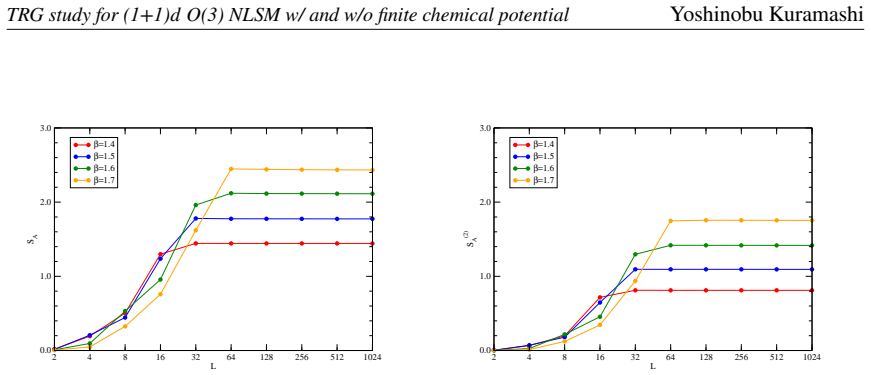
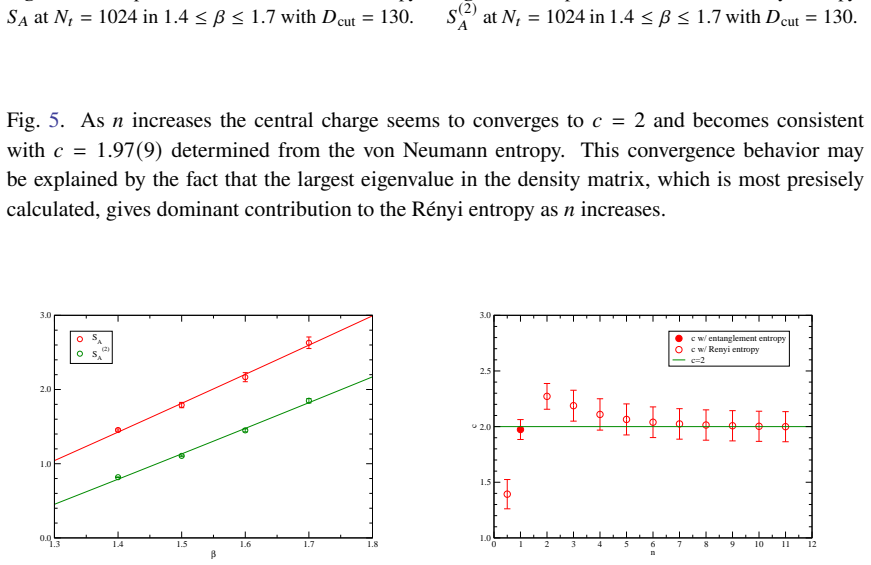
Working with the higher-order tensor renormalization group and taking the bond dimension $D_{\rm cut} \to \infty$ by extrapolation, the authors construct a tensor network representation of the O(3) nonlinear $\sigma$ model partition function at finite chemical potential $\mu$. At $\mu = 0$ they compute both von Neumann and Rényi entanglement entropies on a $128 \times 1024$ subsystem geometry and fit the asymptotic scaling $S_A = (c/3)(2\pi\beta - \ln \beta) + \text{const.}$ to obtain $c = 1.97(9)$ for the von Neumann entropy, with the $n$th-order Rényi entropies yielding $c$ values that converge toward 2 as $n$ grows. For $\mu \ne 0$ at $\beta = 1.4$ they compute the number density by numerical differentiation of $\ln Z$ and the temporal correlation length $\xi_t$ from the leading eigenvalues of the density matrix, on a $225 \times 225$ lattice. Fitting $\langle n \rangle(\mu) = A_n \{ \mu - (\mu_c + B_n/D_{\rm cut})\}^\nu$ and $\ln \xi_t = A_\xi + \alpha \ln|\mu - (\mu_c + B_\xi/D_{\rm cut})|$ with $\alpha = z\nu$ gives $\mu_c = 0.14512(11)$, $\nu = 0.512(15)$, and $z = 1.96(6)$, consistent with the mass gap $m = 0.1449(2)$ from Monte Carlo and with the predictions $\nu = 1/2$, $z = 2$. The consistency of the extracted $\mu_c$ with the independent mass-gap measurement and the agreement of both exponents with theory constitute the paper's central claim.
Load-bearing premise
The paper's thermodynamic-limit claim rests on treating the $225 \times 225$ lattice as effectively zero temperature and infinite volume, supported by the quoted figures $T/m = 2.1 \times 10^{-7}$ and $Lm = 4.9 \times 10^{6}$; those figures appear inconsistent with the stated lattice size and mass gap $m \approx 0.1449$, since they would give $T/m \approx 0.031$ and $Lm \approx 33$, and if the lattice is not truly in the thermodynamic limit the fitted exponents could carry finite-size bias.
Editorial extensions
If this is right
- TRG can map the finite-density phase diagram of an asymptotically free (1+1)-dimensional field theory without a sign problem, locating the critical chemical potential consistently with an independent Monte Carlo mass-gap measurement.
- The dynamical critical exponent z = 1.96(6), extracted from the anisotropic scaling of the temporal correlation length, matches the Heisenberg-chain prediction z = 2, indicating that TRG captures the anisotropy that the chemical potential induces between space and time directions.
- The central charge c = 1.97(9) from the von Neumann entropy, together with the large-n convergence of the Rényi entropies toward c = 2, confirms the expected conformal structure of the mu = 0 critical theory.
- The same computational pipeline, numerical differentiation of ln Z plus eigenvalue-based correlation lengths, carries over to other sign-problematic lattice models, including the finite-density gauge and fermion models the paper cites as motivation.
Reading between the lines
- If z = 2 holds across lattice sizes, the finite-density O(3) NLSM and the integer-spin Heisenberg chain in a magnetic field share not just static but dynamical universality; a stronger test would be to measure the full scaling function of the number density and compare it with the predicted universal curve, not just the exponents.
- The paper's thermodynamic-limit figures for T/m and Lm are inconsistent with L = N_t = 225 and m = 0.1449 by orders of magnitude; repeating the fit on 512-by-512 or 1024-by-1024 lattices would show whether the quoted errors already absorb the finite-size bias.
- The observed n-dependence of the central charge extracted from Rényi entropies suggests the reduced density matrix has a quickly decaying eigenvalue spectrum; a direct spectral analysis could quantify how many eigenvalues are needed to approximate the von Neumann entropy, which would sharpen the extrapolation method.
- The same TRG setup could be applied to finite-density CP(N-1) or SU(2) principal chiral models to ask whether z = 2 is a general feature of massive asymptotically free (1+1)-dimensional theories or specific to the O(3) model.
Editorial analysis
A structured set of objections, weighed in public.
Referee Report
Summary. This paper applies the higher-order tensor renormalization group (HOTRG) to the (1+1)-dimensional O(3) nonlinear sigma model with chemical potential. At μ=0, the authors compute von Neumann and Rényi entanglement entropies for β=1.4–1.7 on 128×1024 and 1024×1024 lattices, extrapolate in bond dimension, and extract the central charge c=1.97(9) from the von Neumann entropy and c=2.27(16) from the second Rényi entropy, with an n-dependent analysis showing convergence toward c≈2. At μ≠0 they compute the number density and temporal correlation length on a 225×225 lattice with Dcut=125, 130, and 135, fit a critical scaling form with 1/Dcut corrections, and obtain μc=0.14512(11), ν=0.512(15), and, from α=zν with α=1.003(5), z=1.96(6). These results are interpreted as the first TRG determination of a dynamical critical exponent and are consistent with the predictions ν=0.5 and z=2.
Significance. The significance is potentially high: if the finite-density results are correct, the paper demonstrates that TRG can extract critical exponents, including the dynamical exponent z, in a sign-problematic regime, and the μc value agrees with an independent Monte Carlo mass gap. The μ=0 entanglement results provide a useful cross-check of the TRG method against MPS. However, the central finite-density claim rests on a volume that is stated to be 'large enough' on the basis of numerical values (T/m=2.1×10^{-7}, Lm=4.9×10^6) that are internally inconsistent with the stated lattice size and mass gap; the actual T/m and Lm are O(0.03) and O(33). This leaves a 10–20% finite-size systematic in the exponent extraction, comparable to the quoted statistical errors. The paper therefore needs additional analysis or more conservative claims before the central result can be accepted.
major comments (4)
- [Sec. 3.2] The statement 'The volume is large enough to be regarded as the thermodynamic limit at zero temperature: T/m = 2.1×10^{-7} and Lm = 4.9×10^6' is inconsistent with the lattice size L=N_t=225 and the mass gap m=1/6.90(1)=0.1449 quoted in the same section. Since T=1/N_t, the actual values are T/m=1/(225×0.1449)=0.0307 and Lm=32.6, smaller than the quoted values by about five orders of magnitude. In the fit window μ∈[0.14575, 0.14700] with μc=0.14512, the reduced distance δ is 0.00063–0.0019, so the correlation length ξ∼δ^{-ν} is approximately 25–44; hence Tξ≈0.11–0.20 and L/ξ≈5–10. The scaling limit requires Tξ≪1, so finite-temperature corrections at the 10–20% level are expected, which is larger than the quoted errors on ν (0.015) and z (0.06). Please either re-run at substantially larger N_t and L, add a finite-temperature/finite-size scaling analysis, or explicitly include this systematic error in the quoted exponents. As written, the agreement with ν=0.5 and z=2 cannot be distinguished from an accidental finite-size effect.
- [Sec. 3.2] The dynamical critical exponent is obtained by fixing μc=0.14512 from the density fit and then using ν=0.512(15) from the same density fit to convert the temporal-correlation-length exponent α=1.003(5) into z=α/ν=1.96(6). This sequential procedure does not propagate the correlations among μc, ν, and α and ignores the uncertainty in the fixing of μc. A joint fit of the density and correlation-length data, or at least a fit with μc free in the ξ_t analysis, is needed to determine whether the quoted error on z is realistic. This is load-bearing for the 'first calculation of the dynamical critical exponent with the TRG method' claim.
- [Sec. 3.2] The infinite-bond-dimension extrapolation is based on only three closely spaced values, Dcut=125, 130, and 135, with a linear 1/Dcut ansatz for the shift in μc. The paper does not report χ²/dof, the number of data points, or any test of the linear extrapolation (for example, including Dcut=100 or 150). Since the central results μc, ν, and z depend on this extrapolation, the systematic error from the Dcut→∞ limit should be quantified by varying the fit range, including a quadratic term in 1/Dcut, or reporting the fit quality.
- [Sec. 3.2] The numerical differentiation used for the number density, ⟨n⟩≈[ln Z(μ+Δμ)-ln Z(μ-Δμ)]/(2Δμ L N_t), does not state the value of Δμ. The closest data points to μc are at δ=0.00063, so if Δμ is not much smaller than this, the derivative will smear the singular behavior and bias ν and μc. Please specify Δμ and verify that the quoted results are stable against reducing it, or provide the raw ln Z values.
minor comments (6)
- [Abstract] The abstract says the study is performed 'with the infinite limit of the bond dimension Dcut→∞', but the paper actually uses a linear 1/Dcut extrapolation from Dcut=125, 130, and 135; please rephrase to 'extrapolated to Dcut→∞'.
- [Sec. 3.1, Fig. 4] The text states that the plotted entropies are obtained by linear extrapolations in 1/Dcut, but the figure caption says 'with Dcut=130'; please clarify which data are shown.
- [Sec. 3.1] The statement that N_t=1024 'is large enough to be regarded as the zero temperature limit' should be quantified by giving T/m for the β values used, since the correlation length varies from about 6.9 to 34.6.
- [Sec. 2.2, Eq. (15)] The definition of ξ_t via λ0 and λ1 would be clearer if the paper stated that these are the leading eigenvalues of the temporal transfer matrix and explained how the reduced tensor T* is constructed in the HOTRG step.
- [Fig. 8] The horizontal axis combines the fitted shift B_ξ/Dcut with μ; please define the effective variable, for example δ_eff=μ-(μc+B_ξ/Dcut), in the caption so that the reader can see what is plotted.
- [Throughout] The manuscript contains many typos and grammatical slips (for example, 'tranasition', 'inital', 'featute', 'nad', 'Futhermore', 'polynominal', 'presisely', 'etropies'); a careful proofreading pass is needed.
Circularity Check
No significant circularity: the extracted exponents are fit outputs benchmarked against external MPS, Monte Carlo, and analytic results, not inputs to the fits.
full rationale
The paper's central quantities are obtained by explicit fits to TRG data: c from the entanglement-entropy scaling forms in Eqs. (19)-(20), and μc, ν, and z from the number-density and temporal-correlation-length fits in Sec. 3.2. The target values c=2, ν=0.5, and z=2 are not used as fit inputs; they serve only as external comparisons, together with the MPS central charge [41] and the Monte Carlo mass gap [39]. The citations to the authors' own prior papers [32,33] describe the same TRG method and preliminary results, but the present fits and data are shown, so those self-citations are not the load-bearing justification. The 'first successful calculation of z with TRG' statement is a novelty claim, not a derivation step. The statement in Sec. 3.2 that a 225x225 lattice gives T/m=2.1e-7 and Lm=4.9e6 is numerically inconsistent with N_t=L=225 and m=1/6.90 (one obtains T/m≈0.031 and Lm≈33); I flag this as a substantive correctness and finite-size-systematics concern, but it is not a circular-reasoning step because the claimed exponents are not defined or fitted in terms of that statement.
Assumptions & free parameters
free parameters (5)
- A_n (density amplitude) =
0.20(2)
- B_n (finite-D_cut shift in density fit) =
0.068(12)
- A_xi (temporal correlation length offset) =
-0.030(29)
- B_xi (finite-D_cut shift in correlation length fit) =
0.0599(9)
- Intercepts in entropy scaling fits =
not quoted
assumptions (4)
- domain assumption The lattice action with chemical potential introduced via the SO(3) twist matrix D(mu,nu) (Eqs. (1)-(3)) yields the correct continuum O(3) NLSM at finite density, and this model is equivalent to the integer-spin Heisenberg chain in a magnetic field.
- domain assumption The asymptotic scaling formula S_A = (c/3) ln xi with xi ~ (1/beta) exp(2*pi*beta) is valid in the fitted beta range (1.4 to 1.7) at mu = 0.
- ad hoc to paper The critical scaling forms <n> = A_n (mu - mu_c - B_n/D_cut)^nu and xi_t ~ |mu - (mu_c + B_xi/D_cut)|^(-z nu) correctly describe the data in the fit ranges.
- ad hoc to paper Linear extrapolation in 1/D_cut removes finite bond dimension effects for entropies and critical parameters.
Cite this review
Pith. "Pith review of Tensor renormalization group study of (1+1)-dimensional O(3) nonlinear sigma model with and without finite chemical potential." pith.science (2026). https://pith.science/paper/4CY2D65M
@misc{pith2026241202995,
  author       = {Pith},
  title        = {Pith review of: Tensor renormalization group study of (1+1)-dimensional O(3) nonlinear sigma model with and without finite chemical potential},
  year         = {2026},
  howpublished = {\url{https://pith.science/paper/4CY2D65M}},
  note         = {Machine review of arXiv:2412.02995}
}
abstract
We study (1+1)-dimensional O(3) nonlinear sigma model using the tensor renormalization group method with the infinite limit of the bond dimension $D_{\rm cut}\rightarrow \infty$. At the vanishing chemical potential $\mu=0$, we investigate the von Neumann and R\'enyi types of entanglement entropies. The central charge is determined to be $c=1.97(9)$ by using the asymptotic scaling properties of the entropies. We also examine the consistency between two entropies. In the finite density region with $\mu\ne 0$, where this model suffers from the sign problem in the standard Monte Carlo approach, we investigate the properties of the quantum phase transition. We determine the transition point $\mu_{\rm c}$ and the critical exponent of the correlation length $\nu$ from the $\mu$ dependence of the number density in the thermodynamic limit. The dynamical critical exponent $z$ is also extracted from the scaling behavior of the temporal correlation length as a function of $\mu$. This is the first successful calculation of the dynamical critical exponent with the TRG method.
Figures

Figures from the paper (2 more)


Reference graph
Works this paper leans on
-
[33]
X. Luo and Y. Kuramashi,Quantum phase transition of (1+1)-dimensional O(3) nonlinear sigma model at finite density with tensor renormalization group, JHEP 11(2024) 144, [2406.08865]
work page Pith review arXiv 2024
-
[1]
M. Levin and C. P. Nave,Tensor renormalization group approach to two-dimensional classical lattice models,Phys. Rev. Lett.99(2007) 120601, [cond-mat/0611687]. 8 TRG study for (1+1)𝑑 O(3) NLSM w/ and w/o finite chemical potential Yoshinobu Kuramashi
arXiv 2007
-
[2]
Z. Y. Xie, J. Chen, M. P. Qin, J. W. Zhu, L. P. Yang and T. Xiang,Coarse-graining renormalization by higher-order singular value decomposition, Phys. Rev. B86 (2012) 045139, [1201.1144]
arXiv 2012
-
[3]
Y. Shimizu and Y. Kuramashi,Grassmann tensor renormalization group approach to one-flavor lattice Schwinger model, Phys. Rev.D90 (2014) 014508, [1403.0642]
arXiv 2014
-
[4]
G. Evenbly and G. Vidal,Tensor network renormalization,Phys. Rev. Lett.115 (2015) 180405
work page 2015
- [5]
-
[6]
S. Yang, Z.-C. Gu and X.-G. Wen,Loop optimization for tensor network renormalization, Phys. Rev. Lett.118 (2017) 110504
work page 2017
- [7]
Show all 41 references
-
[8]
Adachi, T
D. Adachi, T. Okubo and S. Todo,Anisotropic Tensor Renormalization Group,Phys. Rev. B 102 (2020) 054432, [1906.02007]
2020 arXiv
-
[9]
Kadoh and K
D. Kadoh and K. Nakayama,Renormalization group on a triad network, 1912.02414
1912 arXiv
-
[10]
Akiyama, Y
S. Akiyama, Y. Kuramashi, T. Yamashita and Y. Yoshimura,Restoration of chiral symmetry in cold and dense Nambu–Jona-Lasinio model with tensor renormalization group,JHEP 01 (2021) 121, [2009.11583]
2021 arXiv
-
[11]
Adachi, T
D. Adachi, T. Okubo and S. Todo,Bond-weighted tensor renormalization group,Phys. Rev. B 105 (2022) L060402, [2011.01679]
2022 arXiv
-
[12]
Akiyama,Bond-weighting method for the Grassmann tensor renormalization group, JHEP 11 (2022) 030, [2208.03227]
S. Akiyama,Bond-weighting method for the Grassmann tensor renormalization group, JHEP 11 (2022) 030, [2208.03227]
2022 arXiv
-
[13]
Akiyama, Y
S. Akiyama, Y. Kuramashi, T. Yamashita and Y. Yoshimura,Phase transition of four-dimensional Ising model with higher-order tensor renormalization group,Phys. Rev. D100(2019) 054510, [1906.06060]
2019 arXiv
-
[14]
Akiyama, D
S. Akiyama, D. Kadoh, Y. Kuramashi, T. Yamashita and Y. Yoshimura,Tensor renormalization group approach to four-dimensional complex𝜙4 theory at finite density, JHEP 09 (2020) 177, [2005.04645]
2020 arXiv
-
[15]
Akiyama, Y
S. Akiyama, Y. Kuramashi and Y. Yoshimura,Phase transition of four-dimensional lattice𝜙4 theory with tensor renormalization group, Phys. Rev. D104 (2021) 034507, [2101.06953]
2021 arXiv
-
[16]
Akiyama and Y
S. Akiyama and Y. Kuramashi,Tensor renormalization group study of (3+1)-dimensionalZ2 gauge-Higgs model at finite density, JHEP 05(2022) 102, [2202.10051]. 9 TRG study for (1+1)𝑑 O(3) NLSM w/ and w/o finite chemical potential Yoshinobu Kuramashi
2022 arXiv
-
[17]
Akiyama and Y
S. Akiyama and Y. Kuramashi,Critical endpoint of (3+1)-dimensional finite densityZ3 gauge-Higgs model with tensor renormalization group,JHEP 10(2023) 077, [2304.07934]
2023 arXiv
-
[18]
Shimizu and Y
Y. Shimizu and Y. Kuramashi,Critical behavior of the lattice Schwinger model with a topological term at𝜃=𝜋 using the Grassmann tensor renormalization group, Phys. Rev. D90 (2014) 074503, [1408.0897]
2014 arXiv
-
[19]
Kawauchi and S
H. Kawauchi and S. Takeda,Tensor renormalization group analysis of CP(𝑁-1) model,Phys. Rev. D93 (2016) 114503, [1603.09455]
2016 arXiv
-
[20]
Kawauchi and S
H. Kawauchi and S. Takeda,Phase structure analysis of CP(N-1) model using Tensor renormalization group,PoS LATTICE2016(2016) 322, [1611.00921]
2016 arXiv
-
[21]
L.-P. Yang, Y. Liu, H. Zou, Z. Xie and Y. Meurice,Fine structure of the entanglement entropy in the O(2) model,Phys. Rev. E93(2016) 012138, [1507.01471]
2016 arXiv
-
[22]
Shimizu and Y
Y. Shimizu and Y. Kuramashi,Berezinskii-Kosterlitz-Thouless transition in lattice Schwinger model with one flavor of Wilson fermion, Phys. Rev.D97(2018) 034502, [1712.07808]
2018 arXiv
-
[23]
Takeda and Y
S. Takeda and Y. Yoshimura,Grassmann tensor renormalization group for the one-flavor lattice Gross-Neveu model with finite chemical potential,PTEP 2015 (2015) 043B01, [1412.7855]
2015 arXiv
-
[24]
Kadoh, Y
D. Kadoh, Y. Kuramashi, Y. Nakamura, R. Sakai, S. Takeda and Y. Yoshimura,Tensor network formulation for two-dimensional latticeN = 1 Wess-Zumino model,JHEP 03 (2018) 141, [1801.04183]
2018 arXiv
-
[25]
Kadoh, Y
D. Kadoh, Y. Kuramashi, Y. Nakamura, R. Sakai, S. Takeda and Y. Yoshimura,Investigation of complex𝜙4 theory at finite density in two dimensions using TRG,JHEP 02 (2020) 161, [1912.13092]
2020 arXiv
-
[26]
Kuramashi and Y
Y. Kuramashi and Y. Yoshimura,Tensor renormalization group study of two-dimensional U(1) lattice gauge theory with a𝜃 term, JHEP 04(2020) 089, [1911.06480]
2020 arXiv
-
[27]
Akiyama and Y
S. Akiyama and Y. Kuramashi,Tensor renormalization group approach to (1+1)-dimensional Hubbard model, Phys. Rev. D104 (2021) 014504, [2105.00372]
2021 arXiv
-
[28]
Akiyama, Y
S. Akiyama, Y. Kuramashi and T. Yamashita,Metal–insulator transition in the (2+1)-dimensional Hubbard model with the tensor renormalization group, PTEP 2022 (2022) 023I01, [2109.14149]
2022 arXiv
-
[29]
Nakayama, L
K. Nakayama, L. Funcke, K. Jansen, Y.-J. Kao and S. Kühn,Phase structure of the CP(1) model in the presence of a topological𝜃-term, Phys. Rev. D105 (2022) 054507, [2107.14220]
2022 arXiv
-
[30]
Luo and Y
X. Luo and Y. Kuramashi,Tensor renormalization group approach to (1+1)-dimensional SU(2) principal chiral model at finite density,Phys. Rev. D107 (2023) 094509, [2208.13991]. 10 TRG study for (1+1)𝑑 O(3) NLSM w/ and w/o finite chemical potential Yoshinobu Kuramashi
2023 arXiv
-
[31]
Akiyama and Y
S. Akiyama and Y. Kuramashi,Tensor renormalization group study of (1 + 1)-dimensional U(1) gauge-Higgs model at𝜃 =𝜋 with Lüscher’s admissibility condition,JHEP 09 (2024) 086, [2407.10409]
2024 arXiv
-
[32]
Luo and Y
X. Luo and Y. Kuramashi,Entanglement and Rényi entropies of (1+1)-dimensional O(3) nonlinear sigma model with tensor renormalization group, JHEP 03(2024) 020, [2308.02798]
2024 arXiv
-
[34]
G. I. Dzhaparidze and A. A. Nersesyan,Magnetic-field phase transition in a one-dimensional system of electrons with attraction,JETP Lett.27(1978) 356
1978
-
[35]
V. L. Pokrovsky and A. L. Talapov,Ground state, spectrum, and phase diagram of two-dimensional incommensurate crystals,Phys. Rev. Lett.42 (1979) 65
1979
-
[36]
H. J. Schulz,Critical behavior of commensurate-incommensurate phase transitions in two dimensions, Phys. Rev. B22(1980) 5274
1980
-
[37]
H.J.Schulz, Phasediagramsandcorrelationexponentsforquantumspinchainsofarbitrary spin quantum number, Phys. Rev. B34(1986) 6372
1986
-
[38]
Affleck,Theory of haldane-gap antiferromagnets in applied fields,Phys
I. Affleck,Theory of haldane-gap antiferromagnets in applied fields,Phys. Rev. B41(1990) 6697
1990
-
[39]
Wolff,Asymptotic Freedom and Mass Generation in the O(3) Nonlinear𝜎 Model,Nucl
U. Wolff,Asymptotic Freedom and Mass Generation in the O(3) Nonlinear𝜎 Model,Nucl. Phys. B334 581
-
[40]
Calabrese and J
P. Calabrese and J. L. Cardy,Entanglement entropy and quantum field theory,J. Stat. Mech. 0406 (2004) P06002, [hep-th/0405152]
2004 arXiv
-
[41]
Bruckmann, K
F. Bruckmann, K. Jansen and S. Kühn,O(3) nonlinear sigma model in 1+1 dimensions with matrix product states,Phys. Rev. D99(2019) 074501, [1812.00944]. 11
2019 arXiv
Reviewed August 11, 2026 · model on record in the stance chip above.
Discussion (0). Continue with ORCID to comment.