REVIEW 2 major objections 6 minor 2 cited by
A dark, bare rock for TOI-1685 b from a JWST NIRSpec G395H phase curve
T0 review · 2 major / 6 minor · reviewed 2026-08-11 · deepseek-v4-flash
Pith's one-line read A full JWST phase curve shows TOI-1685 b is a dark, bare rock whose dayside emission matches a zero-albedo blackbody.
desk verdict A transparent JWST phase-curve study whose qualitative bare-rock conclusion is plausible, but whose headline brightness-temperature ratio is not yet on solid ground. read the letter →
The pith
A machine-rendered reading of the paper's core claim, the machinery that carries it, and where it could break.
The reading
What carries the argument
The load-bearing quantity is the temperature scaling ratio $R\equiv T_{p,\mathrm{day}}/T_{p,\mathrm{max}}$, where $T_{p,\mathrm{max}}$ is the substellar temperature of a zero-albedo, zero-recirculation blackbody; $R\approx1$ means the dayside emits like a bare rock. The analysis models the full-orbit white-light and spectroscopic light curves with a transit-plus-sinusoid phase-curve model, fits eclipse-only segments as a cross-check, and inflates the parameter uncertainties with a prayer-bead resampling that preserves the correlated noise structure in the residuals. Forward radiative-transfer models of thin secondary atmospheres and simple single-species retrievals are then compared with the featureless emission spectrum and the flat transmission spectrum to decide which atmospheric cases remain. The longer-wavelength detector provides the quoted value because the shorter-wavelength light curve carries a stronger correlated-noise component and a linear trend that degrade the phase-curve parameters.
What would settle it
A decisive test is a new eclipse observation with different systematics—for example, a MIRI LRS spectrum or a NIRSpec visit at another roll angle—deep enough to detect or exclude the CO$_2$ band near 4.3 µm; a detected band would falsify the no-atmosphere claim, while a featureless blackbody upper limit would support it.
Extended reading notes
Core claim
The central claim is that TOI-1685 b's dayside emission is indistinguishable, within $1\sigma$, from a zero-albedo blackbody with no heat redistribution, making a significant atmosphere unlikely. From the longer-wavelength detector (3.823–5.172 µm) the authors measure a dayside brightness ratio $R = T_{p,\mathrm{day}}/T_{p,\mathrm{max}} = 0.98\pm0.07$, corresponding to a dayside brightness temperature of $1360\pm100$ K, and a nightside consistent with near-zero emission; the shorter-wavelength detector gives a noisier $R = 1.10\pm0.10$. The transmission spectrum is flat and rules out clear H$_2$-dominated atmospheres, while emission forward models reject 1-mbar CO$_2$ and SO$_2$ atmospheres and a 10-bar H$_2$O atmosphere, although thinner versions remain possible. The authors conclude that the most probable picture is a dark, airless rock with an Earth-like density, noting that the JWST-derived radius ($1.37$–$1.39$ Earth radii) is slightly smaller than the TESS-based value.
Load-bearing premise
The bare-rock conclusion assumes that the strong, hour-scale correlated noise seen in the light curves shifts the measured eclipse depths and phase-curve parameters by random amounts rather than systematically.
Editorial extensions
If this is right
- If TOI-1685 b is truly airless, it becomes a new anchor point on the Cosmic Shoreline, showing that rocky planets near 1000 K around M dwarfs do not retain detectable atmospheres.
- The data put quantitative limits on secondary atmospheres: clear 1-mbar CO$_2$ and SO$_2$ atmospheres and a 10-bar H$_2$O atmosphere are rejected, so any surviving atmosphere must be thinner, cloudier, or less absorbing.
- The JWST transit photometry revises the planet radius down to 1.37–1.39 Earth radii, making the bulk density consistent with an Earth-like, iron-bearing composition rather than a water-rich one.
- The detector-dependent correlated noise documented here implies that NIRSpec long time-series measurements of ~100 ppm signals need conservative noise treatment before eclipse depths are trusted.
- Because the NIRSpec band cannot separate surface mineralogies, the paper's conclusion makes longer-wavelength emission observations (for example, many MIRI LRS visits) the clear next step for identifying what the bare surface is made of.
Reading between the lines
- We infer that the detector-dependent noise (4.5-hour scale in the blue detector, 2.5-hour in the red) is likely to affect other NIRSpec phase curves, so previously reported eclipse depths from this instrument may carry similar unmodeled systematics unless the analyses used comparably conservative uncertainties.
- We infer that the 2–3σ gap between eclipse-only and full-phase-curve depths is the main internal tension: if the eclipse-only values are closer to truth, the dayside would be cooler than the quoted blackbody match, which still supports a bare rock, while if the full-phase-curve values are right, the shorter-wavelength detector's $R=1.10\pm0.10$ would need a physical explanation.
- A testable extension would be to apply the same residual-preserving uncertainty treatment to existing NIRSpec phase curves of other rocky planets and compare noise timescales and eclipse-depth biases across detectors, which could confirm an instrumental origin.
Signed reviews
Editorial analysis
A structured set of objections, weighed in public.
Referee Report
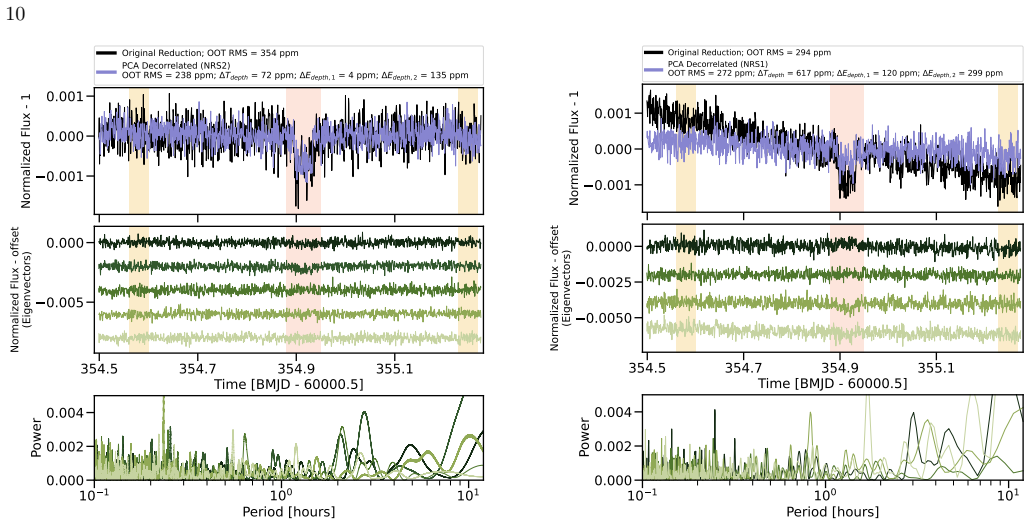
Summary. The paper presents JWST NIRSpec/G395H full-orbit phase-curve observations of the hot rocky super-Earth TOI-1685 b. Three independent data reductions (Eureka!, Tiberius, ExoTIC-JEDI) produce consistent light curves. The transmission spectrum is flat, ruling out clear H2-dominated atmospheres; the emission spectrum is featureless. A strong correlated-noise component (RMS 145-170 ppm, 2-3 times the eclipse depth) is present in both detectors, with different characteristic timescales (4.5 h in NRS1, 2.5 h in NRS2). After unsuccessful attempts to remove this noise, the authors use a prayer-bead analysis to inflate uncertainties. From NRS2 white-light data they derive a dayside brightness-temperature ratio R = 0.98 +/- 0.07 relative to a zero-albedo, no-redistribution blackbody, and conclude that TOI-1685 b is likely a dark, bare rock with no significant atmosphere.
Significance. If correct, the paper adds a new data point to the small sample of M-dwarf rocky planets observed in emission, supporting the cosmic-shoreline hypothesis. The strengths are the three independent reductions, the transparent characterization of correlated noise, and the use of forward models and retrievals to interpret the spectra. The main weakness is that the quantitative R and the no-heat-redistribution interpretation rest on data whose residuals are dominated by correlated noise at a level comparable to the signal; the prayer-bead method expands error bars but does not remove potential bias. The qualitative conclusion of a thin or absent atmosphere is plausible, but the paper's quantitative precision is not yet demonstrated.
major comments (2)
- [§3.2.2, §3.3.2, §4.2.1] The central quantitative claim, R = 0.98 +/- 0.07, is taken from the NRS2 white-light phase curve with prayer-bead uncertainties. The data that enter this fit have residual RMS of 170 ppm (NRS2), 2-3 times the eclipse depth, and full phase-curve eclipse depths are 2-3 sigma larger than eclipse-only fits (§3.2.2). The prayer-bead analysis preserves the residual ordering and refits the same model, so it widens the error bars but does not correct a systematic offset in the eclipse depth. An unmodelled correlated component at the eclipse timescale could shift the eclipse depth by tens of ppm and change R by ~0.1. The authors should provide a test that the eclipse depth is insensitive to the correlated noise, for example by deriving R from the eclipse-only fits for NRS2, by fitting the phase curve with a Gaussian-process or periodic-noise model, or by injecting and recovering synthetic eclipses in the actual residuals. Without such a test, the precision of R is not supported.
- [§4.2.1] The headline R is based on NRS2 alone; NRS1 gives R = 1.10 +/- 0.10 and is discarded because of stronger correlated noise and a linear trend. This is an ad hoc choice, and the paper does not show that the NRS2 value is robust to reasonable alternatives, such as including NRS1 with a more flexible noise model or fitting both detectors jointly. The independent estimate from the low-resolution emission spectrum gives R = 0.94 +/- 0.04 for both detectors, which is formally consistent but not identical to the adopted value. The paper should state explicitly which estimate is adopted for the conclusions, justify that choice, and quantify how much the albedo and heat-redistribution results change if R = 0.94 or R = 1.10 are used instead.
minor comments (6)
- [§3.2.2] The statement that the eclipse depth is 2-3 sigma larger in the full phase-curve fit than in eclipse-only fits is not specified by detector or wavelength; for NRS2 the offset is generally smaller (Table 8). Please quantify for each detector.
- [§3.2.2] The sentence 'they are too deep compared to the maximum expected given the planet's temperature' is ambiguous: the NRS2 full phase-curve eclipse depth corresponds to R = 0.98, i.e., near the maximum expected. Please clarify which detector and which comparison are meant.
- [Abstract, §3.1, Table 2] The NRS2 wavelength range is quoted inconsistently: 3.823-5.172 um in the abstract and §3.1, but 3.850-5.172 um in Table 2. Please harmonize.
- [Figure 5] The legend of Figure 5 is crowded and the symbols overlap; a separate table of the eclipse-depth values (already in Table 8) would make the figure easier to read.
- [§4.2.1] The nightside brightness temperature posteriors extend to zero (e.g., Tp,night = 1100+210-1100 K for NRS1); quoting a 95% upper limit would be more informative.
- [§3.3.2] The sentence describing the prayer-bead procedure is awkward; consider rephrasing: 'For each bead, we shift the residuals by one exposure time, add them to the best-fit model, and refit the new light curve with the same model and priors.'
Circularity Check
No significant circularity: the bare-rock conclusion is derived from measured flux ratios and independent forward-model/retrieval comparisons, not from the model inputs.
full rationale
The central claims of the paper are derived from direct measurements rather than from definitions or fitted parameters that force the conclusion. The brightness temperature ratio R = Tp,day/Tp,max is computed from the observed planet-to-star flux ratio in the phase curve and emission spectrum, converted to temperature with a PHOENIX stellar model; the value 0.98 ± 0.07 for NRS2 could have come out differently (indeed NRS1 gives 1.10 ± 0.10), so it is not constrained by construction. The transmission and emission conclusions are reached by comparing the observed spectra to TauREx and HELIOS forward models using Bayesian evidence; the preference for an airless basalt model over atmospheric models is scored by the data and is not a self-definitional preference. The self-citations, including Zhang et al. (2024), Xue et al. (2024), and Weiner Mansfield et al. (2024), provide methods and comparative context but are not load-bearing: the calculations rely on standard, externally implemented codes (HELIOS, TauREx, PHOENIX, batman) and on stellar parameters from Burt et al. (2024), an independent source. The paper openly flags its main data-quality limitation in Sections 3.2.2 and 3.3.2, noting that the full-phase-curve eclipse depths are 2–3 sigma deeper than eclipse-only fits and that the prayer-bead method inflates uncertainties but does not correct a potential systematic bias. That is a correctness risk, not a circularity: no equation reduces the measured eclipse depth or phase-curve parameters to the bare-rock hypothesis, and the final interpretation is presented as one of several data-driven possibilities consistent with a very low-pressure atmosphere. Overall, the derivation chain is self-contained and the conclusion is not equivalent to the inputs. Consequently, no circular step rises to the level required by the rubric, and the appropriate score is 0.
Assumptions & free parameters
free parameters (6)
- Fp/Fstar (planet-to-star flux ratio) =
NRS1: 103±5 ppm; NRS2: 122±7 ppm (white light, prayer-bead)
- C1 (phase-curve amplitude coefficient) =
NRS1: 0.36±0.21; NRS2: 0.49±0.13
- D1 (phase-curve skew/offset coefficient) =
NRS1: -0.54±0.29; NRS2: -0.05±0.11
- Rp/Rstar (planet-to-star radius ratio) =
NRS1: 0.02801±0.00019; NRS2: 0.02746±0.00021
- c1 (linear trend coefficient for NRS1) =
-0.00181±0.00007
- Stellar spectrum multiplier in brightness-temperature fit =
Gaussian prior with mean 1, sigma 0.03
assumptions (5)
- domain assumption The planet is on a circular orbit (e=0), so the phase-curve model uses a single sinusoid plus transit and two eclipses.
- domain assumption Limb-darkening coefficients are fixed to quadratic values from ExoTIC-LD using stellar parameters from Burt et al. (2024).
- domain assumption The PHOENIX stellar model accurately represents the star's spectrum in the NIRSpec passband, with only a 1% systematic uncertainty.
- standard math The prayer-bead method preserves the correlated-noise structure and yields unbiased uncertainties when residuals are shifted and re-fit.
- ad hoc to paper NRS2 data are more reliable than NRS1 for constraining the phase-curve parameters, because NRS1 shows stronger correlated noise and a linear trend.
Cite this review
Pith. "Pith review of A dark, bare rock for TOI-1685 b from a JWST NIRSpec G395H phase curve." pith.science (2026). https://pith.science/paper/7FLTBRNT
@misc{pith2026241203411,
  author       = {Pith},
  title        = {Pith review of: A dark, bare rock for TOI-1685 b from a JWST NIRSpec G395H phase curve},
  year         = {2026},
  howpublished = {\url{https://pith.science/paper/7FLTBRNT}},
  note         = {Machine review of arXiv:2412.03411}
}
abstract
We report JWST NIRSpec/G395H observations of TOI-1685 b, a hot rocky super-Earth orbiting an M2.5V star, during a full orbit. We obtain transmission and emission spectra of the planet and characterize the properties of the phase curve, including its amplitude and offset. The transmission spectrum rules out clear H$_2$-dominated atmospheres, while secondary atmospheres (made of water, methane, or carbon dioxide) cannot be statistically distinguished from a flat line. The emission spectrum is featureless and consistent with a blackbody-like brightness temperature, helping rule out thick atmospheres with high mean molecular weight. Collecting all evidence, the properties of TOI-1685 b are consistent with a blackbody with no heat redistribution and a low albedo, with a dayside brightness temperature 0.98$\pm$0.07 times that of a perfect blackbody in the NIRSpec NRS2 wavelength range (3.823-5.172 um). Our results add to the growing number of seemingly airless M-star rocky planets, thus constraining the location of the "Cosmic Shoreline". Three independent data reductions have been carried out, all showing a high-amplitude correlated noise component in the white and spectroscopic light curves. The correlated noise properties are different between the NRS1 and NRS2 detectors - importantly the timescales of the strongest components (4.5 hours and 2.5 hours, respectively) - suggesting the noise is from instrumental rather than astrophysical origins. We encourage the community to look into the systematics of NIRSpec for long time-series observations.
Figures


Figures from the paper (14 more)




Forward citations
Cited by 2 Pith papers
-
TOI-421 b: A Hot Sub-Neptune with a Haze-Free, Low Mean Molecular Weight Atmosphere
TOI-421 b, a 920 K sub-Neptune around a Sun-like star, has a clear, hydrogen-dominated, near-solar-metallicity atmosphere with detected water, based on JWST transmission spectroscopy.
-
Population-level Hypothesis Testing with Rocky Planet Emission Data: A Tentative Trend in the Brightness Temperatures of M-Earths
A tentative trend in the brightness temperatures of nine M-Earths suggests hotter planets have darker surfaces or thinner atmospheres, but the statistical evidence depends on the stellar model used.
Reference graph
Works this paper leans on
-
[1]
Akana Murphy, J. M., Luque, R., & Batalha, N. M. 2024, arXiv e-prints, arXiv:2411.02521, doi: 10.48550/arXiv.2411.02521
work page Pith review arXiv doi:10.48550/arxiv.2411.02521 2024
-
[2]
F., Changeat, Q., Venot, O., Waldmann, I
Al-Refaie, A. F., Changeat, Q., Venot, O., Waldmann, I. P., & Tinetti, G. 2022, ApJ, 932, 123, doi: 10.3847/1538-4357/ac6dcd
-
[3]
Al-Refaie, A. F., Changeat, Q., Waldmann, I. P., & Tinetti, G. 2021, ApJ, 917, 37, doi: 10.3847/1538-4357/ac0252
-
[4]
Alderson, L., Wakeford, H. R., MacDonald, R. J., et al. 2022, MNRAS, 512, 4185, doi: 10.1093/mnras/stac661
-
[5]
Alderson, L., Wakeford, H. R., Alam, M. K., et al. 2023, Nature, 614, 664, doi: 10.1038/s41586-022-05591-3
-
[6]
Alderson, L., Batalha, N. E., Wakeford, H. R., et al. 2024, AJ, 167, 216, doi: 10.3847/1538-3881/ad32c9 Astropy Collaboration, Price-Whelan, A. M., Lim, P. L., et al. 2022, ApJ, 935, 167, doi: 10.3847/1538-4357/ac7c74
-
[7]
E., Mandell, A., Pontoppidan, K., et al
Batalha, N. E., Mandell, A., Pontoppidan, K., et al. 2017, PASP, 129, 064501, doi: 10.1088/1538-3873/aa65b0
-
[8]
2022, The Journal of Open Source Software, 7, 4503, doi: 10.21105/joss.04503
Bell, T., Ahrer, E.-M., Brande, J., et al. 2022, The Journal of Open Source Software, 7, 4503, doi: 10.21105/joss.04503
Show all 69 references
-
[9]
2023, Exploring the existence and diversity of volatile-rich water worlds, JWST Proposal
Benneke, B., Mikal-Evans, T., Acuna, L., et al. 2023, Exploring the existence and diversity of volatile-rich water worlds, JWST Proposal. Cycle 2, ID. #4098
2023
- [10]
-
[11]
A., Kempton, E
Bergin, E. A., Kempton, E. M. R., Hirschmann, M., et al. 2023, ApJL, 949, L17, doi: 10.3847/2041-8213/acd377
2023 doi
-
[12]
M., Ferruit, P., Giardino, G., et al
Birkmann, S. M., Ferruit, P., Giardino, G., et al. 2022, A&A, 661, A83, doi: 10.1051/0004-6361/202142592
2022 doi
-
[13]
2021, A&A, 650, A78, doi: 10.1051/0004-6361/202140688
Bluhm, P., Pall´ e, E., Molaverdikhani, K., et al. 2021, A&A, 650, A78, doi: 10.1051/0004-6361/202140688
2021 doi
-
[14]
2019, PASP, 131, 108005, doi: 10.1088/1538-3873/aae7fc —
Buchner, J. 2019, PASP, 131, 108005, doi: 10.1088/1538-3873/aae7fc —. 2021, The Journal of Open Source Software, 6, 3001, doi: 10.21105/joss.03001
2019 doi
-
[15]
A., Hooton, M
Burt, J. A., Hooton, M. J., Mamajek, E. E., et al. 2024, ApJL, 971, L12, doi: 10.3847/2041-8213/ad5b52
2024 doi
-
[16]
2024, JWST Calibration Pipeline, 1.14.0, Zenodo, doi: 10.5281/zenodo.10870758
Bushouse, H., Eisenhamer, J., Dencheva, N., et al. 2024, JWST Calibration Pipeline, 1.14.0, Zenodo, doi: 10.5281/zenodo.10870758
2024 doi
-
[17]
B., & Agol, E
Cowan, N. B., & Agol, E. 2008, ApJL, 678, L129, doi: 10.1086/588553 —. 2011, ApJ, 726, 82, doi: 10.1088/0004-637X/726/2/82
2008 doi
-
[18]
B., Machalek, P., Croll, B., et al
Cowan, N. B., Machalek, P., Croll, B., et al. 2012, The Astrophysical Journal, 747, 82, doi: 10.1088/0004-637X/747/1/82
2012 doi
-
[19]
Crossfield, I. J. M., Malik, M., Hill, M. L., et al. 2022, ApJL, 937, L17, doi: 10.3847/2041-8213/ac886b
2022 doi
-
[20]
2020, The Astrophysical Journal, 898, 160
Essack, Z., Seager, S., & Pajusalu, M. 2020, The Astrophysical Journal, 898, 160
2020
-
[21]
J., Allen, N., et al
Fisher, C., Akin, C. J., Allen, N., et al. 2023, Constraining the Oxidation State of the Super-Earth TOI-1685 b, JWST Proposal. Cycle 2, ID. #4195
2023
-
[22]
2013, emcee: The MCMC Hammer, Astrophysics Source Code Library, record ascl:1303.002
Foreman-Mackey, D., Conley, A., Meierjurgen Farr, W., et al. 2013, emcee: The MCMC Hammer, Astrophysics Source Code Library, record ascl:1303.002
2013
-
[23]
2022, Earth and Planetary Science Letters, 577, 117255
Gaillard, F., Bernadou, F., Roskosz, M., et al. 2022, Earth and Planetary Science Letters, 577, 117255
2022
-
[24]
P., Bell, T
Greene, T. P., Bell, T. J., Ducrot, E., et al. 2023, Nature, 618, 39
2023
-
[25]
1986, PASP, 98, 609, doi: 10.1086/131801
Horne, K. 1986, PASP, 98, 609, doi: 10.1086/131801
1986 doi
-
[26]
L., & Seager, S
Hu, R., Ehlmann, B. L., & Seager, S. 2012, The Astrophysical Journal, 752, 7
2012
-
[27]
2024, Nature, 630, 609
Hu, R., Bello-Arufe, A., Zhang, M., et al. 2024, Nature, 630, 609
2024
-
[28]
O., Wende-von Berg, S., Dreizler, S., et al
Husser, T. O., Wende-von Berg, S., Dreizler, S., et al. 2013, A&A, 553, A6, doi: 10.1051/0004-6361/201219058
2013 doi
-
[29]
2022, A&A, 661, A80, doi: 10.1051/0004-6361/202142663 JWST Transiting Exoplanet Community Early Release Science Team, Ahrer, E.-M., Alderson, L., et al
Jakobsen, P., Ferruit, P., Alves de Oliveira, C., et al. 2022, A&A, 661, A80, doi: 10.1051/0004-6361/202142663 JWST Transiting Exoplanet Community Early Release Science Team, Ahrer, E.-M., Alderson, L., et al. 2023, Nature, 614, 649, doi: 10.1038/s41586-022-05269-w
2022 doi
-
[30]
J., Louden, T., et al
Kirk, J., Wheatley, P. J., Louden, T., et al. 2017, MNRAS, 468, 3907, doi: 10.1093/mnras/stx752
2017 doi
-
[31]
V., MacDonald, R
Kirk, J., Rackham, B. V., MacDonald, R. J., et al. 2021, AJ, 162, 34, doi: 10.3847/1538-3881/abfcd2
2021 doi
-
[32]
B., Fu, G., et al
Kirk, J., Stevenson, K. B., Fu, G., et al. 2024, AJ, 167, 90, doi: 10.3847/1538-3881/ad19df
2024 doi
-
[33]
S., & Barnett, M
Kite, E. S., & Barnett, M. N. 2020, Proceedings of the National Academy of Sciences, 117, 18264
2020
-
[34]
Koll, D. D. 2022, The Astrophysical Journal, 924, 134
2022
-
[35]
C., Triaud, A
Kral, Q., Wyatt, M. C., Triaud, A. H., et al. 2018, Monthly Notices of the Royal Astronomical Society, 479, 2649
2018
-
[36]
2015, PASP, 127, 1161, doi: 10.1086/683602
Kreidberg, L. 2015, PASP, 127, 1161, doi: 10.1086/683602
2015 doi
-
[37]
Kreidberg, L., Koll, D. D. B., Morley, C., et al. 2019, Nature, 573, 87, doi: 10.1038/s41586-019-1497-4
2019 doi
-
[38]
2020, The Journal of Open Source Software, 5, 2281, doi: 10.21105/joss.02281
Laginja, I., & Wakeford, H. 2020, The Journal of Open Source Software, 5, 2281, doi: 10.21105/joss.02281
2020 doi
-
[39]
2023, The Astrophysical Journal Letters, 955, L22
Lim, O., Benneke, B., Doyon, R., et al. 2023, The Astrophysical Journal Letters, 955, L22
2023
-
[40]
Lomb, N. R. 1976, Ap&SS, 39, 447, doi: 10.1007/BF00648343
1976 doi
-
[41]
1971, AJ, 76, 544
Lucy, L., & Sweeney, M. 1971, AJ, 76, 544
1971
-
[42]
2022, Science, 377, 1211, doi: 10.1126/science.abl7164 26
Luque, R., & Pall´ e, E. 2022, Science, 377, 1211, doi: 10.1126/science.abl7164 26
2022 doi
-
[43]
L., Changeat, Q., et al
Luque, R., Bean, J. L., Changeat, Q., et al. 2023, The First Atmospheric Study of a Bona Fide Water World, JWST Proposal. Cycle 2, ID. #3263
2023
-
[44]
M., et al
Lustig-Yaeger, J., Fu, G., May, E. M., et al. 2023, Nature Astronomy, 7, 1317, doi: 10.1038/s41550-023-02064-z
2023 doi
-
[45]
D., Cowan, N
Lyu, X., Koll, D. D., Cowan, N. B., et al. 2024, The Astrophysical Journal, 964, 152
2024
-
[46]
Malik, M., Kempton, E. M. R., Koll, D. D. B., et al. 2019a, ApJ, 886, 142, doi: 10.3847/1538-4357/ab4a05
-
[47]
M., et al
Malik, M., Kitzmann, D., Mendon¸ ca, J. M., et al. 2019b, AJ, 157, 170, doi: 10.3847/1538-3881/ab1084
-
[48]
M., et al
Malik, M., Grosheintz, L., Mendon¸ ca, J. M., et al. 2017, AJ, 153, 56, doi: 10.3847/1538-3881/153/2/56
2017 doi
-
[49]
J., Bennett, K
May, E., MacDonald, R. J., Bennett, K. A., et al. 2023, The Astrophysical Journal Letters, 959, L9
2023
-
[50]
E., Stevenson, K
Moran, S. E., Stevenson, K. B., Sing, D. K., et al. 2023, ApJL, 948, L11, doi: 10.3847/2041-8213/accb9c
2023 doi
-
[51]
A., Brandeker, A., Kitzmann, D., et al
Patel, J. A., Brandeker, A., Kitzmann, D., et al. 2024, A&A, 690, A159, doi: 10.1051/0004-6361/202450748
2024 doi
- [52]
-
[53]
Powell, M. J. D. 1964, The Computer Journal, 7, 155, doi: 10.1093/comjnl/7.2.155
1964 doi
-
[54]
R., Latham, D
Ricker, G. R., Latham, D. W., Vanderspek, R. K., et al. 2010, in American Astronomical Society Meeting
2010
-
[55]
K., Liu, R., & Wang, A
Rustamkulov, Z., Sing, D. K., Liu, R., & Wang, A. 2022, ApJL, 928, L7, doi: 10.3847/2041-8213/ac5b6f
2022 doi
-
[56]
K., Mukherjee, S., et al
Rustamkulov, Z., Sing, D. K., Mukherjee, S., et al. 2023, Nature, 614, 659, doi: 10.1038/s41586-022-05677-y
2023 doi
-
[57]
Scargle, J. D. 1982, ApJ, 263, 835, doi: 10.1086/160554
1982 doi
-
[58]
Speagle, J. S. 2020, MNRAS, 493, 3132, doi: 10.1093/mnras/staa278 STScI Development Team. 2013, pysynphot: Synthetic photometry software package, Astrophysics Source Code Library, record ascl:1303.023
2020 doi
-
[59]
2024, Reflectance and Emission Modelling of Airless Exoplanets, Tech
Kreidberg, L. 2024, Reflectance and Emission Modelling of Airless Exoplanets, Tech. rep., Copernicus Meetings
2024
-
[60]
2008, Contemporary Physics, 49, 71, doi: 10.1080/00107510802066753
Trotta, R. 2008, Contemporary Physics, 49, 71, doi: 10.1080/00107510802066753
2008 doi
-
[61]
K., Diamond-Lowe, H., et al
Wachiraphan, P., Berta-Thompson, Z. K., Diamond-Lowe, H., et al. 2024, arXiv e-prints, arXiv:2410.10987, doi: 10.48550/arXiv.2410.10987
2024 doi
-
[62]
L., Batalha, N
Wallack, N. L., Batalha, N. E., Alderson, L., et al. 2024, AJ, 168, 77, doi: 10.3847/1538-3881/ad3917 Weiner Mansfield, M., Xue, Q., Zhang, M., et al. 2024, No Thick Atmosphere on the Terrestrial Exoplanet Gl 486b, doi: 10.3847/2041-8213/ad8161
2024 doi
-
[63]
A., Malik, M., Ih, J., et al
Whittaker, E. A., Malik, M., Ih, J., et al. 2022, The Astronomical Journal, 164, 258
2022
-
[64]
L., Zhang, M., et al
Xue, Q., Bean, J. L., Zhang, M., et al. 2024, ApJL, 973, L8, doi: 10.3847/2041-8213/ad72e9
2024 doi
-
[65]
J., & Catling, D
Zahnle, K. J., & Catling, D. C. 2017, The Astrophysical Journal, 843, 122
2017
-
[66]
D., & Jacobsen, S
Zeng, L., Sasselov, D. D., & Jacobsen, S. B. 2016, ApJ, 819, 127, doi: 10.3847/0004-637X/819/2/127
2016 doi
-
[67]
2024, The Astrophysical Journal Letters, 961, L44
Zhang, M., Hu, R., Inglis, J., et al. 2024, The Astrophysical Journal Letters, 961, L44
2024
-
[68]
2022, A&A, 664, A79, doi: 10.1051/0004-6361/202142912
Zieba, S., Zilinskas, M., Kreidberg, L., et al. 2022, A&A, 664, A79, doi: 10.1051/0004-6361/202142912
2022 doi
-
[69]
2023, Nature, 620, 746, doi: 10.1038/s41586-023-06232-z
Zieba, S., Kreidberg, L., Ducrot, E., et al. 2023, Nature, 620, 746, doi: 10.1038/s41586-023-06232-z
2023 doi
Reviewed August 11, 2026 · model on record in the stance chip above.
Discussion (0). Continue with ORCID to comment.