REVIEW 3 major objections 4 minor 89 references
Direct Deflection of Millicharged Radiation
T0 review · 3 major / 4 minor · reviewed 2026-08-11 · deepseek-v4-flash
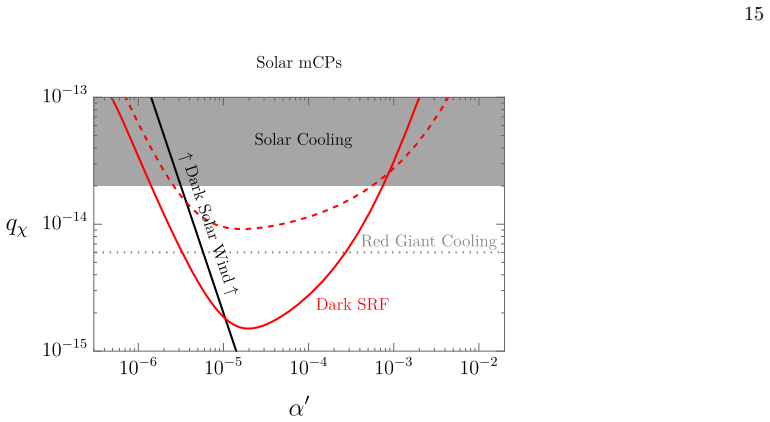
Pith's one-line read A light-shining-through-wall cavity pair can also operate as a direct-deflection detector for a relativistic background of millicharged particles, with a future Dark SRF run probing unexplored parameter space.
desk verdict Existing SRF light-shining-through-wall cavities can plausibly double as direct-deflection detectors for relativistic millicharged radiation; the physics is sound, but the reach curves rest on an unverified mode-overlap factor. read the letter →
The pith
A machine-rendered reading of the paper's core claim, the machinery that carries it, and where it could break.
The reading
What carries the argument
The engine is the plasma linear-response tensor $\widetilde{\Pi}^{\mu\nu}(k)$ of an ultrarelativistic, collisionless, weakly coupled $\chi^\pm$ plasma, derived from the Vlasov equation and decomposed into longitudinal and transverse parts; its poles define the plasma dispersion relations and its static limit gives Debye screening. The deflector current is chosen as a shielded, sinusoidal capacitor-like source $\sim e^{-z^2/L_{\rm def}^2}\cos(x/L_{\rm def})\cos(y/L_{\rm def})$, which approximately reproduces a TM010 cavity mode. The induced millicurrent is fitted by $|J_\chi| \sim a_\gamma (E_{\rm def}/L_{\rm def}) \min(\tilde{\omega}_p L_{\rm def},\,1,\,b_\gamma \gamma/\tilde{\omega}_p L_{\rm def})^2$, and for a dark-photon mediator the substitutions $\tilde{\omega}_p\to\tilde{\omega}_p'$ and $J_\chi\to\epsilon^2 J_\chi$ convert this into the visible current. The detector power is $P_{\rm sig}=(Q/\omega_{\rm def})\eta^2 |J_\chi|^2 V_{\rm det}$, with a mode-overlap factor $\eta=1$ assumed.
What would settle it
Run a future Dark SRF apparatus at the assumed upgraded parameters, $Q=10^{12}$, $E_{\rm def}=60$ MV/m, $\sim 1$ m$^3$ cavities, and one year at 10 mK, and look for the power excess predicted for the dark solar wind, a millicharged cosmic neutrino background, and $\Omega_{\rm DR}\gtrsim 10^{-4}$ thermal dark radiation; no excess at the level of $|J_\chi|\sim 3\times 10^{-24}$ A/m$^2$ would falsify the claimed reach. A separate check is to measure the induced current from a real TM$_{010}$ deflector with an independently known millicharge density and compare the extracted overlap factor to the assumed perfect value.
Extended reading notes
Core claim
The paper's central claim is that a two-cavity light-shining-through-wall apparatus, originally designed to create and detect dark photons, can be repurposed as a direct-deflection detector for an ambient relativistic population of millicharged particles. In this mode, the driven deflector cavity imprints an oscillating deflection on the passing millicharged plasma; the resulting charge and current perturbations, described by the linear response of an ultrarelativistic collisionless plasma, propagate out of the deflector and resonantly drive the TM010 mode of the nearby shielded detector cavity. For cavity frequencies matched to the inverse cavity size, the induced current is maximized and, unlike the quasistatic LC-circuit version of the idea, does not require relative motion between the laboratory and the plasma. Applying this to Dark SRF, the paper projects sensitivity to millicharges from the dark solar wind, from dark matter decay or annihilation, from dark energy, and from the cosmic neutrino background, down to energy densities of order $10^{-4}$ of the CMB.
Load-bearing premise
The projections assume the induced dark-current pattern couples to the detector cavity with perfect efficiency and that the dark-photon-mediated response is just the photon response with rescaled couplings; if either assumption proves too optimistic by a factor of ten, the claimed reach shrinks by roughly a factor of one hundred.
Editorial extensions
If this is right
- Future versions of Dark SRF could probe orders of magnitude of unexplored parameter space for millicharges produced in the Sun as a dark solar wind.
- The same setup could detect a cosmic neutrino background whose lightest neutrino carries a small effective millicharge, or a cosmic neutrino background that has equilibrated with a light millicharged sector.
- Cosmological dark radiation with energy density as small as about $10^{-4}$ of the CMB would be visible through this mechanism.
- Optimal operation occurs at $\omega_{\rm def}\sim L_{\rm def}^{-1}$, so RF cavities, unlike quasistatic LC circuits, work even with no relative wind between the laboratory and the plasma.
- The signal grows quadratically with the millicharge plasma frequency, so thermalized, low-energy, high-density dark radiation is much easier to see than a free-streaming population of the same luminosity.
Reading between the lines
- If the central claim is right, any existing two-cavity light-shining-through-wall apparatus is already a millicharge-radiation telescope; re-analyzing archival noise data from Dark SRF pathfinder-like runs could place immediate bounds without hardware changes.
- The paper leaves the perfect mode-overlap and the dark-photon substitution unchecked; a first-principles two-fluid calculation or a full-cavity simulation would either confirm the reach or move the quoted contours, and this is the cleanest next step before committing to the upgrade.
- The scaling with inverse particle energy suggests that non-thermal, high-occupancy low-momentum populations, for example from parametric resonance or tachyonic instability, would produce disproportionately large signals, making direct-deflection searches a natural probe of those production mechanisms.
- The paper mentions multiple deflecting cavities only briefly; if pursued as a LINAC-like array, the signal would multiply and the experiment could become a purpose-built millicharged-radiation detector rather than an inadvertent one.
Editorial analysis
A structured set of objections, weighed in public.
Referee Report
Summary. This paper proposes that light-shining-through-wall experiments with superconducting RF cavities, such as Dark SRF, can operate as "direct deflection" detectors for a relativistic background of millicharged particles. The authors model the millicharged background as an ultrarelativistic collisionless plasma, compute its linear response to a driven cavity field using a Vlasov formalism (Appendix A), obtain the induced current in the plasma (Eqs. 13 and 14), and estimate the power resonantly deposited in a nearby shielded cavity (Eq. 15). They apply this formalism to the dark solar wind of Ref. [31] and to cosmological dark radiation, including the cosmic neutrino background, and project that future Dark SRF can probe orders of magnitude of unexplored parameter space, including dark radiation with energy density as small as about 10^-4 of the CMB.
Significance. If the quantitative estimates survive scrutiny, this is a valuable proposal: it would turn existing and future RF-cavity LSW experiments into accidental detectors for several classes of dark radiation, with reach beyond current stellar bounds for light millicharged particles. The Vlasov derivation in Appendix A is standard and clearly presented; the numerical response is checked for charge continuity; and the discussion of the physical regimes (weak backreaction, on-shell plasmons, Debye screening) is illuminating. However, the headline reach depends on three asserted O(1) factors: the unit mode-overlap η in Eq. (15), the O(1) fidelity of the idealized infinite periodic source in Eq. (11), and the replacement rule used to obtain the dark-photon response in Eq. (14). Because the reach scales as η^2 and as the square of the induced current, these assumptions are load-bearing for the central claim.
major comments (3)
- [Sec. III C, Eq. (15)] The signal power is written as Psig=(Q/ω) η^2 |Jχ|^2 Vdet and the value η=1 is adopted without computing the overlap integral. The induced current from the source in Eq. (11) has a transverse profile cos(x/Ldef)cos(y/Ldef), while the TM010 mode has a Bessel-function profile J0(2.4ρ/R) (Eq. C11); these profiles are not obviously matched. Since all projected reaches in Figs. 5 and 6 scale as η^2, an order-of-magnitude error in η translates directly into a corresponding shrinkage of the claimed parameter space. An explicit overlap integral over the finite detector volume is required.
- [Sec. III B, Eq. (14)] The dark-photon response is obtained by asserting the replacements ωp→ω'p and Jχ→ε^2 Jχ in the visible-only result. This is not derived from the coupled Vlasov/Maxwell system for the SM photon and the dark photon. In particular, the dark-sector plasma frequency ω'p appears in the A' propagator, and the visible current is generated only after kinetic mixing; the replacement rule assumes that no O(1) form-factor or resonance effects arise from the A' dynamics. Since Eq. (14) is used for every projected limit, a two-fluid derivation, or at least a controlled approximation with explicit validity conditions, is needed.
- [Sec. III B, Eq. (11) and Fig. 2] The idealized deflector source is infinite and periodic in the transverse plane, and the paper argues O(1) fidelity to real cavity modes because the fields are "qualitatively similar" within |x|<~Ldef. This does not establish that the induced current Jχ in a real finite cavity is reproduced to O(1): source regions outside the cavity aperture contribute coherently in the infinite periodic model, and the transverse phase variation of the traveling current over the detector volume affects the overlap in Eq. (15). A finite-source computation, or at least a quantitative comparison of the induced current for a truncated source, is needed to support the claimed O(1) accuracy.
minor comments (4)
- [Sec. II, after Fig. 1] The manuscript contains a block of unrelated text about a Cavendish-shell millicharged-particle trap, including duplicated passages and references [1]-[4] that do not match the paper's bibliography. This material must be removed and the reference list renumbered.
- [Sec. III B, Eq. (13)] The fitting coefficients aγ and bγ are introduced without stating whether the fits are used for the projected reach and how the unmodeled resonance near ωp ~ γ ωdef is treated; please state explicitly whether the reach curves are based on the fit and whether the fit is conservative in the resonance region.
- [Sec. III C, Eq. (15)] The symbol Jχ is used both for the current vector and for its characteristic amplitude in Eq. (15); please use distinct notation for the two quantities.
- [Sec. IV, Fig. 5] The assumption that the cavity axis is aligned with the Earth-Sun axis should be listed explicitly in the caption of Fig. 5, since the dark solar wind signal is directional and the reach depends on this alignment.
Circularity Check
No significant circularity: the reach estimates follow from a Vlasov-based plasma calculation plus explicit experimental assumptions, with no prediction reducing to its own inputs.
full rationale
The derivation chain is self-contained: the linear response tensor is derived from the Vlasov equation in Appendix A, the induced plasma current is obtained numerically by solving Maxwell's equations in Sec. III B and Appendix B, and the signal power and sensitivity thresholds in Eqs. 15 and 16 are definitions/conversions rather than fits to the target signal. Equation 13 is explicitly labeled a 'simple fitting formula' with coefficients a_gamma and b_gamma matched to the authors' own numerical results, so it is a surrogate for the first-principles computation, not a fit to experimental data or to the Dark SRF reach. The dark solar wind parameters in Eqs. 18-19 are quoted from Ref. [31], which shares authors with this paper, but that source is an independently published, externally falsifiable model whose parameters are inputs rather than restatements of the present result; under the review rules this citation does not constitute circularity. The main approximations--the unit mode-overlap factor eta=1 and the infinite transverse extent of the deflector current in Eq. 11--are acknowledged O(1) estimates that affect the numerical reach, but they are correctness risks, not reductions of the prediction to its inputs.
Assumptions & free parameters
free parameters (3)
- mode overlap form factor eta =
1
- fit coefficients a_gamma, b_gamma of Eq 13 =
a_gamma=10^-2, b_gamma=1 (gamma~1); a_gamma=1, b_gamma=10^-2 (gamma>>1)
- deflector frequency =
omega_def = 2.4 / L_def
assumptions (5)
- standard math The Vlasov equation and hard-thermal-loop polarization tensor give the correct linear response of an ultrarelativistic pair plasma.
- domain assumption The millicharged background is a homogeneous, isotropic, collisionless, weak-field ultrarelativistic plasma in its rest frame.
- domain assumption The dark solar wind model of Ref [31] correctly predicts the local parameters (gamma~893, T_chi~10^-4 eV, n_chi~150 cm^-3) at Earth.
- ad hoc to paper For a kinetically mixed dark photon, the visible response is obtained by replacing the plasma frequency and current as in Eq 14.
- ad hoc to paper The idealized deflector source of Eq 11 is a faithful proxy for the driven RF cavity mode to O(1) accuracy.
Cite this review
Pith. "Pith review of Direct Deflection of Millicharged Radiation." pith.science (2026). https://pith.science/paper/ERFDJ2FI
@misc{pith2026241203643,
  author       = {Pith},
  title        = {Pith review of: Direct Deflection of Millicharged Radiation},
  year         = {2026},
  howpublished = {\url{https://pith.science/paper/ERFDJ2FI}},
  note         = {Machine review of arXiv:2412.03643}
}
abstract
Millicharged particles are generic in theories of dark sectors. A cosmic or local abundance of them may be produced by the early universe, stellar environments, or the decay or annihilation of dark matter/dark energy. Furthermore, if such particles are light, these production channels result in a background of millicharged radiation. We show that light-shining-through-wall experiments employing superconducting RF cavities can also be used as ``direct deflection" experiments to search for this relativistic background. The millicharged plasma is first subjected to an oscillating electromagnetic field of a driven cavity, which causes charge separation in the form of charge and current perturbations. In turn, these perturbations can propagate outwards and resonantly excite electromagnetic fields in a well-shielded cavity placed nearby, enabling detection. We estimate that future versions of the existing Dark SRF experiment can probe orders of magnitude of currently unexplored parameter space, including millicharges produced from the Sun, the cosmic neutrino background, or other mechanisms that generate a thermal abundance with energy density as small as $\sim 10^{-4}$ that of the cosmic microwave background.
Figures


Figures from the paper (2 more)

Reference graph
Works this paper leans on
-
[31]
A. Romanenko, A. Grassellino, A. C. Crawford, D. A. Sergatskov, and O. Melnychuk, “Ultra-high quality factors in superconducting niobium cavities in ambient magnetic fields up to 190 mG,” Appl. Phys. Lett.105 (2014) 234103, arXiv:1410.7877 [physics.acc-ph]
arXiv 2014
-
[1]
Isotropic, Ultrarelativistic, Collisionless Plasma In the rest frame of the plasma, we take it be isotropic. In this case, the spatial part of the linear response tensor ˜Πij can be decomposed into its longitudinal and transverse components, ˜ΠL (ω, |k|) = − kikj |k|2 ˜Πij(k) (A1) ˜ΠT (ω, |k|) = 1 2 ηij + kikj |k|2 ˜Πij(k) , (A2) as follows [44] ˜Πij(k) =...
-
[2]
Vlasov Derivation of the Linear Response T ensor of Ultrarelativistic Pair-Plasma The induced currents J µ χ (x) in a plasma of ±eqχ charged plasma particles χ± can be expressed in terms of its distribution functions f±(x, p) [44, 45] J µ χ (x) = 2eqχ Z d3p (2π)3 pµ p · u [f+(x, p) − f−(x, p)] = 2eqχ Z d3p (2π)3 pµ p · u [δf+(x, p) − δf−(x, p)] , (A12) wh...
-
[3]
7), one needs to pick a gauge
Solving Maxwell’s Equations in Coulomb Gauge In order to invert the Fourier-transformed Maxwell’s equations in the plasma frame (Eq. 7), one needs to pick a gauge. In this paper, we adopt Coulomb gauge ki ˜Ai(k) = 0 . (A22) Maxwell’s equations then reduce to |k|2 − ˜Π00 ˜A0(k) − ˜Π0i ˜Ai(k) = ˜J 0 def (k) (A23) kiω − ˜Πi0 ˜A0(k) − k2ηij + ˜Πij ˜Aj(k) = ˜J...
-
[4]
δ kx − L−1 def + δ kx + L−1 def 2 #
Zero Wind V elocity Here, we derive the expressions for the induced currents J µ χ in the absence of a plasma wind in the laboratory frame, γ = 1. The Fourier-transformed deflector currents are J 0 def (k) = (−kz) i4π7/2Jdef L2 defe− (kz)2 L2 def 4 ∆γ=1(k) (B1) J z def (k) = (−ωdef) i4π7/2Jdef L2 defe− (kz)2 L2 def 4 ∆γ=1(k) , (B2) where ∆γ=1(k) =δ (ω − ω...
-
[5]
δ kx − L−1 def + δ kx + L−1 def 2 #
Non-zero Wind V elocity Above, we have adopted the notation where the presence (absence) of a tilde on a function indicates that the function including its argumentis evaluated in the plasma (laboratory) frame. In this subsection only, to keep expressions concise we abuse this notation by sometimes writing lab-frame quantities as functions of plasma-frame...
-
[6]
The boundary between the two regimes becomes less trivial when the deflector is not at rest in the plasma frame
Regimes of Plasma Response It is well known that an oscillating deflector at rest in the plasma frame either excites on-shell, propagating plasma waves or gets Debye shielded, depending on whether its frequency is above or below the plasma frequency ˜ωp [40, 83]. The boundary between the two regimes becomes less trivial when the deflector is not at rest i...
-
[7]
G. G. Raffelt, Stars as laboratories for fundamental physics: The astrophysics of neutrinos, axions, and other weakly interacting particles. 5, 1996
1996
Show all 89 references
-
[8]
Ultralight millicharged dark matter via misalignment,
Z. Bogorad and N. Toro, “Ultralight millicharged dark matter via misalignment,” JHEP 07 (2022) 035, arXiv:2112.11476 [hep-ph]
2022 arXiv
-
[9]
Diffuse Axion Background,
J. Eby and V. Takhistov, “Diffuse Axion Background,” arXiv:2402.00100 [hep-ph]
-
[10]
Spectra of axions emitted from main sequence stars,
N. H. Nguyen, E. H. Tanin, and M. Kamionkowski, “Spectra of axions emitted from main sequence stars,” JCAP 11 (2023) 091, arXiv:2307.11216 [hep-ph]
2023 arXiv
-
[11]
Supernova signals of light dark matter,
W. DeRocco, P. W. Graham, D. Kasen, G. Marques-Tavares, and S. Rajendran, “Supernova signals of light dark matter,” Phys. Rev. D100 no. 7, (2019) 075018, arXiv:1905.09284 [hep-ph]
2019 arXiv
-
[12]
How Massless Neutrinos Affect the Cosmic Microwave Background Damping Tail,
Z. Hou, R. Keisler, L. Knox, M. Millea, and C. Reichardt, “How Massless Neutrinos Affect the Cosmic Microwave Background Damping Tail,” Phys. Rev. D87 (2013) 083008, arXiv:1104.2333 [astro-ph.CO]
2013 arXiv
-
[13]
Phases of New Physics in the CMB,
D. Baumann, D. Green, J. Meyers, and B. Wallisch, “Phases of New Physics in the CMB,” JCAP 01 (2016) 007, arXiv:1508.06342 [astro-ph.CO]
2016 arXiv
-
[14]
BBN And The CMB Constrain Light, Electromagnetically Coupled WIMPs,
K. M. Nollett and G. Steigman, “BBN And The CMB Constrain Light, Electromagnetically Coupled WIMPs,” Phys. Rev. D 89 no. 8, (2014) 083508, arXiv:1312.5725 [astro-ph.CO]
2014 arXiv
-
[15]
BBN And The CMB Constrain Neutrino Coupled Light WIMPs,
K. M. Nollett and G. Steigman, “BBN And The CMB Constrain Neutrino Coupled Light WIMPs,” Phys. Rev. D91 no. 8, (2015) 083505, arXiv:1411.6005 [astro-ph.CO]
2015 arXiv
-
[16]
Cosmological Parameter Estimation with a Joint-Likelihood Analysis of the Cosmic Microwave Background and Big Bang Nucleosynthesis,
C. Giovanetti, M. Lisanti, H. Liu, S. Mishra-Sharma, and J. T. Ruderman, “Cosmological Parameter Estimation with a Joint-Likelihood Analysis of the Cosmic Microwave Background and Big Bang Nucleosynthesis,” arXiv:2408.14531 [astro-ph.CO]
-
[17]
Experimental Tests of the Invisible Axion,
P. Sikivie, “Experimental Tests of the Invisible Axion,” Phys. Rev. Lett.51 (1983) 1415–1417. [Erratum: Phys.Rev.Lett. 52, 695 (1984)]
1983
-
[18]
A Practical Laboratory Detector for Solar Axions,
K. van Bibber, P. M. McIntyre, D. E. Morris, and G. G. Raffelt, “A Practical Laboratory Detector for Solar Axions,” Phys. Rev. D 39 (1989) 2089
1989
-
[19]
Helioscope Bounds on Hidden Sector Photons,
J. Redondo, “Helioscope Bounds on Hidden Sector Photons,” JCAP 07 (2008) 008, arXiv:0801.1527 [hep-ph]
2008 arXiv
-
[20]
Helioscope for gravitationally bound millicharged particles,
A. Berlin and K. Schutz, “Helioscope for gravitationally bound millicharged particles,” Phys. Rev. D105 no. 9, (2022) 095012, arXiv:2111.01796 [hep-ph]
2022 arXiv
-
[21]
Towards a new generation axion helioscope,
I. G. Irastorza et al., “Towards a new generation axion helioscope,” JCAP 06 (2011) 013, arXiv:1103.5334 [hep-ex]
2011 arXiv
-
[22]
New CAST Limit on the Axion-Photon Interaction,
CAST Collaboration, V. Anastassopoulos et al., “New CAST Limit on the Axion-Photon Interaction,” Nature Phys. 13 (2017) 584–590, arXiv:1705.02290 [hep-ex]
2017 arXiv
-
[23]
Signatures of Dark Radiation in Neutrino and Dark Matter Detectors,
Y. Cui, M. Pospelov, and J. Pradler, “Signatures of Dark Radiation in Neutrino and Dark Matter Detectors,” Phys. Rev. D 97 no. 10, (2018) 103004, arXiv:1711.04531 [hep-ph]
2018 arXiv
-
[24]
Terrestrial probes of electromagnetically interacting dark radiation,
J.-L. Kuo, M. Pospelov, and J. Pradler, “Terrestrial probes of electromagnetically interacting dark radiation,” Phys. Rev. D 103 no. 11, (2021) 115030, arXiv:2102.08409 [hep-ph]
2021 arXiv
-
[25]
Cosmic axion background,
J. A. Dror, H. Murayama, and N. L. Rodd, “Cosmic axion background,” Phys. Rev. D103 no. 11, (2021) 115004, arXiv:2101.09287 [hep-ph]. [Erratum: Phys.Rev.D 106, 119902 (2022)]
2021 arXiv
-
[26]
Search for a Dark-Matter-Induced Cosmic Axion Background with ADMX,
ADMX Collaboration, T. Nitta et al., “Search for a Dark-Matter-Induced Cosmic Axion Background with ADMX,” Phys. Rev. Lett.131 no. 10, (2023) 101002, arXiv:2303.06282 [hep-ex]. 29
2023 arXiv
-
[27]
Two U(1)’s and Epsilon Charge Shifts,
B. Holdom, “Two U(1)’s and Epsilon Charge Shifts,” Phys. Lett. B166 (1986) 196–198
1986
-
[28]
Directly Deflecting Particle Dark Matter,
A. Berlin, R. T. D’Agnolo, S. A. R. Ellis, P. Schuster, and N. Toro, “Directly Deflecting Particle Dark Matter,” Phys. Rev. Lett. 124 no. 1, (2020) 011801, arXiv:1908.06982 [hep-ph]
2020 arXiv
-
[29]
Parametrically enhanced hidden photon search,
P. W. Graham, J. Mardon, S. Rajendran, and Y. Zhao, “Parametrically enhanced hidden photon search,” Phys. Rev. D90 no. 7, (2014) 075017, arXiv:1407.4806 [hep-ph]
2014 arXiv
-
[30]
Search for Dark Photons with Superconducting Radio Frequency Cavities,
A. Romanenko et al., “Search for Dark Photons with Superconducting Radio Frequency Cavities,” Phys. Rev. Lett.130 no. 26, (2023) 261801, arXiv:2301.11512 [hep-ex]
2023 arXiv
-
[32]
Signals of millicharged dark matter in light-shining-through-wall experiments,
A. Berlin, R. Tito D’Agnolo, S. A. R. Ellis, and J. I. Radkovski, “Signals of millicharged dark matter in light-shining-through-wall experiments,” JHEP 08 (2023) 017, arXiv:2305.05684 [hep-ph]
2023 arXiv
-
[33]
Searching for Millicharged Particles with Superconducting Radio-Frequency Cavities,
A. Berlin and A. Hook, “Searching for Millicharged Particles with Superconducting Radio-Frequency Cavities,” Phys. Rev. D 102 no. 3, (2020) 035010, arXiv:2001.02679 [hep-ph]
2020 arXiv
-
[34]
Minicharged Particles from the Sun: A Cutting-Edge Bound,
N. Vinyoles and H. Vogel, “Minicharged Particles from the Sun: A Cutting-Edge Bound,” JCAP 03 (2016) 002, arXiv:1511.01122 [hep-ph]
2016 arXiv
-
[35]
New bounds on light millicharged particles from the tip of the red-giant branch,
A. Fung, S. Heeba, Q. Liu, V. Muralidharan, K. Schutz, and A. C. Vincent, “New bounds on light millicharged particles from the tip of the red-giant branch,” Phys. Rev. D109 no. 8, (2024) 083011, arXiv:2309.06465 [hep-ph]
2024 arXiv
-
[36]
Aspects of Debye shielding,
N. Meyer-Vernet, “Aspects of Debye shielding,” American Journal of Physics61 no. 3, (03, 1993) 249–257, https://pubs.aip.org/aapt/ajp/article-pdf/61/3/249/12179178/249 1 online.pdf. https://doi.org/10.1119/1.17300
1993 doi
-
[37]
Dark Solar Wind,
J. H. Chang, D. E. Kaplan, S. Rajendran, H. Ramani, and E. H. Tanin, “Dark Solar Wind,” Phys. Rev. Lett.129 no. 21, (2022) 211101, arXiv:2205.11527 [hep-ph]
2022 arXiv
-
[38]
Field Theoretic Description of Ultrarelativistic Electron-Positron Plasmas,
M. H. Thoma, “Field Theoretic Description of Ultrarelativistic Electron-Positron Plasmas,” Rev. Mod. Phys.81 (2009) 959–968, arXiv:0801.0956 [physics.plasm-ph]
2009 arXiv
-
[39]
Physical kinetics,
E. Lifschitz and L. Pitajewski, “Physical kinetics,” in Textbook of theoretical physics. 10. 1983
1983
-
[40]
The Quark gluon plasma: Collective dynamics and hard thermal loops,
J.-P. Blaizot and E. Iancu, “The Quark gluon plasma: Collective dynamics and hard thermal loops,” Phys. Rept. 359 (2002) 355–528, arXiv:hep-ph/0101103
2002 arXiv
-
[41]
Damping rate of a hard photon in a relativistic plasma,
M. H. Thoma, “Damping rate of a hard photon in a relativistic plasma,” Phys. Rev. D51 (1995) 862–865, arXiv:hep-ph/9405309
1995 arXiv
-
[42]
KINETIC THEORY APPROACH TO QUARK - GLUON PLASMA OSCILLATIONS,
S. Mrowczynski, “KINETIC THEORY APPROACH TO QUARK - GLUON PLASMA OSCILLATIONS,” Phys. Rev. D 39 (1989) 1940–1946
1989
-
[43]
The Electrical conductivity in the early universe,
G. Baym and H. Heiselberg, “The Electrical conductivity in the early universe,” Phys. Rev. D56 (1997) 5254–5259, arXiv:astro-ph/9704214
1997 arXiv
-
[44]
On the electronmagnetic properties of a relativistic plasma,
V. P. Silin, “On the electronmagnetic properties of a relativistic plasma,” Sov. Phys. JETP11 no. 5, (1960) 1136–1140
1960
-
[45]
Collective Excitations in a Hot Quark Gluon Plasma,
V. V. Klimov, “Collective Excitations in a Hot Quark Gluon Plasma,” Sov. Phys. JETP55 (1982) 199–204
1982
-
[46]
Covariant Calculations at Finite Temperature: The Relativistic Plasma,
H. A. Weldon, “Covariant Calculations at Finite Temperature: The Relativistic Plasma,” Phys. Rev. D26 (1982) 1394
1982
-
[47]
Classical transport theory and hard thermal loops in the quark - gluon plasma,
P. F. Kelly, Q. Liu, C. Lucchesi, and C. Manuel, “Classical transport theory and hard thermal loops in the quark - gluon plasma,” Phys. Rev. D50 (1994) 4209–4218, arXiv:hep-ph/9406285
1994 arXiv
-
[48]
Deriving the hard thermal loops of QCD from classical transport theory,
P. F. Kelly, Q. Liu, C. Lucchesi, and C. Manuel, “Deriving the hard thermal loops of QCD from classical transport theory,” Phys. Rev. Lett.72 (1994) 3461–3463, arXiv:hep-ph/9403403
1994 arXiv
-
[49]
Kinetic equations for long wavelength excitations of the quark - gluon plasma,
J. P. Blaizot and E. Iancu, “Kinetic equations for long wavelength excitations of the quark - gluon plasma,” Phys. Rev. Lett. 70 (1993) 3376–3379, arXiv:hep-ph/9301236
1993 arXiv
-
[50]
D. B. Melrose, Quantum plasmadynamics: unmagnetized plasmas, vol. 735. Springer, 2008
2008
-
[51]
Dynamic Debye Screening for a Heavy Anti-quark Pair Traversing a Quark - Gluon Plasma,
M. C. Chu and T. Matsui, “Dynamic Debye Screening for a Heavy Anti-quark Pair Traversing a Quark - Gluon Plasma,” Phys. Rev. D39 (1989) 1892. 30
1989
-
[52]
Wakes in the quark-gluon plasma,
P. Chakraborty, M. G. Mustafa, and M. H. Thoma, “Wakes in the quark-gluon plasma,” Phys. Rev. D74 (2006) 094002, arXiv:hep-ph/0606316
2006 arXiv
-
[53]
Hill, Electromagnetic Fields in Cavities: Deterministic and Statistical Theories
D. Hill, Electromagnetic Fields in Cavities: Deterministic and Statistical Theories. Wiley/IEEE Press, Piscataway, NJ, 2009-09-21, 2009
2009
-
[54]
Tip of the Red Giant Branch Bounds on the Axion-Electron Coupling Revisited,
M. T. Dennis and J. Sakstein, “Tip of the Red Giant Branch Bounds on the Axion-Electron Coupling Revisited,” arXiv:2305.03113 [hep-ph]
-
[55]
Astrophysical Axion Bounds: The 2024 Edition,
A. Caputo and G. Raffelt, “Astrophysical Axion Bounds: The 2024 Edition,” PoS COSMICWISPers (2024) 041, arXiv:2401.13728 [hep-ph]
2024 arXiv
-
[56]
Light(ly)-coupled Dark Matter in the keV Range: Freeze-In and Constraints,
J. H. Chang, R. Essig, and A. Reinert, “Light(ly)-coupled Dark Matter in the keV Range: Freeze-In and Constraints,” JHEP 03 (2021) 141, arXiv:1911.03389 [hep-ph]
2021
-
[57]
Planck 2018 results. VI. Cosmological parameters,
Planck Collaboration, N. Aghanim et al., “Planck 2018 results. VI. Cosmological parameters,” Astron. Astrophys.641 (2020) A6, arXiv:1807.06209 [astro-ph.CO]. [Erratum: Astron.Astrophys. 652, C4 (2021)]
2020 arXiv
-
[58]
The Atacama Cosmology Telescope: DR4 Maps and Cosmological Parameters,
ACT Collaboration, S. Aiola et al., “The Atacama Cosmology Telescope: DR4 Maps and Cosmological Parameters,” JCAP 12 (2020) 047, arXiv:2007.07288 [astro-ph.CO]
2020 arXiv
-
[59]
Interacting radiation after Planck and its implications for the Hubble Tension,
N. Blinov and G. Marques-Tavares, “Interacting radiation after Planck and its implications for the Hubble Tension,” JCAP 09 (2020) 029, arXiv:2003.08387 [astro-ph.CO]
2020 arXiv
-
[60]
Making dark matter out of light: freeze-in from plasma effects,
C. Dvorkin, T. Lin, and K. Schutz, “Making dark matter out of light: freeze-in from plasma effects,” Phys. Rev. D99 no. 11, (2019) 115009, arXiv:1902.08623 [hep-ph]. [Erratum: Phys.Rev.D 105, 119901 (2022)]
2019 arXiv
-
[61]
Millicharged relics reveal massless dark photons,
A. Berlin, J. A. Dror, X. Gan, and J. T. Ruderman, “Millicharged relics reveal massless dark photons,” JHEP 05 (2023) 046, arXiv:2211.05139 [hep-ph]
2023 arXiv
-
[62]
Constraints on dark matter to dark radiation conversion in the late universe with DES-Y1 and external data,
DES Collaboration, A. Chen et al., “Constraints on dark matter to dark radiation conversion in the late universe with DES-Y1 and external data,” Phys. Rev. D103 no. 12, (2021) 123528, arXiv:2011.04606 [astro-ph.CO]
2021 arXiv
-
[63]
TASI Lectures on the Particle Physics and Astrophysics of Dark Matter,
B. R. Safdi, “TASI Lectures on the Particle Physics and Astrophysics of Dark Matter,” PoS T ASI2022(2024) 009, arXiv:2303.02169 [hep-ph]
2024 arXiv
-
[64]
Dark energy radiation,
K. V. Berghaus, P. W. Graham, D. E. Kaplan, G. D. Moore, and S. Rajendran, “Dark energy radiation,” Phys. Rev. D104 no. 8, (2021) 083520, arXiv:2012.10549 [hep-ph]
2021 arXiv
-
[65]
Thermal perturbations from cosmological constant relaxation,
L. Ji, D. E. Kaplan, S. Rajendran, and E. H. Tanin, “Thermal perturbations from cosmological constant relaxation,” Phys. Rev. D 105 no. 1, (2022) 015025, arXiv:2109.05285 [hep-ph]
2022 arXiv
-
[66]
The Cosmology of Dark Energy Radiation,
K. V. Berghaus, T. Karwal, V. Miranda, and T. Brinckmann, “The Cosmology of Dark Energy Radiation,” arXiv:2311.08638 [hep-ph]
-
[67]
An Effective Z’,
P. J. Fox, J. Liu, D. Tucker-Smith, and N. Weiner, “An Effective Z’,” Phys. Rev. D84 (2011) 115006, arXiv:1104.4127 [hep-ph]
2011 arXiv
-
[68]
A Portalino to the Dark Sector,
M. Schmaltz and N. Weiner, “A Portalino to the Dark Sector,” JHEP 02 (2019) 105, arXiv:1709.09164 [hep-ph]
2019 arXiv
-
[69]
Neutrino electromagnetic interactions: a window to new physics,
C. Giunti and A. Studenikin, “Neutrino electromagnetic interactions: a window to new physics,” Rev. Mod. Phys.87 (2015) 531, arXiv:1403.6344 [hep-ph]
2015 arXiv
-
[70]
Electromagnetic neutrinos in laboratory experiments and astrophysics,
C. Giunti, K. A. Kouzakov, Y.-F. Li, A. V. Lokhov, A. I. Studenikin, and S. Zhou, “Electromagnetic neutrinos in laboratory experiments and astrophysics,” Annalen Phys. 528 (2016) 198–215, arXiv:1506.05387 [hep-ph]
2016 arXiv
-
[71]
Neutrino Electromagnetic Properties,
C. Giunti, K. Kouzakov, Y.-F. Li, and A. Studenikin, “Neutrino Electromagnetic Properties,” arXiv:2411.03122 [hep-ph]
-
[72]
Limits on neutrino electromagnetic properties: An update,
G. G. Raffelt, “Limits on neutrino electromagnetic properties: An update,” Phys. Rept. 320 (1999) 319–327
1999
-
[73]
Electric Charge of the Neutrinos from SN1987A,
G. Barbiellini and G. Cocconi, “Electric Charge of the Neutrinos from SN1987A,” Nature 329 (1987) 21–22
1987
-
[74]
The Cosmology of Sub-MeV Dark Matter,
D. Green and S. Rajendran, “The Cosmology of Sub-MeV Dark Matter,” JHEP 10 (2017) 013, arXiv:1701.08750 [hep-ph]
2017 arXiv
-
[75]
Thermal Dark Matter Below an MeV,
A. Berlin and N. Blinov, “Thermal Dark Matter Below an MeV,” Phys. Rev. Lett.120 no. 2, (2018) 021801, arXiv:1706.07046 [hep-ph]. 31
2018 arXiv
-
[76]
Thermal neutrino portal to sub-MeV dark matter,
A. Berlin and N. Blinov, “Thermal neutrino portal to sub-MeV dark matter,” Phys. Rev. D99 no. 9, (2019) 095030, arXiv:1807.04282 [hep-ph]
2019 arXiv
-
[77]
Neutrinoless universe,
J. F. Beacom, N. F. Bell, and S. Dodelson, “Neutrinoless universe,” Phys. Rev. Lett.93 (2004) 121302, arXiv:astro-ph/0404585
2004 arXiv
-
[78]
Direct Detection of Strongly Interacting Sub-GeV Dark Matter via Electron Recoils,
T. Emken, R. Essig, C. Kouvaris, and M. Sholapurkar, “Direct Detection of Strongly Interacting Sub-GeV Dark Matter via Electron Recoils,” JCAP 09 (2019) 070, arXiv:1905.06348 [hep-ph]
2019 arXiv
-
[79]
A Predictive Analytic Model for the Solar Modulation of Cosmic Rays,
I. Cholis, D. Hooper, and T. Linden, “A Predictive Analytic Model for the Solar Modulation of Cosmic Rays,” Phys. Rev. D 93 no. 4, (2016) 043016, arXiv:1511.01507 [astro-ph.SR]
2016 arXiv
-
[80]
Very local interstellar spectra for galactic electrons, protons and helium,
M. S. Potgieter, “Very local interstellar spectra for galactic electrons, protons and helium,” Braz. J. Phys.44 (2014) 581–588, arXiv:1310.6133 [astro-ph.SR]
2014 arXiv
-
[81]
Reopening the window on charged dark matter,
L. Chuzhoy and E. W. Kolb, “Reopening the window on charged dark matter,” JCAP 07 (2009) 014, arXiv:0809.0436 [astro-ph]
2009 arXiv
-
[82]
Dynamics of millicharged dark matter in supernova remnants,
J.-T. Li and T. Lin, “Dynamics of millicharged dark matter in supernova remnants,” Phys. Rev. D101 no. 10, (2020) 103034, arXiv:2002.04625 [astro-ph.CO]
2020 arXiv
-
[83]
Waking the colored plasma,
J. Ruppert and B. Muller, “Waking the colored plasma,” Phys. Lett. B618 (2005) 123–130, arXiv:hep-ph/0503158
2005 arXiv
-
[84]
Ultrarelativistic Electron-Positron Plasma,
M. H. Thoma, “Ultrarelativistic Electron-Positron Plasma,” Eur. Phys. J. D55 (2009) 271–278, arXiv:0810.0909 [hep-ph]
2009 arXiv
-
[85]
What Do Electromagnetic Plasmas Tell Us about Quark-Gluon Plasma?,
S. Mrowczynski and M. H. Thoma, “What Do Electromagnetic Plasmas Tell Us about Quark-Gluon Plasma?,” Ann. Rev. Nucl. Part. Sci.57 (2007) 61–94, arXiv:nucl-th/0701002
2007 arXiv
-
[86]
Dielectric functions and dispersion relations of ultrarelativistic plasmas with collisions,
M. E. Carrington, T. Fugleberg, D. Pickering, and M. H. Thoma, “Dielectric functions and dispersion relations of ultrarelativistic plasmas with collisions,” Can. J. Phys.82 (2004) 671–678, arXiv:hep-ph/0312103
2004 arXiv
-
[87]
Wake in anisotropic quark-gluon plasma,
M. Mandal and P. Roy, “Wake in anisotropic quark-gluon plasma,” Phys. Rev. D86 (2012) 114002, arXiv:1310.4657 [hep-ph]
2012 arXiv
-
[88]
Dynamic magnetic response of the quark-gluon plasma to electromagnetic fields,
C. Grayson, M. Formanek, J. Rafelski, and B. Mueller, “Dynamic magnetic response of the quark-gluon plasma to electromagnetic fields,” Phys. Rev. D106 no. 1, (2022) 014011, arXiv:2204.14186 [hep-ph]
2022 arXiv
-
[89]
Transport coefficients in the early universe,
J. Ahonen, “Transport coefficients in the early universe,” Phys. Rev. D59 (1999) 023004, arXiv:hep-ph/9801434
1999 arXiv
Reviewed August 11, 2026 · model on record in the stance chip above.
Discussion (0). Continue with ORCID to comment.