REVIEW 4 major objections 5 minor 1 cited by
Emergent unitary designs for encoded qubits from coherent errors and syndrome measurements
T0 review · 4 major / 5 minor · reviewed 2026-08-11 · deepseek-v4-flash
Pith's one-line read Applying strong enough local rotations to a surface code makes syndrome measurements generate random logical gates that converge to a unitary design.
desk verdict Solid theorem and a genuinely new numerical transition, but the thermodynamic-limit design phase rests on d=7–15 scaling collapse, so the referee should push on larger distances and MPS convergence. read the letter →
The pith
A machine-rendered reading of the paper's core claim, the machinery that carries it, and where it could break.
The reading
What carries the argument
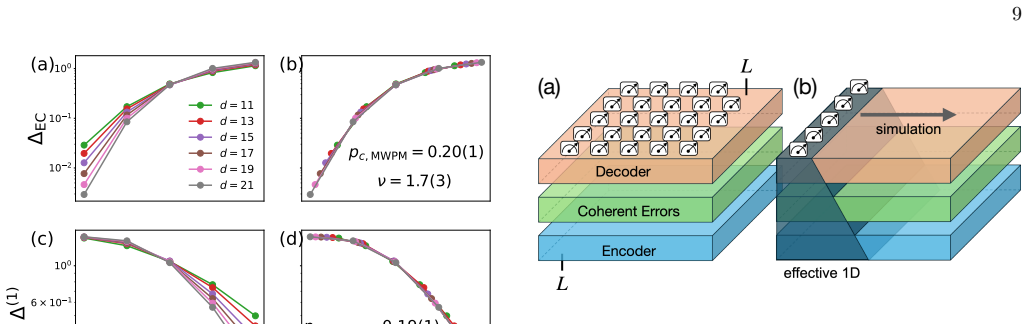
The argument rests on three interlocking devices. First, Theorem 2's time-reversal symmetry condition: all logical information lives in time-reversal-odd operators, while syndrome measurements probe only even-weight stabilizer operators, so the measurement reveals nothing about the logical input state and the induced transformations are unitary by a standard fact about Kraus operators. Second, the choice of decoder: a random decoder that multiplies each recovery by a uniform logical Pauli turns the ensemble into an exact 1-design and lets the intrinsic k ≥ 2 randomness be studied, while the optimal decoder isolates the error-correction threshold. Third, the classical simulation: writing the surface code encoder and decoder as staircase circuits of CNOT gates converts the two-dimensional problem into a (1+1)-dimensional monitored circuit amenable to matrix-product-state simulation, in which the purification time of a reference qubit exhibits an entanglement phase transition at the same p_c.
What would settle it
Compute the k = 2 design distance Δ^(2)(p, d) for a fixed p above 0.9 at larger code distances d = 19, 23, 27 using the same matrix-product-state method; if the values stop decreasing with d, or the finite-size crossing point drifts outside the stated p_c ≈ 0.87 interval, the claimed design phase would be falsified.
Extended reading notes
Core claim
When a CSS code with one logical qubit, even-weight stabilizer generators, and odd X and Z distances is acted on by a physical unitary that commutes with time reversal T = K ∏ iY_j, the syndrome-dependent correction satisfies C_s Π_s U Π_0 = √p(s) U_{L,s} Π_0 with U_{L,s} unitary (Theorem 2). Thus the Born-rule randomness of syndrome outcomes gives a well-defined probability distribution over logical unitaries. The paper's numerical finding is that for odd-distance rotated surface codes with independent random single-qubit unitaries applied at density p, this projected ensemble approaches the Haar distribution on U(2) as d → ∞ for p > p_c ≈ 0.87, while below threshold it flows to a random Pauli ensemble (or identity under optimal decoding), with the same critical point governing the optimal error-correction threshold and the entanglement transition of the staircase-mapped monitored circuit.
Load-bearing premise
The infinite-distance conclusions are inferred from scaling collapse of design distances computed at code distances 7 through 15, and the paper conjectures without proof that a single critical point controls all moments and survives in the thermodynamic limit.
Editorial extensions
If this is right
- Randomized protocols requiring unitary 2- or 3-designs—classical shadow tomography, randomized benchmarking, quantum cryptography—could run directly on encoded logical qubits of surface codes without transversal Clifford gates or magic-state distillation.
- The projected ensemble gives approximate designs with approximation error suppressed exponentially in code distance, so scaling up the distance reduces the error of any protocol built on these gates.
- Below p_c the same circuit works as error correction: all logical unitaries converge to the identity under the optimal decoder, so the coherent errors are successfully corrected.
- The classical matrix-product-state decoder is efficient below p_c and inefficient above it, meaning the unitary-design phase coincides with a computational-complexity transition for the simulation algorithm.
- The random decoder's uniform logical Pauli scrambling guarantees an exact 1-design while leaving the higher-moment convergence to the intrinsic randomness of syndrome outcomes, separating decoder-dependent and intrinsic effects.
Reading between the lines
- The result suggests a general engineering principle: measurement-induced randomness in stabilizer codes can be harvested as a resource (random logical gates) rather than treated only as noise, and codes with even-weight stabilizers and odd-weight logical operators may exhibit similar design phases.
- A testable extension is the many-body unitary case: Theorem 2 covers unitaries commuting with time reversal, such as three-body ZZZ gates, and whether the design transition persists for interacting coherent errors at finite density is open.
- The threshold p_c ≈ 0.87 is high; one could ask whether biased rotations (for example, only Z-type) or noise-assisted strategies lower the threshold, or whether repeated rounds of the protocol near threshold yield effective fault tolerance, as the paper speculates.
- The entanglement transition in the staircase circuit invites a spacetime-dual statistical-mechanics interpretation of the logical channel, which could give an analytical handle on the phase boundary beyond the numerical scaling collapse.
Editorial analysis
A structured set of objections, weighed in public.
Referee Report
Summary. The paper proposes a protocol to generate random logical unitaries on encoded qubits by applying local coherent errors to a surface code, measuring syndromes, and applying a recovery operation. Theorem 2 gives sufficient conditions (even-weight stabilizers, CSS code with odd X and Z distances, and a physical unitary U commuting with time reversal T) under which the corrected post-measurement map acts on the logical subspace as a unitary operator whose distribution is independent of the input logical state. Numerically, using a tensor-network/staircase mapping, the authors find a finite-size crossing in the unitary k-design distance Δ^(k) (k = 2, 3, 4) at p_c ≈ 0.87 for random single-qubit unitaries applied with density p, coincident within error bars with the optimal-decoder error-correction threshold p_c,EC ≈ 0.88. The same p_c appears in an MPS purification-time entanglement transition and in Clifford simulations at larger distances. The paper concludes that for p > p_c the projected ensemble becomes a unitary k-design in the thermodynamic limit, with applications to shadow tomography, randomized benchmarking, and quantum cryptography.
Significance. If the central finite-size claim survives a more thorough numerical analysis, the result is significant: it provides a resource-lean route to non-Clifford random gates on logical qubits, and it identifies a new 'unitary design phase transition' that appears to coincide with the optimal coherent-error threshold and with a complexity transition in a classical decoding algorithm. The proof of Theorem 2 is a genuine generalization of earlier work on coherent Z errors and appears sound. The Clifford-simulation appendix (Appendix C) is a valuable cross-check at much larger distances, and the scaling collapses across k = 2, 3, 4 and across the design, error-correction, and purification diagnostics are consistent. However, the thermodynamic-limit claim currently rests on small-distance (d ≤ 15) finite-size scaling without error bars or MPS convergence data, so the numerical support is not yet commensurate with the strength of the central claim.
major comments (4)
- [IV A, Eq. (24), Fig. 3] The claim of a unitary design phase for p > p_c in the thermodynamic limit is inferred entirely from the data collapse of Δ^(k) for d = 7, 9, 11, 13, 15 shown in Fig. 3. The plotted values at the largest available d and at p = 1 are still far from zero, so the collapse demonstrates a consistent crossing but not the asymptotic convergence Δ^(k) → 0 required for a design. The scaling ansatz (24), with p_c and ν fitted and the scaling function F_k determined by the collapse, is a reasonable but not conclusive inference, especially because no error bars are shown for Δ^(k). No larger-distance data for Haar-distributed single-qubit unitaries are presented: the Clifford data in Appendix C reach d = 161, but, as the paper notes, Clifford coherent errors cannot generate k ≥ 2 designs, so they cannot validate the k ≥ 2 design transition for the actual Haar-rotation ensemble. I ask for either a direct finite-size extrapolation of Δ^(k) to d = ∞ at several p > p_c showing that it vanishes, or larger-distance data for the non-Clifford ensemble, or a clear statement that the design phase is a conjecture supported only by this finite-size collapse.
- [IV A, Eq. (24)] The scaling analysis assumes a single critical point and a single correlation-length exponent for all moments k; this is stated as a conjecture immediately after Eq. (24). The central claim of convergence to the Haar distribution for all k depends on this unproven assumption. The data for k = 2, 3, 4 are consistent with a common p_c, but they do not test k > 4, where the ensemble cardinality bound (2^{n−1}) still permits designs up to k ≤ 2^{n/2}. To make the central claim robust, the authors should either prove that the threshold is k-independent, or present evidence for at least one higher moment (for example k = 5), or explicitly discuss how the scaling ansatz would detect a k-dependent threshold if one existed.
- [V C, Fig. 7] The purification-time data used to identify the coincident entanglement transition are obtained from MPS simulations, but the manuscript does not state the bond dimension used, the truncation error, or any convergence criterion. Without this information the critical point p_c = 0.88(1) and ν = 1.3(2) extracted from Fig. 7 cannot be assessed, and the associated claim that the MPS algorithm becomes inefficient above threshold is not fully supported. Please report bond dimensions and show convergence of τ/d with bond dimension at several values of p across the transition. The exact Clifford checks in Appendix C reach larger sizes, but they concern a different (Clifford) ensemble, so they do not resolve this gap for the Haar-rotation protocol studied in the main text.
- [IV B, Sec. IV A] The numerical claim that the unitary design threshold p_c exactly equals the optimal error-correction threshold p_c,EC is based on comparing two separately fitted critical points, p_c = 0.87(2) and p_c,EC = 0.88(1), whose uncertainties overlap. This is reasonable evidence, but the two quantities are extracted from the same finite-size data with the same scaling ansatz, so the overlap does not by itself establish equality in the thermodynamic limit. A joint scaling analysis or a simultaneous collapse of Δ^(k) and Δ_EC with a common p_c would be stronger; otherwise, the wording should be softened to 'consistent with coincidence'.
minor comments (5)
- [Appendix A, Eq. (A7)] Equation (A7) writes p(s) = (1/2)Tr(Π_0 U Π_s U^†), but the derivation gives p(s) = (1/2)Tr(Π_s U Π_0 U^†) = (1/2)Tr(U Π_0 U^† Π_s), as stated in Corollary 2.1. The displayed equation in Appendix A appears to be a typo and should be corrected.
- [Fig. 3 and Fig. 7 captions] The captions state that data are averaged over 384–1280 realizations, but no error bars or standard errors are shown. Since the central inference is a scaling collapse, the absence of statistical uncertainty information should be addressed, at least by adding error bars to the main data points or reporting the sample-to-sample variance.
- [Appendix C, Fig. 11] The caption and text use the phrase 'unitary design phase transition' in the Clifford setting, although the same appendix proves that Clifford coherent errors can only form a unitary 1-design. Please rephrase to 'unitary 1-design transition' or 'design transition for k = 1' to avoid implying that the Clifford data validate higher-moment designs.
- [Eqs. (22)-(23)] The notation U_{dec,s} is used both for the unitary operator and for the superoperator U_{dec,s}(·) = U_{dec,s}[·]U_{dec,s}^†. Please distinguish these explicitly, for example by writing U_{dec,s} for the channel and U_{L,s} or U_s for the unitary.
- [Sec. IV A, random decoder] The random decoder introduces a logical Pauli σ_rand,s chosen randomly for each syndrome. It would be helpful to state explicitly that these random choices are known to the experimentalist and can be classically tracked, since otherwise the projected ensemble is not operationally accessible.
Circularity Check
No significant circularity: the design transition is an extrapolated finite-size numerical finding, and the analytic connections use the measured ensemble flow as an input rather than assuming the target result.
full rationale
The paper's central derivation chain is self-contained. Theorem 2 (Sec. III, Appendix A) starts from explicit stabilizer-code conditions—even-weight stabilizers, odd X and Z distances, and [U,T]=0—decomposes the logical density matrix into time-reversal-even and odd parts, and invokes Fact 1 to conclude unitarity; no fitted quantity or target conclusion is built into the assumptions. The unitary-design phase transition (Sec. IV A) is inferred from finite-size scaling of the independently defined design distance Delta^(k)(p,d) under Eq. (24); the critical point p_c and exponent nu are outputs of the data collapse, not imposed inputs, so this is not a fitted input renamed as a prediction. The claimed coincidence of p_c with the optimal error-correction threshold is a comparison of two distinct functionals of the same projected ensemble (Eq. 22 vs Eq. 25), and the paper explicitly states that a priori one could have p_c,EC < p_c, so the observed equality is not true by construction. The analytic argument in Sec. V D uses the numerically inferred flow of the projected ensemble—to random Pauli below threshold and Haar above threshold—as an input to explain the purification/entanglement transition; that is a conditional derivation, not a circular one. Self-citations such as Ref. [9] (deep thermalization background) and Ref. [46] (SEBD method) are paired with external references such as Ref. [48] and do not carry the load-bearing claim that the projected ensemble forms a unitary design in the thermodynamic limit. The finite-size-scaling extrapolation from d=7–15 and the unstated MPS bond dimension in Sec. V C are evidence-quality and reproducibility concerns, not circularity.
Assumptions & free parameters
free parameters (7)
- p_c (unitary design critical point) =
0.87(2)
- nu (design correlation length exponent) =
1.6(2)
- p_c,EC (optimal error-correction threshold) =
0.88(1)
- nu_EC (EC correlation length exponent) =
1.4(2)
- p_c,ent (entanglement transition critical point) =
0.88(1)
- nu_ent (entanglement correlation length exponent) =
1.3(2)
- MPS bond dimension =
not stated
assumptions (7)
- standard math Born rule and projective measurements give a syndrome probability p(s) independent of the input state iff the Kraus operators are proportional to unitaries (Fact 1).
- domain assumption The code is a CSS stabilizer code with one logical qubit, even-weight stabilizer generators, and odd X and Z distances (Theorem 2 conditions 1-2).
- domain assumption The physical unitary U commutes with time reversal T = K ∏ iY_j (Theorem 2 condition 3).
- ad hoc to paper Scaling ansatz Δ(k)(p,d) = F[(p-p_c)d^{1/ν}] with a single p_c and ν for all k.
- domain assumption Finite-size scaling from d ≤ 15 captures thermodynamic-limit behavior.
- domain assumption The MPS representation of the monitored circuit is accurate (area-law scaling holds below and at the transition; bond dimension sufficient).
- domain assumption Sampling u_j Haar-randomly with probability p, else identity, models the coherent-error ensemble.
Cite this review
Pith. "Pith review of Emergent unitary designs for encoded qubits from coherent errors and syndrome measurements." pith.science (2026). https://pith.science/paper/ECEVW5XO
@misc{pith2026241204414,
  author       = {Pith},
  title        = {Pith review of: Emergent unitary designs for encoded qubits from coherent errors and syndrome measurements},
  year         = {2026},
  howpublished = {\url{https://pith.science/paper/ECEVW5XO}},
  note         = {Machine review of arXiv:2412.04414}
}
abstract
Unitary $k$-designs are distributions of unitary gates that match the Haar distribution up to its $k$-th statistical moment. They are a crucial resource for randomized quantum protocols. However, their implementation on encoded logical qubits is nontrivial due to the need for magic gates, which can require a large resource overhead. In this work, we propose an efficient approach to generate unitary designs for encoded qubits in surface codes by applying local unitary rotations ("coherent errors") on the physical qubits followed by syndrome measurement and error correction. We prove that under some conditions on the coherent errors (notably including all single-qubit unitaries) and on the error correcting code, this process induces a unitary transformation of the logical subspace. We numerically show that the ensemble of logical unitaries (indexed by the random syndrome outcomes) converges to a unitary design in the thermodynamic limit, provided the density or strength of coherent errors is above a finite threshold. This "unitary design" phase transition coincides with the code's coherent error threshold under optimal decoding. Furthermore, we propose a classical algorithm to simulate the protocol based on a "staircase" implementation of the surface code encoder and decoder circuits. This enables a mapping to a 1+1D monitored circuit, where we observe an entanglement phase transition (and thus a classical complexity phase transition of the decoding algorithm) coinciding with the aforementioned unitary design phase transition. Our results provide a practical way to realize unitary designs on encoded qubits, with applications including quantum state tomography and benchmarking in error correcting codes.
Figures


Figures from the paper (9 more)


Forward citations
Cited by 1 Pith paper
-
Coherent error induced phase transition
The paper shows that in stabilizer codes a change in the logical stabilizer group after a coherent Clifford error and syndrome measurement exactly determines the MAP recovery probability, and that above a critical err...
Reference graph
Works this paper leans on
-
[1]
Pauli- twirling
Applications of logical unitary designs Unitary designs have many applications in quantum information science. Our work presents an efficient route to port these applications to the setting of encoded logical qubits, which is especially interesting as we enter the era of error-corrected quantum processors. First, we note that some applications such as “Pa...
-
[2]
coherent errors
Effect of noise In this work we have focused on the ideal setting where unitary control and measurements are perfect. Where we discussed an error correction threshold, it was in refer- ence to “coherent errors” (the physical unitaries {uj}) that are applied intentionally and known by the experi- mentalist. The performance of this protocol in the pres- enc...
-
[3]
These include the surface code and color code which are practically very relevant to near-term architectures, particularly superconductig qubits where spatial locality is required
Extension to general LDPC codes and multiple logical qubits Our Theorem 2 establishes the unitarity of the pro- jected ensemble for an important set of codes: CSS codes with one logical qubit, odd distance, and whose stabiliz- ers have even Pauli weight. These include the surface code and color code which are practically very relevant to near-term archite...
-
[4]
We conclude that all nontrivial logical operators have odd Pauli weight
Additionally, since dx and dz are both odd, we have that ∣XL∣ and ∣ZL∣ are odd, and since XL and ZL anti- commute, Fact 3 gives ∣YL∣ = ∣XL∣+ ∣ZL∣+ 1 mod 2 and thus ∣YL∣ is odd as well. We conclude that all nontrivial logical operators have odd Pauli weight. Based on this fact we can decompose ρL as ρL = ρ++ ρ−, (A3) with ρ+ = 1 2 Π0 made exclusively of ev...
-
[5]
phase bits
Data are sampled over 10000 instances. than 1-designs (see App. C), so an upper limit to the design phase is expected before α = π/3, hence the non- monotonic behavior of ∆ (4) in Fig. 9. To investigate the unitary distributions in both phases, we choose α = 0.15π as representative of the error- correcting phase and α= 0.225π as representative of the unit...
-
[7]
E. Knill, Fault-Tolerant Postselected Quantum Compu- tation: Schemes, arXiv:0402171 10.48550/arXiv.quant- ph/0402171 (2004)
-
[8]
S. Bravyi, Universal quantum computation with ideal Clifford gates and noisy ancillas, Physical Review A 71, 10.1103/PhysRevA.71.022316 (2005)
-
[9]
M. B. Hastings, Distillation with Sublogarithmic Over- head, Physical Review Letters 120, 10.1103/Phys- RevLett.120.050504 (2018)
doi:10.1103/phys- 2018
Show all 93 references
- [10]
-
[11]
J. Choi, A. L. Shaw, I. S. Madjarov, X. Xie, R. Finkel- stein, J. P. Covey, J. S. Cotler, D. K. Mark, H.-Y. Huang, A. Kale, H. Pichler, F. G. S. L. Brand˜ ao, S. Choi, and M. Endres, Preparing random states and benchmarking with many-body quantum chaos, Nature613, 468 (2023). 20
2023
-
[12]
J. S. Cotler, D. K. Mark, H.-Y. Huang, F. Hern´ andez, J. Choi, A. L. Shaw, M. Endres, and S. Choi, Emergent quantum state designs from individual many-body wave functions, PRX Quantum 4, 010311 (2023)
2023
-
[13]
W. W. Ho and S. Choi, Exact Emergent Quantum State Designs from Quantum Chaotic Dynamics, Physical Re- view Letters 128, 060601 (2022)
2022
-
[14]
Ippoliti and W
M. Ippoliti and W. W. Ho, Solvable model of deep ther- malization with distinct design times, Quantum 6, 886 (2022)
2022
-
[15]
Turkeshi and P
X. Turkeshi and P. Sierant, Error-resilience phase transi- tions in encoding-decoding quantum circuits, Phys. Rev. Lett. 132, 140401 (2024)
2024
-
[16]
Niroula, C
P. Niroula, C. D. White, Q. Wang, S. Johri, D. Zhu, C. Monroe, C. Noel, and M. J. Gullans, Phase transition in magic with random quantum circuits, Nature Physics 20, 1786 (2024)
2024
-
[17]
Behrends, F
J. Behrends, F. Venn, and B. B´ eri, Surface codes, quan- tum circuits, and entanglement phases, Phys. Rev. Res. 6, 013137 (2024)
2024
-
[18]
F. Venn, J. Behrends, and B. B´ eri, Coherent-error thresh- old for surface codes from majorana delocalization, Phys. Rev. Lett. 131, 060603 (2023)
2023
-
[19]
Knill, Randomized benchmarking of quantum gates, Physical Review A 77, 10.1103/PhysRevA.77.012307 (2008)
E. Knill, Randomized benchmarking of quantum gates, Physical Review A 77, 10.1103/PhysRevA.77.012307 (2008)
2008 doi
-
[20]
J. R. McClean, S. Boixo, V. N. Smelyanskiy, R. Bab- bush, and H. Neven, Barren plateaus in quantum neural network training landscapes, Nature Communications 9, 4812 (2018)
2018
-
[21]
Huang, R
H.-Y. Huang, R. Kueng, and J. Preskill, Predicting many properties of a quantum system from very few measure- ments, Nature Physics 16, 1050 (2020)
2020
-
[22]
Elben, S
A. Elben, S. T. Flammia, H.-Y. Huang, R. Kueng, J. Preskill, B. Vermersch, and P. Zoller, The random- ized measurement toolbox, Nature Reviews Physics 5, 9 (2023)
2023
-
[23]
A. A. Mele, Introduction to Haar Measure Tools in Quan- tum Information: A Beginner’s Tutorial, Quantum 8, 1340 (2024)
2024
-
[24]
Ambainis and J
A. Ambainis and J. Emerson, Quantum t-designs: t-wise Independence in the Quantum World, in Twenty-Second Annual IEEE Conference on Computational Complexity (CCC’07) (IEEE Computer Society, Los Alamitos, CA, USA, 2007) pp. 129–140
2007
-
[25]
Dankert, Exact and approximate unitary 2-designs and their application to fidelity estimation, Physical Re- view A 80, 10.1103/PhysRevA.80.012304 (2009)
C. Dankert, Exact and approximate unitary 2-designs and their application to fidelity estimation, Physical Re- view A 80, 10.1103/PhysRevA.80.012304 (2009)
2009 doi
-
[26]
D. A. Roberts and B. Yoshida, Chaos and complexity by design, arXiv:1610.04903 2017, 121 (2017)
2017 arXiv
- [27]
-
[28]
Schuster, J
T. Schuster, J. Haferkamp, and H.-Y. Huang, Random unitaries in extremely low depth, Science 389, 92 (2025)
2025
-
[29]
Ippoliti and W
M. Ippoliti and W. W. Ho, Dynamical Purification and the Emergence of Quantum State Designs from the Pro- jected Ensemble, PRX Quantum 4, 030322 (2023)
2023
-
[30]
Bhore, J.-Y
T. Bhore, J.-Y. Desaules, and Z. Papic, Deep thermaliza- tion in constrained quantum systems, Physical Review B 108, 104317 (2023)
2023
-
[31]
D. K. Mark, F. Surace, A. Elben, A. L. Shaw, J. Choi, G. Refael, M. Endres, and S. Choi, Maximum entropy principle in deep thermalization and in hilbert-space er- godicity, Phys. Rev. X 14, 041051 (2024)
2024
-
[32]
Chan and A
A. Chan and A. De Luca, Projected state ensemble of a generic model of many-body quantum chaos, Journal of Physics A: Mathematical and Theoretical 57, 405001 (2024)
2024
-
[33]
Lucas, L
M. Lucas, L. Piroli, J. De Nardis, and A. De Luca, Gen- eralized deep thermalization for free fermions, Physical Review A 107, 032215 (2023)
2023
-
[34]
C. Liu, Q. C. Huang, and W. W. Ho, Deep thermalization in gaussian continuous-variable quantum systems, Phys. Rev. Lett. 133, 260401 (2024)
2024
-
[35]
Chang, H
R.-A. Chang, H. Shrotriya, W. W. Ho, and M. Ippoliti, Deep thermalization under charge-conserving quantum dynamics, PRX Quantum 6, 020343 (2025)
2025
-
[36]
Bravyi, M
S. Bravyi, M. Englbrecht, R. K¨ onig, and N. Peard, Cor- recting coherent errors with surface codes, npj Quantum Information 4, 55 (2018)
2018
-
[37]
M. P. A. Fisher, V. Khemani, A. Nahum, and S. Vi- jay, Random Quantum Circuits, Annual Review of Con- densed Matter Physics 14, 335 (2023)
2023
-
[38]
A. C. Potter and R. Vasseur, Entanglement Dynamics in Hybrid Quantum Circuits, in Entanglement in Spin Chains: From Theory to Quantum Technology Appli- cations, Quantum Science and Technology, edited by A. Bayat, S. Bose, and H. Johannesson (Cham, 2022) pp. 211–249
2022
-
[39]
Skinner, J
B. Skinner, J. Ruhman, and A. Nahum, Measurement- induced phase transitions in the dynamics of entangle- ment, Phys. Rev. X 9, 031009 (2019)
2019
-
[40]
Y. Li, X. Chen, and M. P. A. Fisher, Quantum Zeno ef- fect and the many-body entanglement transition, Physi- cal Review B 98, 205136 (2018)
2018
-
[41]
S. Choi, Y. Bao, X.-L. Qi, and E. Altman, Quantum er- ror correction in scrambling dynamics and measurement- induced phase transition, Phys. Rev. Lett. 125, 030505 (2020)
2020
-
[42]
Y. Bao, S. Choi, and E. Altman, Theory of the phase transition in random unitary circuits with measurements, Phys. Rev. B 101, 104301 (2020)
2020
-
[43]
M. J. Gullans and D. A. Huse, Dynamical purifica- tion phase transition induced by quantum measurements, Phys. Rev. X 10, 041020 (2020)
2020
-
[44]
M. J. Gullans and D. A. Huse, Scalable probes of measurement-induced criticality, Phys. Rev. Lett. 125, 070606 (2020)
2020
-
[45]
R. Fan, S. Vijay, A. Vishwanath, and Y.-Z. You, Self- organized error correction in random unitary circuits with measurement, Phys. Rev. B 103, 174309 (2021)
2021
-
[46]
Li and M
Y. Li and M. P. A. Fisher, Statistical mechanics of quantum error correcting codes, Physical Review B 103, 104306 (2021)
2021
-
[47]
Y. Li, Y. Zou, P. Glorioso, E. Altman, and M. P. A. Fisher, Cross Entropy Benchmark for Measurement- Induced Phase Transitions, Physical Review Letters130, 220404 (2023)
2023
-
[48]
C. Noel, P. Niroula, D. Zhu, A. Risinger, L. Egan, D. Biswas, M. Cetina, A. V. Gorshkov, M. J. Gullans, D. A. Huse, and C. Monroe, Measurement-induced quan- tum phases realized in a trapped-ion quantum computer, Nature Physics 18, 760 (2022)
2022
-
[49]
J. C. Hoke, M. Ippoliti, E. Rosenberg, D. Abanin, R. Acharya, T. I. Andersen, M. Ansmann, F. Arute, K. Arya, A. Asfaw, J. Atalaya, J. C. Bardin, A. Bengts- son, G. Bortoli, A. Bourassa, J. Bovaird, et al. , 21 Measurement-induced entanglement and teleportation on a noisy quant...
2023
-
[50]
Vovk and H
T. Vovk and H. Pichler, Entanglement-optimal trajec- tories of many-body quantum markov processes, Phys. Rev. Lett. 128, 243601 (2022)
2022
-
[51]
Cheng and M
Z. Cheng and M. Ippoliti, Efficient sampling of noisy shal- low circuits via monitored unraveling, PRX Quantum 4, 040326 (2023)
2023
-
[52]
Z. Chen, Y. Bao, and S. Choi, Optimized trajectory un- raveling for classical simulation of noisy quantum dynam- ics, Phys. Rev. Lett. 133, 230403 (2024)
2024
-
[53]
J. C. Napp, R. L. La Placa, A. M. Dalzell, F. G. S. L. Brand˜ ao, and A. W. Harrow, Efficient classical simula- tion of random shallow 2d quantum circuits, Phys. Rev. X 12, 021021 (2022)
2022
-
[54]
Venn and B
F. Venn and B. B´ eri, Error-correction and noise- decoherence thresholds for coherent errors in planar- graph surface codes, Phys. Rev. Res. 2, 043412 (2020)
2020
-
[55]
A. S. Darmawan, Optimal adaptation of surface-code de- coders to local noise (2024), arXiv:2403.08706 [quant-ph]
2024 arXiv
-
[56]
Dennis, A
E. Dennis, A. Kitaev, A. Landahl, and J. Preskill, Topological quantum memory, Journal of Mathematical Physics 43, 4452 (2002)
2002
-
[57]
A. G. Fowler, Towards Practical Classical Processing for the Surface Code, Physical Review Letters 108, 10.1103/PhysRevLett.108.180501 (2012)
2012 doi
-
[58]
Javadi-Abhari, M
A. Javadi-Abhari, M. Treinish, K. Krsulich, C. J. Wood, J. Lishman, J. Gacon, S. Martiel, P. D. Nation, L. S. Bishop, A. W. Cross, B. R. Johnson, and J. M. Gambetta, Quantum computing with Qiskit (2024), arXiv:2405.08810 [quant-ph]
2024 arXiv
-
[59]
Watrous, Simpler semidefinite programs for completely bounded norms (2012), arXiv:1207.5726 [quant-ph]
J. Watrous, Simpler semidefinite programs for completely bounded norms (2012), arXiv:1207.5726 [quant-ph]
2012 arXiv
-
[60]
F. G. S. L. Brand˜ ao, A. W. Harrow, and M. Horodecki, Local random quantum circuits are approximate polynomial-designs, Communications in Mathematical Physics 346, 397 (2016)
2016
-
[61]
T. M. Stace and S. D. Barrett, Error correction and de- generacy in surface codes suffering loss, Phys. Rev. A 81, 022317 (2010)
2010
-
[62]
Behrends and B
J. Behrends and B. B´ eri, The surface code beyond pauli channels: Logical noise coherence, information-theoretic measures, and errorfield-double phenomenology (2025), arXiv:2412.21055 [quant-ph]
2025
-
[63]
Suzuki, K
Y. Suzuki, K. Fujii, and M. Koashi, Efficient simulation of quantum error correction under coherent error based on the nonunitary free-fermionic formalism, Phys. Rev. Lett. 119, 190503 (2017)
2017
-
[64]
K. J. Satzinger, Y.-J. Liu, A. Smith, C. Knapp, M. Newman, C. Jones, Z. Chen, C. Quintana, X. Mi, A. Dunsworth, C. Gidney, I. Aleiner, F. Arute, K. Arya, J. Atalaya, R. Babbush, et al. , Realizing topologically ordered states on a quantum processor, Science 374, 1237 (2021), h...
2021 doi
-
[65]
Higgott, M
O. Higgott, M. Wilson, J. Hefford, J. Dborin, F. Hanif, S. Burton, and D. E. Browne, Optimal local unitary en- coding circuits for the surface code, Quantum 5, 517 (2021)
2021
-
[66]
Iqbal, N
M. Iqbal, N. Tantivasadakarn, T. M. Gatterman, J. A. Gerber, K. Gilmore, D. Gresh, A. Hankin, N. Hewitt, C. V. Horst, M. Matheny, T. Mengle, B. Neyenhuis, A. Vishwanath, M. Foss-Feig, R. Verresen, and H. Dreyer, Topological order from measurements and feed-forward on a trapped...
2024
-
[67]
Foss-Feig, A
M. Foss-Feig, A. Tikku, T.-C. Lu, K. Mayer, M. Iqbal, T. M. Gatterman, J. A. Gerber, K. Gilmore, D. Gresh, A. Hankin, N. Hewitt, C. V. Horst, M. Matheny, T. Men- gle, B. Neyenhuis, H. Dreyer,et al., Experimental demon- stration of the advantage of adaptive quantum circuits, ar...
-
[68]
Tillich and G
J.-P. Tillich and G. Zemor, Quantum ldpc codes with positive rate and minimum distance proportional to the square root of the blocklength, IEEE Trans. Inf. Theor. 60, 1193–1202 (2014)
2014
-
[69]
Foss-Feig, D
M. Foss-Feig, D. Hayes, J. M. Dreiling, C. Figgatt, J. P. Gaebler, S. A. Moses, J. M. Pino, and A. C. Potter, Holographic quantum algorithms for simulating corre- lated spin systems, Physical Review Research 3, 033002 (2021)
2021
-
[70]
Ippoliti, T
M. Ippoliti, T. Rakovszky, and V. Khemani, Fractal, Logarithmic, and Volume-Law Entangled Nonthermal Steady States via Spacetime Duality, Physical Review X 12, 011045 (2022)
2022
-
[71]
Lu and T
T.-C. Lu and T. Grover, Spacetime duality between local- ization transitions and measurement-induced transitions, PRX Quantum 2, 040319 (2021)
2021
-
[72]
Anand, J
S. Anand, J. Hauschild, Y. Zhang, A. C. Potter, and M. P. Zaletel, Holographic Quantum Simulation of En- tanglement Renormalization Circuits, PRX Quantum 4, 030334 (2023)
2023
-
[73]
Schuch, M
N. Schuch, M. M. Wolf, F. Verstraete, and J. I. Cirac, En- tropy scaling and simulability by matrix product states, Phys. Rev. Lett. 100, 030504 (2008)
2008
-
[74]
Zabalo, M
A. Zabalo, M. J. Gullans, J. H. Wilson, S. Gopalakrish- nan, D. A. Huse, and J. H. Pixley, Critical properties of the measurement-induced transition in random quantum circuits, Phys. Rev. B 101, 060301(R) (2020)
2020
-
[75]
D¨ ur, M
W. D¨ ur, M. Hein, J. I. Cirac, and H.-J. Briegel, Standard forms of noisy quantum operations via depolarization, Phys. Rev. A 72, 052326 (2005)
2005
-
[76]
Cai and S
Z. Cai and S. C. Benjamin, Constructing Smaller Pauli Twirling Sets for Arbitrary Error Channels, Scientific Re- ports 9, 11281 (2019)
2019
-
[77]
B. J. Brown, K. Laubscher, M. S. Kesselring, and J. R. Wootton, Poking holes and cutting corners to achieve clif- ford gates with the surface code, Phys. Rev. X 7, 021029 (2017)
2017
-
[78]
Nakata, D
Y. Nakata, D. Zhao, T. Okuda, E. Bannai, Y. Suzuki, S. Tamiya, K. Heya, Z. Yan, K. Zuo, S. Tamate, Y. Tabuchi, and Y. Nakamura, Quantum circuits for ex- act unitary t-designs and applications to higher-order randomized benchmarking, PRX Quantum 2, 030339 (2021)
2021
-
[79]
Hines, D
J. Hines, D. Hothem, R. Blume-Kohout, B. Whaley, and T. Proctor, Fully scalable randomized benchmark- ing without motion reversal, PRX Quantum 5, 030334 (2024)
2024
-
[80]
Boixo, S
S. Boixo, S. V. Isakov, V. N. Smelyanskiy, R. Babbush, N. Ding, Z. Jiang, M. J. Bremner, J. M. Martinis, and H. Neven, Characterizing quantum supremacy in near- term devices, Nature Physics 14, 595–600 (2018)
2018
-
[81]
Arute, K
F. Arute, K. Arya, R. Babbush, D. Bacon, J. C. Bardin, R. Barends, R. Biswas, S. Boixo, F. G. S. L. Brandao, D. A. Buell, B. Burkett, Y. Chen, Z. Chen, B. Chiaro, R. Collins, W. Courtney, et al., Quantum supremacy us- ing a programmable superconducting processor, Nature 22 574...
2019
-
[82]
Lancien and C
C. Lancien and C. Majenz, Weak approximate unitary designs and applications to quantum encryption, Quan- tum 4, 313 (2020)
2020
-
[83]
Ji, Y.-K
Z. Ji, Y.-K. Liu, and F. Song, Pseudorandom Quan- tum States, in Advances in Cryptology - CRYPTO 2018 , edited by H. Shacham and A. Boldyreva (Cham, 2018) pp. 126–152
2018
-
[84]
Begusic and G
T. Begusic and G. K.-L. Chan, Real-time operator evo- lution in two and three dimensions via sparse pauli dy- namics, PRX Quantum 6, 020302 (2025)
2025
-
[85]
Gonz´ alez-Garc ´ ıa, J
G. Gonz´ alez-Garc ´ ıa, J. I. Cirac, and R. Trivedi, Pauli path simulations of noisy quantum circuits beyond aver- age case, Quantum 9, 1730 (2025)
2025
-
[86]
X. Mi, P. Roushan, C. Quintana, S. Mandra, J. Marshall, C. Neill, F. Arute, K. Arya, J. Atalaya, R. Babbush, J. C. Bardin, R. Barends, J. Basso, A. Bengtsson, S. Boixo, A. Bourassa, et al. , Information scrambling in quantum circuits, Science 374, 1479 (2021)
2021
-
[87]
A. S. Darmawan and D. Poulin, Tensor-network simula- tions of the surface code under realistic noise, Phys. Rev. Lett. 119, 040502 (2017)
2017
-
[88]
N. P. Breuckmann and J. N. Eberhardt, Quantum low- density parity-check codes, PRX Quantum 2, 040101 (2021)
2021
-
[89]
Bravyi and B
S. Bravyi and B. Terhal, A no-go theorem for a two- dimensional self-correcting quantum memory based on stabilizer codes, New J. Phys. 11, 043029 (2009)
2009
- [90]
-
[91]
Behrends and B
J. Behrends and B. Beri, Statistical mechanical map- ping and maximum-likelihood thresholds for the sur- face code under generic single-qubit coherent errors, arXiv:2410.22436 10.48550/arXiv.2410.22436 (2024)
2024 doi
- [92]
-
[93]
Aaronson and D
S. Aaronson and D. Gottesman, Improved simulation of stabilizer circuits, Phys. Rev. A 70, 052328 (2004)
2004
-
[94]
Krastanov, F
S. Krastanov, F. Ahmad, P. Viswanathan, S. Par- dis, A. Micciche, J. Lapeyre, Rabqubit, gsommers, T. Hofmann, A. Bhatt, A. Meligrana, Benzillaist, C. Zhao, IsaacP1234, L. G¨ ottgens, ShuGe-MIT, T. Holy, T. Dang, adrianariton, and ismoldayev, Quantumsa- vory/quantumclifford.jl:...
2024
Reviewed August 11, 2026 · model on record in the stance chip above.
Discussion (0). Continue with ORCID to comment.