REVIEW 3 major objections 6 minor 19 references
YSO implantation detector for beta-delayed neutron spectroscopy
T0 review · 3 major / 6 minor · reviewed 2026-08-11 · deepseek-v4-flash
Pith's one-line read A segmented yttrium orthosilicate (YSO) scintillator coupled to a position-sensitive photomultiplier tube can serve as the implantation detector for beta-delayed neutron time-of-flight spectroscopy, giving about 80% beta-detection…
desk verdict Useful, honest instrumentation paper: larger YSO implant detector with sub-ns timing for neutron ToF start, but the beta-trigger timing extrapolation is under-supported. read the letter →
The pith
A machine-rendered reading of the paper's core claim, the machinery that carries it, and where it could break.
The reading
What carries the argument
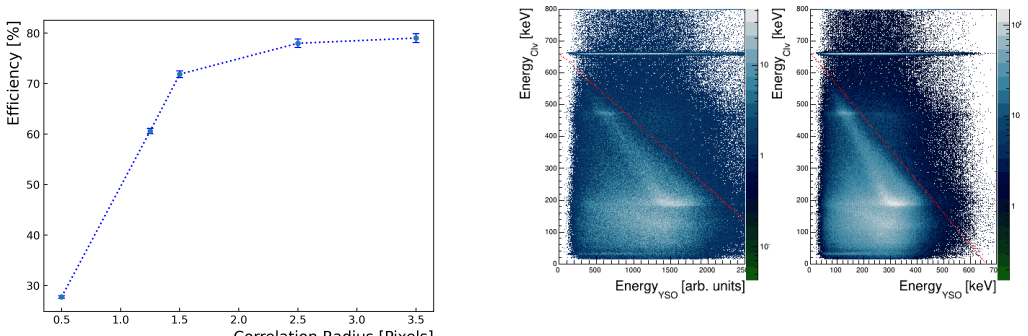
The load-bearing mechanism is light quenching in yttrium orthosilicate (YSO), described by Birks' relation: high-energy ions produce far less scintillation light per unit energy than electrons, so the same crystal can register both the multi-GeV implanted ion and the MeV beta without saturating the photomultiplier. Position is reconstructed with Anger logic, a resistive-network readout that derives coordinates from weighted fractions of the anode signals on the 64 PSPMT channels, while the dynode signal gives the energy deposit. Ion and beta images are converted to a common pixel map by nearest-neighbor assignment, and a correlation radius in that map defines an ion-beta match. For neutron time-of-flight, the correlated beta position sets the origin of the neutron trajectory, the pulse-shape timing algorithm sets the start time, and the neutron-array hit time sets the stop time; flight paths are computed per event and scaled to a common 105 cm distance.
What would settle it
Measure the timing resolution of a single YSO detector directly against a reference start detector with independently known sub-100 ps jitter, for example a fast Cherenkov counter on a pulsed beam, and compare the result with the 650 ps inferred from the equal-detector assumption.
Extended reading notes
Core claim
The central claim is that the segmented YSO detector, originally demonstrated for ion-beta correlation, can be extended to time-of-flight measurements of beta-delayed neutrons. The detector reconstructs ion and beta positions in pixel space using Anger-logic readout of an 8x8 position-sensitive photomultiplier, then matches ion-beta pairs within an optimized correlation radius; in the decay of 79Cu this matching yields about 80% beta-detection efficiency. Timing is extracted from digitized traces with a pulse-shape algorithm, and a 60Co coincidence measurement gives a combined FWHM of 922 ps, from which the paper infers about 650 ps per detector by assuming equal detectors and a Gaussian difference distribution. The paper demonstrates the application by producing a neutron time-of-flight spectrum for 83Ga and builds a simulation of the experimental setup to model scattering tails in the ToF response, which is then used to fit neutron-energy peaks. On the paper's terms, the detector supplies position, start time, and flight-path origin for neutron spectroscopy in the 78Ni region.
Load-bearing premise
The sub-nanosecond single-detector timing resolution is inferred from the width of a coincidence distribution by assuming the two YSO detectors have identical timing performance and that the distribution is Gaussian; if the detectors are not matched, the 650 ps figure is not reliable.
Editorial extensions
If this is right
- Beta-delayed neutron energies near 78Ni become measurable because the YSO supplies the start time and the beta position that fixes the neutron flight path on an event-by-event basis.
- The same detector can measure half-lives and ion-beta correlations while also feeding a neutron time-of-flight analysis, so one implantation device covers multiple decay-spectroscopy tasks.
- The roughly 80% beta-detection efficiency gives better statistical reach for weak neutron branches in very exotic isotopes than silicon-based implant detectors of comparable size.
- The simulated scattering response, fitted with an asymmetric Lorentzian profile plus three exponential tails, can be used to deconvolve multi-neutron energy spectra and extract resonance intensities.
- The sub-nanosecond start-time resolution keeps the ToF energy uncertainty dominated by flight-path and neutron-detector effects rather than by the start signal.
Reading between the lines
- A natural next check is a direct single-detector timing calibration against a reference detector with sub-100 ps jitter; that would settle whether the equal-detector assumption biases the quoted 650 ps.
- Because YSO has higher atomic number than silicon, the detector may also work for beta-delayed proton or fission-fragment spectroscopy, where fast timing and position information are similarly valuable.
- The cross-wire artifacts in the Anger-logic images come from the four-segment light guide; a per-pixel gain calibration or a monolithic light guide could improve position uniformity and reduce the correlation radius needed for the same efficiency.
- The same coincidence-timing analysis could be repeated with two detectors of deliberately different timing response to quantify how much of the 922 ps combined width is due to the scintillator and photomultiplier versus the readout electronics.
Editorial analysis
A structured set of objections, weighed in public.
Referee Report
Summary. The paper presents a segmented YSO scintillator (coupled to an 8×8 PSPMT via a tapered, pixelated acrylic light guide) as an implantation detector for beta-delayed neutron time-of-flight (ToF) spectroscopy. The detector was operated at RIBF, RIKEN, in an experiment around 78Ni, providing ion-beta correlation, a beta trigger for neutron ToF, and position information for flight-path correction. The central performance claims are a sub-nanosecond timing resolution (inferred single-detector resolution of ~650 ps from a 60Co coincidence FWHM of 922±7 ps) and a high beta-detection efficiency (~80% obtained on 79Cu). The paper also reports a 79Cu half-life of 252.2(9.0) ms, consistent with literature, and describes a GEANT4 simulation of the VANDLE neutron detector response to mono-energetic neutrons, intended for deconvolving multi-neutron-energy spectra.
Significance. If the performance claims hold, the detector is a valuable new instrument: it offers fast timing and position sensitivity simultaneously, which is a genuine advantage over silicon-based implantation detectors for beta-delayed neutron ToF studies of very neutron-rich nuclei. The paper reports measured quantities with quoted statistical errors (e.g., the combined timing FWHM and the half-life) and includes a cross-check of the half-life against literature. The GEANT4 response-function framework, if validated, would be a useful tool for the analysis of VANDLE data. However, two of the headline quantities—the beta-detection efficiency and the sub-nanosecond start-time capability under real experimental conditions—are not yet supported to the required standard: the efficiency is quoted without an uncertainty and is tuned via a correlation radius, while the timing resolution is extrapolated from a high-energy gamma-ray bench test to the actual low-energy beta trigger. The simulation's quantitative validation is also not yet demonstrated. Thus the paper establishes the detector concept but needs additional work on these load-bearing points.
major comments (3)
- [Sec. 2 (Eq. 4) and Sec. 6] The single-detector timing resolution of ~650 ps is inferred from a 60Co coincidence measurement with a combined FWHM of 922±7 ps under the assumption of equal detector resolutions. As the reader notes, the equal-resolution assumption is not critical because the combined width alone bounds each detector below 1 ns. The more important gap is that the bench test uses 1.17/1.33 MeV gamma rays and signals representing energies of at least 1 MeV, whereas the beta trigger used for ToF accepts a continuous electron spectrum with an unspecified threshold. Since the GEANT4 response functions (Figs. 18-19) are generated with a fixed 650 ps Gaussian timing smearing, a slower or energy-dependent timing for low-energy beta events would bias the simulated ToF distributions and any extracted neutron intensities. Please provide timing resolution as a function of deposited energy (or at least at the actual beta-trigger threshold), and specify the threshold settings and readout branches described in Sec. 4.
- [Sec. 5 (Fig. 9)] The quoted '~80% beta-detection efficiency' is stated without any statistical or systematic uncertainty. The value is obtained by optimizing the correlation radius n for the same 79Cu dataset, which can bias the efficiency upward, and the numerator/denominator of the efficiency (e.g., number of correlated beta events over number of implanted ions within a time window) is not explicitly defined. The efficiency likely depends on the isotope, beta endpoint energy, implantation depth, and the imaging non-uniformities discussed in Sec. 5. Please provide a full definition, describe the optimization procedure, estimate the systematic uncertainty (e.g., by varying n and the alignment procedure), and, if possible, validate the efficiency with a second isotope.
- [Sec. 6 (Fig. 19)] The GEANT4 response functions are intended to de-convolve neutron ToF spectra, but the only validation shown is qualitative—the 83Ga QDC-ToF spectrum is said to have 'a signature typical of the VANDLE spectrum from previous measurements.' The simulation relies on approximations (e.g., the BRIKEN detector modeled as an HDPE block with a cuboid cavity) and on the assumed 650 ps timing smearing. Please include a quantitative benchmark of the simulated response against a measured ToF distribution (or a calibration run), and discuss the sensitivity of the extracted neutron energies and intensities to the timing-smearing assumption and the geometry approximations.
minor comments (6)
- [Abstract and Sec. 2] The abstract states '34 × 34 YSO scintillator', while Sec. 2 describes a '75 mm × 75 mm segmented scintillator with 2-mm pitch'; 2 mm × 34 = 68 mm, not 75 mm. Please reconcile the pixel count and the physical dimensions.
- [Sec. 2, Eq. (1)] In Birks' relation the denominator should contain dE/dx (not dE/dr) as written in the manuscript; please correct the typo.
- [Sec. 5, Eq. (2)] Please define L_i(E) and L_e(E) explicitly as the light yields for ions and electrons at the same energy E.
- [Sec. 5, Ref. [16]] The calibration data are taken from Ref. [16], which is cited as 'submitted to Phys. Rev. Lett. (2018)'. If this work has since been published or is still unpublished, please update the citation so the source of the quenching-factor data is traceable.
- [Abstract and Sec. 5] The phrase 'high ~80% beta-detection efficiency' should be qualified as 'for 79Cu with the optimized correlation radius' to avoid implying a universal efficiency for all isotopes and conditions.
- [Sec. 6, Eq. (8)] Equation (8) gives the energy resolution as 2E sqrt((ΔL/L)^2 + (ΔToF/ToF)^2); please state the assumption that the errors are uncorrelated and small, and show the step from E = 0.5 m (L/ToF)^2.
Circularity Check
No circular dependency: timing, efficiency, and quenching are measured or externally benchmarked, not derived from their own inputs.
full rationale
The paper's central claims are measurement-based rather than derived from fitted inputs. The sub-nanosecond timing resolution is obtained from a 60Co coincidence measurement: a combined FWHM of 922±7 ps is measured directly (Fig. 3), and Eq. (4) divides by sqrt(2) under an explicit equal-resolution assumption. This is a standard estimate with a stated assumption, not a quantity defined in terms of itself, and the combined FWHM already bounds each detector below 1 ns even if the detectors are mismatched. The ~80% beta-detection efficiency is determined by optimizing a correlation radius and gating on the 79Cu decay; this is a measured acceptance, and the resulting half-life of 252.2(9.0) ms is checked against an independent literature value of 241.0(3.2) ms [15], providing external validation. The quenching factors are derived from a ratio of LISE++ simulated ion energy endpoints to measured low-gain branch endpoints; this is a calibration, not a prediction of the same quantity. The GEANT4 response simulation uses the measured ~650 ps timing resolution as an input parameter, not as a derived output, so no quantity is folded back into the claim it is supposed to support. The self-citations, [6] for the detector concept and [16] for quenching-factor data, are provenance or data references and are not load-bearing in any derivation. The equal-resolution and energy-extrapolation assumptions in the timing measurement are legitimate correctness risks, but they are not circularity. Overall, no step reduces to its own inputs by construction.
Assumptions & free parameters
free parameters (2)
- Correlation radius n =
3 pixels (for 79Cu)
- Per-isotope light quenching factors =
varies with Z; Fig. 14
assumptions (6)
- domain assumption Birks' quenching relation (Eq. 1) with a single kB describes ion light output in YSO.
- ad hoc to paper The two YSO detectors in the coincidence test have identical timing resolution (Tres1 = Tres2).
- domain assumption The coincidence-time distribution of 60Co gamma events is Gaussian.
- domain assumption LISE++ accurately simulates energy loss of high-energy ions in the beam path and stopping in YSO.
- domain assumption Position of the correlated beta event approximates the neutron emission point; ToF scales linearly with path length (Eq. 10).
- ad hoc to paper GEANT4 geometry approximations for scattered materials (BRIKEN as HDPE block with cuboid cavity) are sufficient for response functions.
Cite this review
Pith. "Pith review of YSO implantation detector for beta-delayed neutron spectroscopy." pith.science (2026). https://pith.science/paper/ZZE5TMBB
@misc{pith2026241204507,
  author       = {Pith},
  title        = {Pith review of: YSO implantation detector for beta-delayed neutron spectroscopy},
  year         = {2026},
  howpublished = {\url{https://pith.science/paper/ZZE5TMBB}},
  note         = {Machine review of arXiv:2412.04507}
}
abstract
A segmented-scintillator-based implantation detector was developed to study the energy distribution of beta-delayed neutrons emitted from exotic isotopes. The detector comprises a 34 $\times$ 34 YSO scintillator coupled to an 8 $\times$ 8 Position-Sensitive Photo-Multiplier Tube (PSPMT) via a tapered light guide. The detector was used at RIBF, RIKEN, for time-of-flight-based neutron spectroscopy measurement in the $^{78}$Ni region. The detector provides the position and timing resolution necessary for ion-beta correlations and ToF measurements. The detector provides a high $\sim$ 80 $\%$ beta-detection efficiency and a sub-nanosecond timing resolution. This contribution discusses the details of the design, operation, implementation, and analysis developed to obtain neutron time-of-flight spectrum and the analysis methods in the context of neutron-rich nuclei in the $^{78}$Ni region.
Figures


Figures from the paper (10 more)




Reference graph
Works this paper leans on
-
[1]
E. M. Burbidge, G. R. Burbidge, W. A. Fowler, F. Hoyle, Synthesis of the elements in stars, Rev. Mod. Phys. 29 (1957) 547–650. doi:10.1103/ RevModPhys.29.547. URL https://link.aps.org/doi/10.1103/RevModPhys.29.547
-
[2]
R. B. Roberts, L. R. Hafstad, R. C. Meyer, P. Wang, The delayed neutron emission which accompanies fission of uranium and thorium, Phys. Rev. 55 (1939) 664–664. doi:10.1103/PhysRev.55.664
-
[3]
C. J. Gri ffin, T. Davinson, A. Estrade, D. Braga, I. Burrows, P. Coleman- Smith, T. Grahn, A. Grant, L. J. Harkness-Brennan, M. Kogimtzis, I. Lazarus, S. Letts, Z. Liu, G. Lorusso, K. Matsui, S. Nishimura, R. D. Page, M. Prydderch, V . Pucknell, S. Rinta-Antila, O. Roberts, D. A. Sed- don, J. Simpson, J. Strachan, S. L. Thomas, P. J. Woods, β-decay stud-...
work page 2014
-
[4]
S. Nishimura, G. Lorusso, Z. Xu, J. Wu, R. Gernh, H. S. Jung, Y . K. Kwon, Z. Li, K. Steiger, H. Sakurai, RIKEN Accelerator Progress Report (2013)
work page 2013
-
[5]
A. Tolosa-Delgado, J. Agramunt, J. Tain, A. Algora, C. Domingo- Pardo, A. Morales, B. Rubio, A. Tarife ˜no-Saldivia, F. Calvi ˜no, G. Cortes, N. Brewer, B. Rasco, K. Rykaczewski, D. Stracener, J. All- mond, R. Grzywacz, R. Yokoyama, M. Singh, T. King, M. Madurga, S. Nishimura, V . Phong, S. Go, J. Liu, K. Matsui, H. Sakurai, G. Kiss, T. Isobe, H. Baba, S....
work page 2019
-
[6]
R. Yokoyama, M. Singh, R. Grzywacz, A. Keeler, T. King, J. Agramunt, N. Brewer, S. Go, J. Heideman, J. Liu, S. Nishimura, P. Parkhurst, V . Phong, M. Rajabali, B. Rasco, K. Rykaczewski, D. Stracener, J. Tain, A. Tolosa-Delgado, K. Vaigneur, M. Woli ´nska-Cichocka, Segmented yso scintillation detectors as a new β-implant detection tool for decay spectrosco...
work page 2019
-
[7]
PROTEUS INC, (accessed on March 11, 2020). URL https://proteus-pp.com/
work page 2020
-
[8]
URL https://www.hamamatsu.com/resources/pdf/etd/ H12700_H14220_TPMH1379E.pdf
Hamamatsu Photonics K.K., (accessed on March 10, 2020). URL https://www.hamamatsu.com/resources/pdf/etd/ H12700_H14220_TPMH1379E.pdf
work page 2020
Show all 19 references
-
[9]
H. O. Anger, Scintillation camera, Review of Scientific Instruments 29 (1) (1958) 27–33. doi:10.1063/1.1715998
1958 doi
-
[10]
URL http://vertilon.com/pdf/PS2738.pdf
Vertilon Corporation, (accessed on March 10, 2020). URL http://vertilon.com/pdf/PS2738.pdf
2020
-
[11]
J. B. J. B. Birks, The theory and practice of scintillation counting (1964)
1964
-
[12]
Paulauskas, M
S. Paulauskas, M. Madurga, R. Grzywacz, D. Miller, S. Padgett, H. Tan, A digital data acquisition framework for the versatile array of neutron detectors at low energy (vandle), Nuclear Instruments and Methods in Physics Research Section A: Accelerators, Spectrometers, Detector...
2014
-
[13]
T. Kubo, In-flight RI beam separator BigRIPS at RIKEN and elsewhere in Japan, Nuclear Instruments and Methods in Physics Research Section B: Beam Interactions with Materials and Atoms 204 (2003) 97–113. doi:10.1016/S0168-583X(02)01896-7 . URL http://linkinghub.elsevier.com/ret...
2003 doi
-
[14]
URL https://www.xia.com/dgf_pixie-16.html
XIA LLC, (accessed on March 10, 2020). URL https://www.xia.com/dgf_pixie-16.html
2020
-
[15]
Z. Y . Xu, S. Nishimura, G. Lorusso, F. Browne, P. Doornenbal, G. Gey, H.-S. Jung, Z. Li, M. Niikura, P.-A. S ¨oderstr¨om, T. Sumikama, J. Taprogge, Z. Vajta, H. Watanabe, J. Wu, A. Yagi, K. Yoshinaga, H. Baba, S. Franchoo, T. Isobe, P. R. John, I. Kojouharov, S. Kubono, N. Ku...
2014
-
[16]
Yokoyama, et al., submitted to Phys
R. Yokoyama, et al., submitted to Phys. Rev. Lett. (2018)
2018
-
[17]
Tarasov, D
O. Tarasov, D. Bazin, Lise ++: Exotic beam production with frag- ment separators and their design, Nuclear Instruments and Methods in Physics Research Section B: Beam Interactions with Materials and Atoms 376 (2016) 185 – 187, proceedings of the XVIIth Interna- tional Conferen...
2016 doi
-
[18]
URL https://geant4.web.cern.ch
GEANT Collaboration, (accessed on March 10, 2020). URL https://geant4.web.cern.ch
2020
-
[19]
Agostinelli, J
S. Agostinelli, J. Allison, K. Amako, J. Apostolakis, H. Araujo, P. Arce, M. Asai, D. Axen, S. Banerjee, G. Barrand, F. Behner, L. Bellagamba, J. Boudreau, L. Broglia, A. Brunengo, H. Burkhardt, S. Chauvie, J. Chuma, R. Chytracek, G. Cooperman, G. Cosmo, P. Degtyarenko, A. Del...
2003
Reviewed August 11, 2026 · model on record in the stance chip above.
Discussion (0). Continue with ORCID to comment.