REVIEW 3 major objections 4 minor 59 references
Predicting the Curie temperature in substitutionally disordered alloys using a first-principles based model
T0 review · 3 major / 4 minor · reviewed 2026-08-11 · deepseek-v4-flash
Pith's one-line read A four-parameter model fit to 32 known magnets reproduces Curie-temperature trends in seven untested alloy families and predicts a decrease in Tc for iron-technetium.
desk verdict Honest out-of-sample test of a fixed four-parameter TC model; trends hold in most systems, but the Cr/V manual exceptions and lack of error bars keep the 'broad applicability' claim from being fully proven. read the letter →
The pith
A machine-rendered reading of the paper's core claim, the machinery that carries it, and where it could break.
The reading
What carries the argument
The load-bearing machinery is the DLM supercell representation of the paramagnetic state together with Eq. (1). In one DLM run, atomic spin directions are fixed in near-random orientations with short-range order close to zero using the constraint method of Ref. 29, while magnitudes relax; the magnetic ground state comes from a non-collinear ground-state search (Ref. 23), and substitutional disorder is encoded in special quasirandom structures (Ref. 28). From these calculations the paper extracts $\Delta E = E_\text{DLM} - E_\text{GS}$, the magnetic entropy $S_\text{mag} = k_B \sum_i \ln(m_i+1)/N_\text{mag}$ over constrained moment magnitudes $m_i$ in Bohr magnetons, and $N_N$, the number of nearest magnetic neighbors defined by a 0.75 $\mu_B$ ground-state moment threshold. The empirical factor $(1 - B/N_N^C)$ is the model's correction for short-range-order effects that matter when the magnetic energy is distributed over few neighbors, and $D$ sets a 124 K floor.
What would settle it
Measure the Curie temperature of a bcc Fe$_{0.9}$Tc$_{0.1}$ sample; a value above rather than below the pure-Fe prediction would contradict the claimed monotonic decrease, and a cheaper check is to recompute one Fe-V or Fe-Cr composition with several independent SQS cells and DLM configurations to see whether the scatter exceeds the trend the model attributes to composition.
Extended reading notes
Core claim
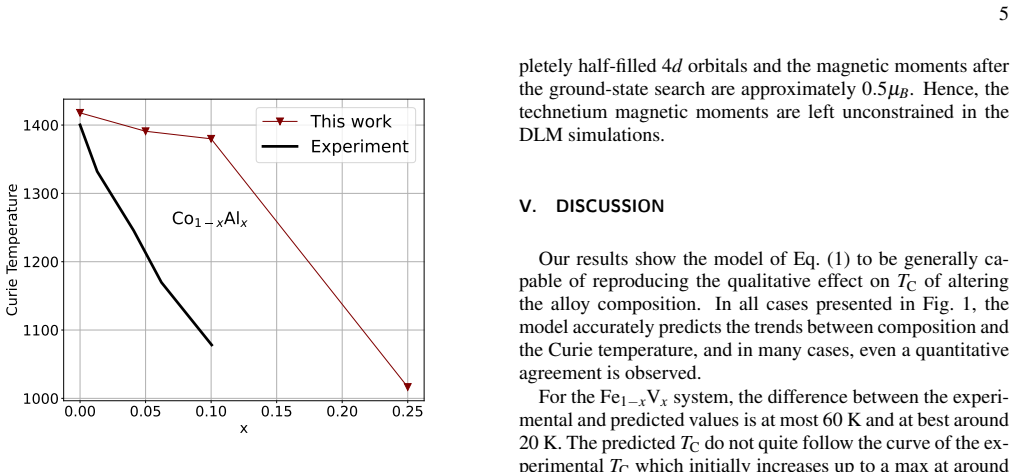
The central claim is that Eq. (1), with the fixed constants $A=0.85$, $B=0.69$, $C=0.14$, and $D=124$ K, is generally capable of reproducing the qualitative dependence of the Curie temperature on alloy composition across diverse chemistries and crystal structures, and in several systems the absolute values are close to experiment. None of the seven alloys studied here belongs to the 32 materials used to fit those constants, so the agreement is presented as a transferability test. The formula $T_\text{C} = A(\Delta E/S_\text{mag})(1 - B/N_N^C) + D$ K ties the ordering temperature to the energy penalty for magnetic disorder, divided by the magnetic entropy, corrected by the number of nearest magnetic neighbors, and offset by a constant floor. The paper's own agreement ranges from roughly 20-80 K for the Fe binaries to within about 170 K for the Heusler alloys, while fcc Co$_{1-x}$Al$_x$ clearly fails and Ti$_{1-x}$Cr$_x$N is overestimated because its low $T_\text{C}$ approaches the model's 124 K lower limit.
Load-bearing premise
The load-bearing premise is that one DLM supercell with near-zero spin short-range order, a fixed 0.75 $\mu_B$ threshold for constraining moments, and the four fitted constants faithfully represent the paramagnetic state of every tested chemistry; the paper's own hand-adjusted exemptions for chromium and vanadium moments show where that premise is strained.
Editorial extensions
If this is right
- For the six families with experimental data, the model returns the correct sign of $\partial T_\text{C}/\partial x$ in every case, so it can rank compositions by magnetic ordering temperature before synthesis.
- The fixed parameters mean each new alloy family is an independent test; the observed agreement within about 170 K across Heusler alloys and Fe binaries indicates the model is not being re-fit per system.
- The failure on fcc Co$_{1-x}$Al$_x$ and the too-high values for Ti$_{1-x}$Cr$_x$N delimit the method's domain: robust local moments and $T_\text{C}$ well above the 124 K floor.
- For Fe$_{1-x}$Tc$_x$, the predicted drop in $T_\text{C}$ with technetium content is a concrete, testable experimental target, despite the radioactivity of Tc.
Reading between the lines
- A natural next stress test is an ordered intermetallic or a strongly localized-moment oxide, where the single-DLM-configuration approximation is less demanding; if Eq. (1) holds there, the entropy and neighbor-count terms are doing genuinely physical work rather than absorbing the fit.
- The predicted Fe$_{1-x}$Tc$_x$ curve could be sharpened by repeating one composition with several independent SQS cells and DLM configurations; if the scatter exceeds the roughly 50 K drop the model predicts, the trend is not yet a robust target.
- The manual exemptions for Cr and V moments suggest a principled extension: an itinerancy-aware constraint threshold, or a separately parameterized DLM moment magnitude, could remove the convergence-related exceptions and let the model speak for systems like Fe-V and Co-Al.
Editorial analysis
A structured set of objections, weighed in public.
Referee Report
Summary. This paper applies a previously developed four-parameter model, Eq. (1), to predict the Curie temperature of seven substitutionally disordered alloy systems (Fe-Co, Fe-Cr, Fe-V, Ni-Cu-MnSb, Ni-MnSb, Ti-Cr-N, and Co-Al), comparing the predictions with experimental values and also presenting a prediction for the experimentally unexplored Fe-Tc system. The model, with parameters A=0.85, B=0.69, C=0.14, and D=124 K fitted to 32 known magnets in an earlier work (Ref. 20), uses the DLM-ground-state energy difference, a magnetic-entropy term, and the number of nearest magnetic neighbors. The authors report qualitative agreement with the composition dependence of TC in most systems, some quantitative agreement, and explicitly discuss cases where the model fails (Co-Al) or where the standard workflow had to be altered (unconstrained Cr/V moments in Fe-Cr and Fe-V, modified λ schedule for Co-Al). The central claim is that the method is broadly applicable with less hands-on adjustment than competing approaches.
Significance. If the central claim is supported, the model provides a computationally efficient, out-of-sample screening tool for alloy Curie-temperature trends, complementing more expensive Heisenberg-based methods and potentially guiding experimental alloy design. The work has several strengths: none of the tested alloys are in the 32-material fitting set, so the test is genuinely out-of-sample; the authors are unusually honest in reporting the Co-Al failure and the workflow modifications; the Fe-Tc prediction is a falsifiable experimental target; and the Python scripts for data extraction are openly available. The main reservation is that the evidence for 'broad applicability requiring less hands-on adjustments' is weakened by the very exceptions the paper acknowledges, and at least one of the claimed qualitative successes (Fe-V) does not actually reproduce the experimental composition trend.
major comments (3)
- [Sec. V and Table I] The central claim that the model reproduces 'the qualitative effect on TC of altering the alloy composition' is contradicted by the Fe1-xVx results. From x=0.125 to x=0.25, the experimental TC decreases (1111 K to 1053 K), while the predicted TC increases (1053 K to 1091 K). The text in Sec. V states that 'our method correctly predicts this observation' and attributes the discrepancy to the changes being 'minimal,' but the predicted slope has the opposite sign to the experimental slope. This is a qualitative failure, not a quantitative offset. The discussion should explicitly acknowledge this and explain why the model nevertheless is considered to capture the trend.
- [Sec. IV A and Sec. V] The unconstrained Cr and V moments in Fe1-xCrx and Fe1-xVx break the prescribed workflow of Sec. II C, and the good agreement for these systems is therefore not a clean out-of-sample test of Eq. (1). Because Cr and V are not constrained in the DLM runs, they are excluded from the magnetic entropy in Eq. (2), while their moment collapse (e.g., Cr from 1.3 to 0.2 μB at x=0.125) contributes to the energy difference ΔE in a way that a constrained run would not. A control calculation with constrained Cr/V moments, or a sensitivity analysis showing how TC depends on the choice of constraint, is needed to establish that the agreement is not fortuitous.
- [Abstract and Sec. V] The abstract's claim that the method requires 'less hands-on adjustments compared to other theoretical approaches' is overstated given the manual interventions described in the paper: the 0.75 μB moment threshold is relaxed for Cr and V in Fe-Cr and Fe-V, and the λ schedule is modified for Co-Al. These are exactly the type of system-specific adjustments the method aims to avoid. Please either soften the claim to accurately reflect the observed level of intervention, or provide a quantitative measure of the manual tuning needed per system.
minor comments (4)
- [Fig. 3 caption] The word 'cobolt' in the caption of Fig. 3 should be 'cobalt'.
- [Sec. II A] The description of the parameter fit states that 'A linear fit to the experimental TC subsequently gives the parameters A and D,' but it does not specify which experimental data are used; a cross-reference to Ref. 20 would clarify the procedure.
- [Sec. IV A] The legend in Fig. 1 lists 'This work' three times, which is redundant and could be simplified to a single entry or a note explaining that all filled symbols are from this work.
- [Sec. III] The details of the SQS supercells (size, number of configurations, and generated k-points) are not fully specified, which limits reproducibility; providing the SQS parameters or a reference to the generation code would be helpful.
Circularity Check
No significant circularity: the model is a fixed, previously fitted formula applied out-of-sample.
full rationale
The paper does not derive Eq. (1) in this work; it applies a fixed model whose parameters A=0.85, B=0.69, C=0.14, and D=124 K were fitted in Ref. 20 to a disjoint set of materials. The paper explicitly states: "None of the alloys investigated in the present work are included among the 32 systems used to obtain the fitting parameters of Eq. (1) and can thus be seen as a critical test of its generality." Each predicted TC is therefore an out-of-sample evaluation of a fixed formula, built from DFT-derived inputs (Delta E, S_mag, N_N) that are computed for the alloy in question and compared against independent experimental data. The self-citation to Ref. 20 is load-bearing for the model form, but that prior publication is independently published and externally calibrated, and no uniqueness theorem or unverified same-author result is invoked to force the present choice. The acknowledged limitations in Sec. V, namely the unconstrained Cr/V moments in Fe-Cr and Fe-V, the 124 K lower bound for Ti-Cr-N, and the itinerant-magnetism failure for Co-Al, are stated caveats that weaken specific comparisons but do not make the predictions identical to their inputs or to the fitted data. No step in the derivation chain reduces, by construction, to the fitted parameters or to the experimental TC values being reproduced.
Assumptions & free parameters
free parameters (5)
- A =
0.85
- B =
0.69
- C =
0.14
- D =
124 K
- Magnetic moment threshold =
0.75 μB
assumptions (5)
- domain assumption DFT with the PBE functional and PAW potentials gives accurate total energies and magnetic moments for the studied alloys.
- domain assumption A single DLM supercell with SRO close to zero adequately represents the paramagnetic state.
- domain assumption SQS supercells represent substitutional disorder at each composition.
- standard math The mean-field relation TC ∝ (EDLM - EFM)/Smag is a valid approximation for the studied systems.
- ad hoc to paper The functional form (1 - B/NN^C) transfers to alloy systems outside the 32-material fitting set.
Cite this review
Pith. "Pith review of Predicting the Curie temperature in substitutionally disordered alloys using a first-principles based model." pith.science (2026). https://pith.science/paper/7WJDXQLP
@misc{pith2026241204920,
  author       = {Pith},
  title        = {Pith review of: Predicting the Curie temperature in substitutionally disordered alloys using a first-principles based model},
  year         = {2026},
  howpublished = {\url{https://pith.science/paper/7WJDXQLP}},
  note         = {Machine review of arXiv:2412.04920}
}
abstract
When exploring new magnetic materials, the effect of alloying plays a crucial role for numerous properties. By altering the alloy composition, it is possible to tailor, e.g., the Curie temperature ($T_\text{C}$). In this work, $T_\text{C}$ of various alloys is investigated using a previously developed technique [Br\"{a}nnvall et al. Phys. Rev. Mat. (2024)] designed for robust predictions of $T_\text{C}$ across diverse chemistries and structures. The technique is based on density functional theory calculations and utilizes the energy difference between the magnetic ground state and the magnetically disordered paramagnetic state. It also accounts for the magnetic entropy in the paramagnetic state and the number of nearest magnetic neighbors. The experimentally known systems, Fe$_{1-x}$Co$_x$, Fe$_{1-x}$Cr$_x$, Fe$_{1-x}$V$_x$, NiMnSb-based Heusler alloys, Ti$_{1-x}$Cr$_x$N, and Co$_{1-x}$Al$_x$ are investigated. The experimentally unexplored system Fe$_{1-x}$Tc$_x$ is also tested to demonstrate the usefulness of the developed method in guiding future experimental efforts. This work demonstrates the broad applicability of the developed method across various systems, requiring less hands-on adjustments compared to other theoretical approaches.
Figures

Figures from the paper (2 more)


Reference graph
Works this paper leans on
-
[1]
O. Haglund, Curie temperature of alloys, its measurement and technical importance http://link.springer.com/10.1007/BF01913052, Journal of Thermal Analysis 25 (1) (1982) 21--43. https://doi.org/10.1007/BF01913052 doi:10.1007/BF01913052 . ://link.springer.com/10.1007/BF01913052
-
[3]
J. Rusz, L. Bergqvist, J. Kudrnovský, I. Turek, https://link.aps.org/doi/10.1103/PhysRevB.73.214412 Exchange interactions and Curie temperatures in Ni 2-x MnSb alloys: First -principles study , Physical Review B 73 (21) (2006) 214412, publisher: American Physical Society. https://doi.org/10.1103/PhysRevB.73.214412 doi:10.1103/PhysRevB.73.214412 . ://link....
-
[4]
M. Le z ai\' c , P. Mavropoulos, S. Bl\" u gel, First-principles prediction of high Curie temperature for ferromagnetic bcc- Co and bcc- FeCo alloys and its relevance to tunneling magnetoresistance, Applied Physics Letters 90 (8) (2007) 082504. https://doi.org/10.1063/1.2710181 doi:10.1063/1.2710181
-
[5]
B. Alling, A. V. Ruban, I. A. Abrikosov, https://link.aps.org/doi/10.1103/PhysRevB.79.134417 Effect of thermal expansion, electronic excitations, and disorder on the Curie temperature of Ni 1-x Cu x Mn Sb alloys , Physical Review B 79 (13) (2009) 134417, publisher: American Physical Society. https://doi.org/10.1103/PhysRevB.79.134417 doi:10.1103/PhysRevB....
-
[6]
B. Alling, https://link.aps.org/doi/10.1103/PhysRevB.82.054408 Theory of the ferromagnetism in Ti 1-x Cr x N solid solutions , Physical Review B 82 (5) (2010) 054408, publisher: American Physical Society. https://doi.org/10.1103/PhysRevB.82.054408 doi:10.1103/PhysRevB.82.054408 . ://link.aps.org/doi/10.1103/PhysRevB.82.054408
-
[7]
S. V. Halilov, H. Eschrig, A. Y. Perlov, P. M. Oppeneer, Adiabatic spin dynamics from spin-density-functional theory: Application to Fe , Co , and Ni , Physical Review B 58 (1) (1998) 293--302. https://doi.org/10.1103/PhysRevB.58.293 doi:10.1103/PhysRevB.58.293
-
[8]
J. K\" u bler, https://dx.doi.org/10.1088/0953-8984/18/43/003 Ab initio estimates of the Curie temperature for magnetic compounds , Journal of Physics: Condensed Matter 18 (43) (2006) 9795. https://doi.org/10.1088/0953-8984/18/43/003 doi:10.1088/0953-8984/18/43/003 . ://dx.doi.org/10.1088/0953-8984/18/43/003
-
[9]
J. Rusz, I. Turek, M. Divi s , Ab initio calculations of Curie temperatures in GdX compounds, Journal of Alloys and Compounds 408-412 (2006) 930--933. https://doi.org/10.1016/j.jallcom.2004.12.099 doi:10.1016/j.jallcom.2004.12.099
Show all 59 references
-
[10]
T. Zelai, First principle study of Curie temperature, spin polarization, ferromagnetism and transport behavior of Sr 2 Cr X O 6 ( X = Ta , W , Re , Os ) for spintronic, Journal of Alloys and Compounds 968 (2023) 172043. https://doi.org/10.1016/j.jallcom.2023.172043 doi:10.1016...
2023
-
[11]
Nelson, S
J. Nelson, S. Sanvito, https://link.aps.org/doi/10.1103/PhysRevMaterials.3.104405 Predicting the Curie temperature of ferromagnets using machine learning , Physical Review Materials 3 (10) (2019) 104405, publisher: American Physical Society. https://doi.org/10.1103/PhysRevMate...
2019 doi
-
[12]
J. F. Belot, V. Taufour, S. Sanvito, G. L. W. Hart, https://doi.org/10.1063/5.0156377 Machine learning predictions of high- Curie -temperature materials , Applied Physics Letters 123 (4) (2023) 042405. https://doi.org/10.1063/5.0156377 doi:10.1063/5.0156377 . ://doi.org/10.106...
2023 doi
-
[13]
H. C. Dam, V. C. Nguyen, T. L. Pham, A. T. Nguyen, K. Terakura, T. Miyake, H. Kino, https://journals.jps.jp/doi/10.7566/JPSJ.87.113801 Important Descriptors and Descriptor Groups of Curie Temperatures of Rare -earth Transition -metal Binary Alloys , Journal of the Physical Soc...
2018 doi
-
[14]
T. Long, N. M. Fortunato, Y. Zhang, O. Gutfleisch, H. Zhang, https://doi.org/10.1080/21663831.2020.1863876 An accelerating approach of designing ferromagnetic materials via machine learning modeling of magnetic ground state and Curie temperature , Materials Research Letters 9 ...
2021
-
[15]
S. Lu, Q. Zhou, Y. Guo, J. Wang, https://www.sciencedirect.com/science/article/pii/S2451929421005805 On-the-fly interpretable machine learning for rapid discovery of two-dimensional ferromagnets with high Curie temperature , Chem 8 (3) (2022) 769--783. https://doi.org/10.1016/...
2022 doi
-
[16]
Nguyen, T.-L
D.-N. Nguyen, T.-L. Pham, V.-C. Nguyen, H. Kino, T. Miyake, H.-C. Dam, https://dx.doi.org/10.1088/2515-7639/ab1738 Ensemble learning reveals dissimilarity between rare-earth transition-metal binary alloys with respect to the Curie temperature , Journal of Physics: Materials 2 ...
2019 doi
-
[17]
G. Xu, F. Cheng, H. Lu, C. Hou, X. Song, https://www.sciencedirect.com/science/article/pii/S1359645424003781 Predicting the Curie temperature of Sm - Co -based alloys via data-driven strategy , Acta Materialia 274 (2024) 120026. https://doi.org/10.1016/j.actamat.2024.120026 do...
2024
-
[18]
X. Hu, Y. Zhang, S. Fan, X. Li, Z. Zhao, C. He, Y. Zhao, Y. Liu, W. Xie, https://dx.doi.org/10.1088/1361-648X/ab6e96 Searching high spin polarization ferromagnet in Heusler alloy via machine learning , Journal of Physics: Condensed Matter 32 (20) (2020) 205901, publisher: IOP ...
2020 doi
-
[19]
X. Zhai, M. Chen, W. Lu, https://www.sciencedirect.com/science/article/pii/S0927025618302726 Accelerated search for perovskite materials with higher Curie temperature based on the machine learning methods , Computational Materials Science 151 (2018) 41--48. https://doi.org/10....
2018 doi
-
[20]
Arale Br\" a nnvall, G
M. Arale Br\" a nnvall, G. Persson, L. Casillas-Trujillo, R. Armiento, B. Alling, Predicting the Curie temperature of magnetic materials with automated calculations across chemistries and structures, Physical Review Materials 8 (11) (2024) 114417. https://doi.org/10.1103/PhysR...
2024 doi
-
[21]
Alling, T
B. Alling, T. Marten, I. A. Abrikosov, https://link.aps.org/doi/10.1103/PhysRevB.82.184430 Effect of magnetic disorder and strong electron correlations on the thermodynamics of CrN , Physical Review B 82 (18) (2010) 184430, publisher: American Physical Society. https://doi.org...
2010 doi
-
[22]
B. L. Gyorffy, A. J. Pindor, J. Staunton, G. M. Stocks, H. Winter, A first-principles theory of ferromagnetic phase transitions in metals, Journal of Physics F: Metal Physics 15 (6) (1985) 1337--1386. https://doi.org/10.1088/0305-4608/15/6/018 doi:10.1088/0305-4608/15/6/018
1985 doi
-
[23]
A. Ehn, B. Alling, I. A. Abrikosov, https://link.aps.org/doi/10.1103/PhysRevB.107.104422 First-principles theory of the pressure-induced invar effect in FeNi alloys , Physical Review B 107 (10) (2023) 104422, publisher: American Physical Society. https://doi.org/10.1103/PhysRe...
2023 doi
-
[24]
J. A. Nelder, R. Mead, https://doi.org/10.1093/comjnl/7.4.308 A Simplex Method for Function Minimization , The Computer Journal 7 (4) (1965) 308--313. https://doi.org/10.1093/comjnl/7.4.308 doi:10.1093/comjnl/7.4.308 . ://doi.org/10.1093/comjnl/7.4.308
1965 doi
-
[25]
Turek, J
I. Turek, J. Kudrnovsk, G. Bihlmayer, S. Bl gel, Ab initio theory of exchange interactions and the Curie temperature of bulk Gd , Journal of Physics: Condensed Matter 15 (17) (2003) 2771--2782. https://doi.org/10.1088/0953-8984/15/17/327 doi:10.1088/0953-8984/15/17/327
2003 doi
-
[27]
Bergqvist, P
L. Bergqvist, P. H. Dederichs, A theoretical study of half-metallic antiferromagnetic diluted magnetic semiconductors https://dx.doi.org/10.1088/0953-8984/19/21/216220, Journal of Physics: Condensed Matter 19 (21) (2007) 216220. https://doi.org/10.1088/0953-8984/19/21/216220 d...
2007 doi
-
[28]
Zunger, S.-H
A. Zunger, S.-H. Wei, L. G. Ferreira, J. E. Bernard, Special quasirandom structures https://link.aps.org/doi/10.1103/PhysRevLett.65.353, Physical Review Letters 65 (3) (1990) 353--356, publisher: American Physical Society. https://doi.org/10.1103/PhysRevLett.65.353 doi:10.1103...
1990 doi
-
[29]
P.-W. Ma, S. L. Dudarev, Constrained density functional for noncollinear magnetism https://link.aps.org/doi/10.1103/PhysRevB.91.054420, Physical Review B 91 (5) (2015) 054420. https://doi.org/10.1103/PhysRevB.91.054420 doi:10.1103/PhysRevB.91.054420 . ://link.aps.org/doi/10.11...
2015 doi
-
[30]
Kresse, J
G. Kresse, J. Hafner, https://link.aps.org/doi/10.1103/PhysRevB.47.558 Ab initio molecular dynamics for liquid metals , Physical Review B 47 (1) (1993) 558--561. https://doi.org/10.1103/PhysRevB.47.558 doi:10.1103/PhysRevB.47.558 . ://link.aps.org/doi/10.1103/PhysRevB.47.558
1993 doi
-
[31]
Kresse, J
G. Kresse, J. Hafner, Ab initio molecular-dynamics simulation of the liquid-metal–amorphous-semiconductor transition in germanium, Physical Review B 49 (20) (1994) 14251--14269. https://doi.org/10.1103/PhysRevB.49.14251 doi:10.1103/PhysRevB.49.14251
1994 doi
-
[32]
Kresse, J
G. Kresse, J. Furthm\"uller, Efficiency of ab-initio total energy calculations for metals and semiconductors using a plane-wave basis set, Computational Materials Science 6 (1) (1996) 15--50. https://doi.org/10.1016/0927-0256(96)00008-0 doi:10.1016/0927-0256(96)00008-0
1996 doi
-
[33]
Kresse, J
G. Kresse, J. Furthmüller, Efficient iterative schemes for ab initio total-energy calculations using a plane-wave basis set, Physical Review B 54 (16) (1996) 11169--11186. https://doi.org/10.1103/PhysRevB.54.11169 doi:10.1103/PhysRevB.54.11169
1996 doi
-
[34]
P. E. Blöchl, Projector augmented-wave method, Physical Review B 50 (24) (1994) 17953--17979. https://doi.org/10.1103/PhysRevB.50.17953 doi:10.1103/PhysRevB.50.17953
1994 doi
-
[35]
Kresse, D
G. Kresse, D. Joubert, From ultrasoft pseudopotentials to the projector augmented-wave method, Physical Review B 59 (3) (1999) 1758--1775. https://doi.org/10.1103/PhysRevB.59.1758 doi:10.1103/PhysRevB.59.1758
1999 doi
-
[36]
J. P. Perdew, K. Burke, M. Ernzerhof, Generalized Gradient Approximation Made Simple , Physical Review Letters 77 (18) (1996) 3865--3868. https://doi.org/10.1103/PhysRevLett.77.3865 doi:10.1103/PhysRevLett.77.3865
1996 doi
-
[37]
H. J. Monkhorst, J. D. Pack, Special points for Brillouin -zone integrations, Physical Review B 13 (12) (1976) 5188--5192. https://doi.org/10.1103/PhysRevB.13.5188 doi:10.1103/PhysRevB.13.5188
1976 doi
-
[38]
Nishizawa, K
T. Nishizawa, K. Ishida, http://link.springer.com/10.1007/BF02868548 The Co - Fe ( Cobalt - Iron ) system , Bulletin of Alloy Phase Diagrams 5 (3) (1984) 250--259. https://doi.org/10.1007/BF02868548 doi:10.1007/BF02868548 . ://link.springer.com/10.1007/BF02868548
1984 doi
-
[39]
Stuart, N
H. Stuart, N. Ridley, Lattice parameters and curiepoint anomalies of iron-cobalt alloys, Brit. J. Appl. Phys. 485 (2) (1969)
1969
-
[40]
A. S. Normamnton, P. E. Bloomfield, F. R. Sale, B. B. Argent, A calorimetric study ofiron-cobalt alloys, Met. Sci. 510 (9) (1975)
1975
-
[41]
J. F. Smith, https://doi.org/10.1007/BF02868958 The Fe - V ( Iron - Vanadium ) system , Bulletin of Alloy Phase Diagrams 5 (2) (1984) 184--194. https://doi.org/10.1007/BF02868958 doi:10.1007/BF02868958 . ://doi.org/10.1007/BF02868958
1984 doi
-
[42]
Portevin, Rev
A. Portevin, Rev. Metall 6 (1909) 1352--1355
1909
-
[43]
Honda, Ann
K. Honda, Ann. Phys. 32 (1910) 1010--1011
1910
-
[44]
Maurer, Stahl Eisen 45 (1925) 1629--1632
E. Maurer, Stahl Eisen 45 (1925) 1629--1632
1925
-
[45]
Oya, Sci
M. Oya, Sci. Res. Inst. Tohoku Univ. 19 (1930) 235--245
1930
-
[46]
Wever, W
F. Wever, W. Jellinghaus, Mitt. Kaiser-Wilhelm Inst. Eisenforsch. D\"usseldorf 12 (1930) 317--322
1930
-
[47]
Vogel, E
R. Vogel, E. Martin, Arch. Eisenh\"uttenwes. 4 (1931) 487--495
1931
-
[48]
H. H. Abram, J. Iron Steel Inst. 130 (1934) 351--375
1934
-
[49]
Fallot, Ann
M. Fallot, Ann. Phys. 6 (1936) 305--387
1936
-
[50]
H. P. J. Wijn (Ed.), http://materials.springer.com/bp/docs/978-3-540-44932-4 3d, 4d and 5d Elements , Alloys and Compounds , Vol. 32A of Landolt- B\"ornstein - Group III Condensed Matter , Springer-Verlag, Berlin/Heidelberg, 1997. https://doi.org/10.1007/b52851 doi:10.1007/b52...
1997 doi
-
[51]
S. K. Ren, W. Q. Zou, J. Gao, X. L. Jiang, F. M. Zhang, Y. W. Du, Magnetic behavior of half- Heusler alloy Cu x Ni 1-x MnSb , Journal of Magnetism and Magnetic Materials 288 (2005) 276--281
2005
-
[52]
Neibecker, X
P. Neibecker, X. Xu, D. Simonne, L. Hollender, F. Porcher, A. Senyshyn, T. Omori, R. Kainuma, W. Petry, M. Leitner, https://onlinelibrary.wiley.com/doi/abs/10.1002/pssb.202100174 Atomic Order Along the Half - to Full - Heusler Transition in Ni1 + MnSb , physica status solidi (...
2022 doi
-
[53]
Inumaru, K
K. Inumaru, K. Koyama, Y. Miyaki, K. Tanaka, S. Yamanaka, https://doi.org/10.1063/1.2776853 Ferromagnetic Cr x Ti 1-x N solid solution nitride thin films grown by pulsed laser deposition and their magnetoresistance , Applied Physics Letters 91 (15) (2007) 152501. https://doi.o...
2007 doi
-
[54]
P. J. Webster, https://etheses.whiterose.ac.uk/14605/ The magnetic and chemical structures of the Heusler alloys. , phd, University of Sheffield (1968). ://etheses.whiterose.ac.uk/14605/
1968
-
[55]
Szytu a, A
A. Szytu a, A. Ko dziejczyk, H. R\. z any, J. Todorovi\' c , A. Wanic, https://onlinelibrary.wiley.com/doi/abs/10.1002/pssa.2210110105 Atomic and magnetic structure of the Heusler alloys Ni 2 MnSb , Ni 2 MnSn , and Co 2 MnSn , physica status solidi (a) 11 (1) (1972) 57--65. ht...
1972 doi
-
[56]
P. J. Webster, R. M. Mankikar, https://www.sciencedirect.com/science/article/pii/0304885384901136 Chemical order and magnetic properties of the Ni 2-x MnSb system , Journal of Magnetism and Magnetic Materials 42 (3) (1984) 300--308. https://doi.org/10.1016/0304-8853(84)90113-6...
1984
-
[57]
M. I. Aivazov, S. V. Gurov, https://www.osti.gov/biblio/7185472 Magnetic properties of solid solutions in the systems TiN -- CrN and VN -- CrN , Inorg. Mater. (USSR) (Engl. Transl.); (United States) 11:8, institution: Inst. of New Chemical Problems, Moscow (Aug. 1975). ://www....
1975
-
[58]
A. J. McAlister, https://doi.org/10.1007/BF02877635 The Al - Co ( Aluminum - Cobalt ) system , Bulletin of Alloy Phase Diagrams 10 (6) (1989) 646--650. https://doi.org/10.1007/BF02877635 doi:10.1007/BF02877635 . ://doi.org/10.1007/BF02877635
1989 doi
-
[59]
o ttker, C. Paduani, J. D. Ardisson, M. I. Ioshida, https://onlinelibrary.wiley.com/doi/abs/10.1002/pssb.200302062 M\
W. E. P\" o ttker, C. Paduani, J. D. Ardisson, M. I. Ioshida, https://onlinelibrary.wiley.com/doi/abs/10.1002/pssb.200302062 M\" o ssbauer effect studies of disordered Fe - Ru alloys , physica status solidi (b) 241 (11) (2004) 2586--2593. https://doi.org/10.1002/pssb.200302062...
2004 doi
-
[60]
Arajs, Ferromagnetic Curie Temperatures of Iron Solid Solutions with Germanium , Silicon , Molybdenum , and Manganese , physica status solidi (b) 11 (1) (1965) 121--126
S. Arajs, Ferromagnetic Curie Temperatures of Iron Solid Solutions with Germanium , Silicon , Molybdenum , and Manganese , physica status solidi (b) 11 (1) (1965) 121--126. https://doi.org/10.1002/pssb.19650110110 doi:10.1002/pssb.19650110110
1965 doi
-
[61]
Cie\'slak, S
J. Cie\'slak, S. M. Dubiel, M. Reissner, J. Tobola, https://pubs.aip.org/jap/article/116/18/183902/992429/Discovery-and-characterization-of-magnetism-in Discovery and characterization of magnetism in sigma-phase intermetallic Fe - Re compounds , Journal of Applied Physics 116 ...
2014 doi
Reviewed August 11, 2026 · model on record in the stance chip above.
Discussion (0). Continue with ORCID to comment.