REVIEW 4 major objections 5 minor 39 references
Prediction of Activity Coefficients by Similarity-Based Imputation using Quantum-Chemical Descriptors
T0 review · 4 major / 5 minor · reviewed 2026-08-11 · deepseek-v4-flash
Pith's one-line read Similarity-based imputation with quantum-chemical descriptors predicts infinite-dilution activity coefficients more accurately than modified UNIFAC and COSMO-SAC-dsp on the same dataset.
desk verdict A clean, simple imputation idea that is plausibly useful, but the headline comparison to UNIFAC/COSMO-SAC is not out-of-sample because hyperparameters are tuned on the same data; needs nested resampling before the central claim is established. read the letter →
The pith
A machine-rendered reading of the paper's core claim, the machinery that carries it, and where it could break.
The reading
What carries the argument
The load-bearing object is the similarity score $S_{mn}$ (Eq. 1), a number between 0 and 1 built from two pieces: $S^\sigma_{mn}$, the bin-wise overlap $\sum_k \min(\bar p_m(\sigma_k), \bar p_n(\sigma_k))$ of modified $\sigma$-profiles with polar regions optionally emphasized by $w_P$, and $S^A_{mn}$, the ratio of the smaller to the larger cavity surface area. These are combined with weight $w_\sigma$. A threshold $\xi$ selects which solvent or solute replacements count as similar, and the prediction is the arithmetic mean of the corresponding experimental $\ln\gamma^\infty_{ij}$ values from a leave-one-out training set. The score's role is to decide, for each unstudied pair, which measured mixtures are relevant enough to average.
What would settle it
A direct test would be to pick a solute-solvent pair whose most similar replacement in the database scores above $\xi$ but is known to interact via a specific mechanism the $\sigma$-profile overlap underweights, such as a hydrogen-bond donor/acceptor mismatch or steric shielding, and compare the SBM's averaged prediction with a fresh measurement at 298.15 K. More systematically, one could remove all alkanes from the training matrix and ask whether SBM predictions for alkane-containing mixtures degrade; if they stay accurate, the similarity score transfers, and if they collapse, the apparent performance is carried by dense similar neighbors rather than by the descriptor.
Extended reading notes
Core claim
The paper's central claim is that pairwise similarity of components, computed as a weighted overlap of polar-enhanced $\sigma$-profiles combined with surface-area ratio, is enough information to predict infinite-dilution activity coefficients by imputation. For a target solute $i$ and solvent $j$, the SBM collects experimental $\ln\gamma^\infty_{ij}$ values from mixtures where the other partner is replaced by a component with similarity above a threshold $\xi$, and averages them. In leave-one-out testing on the Dortmund Data Bank set of 3,568 points (221 solutes, 198 solvents), the method with $w_\sigma=0.6$, $w_P=2$ can be tuned so that, e.g., at $\xi=0.85$ it covers 3,301 points with MAE 0.30 versus COSMO-SAC-dsp's 3,199 points with MAE 0.61, and at $\xi=0.87$ it covers 3,115 points with MAE 0.27 versus modified UNIFAC (Dortmund)'s 2,987 points with MAE 0.33. The paper states that for every physical benchmark there is a threshold choice at which the SBM is both more accurate and broader in scope. The approach is presented as transferable to any binary mixture property for which a partially filled data matrix exists.
Load-bearing premise
The method assumes that two components with similar charge-density profiles and surface areas will behave similarly enough in any given partner that their measured activity coefficients can be averaged; if that similarity is not a reliable proxy, the imputed prediction inherits errors from chemically incompatible mixtures.
Editorial extensions
If this is right
- For the considered database and temperature, a user can choose $\xi$ to obtain a model that is simultaneously more accurate and broader in coverage than modified UNIFAC (Dortmund) or COSMO-SAC-dsp.
- Because only $\sigma$-profiles, surface areas, and an experimental data matrix are needed, the same imputation recipe applies to other binary properties such as excess enthalpies or vapor-liquid equilibria.
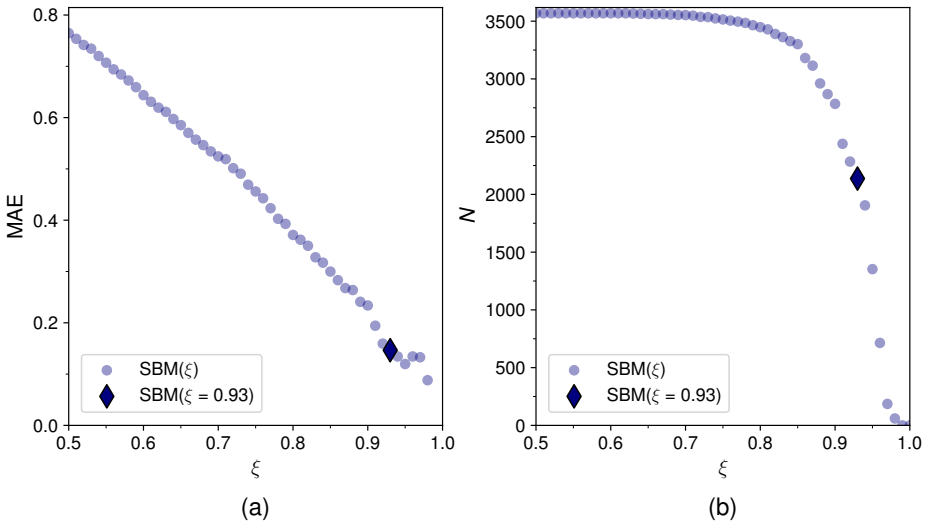
- At $\xi=0.93$, over half the database is predictable with most deviations within $\pm 0.1$ in $\ln\gamma^\infty_{ij}$, i.e. within common experimental uncertainty.
- The few highly similar neighbors per mixture mean targeted measurement of one representative system can yield accurate predictions for a cluster of systems, supporting proxy-substance strategies and design-of-experiments planning.
Reading between the lines
- A testable extension of the paper's logic is to run the SBM on a different property, such as excess enthalpy or infinite-dilution selectivity, with the same $w_\sigma=0.6$, $w_P=2$ weights; if the score is genuinely generic, the Pareto front should still beat group-contribution baselines.
- The paper's benchmark comparison leaves a gap for components with no close neighbor, with water as the highlighted example; a natural complement would be a hybrid that falls back on COSMO-SAC or UNIFAC when the nearest similarity score falls below threshold.
- Because leave-one-out only removes one mixture at a time, the reported accuracy tests interpolation within the existing database coverage; performance on entirely new chemical classes, where similarity to known components is low, is not yet measured and is the main extrapolation risk.
- The similarity matrix itself could be used to select the next measurements that most increase matrix coverage, so the method couples naturally to an active-learning loop.
Editorial analysis
A structured set of objections, weighed in public.
Referee Report
Summary. The paper introduces a similarity-based method (SBM) for predicting infinite-dilution activity coefficients ln γ_ij^∞ of binary mixtures. The similarity between two components is computed from COSMO σ-profiles and surface areas via a weighted overlap measure (Eqs. 1–6), and the activity coefficient of a target mixture is predicted by arithmetically averaging the experimental values of mixtures that share one component with the target and whose other component has a similarity above a threshold ξ. Using leave-one-out validation on 3,568 DDB datapoints (221 solutes, 198 solvents at 298.15 K), the authors select hyperparameters w_σ, w_P, and ξ by grid search and report that some SBM variant outperforms modified UNIFAC (Dortmund), COSMO-SAC, and COSMO-SAC-dsp in both accuracy (MAE) and scope. The method is presented as generic and transferable to other binary-mixture properties.
Significance. If the reported performance survives a properly nested evaluation, the SBM would be a useful, conceptually simple baseline for mixture-property prediction: it requires only σ-profiles (available from the open-source Bell et al. database), involves no regression on the target values, and is transparent about the accuracy/scope trade-off controlled by ξ. The paper's strengths include a clearly specified algorithm, a leave-one-out protocol that genuinely removes the target value from the averaging step (so there is no direct leakage of the target into its own prediction), open quantum-chemical descriptors, and an honest acknowledgment that the physical benchmark models may have seen parts of the training data. The main weakness is that the hyperparameters and the threshold ξ are selected on the same data that are then used for the headline benchmark comparison, so the reported MAE values are in-sample statistics of a model-selection procedure; this is the load-bearing issue that must be addressed before the central claim can be accepted.
major comments (4)
- [Results and Discussion, 'Overall Performance of Different Similarity-Based Methods' and Fig. 4] The procedure selects w_σ and w_P on the full DDB set using the leave-one-out MAE/scope computed from that same set (Fig. 3, 'Studied Model Variants', Eqs. 1 and 4), and then sweeps ξ on the same full set and quotes favorable operating points (ξ = 0.85, 0.87, 0.62) as evidence for the headline claim. Because every target value contributes both to model selection and to the reported error, the quoted MAE values are optimistic in-sample estimates of the whole procedure. The statement 'one can always find an SBM variant (by varying ξ) that outperforms it' is an existential claim over a parameter tuned on the evaluation set and is therefore not established. Please re-run the evaluation with a nested scheme: select (w_σ, w_P) and ξ on a training portion (or use an inner CV), then report errors on an untouched test portion; alternatively, report the performance of an a-priori fixed rule for choosing ξ (e.g., a target scope). At a minimum, report the distribution of test-set MAE over multiple random splits to show that the advantage is not an artifact of the selection step.
- [Results and Discussion, 'Comparison to Physical Benchmark Models', Fig. 4] The headline comparisons are not made on a common subset of mixtures: at ξ = 0.85 the SBM covers N = 3,301 points while COSMO-SAC-dsp covers N = 3,199, and at ξ = 0.87 the SBM covers N = 3,115 versus N = 2,987 for modified UNIFAC (Dortmund). The MAE values are computed on different, only partially overlapping subsets, so a direct comparison of accuracy at different scopes is not apples-to-apples. The histograms later restrict all methods to the 1,748 common points, but that matched analysis is only shown for ξ = 0.93, not for the quoted operating points. Please report, for each ξ, the MAE of all methods on the intersection of their predictable sets (or on a fixed common set), and state which mixtures are excluded in each comparison; otherwise the combined claim of 'higher accuracy and broader scope' is not fully supported by the displayed numbers.
- [Results and Discussion, Fig. 5 and all reported MAE values] No uncertainty quantification is provided for any MAE or scope value. The quoted margins are small (e.g., 0.27 vs 0.33 against modified UNIFAC at ξ = 0.87, and 0.30 vs 0.61 against COSMO-SAC-dsp at ξ = 0.85), and the MAE values vary smoothly with ξ (Fig. 5a), so without confidence intervals (bootstrap over the leave-one-out residuals, or across repeated splits) the reader cannot assess whether the differences are significant. This is especially important because the model-selection bias discussed above and the differing subsets discussed in the previous comment both affect the magnitude of the reported gains. Please add standard errors or bootstrap confidence intervals to the MAE values in Figs. 3–5 and to the quoted numbers.
- [Supporting Information, Table S.1 and 'Outliers of Modified UNIFAC (Dortmund)'] The removal of eight outliers from modified UNIFAC (Dortmund) is statistically consequential: the MAE decreases from 0.6477 to 0.3340 after their removal. This filtering is reasonable and it actually makes the comparison harder for the SBM, but the criterion for outlier removal should be specified a priori (e.g., defined by a deviation threshold or by a documented DDB quality flag) rather than being applied only to the benchmark. Please also show the sensitivity of the comparison in Fig. 4 to including or excluding these eight points, and clarify whether any analogous outlier handling is applied to the SBM or to the COSMO variants. Without this, the benchmark comparison is not fully reproducible.
minor comments (5)
- [Fig. 4 caption] The caption contains the typo 'COMSO-SAC' (twice) for COSMO-SAC; please correct it, as it may confuse readers searching for the model name.
- [Similarity-Based Method, Eq. (6)] The moving-average window width (2 bins, corresponding to 0.002 e/Å^2) is a fixed hyperparameter that is not varied in the grid search; the paper should state explicitly that this choice was not optimized, or, if it was tested in preliminary studies, give the range explored.
- [Prediction of Activity Coefficients] Please clarify how predictions are formed when the target mixture has both similar solvents (same solute) and similar solutes (same solvent) with scores above ξ: is the final prediction a simple average over the union of all available neighboring mixtures, or is one side preferred? The description of the averaging step is ambiguous and affects the leave-one-out protocol.
- [Data Availability Statement] The DDB data are available only under license, so the full dataset cannot be shared. Please state whether the preprocessed data matrix (the 221 × 198 matrix used in the study) can be made available in a form that does not violate the DDB license, or provide a synthetic demonstration dataset so that the pipeline can be re-run by readers.
- [Results and Discussion, Fig. 5] In Fig. 5b the legend labels 'SBM(ξ)' and 'SBM(ξ = 0.93)' are redundant because the same line is plotted in both panels; consider labeling the highlighted operating point directly in the caption to avoid confusion.
Circularity Check
No circularity: SBM predictions are leave-one-out averages of experimental neighbors; hyperparameter selection is a statistical validity concern, not a definitional reduction.
full rationale
The central claim that SBM outperforms modified UNIFAC (Dortmund) and COSMO-SAC-dsp is an empirical benchmark, not a derivation from the method's inputs. For each held-out mixture, ln γ∞,pred_ij is computed as the arithmetic mean of experimental ln γ∞ values of the same solute/solvent with a similar partner (similarity via Eqs. (1)-(6) and the averaging rule); the held-out point is not used in its own prediction, so there is no self-definitional or fitted-input circularity. The hyperparameters wσ, wP, and ξ are selected on the same dataset, which makes the reported MAE-vs-scope curves in-sample (optimistically selected) estimates, but that is a statistical validity limitation, not a case where a prediction reduces to a fitted parameter by construction. No load-bearing argument relies on a self-citation: cited prior work of the authors concerns matrix completion and clustering used for context/visualization, and the quantum-chemical descriptors and benchmark implementations come from external open sources (Bell et al.). Accordingly, no circular step meets the evidentiary threshold.
Assumptions & free parameters
free parameters (4)
- w_sigma =
0.6
- w_P =
2
- xi =
0.93 for headline, otherwise user-adjustable
- Moving-average window width =
2 bins (0.002 e/Ų)
assumptions (4)
- domain assumption Similar components exhibit similar thermodynamic properties in mixtures (similia similibus solvuntur), stated as the foundation of the SBM.
- domain assumption Sigma-profiles and molecular surface areas from COSMO calculations are sufficient descriptors to capture similarity relevant to infinite-dilution activity coefficients.
- domain assumption The filtered DDB experimental data are reliable and representative after discarding undefined components and 'poor quality' sets, with medians taken for duplicates.
- domain assumption Leave-one-out error of the hyperparameter-selected model estimates out-of-sample performance.
Cite this review
Pith. "Pith review of Prediction of Activity Coefficients by Similarity-Based Imputation using Quantum-Chemical Descriptors." pith.science (2026). https://pith.science/paper/ZW3XQOEP
@misc{pith2026241204993,
  author       = {Pith},
  title        = {Pith review of: Prediction of Activity Coefficients by Similarity-Based Imputation using Quantum-Chemical Descriptors},
  year         = {2026},
  howpublished = {\url{https://pith.science/paper/ZW3XQOEP}},
  note         = {Machine review of arXiv:2412.04993}
}
abstract
In this work, we introduce a novel approach for predicting thermodynamic properties of binary mixtures, which we call the similarity-based method (SBM). The method is based on quantifying the pairwise similarity of components, which we achieve by comparing quantum-chemical descriptors of the components, namely $\sigma$-profiles. The basic idea behind the approach is that mixtures with similar pairs of components will have similar thermodynamic properties. The SBM is trained on a matrix that contains some data for a given property for different binary mixtures; the missing entries are then predicted by the SBM. As an example, we consider the prediction of isothermal activity coefficients at infinite dilution ($\gamma^\infty_{ij}$) and show that the SBM outperforms the well-established physical methods modified UNIFAC (Dortmund) and COSMO-SAC-dsp. In this case, the matrix is only sparsely occupied, and it is shown that the SBM works also if only a limited number of data for similar mixtures is available. The SBM idea can be transferred to any mixture property and is a powerful tool for generating essential data for many applications.
Figures


Figures from the paper (4 more)



Reference graph
Works this paper leans on
-
[1]
Approaches to Measure Chemical Similarity -- a Review
Nikolova, N.; Jaworska, J. Approaches to Measure Chemical Similarity -- a Review. QSAR & Combinatorial Science 2003, 22, 1006--1026
work page 2003
-
[2]
Stumpfe, D.; Bajorath, J. Similarity searching. WIREs Computational Molecular Science 2011, 1, 260--282
work page 2011
-
[3]
Flower, D. R. On the Properties of Bit String-Based Measures of Chemical Similarity. Journal of Chemical Information and Computer Sciences 1998, 38, 379--386
work page 1998
-
[4]
Fligner, M. A.; Verducci, J. S.; Blower, P. E. A Modification of the Jaccard--Tanimoto Similarity Index for Diverse Selection of Chemical Compounds Using Binary Strings. Technometrics 2002, 44, 110--119
work page 2002
-
[5]
Bajusz, D.; R \'a cz, A.; H \'e berger, K. Why is Tanimoto index an appropriate choice for fingerprint-based similarity calculations? Journal of Cheminformatics 2015, 7, 20
work page 2015
-
[6]
Raymond, J. W.; Willett, P. Effectiveness of graph-based and fingerprint-based similarity measures for virtual screening of 2D chemical structure databases. Journal of Computer-Aided Molecular Design 2002, 16, 59--71
work page 2002
-
[7]
Conductor-like Screening Model for Real Solvents: A New Approach to the Quantitative Calculation of Solvation Phenomena
Klamt, A. Conductor-like Screening Model for Real Solvents: A New Approach to the Quantitative Calculation of Solvation Phenomena. The Journal of Physical Chemistry 1995, 99, 2224--2235
1995
-
[8]
COSMOsim3D: 3D-similarity and alignment based on COSMO polarization charge densities
Thormann, M.; Klamt, A.; Wichmann, K. COSMOsim3D: 3D-similarity and alignment based on COSMO polarization charge densities. Journal of chemical information and modeling 2012, 52, 2149--2156
work page 2012
Show all 39 references
-
[9]
Thormann, M.; Traube, N.; Yehia, N.; Koestler, R.; Galabova, G.; MacAulay, N.; Toft-Bertelsen, T. L. Toward New AQP4 Inhibitors: ORI-TRN-002. International Journal of Molecular Sciences 2024, 25, 924
2024
-
[10]
Model Performances Evaluated for Infinite Dilution Activity Coefficients Prediction at 298.15 K
Brouwer, T.; Schuur, B. Model Performances Evaluated for Infinite Dilution Activity Coefficients Prediction at 298.15 K. Industrial & Engineering Chemistry Research 2019, 58, 8903--8914
2019
-
[11]
2023; www.ddbst.com
Dortmund Data Bank. 2023; www.ddbst.com
2023
-
[12]
Orbey, H.; Sandler, S. I. Relative measurements of activity coefficients at infinite dilution by gas chromatography. Industrial & Engineering Chemistry Research 1991, 30, 2006--2011
1991
-
[13]
Measuring methods of infinite dilution activity coefficients and a database for systems including water
Kojima, K.; Zhang, S.; Hiaki, T. Measuring methods of infinite dilution activity coefficients and a database for systems including water. Fluid Phase Equilibria 1997, 131, 145--179
1997
-
[14]
L.; Prausnitz, J
Fredenslund, A.; Jones, R. L.; Prausnitz, J. M. Group-contribution estimation of activity coefficients in nonideal liquid mixtures. AIChE Journal 1975, 21, 1086--1099
1975
-
[15]
Vapor - Liquid Equilibria by UNIFAC Group Contribution
Wittig, R.; Lohmann, J.; Gmehling, J. Vapor - Liquid Equilibria by UNIFAC Group Contribution. 6. Revision and Extension. Industrial & Engineering Chemistry Research 2003, 42, 183--188
2003
-
[16]
A modified UNIFAC model
Weidlich, U.; Gmehling, J. A modified UNIFAC model. 1. Prediction of VLE, hE, and .gamma..infin. Industrial & Engineering Chemistry Research 1987, 26, 1372--1381
1987
-
[17]
Further Development of Modified UNIFAC (Dortmund): Revision and Extension 6
Constantinescu, D.; Gmehling, J. Further Development of Modified UNIFAC (Dortmund): Revision and Extension 6. Journal of Chemical & Engineering Data 2016, 61, 2738--2748
2016
-
[18]
COSMO-RS: a novel and efficient method for the a priori prediction of thermophysical data of liquids
Klamt, A.; Eckert, F. COSMO-RS: a novel and efficient method for the a priori prediction of thermophysical data of liquids. Fluid Phase Equilibria 2000, 172, 43--72
2000
-
[19]
COSMO-RS: From quantum chemistry to fluid phase thermodynamics and drug design, 1st ed.; Elsevier: Amsterdam, 2005
Klamt, A. COSMO-RS: From quantum chemistry to fluid phase thermodynamics and drug design, 1st ed.; Elsevier: Amsterdam, 2005
2005
-
[20]
Lin, S.-T.; Sandler, S. I. A Priori Phase Equilibrium Prediction from a Segment Contribution Solvation Model. Industrial & Engineering Chemistry Research 2002, 41, 899--913
2002
-
[21]
I.; Lin, S.-T
Hsieh, C.-M.; Sandler, S. I.; Lin, S.-T. Improvements of COSMO-SAC for vapor--liquid and liquid--liquid equilibrium predictions. Fluid Phase Equilibria 2010, 297, 90--97
2010
-
[22]
Considering the dispersive interactions in the COSMO-SAC model for more accurate predictions of fluid phase behavior
Hsieh, C.-M.; Lin, S.-T.; Vrabec, J. Considering the dispersive interactions in the COSMO-SAC model for more accurate predictions of fluid phase behavior. Fluid Phase Equilibria 2014, 367, 109--116
2014
-
[23]
Perspective: Machine Learning of Thermophysical Properties
Jirasek, F.; Hasse, H. Perspective: Machine Learning of Thermophysical Properties. Fluid Phase Equilibria 2021, 549, 113206
2021
-
[24]
Combining Machine Learning with Physical Knowledge in Thermodynamic Modeling of Fluid Mixtures
Jirasek, F.; Hasse, H. Combining Machine Learning with Physical Knowledge in Thermodynamic Modeling of Fluid Mixtures. Annual review of chemical and biomolecular engineering 2023, 14, 31--51
2023
-
[25]
I.; Linke, S.; Stoll, M.; Sundmacher, K
Sanchez Medina , E. I.; Linke, S.; Stoll, M.; Sundmacher, K. Graph neural networks for the prediction of infinite dilution activity coefficients. Digital Discovery 2022, 1, 216--225
2022
-
[26]
A smile is all you need: predicting limiting activity coefficients from SMILES with natural language processing
Winter, B.; Winter, C.; Schilling, J.; Bardow, A. A smile is all you need: predicting limiting activity coefficients from SMILES with natural language processing. Digital Discovery 2022, 1, 859--869
2022
-
[27]
Jirasek, F.; Alves, R. A. S.; Damay, J.; Vandermeulen, R. A.; Bamler, R.; Bortz, M.; Mandt, S.; Kloft, M.; Hasse, H. Machine Learning in Thermodynamics: Prediction of Activity Coefficients by Matrix Completion. The journal of physical chemistry letters 2020, 11, 981--985
2020
-
[28]
Hybridizing physical and data-driven prediction methods for physicochemical properties
Jirasek, F.; Bamler, R.; Mandt, S. Hybridizing physical and data-driven prediction methods for physicochemical properties. Chemical Communications 2020, 56, 12407--12410
2020
-
[29]
Predicting Activity Coefficients at Infinite Dilution for Varying Temperatures by Matrix Completion
Damay, J.; Jirasek, F.; Kloft, M.; Bortz, M.; Hasse, H. Predicting Activity Coefficients at Infinite Dilution for Varying Temperatures by Matrix Completion. Industrial & Engineering Chemistry Research 2021, 60, 14564--14578
2021
-
[30]
SPT-NRTL: A physics-guided machine learning model to predict thermodynamically consistent activity coefficients
Winter, B.; Winter, C.; Esper, T.; Schilling, J.; Bardow, A. SPT-NRTL: A physics-guided machine learning model to predict thermodynamically consistent activity coefficients. Fluid Phase Equilibria 2023, 568, 113731
2023
-
[31]
Prediction of parameters of group contribution models of mixtures by matrix completion
Jirasek, F.; Hayer, N.; Abbas, R.; Schmid, B.; Hasse, H. Prediction of parameters of group contribution models of mixtures by matrix completion. Physical chemistry chemical physics : PCCP 2023, 25, 1054--1062
2023
-
[32]
G.; Felton, K
Rittig, J. G.; Felton, K. C.; Lapkin, A. A.; Mitsos, A. Gibbs--Duhem-informed neural networks for binary activity coefficient prediction. Digital Discovery 2023, 2, 1752--1767
2023
-
[33]
HANNA: Hard-constraint Neural Network for Consistent Activity Coefficient Prediction
Specht, T.; Nagda, M.; Fellenz, S.; Mandt, S.; Hasse, H.; Jirasek, F. HANNA: Hard-constraint Neural Network for Consistent Activity Coefficient Prediction. Chemical science 2024,
2024
-
[34]
Advancing Thermodynamic Group-Contribution Methods by Machine Learning: UNIFAC 2.0
Hayer, N.; Wendel, T.; Mandt, S.; Hasse, H.; Jirasek, F. Advancing Thermodynamic Group-Contribution Methods by Machine Learning: UNIFAC 2.0. http://arxiv.org/pdf/2408.05220
-
[35]
H.; Mickoleit, E.; Hsieh, C.-M.; Lin, S.-T.; Vrabec, J.; Breitkopf, C.; J \"a ger, A
Bell, I. H.; Mickoleit, E.; Hsieh, C.-M.; Lin, S.-T.; Vrabec, J.; Breitkopf, C.; J \"a ger, A. A Benchmark Open-Source Implementation of COSMO-SAC. Journal of Chemical Theory and Computation 2020, 16, 2635--2646
2020
-
[36]
Hastie, T.; Tibshirani, R.; Friedman, J. H. The elements of statistical learning: Data mining, inference, and prediction, second edition ed.; Springer Series in Statistics; Springer: New York, NY, 2017
2017
-
[37]
MATLAB version: 9.13.0 (R2022b)
The MathWorks Inc. MATLAB version: 9.13.0 (R2022b). 2022; https://www.mathworks.com
2022
-
[38]
CY-CH2"), while all of the relevant solvents contain main group 18 (
Gond, D.; Sohns, J.-T.; Leitte, H.; Hasse, H.; Jirasek, F. Hierarchical Matrix Completion for the Prediction of Properties of Binary Mixtures. http://arxiv.org/pdf/2410.06060 mcitethebibliography document 2_ESI.tex0000664000000000000000000003455314724567611011170 0ustar rootro...
-
[39]
Y p X_ 5eFҸU`'z xۥE4]IPyi +^פ doX 2ؤ꽀 g(?w ،Ue #x誯+Sߤ/ ӗ+ ;/ |# ^e k !z o9 ]ȟl
Hsieh, C.-M.; Sandler, S. I.; Lin, S.-T. Improvements of COSMO-SAC for vapor--liquid and liquid--liquid equilibrium predictions. Fluid Phase Equilibria 2010, 297, 90--97 mcitethebibliography document figures/0000775000000000000000000000000014724567246011243 5ustar rootrootfigu...
2010
Reviewed August 11, 2026 · model on record in the stance chip above.
Discussion (0). Continue with ORCID to comment.