REVIEW 3 major objections 6 minor 1 cited by
First experiences with the LHCb heterogeneous software trigger
T0 review · 3 major / 6 minor · reviewed 2026-08-11 · deepseek-v4-flash
Pith's one-line read LHCb now processes the full 30 MHz collision rate with a purely software trigger, and early 2022 mass peaks indicate the online output is already suitable for physics analyses.
desk verdict Operationally important status report from LHCb's RTA group, but the physics-readiness claim rests on a weak unbiasedness test and mostly on internal figures. read the letter →
The pith
A machine-rendered reading of the paper's core claim, the machinery that carries it, and where it could break.
The reading
What carries the argument
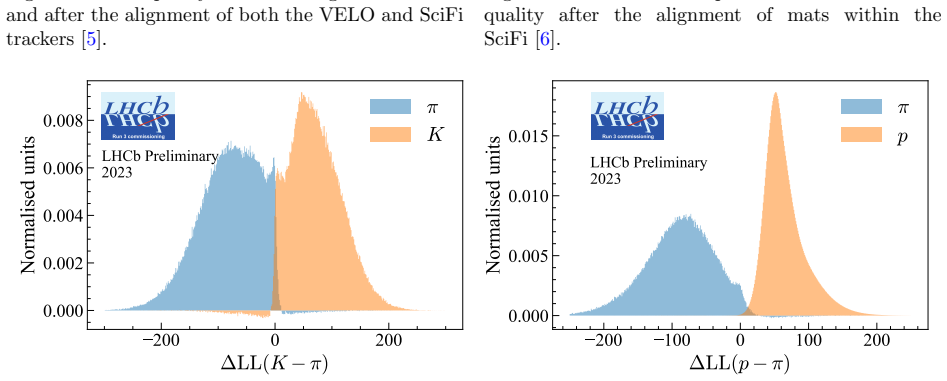
The load-bearing components are the HLT1 and HLT2 trigger stages and the Allen GPU framework that drives the first stage. HLT1 keeps throughput high by using simplified pattern recognition, with forward tracking and seeding-matching algorithms and a parameterized magnetic field, and by ignoring RICH information so that only muons, electrons, and photons receive dedicated PID at this stage. HLT2 reruns a CPU-transpiled HLT1 and then applies the full track fit and all PID information, giving it enough purity to make most analysis selections inside the trigger lines. The real-time alignment and calibration step closes a feedback loop: corrections computed from buffered data improve tracking and PID as data taking continues, and the improved detector description is used by both trigger stages. The visible mass peaks in the paper's figures are the evidence that this chain produces physics-quality objects rather than just a data-reduction system.
What would settle it
Recompute the $D^0$/$\bar{D}^0$ yields in the same inclusive HLT1 dataset after applying an unbiased offline reconstruction and selection; if a charge asymmetry or a selection-efficiency difference beyond the quoted statistical uncertainty appears, the claim that the trigger output is ready for physics would need to be revisited.
Extended reading notes
Core claim
The central claim is that LHCb has operated a two-stage, purely software trigger at the full 30 MHz LHC collision rate since 2022. HLT1, implemented on GPUs in the Allen framework, performs simplified reconstruction and filters events by a few dozen inclusive lines, reducing the rate by roughly a factor of 30 into a buffer; HLT2, running on CPUs, adds full tracking, RICH and muon PID, and applies many hundreds of exclusive selections, persisting mostly physics objects at about 10 GB/s instead of raw detector banks. The paper's demonstration is the early physics output: mass peaks for $K^0_S$, $D^0$, $D^{*+}$, $J/\psi$, $\psi(2S)$, and $B^+ \to (J/\psi \to e^+e^-) K^+$ reconstructed from online data, with the similar yields of $D^0$ and $\bar{D}^0$ in the inclusive HLT1 sample cited as evidence that the trigger selections are not biased. The conclusion drawn is that the real-time analysis chain has moved from design to operation and already produces data suitable for physics analyses.
Load-bearing premise
The physics-readiness claim rests on the assumption that the online trigger selections are unbiased, and the paper's only direct evidence is that an inclusive HLT1 line selects similar numbers of $D^0$ and $\bar{D}^0$ candidates.
Editorial extensions
If this is right
- A hardware trigger level is no longer required: the full 30 MHz collision rate can be reconstructed and filtered in software, with the first stage on GPUs and the second on CPUs.
- Physics analyses can be run on the trigger output directly, because alignment, calibration, reconstruction, and selections are all performed online and the resulting objects are what gets stored.
- Persisting physics objects instead of raw banks reduces HLT2 output to about 10 GB/s, which shrinks storage needs for Run 3.
- Detector alignment and calibration improve during data taking and feed back into the trigger, so data quality is corrected continuously rather than in a separate offline pass.
Reading between the lines
- A concrete test of the bias claim would be to compare the HLT1-selected $D^0$/$\bar{D}^0$ yields, or the trigger-line efficiencies, against an unbiased offline-selected reference sample from the same data.
- The same GPU-first, CPU-second architecture could plausibly transfer to other high-rate experiments, because its ingredients—simplified online tracking, online calibration feedback, and persistence of analysis-level objects—are not specific to LHCb.
- Removing the hardware trigger means trigger thresholds can be changed during data taking without detector changes, which could open searches for rare signals that a fixed hardware prefilter would suppress.
Signed reviews
Editorial analysis
A structured set of objections, weighed in public.
Referee Report
Summary. This proceedings paper reports first experiences with the LHCb Run 3 trigger upgrade: a fully software-based trigger with no hardware L0 stage, implemented as a GPU-based HLT1 running at the full 30 MHz non-empty proton-proton collision rate and a CPU-based HLT2 performing full reconstruction and selections. It describes the real-time alignment and calibration scheme, shows reconstructed mass peaks for K_S0, D0, D*+, J/psi, psi(2S), and B+ candidates from HLT1/HLT2 output, and argues that these results demonstrate that the online trigger output is already suitable for physics analyses.
Significance. If the operational claims are correct, this is a significant milestone: LHCb would be the first LHC experiment running a trigger with no hardware stage at the full collision rate, with real-time alignment, calibration, and analysis-level selections. The paper also demonstrates a coherent 'real time analysis' paradigm in which most physics selections are performed online. The supporting evidence is, however, largely qualitative or referenced to internal LHCb figures, and the manuscript does not provide measured trigger rates, efficiencies, signal yields, or a quantitative unbiasedness check. The physics-readiness conclusion is therefore plausible but not fully demonstrated in this proceedings contribution.
major comments (3)
- [Section 5] The inference that similar D0 and D0 yields 'imply a lack of bias in the trigger selection' is not supported. The two samples are reconstructed from the same opposite-charge track pairs by assigning the kaon mass hypothesis to one or the other pion; any charge-symmetric selection will produce comparable yields by construction. Equal raw counts do not constrain asymmetries in acceptance, reconstruction, material interactions, or trigger-line definitions, and no comparison to an unbiased offline-selected reference sample or efficiency ratios as a function of pT, pseudorapidity, or magnet polarity is provided. This is the only direct evidence offered for the unbiasedness of the online selections, so the physics-readiness claim in Section 7 is stronger than the evidence warrants.
- [Section 3 and Fig. 2] The central operational statement that LHCb 'has been taking data at the LHC collision rate using a fully software-based trigger' is not backed by any measured throughput or trigger-rate values in this manuscript. The numbers in Fig. 2 are explicitly taken from the TDRs, and the text reports reductions such as 'by a factor of 30' and '10 GB/s' without distinguishing design values from achieved values. Please add at least one measured quantity (for example, HLT1 input rate, output rate, GPU farm occupancy, or a reference to a public performance paper) so that the reader can separate design expectations from operational experience.
- [Section 7] The conclusion that the trigger covers 'almost the entire physics program at LHCb' is too strong given the evidence presented. The mass peaks in Figs. 6-12 demonstrate that reconstruction and selection are functioning, but no signal yields, signal-to-background ratios, efficiencies, or comparisons with offline-selected reference samples are given. Several of the supporting figures are internal LHCb notes rather than reproduced plots, so the quantitative quality of the signals cannot be assessed by the reader. The conclusions should either be tempered to 'commissioning is making good progress' or supplemented with quantitative checks showing that the online samples are suitable for precision physics.
minor comments (6)
- [Section 2] The tracker name 'Tracker Turencis' appears to be a typo for 'Tracker Turicensis'.
- [Throughout] The word 'analysists' should be 'analysts' wherever it appears.
- [Section 5] The word 'simplifed' should be 'simplified' in the description of the HLT1 pattern recognition.
- [Figure 12 caption] The word 'symetrical' should be 'symmetrical'.
- [Section 4] The phrase 's Weights' should be 'sWeights', the standard name of the statistical tool.
- [Section 6] The statement that HLT2 processes 'take 10 times longer than the full HLT1 reconstruction' is ambiguous; it should specify whether this is per event, per process, or per stage.
Circularity Check
No significant circularity: the paper reports commissioning data and reconstructed mass spectra, with no fitted quantity relabeled as a prediction.
full rationale
This is an experimental commissioning note, not a derivation. It reports the LHCb software trigger's throughput, alignment improvements, and reconstructed invariant-mass peaks from early Run 3 data. There are no equations whose outputs are defined in terms of their inputs, no parameters fitted to a subset of data and then presented as predictions of closely related quantities, and no uniqueness theorem invoked to force a choice. The closest candidate for a circularity concern is Section 5's statement that similar numbers of D0 and D0 candidates in the same dataset 'implying a lack of bias in the trigger selection'; however, this is an operational sanity check used to validate the trigger output, not a derived result that reduces to its own assumptions, and the paper does not claim this equal-yield observation is a first-principles prediction. The many internal LHCb figure references are supporting data products and commissioning plots, not unverified theoretical results imported as load-bearing premises. The paper is self-contained against external benchmarks in the sense that its claims are direct reports of observed detector performance. Weaknesses such as the limited unbiasedness test are correctness or validation concerns, not circularity.
Assumptions & free parameters
assumptions (3)
- domain assumption The dataflow rates in Fig. 2 (5 TB/s input, 30 MHz non-empty pp, 10 GB/s output) taken from the LHCb Upgrade TDR are representative of actual Run 3 operation.
- standard math sWeight statistical unfolding correctly separates signal from background in the calibration samples.
- ad hoc to paper The online selections are unbiased, with roughly equal D0 and D0 yields taken as evidence.
Cite this review
Pith. "Pith review of First experiences with the LHCb heterogeneous software trigger." pith.science (2026). https://pith.science/paper/HVNEX7J4
@misc{pith2026241205041,
  author       = {Pith},
  title        = {Pith review of: First experiences with the LHCb heterogeneous software trigger},
  year         = {2026},
  howpublished = {\url{https://pith.science/paper/HVNEX7J4}},
  note         = {Machine review of arXiv:2412.05041}
}
read the original abstract
Since 2022, the LHCb detector has been taking both proton-proton and lead-ion data at the LHC collision rate using a fully software-based trigger. This has been implemented on GPUs at its first stage and CPUs at its second. The setup allows for reconstruction, alignment, calibration and selections to be performed online -- known as the real time analysis paradigm. As well as this, physics analyses are performed using the output of online reconstruction with early results shown using data taken in 2022.
Figures


Figures from the paper (8 more)


Forward citations
Cited by 1 Pith paper
-
Review of Machine Learning for Real-Time Analysis at the Large Hadron Collider experiments ALICE, ATLAS, CMS and LHCb
A SMARTHEP-network review of deployed and developing machine-learning methods for real-time triggering at ALICE, ATLAS, CMS and LHCb, with examples of industrial crossover.
Reference graph
Works this paper leans on
-
[1]
A. A. Alves Jr et al. , The LHCb detector at the LHC , Journal of instrumentation 3 (2008) S08005
work page 2008
- [2]
-
[3]
minucci, LHCb status report , LHCb-TALK-2023-069
E. minucci, LHCb status report , LHCb-TALK-2023-069
work page 2023
-
[4]
LHCb collaboration, R. Aaij et al., RTA and DPA dataflow diagrams for Run 1, Run 2, and the upgraded LHCb detector , LHCb-FIGURE-2020-016
work page 2020
-
[5]
LHCb collaboration, R. Aaij et al. , SciFi tracking alignment with LHCb Run 3 commissioning data , LHCb-FIGURE-2022-018
work page 2022
-
[6]
LHCb collaboration, R. Aaij et al. , SciFi alignment per mat with LHCb Run 3 commissioning data , LHCb-FIGURE-2023-018
work page 2023
-
[7]
M. Pivk and F. R. Le Diberder, sPlot: A statistical tool to unfold data distributions , Nucl. Instrum. Meth. A555 (2005) 356, arXiv:physics/0402083
arXiv 2005
-
[8]
LHCb collaboration, R. Aaij et al. , Hadron PID performance with 2023 data , LHCb-FIGURE-2023- 023
work page 2023
Show all 19 references
-
[9]
Aaij et al
LHCb collaboration, R. Aaij et al. , HLT1 TwoTrackKs and TwoKs lines invariant mass plots , LHCb- FIGURE-2023-005
2023
-
[10]
Amhis et al
Y. Amhis et al. , Description and performance studies of the Forward Tracking for a scintilating fibre detector at LHCb , LHCb-PUB-2014-001
2014
-
[11]
B. K. Jashal, Standalone track reconstruction and matching algorithms for GPU-based High level trigger at LHCb , LHCb-PROC-2022-013
2022
-
[12]
Aaij et al., Measurement of CP asymmetry in D0 → K 0 SK 0 S decays, Phys
LHCb collaboration, R. Aaij et al., Measurement of CP asymmetry in D0 → K 0 SK 0 S decays, Phys. Rev. D 104 (2021) L031102, arXiv:2105.01565
2021
-
[13]
Aaij et al
LHCb collaboration, R. Aaij et al. , D0 → K −π+ mass plots at HLT1 level with 2022 commissioning data, LHCb-FIGURE-2023-009
2022
-
[14]
Aaij et al
R. Aaij et al. , Allen: A high level trigger on GPUs for LHCb , Comput. Softw. Big Sci. 4 (2020) 7, arXiv:1912.09161
2020 arXiv
-
[15]
Aaij et al., HLT2 reconstruction throughput and Forward Tracking performance for Run 3 of LHCb , LHCb-FIGURE-2022-005
LHCb collaboration, R. Aaij et al., HLT2 reconstruction throughput and Forward Tracking performance for Run 3 of LHCb , LHCb-FIGURE-2022-005
2022
-
[16]
Aaij et al
LHCb collaboration, R. Aaij et al. , Mass plots with early Run 3 data , LHCb-FIGURE-2023-002
2023
-
[17]
Aaij et al
LHCb collaboration, R. Aaij et al. , Jpsi2MuMu 2022 mass figure , LHCb-FIGURE-2023-015
2022
-
[18]
Aaij et al
LHCb collaboration, R. Aaij et al. , Psi2STomumu plot using 2022 data , LHCb-FIGURE-2023-014
2022
-
[19]
Aaij et al
LHCb collaboration, R. Aaij et al. , B+ → J/ψ(→ e+e−)K + mass plots using 2022 data , LHCb- FIGURE-2023-010. 8
2022
Reviewed August 11, 2026 · model on record in the stance chip above.
Discussion (0). Continue with ORCID to comment.