REVIEW 2 major objections 4 minor 1 cited by
Coherent Axion Production through Laser Crystal Interaction
T0 review · 2 major / 4 minor · reviewed 2026-08-11 · deepseek-v4-flash
Pith's one-line read Phase-matched optical lasers in a stacked ionic crystal can generate axions coherently, raising conversion probability by about two orders of magnitude over light-shining-through-wall experiments and pushing the 10-meter exclusion limit…
desk verdict The central coherence mechanism is built on a vanishing dipole for CaF2; the claimed two-order LSW improvement is not supported, though the layer-stacking idea is worth a second look. read the letter →
The pith
A machine-rendered reading of the paper's core claim, the machinery that carries it, and where it could break.
The reading
What carries the argument
The carrying object is the translation term $T = \sum_s q_s e^{-i\Delta k \cdot r_s}$, which the paper splits as $T = T_{\mathrm{cell}} \cdot T_{\mathrm{lat}}$: $T_{\mathrm{cell}}$ sums the charges in one unit cell, $T_{\mathrm{lat}}$ sums the unit-cell positions. The argument requires $T_{\mathrm{cell}}$ to start at first order in $\Delta k$, $T_{\mathrm{cell}} \approx i q\, \Delta k \cdot \delta r$, which happens when the cell has a net electric dipole; the phase-matched lattice sum $T_{\mathrm{lat}}$ then supplies $N_x N_z$ coherence, and the layered stack adds $N_{\mathrm{layer}}$ by keeping $\Delta k \cdot D = 2\pi$ between successive layers. This decomposition is what turns the microscopic $E \cdot B$ source into a macroscopic coherent emitter, and it is also where the scheme's feasibility is decided.
What would settle it
Compute the cell structure factor $T_{\mathrm{cell}} = \sum_c q_c e^{-i\Delta k\cdot \delta r_c}$ for the fluorite primitive cell at the paper's phase-match momentum transfer (transverse $\Delta k$ with $|\Delta k| \approx \omega \tan\alpha$). Because the F$^-$ ions sit at equal and opposite displacements around each Ca$^{2+}$, the linear term cancels and $T_{\mathrm{cell}}$ is quadratic in $\Delta k\cdot\delta r$; the conversion probability in Eq. (A14) then falls by roughly $(d/\lambda)^2 \approx 2.6\times10^{-7}$ relative to the paper's estimate. A measurement that finds no enhancement at the claimed level, or a calculation that confirms the quadrupolar suppression, would settle the matter.
Extended reading notes
Core claim
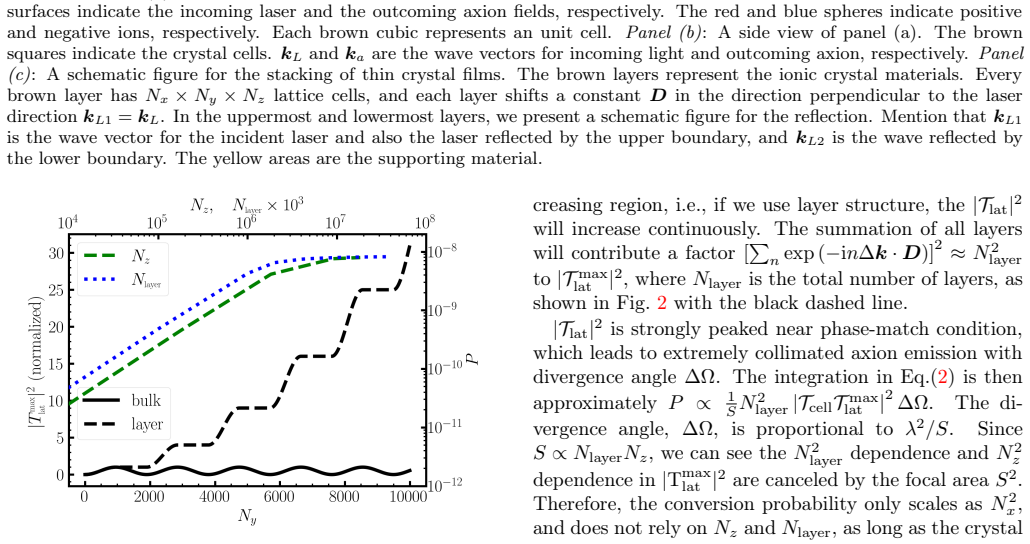
On the paper's own terms, the discovery is that the axion source $E \cdot B$ can be made to add coherently across a macroscopic crystal. For a laser of wave vector $k_L$ in a medium of refractive index $n$, an outgoing axion with $m_a \ll \omega$ has $|k_a| \approx \omega$; choosing the incidence angle $\alpha = \arccos(1/n)$ makes $\Delta k = k_a - k_L$ perpendicular to the laser direction, so planes of lattice cells contribute with the same phase. The lattice sum then gives $|T_{\mathrm{lat}}|^2 \propto N_x^2 N_z^2$, with a periodic oscillation in the thickness direction, and the paper removes the oscillation by cutting the crystal into layers about 518 nm thick, displacing each layer so that $\Delta k \cdot D = 2\pi$, and embedding the stack in a transparent, axion-inactive support. For $g_{a\gamma\gamma} = 10^{-7}\,\mathrm{GeV}^{-1}$ and $m_a = 10^{-6}\,\mathrm{eV}$, the laser-to-axion conversion probability for a 1 m × 5 mm × 5 mm CaF$_2$ rod is $8.53\times10^{-11}$, rising to $7.58\times10^{-9}$ for a 10 m rod; reconversion in a second phase-matched crystal gives $1.85\times10^{-10}$ and $1.85\times10^{-8}$, and one event per year translates to $g_{a\gamma\gamma} \gtrsim 1.32\times10^{-11}\,\mathrm{GeV}^{-1}$ at 10 m.
Load-bearing premise
The whole gain rests on each unit cell of the ionic crystal having a net electric dipole, so that the phases of its charges add at first order in the momentum transfer; if the cell is mirror-symmetric, as the fluorite cell of CaF2 is, that first-order term is zero and the claimed enhancement collapses.
Editorial extensions
If this is right
- The conversion probability scales coherently with rod length: a 10 m CaF$_2$ rod reaches $P_{\mathrm{laser}\to a} \approx 7.6\times10^{-9}$ at $g_{a\gamma\gamma}=10^{-7}\,\mathrm{GeV}^{-1}$, roughly two orders of magnitude above the reference LSW value for the same interaction length.
- The emitted axion beam is highly collimated, with divergence $\Delta\theta \lesssim 3\times10^{-5}\pi$, so a second phase-matched crystal can reconvert a useful fraction of it into detectable light.
- Using a 150 kW effective laser at 1064 nm for one year, one detected event per year yields an exclusion limit $g_{a\gamma\gamma} \gtrsim 1.32\times10^{-11}\,\mathrm{GeV}^{-1}$ for a 10 m interaction region in the $m_a \ll \omega$ limit; the full $g_{a\gamma\gamma}$–$m_a$ exclusion line follows by scanning the axion mass.
- The design is compatible with current coating technology, which already stacks about 1000 layers with thicknesses from 5 nm to 10 µm over tens of square centimeters, so the experiment is buildable with present or near-future techniques.
- The saturation in $N_z$ and $N_{\mathrm{layer}}$ means that after a certain size the sensitivity grows only with $N_x$; a longer rod, not a wider or multi-layer stack, is the scaling route to lower couplings.
Reading between the lines
- A clean test of the mechanism is to repeat the calculation for a non-centrosymmetric transparent ionic crystal; if the linear cell structure factor is the active ingredient, coherence should persist there, whereas the centrosymmetric fluorite cell should show the suppressed, quadrupolar behavior.
- Even if the dipole term vanishes in CaF$_2$, the same phase-matched stack should still emit axions through the quadrupolar term, but with probability suppressed by roughly $(d/\lambda)^2$; that would erase the claimed two-order-of-magnitude gain and make the proposed limit unattainable.
- The support layers between the active crystal films must have no net cell dipole and a refractive index close to CaF$_2$; the practical availability of such a transparent, index-matched, axion-inactive material is an implicit constraint the paper does not quantify.
- Because the phase-match angle equals the total-internal-reflection angle, a real device will operate as a waveguide or cavity; standing-wave nodes and mirror losses could modify the single-pass conversion estimate in either direction.
Editorial analysis
A structured set of objections, weighed in public.
Referee Report
Summary. The manuscript proposes a new mechanism for coherent axion production by shining an optical laser on an ionic crystal, exploiting a phase-matching condition and a stacked-layer geometry to maintain constructive interference. The authors derive the conversion probability from the axion-photon Lagrangian, compute numerical values for CaF2, and quote an exclusion limit of g_{aγγ} ≳ 1.32×10^{-11} GeV^{-1} for a 10 m device, about two orders of magnitude beyond current LSW bounds.
Significance. If the proposed mechanism were correct, the paper would offer a concrete, technology-accessible route to improved axion searches, with a transparent analytic derivation, explicit experimental parameters, and a falsifiable sensitivity projection. However, the central physical assumption used to obtain the coherent enhancement is incorrect for the specific crystal (CaF2) employed in the calculations. The claimed two-order-of-magnitude gain and the quoted exclusion line therefore do not follow.
major comments (2)
- [Eq. (3) and text following it] The central mechanism requires T_cell ≡ Σ_c q_c e^{-iΔk·δr_c} to have a linear term T_cell ≈ i q Δk·δr, i.e., a net electric dipole in the unit cell. For the CaF2 cell used in the paper (4 Ca^{2+} and 8 F^{-} in the conventional face-centered cubic cell), the structure is centrosymmetric (space group Fm-3m): the ions are arranged in inversion-related pairs about the cell center, so Σ_c q_c δr_c = 0. The leading term is therefore quadratic in Δk·d. With d = 0.5451 nm, λ = 1064 nm, and n = 1.43, |Δk| d ≈ 3.3×10^{-3}, so |T_cell|^2 is suppressed by ~10^{-5} relative to the linear estimate used in the paper. This removes the claimed factor-of-~100 improvement over LSW (P_{10m} would drop from 7.58×10^{-9} to ~10^{-13}) and invalidates the quoted limit g_{aγγ} ≳ 1.32×10^{-11} GeV^{-1}.
- [Appendix C, around Eq. (C6)] The argument that in-ion electric fields are negligible uses the same linear approximation: the point-charge term is estimated as Σ_c e^{-iΔk·δr_c} Q_c ≈ i |Δk| d, so it scales as d/λ and dominates over the in-ion term of order R_s^2 (Δk)^2 ~ (d/λ)^2. For CaF2, the cell dipole vanishes, so the point-charge term also scales as (Δk·d)^2. The point-charge and in-ion contributions are then of the same order (R_s ~ d), and the stated suppression of the in-ion term no longer holds. This does not rescue the mechanism; it shows that the finite-size correction cannot be neglected at the claimed level of accuracy.
minor comments (4)
- [Introduction / Fig. 1] There is a typo: 'the axion field travesl along' should be 'the axion field travels along'.
- [Layer Structure] There is a typo: 'In this staked layers' should be 'In this stacked layers'.
- [References] Reference [22] is a Wikipedia article; the crystal structure of CaF2 should be cited from a standard crystallography reference or database.
- [Fig. 1 caption] The caption contains informal phrasing such as 'Mention that kL1 is the wave vector for the incident laser' that is more appropriate for a draft than a journal.
Circularity Check
No significant circularity: the derivation is a forward calculation from the axion-photon Lagrangian with no fitted parameter standing in for a prediction.
full rationale
The paper is a forward perturbation-theory calculation. It starts from the ALP Lagrangian (A1), derives the Klein-Gordon equation with source g_{aγγ} E·B (A2), writes the axion number as an integral over the Fourier-transformed source (A3), and evaluates that source for a set of point charges (A5-A10). The translation term in Eq. (2) is defined as Σ q_s exp(-iΔk·r_s), and Eq. (3) is an exact factorization T = T_cell T_lat for a periodic lattice; no final result is inserted into that factorization. The phase-matching condition α = arccos(1/n) follows from evaluating the geometric lattice sum (A17)-(A20), and the layer-stacking enhancement follows from summing layer phases exp(-i n Δk·D). Reconversion is derived from the same Maxwell equations with the effective axion current (B1)-(B16). The quoted conversion probabilities and the exclusion limit g_{aγγ} ≥ 1.32×10^-11 GeV^-1 are obtained by substituting the refractive index, lattice constant, wavelength, crystal dimensions, laser power, and running time; no parameter is fitted to the quantity being predicted, and the OSQAR comparison is an external benchmark. The cited Ref. [29], which shares one co-author, supplies the standard axion-modified Maxwell equations, but those equations are textbook material and are not the source of the claimed coherent-enhancement result; the central derivation does not reduce to that citation. The reader-identified weakness, that CaF2's centrosymmetric unit cell makes the linear term in T_cell vanish, is a physical-symmetry concern about an input assumption, not a circularity: the paper does not define T_cell in terms of its conclusion, does not fit the enhancement from data, and does not invoke a self-citation chain to forbid alternatives. No circular step can therefore be exhibited.
Assumptions & free parameters
free parameters (1)
- Layer optimization integers M and N =
M=1, N=1
assumptions (4)
- domain assumption The axion obeys the classical wave equation (∂t^2 - ∇^2 + m_a^2)a = g_{aγγ} E·B with the standard ALP Lagrangian.
- domain assumption Ions are treated as point charges with bare Coulomb fields; in-atom fields are neglected after an estimate that they are suppressed by (R_s/λ)^2.
- ad hoc to paper The CaF2 unit cell has a nonzero dipole moment, giving T_cell ≈ i q Δk·δr.
- domain assumption The laser propagates as a rectangular TE waveguide mode via total internal reflection at the crystal boundaries, represented by two plane waves k_L1 and k_L2.
Cite this review
Pith. "Pith review of Coherent Axion Production through Laser Crystal Interaction." pith.science (2026). https://pith.science/paper/5LUOLMJQ
@misc{pith2026241205073,
  author       = {Pith},
  title        = {Pith review of: Coherent Axion Production through Laser Crystal Interaction},
  year         = {2026},
  howpublished = {\url{https://pith.science/paper/5LUOLMJQ}},
  note         = {Machine review of arXiv:2412.05073}
}
abstract
We investigate the interaction between an optical laser and an ionic crystal and reveal coherent emission of axions through phase-match between laser and axion fields. Such emission is further enhanced by stacking thin crystal layers of half-wavelength thickness. Based on these findings, we propose a novel method for generating and detecting axions in terrestrial experiments, achieving up to a two-order-of-magnitude increase in transition probability compared to light-shining-through-wall (LSW) experiments with the same interaction region size. For an experimental length of 10 meters, this setup could lower the exclusion limit to $g_{a\gamma\gamma}\gtrsim1.32\times10^{-11}\textrm{GeV}^{-1}$ with currently available laser technologies.
Figures


Forward citations
Cited by 1 Pith paper
-
Spin-Dependent Axion Generation with Controllable Emission Angles in Strong Laser Fields
Spin-polarized electrons in a strong laser field radiate axions with a spin-dependent angular asymmetry, giving a tunable milliradian deflection that could serve as a new laboratory axion signal.
Reference graph
Works this paper leans on
-
[1]
G. Bertone, D. Hooper, and J. Silk, Phys. Rept.405, 279 (2005), arXiv:hep-ph/0404175
arXiv 2005
-
[2]
R. D. Peccei and H. R. Quinn, Phys. Rev. Lett.38, 1440 (1977)
1977
-
[3]
R. D. Peccei and H. R. Quinn, Phys. Rev. D16, 1791 (1977)
1977
-
[4]
Dine and W
M. Dine and W. Fischler, Phys. Lett. B120, 137 (1983)
1983
-
[5]
L. F. Abbott and P. Sikivie, Phys. Lett. B 120, 133 (1983)
1983
-
[6]
Preskill, M
J. Preskill, M. B. Wise, and F. Wilczek, Phys. Lett. B 120, 127 (1983)
1983
-
[7]
S. Andriamonje et al. (CAST), J. Cosmol. Astropart. Phys. 04, 010, arXiv:hep-ex/0702006
-
[8]
Anastassopoulos, others, and CAST Collaboration (CAST collaboration), Nat
V. Anastassopoulos, others, and CAST Collaboration (CAST collaboration), Nat. Phys.13, 584 (2017)
work page 2017
Show all 33 references
-
[9]
Ahmed et al., Phys
Z. Ahmed et al., Phys. Rev. Lett.103, 141802 (2009)
2009
-
[10]
M. F. Albakry et al. (SuperCDMS), A Strategy for Low-Mass Dark Matter Searches with Cryogenic De- tectors in the SuperCDMS SNOLAB Facility (2023), arXiv:2203.08463
2023 arXiv
-
[11]
R. J. Creswick, F. T. Avignone, III, H. A. Farach, J. I. Collar, A.O.Gattone, S.Nussinov,andK.Zioutas,Phys. 5 Lett. B 427, 235 (1998), arXiv:hep-ph/9708210
1998 arXiv
-
[12]
Ballou et al
R. Ballou et al. (OSQAR Collaboration), Phys. Rev. D 92, 092002 (2015)
2015
-
[13]
Kozlowskiet al., Design and Performance of the ALPS II Regeneration Cavity (2024), arXiv:2408.13218
T. Kozlowskiet al., Design and Performance of the ALPS II Regeneration Cavity (2024), arXiv:2408.13218
2024
-
[14]
Ehret et al., Phys
K. Ehret et al., Phys. Lett. B689, 149 (2010)
2010
-
[15]
Della Valleet al., Eur
F. Della Valleet al., Eur. Phys. J. C76, 24 (2016)
2016
-
[16]
Ejlli et al., Phys
A. Ejlli et al., Phys. Rep.871, 1 (2020)
2020
-
[17]
Buchmuller and F
W. Buchmuller and F. Hoogeveen, Phys. Lett. B237, 278 (1990)
1990
-
[18]
B. L. Henke, E. M. Gullikson, and J. C. Davis, Atom. Data Nucl. Data Tabl.54, 181 (1993)
1993
-
[19]
Yamaji, T
T. Yamaji, T. Yamazaki, K. Tamasaku, and T. Namba, Phys. Rev. D96, 115001 (2017), arXiv:1709.03299
2017 arXiv
-
[20]
J. W. D. Hallidayet al., Phys. Lett. Lett.134, 055001 (2025), arXiv:2404.17333
2025 arXiv
-
[21]
M. E. Peskin,An Introduction to Quantum Field Theory (Westview Press, 1995)
1995
-
[22]
php?title=Calcium_fluoride&oldid=1256066213 (2024)
Calcium fluoride,https://en.wikipedia.org/w/index. php?title=Calcium_fluoride&oldid=1256066213 (2024)
2024
-
[23]
M. N. Polyanskiy, Sci. Data11, 94 (2024)
2024
-
[24]
ALPS II, https://alps.desy.de/our_activities/ axion_wisp_experiments/alps_ii/
-
[25]
O’Hare, Cajohare/AxionLimits: AxionLimits (2020)
C. O’Hare, Cajohare/AxionLimits: AxionLimits (2020)
2020
-
[26]
Matsumoto, J
S. Matsumoto, J. Sheng, and C.-Y. Xing, Detec- tion of Dark Matter Coherent Scattering via Torsion Balance with Test Bodies of Different Sizes (2024), arXiv:2409.09950 [hep-ph]
2024
-
[27]
cn/global/en/products/leybold_optics_ heliosseriesprecisionopticsvacuumcoater.html
Helios Sputtering Tool | Bühler Leybold Op- tics | Bühler Group, https://www.buhlergroup. cn/global/en/products/leybold_optics_ heliosseriesprecisionopticsvacuumcoater.html
-
[28]
Baddour, in Advances in Imaging and Electron Physics, Advances in Imaging and Electron Physics, Vol
N. Baddour, in Advances in Imaging and Electron Physics, Advances in Imaging and Electron Physics, Vol. 165, edited by P. W. Hawkes (Elsevier, 2011) pp. 1–45
2011
-
[29]
X. An, M. Chen, J. Liu, Z. Sheng, and J. Zhang, Matter Radiat. Extremes 9, 067204 (2024), arXiv:2406.16796
2024 arXiv
-
[30]
J. D. Jackson,Classical Electrodynamics, 3rd ed. (JOHN WILEY & SONS, INC., 1999). 6 Appendix A: Axion Production in Coulomb Potentials In this appendix, we will consider the interaction between the laser and the ions, where the ions are components of some ionic crystal. We men...
1999
-
[31]
translation term
conversion probability in Medium We consider a linearly polarized laser propagating along thex-axis. The magnetic component is then: B = (0, B0 cos (ωt − kLx) , 0) . (A4) where ω is the frequency of the laser, andkL is the corresponding wave vector, kL ≡ |kL|. In crystals, we ...
-
[32]
X c qce−i(ka−kL)·δrc #
Incident Angle for Coherent Enhancement From Eq.(A14), we can see that the conversion probability is related to|T |2, where T is the translation term as defined in Eq.(A8). This term contains a summation over all charges, so it is possible to grow when the crystal volume 8 inc...
-
[33]
crystal coordinate
T wo Plane W aves Now, we are going to rotate the coordinate. In the new coordinate, the cell lattice for the crystal will be aligned along the axis. We will therefore call the new coordinate “crystal coordinate”. The original coordinate will be called “laser coordinate”. In c...
Reviewed August 11, 2026 · model on record in the stance chip above.
Discussion (0). Continue with ORCID to comment.