REVIEW 3 major objections 7 minor 39 references
Dome-Shaped Superconducting Phase Diagram Linked to Charge Order in LaRu$_{3}$Si$_{2}$
T0 review · 3 major / 7 minor · reviewed 2026-08-11 · deepseek-v4-flash
Pith's one-line read In LaRu3Si2, superconductivity and charge order cooperate under pressure, peaking together at 9 K before both weaken.
desk verdict New high-pressure phase diagram for LaRu3Si2, but the claim that superconductivity is 'closely tied' to charge order leans on an unverified identification of diffuse scattering. read the letter →
The pith
A machine-rendered reading of the paper's core claim, the machinery that carries it, and where it could break.
The reading
What carries the argument
The load-bearing objects are the two charge-density-wave propagation vectors in the kagome planes, q=(1/4,0,0) and q=(1/6,0,0), together with the normal-state transport anomalies at Tco,II about 80 K and T* about 35 K. Pressure is the tuning knob: X-ray diffraction maps the crossover from sharp superlattice peaks (long-range order) to broad diffuse scattering above about 12 GPa, while resistivity and magnetoresistance track the strength of the electronic responses that follow the same dome as Tc. The convergence of Tco,I and Tco,II at 12.5 GPa marks the endpoint of long-range order and the start of the short-range diffuse regime where Tc begins to fall.
What would settle it
Measure the diffuse scattering above 12 GPa with enough momentum resolution to determine whether the broad intensity is centered at the same two wavevectors as the low-pressure superlattice peaks; if the diffuse signal is not charge order of the same two types, or if an alternative nonhydrostatic pressure medium removes the diffuse signal while Tc keeps its dome shape, the claimed correlation between short-range charge order and Tc suppression would be refuted.
Extended reading notes
Core claim
The central claim is that LaRu3Si2 displays a pronounced interdependence between superconductivity and charge order: the superconducting critical temperature peaks in the same pressure window in which the charge-order transitions, the T* resistivity anomaly, and magnetoresistance are all strongest, and the onset of Tc suppression coincides with the crossover from long-range to short-range charge order near 12.5 GPa. This is cast as coexistence plus synergy rather than competition, and the authors point to pressure-tuned Ru–Ru bond disproportionation as the microscopic coupling: out-of-plane Ru–Ru distortions associated with the charge-ordered kagome band structure favor a higher Tc.
Load-bearing premise
Above 12 GPa, the broad diffuse X-ray scattering that appears at the same onset temperature as Tco,II is assumed to be short-range charge order of the same (1/4,0,0) and (1/6,0,0) types, rather than a separate lattice distortion or pressure-induced disorder.
Editorial extensions
If this is right
- If the claim holds, Tc in LaRu3Si2 is directly tied to the lattice distortions that stabilize charge order, so tuning those distortions should tune superconductivity.
- The system becomes a model case where charge order and superconductivity cooperate, providing a counterpoint to the AV3Sb5 kagome family where they compete.
- The dome-shaped Tc under pressure, together with its coincidence with optimal electronic responses, suggests the pairing may be unconventional and driven by the same electronic correlations that produce charge order.
- The specific pressure landmark at about 12.5 GPa, where long-range order vanishes and Tc starts to decrease, gives a concrete target for future spectroscopic and thermodynamic probes.
Reading between the lines
- Extension: the paper does not identify the pairing mechanism, but its picture suggests that if the diffuse scattering above 12 GPa represents short-range charge-order fluctuations, then Tc may track the fluctuation spectrum rather than static order; a correlation-length measurement across the dome would test this.
- Extension: the authors argue that out-of-plane Ru–Ru distortions matter, so in-plane uniaxial strain should shift Tc more strongly than hydrostatic pressure; this is a direct, testable prediction that goes beyond the reported experiments.
- Extension: if the positive coupling between charge order and superconductivity is generic, other kagome superconductors with high-temperature charge order might be optimized by pressure or strain rather than suppressed, which would expand the search space for enhanced Tc.
Signed reviews
Editorial analysis
A structured set of objections, weighed in public.
Referee Report
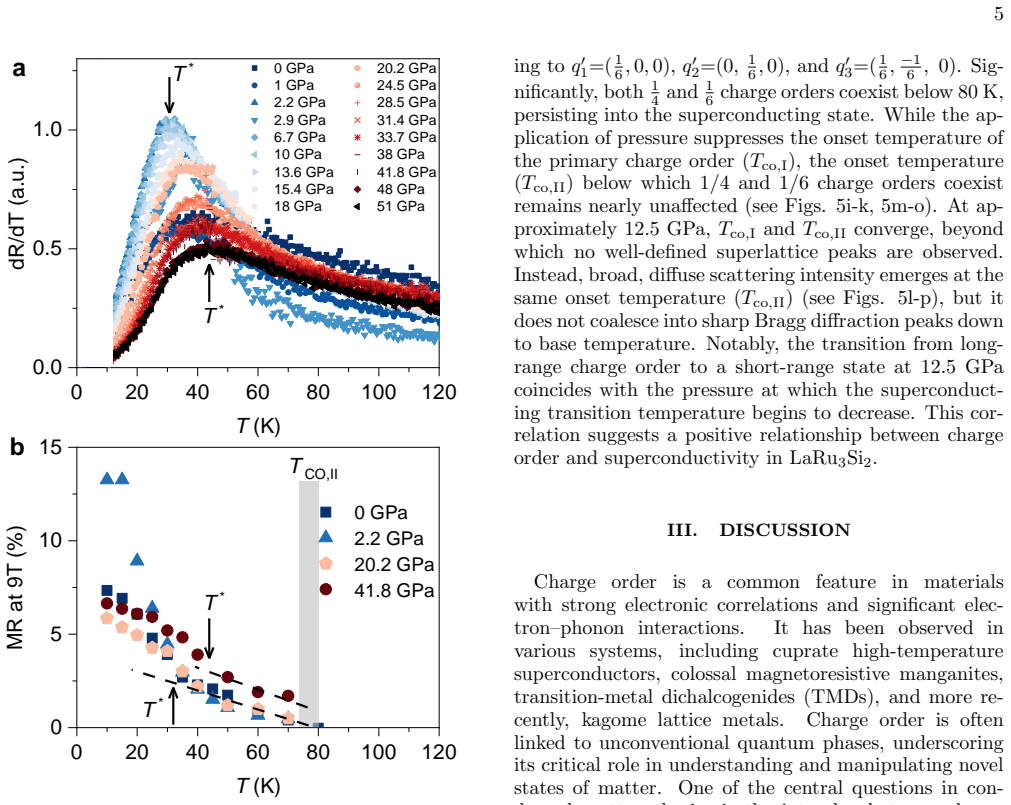
Summary. The manuscript reports a high-pressure study of the kagome superconductor LaRu3Si2 combining electrical resistivity, magnetoresistance, and single-crystal X-ray diffraction. The authors find that Tc rises from 6.5 K at ambient pressure to about 9 K at 2 GPa, stays nearly constant to about 12 GPa, and then decreases to about 2 K at 38-40 GPa, yielding a dome-shaped phase diagram. The resistivity anomaly at T* (~35 K) and the low-temperature magnetoresistance both show a similar dome-shaped pressure dependence. X-ray diffraction shows that the (1/4,0,0) and (1/6,0,0) charge orders remain sharp up to ~12 GPa, above which only broad diffuse scattering is observed. The authors interpret this as a transition to short-range charge order and argue that superconductivity is not competitive but 'closely tied' to charge order, with Tc optimized when charge order and normal-state electronic responses are strongest.
Significance. If the central claim holds, this is a valuable experimental case of a positive correlation between charge order and superconductivity in a kagome system, contrasting with the more common competition scenario in cuprates, TMDs, and AV3Sb5. The pressure-dependent data set is comprehensive and includes direct X-ray evidence for the charge-order wavevectors, and the proposed strain route to further enhance Tc is a concrete falsifiable prediction. However, the key interpretation that the diffuse scattering above 12 GPa represents short-range order of the same (1/4,0,0)/(1/6,0,0) charge orders is not demonstrated, and the pressure-media mismatch between transport (NaCl) and X-ray (He) measurements complicates the quantitative correlation. The paper is therefore significant if the diffuse-scattering identification can be corroborated.
major comments (3)
- [Section II, Fig. 5(l-p)] The identification of the diffuse scattering at high pressure as short-range order of the same (1/4,0,0) and (1/6,0,0) charge orders is not demonstrated. The text states that 'broad, diffuse scattering intensity emerges at the same onset temperature (Tco,II)' but does not report the wavevector of this diffuse intensity. The only low-temperature diffraction data above 12 GPa appear to be at 19.8 GPa (Fig. 5l-p), so the placement of the 'short-range charge order' region in Fig. 1 rests on a single pressure point. To support the central claim that the loss of long-range charge order correlates with the suppression of Tc, the authors should show reciprocal-space maps or line cuts at low temperature above 12 GPa with the diffuse intensity centered at q=(1/4,0,0) and (1/6,0,0) (or symmetry equivalents), and ideally extract a correlation length. Without this, the diffuse scattering could be a distinct structural distortion or pressure-induced disorder, and the claimed correlation would not be established.
- [Section V.A, Fig. 1(c)] The transport measurements that determine Tc use NaCl as the pressure-transmitting medium, while the X-ray charge-order measurements use helium (Section V.B). NaCl becomes non-hydrostatic at pressures above roughly 10 GPa, and deviatoric stress can broaden and suppress superconductivity independently of the intrinsic pressure response. The downturn of Tc above approximately 10-12 GPa could therefore be influenced by the pressure medium rather than being a purely electronic effect. Since the paper draws a quantitative correlation between the Tc downturn and the charge-order transition at ~12.5 GPa measured under helium, the mismatch of pressure conditions is a confound. The authors should either present transport data under a more hydrostatic medium (e.g., helium or neon) or provide an estimate of the non-hydrostatic stress in NaCl at these pressures and discuss its possible effect on Tc.
- [Section III, Fig. 1(d,e)] The conclusion that Tc is 'closely tied' to charge order relies in part on assigning the T* resistivity anomaly and the magnetoresistance to charge-order-related electronic responses. These assignments are inherited from previous work (refs 7 and 31); the present paper does not independently show that T* tracks the charge-order wavevector under pressure. The observation that T* and MR display a dome-shaped pressure dependence is thus not, by itself, evidence for a connection between superconductivity and charge order, since T* could be a generic electronic crossover with a similar pressure dependence. The authors should compare the pressure evolution of T* with the X-ray-determined Tco,II (or Tco,I) and, if they do not match, moderate the claim accordingly.
minor comments (7)
- [Abstract and Section V.A] The use of 'hydrostatic pressures up to 40 GPa' is misleading because NaCl is used as the pressure medium in transport; it should be described as 'quasi-hydrostatic' or simply 'pressures'.
- [Figures 1(c)-(e) and 2] No error bars are shown for Tc, T*, or the anomaly strength. The authors should state the precision of the determinations (e.g., transition width, thermometer accuracy) and add error bars or at least a statement in the text.
- [Abstract and Fig. 1(c)] The abstract states that Tc 'decreases to 2 K at 40 GPa', but the transport data in Fig. 1(c) and Fig. 2(a) extend to 51 GPa and show Tc ~2 K at 38 GPa. Please clarify the maximum pressure and the value at 40 GPa.
- [Section II and Abstract] The onset of the Tc suppression is described as 'beyond 10 GPa' in Section II and 'up to 12 GPa' in the Abstract and Introduction. These statements should be reconciled.
- [Section II, Fig. 1(d)] The anomaly strength is defined as the difference in dR/dT between its maximum at T* and its value at 120 K. The choice of the 120 K reference is not justified; the authors should state whether the result is robust to this choice.
- [Figure 4 and Section II] The magnetoresistance is measured with the field perpendicular to what crystallographic direction? The orientation relative to the kagome planes should be stated.
- [References] Some references are arXiv preprints (refs 7 and 31); if they have been published in the meantime, the published versions should be cited.
Circularity Check
No significant circularity; the dome-shaped Tc and its correlation with charge order are based on independent measurements, with only minor same-group citations that are not load-bearing.
full rationale
The paper's central superconducting dome is derived directly from measured resistivity transitions (Fig. 1c) and is not fitted to any charge-order parameter. The T* anomaly strength and magnetoresistance are separate transport quantities measured under pressure, and the long-range-to-short-range charge-order crossover is inferred from single-crystal X-ray superlattice peaks versus diffuse scattering (Fig. 5). The coincidence between the Tc downturn near 12 GPa and the loss of sharp charge-order peaks is an empirical comparison, not an identity or a construction. The same-group prior work (refs 7 and 31) is used to label Tco,I, Tco,II, and T* and to interpret their electronic and magnetic character, but those labels are supported by independent prior measurements whose assumptions do not include the pressure-dome result; under the review rules this counts as real evidence, not circularity. The main interpretive risk—that the broad diffuse scattering above 12 GPa is the same (1/4,0,0)/(1/6,0,0) charge order in short-range form, and that NaCl versus He pressure media do not create a spurious Tc downturn—is an unverified empirical identification, not a self-referential reduction, and therefore affects correctness risk rather than circularity score.
Assumptions & free parameters
assumptions (4)
- domain assumption The charge order transitions at Tco,I (~400 K) and Tco,II (~80 K) exist and are correctly identified in LaRu3Si2.
- domain assumption The resistivity anomaly and magnetoresistance response at T* (~35 K) are signatures of a charge-order-related electronic transition.
- ad hoc to paper The broad diffuse X-ray scattering observed above 12 GPa represents short-range order of the same (1/4,0,0) and (1/6,0,0) charge orders rather than a distinct structural distortion or disorder artifact.
- domain assumption NaCl remains sufficiently hydrostatic up to 40 GPa so that the measured superconducting transitions accurately reflect the intrinsic pressure dependence.
Cite this review
Pith. "Pith review of Dome-Shaped Superconducting Phase Diagram Linked to Charge Order in LaRu$_{3}$Si$_{2}$." pith.science (2026). https://pith.science/paper/OPN2EDIN
@misc{pith2026241205459,
  author       = {Pith},
  title        = {Pith review of: Dome-Shaped Superconducting Phase Diagram Linked to Charge Order in LaRu$_3$Si$_2$},
  year         = {2026},
  howpublished = {\url{https://pith.science/paper/OPN2EDIN}},
  note         = {Machine review of arXiv:2412.05459}
}
abstract
The interplay between superconductivity and charge order is a central focus in condensed matter research, with kagome lattice systems offering unique insights. The kagome superconductor LaRu$_{3}$Si$_{2}$ ($T_{\rm c}$ ${\simeq}$ 6.5 K) exhibits a hierarchy of charge order transitions: primary ($T_{\rm co,I}$ ${\simeq}$ 400 K), secondary ($T_{\rm co,II}$ ${\simeq}$ 80 K), and an additional transition at ($T^{*}$ $\simeq$ 35 K). The transitions at $T_{\rm co,II}$ and $T^{*}$ are linked to electronic and magnetic responses as revealed by muon-spin rotation and magnetotransport experiments. However, the connection between superconductivity, charge order, and electronic responses has remained elusive. By employing magnetotransport and X-ray diffraction techniques under pressures of up to 40 GPa, we observe that $T_{\rm c}$ rises to 9 K at 2 GPa, remains nearly constant up to 12 GPa, and then decreases to 2 K at 40 GPa, resulting in a dome-shaped phase diagram. The resistivity anomaly at $T^{*}$ and magnetoresistance also exhibit a similar dome-shaped pressure dependence. Furthermore, we find that charge order transitions from long-range to short-range above 12 GPa, correlating with the suppression of $T_{\rm c}$, suggesting superconductivity is closely tied to the charge-ordered state. Specifically, $T_{\rm c}$ peaks when charge order and the normal-state electronic responses are optimized. In contrast to systems like the cuprates, transition metal dichalcogenides, and other kagome materials, where superconductivity typically competes with charge order, LaRu$_{3}$Si$_{2}$ displays a pronounced interdependence between these two phenomena. This distinctive behavior sheds new light on the connection between superconductivity and charge order, offering avenues for theoretical advancements in understanding superconductivity.
Figures


Figures from the paper (2 more)


Reference graph
Works this paper leans on
-
[1]
Syôzi, I. Statistics of Kagome Lattice. Prog. Theor. Phys. 6, 306 (1951)
work page 1951
-
[2]
Guguchia, Z., Khasanov, R. and Luetkens, H. Unconventional charge order and superconductivity in kagome-lattice systems as seen by muon-spin rotation. npj Quantum Materials 8, 41 (2023)
work page 2023
-
[3]
Yin, J.-X., Lian, B. and Hasan, M.Z.. Topological kagome magnets and superconductors. Nature 612 , 647-657 (2022)
work page 2022
-
[4]
Mielke III, C. et al. Nodeless kagome superconductivity in LaRu _ 3 Si _ 2 . Phys. Rev. Mat. 5, 034803 (2021)
work page 2021
-
[5]
Guguchia, Z. et al. Tunable anomalous Hall conductivity through volume-wise magnetic competition in a topological kagome magnet. Nature Communications 11, 559 (2020)
work page 2020
-
[6]
Kiesel, M.L. and Thomale, R. Sublattice interference in the kagome Hubbard model. Phys. Rev. B 86, 121105 (2012)
work page 2012
-
[7]
Plokhikh, I and Guguchia, Z. et al., Charge order above room-temperature in a prototypical kagome superconductor La(Ru _ 1-x Fe _ x ) _ 3 Si _ 2 . arXiv:2309.09255 (2023)
work page Pith review arXiv 2023
-
[8]
Ternary transition metal phosphides: High-temperature superconductors
Barz, H. Ternary transition metal phosphides: High-temperature superconductors. Mater. Res. Bull. PNAS 15, 1489 (1980)
work page 1980
Show all 39 references
-
[9]
and Barz, H
Vandenberg, J.M. and Barz, H. ibid. 15, 1493 (1980)
1980
-
[10]
Ortiz, B. et al. CsV _ 3 Sb _ 5 : A Z _ 2 Topological Kagome Metal with a Superconducting Ground State. Phys. Rev. Lett. 125, 247002 (2020)
2020
-
[11]
Superconductivity in the Z _ 2 kagome metal KV _ 3 Sb _ 5
Ortiz, B., Sarte, P., Kenney, E., Graf, M., Teicher, S., Seshadri, R., & Wilson, S. Superconductivity in the Z _ 2 kagome metal KV _ 3 Sb _ 5 . Phys. Rev. Materials 5, 034801 (2021)
2021
-
[12]
Superconductivity and normal-state properties of kagome metal RbV _ 3 Sb _ 5 single crystals
Yin, Q., Tu, Z., Gong, C., Fu, Y., Yan, S., & Lei, H. Superconductivity and normal-state properties of kagome metal RbV _ 3 Sb _ 5 single crystals. Chinese Phys. Lett. 38, 037403 (2021)
2021
-
[13]
Jiang, Y.-X. et al. Discovery of topological charge order in kagome superconductor KV _ 3 Sb _ 5 . Nature Materials 20 , 1353-1357 (2021)
2021
-
[14]
et al., and Guguchia, Z
Mielke III, C. et al., and Guguchia, Z. Time-reversal symmetry-breaking charge order in a kagome superconductor. Nature 602 , 245-250 (2022)
2022
-
[15]
Charge order and superconductivity in kagome materials
Neupert, T., Denner, M.M., Yin, J.-X., Thomale, R., and Hasan, M.Z.. Charge order and superconductivity in kagome materials. Nature Physics 18 , 137-143 (2022)
2022
-
[16]
Loop currents in A V _ 3 Sb _ 5 kagome metals: multipolar and toroidal magnetic orders
Christensen, M.H., Birol, T., Andersen, B.M., Fernandes, R.M. Loop currents in A V _ 3 Sb _ 5 kagome metals: multipolar and toroidal magnetic orders. Phys. Rev. B 106 , 144504 (2022)
2022
-
[17]
and Fischer, M.H
Wagner, G., Guo, C., Moll, Philip J.W., Neupert, T. and Fischer, M.H.. Phenomenology of bond and flux orders in kagome metals. Phys. Rev. B 108 , 125136 (2023)
2023
-
[18]
Grandi, F. et al. Theory of nematic charge orders in kagome metals. Phys. Rev. B 107, 155131 (2023)
2023
-
[19]
et al., Tunable unconventional kagome superconductivity in charge ordered RbV _ 3 Sb _ 5 and KV _ 3 Sb _ 5
Guguchia, Z. et al., Tunable unconventional kagome superconductivity in charge ordered RbV _ 3 Sb _ 5 and KV _ 3 Sb _ 5 . Nature Communications 14 , 153 (2023)
2023
-
[20]
Wang, Z. et al. Electronic nature of chiral charge order in the kagome superconductor CsV _ 3 Sb _ 5 . Phys. Rev. B 104 , 075148 (2021)
2021
-
[21]
Khasanov, R. et al. Time-reversal symmetry broken by charge order in CsV _ 3 Sb _ 5 . Phys. Rev. Research 4 , 023244 (2022)
2022
-
[22]
Xu, Y. et al. Three-state nematicity and magneto-optical Kerr effect in the charge density waves in kagome superconductors. Nature Physics 18 , 1470-1475 (2022)
2022
-
[23]
Switchable chiral transport in charge-ordered kagome metal CsV _ 3 Sb _ 5
Guo, C et al. Switchable chiral transport in charge-ordered kagome metal CsV _ 3 Sb _ 5 . Nature 611 , 461-466 (2022)
2022
-
[24]
Yang, S. et. al., Giant, unconventional anomalous Hall effect in the metallic frustrated magnet candidate, KV _ 3 Sb _ 5 . Sci. Adv. 6 , 1-7s (2020)
2020
-
[25]
Analysis of charge order in the kagome metal A V _ 3 Sb _ 5 ( A = K, Rb, Cs)
Denner, M., Thomale, R., Neupert, T. Analysis of charge order in the kagome metal A V _ 3 Sb _ 5 ( A = K, Rb, Cs). Phys. Rev. Lett. 127 , 217601 (2022)
2022
-
[26]
Theory of the charge-density wave in A V _ 3 Sb _ 5 kagome metals
Christensen, M.H., Birol, T., Andersen, B.M., Fernandes, R.M. Theory of the charge-density wave in A V _ 3 Sb _ 5 kagome metals. Phys. Rev. B 104 , 214513 (2021)
2021
-
[27]
Mechanism of exotic density-wave and beyond-Migdal unconventional superconductivity in kagome metal A V _ 3 Sb _ 5 ( A =K, Rb, Cs)
Tazai, R., Yamakawa, Y., Onari, S., Kontani, H. Mechanism of exotic density-wave and beyond-Migdal unconventional superconductivity in kagome metal A V _ 3 Sb _ 5 ( A =K, Rb, Cs). Sci. Adv. 8 , eabl4108 (2022)
2022
-
[28]
Electronic instabilities of kagome metals: Saddle points and Landau theory
Park, T., Ye, M., Balents, L. Electronic instabilities of kagome metals: Saddle points and Landau theory. Phys. Rev. B 104 , 035142 (2021)
2021
-
[29]
and Nandkishore, R.M
Lin, Y.-P. and Nandkishore, R.M. Complex charge density waves at Van Hove singularity on hexagonal lattices: Haldane-model phase diagram and potential realization in the kagome metals A V _ 3 Sb _ 5 . Phys. Rev. B 104 , 045122 (2021)
2021
-
[30]
Electron correlations and T -breaking density wave order in a Z_ 2 kagome metal, https://arxiv.org/abs/2105.15204 (2021)
Chandan Setty, C., Hu, H., Chen, L., Si, Q. Electron correlations and T -breaking density wave order in a Z_ 2 kagome metal, https://arxiv.org/abs/2105.15204 (2021)
2021 arXiv
-
[31]
Mielke III, V
C. Mielke III, V. Sazgari, et. al., and Z. Guguchia. Charge orders with distinct magnetic response in a prototypical kagome superconductor LaRu _ 3 Si _ 2 . https://arxiv.org/pdf/2402.16219 (2024)
2024 arXiv
-
[32]
Giraldo-Gallo, P. et al. Scale-invariant magnetoresistance in a cuprate superconductor. Science 361, 479-481 (2018)
2018
-
[33]
Large linear magnetoresistance in the Dirac semimetal TlBiSSe
Novak, M., Sasaki, S., Segawa, K., and Ando, Y. Large linear magnetoresistance in the Dirac semimetal TlBiSSe. Phys. Rev. B 91, 041203(R) (2015)
2015
-
[34]
Wei, X. et al. Linear nonsaturating magnetoresistance in kagome superconductor CsV _ 3 Sb _ 5 thin flakes. Preprint at https://arXiv:2210.16890 (2022)
2022 arXiv
-
[35]
Das, L. et al. Two-carrier Magnetoresistance: Applications to Ca _ 3 Ru _ 2 O _ 7 . J. Phys. Soc. Jpn. 90 , 054702 (2021)
2021
-
[36]
Magnetoresistance and Hall Effect of Two-Dimensional 2H-NbSe _ 2
Li, L., Shen, J., Xu, Z., and Wang, H. Magnetoresistance and Hall Effect of Two-Dimensional 2H-NbSe _ 2 . International Journal of Modern Physics B 19, 275-279 (2005)
2005
-
[37]
et al., Electron pockets in the Fermi surface of hole-doped high- T_ c superconductors
LeBoeuf, D. et al., Electron pockets in the Fermi surface of hole-doped high- T_ c superconductors. Nature 450, 533-536 (2007)
2007
-
[38]
et al., Lifshitz critical point in the cuprate superconductor YBa _ 2 Cu _ 3 O _ y from high-field Hall effect measurements
LeBoeuf, D. et al., Lifshitz critical point in the cuprate superconductor YBa _ 2 Cu _ 3 O _ y from high-field Hall effect measurements. Phys. Rev. B 83, 054506 (2011)
2011
-
[39]
et al., The high flux nano-X-ray diffraction, fluorescence and imaging beamline ID27 for science under extreme conditions on the ESRF Extremely Brilliant Source
Mezouar, M. et al., The high flux nano-X-ray diffraction, fluorescence and imaging beamline ID27 for science under extreme conditions on the ESRF Extremely Brilliant Source. High Pressure Research 44, 171–198 (2024)
2024
Reviewed August 11, 2026 · model on record in the stance chip above.
Discussion (0). Continue with ORCID to comment.