REVIEW 3 major objections 5 minor 55 references
Oscillatory properties of strange quark stars described by the vector MIT bag model
T0 review · 3 major / 5 minor · reviewed 2026-08-11 · deepseek-v4-flash
Pith's one-line read Strange quark stars, modeled with the vector MIT bag model, would emit gravitational-wave f-mode oscillations confined to a narrow band of roughly 1.5-1.8 kHz, giving a clean observational signature to distinguish them from ordinary…
desk verdict Solid f-mode calculations for vMIT strange stars, but the headline frequency 'restriction' rests on a single post hoc parameter set and overstates the robustness. read the letter →
The pith
A machine-rendered reading of the paper's core claim, the machinery that carries it, and where it could break.
The reading
What carries the argument
The central object is the vector MIT bag model: MIT-bag confinement of quarks plus a generic massive vector field V_mu coupled to up, down, and strange quarks, with the coupling rewritten as G_V = (g_uV/m_V)^2 and a universal coupling ratio X_V = g_sV/g_uV = 1.0. A mass term -1/2 $m_V^{2}$ $V_0^{2}$ is included to maintain thermodynamic consistency, the mean-field approximation yields the equation of state, and the Tolman-Oppenheimer-Volkoff equations give equilibrium configurations. Radial oscillations use the Gondek et al. formulation and non-radial l = 2 oscillations use the full Detweiler-Lindblom perturbation system with outgoing-wave boundary conditions via the Zerilli equation, so no Cowling approximation is made.
What would settle it
Detect a gravitational-wave f-mode from a compact object whose mass is independently known, with central frequency outside 1.5-1.8 kHz for the G_V = 0.30 family, or measure a 1.4 solar-mass radius above 13.1 km while the object otherwise behaves as a strange quark star; either would contradict the paper's restricted band and its mass-radius fit.
Extended reading notes
Core claim
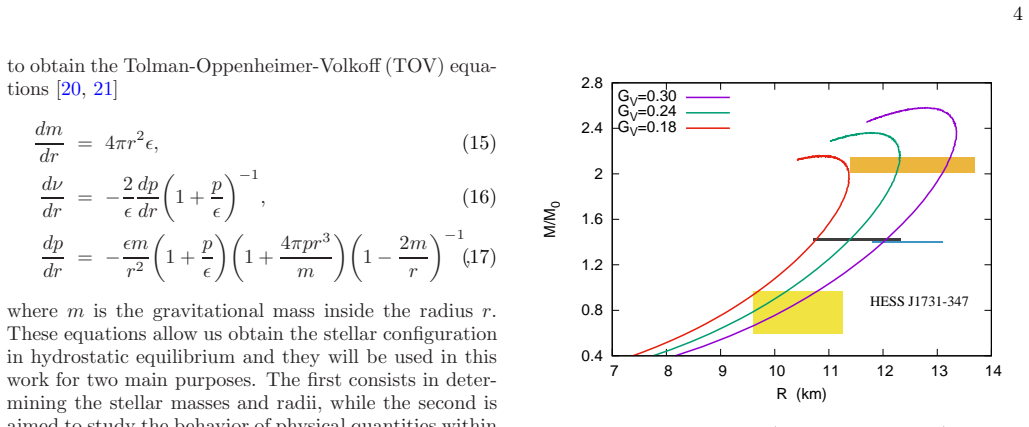
The central claim is that strange quark stars described by the vector MIT bag model, with a universal vector coupling X_V = 1.0 and a thermodynamically consistent equation of state, have quadrupole f-mode gravitational-wave frequencies restricted to (1.6-1.8) kHz for high-mass stars and (1.5-1.6) kHz for low-mass stars, once the coupling G_V = 0.30 $fm^{2}$ is selected to match current astrophysical observations. The paper also finds that the radial f-mode frequency reaches zero exactly at the maximum mass, that increasing G_V stabilizes stars in the (1.2-2.0) solar-mass range, and that the non-radial f-mode obeys the universal linear relation f = a + b (M/$R^{3}$)^{1/2} with b = 42.5 km*kHz and a = 0.086 kHz, an intercept much closer to zero than in hadronic neutron-star models, which the authors attribute to the absence of a crust.
Load-bearing premise
The vector field couples to up, down, and strange quarks with exactly the same strength (X_V = 1.0), which makes stars more massive; if the true coupling follows the symmetry-group value X_V = 0.4, the G_V = 0.30 family no longer reaches 2 solar masses and the predicted frequency band shifts.
Editorial extensions
If this is right
- If the paper is right, a gravitational-wave detection of an f-mode from a compact star with known mass in the 1.5-1.8 kHz band would support the strange-quark-star interpretation over ordinary neutron stars.
- The G_V = 0.30 fm^2 family is singled out as the only one satisfying all four adopted astrophysical constraints, so continued radius measurements can independently test the model.
- The universal relation f = a + b (M/R^3)^{1/2} holds across all three equations of state, with a slope b similar to hadronic models but an intercept a near zero, making the intercept a potential crust diagnostic.
- The vanishing radial f-mode frequency at maximum mass confirms that the stability boundary coincides with the TOV maximum-mass turning point for these one-phase stars.
Reading between the lines
- Because the predicted band is so narrow, a future detection of a compact-star f-mode outside 1.5-1.8 kHz would disfavor this vMIT strange-star family even before detailed equation-of-state reconstruction; this is my inference, not the paper's claim.
- The near-zero intercept a, tied to a crustless self-bound object, suggests that precise f-mode versus average-density measurements could serve as a crust detector separating strange stars from hadronic stars.
- The universal-coupling assumption X_V = 1.0 is the load-bearing choice; if the symmetry-group value X_V = 0.4 were used, the G_V = 0.30 family would not reach 2 solar masses and the quoted frequency band would shift, so an independent Bayesian analysis with X_V treated as free would test the prediction directly.
- The paper's machinery could be extended to compute g-modes or tidal deformability for the same equations of state, giving additional gravitational-wave discriminators between quark stars and neutron stars.
Signed reviews
Editorial analysis
A structured set of objections, weighed in public.
Referee Report
Summary. The paper investigates radial and non-radial fundamental-mode oscillations of self-bound strange quark stars in the vector MIT (vMIT) bag model. After constructing a thermodynamically consistent equation of state, the authors solve the TOV equations for three values of the vector coupling G_V (0.18, 0.24, 0.30 fm^2) with corresponding bag constants chosen inside the Bodmer-Witten stability window. They compare the resulting mass-radius curves with recent NICER, PSR J0740+6620, PSR J0437-4715, and HESS J1731-347 constraints, concluding that G_V = 0.30 fm^2 is the only value satisfying all constraints. They then compute radial f-mode frequencies using the Gondek et al. formulation and non-radial f-mode frequencies and damping times using the full Detweiler-Lindblom perturbation equations without the Cowling approximation. The main reported results are that the non-radial f-mode frequency is 'restricted' to 1.6-1.8 kHz for high-mass stars and 1.5-1.6 kHz for low-mass stars, and that a universal linear relation between f and (M/R^3)^{1/2} holds, with fit coefficients a = 0.086 kHz and b = 42.5 km·kHz on average.
Significance. If the quoted narrow f-mode frequency ranges were robust, they would provide a useful gravitational-wave signature for distinguishing strange quark stars from ordinary neutron stars. The paper's methods are standard and carefully chosen: the radial oscillation equations follow Gondek et al., the non-radial calculation solves the full time-dependent perturbation equations without the Cowling approximation, and the inclusion of the -1/2 m_V^2 V_0^2 term in Eq. (8) ensures thermodynamic consistency, an improvement over earlier vMIT implementations. The comparison with observational constraints is also a strength. However, the central claim of a 'restricted' f-mode frequency band is conditional on a single post hoc parameter choice, and the paper does not provide a parameter-space scan, uncertainties, or a quantitative robustness study. The universal-relation claim is likewise based on three correlated EoSs without fit errors. These issues undermine the strength of the conclusions as currently stated.
major comments (3)
- [Section V, Fig. 5; Abstract] The statement that the gravitational-wave frequency of the fundamental mode is 'restricted to (1.6 - 1.8) kHz for high mass stars and to (1.5 - 1.6) kHz for low mass stars' is derived from a single parameter set: G_V = 0.30 fm^2, B^{1/4} = 140 MeV, and X_V = 1.0. This set is selected in Section III because it satisfies the adopted astronomical constraints, and X_V = 1.0 is chosen 'in opposition' to the symmetry-group value 0.4 used in Refs. [17,18]. The abstract claims that 'variations of the remaining vMIT parameters slightly modify this conclusion,' but no quantitative variation study, error bars, or allowed-region mapping appears anywhere in the manuscript. The stability window defined by Eqs. (9)-(10) permits a range of bag constants for each G_V, and the degeneracy between X_V, G_V, and B is not explored. Without a scan over the full parameter region compatible with the observational constraints, the word 'restricted' overstates what the calculation demonstrates.
- [Section V, Eq. (43), Table I] The universal relation f = a + b (M/R^3)^{1/2} is presented as a main result, but the fit coefficients are quoted without uncertainties: a = 0.142, 0.107, 0.009 kHz and b = 41.1, 42.3, 44.2 km·kHz for G_V = 0.30, 0.24, 0.18 fm^2, with a mean a = 0.086 kHz and b = 42.5 km·kHz. Only three EoSs, all from the same model and with correlated parameters, are used. The text claims that the coefficient a for strange stars is 'much closer to zero' than for hadronic stars, but the strange-star result from Ref. [48] (a = -0.023, b = 44.1) lies within the scatter of the quoted hadronic values. A quantitative comparison with fit errors, or a softened statement, is needed to support the claimed universality and the distinction between strange and hadronic stars.
- [Section III and Section II, stability window] The conclusion that only G_V = 0.30 fm^2 satisfies all four adopted constraints rests on a point selection of bag constants (B^{1/4} = 150, 145, 140 MeV for G_V = 0.18, 0.24, 0.30 fm^2) rather than on an exploration of the full stability window. Since the EoS, mass-radius curves, and hence the f-mode frequencies depend on B, choosing a different B within the allowed window for G_V = 0.30 could shift the quoted f-mode bands. The paper should map the region of (G_V, B^{1/4}, X_V) that is compatible with the observational constraints and show the resulting spread in f-mode frequencies before claiming a 'restricted' range.
minor comments (5)
- [Section II, text after Eq. (8)] The phrase 'is crucial to kept the thermodynamic consistency' should be reworded, and 'monotonically crescent' should be 'monotonically increasing'.
- [Section V, boundary conditions] In the bullet on the exterior solution, 'outgoing and ongoing gravitational waves' should read 'outgoing and ingoing gravitational waves', since the physical solution is then correctly stated to be purely outgoing.
- [Section III, paragraph on HESS J1731-347] The sentence 'the proper existence of the so-called HESS J1731-347 supernova remnant present a puzzle' is grammatically unclear; consider rephrasing.
- [References] Reference [25] is incomplete: it lacks journal, volume, and page information and currently ends with an arXiv identifier only.
- [Section V, Eq. (33)] The definition of X in Eq. (33) is introduced after it is used in Eqs. (29)-(32) and (34); adding a forward reference or reordering would improve readability.
Circularity Check
No significant circularity: the f-mode calculation is independent of the mass-radius fitting, and comparisons are made against external benchmarks.
full rationale
The central derivation is self-contained in the relevant sense. The vMIT EoS is constructed from the Lagrangian in Sec. II with explicit quark masses and couplings; the TOV equations and the Chandrasekhar/Detweiler-Lindblom perturbation equations in Secs. IV and V are standard first-principles tools. The parameter choice GV=0.30 fm^2, B^1/4=140 MeV, XV=1.0 is selected in Sec. III by requiring the mass-radius relation to satisfy NICER/PSR/HESS constraints. This is parameter calibration to one set of observables, not fitting to f-mode frequencies. The f-mode frequencies are then obtained by solving the radial and non-radial perturbation equations for the resulting equilibrium configurations; no equation in the paper defines the f-mode frequency in terms of the fitted parameters, nor are f-mode data used in the parameter selection. The universal relation of Eq. (43) is fitted to the computed f-mode frequencies and compared with independent literature values, which is standard practice rather than a circular step. The paper does overstate robustness by saying the frequencies are 'restricted' to the quoted bands without a quantitative scan over all parameter sets compatible with the constraints, but that is a limitation in uncertainty quantification, not a circularity: the quoted band would change if other viable parameter points were included, but it is not logically forced by the model definition. Self-citations (Refs. [3,4] for model parameters, [48] for strange-star universal-relation values) are either ordinary model attribution or external comparisons and are not load-bearing in the derivation of the claimed frequency range. No specific reduction of a prediction to its input can be quoted, so no circular step is exhibited.
Assumptions & free parameters
free parameters (5)
- GV =
0.18, 0.24, 0.30 fm^2
- Bag constant B^(1/4) =
150, 145, 140 MeV for GV = 0.18, 0.24, 0.30 fm^2
- Universal coupling ratio XV =
1.0
- Universal relation intercept a =
+0.142, +0.107, +0.009 kHz for GV = 0.30, 0.24, 0.18
- Universal relation slope b =
41.1, 42.3, 44.2 km*kHz for GV = 0.30, 0.24, 0.18
assumptions (6)
- domain assumption Strange quark matter is the true ground state of strongly interacting matter (Bodmer-Witten conjecture)
- domain assumption The mean-field approximation and the vector MIT Lagrangian (Eqs. 1-8) describe quark matter
- domain assumption The bag constant for each GV must satisfy the stability window inequalities (Eqs. 9-10)
- ad hoc to paper Dirac sea / vector self-interaction contributions are negligible
- standard math The TOV equations (15-17) and the linearized perturbation equations (20-21, 29-32) are the correct description of hydrostatic equilibrium and small oscillations
- domain assumption Strange stars have no hadronic crust that would affect the f-modes
Cite this review
Pith. "Pith review of Oscillatory properties of strange quark stars described by the vector MIT bag model." pith.science (2026). https://pith.science/paper/TDUL4EXA
@misc{pith2026241205752,
  author       = {Pith},
  title        = {Pith review of: Oscillatory properties of strange quark stars described by the vector MIT bag model},
  year         = {2026},
  howpublished = {\url{https://pith.science/paper/TDUL4EXA}},
  note         = {Machine review of arXiv:2412.05752}
}
abstract
We investigated the radial and non-radial fundamental ($f$) mode oscillations of self-bound (quark) stars obtained after employing the Vector MIT (vMIT) bag model. Within this model, we computed the equation of state for strange quark matter satisfying thermodynamic consistency. This allowed us to obtain the corresponding behavior of the speed of sound, mass-radius relation, and gravitational redshift. In particular, our choice of $G_V$ = 0.30 fm$^2$ produces masses and radii in agreement with recent astronomical data (e.g. from NICER and HESS J1731). In fact, we tested that variations of the remaining vMIT parameters slightly modify this conclusion. Then, we proceeded to compute the radial oscillation frequencies of the $f$-mode, which is tightly connected to the dynamical stability of these compact stars. We found that increments of the $G_V$ parameter have a stabilizing property around the maximal-mass stars for a given stellar family. We also calculated the gravitational-wave frequencies of the non-radial $f$-mode. Our results show that they are restricted to be in the range (1.6 - 1.8) kHz for high-mass stars and to (1.5 - 1.6) kHz for low-mass stars. Finally, we propose a universal relation between these frequencies and the square root of the average density. All these last results are important in distinguishing strange stars from ordinary neutron stars in future gravitational-wave detections coming from compact sources with activated non-radial modes.
Figures


Figures from the paper (3 more)


Reference graph
Works this paper leans on
-
[48]
N. Andersson and K. D. Kokkotas, To- wards gravitational wave asteroseismology, Mon. Not. Roy. Astron. Soc. 299, 1059 (1998)
work page 1998
-
[1]
C. Flores acknowledges the financial support of the productivity program of the Conselho Nacional de Desenvolvimento Cient ´ ıfico e Tecnol´ ogico (CNPq), with Project No. 304569/2022-4. J.C.J. is supported by Conselho Nacional de Desenvolvimento Cient ´ ıfico e Tec- nol´ ogico (CNPq) with Grant No. 151390/2024-0
work page 2022
-
[2]
must be lower than the nonstrange infinite baryonic matter. Or explicitly [ 1, 2]: 3 E(uds)/A< 930 MeV, (9) at the same time, the nonstrange matter still needs to have an energy per baryon higher than the one of non- strange infinite baryonic matter, otherwise, protons and neutrons would decay into u and d quarks: E(ud)/A> 930 MeV. (10) Therefore, both, eq. (
- [3]
-
[4]
L. L. Lopes et al., Modified mit bag models—part ii: Qcd phase diagram and hot quark stars, Phys. Scr. 96, 065302 (2021)
work page 2021
-
[5]
For instance, near to the maximum mass of the stellar models, the f -mode curves downwards
One can see that the effect of the GV parameter has similar effects in the curves. For instance, near to the maximum mass of the stellar models, the f -mode curves downwards. The only difference is that this bending is more abrupt when com- pared to other work reported in the literature [ 42, 43]. We also observe that an increase in the values of GV produces...
work page 2021
-
[6]
B. P. Abbott et al. (LIGO Scientific, Virgo), GW170817: Observation of Gravitational Waves from a Binary Neu- tron Star Inspiral, Phys. Rev. Lett. 119, 161101 (2017) , arXiv:1710.05832 [gr-qc]
arXiv 2017
-
[7]
M. Branchesi et al., Science with the Einstein Telescope: a comparison of different designs, JCAP 2023 (07), 068
work page 2023
Show all 55 references
-
[8]
To construct an electrically neutral, beta- stable matter, leptons are added as a free Fermi gas
being absent in Refs.[ 14– 16] is crucial to kept the thermodynamic consistency of the model. To construct an electrically neutral, beta- stable matter, leptons are added as a free Fermi gas. The pressure is obtained via the thermodynamic relation, p =∑ iµini −ε, where the sum...
-
[9]
For a given value of GV , the values of the bag that satisfy the SQM hypothesis form the so-called stability window
and ( 10) must simultaneous be true. For a given value of GV , the values of the bag that satisfy the SQM hypothesis form the so-called stability window. The stability window for GV = 0.0 up to 0.3 fm 2 is presented as Fig. 4 in Ref. [ 3]. The GV and the bag act together in a ...
-
[10]
A. R. Bodmer, Collapsed nuclei, Phys. Rev. D 4, 1601 (1971)
1971
-
[11]
Witten, Cosmic separation of phases, Phys
E. Witten, Cosmic separation of phases, Phys. Rev. D 30, 272 (1984)
1984
-
[12]
H. T. Cromartie et al. (NANOGrav), Relativistic Shapiro delay measurements of an extremely massive millisecond pulsar, Nature Astron. 4, 72 (2019) , 1904.06759
2019 arXiv
-
[13]
Furnstahl, B
R. Furnstahl, B. D. Serot, and H.-B. Tang, Vacuum nucleon loops and naturalness, Nucl. Phys. A 618, 446 (1997)
1997
-
[14]
R. O. Gomes, V. Dexheimer, S. Han, and S. Schramm, Can magnetic fields (de)stabilize twin stars?, Mont. Not. Roy. Astron. Soc. 485, 4873 (2019)
2019
-
[15]
Evans et al., A Horizon Study for Cosmic Explorer: Science, Observatories, and Community, arXiv (2021), 2109.09882 [astro-ph.IM]
M. Evans et al., A Horizon Study for Cosmic Explorer: Science, Observatories, and Community, arXiv (2021), 2109.09882 [astro-ph.IM]
2021 arXiv
-
[16]
Colpi et al., LISA Definition Study Report, arXiv (2024), 2402.07571 [astro-ph.CO]
M. Colpi et al., LISA Definition Study Report, arXiv (2024), 2402.07571 [astro-ph.CO]
2024 arXiv
-
[17]
Flores, L
C. Flores, L. Lopes, L. Benito, and D. Menezes, Gravitational wave signa- tures of highly magnetized neutron stars, The European Physical Journal C 80, 1142 (2020)
2020
-
[18]
Chodos, R
A. Chodos, R. L. Jaffe, K. Johnson, C. B. Thorn, and V. F. Weisskopf, New extended model of hadrons, Phys. Rev. D 9, 3471 (1974)
1974
-
[19]
B. D. Serot, Quantum hadrodynamics, Rep. Progr. Phys. 55, 1855 (1992)
1992
-
[20]
The integration proceeds outward, with the aim of matching the boundary condition at the star’s surface
and ( 21) using the initial values of ξ(r = 0) and ∆ p(r = 0) that satisfy the central boundary condi- tion outlined above. The integration proceeds outward, with the aim of matching the boundary condition at the star’s surface. After each integration, the trial value of ω2 is...
-
[21]
J. R. Oppenheimer and G. M. Volkoff, On massive neu- tron cores, Phys. Rev. 55, 374 (1939)
1939
-
[22]
R. O. Gomes, P. Char, and S. Schramm, Con- straining strangeness in dense matter with gw170817, Astrophys. J. 877, 139 (2019)
2019
-
[23]
Franzon, R
B. Franzon, R. O. Gomes, and S. Schramm, Effects of the quark-hadron phase transi- tion on highly magnetized neutron stars, Mon. Not. Roy. Astron. Soc. 463, 571 (2016)
2016
-
[24]
tortoise
under these conditions are identified as the eigenfrequencies of the radial pertur- bations. For more details on the method see Ref. [ 35]. In this section, for reasons of coherence, we call ν0 the nu- merical value of the frequency of the fundamental radial mode. In Fig. 4 we ...
-
[25]
F. M. da Silva et al., Bayesian study of quark models in view of recent astrophysical constraints, Phys. Rev. D 109, 043054 (2024)
2024
-
[26]
Biesdorf, L
C. Biesdorf, L. L. Lopes, and D. P. Menezes, Qcd phase diagrams via qhd and mit-based models, Braz. J. Phys. 53, 137 (2023)
2023
-
[27]
Altiparmak, C
S. Altiparmak, C. Ecker, and L. Rezzolla, On the Sound Speed in Neutron Stars, Astrophys. J. Lett. 939, L34 (2022)
2022
-
[28]
R. C. Tolman, Static solutions of einstein’s field equations for spheres of fluid, Phys. Rev. 55, 364 (1939)
1939
-
[29]
T. E. Riley et al., A NICER View of PSR J0030+0451: Millisecond Pulsar Parameter Estimation, Astrophys. J. Lett. 887, L21 (2019)
2019
-
[30]
Miller et al., PSR J0030+0451 Mass and Radius from NICER Data and Implications for the Properties of Neu- tron Star Matter, Astrophys
M. Miller et al., PSR J0030+0451 Mass and Radius from NICER Data and Implications for the Properties of Neu- tron Star Matter, Astrophys. J. Lett. 887, L24 (2019)
2019
-
[31]
Miller et al., The radius of PSR j0740+6620 from NICER and XMM-newton data, Astrophys
M. Miller et al., The radius of PSR j0740+6620 from NICER and XMM-newton data, Astrophys. J. Lett. 918, L28 (2021)
2021
-
[32]
Choudhury et al., A nicer view of the nearest and brightest millisecond (2024), arXiv:2407.06789 [astro-ph.HE]
D. Choudhury et al., A nicer view of the nearest and brightest millisecond (2024), arXiv:2407.06789 [astro-ph.HE]
2024 arXiv
-
[33]
Riley et al., A nicer view of the massive pulsar psr j0740+6620 informed by radio timing and xmm-newton spectroscopy, Astrophys
T. Riley et al., A nicer view of the massive pulsar psr j0740+6620 informed by radio timing and xmm-newton spectroscopy, Astrophys. J. Lett. 918, L27 (2021)
2021
-
[34]
Doroshenko, V
V. Doroshenko, V. Suleimanov, G. P¨ uhlhofer, and A. Santangelo, A strangely light neutron star within a 10 supernova remnant, Nat. Astron. 6, 1444 (2022)
2022
-
[35]
L. L. Lopes, The neutron star inner crust: An empirical essay, Europhys. Lett. 134, 52001 (2021)
2021
-
[36]
J. P. Pereira, C. V. Flores, and G. Lugones, Phase Transition Effects on the Dynamical Stability of Hybrid Neutron Stars, Astrophys. J. 860, 12 (2018) , arXiv:1706.09371 [gr-qc]
2018 arXiv
-
[37]
J. D. V. Arba˜ nil, G. A. Carvalho, R. V. Lobato, R. M. Marinho, and M. Malheiro, Extra dimensions’ influence on the equilibrium and radial stability of strange quark stars, Phys. Rev. D 100, 024035 (2019) , arXiv:1907.07661 [gr-qc]
2019 arXiv
-
[38]
J. M. Z. Pretel, Equilibrium, radial stability and non-adiabatic gravitational collapse of anisotropic neu- tron stars, European Physical Journal C 80, 726 (2020) , arXiv:2008.05331 [gr-qc]
2020 arXiv
-
[39]
Chandrasekhar, The Dynamical Instability of Gaseous Masses Approaching the Schwarzschild Limit in General Relativity., Astrophys
S. Chandrasekhar, The Dynamical Instability of Gaseous Masses Approaching the Schwarzschild Limit in General Relativity., Astrophys. J. 140, 417 (1964)
1964
-
[40]
Chanmugam, Radial oscillations of zero-temperature white dwarfs and neutron stars below nuclear densities., Astrophys
G. Chanmugam, Radial oscillations of zero-temperature white dwarfs and neutron stars below nuclear densities., Astrophys. J. 217, 799 (1977)
1977
-
[41]
Gondek, P
D. Gondek, P. Haensel, and J. L. Zdunik, Ra- dial pulsations and stability of protoneutron stars, Astron. Astrophys. 325, 217 (1997)
1997
-
[42]
V´ asquez Flores and G
C. V´ asquez Flores and G. Lugones, Radial oscilla- tions of color superconducting self-bound quark stars, Phys. Rev. D 82, 063006 (2010)
2010
-
[43]
H. M. Vaeth and G. Chanmugam, Radial os- cillations of neutron stars and strange stars, Astron. Astrophys. 260, 250 (1992)
1992
-
[44]
Gondek-Rosinska and J
D. Gondek-Rosinska and J. L. Zdunik, Avoided cross- ings in radial pulsations of neutron and strange stars, Astron. Astrophys. 344, 117 (1999)
1999
-
[45]
Mariani, I
M. Mariani, I. F. Ranea-Sandoval, G. Lugones, and M. G. Orsaria, Could a slow stable hy- brid star explain the central compact object in HESS J1731-347?, Phys. Rev. D 110, 043026 (2024) , arXiv:2407.06347 [astro-ph.HE]
2024 arXiv
-
[46]
Detweiler and L
S. Detweiler and L. Lindblom, On the nonra- dial pulsations of general relativistic stellar models, Astrophys. J. 292, 12 (1985)
1985
-
[47]
L¨ u and W.-M
J.-L. L¨ u and W.-M. Suen, Determining the long living quasi-normal modes of relativistic stars, Chinese Physics B 20, 040401 (2011)
2011
-
[49]
B. K. Pradhan, D. Chatterjee, M. Lanoye, and P. Jaiku- mar, General relativistic treatment of f -mode oscillations of hyperonic stars, Phys. Rev. C 106, 015805 (2022)
2022
-
[50]
L. L. Lopes et al., Imprints of the nuclear symmetry en- ergy slope in gravitational wave signals emanating from neutron stars, Phys. Rev. D 108, 083042 (2023)
2023
-
[51]
Benhar, V
O. Benhar, V. Ferrari, and L. Gualtieri, Grav- itational wave asteroseismology reexamined, Phys. Rev. D 70, 124015 (2004)
2004
-
[52]
Shirke, B
S. Shirke, B. K. Pradhan, D. Chatterjee, L. Sa- gunski, and J. Schaffner-Bielich, Effects of dark matter on f -mode oscillations of neutron stars, Phys. Rev. D 110, 063025 (2024)
2024
-
[53]
Guha Roy, T
D. Guha Roy, T. Malik, S. Bhattacharya, and S. Banik, Analysis of neutron star f-mode oscillations in general rel - ativity with spectral representation of nuclear equations of state, Astrophys. J. 968, 124 (2024)
2024
-
[54]
Chirenti, G
C. Chirenti, G. H. de Souza, and W. Kastaun, Fundamen- tal oscillation modes of neutron stars: validity of univer- sal relations, Phys. Rev. D 91, 044034 (2015)
2015
-
[55]
C. V. Flores and G. Lugones, Constraining color fla- vor locked strange stars in the gravitational wave era, Phys. Rev. C 95, 025808 (2017)
2017
Reviewed August 11, 2026 · model on record in the stance chip above.
Discussion (0). Continue with ORCID to comment.