REVIEW 2 major objections 6 minor 43 references
Transcorrelated Theory with Pseudopotentials
T0 review · 2 major / 6 minor · reviewed 2026-08-11 · deepseek-v4-flash
Pith's one-line read First two pseudopotential commutators give transcorrelated theory chemical accuracy.
desk verdict A genuine, honest methods advance — the first nonlocal pseudopotential treatment in transcorrelated theory — whose chemical-accuracy claims rest on an unquantified three-body commutator truncation that the authors flag but do not bound. read the letter →
The pith
A machine-rendered reading of the paper's core claim, the machinery that carries it, and where it could break.
The reading
What carries the argument
The machinery is the nested commutator expansion $\hat H_{\mathrm{TC}} = e^{-J}\hat H e^{J} = \hat H + [\hat H,J] + \frac{1}{2!}[[\hat H,J],J] + \cdots$, applied to the nonlocal pseudopotential $\hat V_{\mathrm{eff}}(r) = V_{l_{\max}}(r) + \sum_{l=0}^{l_{\max}-1} V_l(r)\sum_{m=-l}^{l} |Y_{lm}\rangle\langle Y_{lm}|$. The pseudopotential's angular projection operator means it does not commute with the Drummond–Towler–Needs Jastrow factor (a sum of one-, two-, and three-body correlation functions), so the paper must compute the one- and two-body commutator terms $\Pi$ and $\Gamma$ of Eqs. (11)–(12), evaluating the spherical projection numerically on an icosahedral grid with $N_s = 12$ points. Terms involving three distinct electrons ($i > j > m$) from the pseudopotential commutators are dropped, while the three-body kinetic-energy commutator terms are handled by the xTC approximation. The result is a second-quantized transcorrelated Hamiltonian with one-, two-, and three-body pieces whose pseudopotential correction is the tensor $P^{pq}_{rs}$ entering alongside the kinetic-energy corrections $K$ and $L$.
What would settle it
Compute the dropped three-body pseudopotential commutator terms (the $\sum_{i>j>m}$ part of Eq. (9)) for a first-row atom or for N$_2$ and show that they change the energy by more than the claimed sub-milliHartree level; alternatively, run the full commutator series with the three-body terms retained and compare against PP-2.
Extended reading notes
Core claim
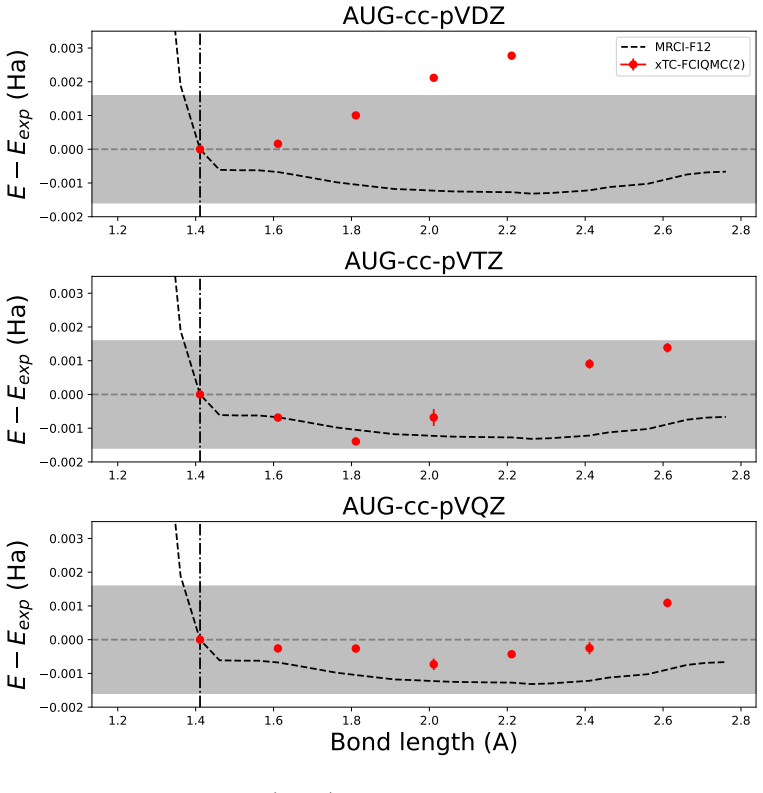
The central result is that a pseudopotential-based transcorrelated Hamiltonian is reliable only if the nonlocal pseudopotential's non-commutation with the Jastrow factor is corrected through at least the first two non-zero commutators, the PP-2 level. In the all-electron case the similarity transformation terminates exactly at the second commutator; with a nonlocal effective potential it does not, and the authors truncate the series by dropping the three-body $i > j > m$ terms under the assumption that valence electrons near the core make them negligible. With that approximation, the corrected transcorrelated Hamiltonian makes xTC-CCSD(T)(PP-2) chemically accurate for the first-row ionization energies Be–F with both eCEPP and ccECP pseudopotentials, for atomization energies of CN, CO, CF, N2, O2, F2, H2O, and CO2 (eCEPP at AVQZ and ccECP at AVTZ), and for xTC-FCIQMC dissociation curves of N2 and F2 at AVQZ. Higher commutator orders change energies by about 1 mHa or less, which the authors take as evidence that PP-2 is sufficient.
Load-bearing premise
The method assumes that the three-body pseudopotential commutator terms dropped from the series are negligible for valence electrons near the core; the paper provides no numerical estimate of their size.
Editorial extensions
If this is right
- With PP-2, xTC-CCSD(T) reaches chemical accuracy for first-row ionization energies (Be–F) in triple- and quadruple-zeta bases with both eCEPP and ccECP pseudopotentials.
- Atomization energies of the eight-molecule test set reach chemical accuracy with xTC-CCSDT(PP-2) using eCEPPs in AVQZ and with ccECPs in AVTZ.
- xTC-FCIQMC(PP-2) reproduces the N2 and F2 dissociation curves to chemical accuracy in AVQZ, apart from the most compressed N2 bond lengths.
- Because pseudopotentials cut the VMC variance to roughly 8–30% of the all-electron value, Jastrow optimization becomes cheaper, making larger molecules, transition metals, and solid-state systems more accessible.
- The small size-inconsistency of the combined Jastrow treatment (~1–2 mHa) is removed by the separated Jastrow treatment, which the paper verifies gives identical equilibrium results.
Reading between the lines
- The PP-2 truncation should be re-tested for transition metals and heavier elements, where pseudopotentials have more angular-momentum channels and the nonlocal commutators are likely larger.
- The non-monotonic basis-set behavior of ccECPs (better at AVTZ than AVQZ for both xTC and F12) suggests the pseudopotential and basis set are not fully converged together; joint reoptimization could remove the artifact.
- One could estimate the dropped three-body pseudopotential commutator terms by comparing PP-2 against a version that keeps them within the xTC treatment, giving a direct numerical check of the core assumption without all-electron calculations.
- For strongly correlated dissociation like N2, the need for a multideterminant trial wave function in Jastrow optimization hints that single-reference VMC may be the next bottleneck when applying this method to bond breaking.
Editorial analysis
A structured set of objections, weighed in public.
Referee Report
Summary. The paper presents an extension of the transcorrelated (TC) method to calculations with nonlocal pseudopotentials (PPs). The similarity transformation of the Hamiltonian with a Jastrow factor is derived for the PP operator, and the resulting commutator terms are evaluated numerically in a modified TCHINT code. The method is tested on first-row atoms and molecules, with ionization potentials, atomization energies, and N2/F2 dissociation curves computed using xTC-CCSD(T), xTC-CCSDT, and xTC-FCIQMC. The central claims are that the PP-2 approximation (including the first two commutators of the PP with the Jastrow factor) is necessary and sufficient to reach chemical accuracy for the studied properties, and that the use of PPs substantially reduces the variance of the Jastrow-optimization VMC calculation.
Significance. If the central claims hold, this work is an important step toward applying transcorrelated methods to heavier elements and periodic systems, where the all-electron approach is costly. The paper provides a clear account of the commutator integrals, a practical numerical integration scheme, and benchmark data across several properties. The demonstrated variance reduction and the availability of optimized Jastrow parameters in the Supplementary Material are valuable. However, the chemical-accuracy claims rest on an unquantified truncation of the PP commutator series, and the combined Jastrow treatment introduces a size-consistency error that is on the order of the accuracy target. These issues make the presented results conditional rather than definitive.
major comments (2)
- [Pseudopotentials in the Transcorrelated Hamiltonian, Eqs. (9)-(10)] The truncation of the PP commutator series by dropping all three-body terms (the sums over i>j>m in Eq. 9) is not numerically justified. The paper correctly notes that for nonlocal PPs the BCH series does not terminate at the second commutator, but then it removes the three-body contributions under an assumption of negligible valence-electron density near the core. No estimate of these terms is provided. The convergence test in Fig. 3 and Table 4 (varying the number of retained commutators, n=0-4) does not probe this truncation because all n drop the same three-body terms; it only tests convergence of the two-body part. For first-row atoms, valence electrons have significant probability inside the nonlocal core region, so the omitted terms may be comparable to the 1-2 mHa chemical-accuracy target. The authors should provide a numerical estimate of the dropped three-body PP commutator terms for a representative system (e.g., Be or B), ideally by computing them explicitly or by comparing PP-2 results with an implementation that includes them, and show that they are below the accuracy target.
- [Dissociation energies] The combined Jastrow treatment used for the dissociation curves introduces a size-consistency error of -1.5(2) mHa for N2 at the largest bond length, as reported in the text. This error is at the same scale as the chemical-accuracy threshold (1.6 mHa), and the paper does not quantify how it affects the error curves in Figs. 9 and 10. Since dissociation curves are one of the three principal benchmark classes, the authors should either recompute key points with the separate Jastrow treatment (which they state eliminates the error) or provide a quantitative estimate of the size-consistency error along the computed curves to confirm that the chemical-accuracy claims are unaffected.
minor comments (6)
- [Introduction] The phrase 'cusps, 1 in the wave function' should have a space before the citation, and the reference formatting should be consistent throughout.
- [Pseudopotential approximation] In the sentence 'for to simplify presentation', the word 'the' is missing; it should read 'to simplify the presentation'.
- [Evaluation of transcorrelated Hamiltonian with pseudopotentials] In Eq. (13), the summation index 'i' is reused for both the electron index and the grid-point index, which is confusing; a different index (e.g., 'k') should be used for the spherical grid points.
- [Evaluation of transcorrelated Hamiltonian with pseudopotentials] The acronym 'NECP' is used in the text but never defined; presumably it denotes the number of grid points under pseudopotential influence, but it should be spelled out at first use.
- [Notation] The notation 'xTC-CCSD(T)(PP-0)' is ambiguous because the parentheses could be misread as subtraction; using a clearer notation such as 'xTC-CCSD(T)-PP0' would improve readability.
- [Conclusions] The phrase 'a feature than can provide useful' should be 'a feature that can be useful'.
Circularity Check
No circularity: PP commutator theory is derived from the nonlocal PP operator and benchmarked against external experimental/HEAT data; the unquantified 3-body truncation is a reliability risk, not a circular reduction.
full rationale
The paper's central derivation is self-contained: the transcorrelated pseudopotential Hamiltonian in Eqs. (8)-(12) is obtained by explicit commutators of the nonlocal PP operator with the Jastrow factor, and no target observable enters as a fitted input. The pseudopotentials are fixed literature objects (Trail-Needs eCEPPs and Bennett-Mitas ccECPs), and the Jastrow parameters are variance-optimized on Hartree-Fock wave functions rather than fitted to ionization potentials, atomization energies, or dissociation curves. Accuracy is judged against experimental ionization energies, the HEAT database, and experimental dissociation curves, all external benchmarks. The paper does rely on the authors' prior xTC approximation and TC formalism, but those are independently published methods; the present numerical claims concern the additional PP commutator contributions and are not forced by those citations. The dropped three-body PP commutator terms (the i > j > m sums in Eq. 9) are an unquantified truncation and a legitimate correctness concern, and the PP-n convergence scan does not test them because all n drop the same three-body terms. However, that is an unverified approximation about the completeness of the Hamiltonian, not a circular step: no defined quantity reduces by construction to the claimed chemical-accuracy benchmarks.
Assumptions & free parameters
free parameters (3)
- Jastrow cutoff radii =
u: 4.5 Bohr, chi: 4 Bohr, f: 4 Bohr
- FCIQMC initiator threshold =
3
- Spherical grid size for PP projections =
12 icosahedron vertices
assumptions (6)
- standard math Similarity transformation by exp(-J) preserves the eigenvalues of the Hamiltonian.
- ad hoc to paper Three-body terms of the pseudopotential commutators are negligible, so the commutator series can be truncated to two-body terms.
- domain assumption The xTC generalized normal ordering treatment of the three-body kinetic-energy commutator is accurate.
- domain assumption eCEPP and ccECP pseudopotentials accurately represent the valence Hamiltonian outside the core region.
- domain assumption The Hartree-Fock determinant is an adequate reference for Jastrow variance optimization for these systems.
- domain assumption The 12-point icosahedral spherical grid with random rotations gives converged pseudopotential projections.
Cite this review
Pith. "Pith review of Transcorrelated Theory with Pseudopotentials." pith.science (2026). https://pith.science/paper/SF7ZW33N
@misc{pith2026241205885,
  author       = {Pith},
  title        = {Pith review of: Transcorrelated Theory with Pseudopotentials},
  year         = {2026},
  howpublished = {\url{https://pith.science/paper/SF7ZW33N}},
  note         = {Machine review of arXiv:2412.05885}
}
read the original abstract
The transcorrelated (TC) method performs a similarity transformation on the electronic Schr\"odinger equation via Jastrow factorization of the wave function. This has demonstrated significant advancements in computational electronic structure theory by improving basis set convergence and compactifying the description of the wave function. In this work, we introduce a new approach that incorporates pseudopotentials (PPs) into the TC framework, significantly accelerating Jastrow factor optimization and reducing computational costs. Our results for ionization potentials, atomization energies, and dissociation curves of first-row atoms and molecules show that PPs provide chemically accurate descriptions across a range of systems and give guidelines for future theory and applications. The new pseudopotential-based TC method opens possibilities for applying TC to more complex and larger systems, such as transition metals and solid-state systems.
Figures


Figures from the paper (7 more)


Reference graph
Works this paper leans on
-
[1]
On the eigenfunctions of many-particle systems in quantum mechanics
Kato, T. On the eigenfunctions of many-particle systems in quantum mechanics. Communications on Pure and Applied Mathematics 1957, 10, 151--177
work page 1957
-
[2]
r 12-Dependent terms in the wave function as closed sums of partial wave amplitudes for large l
Kutzelnigg, W. r 12-Dependent terms in the wave function as closed sums of partial wave amplitudes for large l. Theoretica chimica acta 1985, 68, 445--469
work page 1985
-
[3]
Initiation of explicitly correlated Slater-type geminal theory
Ten-no, S. Initiation of explicitly correlated Slater-type geminal theory. Chemical Physics Letters 2004, 398, 56--61
work page 2004
-
[4]
Kutzelnigg, W.; Klopper, W. Wave functions with terms linear in the interelectronic coordinates to take care of the correlation cusp. I. General theory. The Journal of Chemical Physics 1991, 94, 1985--2001
work page 1991
-
[5]
Noga, J.; Kutzelnigg, W. Coupled cluster theory that takes care of the correlation cusp by inclusion of linear terms in the interelectronic coordinates. The Journal of Chemical Physics 1994, 101, 7738--7762
work page 1994
-
[6]
Kong, L.; Bischoff, F. A.; Valeev, E. F. Explicitly Correlated R12/F12 Methods for Electronic Structure. Chemical Reviews 2012, 112, 75--107
work page 2012
-
[7]
J.; Luo, H.; Guther, K.; Dobrautz, W.; Tew, D
Cohen, A. J.; Luo, H.; Guther, K.; Dobrautz, W.; Tew, D. P.; Alavi, A. Similarity transformation of the electronic Schrödinger equation via Jastrow factorization. The Journal of Chemical Physics 2019, 151, 061101
work page 2019
-
[8]
Ammar, A.; Scemama, A.; Giner, E. Transcorrelated selected configuration interaction in a bi-orthonormal basis and with a cheap three-body correlation factor. The Journal of Chemical Physics 2023, 159, 114121
work page 2023
Show all 43 references
-
[9]
Biorthonormal Orbital Optimization with a Cheap Core-Electron-Free Three-Body Correlation Factor for Quantum Monte Carlo and Transcorrelation
Ammar, A.; Scemama, A.; Giner, E. Biorthonormal Orbital Optimization with a Cheap Core-Electron-Free Three-Body Correlation Factor for Quantum Monte Carlo and Transcorrelation. Journal of Chemical Theory and Computation 2023, 19, 4883--4896, PMID: 37390472
2023
-
[10]
Lee, N.; Thom, A. J. W. Studies on the Transcorrelated Method. Journal of Chemical Theory and Computation 2023, 19, 5743--5759, PMID: 37640393
2023
-
[11]
Ten-no, S. L. Nonunitary projective transcorrelation theory inspired by the F12 ansatz. The Journal of Chemical Physics 2023, 159, 171103
2023
-
[12]
Compactification of determinant expansions via transcorrelation
Ammar, A.; Scemama, A.; Loos, P.-F.; Giner, E. Compactification of determinant expansions via transcorrelation. The Journal of Chemical Physics 2024, 161, 084104
2024
-
[13]
P.; Hosseini, S
Haupt, J. P.; Hosseini, S. M.; López Ríos, P.; Dobrautz, W.; Cohen, A.; Alavi, A. Optimizing Jastrow factors for the transcorrelated method. The Journal of Chemical Physics 2023, 158, 224105
2023
-
[14]
Compact numerical solutions to the two-dimensional repulsive Hubbard model obtained via nonunitary similarity transformations
Dobrautz, W.; Luo, H.; Alavi, A. Compact numerical solutions to the two-dimensional repulsive Hubbard model obtained via nonunitary similarity transformations. Phys. Rev. B 2019, 99, 075119
2019
-
[15]
Christlmaier, E. M. C.; Schraivogel, T.; López Ríos, P.; Alavi, A.; Kats, D. xTC: An efficient treatment of three-body interactions in transcorrelated methods. The Journal of Chemical Physics 2023, 159, 014113
2023
-
[16]
Combining the Transcorrelated Method with Full Configuration Interaction Quantum Monte Carlo: Application to the Homogeneous Electron Gas
Luo, H.; Alavi, A. Combining the Transcorrelated Method with Full Configuration Interaction Quantum Monte Carlo: Application to the Homogeneous Electron Gas. Journal of Chemical Theory and Computation 2018, 14, 1403--1411, PMID: 29431996
2018
-
[17]
Towards efficient and accurate ab initio solutions to periodic systems via transcorrelation and coupled cluster theory
Liao, K.; Schraivogel, T.; Luo, H.; Kats, D.; Alavi, A. Towards efficient and accurate ab initio solutions to periodic systems via transcorrelation and coupled cluster theory. Phys. Rev. Res. 2021, 3, 033072
2021
-
[18]
J.; Luo, H.; Alavi, A
Guther, K.; Cohen, A. J.; Luo, H.; Alavi, A. Binding curve of the beryllium dimer using similarity-transformed FCIQMC: Spectroscopic accuracy with triple-zeta basis sets. The Journal of Chemical Physics 2021, 155, 011102
2021
-
[19]
J.; Alavi, A.; Kats, D
Schraivogel, T.; Cohen, A. J.; Alavi, A.; Kats, D. Transcorrelated coupled cluster methods. The Journal of Chemical Physics 2021, 155, 191101
2021
-
[20]
Schraivogel, T.; Christlmaier, E. M. C.; López Ríos, P.; Alavi, A.; Kats, D. Transcorrelated coupled cluster methods. II. Molecular systems. The Journal of Chemical Physics 2023, 158, 214106
2023
-
[21]
O.; Dobrautz, W.; Luo, H.; Alavi, A.; Tavernelli, I
Sokolov, I. O.; Dobrautz, W.; Luo, H.; Alavi, A.; Tavernelli, I. Orders of magnitude increased accuracy for quantum many-body problems on quantum computers via an exact transcorrelated method. Phys. Rev. Res. 2023, 5, 023174
2023
-
[22]
R.; Needs, R
Trail, J. R.; Needs, R. J. Shape and energy consistent pseudopotentials for correlated electron systems. The Journal of Chemical Physics 2017, 146, 204107
2017
-
[23]
C.; Melton, C
Bennett, M. C.; Melton, C. A.; Annaberdiyev, A.; Wang, G.; Shulenburger, L.; Mitas, L. A new generation of effective core potentials for correlated calculations. The Journal of Chemical Physics 2017, 147, 224106
2017
-
[24]
W.; Louie, S
Fahy, S.; Wang, X. W.; Louie, S. G. Variational quantum Monte Carlo nonlocal pseudopotential approach to solids: Formulation and application to diamond, graphite, and silicon. Phys. Rev. B 1990, 42, 3503--3522
1990
-
[25]
D.; Towler, M
Drummond, N. D.; Towler, M. D.; Needs, R. J. Jastrow correlation factor for atoms, molecules, and solids. Phys. Rev. B 2004, 70, 235119
2004
-
[26]
TCHINT, To be published
-
[27]
G.; Császár, A
Tajti, A.; Szalay, P. G.; Császár, A. G.; Kállay, M.; Gauss, J.; Valeev, E. F.; Flowers, B. A.; Vázquez, J.; Stanton, J. F. HEAT: High accuracy extrapolated ab initio thermochemistry. The Journal of Chemical Physics 2004, 121, 11599--11613
2004
-
[28]
Sun, Q. et al. Recent developments in the PySCF program package. The Journal of Chemical Physics 2020, 153, 024109
2020
-
[29]
J.; Towler, M
Needs, R. J.; Towler, M. D.; Drummond, N. D.; López Ríos, P.; Trail, J. R. Variational and diffusion quantum Monte Carlo calculations with the CASINO code. The Journal of Chemical Physics 2020, 152, 154106
2020
-
[30]
ElemCo.jl ,: Julia program package for electron correlation methods
Kats, D.; Schraivogel, T.; Hauskrecht, J.; Rickert, C.; Wu, F., et al. ElemCo.jl ,: Julia program package for electron correlation methods. 2024,
2024
-
[31]
M.; Schraivogel, T.; Alavi, A
Kats, D.; Christlmaier, E. M.; Schraivogel, T.; Alavi, A. Orbital optimisation in xTC transcorrelated methods. Faraday Discussions 2024, 254, 382--401
2024
-
[32]
J.; Knizia, G.; Manby, F
Werner, H.-J.; Knowles, P. J.; Knizia, G.; Manby, F. R.; ; Schütz, M. Molpro: a general-purpose quantum chemistry program package. Wiley Interdisciplinary Reviews: Computational Molecular Science
-
[33]
J.; Manby, F
Werner, H.-J.; Knowles, P. J.; Manby, F. R.; Black, J. A.; Doll, K.; He , A., elmann; Kats, D.; K \"o , A., hn; Korona, T.; Kreplin, D. A., et al. The Molpro quantum chemistry package. The Journal of chemical physics 2020, 152
2020
-
[34]
J., et al
Werner, H.-J.; Knowles, P. J., et al. MOLPRO, a package of ab initio programs. For more information, see https://www.molpro.net/,
-
[35]
A.; Adler, T
Peterson, K. A.; Adler, T. B.; Werner, H.-J. Systematically convergent basis sets for explicitly correlated wavefunctions: The atoms H, He, B–Ne, and Al–Ar. The Journal of Chemical Physics 2008, 128, 084102
2008
-
[36]
H.; Alavi, A
Cleland, D.; Booth, G. H.; Alavi, A. Communications: Survival of the fittest: Accelerating convergence in full configuration-interaction quantum Monte Carlo. The Journal of Chemical Physics 2010, 132, 041103
2010
-
[37]
Guther, K. et al. NECI: N-Electron Configuration Interaction with an emphasis on state-of-the-art stochastic methods. The Journal of Chemical Physics 2020, 153, 034107
2020
-
[38]
R.; Silver, D
Davidson, E. R.; Silver, D. W. Size consistency in the dilute helium gas electronic structure. Chemical Physics Letters 1977, 52, 403--406
1977
-
[39]
J.; Gwaltney, S
Chakravorty, S. J.; Gwaltney, S. R.; Davidson, E. R.; Parpia, F. A.; p Fischer, C. F. Ground-state correlation energies for atomic ions with 3 to 18 electrons. Phys. Rev. A 1993, 47, 3649--3670
1993
-
[40]
J.; Huang, Y.; Jary, C
Le Roy, R. J.; Huang, Y.; Jary, C. An accurate analytic potential function for ground-state N 2 , from a direct-potential-fit analysis of spectroscopic data. The Journal of Chemical Physics 2006, 125, 164310
2006
-
[41]
P.; et al., To be published
Haupt, J. P.; et al., To be published
-
[42]
combined
Colbourn, E. A.; Dagenais, M.; Douglas, A. E.; Raymonda, J. W. The electronic spectrum of F2. Canadian Journal of Physics 1976, 54, 1343--1359 mcitethebibliography main.tex0000664000000000000000000027615715002173706011247 0ustar rootroot [journal=jctc,manuscript=article] achem...
1976
-
[43]
2AG#K ٭DF ʴ _6 6f ֣dzi Xd
Colbourn, E. A.; Dagenais, M.; Douglas, A. E.; Raymonda, J. W. The electronic spectrum of F2. Canadian Journal of Physics 1976, 54, 1343--1359 mcitethebibliography document molecule_total_energies_lm.pdf0000664000000000000000000004531214756403342015647 0ustar rootroot 1 0 obj ...
2004
Reviewed August 11, 2026 · model on record in the stance chip above.
Discussion (0). Continue with ORCID to comment.