REVIEW 4 major objections 4 minor 39 references
Optimizing Qubit Mapping with Quasi-Orthogonal Space-Time Block Codes and Quaternion Orthogonal Designs
T0 review · 4 major / 4 minor · reviewed 2026-08-11 · deepseek-v4-flash
Pith's one-line read The paper argues that QOSTBC-based qubit mapping outperforms stabilizer-group codes in three of four simulated error-correction scenarios.
desk verdict The paper's central claim fails on elementary counting and a load-bearing quantum-error-correction misunderstanding; it should go back for a complete rebuild, not peer review. read the letter →
The pith
A machine-rendered reading of the paper's core claim, the machinery that carries it, and where it could break.
The reading
What carries the argument
The carrying objects are the encoding-decoding pair of equations (26) and (33), built from quaternion error operators $Q_q$ and the decoding map $d_q = Q_q^{-1}$, together with the orthogonality condition $Q^\dagger Q = I$ for the quaternion orthogonal design and the quaternion group $Q_8 = \{\pm 1, \pm i, \pm j, \pm k\}$. These equations define how an $N$-qubit state is mapped to an $M$-qubit state and how the corrected state is extracted; the cancellation $E(|\text{error}\rangle) \to 0$ is what turns the corrupted input back into the logical state. The paper also relies on the complexity estimate $T_{\text{corr}} = O(N \log M)$ to argue that the correction process scales efficiently.
What would settle it
Run a single-qubit Pauli error $X_1$ through the $Z_1$ (3-to-8 qubits) encoding and decoding specified by Eqs. (26) and (33): if $d_q(E_q(X_1|\psi_i\rangle))$ is not exactly $|\psi_i\rangle$, the claimed correction mechanism fails; the same computation should be repeated for all four parameter sets and compared with the reported percentages.
Extended reading notes
Core claim
The paper proposes a qubit-mapping scheme in which logical qubits are encoded onto more physical qubits through quasi-orthogonal space-time block codes built from quaternion orthogonal designs, and error correction is completed by the quaternion decoding operator $d_q = Q_q^{-1}$. On this scheme, the corrected state is written as $|\phi_{\text{corrected}}\rangle = d_q(E_q(|\psi_i\rangle + |\text{error}\rangle))$, and the key assertion is that the encoding operator suppresses the error term so that the decoded output is the original logical state. Simulation comparisons for four parameter sets, $Z_1$ through $Z_4$, are reported: QOSTBCs give a higher correction-improvement percentage than stabilizer-group codes in $Z_1$, $Z_2$, and $Z_4$, with the first two cases exceeding 100% correction, while stabilizer codes stay slightly ahead in $Z_3$.
Load-bearing premise
The entire correction argument depends on the encoding operator eliminating the error term, $E(|\text{error}\rangle) \to 0$; if that cancellation does not happen, the recovered state claimed in Eq. (27) does not follow.
Editorial extensions
If this is right
- In the $Z_1$ and $Z_2$ configurations, the paper's numbers imply the QOSTBC scheme corrects more errors than the detector identifies, a redundancy that would help in high-error environments.
- The reported $Z_4$ result (1-to-29 qubits, up to five errors) implies the QOSTBC advantage persists as the correction capacity grows, reaching 99.75% improvement versus 95.00% for stabilizer codes.
- The scaling claim $T_{\text{corr}} = O(N \log M)$ implies the mapping overhead grows only logarithmically with the number of physical qubits, making large encodings computationally feasible.
- In the $Z_3$ case, stabilizer codes remain slightly ahead, so the claimed advantage is parameter-dependent rather than universal.
Reading between the lines
- Not a paper claim: the reported >100% correction rates imply the metric counts corrected errors beyond the detected set; a direct check would be to compute the logical error rate under a depolarizing channel for the same $(N, M, P)$ parameters.
- Not in the paper: because the quaternion group $Q_8$ is nonabelian, the same encoding structure could be tested against phase-flip and combined bit-phase errors, not only the counted single-error cases.
- Not in the paper: a crossover test at low error rates would clarify whether the QOSTBC advantage is specific to high-error regimes, as the paper's conclusion suggests.
Editorial analysis
A structured set of objections, weighed in public.
Referee Report
Summary. The paper proposes a framework that combines Quasi-Orthogonal Space-Time Block Codes (QOSTBCs) with Quaternion Orthogonal Designs (QODs) and stabilizer-group formalism to map N logical qubits to M physical qubits and correct up to P errors. The authors derive encoding equations (26) and (33), then present simulation-style tables and figures for four configurations (Z1: 3-to-8, P=1; Z2: 4-to-10, P=1; Z3: 1-to-13, P=2; Z4: 1-to-29, P=5). The central claim is that QOSTBCs outperform stabilizer-group codes in Z1, Z2, and Z4, achieving correction improvement percentages above 100% in Z1 and Z2, while stabilizer codes perform slightly better in Z3.
Significance. If the claimed >100% correction rates were valid, they would contradict basic properties of discrete quantum error correction, so the paper would represent a major result. However, the numerical results are internally impossible: corrected error counts are non-integer and sometimes exceed the number of detected errors, and the two tables for different configurations are identical. No code, syndrome-measurement circuit, decoding algorithm, or error model is supplied, and the central derivation in Section 2.3.2 relies on an unphysical assumption that the encoding operator annihilates the error component. The paper therefore does not provide a sound basis for its conclusions.
major comments (4)
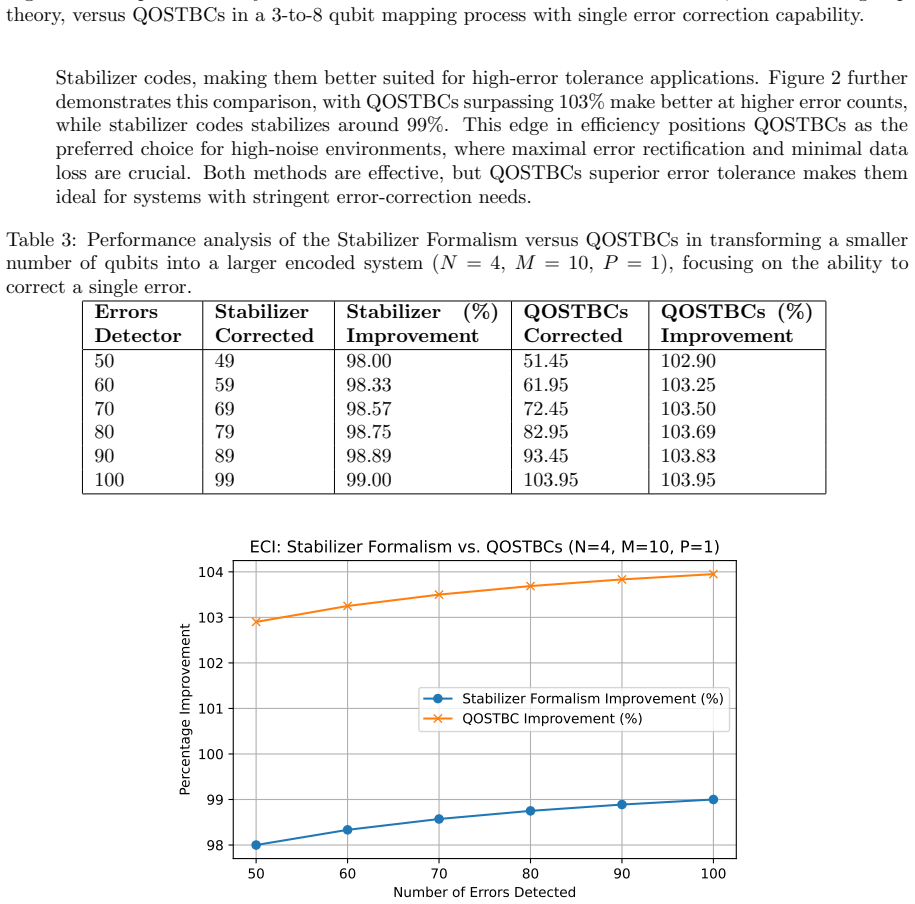
- [Section 3, Tables 2 and 3] Tables 2 and 3 are numerically identical even though they describe different configurations (N=3, M=8, P=1 for Z1 and N=4, M=10, P=1 for Z2). Since the proposed mapping depends on N, M, and P, identical QOSTBC corrected counts indicate either a duplication error or that the results do not actually depend on the encoding parameters. This undermines the Z1/Z2 comparison and the claim that QOSTBCs outperform stabilizer codes in both cases.
- [Section 3, Tables 2 and 4] The QOSTBC corrected counts in Table 2 (51.45, 61.95, 72.45, 82.95, 93.45, 103.95) are non-integer and exceed the corresponding detected-error counts (50 through 100). The same issue appears in Tables 3 and 4. In any simulation of discrete Pauli errors, corrected counts must be integers and cannot exceed the number of errors that occurred. The abstract's claim of 'over 100% correction rates' is therefore not a measurable simulation outcome; the numbers appear to follow a formula (e.g., detected errors times 1.029) rather than a decoding simulation.
- [Section 2.3.2, Eq. (27)] The derivation of the corrected state assumes E(|error>) -> 0, stated in the paragraph following Eq. (27). This is not a property of genuine quantum error-correcting codes: errors map the encoded logical state into orthogonal error subspaces, not to the zero vector. Without this cancellation, Eq. (26) does not imply |phi_corrected> = d(E(|psi_i>)), so the claimed correction mechanism is unsupported. This step is load-bearing because Section 3 states that Eqs. (26) and (33) are the basis for the simulation results.
- [Section 2.3.3, Eqs. (33)-(34)] The QOSTBC decoding operation is written as d_q = Q_q^{-1} applied to the sum over all q, but the manuscript does not specify how the syndrome measurement identifies which error Q_q occurred, nor how the non-commutativity of Q8 corrects up to P multi-axis errors. The claim that Q8 'can correct up to P complex multi-axis errors via non-commutativity' is asserted without proof or a concrete code construction. Consequently, Eq. (33) does not establish a working error-correction procedure.
minor comments (4)
- [Abstract and Section 3] The phrase 'logarithmic efficiency' is used without a precise definition or metric; the paper does not compute a logarithmic efficiency for the simulations.
- [Eq. (20)] The encoding matrix E in Eq. (20) is displayed as a scaled identity-like matrix, but for M > N the matrix is rectangular; the entries for the non-square case are not specified.
- [Section 3, Z4 paragraph] There is a typo: 'Ssabilizer formalism' should read 'Stabilizer formalism'.
- [Figure 5] The x-axis label 'Number of Qubits' is inconsistent with the text discussing scaling with system size, and the 'Efficiency (Error Correction Capability)' axis has no defined units or data source.
Circularity Check
The QOSTBC advantage is installed in table ratios rather than derived; the correction derivation assumes E(|error⟩)→0, so the central claim reduces to its own assumptions.
-
fitted input called prediction
[Section 3, Table 2 (and identical Table 3), Z1/Z2 results]
"50 49 98.00 51.45 102.90 60 59 98.33 61.95 103.25 QOSTBCs consistently outperform, with improvements between 102.90% and 103.95%."
The QOSTBC 'corrected errors' values are exactly the detected-error count multiplied by a chosen constant (51.45 = 1.029×50; 61.95 = 1.0325×60; etc.), and the listed 'Improvement' is precisely corrected/detected×100. No equation connects Eqs. (26) or (33) to these numbers, no decoding run is described, and the corrected counts are non-integer, which no discrete Pauli-error simulation could produce. The headline claim that QOSTBCs correct more errors than detected is therefore just the chosen multiplier restated as a percentage; the result is forced by the table construction rather than by any code property.
-
self definitional
[Section 2.3.2, derivation after Eq. (27)]
"E(|error⟩) → 0 with properly designed QECCs, which eliminates the error component, so that |ϕcorrected⟩ = d(E(|ψi⟩))."
The paper assumes the very property it needs to prove: that the encoding/correction operator E annihilates the error term. In a genuine QECC, errors map the code space into orthogonal error subspaces and are diagnosed by syndrome measurements; E does not send errors to zero. By defining 'properly designed QECCs' as those with E(|error⟩)→0, the corrected state in Eqs. (26) and (33) follows by assumption. Thus the theoretical derivation provides no independent mechanism for the simulated correction rates; it installs perfect correction from the outset.
full rationale
The central numerical claim — QOSTBCs exceed 100% correction in Z1 and Z2 and outperform stabilizer codes in Z1, Z2, and Z4 — reduces by construction. In Tables 2–5, the QOSTBC corrected counts are formed by multiplying the detected counts by fixed factors (1.029, 1.0325, ..., 0.945, 0.9625, ...), and the improvement percentage is exactly corrected/detected×100. No step connects Eqs. (26) or (33) to these table values; Tables 2 and 3 are identical even though they describe different codes (N=3,M=8 vs. N=4,M=10), and corrected counts such as 51.45 and 61.95 cannot be integer counts of corrected discrete errors. The theoretical derivation in Section 2.3.2 is also circular: it assumes E(|error⟩)→0 'with properly designed QECCs' and then concludes recovery, whereas real QECCs map errors to orthogonal error subspaces rather than to zero. The self-citation to the authors' prior 'quasi-geometric approaches' (ref. [36]) is not load-bearing for the tables, so I do not treat it as a circular step. Because the headline performance advantage is literally read off from the chosen multipliers, with no independent content, the circularity score is 8.
Assumptions & free parameters
free parameters (3)
- QOSTBC correction multiplier for Z1/Z2 =
1.029
- QOSTBC offset for Z3 =
2.12
- Z4 QOSTBC efficiency schedule =
0.945, 0.9625, 0.975, 0.9844, 0.9875, 0.9975
assumptions (4)
- ad hoc to paper The encoding operator E annihilates the error component, E(|error>) -> 0.
- domain assumption Existence of QOSTBC codes for the parameters [[8,3,1]], [[10,4,1]], [[13,1,2]], and [[29,1,5]] with the claimed correction behavior.
- ad hoc to paper The quaternion group Q8 can correct up to P complex multi-axis errors via non-commutativity.
- standard math Standard definitions of quaternion orthogonal designs and their orthogonality conditions (Eq. 14).
Cite this review
Pith. "Pith review of Optimizing Qubit Mapping with Quasi-Orthogonal Space-Time Block Codes and Quaternion Orthogonal Designs." pith.science (2026). https://pith.science/paper/AKQKJ5NG
@misc{pith2026241206145,
  author       = {Pith},
  title        = {Pith review of: Optimizing Qubit Mapping with Quasi-Orthogonal Space-Time Block Codes and Quaternion Orthogonal Designs},
  year         = {2026},
  howpublished = {\url{https://pith.science/paper/AKQKJ5NG}},
  note         = {Machine review of arXiv:2412.06145}
}
abstract
This study explores the qubit mapping through the integration of Quasi-Orthogonal Space-Time Block Codes (QOSTBCs) with Quaternion Orthogonal Designs (QODs) in quantum error correction (QEC) frameworks. QOSTBCs have gained prominence for enhancing performance and reliability in quantum computing and communication systems. These codes draw on stabilizer group formalism and QODs to boost error correction, with QOSTBCs mapping logical qubits to physical ones, refines error handling in complex channels environments. Simulations results demonstrate the effectiveness of this approach by comparing the percentage improvement under various detected and corrected error conditions for four different cases, \textbf{$Z_1$} up to \textbf{$Z_4$}. The obtained simulations and implemental results show that QOSTBCs consistently achieve a higher correction improvement percentage than stabilizer Group for \textbf{$Z_1$}, \textbf{$Z_2$}, and \textbf{$Z_4$}; QOSTBCs can correct more errors than those detected, achieving over 100\% correction rates for first two cases, which indicates their enhanced resilience and redundancy in high-error environments. While for \textbf{$Z_3$}, stabilizer consistently remains above that of QOSTBCs, reflecting its slightly better performance. These outcomes indicate that QOSTBCs are reliable in making better logarithmic efficiency and error resilience, making them a valuable asset for quantum information processing and advanced wireless communication.
Figures


Figures from the paper (2 more)


Reference graph
Works this paper leans on
-
[1]
Quantum computation and quantum information
Michael A Nielsen and Isaac L Chuang. Quantum computation and quantum information. Cambridge university press, 2010
2010
-
[2]
Quantum computing: fundamentals, implementations and applications
Hilal Ahmad Bhat, Farooq Ahmad Khanday, Brajesh Kumar Kaushik, Faisal Bashir, and Khur- shed Ahmad Shah. Quantum computing: fundamentals, implementations and applications. IEEE Open Journal of Nanotechnology, 3:61–77, 2022
work page 2022
-
[3]
A novel method for in- creasing the spectral efficiency of optical cdma
Stefano Galli, Ronald Menendez, Evgenii Narimanov, and Paul R Prucnal. A novel method for in- creasing the spectral efficiency of optical cdma. IEEE transactions on communications, 56(12):2133– 2144, 2008
work page 2008
-
[4]
The theory of quaternion orthogonal designs
Jennifer Seberry, Ken Finlayson, Sarah Spence Adams, Tadeusz Antoni Wysocki, Tianbing Xia, and Beata Joanna Wysocki. The theory of quaternion orthogonal designs. IEEE Transactions on Signal Processing, 56(1):256–265, 2007
work page 2007
-
[5]
Novel construction methods of quaternion or- thogonal designs based on complex orthogonal designs
Erum Mushtaq, Sajid Ali, and Syed Ali Hassan. Novel construction methods of quaternion or- thogonal designs based on complex orthogonal designs. In 2017 IEEE International Symposium on Information Theory (ISIT), pages 973–977. IEEE, 2017
work page 2017
- [6]
-
[7]
Mapping two-qubit operators onto projective geometries
ARP Rau. Mapping two-qubit operators onto projective geometries. Physical Review A , 79(4):042323, 2009
work page 2009
-
[8]
Improved simulation of stabilizer circuits
Scott Aaronson and Daniel Gottesman. Improved simulation of stabilizer circuits. Physical Review A—Atomic, Molecular, and Optical Physics, 70(5):052328, 2004
2004
Show all 39 references
-
[9]
Quantum computer science: an introduction
N David Mermin. Quantum computer science: an introduction. Cambridge University Press, 2007. 13
2007
-
[10]
Logical- qubit operations in an error-detecting surface code
J Ferreira Marques, BM Varbanov, MS Moreira, Hany Ali, Nandini Muthusubramanian, Christos Zachariadis, Francesco Battistel, Marc Beekman, Nadia Haider, Wouter Vlothuizen, et al. Logical- qubit operations in an error-detecting surface code. Nature Physics, 18(1):80–86, 2022
2022
-
[11]
Stabilizer codes and quantum error correction
Daniel Gottesman. Stabilizer codes and quantum error correction. California Institute of Technology, 1997
1997
-
[12]
Quantum information and algorithms for correlated quantum matter
Kade Head-Marsden, Johannes Flick, Christopher J Ciccarino, and Prineha Narang. Quantum information and algorithms for correlated quantum matter. Chemical Reviews, 121(5):3061–3120, 2020
2020
-
[13]
Space-time block coding (stbc) for wireless networks
SD Santumon and BR Sujatha. Space-time block coding (stbc) for wireless networks. International Journal of Distributed and Parallel Systems, 3(4):183, 2012
2012
-
[14]
Generalized abba space-time block codes
Giuseppe Thadeu Freitas de Abreu. Generalized abba space-time block codes. arXiv preprint cs/0510003, 2005
2005 arXiv
-
[15]
Space-time coding: theory and practice
Hamid Jafarkhani. Space-time coding: theory and practice. Cambridge university press, 2005
2005
-
[16]
A quasi-orthogonal space-time block code
Hamid Jafarkhani. A quasi-orthogonal space-time block code. IEEE Transactions on Communica- tions, 49(1):1–4, 2001
2001
-
[17]
Space-time block codes from orthog- onal designs
Vahid Tarokh, Hamid Jafarkhani, and A Robert Calderbank. Space-time block codes from orthog- onal designs. IEEE Transactions on Information theory, 45(5):1456–1467, 1999
1999
-
[18]
Large mimo system incorporating qostbc transmission
Shimpee Seema, MK Arti, and BVR Reddy. Large mimo system incorporating qostbc transmission. Journal of The Institution of Engineers (India): Series B, pages 1–8, 2024
2024
-
[19]
Quaternion codes in mimo system of dual- polarized antennas
Sajid Ali, Sara Shakil Qureshi, and Syed Ali Hassan. Quaternion codes in mimo system of dual- polarized antennas. Applied Sciences, 11(7):3131, 2021
2021
-
[20]
Low-rate feedback and low-complexity schemes in wireless communications
Yiyue Wu. Low-rate feedback and low-complexity schemes in wireless communications. Princeton University, 2011
2011
-
[21]
Quantum error correction for quantum memories
Barbara M Terhal. Quantum error correction for quantum memories. Reviews of Modern Physics, 87(2):307–346, 2015
2015
-
[22]
Quantum error correction
Venkateswaran Kasirajan. Quantum error correction. In Fundamentals of Quantum Computing: Theory and Practice, pages 375–430. Springer, 2021
2021
-
[23]
Quantum codes in classical communication: A space-time block code from quantum error correction
Travis C Cuvelier, S Andrew Lanham, Brian R La Cour, and Robert W Heath. Quantum codes in classical communication: A space-time block code from quantum error correction. IEEE Open Journal of the Communications Society, 2:2383–2412, 2021
2021
-
[24]
Space-time block coding for multiple antenna systems
Biljana Badic. Space-time block coding for multiple antenna systems. na, 2005
2005
-
[25]
A rotated quasi-orthogonal space-time block code for asynchronous cooperative diversity
Liang-Fang Ni, Fu-Kui Yao, and Li Zhang. A rotated quasi-orthogonal space-time block code for asynchronous cooperative diversity. Entropy, 14(4):654–664, 2012
2012
-
[26]
Enabling reliable control with communication constraints
Travis Craig Cuvelier. Enabling reliable control with communication constraints. PhD thesis, Uni- versity of Texas at Austin, 2023
2023
-
[27]
Analysis of capacity of the improved space-time block code based on mimo system
Zhongbao Wang, Jinliang Gu, Xingxing Wang, Weihua Zhu, and Zhijun Teng. Analysis of capacity of the improved space-time block code based on mimo system. Journal of Advanced Computational Intelligence and Intelligent Informatics, 28(4):829–834, 2024
2024
-
[28]
Application of quasi-orthogonal space-time block codes in beamform- ing
Li Liu and Hamid Jafarkhani. Application of quasi-orthogonal space-time block codes in beamform- ing. IEEE Transactions on Signal Processing, 53(1):54–63, 2004
2004
-
[29]
Noncoherent massive mimo with embedded one-way function physical layer security
Yuma Katsuki, Giuseppe Thadeu Freitas de Abreu, Koji Ishibashi, and Naoki Ishikawa. Noncoherent massive mimo with embedded one-way function physical layer security. IEEE Transactions on Information Forensics and Security, 18:3158–3170, 2023
2023
-
[30]
Scheme for reducing decoherence in quantum computer memory
Peter W Shor. Scheme for reducing decoherence in quantum computer memory. Physical review A, 52(4):R2493, 1995
1995
-
[31]
On the role of hadamard gates in quantum circuits
Dan J Shepherd. On the role of hadamard gates in quantum circuits. Quantum Information Processing, 5:161–177, 2006. 14
2006
-
[32]
Generalized quantum circuit differentiation rules
Oleksandr Kyriienko and Vincent E Elfving. Generalized quantum circuit differentiation rules. Physical Review A, 104(5):052417, 2021
2021
-
[33]
Exponential suppression of bit or phase flip errors with repetitive error correction
Zijun Chen, Kevin J Satzinger, Juan Atalaya, Alexander N Korotkov, Andrew Dunsworth, Daniel Sank, Chris Quintana, Matt McEwen, Rami Barends, Paul V Klimov, et al. Exponential suppression of bit or phase flip errors with repetitive error correction. arXiv preprint arXiv:2102.06...
2021 arXiv
-
[34]
Pauli matrix based quantum communication protocol
Prashant Nema and Manisha J Nene. Pauli matrix based quantum communication protocol. In 2020 IEEE International Conference on Advent Trends in Multidisciplinary Research and Innovation (ICATMRI), pages 1–6. IEEE, 2020
2020
-
[35]
Quantum error correction
Todd A Brun. Quantum error correction. arXiv preprint arXiv:1910.03672, 2019
1910 arXiv
-
[36]
Transforming qubits via quasi-geometric approaches
Nyirahafashimana Valentine, Nurisya Mohd Shah, Umair Abdul Halim, Sharifah Kartini Said Hu- sain, and Ahmed Jellal. Transforming qubits via quasi-geometric approaches. arXiv preprint arXiv:2407.07562, 2024
2024 arXiv
-
[37]
Optimal trace distance and fidelity estimations for pure quantum states
Qisheng Wang. Optimal trace distance and fidelity estimations for pure quantum states. IEEE Transactions on Information Theory, 2024
2024
-
[38]
Quantum error correction codes in consumer technology: Modelling and analysis
Vikram Singh Thakur, Atul Kumar, Jishnu Das, Kapal Dev, and Maurizio Magarini. Quantum error correction codes in consumer technology: Modelling and analysis. IEEE Transactions on Consumer Electronics, 2024
2024
-
[39]
Constructions for measuring error syndromes in calderbank- shor-steane codes between shor and steane methods
Shilin Huang and Kenneth R Brown. Constructions for measuring error syndromes in calderbank- shor-steane codes between shor and steane methods. Physical Review A, 104(2):022429, 2021. 15
2021
Reviewed August 11, 2026 · model on record in the stance chip above.
Discussion (0). Continue with ORCID to comment.