REVIEW 3 major objections 5 minor 58 references
Multigrid low-mode averaging
T0 review · 3 major / 5 minor · reviewed 2026-08-11 · deepseek-v4-flash
Pith's one-line read By projecting a small fixed set of low quark modes onto local spacetime blocks, multigrid low-mode averaging keeps stochastic variance under control as the lattice volume grows, without requiring more low modes.
desk verdict A well-executed methods paper extending LMA to connected correlators; the volume-independence claim is promising but backed by thinner numerics than the text suggests. read the letter →
The pith
A machine-rendered reading of the paper's core claim, the machinery that carries it, and where it could break.
The reading
What carries the argument
The key object is the block-projected low-mode subspace: each of the $N_c$ low eigenmodes of the Hermitian Dirac operator $Q=\gamma_5 D$ is restricted to each block of a lattice decomposition and re-orthonormalized, so that $N_c N_s V_1$ fields span a space approximating the whole low-mode band, exploiting local coherence (small deficits in Eq. (19)). Restriction and prolongation operators between nested grids define coarse-grid operators $Q_{l+1}=R_l Q_l T_l$; iterating the identity $Q_l^{-1}=\{Q_l^{-1}-T_l Q_{l+1}^{-1}R_l\}+T_l Q_{l+1}^{-1}R_l$ gives a telescoping sum for the quark propagator, $S=S_0+\cdots+S_{N_\ell-1}$, whose levels can be estimated with different numbers of stochastic sources. Preserving chiral degrees of freedom on the coarse grids ($N_s=2$) keeps the coarse operators well conditioned and makes the lowest $N_c$ eigenvalues match the fine-grid ones.
What would settle it
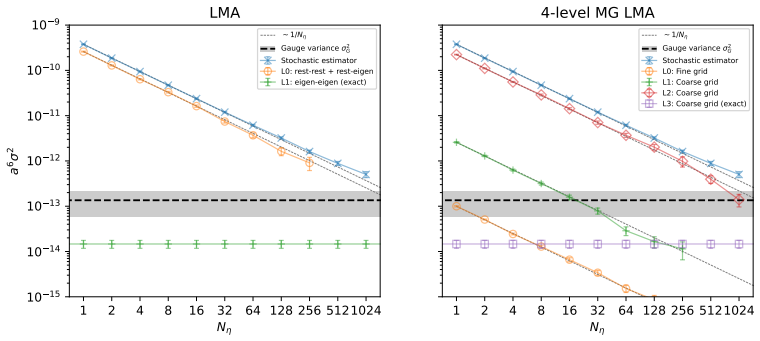
Extend the two-level multigrid LMA measurement of Fig. 7 to $L\approx 6$-$8$ fm with the same $N_c=50$ and block size $8^4$, averaging the fine-level variance over many configurations: if the fine-level contribution stops decreasing with $L$, or the coarse-level inversion count grows so that total cost no longer stays flat, the central claim fails. A cheaper check is to measure the deficits of Eq. (19) on an ensemble average at larger volume and look for a systematic rise.
Extended reading notes
Core claim
The paper's central claim is that local coherence of the low quark modes converts low-mode averaging from a method whose mode count must grow with volume into one whose mode count can stay fixed. Concretely, with $N_c=50$ exact low modes block-projected onto cubes of side roughly $0.5\,\mathrm{fm}$, the variance of the fine-level contribution to the translation-averaged isovector vector correlator at $t\simeq 1.3\,\mathrm{fm}$ falls as $L$ goes from 2.1 to 4.2 fm, while ordinary LMA's fine-level variance rises until it equals the plain stochastic estimator. The coarser levels carry most of the stochastic variance, but their Dirac operators act on much smaller spaces, so many stochastic sources there are cheap; the coarsest level can be evaluated exactly. The result is an estimator that reaches the gauge-noise floor with one stochastic source on the fine grid and a modest number on the coarse grids, at a cost in fine-grid inversion units that is orders of magnitude below plain stochastic sampling on the larger volumes.
Load-bearing premise
The load-bearing premise is local coherence: a fixed small set of block-projected low modes spans almost the entire low-mode space (small deficits in Eq. (19)) uniformly across gauge configurations and volumes; if that uniformity fails as the volume or the gauge field changes, the volume-independence of the variance suppression collapses.
Editorial extensions
If this is right
- A fixed set of order 10-100 low modes suffices for constant variance reduction as the lattice volume grows, so the cost and storage of low-mode generation no longer scale with volume.
- Each level of the multigrid split can be estimated independently: one stochastic source on the fine grid, more on coarser grids, and an exact evaluation on the coarsest level, so the total cost is set by the small coarse-grid operators.
- The variance reduction applies to quark-line connected diagrams at large separations, directly targeting the isovector hadronic vacuum polarization contribution to the muon $g-2$ and baryonic correlators.
- The measured and modelled costs in fine-grid inversion units improve by orders of magnitude over plain stochastic estimators on the larger volumes, with further gains expected from a multiple right-hand-side coarse solver.
- Retaining chiral spin structure on the coarse grid is required for well-conditioned coarse operators; without it, spurious low eigenvalues appear.
Reading between the lines
- Beyond the tested range, the same local-coherence argument suggests the variance suppression persists at $L\gtrsim 6$ fm, but only a measurement with error bars on the variance estimates at those volumes would confirm it.
- Because the coarse subspace dimension grows with the lattice volume while its operators stay cheap, the scheme should pair naturally with master-field style analysis on very large lattices; this connection is not explored in the paper.
- A direct extension to baryonic correlators (three quark propagators) is plausible since low modes dominate at large separations, but the cross-term variance structure is untested.
- Replacing exact low modes with inexact ones in the coarse operators could remove most of the mode-generation overhead, since the construction does not require exact eigenvectors; the paper notes this possibility but does not test it.
Editorial analysis
A structured set of objections, weighed in public.
Referee Report
Summary. The paper proposes multigrid low-mode averaging (MG LMA), a hierarchical variance-reduction scheme for quark-line connected correlation functions. The method decomposes the quark propagator into a telescoping sum over block-decomposed low-mode subspaces, Eq. (29), and evaluates the different levels with tailored stochastic estimators, with the coarsest level often evaluated exactly. The authors test the method on the isovector vector current correlator using N_f=2 O(a)-improved Wilson fermions on ensembles with L approximately 2.1, 3.2, and 4.2 fm. The central numerical claim is that, unlike ordinary low-mode averaging, the fine-level variance of MG LMA decreases as the physical volume grows when the block size and the number of low modes are held fixed, so that a constant variance reduction can be maintained with O(10-100) low modes.
Significance. The proposed algebraic decomposition is exact, and the numerical results are encouraging: if the volume-independence claim survives scrutiny, the method directly addresses a well-known bottleneck in large-volume low-mode averaging for observables such as the hadronic vacuum polarization. The paper is honest about its limitations, explicitly stating that the gauge variance is poorly determined and that the coarse-grid solver is suboptimal, and it avoids circularity by comparing variances against the gauge variance rather than against the method's own outputs. The main weaknesses are statistical: the central scaling plot has no error bars, and the local-coherence mechanism is demonstrated on a single configuration and with parameter sets that do not exactly match the scaling test. These issues are fixable with additional analysis rather than being fundamental flaws in the derivation.
major comments (3)
- [Sec. 5, Fig. 7] The central claim that the fine-level variance decreases with volume is supported by three points at L approximately 2.1, 3.2, and 4.2 fm, but the variance estimates are plotted without error bars. With N=100 configurations, the relative statistical error on a variance estimate is of order 14%, which is comparable to the differences between the three volumes shown in the right panel of Fig. 7. Please add jackknife or bootstrap uncertainties to the variance estimates in Fig. 7 (and to the corresponding points in Figs. 5 and 6), and state whether the observed decrease is statistically significant.
- [Sec. 3, Fig. 1] The local-coherence mechanism underlying the volume-independence claim is tested in Fig. 1 on a single thermalized configuration of F7, for Nc=20 and 100 and for two block sizes, while the scaling test in Fig. 7 uses Nc=50 and a block size of 8^4. No deficit data are shown for that parameter set, for the other ensembles, or across the gauge ensemble. Please either provide the deficit Eq. (19) for the exact parameter set used in Fig. 7 and show its ensemble spread, or argue explicitly why the one-configuration test is sufficient to establish the uniformity needed for the volume-scaling conclusion.
- [Sec. 5.1 and Tab. 3] The cost comparison is expressed in terms of the number of stochastic sources needed to 'reach the gauge noise,' but the text concedes that the gauge variance is 'fairly poorly determined' and that the quoted costs should be taken as indicative only. Because the measured costs in Tab. 3 (e.g., 557.8 versus 80.7 for G7) depend directly on that threshold, the uncertainty in sigma_G should be propagated into the quoted costs, or the cost claims should be reformulated as ranges rather than single numbers.
minor comments (5)
- [Eq. (34)] The symbol Nl in Eq. (34) should be N_ell for consistency with the rest of the text.
- [Table 1] The H7 entry '192 x 96 3' is ambiguous; it should read 192 x 96^3 (or a similar explicit notation for the spatial extent).
- [Fig. 1] The legend entries '4x4x4x4' and '48x8x8x8' do not match the text's statement that only spatial block sizes of b/a=4 and 8 are varied; please clarify the block geometry used in each curve.
- [App. B, Eq. (47)] The performance model would benefit from a short justification of why mem(K) can be neglected in the asymptotic limit N_rhs -> infinity; Eq. (50) relies on this drop-out but the text does not state the assumption explicitly.
- [App. E] In the sentence 'unpreconditioned BiCGSTAB 3 solve,' the superscript 3 appears to be an artifact; please remove it.
Circularity Check
No significant circularity: the multigrid propagator decomposition is an exact algebraic identity and the variance-suppression claim is measured against an external gauge variance rather than defined by the method's own outputs.
full rationale
Walking the derivation chain, I find no step where a claimed result reduces by construction to an input. The central decomposition S = S0 + S1 + ... + S_{Nl-1} (Eqs. 28-31) is an exact telescoping identity that holds for any choice of coarse spaces; no variance-suppression property is built into it. The volume-independence claim (Sec. 5, Fig. 7) is an empirical measurement: the variance of the L0 fine-level estimator with one stochastic source is computed directly (Eqs. 40-42, 46) and compared with the gauge variance sigma^2_G estimated from independent noise fields (Eq. 45), rather than defined in terms of the method's own outputs. The method parameters Nc = 50, Ns = 2 and block size b = 8^4 are fixed a priori across all ensembles (Tab. 2), not fitted to the variance curves, and the comparison is made at equal N_eta = 1 per term, so the volume trend is not an artefact of tuned source counts. The local-coherence mechanism (Eq. 19) is an assumption that the paper tests only once (Fig. 1, a single F7 configuration, Nc = 20/100 rather than the Nc = 50 setting used in Fig. 7); this is a gap in empirical support for the stated mechanism - a robustness/correctness risk, not circularity. The paper itself flags related open points ('A more thorough understanding of the variance from a theoretical perspective... would clearly be useful', Sec. 6). The only self-citation is [38] (Gruber-Harris-Krstic Marinkovic, PoS LATTICE2023), used in the Introduction merely to attribute the motivation for applying deflation to quark-line connected correlators; the paper's central claims rest on its own new numerical results (Figs. 5-7), so this citation is not load-bearing. Because the variance-suppression result is a measured quantity that could in principle have gone the other way - and indeed does fail for plain LMA in the left panel of Fig. 7 - no fitted-input-called-prediction or self-definitional pattern is present.
Assumptions & free parameters
free parameters (5)
- Number of low modes Nc =
50
- Chiral spin degrees of freedom Ns =
2
- Block sizes =
8^4 and 4^4 lattice units
- Number of stochastic sources per level N_eta(Lk) =
e.g., L0:1, L1:16, L2:1024 on G7 four-level scheme
- Number of levels N_l =
2-4 depending on ensemble
assumptions (5)
- domain assumption Local coherence: block-projected low modes span the low-mode subspace with small deficits Eq. (19) for the modes that dominate long-distance correlators.
- domain assumption Low modes dominate both signal and stochastic variance of quark-line connected correlators at large separations.
- domain assumption Coarse-grid operators Q_k are invertible and well-conditioned when chirality is preserved (Ns=2).
- standard math Stochastic estimators have zero mean and unit variance as defined in Eqs. (38)-(39), and the resulting one-end-trick estimators are unbiased.
- domain assumption Gauge ensembles are statistically independent and variance can be estimated from 100 configurations, or 5 for H7.
Cite this review
Pith. "Pith review of Multigrid low-mode averaging." pith.science (2026). https://pith.science/paper/JOHAB2TG
@misc{pith2026241206347,
  author       = {Pith},
  title        = {Pith review of: Multigrid low-mode averaging},
  year         = {2026},
  howpublished = {\url{https://pith.science/paper/JOHAB2TG}},
  note         = {Machine review of arXiv:2412.06347}
}
abstract
We develop a generalization of low-mode averaging in which the number of low quark modes of the Dirac operator required for a constant variance reduction can be kept independent of the volume by exploiting their local coherence. Typically in lattice QCD simulations, the benefit of translation averaging quark propagators over the space-time volume is spoiled by large fluctuations introduced by the approximations needed to estimate the average. For quark-line connected diagrams at large separations, most of this additional variance can be efficiently suppressed by the introduction of hierarchical subspaces, thanks to the reduced size of the coarse grid operators that act within the subspaces. In this work, we investigate the contributions to the variance of the isovector vector current correlator with $N_{\mathrm f}=2$ non-perturbatively $\mathrm O(a)$-improved Wilson fermions on lattices approximately of size $L=2,3$ and $4$ $\mathrm {fm}$. The numerical results obtained confirm that the variance decreases as the volume is increased when a multigrid decomposition is used with a fixed number of low modes. While the proposed decomposition can be applied to any quark propagator, it is expected to be especially effective for quark-line connected diagrams at large separations, for example, the isovector contribution to the hadronic vacuum polarization or baryonic correlators.
Figures


Figures from the paper (10 more)




Reference graph
Works this paper leans on
-
[1]
Y. Aoki et al. “FLAG Review 2021”. In: Eur. Phys. J. C 82.10 (2022), p. 869. arXiv: 2111.09849 [hep-lat]
arXiv 2022
-
[2]
Ab initio calculation of the neutron-proton mass difference
S. Borsanyi et al. “Ab initio calculation of the neutron-proton mass difference”. In: Science 347 (2015), pp. 1452–1455. arXiv: 1406.4088 [hep-lat]
arXiv 2015
-
[3]
The anomalous magnetic moment of the muon in the Standard Model
T. Aoyama et al. “The anomalous magnetic moment of the muon in the Standard Model”. In: Phys. Rept. 887 (2020), pp. 1–166. arXiv: 2006.04822 [hep-ph]
arXiv 2020
-
[4]
Critical slowing down and error analysis in lattice QCD simulations
S. Schaefer, R. Sommer, and F. Virotta. “Critical slowing down and error analysis in lattice QCD simulations”. In: Nucl. Phys. B 845 (2011), pp. 93–119. arXiv: 1009.5228 [hep-lat]
arXiv 2011
-
[5]
Frequency-splitting estimators of single-propagator traces
L. Giusti et al. “Frequency-splitting estimators of single-propagator traces”. In: Eur. Phys. J. C 79.7 (2019), p. 586. arXiv: 1903.10447 [hep-lat]
arXiv 2019
-
[6]
Lattice QCD noise reduction for bosonic correlators through block- ing
L. Altenkort et al. “Lattice QCD noise reduction for bosonic correlators through block- ing”. In: Phys. Rev. D 105.9 (2022), p. 094505. arXiv: 2112.02282 [hep-lat]
arXiv 2022
-
[7]
Stochastic locality and master-field simulations of very large lattices
M. L¨ uscher. “Stochastic locality and master-field simulations of very large lattices”. In: EPJ Web Conf. 175 (2018). Ed. by M. Della Morte et al., p. 01002. arXiv: 1707.09758 [hep-lat]
arXiv 2018
-
[8]
Master-field simulations of O( a)-improved lattice QCD: Algorithms, stability and exactness
A. Francis et al. “Master-field simulations of O( a)-improved lattice QCD: Algorithms, stability and exactness”. In: Comput. Phys. Commun. 255 (2020), p. 107355. arXiv: 1911.04533 [hep-lat]
arXiv 2020
Show all 58 references
-
[9]
A stochastic estimator of the trace of the influence matrix for laplacian smoothing splines
M. Hutchinson. “A stochastic estimator of the trace of the influence matrix for laplacian smoothing splines”. In: Communications in Statistics - Simulation and Computation 19.2 (1990), pp. 433–450. eprint: https://doi.org/10.1080/03610919008812866 . url: https://doi.org/10.108...
1990 doi
-
[10]
Maximal variance reduction for stochastic propagators with applications to the static quark spectrum
C. Michael and J. Peisa. “Maximal variance reduction for stochastic propagators with applications to the static quark spectrum”. In: Phys. Rev. D 58 (1998), p. 034506. arXiv: hep-lat/9802015
1998 arXiv
-
[11]
Dynamical Twisted Mass Fermions with Light Quarks: Simulation and Analysis Details
P. Boucaud et al. “Dynamical Twisted Mass Fermions with Light Quarks: Simulation and Analysis Details”. In: Comput. Phys. Commun. 179 (2008), pp. 695–715. arXiv: 0803.0224 [hep-lat]
2008 arXiv
-
[12]
Sigma terms and strangeness content of the nucleon with Nf = 2+1+1 twisted mass fermions
S. Dinter et al. “Sigma terms and strangeness content of the nucleon with Nf = 2+1+1 twisted mass fermions”. In: JHEP 08 (2012), p. 037. arXiv: 1202.1480 [hep-lat]
2012 arXiv
-
[13]
On the low fermionic eigenmode dominance in QCD on the lattice
H. Neff et al. “On the low fermionic eigenmode dominance in QCD on the lattice”. In: Phys. Rev. D 64 (2001), p. 114509. arXiv: hep-lat/0106016
2001 arXiv
-
[14]
Low-energy couplings of QCD from current correlators near the chiral limit
L. Giusti et al. “Low-energy couplings of QCD from current correlators near the chiral limit”. In: JHEP 04 (2004), p. 013. arXiv: hep-lat/0402002
2004 arXiv
-
[15]
Improving meson two point functions in lattice QCD
T. A. DeGrand and S. Schaefer. “Improving meson two point functions in lattice QCD”. In: Comput. Phys. Commun. 159 (2004), pp. 185–191. arXiv: hep-lat/0401011
2004 arXiv
-
[16]
Chiral symmetry breaking in confining theories
T. Banks and A. Casher. “Chiral symmetry breaking in confining theories”. In: Nu- clear Physics B 169.1 (1980), pp. 103–125. issn: 0550-3213. url: https : / / www . sciencedirect.com/science/article/pii/0550321380902552. 27
1980
-
[17]
The long-distance window of the hadronic vacuum polarization for the muon g-2
T. Blum et al. “The long-distance window of the hadronic vacuum polarization for the muon g-2”. In: (Oct. 2024). arXiv: 2410.20590 [hep-lat]
2024 arXiv
-
[18]
Hadronic vacuum polarization contribution to the anomalous mag- netic moments of leptons from first principles
S. Borsanyi et al. “Hadronic vacuum polarization contribution to the anomalous mag- netic moments of leptons from first principles”. In: Phys. Rev. Lett. 121.2 (2018), p. 022002. arXiv: 1711.04980 [hep-lat]
2018 arXiv
-
[19]
The hadronic vacuum polarization contribution to the muon g − 2 at long distances
D. Djukanovic et al. “The hadronic vacuum polarization contribution to the muon g − 2 at long distances”. In: (Nov. 2024). arXiv: 2411.07969 [hep-lat]
2024 arXiv
-
[20]
High precision calculation of the hadronic vacuum polarisation contribution to the muon anomaly
A. Boccaletti et al. “High precision calculation of the hadronic vacuum polarisation contribution to the muon anomaly”. In: (July 2024). arXiv: 2407.10913 [hep-lat]
2024 arXiv
-
[22]
Lattice calculation of the short and intermediate time-distance hadronic vacuum polarization contributions to the muon magnetic moment using twisted- mass fermions
C. Alexandrou et al. “Lattice calculation of the short and intermediate time-distance hadronic vacuum polarization contributions to the muon magnetic moment using twisted- mass fermions”. In: Phys. Rev. D 107.7 (2023), p. 074506. arXiv:2206.15084 [hep-lat]
2023 arXiv
-
[23]
Hadronic vacuum polarization for the muon g − 2 from lattice QCD: Complete short and intermediate windows
A. Bazavov et al. “Hadronic vacuum polarization for the muon g − 2 from lattice QCD: Complete short and intermediate windows”. In: (Nov. 2024). arXiv: 2411.09656 [hep-lat]
2024 arXiv
-
[24]
Local coherence and deflation of the low quark modes in lattice QCD
M. L¨ uscher. “Local coherence and deflation of the low quark modes in lattice QCD”. In: JHEP 07 (2007), p. 081. arXiv: 0706.2298 [hep-lat]
2007 arXiv
-
[25]
Adaptive multigrid algorithm for the lattice Wilson-Dirac operator
R. Babich et al. “Adaptive multigrid algorithm for the lattice Wilson-Dirac operator”. In: Phys. Rev. Lett. 105 (2010), p. 201602. arXiv: 1005.3043 [hep-lat]
2010 arXiv
-
[26]
Adaptive Aggregation-Based Domain Decomposition Multigrid for the Lattice Wilson–Dirac Operator
A. Frommer et al. “Adaptive Aggregation-Based Domain Decomposition Multigrid for the Lattice Wilson–Dirac Operator”. In: SIAM J. Sci. Comput. 36.4 (2014), A1581– A1608. arXiv: 1303.1377 [hep-lat]
2014 arXiv
-
[27]
Adaptive Aggregation-based Domain Decomposition Multigrid for Twisted Mass Fermions
C. Alexandrou et al. “Adaptive Aggregation-based Domain Decomposition Multigrid for Twisted Mass Fermions”. In: Phys. Rev. D 94.11 (2016), p. 114509. arXiv: 1610.02370 [hep-lat]
2016 arXiv
-
[28]
Multigrid algorithm for staggered lattice fermions
R. C. Brower et al. “Multigrid algorithm for staggered lattice fermions”. In: Phys. Rev. D 97.11 (2018), p. 114513. arXiv: 1801.07823 [hep-lat]
2018 arXiv
-
[29]
Multigrid for chiral lattice fermions: Domain wall
R. C. Brower et al. “Multigrid for chiral lattice fermions: Domain wall”. In: Phys. Rev. D 102.9 (2020), p. 094517. arXiv: 2004.07732 [hep-lat]
2020 arXiv
-
[30]
Comparison of Domain Wall Fermion Multigrid Methods
P. Boyle and A. Yamaguchi. “Comparison of Domain Wall Fermion Multigrid Methods”. In: (Mar. 2021). arXiv: 2103.05034 [hep-lat]
2021 arXiv
-
[31]
Coarsest-level improvements in multigrid for lattice QCD on large-scale computers
J. Espinoza-Valverde et al. “Coarsest-level improvements in multigrid for lattice QCD on large-scale computers”. In: Comput. Phys. Commun. 292 (2023), p. 108869. arXiv: 2205.09104 [math.NA]
2023 arXiv
-
[32]
Optimizing Staggered Multigrid for Exascale performance
V. Ayyar et al. “Optimizing Staggered Multigrid for Exascale performance”. In: PoS LATTICE2022 (2023), p. 335. arXiv: 2212.12559 [hep-lat]
2023 arXiv
-
[33]
Multiple right hand side multigrid for domain wall fermions with a multi- grid preconditioned block conjugate gradient algorithm
P. A. Boyle. “Multiple right hand side multigrid for domain wall fermions with a multi- grid preconditioned block conjugate gradient algorithm”. In: (Sept. 2024). arXiv: 2409. 03904 [hep-lat]. 28
2024
-
[34]
Multi-Grid Lanczos
M. A. Clark, C. Jung, and C. Lehner. “Multi-Grid Lanczos”. In: EPJ Web Conf. 175 (2018). Ed. by M. Della Morte et al., p. 14023. arXiv: 1710.06884 [hep-lat]
2018 arXiv
-
[35]
(Approximate) Low-Mode Averaging with a new Multigrid Eigensolver
G. Bali et al. “(Approximate) Low-Mode Averaging with a new Multigrid Eigensolver”. In: PoS LATTICE2015 (2015), p. 350. arXiv: 1509.06865 [hep-lat]
2015 arXiv
-
[36]
Multigrid deflation for Lattice QCD
E. Romero, A. Stathopoulos, and K. Orginos. “Multigrid deflation for Lattice QCD”. In: J. Comput. Phys. 409 (2020), p. 109356. arXiv: 1909.12234 [math.NA]
2020 arXiv
-
[37]
A Multilevel Approach to Vari- ance Reduction in the Stochastic Estimation of the Trace of a Matrix
A. Frommer, M. N. Khalil, and G. Ramirez-Hidalgo. “A Multilevel Approach to Vari- ance Reduction in the Stochastic Estimation of the Trace of a Matrix”. In: SIAM J. Sci. Comput. 44.4 (2022), A2536–A2556. arXiv: 2108.11281 [math.NA]
2022 arXiv
-
[38]
Variance reduction via deflation with local coherence
R. Gruber, T. Harris, and M. Krsti´ c Marinkovi´ c. “Variance reduction via deflation with local coherence”. In: PoS LATTICE2023 (2024), p. 153. arXiv: 2401.14724 [hep-lat]
2024 arXiv
-
[39]
Vector Correlators in Lattice QCD: Methods and applications
D. Bernecker and H. B. Meyer. “Vector Correlators in Lattice QCD: Methods and applications”. In: Eur. Phys. J. A 47 (2011), p. 148. arXiv: 1107.4388 [hep-lat]
2011 arXiv
-
[40]
Effective noise reduction techniques for discon- nected loops in Lattice QCD
G. S. Bali, S. Collins, and A. Schafer. “Effective noise reduction techniques for discon- nected loops in Lattice QCD”. In: Comput. Phys. Commun. 181 (2010), pp. 1570–1583. arXiv: 0910.3970 [hep-lat]
2010 arXiv
-
[41]
New class of variance-reduction techniques using lattice symmetries
T. Blum, T. Izubuchi, and E. Shintani. “New class of variance-reduction techniques using lattice symmetries”. In: Phys. Rev. D 88.9 (2013), p. 094503. arXiv: 1208.4349 [hep-lat]
2013 arXiv
-
[42]
Muon g − 2: Lattice calculations of the hadronic vacuum polarization
S. Kuberski. “Muon g − 2: Lattice calculations of the hadronic vacuum polarization”. In: PoS LATTICE2023 (2024), p. 125. arXiv: 2312.13753 [hep-lat]
2024 arXiv
-
[43]
Coordinated Lattice Simulations
CLS. Coordinated Lattice Simulations. 2007-2023. url: https://wiki-zeuthen.desy. de/CLS/
2007
-
[44]
O(a) improvement of lattice QCD with two flavors of Wilson quarks
K. Jansen and R. Sommer. “O(a) improvement of lattice QCD with two flavors of Wilson quarks”. In: Nucl. Phys. B 530 (1998). [Erratum: Nucl.Phys.B 643, 517–518 (2002)], pp. 185–203. arXiv: hep-lat/9803017
1998 arXiv
-
[45]
https : / / luscher
Simulation program for lattice QCD . https : / / luscher . web . cern . ch / luscher / openQCD. Accessed: 2024
2024
-
[46]
PRIMME: PReconditioned Iterative Multi- Method Eigensolver: Methods and software description
A. Stathopoulos and J. R. McCombs. “PRIMME: PReconditioned Iterative Multi- Method Eigensolver: Methods and software description”. In: ACM Transactions on Mathematical Software 37.2 (2010), 21:1–21:30
2010
-
[47]
The Strategy for Computing the Hadronic Mass Spectrum
G. Parisi. “The Strategy for Computing the Hadronic Mass Spectrum”. In: Phys. Rept. 103 (1984). Ed. by C. Itzykson, Y. Pomeau, and N. Sourlas, pp. 203–211
1984
-
[48]
The Analysis of Algorithms for Lattice Field Theory
G. P. Lepage. “The Analysis of Algorithms for Lattice Field Theory”. In: Theoretical Advanced Study Institute in Elementary Particle Physics . June 1989
1989
-
[49]
Solution of the Dirac equation in lattice QCD using a domain de- composition method
L¨ uscher, Martin. “Solution of the Dirac equation in lattice QCD using a domain de- composition method”. In: Comput. Phys. Commun. 156 (2004), pp. 209–220. arXiv: hep-lat/0310048
2004 arXiv
-
[50]
openQ*D code: a versatile tool for QCD+QED simulations
I. Campos et al. “openQ*D code: a versatile tool for QCD+QED simulations”. In: Eur. Phys. J. C 80.3 (2020), p. 195. arXiv: 1908.11673 [hep-lat]
2020 arXiv
-
[51]
Campos et al
I. Campos et al. openQ*D. https://hdl.handle.net/10261/173334. 2018. 29
2018
-
[52]
Strong Coupling Calculations of Lattice Gauge Theories: (1+1)-Dimensional Exercises
T. Banks, L. Susskind, and J. B. Kogut. “Strong Coupling Calculations of Lattice Gauge Theories: (1+1)-Dimensional Exercises”. In: Phys. Rev. D 13 (1976), p. 1043
1976
-
[53]
Lattice Fermions
L. Susskind. “Lattice Fermions”. In: Phys. Rev. D 16 (1977), pp. 3031–3039
1977
-
[54]
Susskind fermions on a Euclidean lattice
H. S. Sharatchandra, H. J. Thun, and P. Weisz. “Susskind fermions on a Euclidean lattice”. In: Nucl. Phys. B 192 (1981), pp. 205–236
1981
-
[55]
The Dirac-K¨ ahler equation and fermions on the lattice
P. Becher and H. Joos. “The Dirac-K¨ ahler equation and fermions on the lattice”. In: Zeitschrift f¨ ur Physik C Particles and Fields 15 (1982), pp. 343–365
1982
-
[56]
Equivalence of Dirac-K¨ ahler and staggered lattice fermions in two dimensions
G. T. Bodwin and E. V. Kov´ acs. “Equivalence of Dirac-K¨ ahler and staggered lattice fermions in two dimensions”. In: Physical Review D 38.4 (1988), p. 1206
1988
-
[57]
Domain decomposition, multi-level integration and exponential noise reduction in lattice QCD
M. C` e, L. Giusti, and S. Schaefer. “Domain decomposition, multi-level integration and exponential noise reduction in lattice QCD”. In: Phys. Rev. D 93.9 (2016), p. 094507. arXiv: 1601.04587 [hep-lat]
2016 arXiv
-
[58]
A local factorization of the fermion determinant in lattice QCD
M. C` e, L. Giusti, and S. Schaefer. “A local factorization of the fermion determinant in lattice QCD”. In: Phys. Rev. D 95.3 (2017), p. 034503. arXiv: 1609.02419 [hep-lat]
2017 arXiv
-
[59]
JUWELS Cluster and Booster: Exascale Pathfinder with Modular Supercomputing Architecture at Juelich Supercomputing Centre
J¨ ulich Supercomputing Centre. “JUWELS Cluster and Booster: Exascale Pathfinder with Modular Supercomputing Architecture at Juelich Supercomputing Centre”. In: Journal of large-scale research facilities 7.A138 (2021). url: http://dx.doi.org/10. 17815/jlsrf-7-183. 30
2021
Reviewed August 11, 2026 · model on record in the stance chip above.
Discussion (0). Continue with ORCID to comment.