REVIEW 3 major objections 6 minor 24 references
Exploring the Impact of Synthetic Data on Human Gesture Recognition Tasks Using GANs
T0 review · 3 major / 6 minor · reviewed 2026-08-11 · deepseek-v4-flash
Pith's one-line read This paper claims that GAN-generated synthetic wrist-motion data can train allergic-rhinitis gesture classifiers to nearly the accuracy of real data, with DoppelGANger matching fidelity and exceeding diversity and generalization relative…
desk verdict A competent but leaky empirical study: the TSTR numbers are not out-of-sample because overlapping windows and a 3-subject sample undermine the generalization claim. read the letter →
The pith
A machine-rendered reading of the paper's core claim, the machinery that carries it, and where it could break.
The reading
What carries the argument
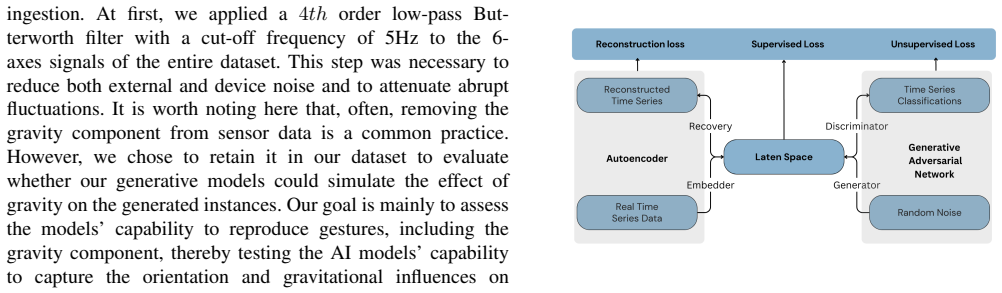
The argument is carried by two time-series GAN architectures plus a pair of evaluation protocols. TimeGAN couples adversarial training with an embedding network and a supervised next-step loss to capture temporal dynamics; DoppelGANger generates batches of records and uses per-instance auto-normalization with min/max metadata to preserve long-range correlations and diversity. The evaluation protocols are TRTS (train on real, test on synthetic) and TSTR (train on synthetic, test on real), applied with a fixed 1D convolutional classifier; TSTR is the quantity that decides whether synthetic data can replace real training data, because good performance on real test windows means the generator captured the real distribution's diversity rather than memorizing single modes.
What would settle it
Run the identical TimeGAN and DoppelGANger pipelines on the same four gesture classes taken from the 121-patient clinical portion of GestureSet, and measure TSTR accuracy; if it falls materially below 0.873 or below the real-data baseline by a clinically meaningful margin, the synthetic-substitution claim does not transfer to realistic patient variability.
Extended reading notes
Core claim
On the paper's own terms, the central discovery is that both TimeGAN and DoppelGANger are adequate for synthesizing allergic rhinitis motion gestures from wearable inertial data, and that DoppelGANger stands out on diversity and generalization while matching TimeGAN on fidelity. Across four gesture classes, DoppelGANger produces lower statistical distance and MMD values, higher privacy scores, and lower discriminative scores than TimeGAN, and it wins in both the TRTS and TSTR protocols. The decisive number is a TSTR accuracy of 0.873 with DoppelGANger synthetic training data versus 0.880 when the classifier is trained on real data, which the paper reads as evidence that synthetic data can substitute for real data in training scenarios.
Load-bearing premise
The load-bearing premise is that four gesture classes recorded from just three laboratory subjects represent how allergic-rhinitis patients generally perform these gestures, so the measured generalization accuracy carries over to the wider patient population.
Editorial extensions
If this is right
- If the claim holds, gesture classifiers for allergic rhinitis can be trained on synthetic data to near real-data accuracy, reducing the need for large labeled patient datasets.
- The high privacy scores suggest synthetic gesture records can be shared or used for model development without exposing individual patient motion traces.
- The TSTR and TRTS numbers provide a reusable benchmark for comparing future generative models on this dataset and on other wearable gesture data.
- The same pipeline should extend to the remaining twelve gesture classes in the open benchmark dataset and to other motion-data HGR domains.
Reading between the lines
- Because the current experiments use only four gesture classes from three subjects in a controlled lab, the 0.873 result is likely an upper bound for what would be seen on the full 121-patient clinical cohort; the authors state this clinical extension as future work, not as an established finding.
- The privacy metric (one minus one-class SVM precision) does not rule out nearest-neighbor reconstruction of real windows; a direct check of duplicated or near-duplicated synthetic windows would test the privacy claim more strongly.
- The paper's own plan to combine synthetic and real instances in hybrid training implies an optimal mixing ratio exists, and the TRTS/TSTR scores give a concrete way to tune that ratio.
Editorial analysis
A structured set of objections, weighed in public.
Referee Report
Summary. This paper studies whether GANs can generate synthetic wrist-worn accelerometer/gyroscope time series for four allergic rhinitis gesture classes from the GestureSet benchmark. It trains TimeGAN and DoppelGANger on windowed, min-max scaled sensor data, evaluates synthetic quality via PCA, statistical distance, MMD, discriminative and privacy scores, and measures downstream utility under TRTS/TSTR with a 1D CNN classifier. The paper reports that both GANs are adequate for synthesizing allergic rhinitis gestures, with DoppelGANger superior on diversity and generalization and comparable to TimeGAN on fidelity (TSTR accuracy 0.873 for DoppelGANger versus 0.880 baseline).
Significance. If substantiated, this is a useful first demonstration of GAN-based synthetic data for a less-explored healthcare HGR domain, with practical relevance for data scarcity and privacy in wearable health monitoring. The paper's strengths include repeated experiments (10 runs), release of the synthetic data, use of an established open dataset, and multiple complementary evaluation metrics. However, the headline generalization numbers are not yet reliable because of a window-level train/test split that can leak overlapping windows, and because the experimental data come from only three subjects in a controlled laboratory setting.
major comments (3)
- [Section V, Table II] The train/test split for the baseline and TSTR evaluations is performed after sliding-window transformation, with 99% overlap for TimeGAN and 50% overlap for DoppelGANger. Because windows derived from the same raw gesture recording overlap by up to 99 timesteps, a random shuffle of windows can place near-duplicate windows in both the training and test sets; the statement that shuffling minimizes sequential adjacency does not prevent instance-level leakage. Both the GANs and the classifier are trained on these windowed data, so synthetic instances can encode patterns from a raw recording whose windows later appear in the real test set. Consequently, the TSTR accuracy of 0.873 and the baseline accuracy of 0.880 are not clean out-of-sample estimates, and the central claim that synthetic data are nearly as good as real data is not yet supported. Please re-run the evaluation with a split performed at the raw-recording or subject level before windowing, or otherwise demonstrate that no overlapping windows cross the train/test boundary.
- [Sections IV and VIII] The experiments use four gesture classes from only three subjects who performed gestures in a controlled laboratory environment, while Section IV states that the full GestureSet section includes 121 clinical patients in addition to the three laboratory subjects. Section VIII itself concedes that the current experiments used data from only three subjects and that applying the same setup to the 121-subject clinical data is future work. With n=3 subjects, the reported accuracies largely measure within-subject recognizability and cannot support generalization to the allergic-rhinitis patient population. Please either provide a subject-disjoint evaluation on the clinical cohort, or explicitly restrict all conclusions to the laboratory subset and remove the generalization language from the abstract and Section VII.
- [Section VI.B, Table I] The privacy score is defined as one minus the precision of a one-class SVM classifier, but the direction of interpretation is not argued. The paper asserts that a higher privacy score for DoppelGANger indicates the ability to generate diverse data while preserving privacy, and that TimeGAN's lower privacy score might indicate replication of real data, yet no evidence or reference is given that one-class SVM precision measures membership or memorization in this setting. Since privacy is one of the three advertised criteria (fidelity, diversity, privacy), please clarify what quantity is actually measured and why higher values imply privacy rather than lower fidelity.
minor comments (6)
- [Section III] The model name is spelled inconsistently as both "DoppelGanger" and "DoppelGANger"; please use the latter consistently.
- [Section VI.B] There is a grammar error in the sentence beginning "it is essential to determine whether the these can be used to train the model"; delete "the".
- [Table I] The abbreviations "Stat. Dist." and "Priv. Score" are not expanded in the table caption; please define them, and also specify the direction of the discriminative score (higher means easier to distinguish real from synthetic).
- [Section II.D] The related work lists Predictive Score among TimeGAN's evaluation metrics, but Section VI.B states that all metrics except the Predictive Score were used; please explain why the Predictive Score was omitted.
- [Section III] The description of the held-out set is ambiguous: it says the held-out set for evaluating generative models was created before other processing steps, but later the train/test split for the classifier occurs after sliding-window transformation and shuffling. Please clarify whether the held-out set consists of raw instances excluded before windowing and whether any windows derived from those instances appear in GAN training.
- [Figure 5] The PCA plots would be more informative if the axes were labeled and the explained variance percentages for PC1 and PC2 were reported, since the visual claims rely on the two-dimensional projection.
Circularity Check
No significant circularity: the evaluation is an empirical benchmark with externally defined protocols, and self-citations serve only as data provenance and prior-work context.
full rationale
The paper's central claim is that TimeGAN and DoppelGANger can synthesize allergic-rhinitis gesture data with adequate fidelity, diversity, and generalization, as measured by PCA, statistical distance, MMD, discriminative score, privacy score, and the TRTS/TSTR protocols. None of these quantities is derived from the claim itself or defined in terms of the conclusion. The GANs are trained on real gesture windows and evaluated with independently trained 1D convolutional classifiers on held-out real data; the TRTS/TSTR metrics are external protocols introduced in [9] and used in the time-series GAN literature. No fitted parameter is renamed as a prediction, and no 'uniqueness theorem' or prior-work citation is used to rule out alternatives. The authors' self-citations to [1], [2], and [19] identify the source dataset and earlier recognition pipelines; these are inputs and background, not load-bearing evidence for the adequacy claim. The potential weakness highlighted by the skeptic—overlapping sliding windows causing possible train/test leakage and the use of only three laboratory subjects—is a threat to external validity and experimental rigor, not a circularity. It does not make the TSTR accuracy equal to an input by construction. The paper explicitly acknowledges the three-subject limitation in Section VIII and frames the clinical-trial data as future work, which further confirms that the reported generalization numbers are empirical estimates rather than definitionally forced results. Therefore, no circular step is present, and the appropriate score is 0.
Assumptions & free parameters
free parameters (2)
- TimeGAN sliding window overlap =
0.99
- DoppelGANger sliding window overlap =
0.50
assumptions (3)
- domain assumption The 1-second window of 100 timesteps captures the discriminative content of allergic rhinitis gestures.
- domain assumption The four gesture classes collected from three laboratory subjects are representative of allergic rhinitis gestures generally.
- domain assumption Retaining the gravity component in accelerometer signals is appropriate for the GANs to reproduce.
Cite this review
Pith. "Pith review of Exploring the Impact of Synthetic Data on Human Gesture Recognition Tasks Using GANs." pith.science (2026). https://pith.science/paper/7IMW6EZP
@misc{pith2026241206389,
  author       = {Pith},
  title        = {Pith review of: Exploring the Impact of Synthetic Data on Human Gesture Recognition Tasks Using GANs},
  year         = {2026},
  howpublished = {\url{https://pith.science/paper/7IMW6EZP}},
  note         = {Machine review of arXiv:2412.06389}
}
read the original abstract
In the evolving domain of Human Activity Recognition (HAR) using Internet of Things (IoT) devices, there is an emerging interest in employing Deep Generative Models (DGMs) to address data scarcity, enhance data quality, and improve classification metrics scores. Among these types of models, Generative Adversarial Networks (GANs) have arisen as a powerful tool for generating synthetic data that mimic real-world scenarios with high fidelity. However, Human Gesture Recognition (HGR), a subset of HAR, particularly in healthcare applications, using time series data such as allergic gestures, remains highly unexplored. In this paper, we examine and evaluate the performance of two GANs in the generation of synthetic gesture motion data that compose a part of an open-source benchmark dataset. The data is related to the disease identification domain and healthcare, specifically to allergic rhinitis. We also focus on these AI models' performance in terms of fidelity, diversity, and privacy. Furthermore, we examine the scenario if the synthetic data can substitute real data, in training scenarios and how well models trained on synthetic data can be generalized for the allergic rhinitis gestures. In our work, these gestures are related to 6-axes accelerometer and gyroscope data, serving as multi-variate time series instances, and retrieved from smart wearable devices. To the best of our knowledge, this study is the first to explore the feasibility of synthesizing motion gestures for allergic rhinitis from wearable IoT device data using Generative Adversarial Networks (GANs) and testing their impact on the generalization of gesture recognition systems. It is worth noting that, even if our method has been applied to a specific category of gestures, it is designed to be generalized and can be deployed also to other motion data in the HGR domain.
Figures


Figures from the paper (2 more)


Reference graph
Works this paper leans on
-
[1]
X. Aggelides, A. Bardoutsos, S. Nikoletseas, N. Papadopoulos, C. Rap- topoulos, and P. Tzamalis, “A gesture recognition approach to classifying allergic rhinitis gestures using wrist-worn devices: a multidisciplinary case study,” in 2020 16th International Conference on Distributed Computing in Sensor Systems (DCOSS) . IEEE, 2020, pp. 1–10
work page 2020
-
[2]
End-to-end gesture recog- nition framework for the identification of allergic rhinitis symptoms,
P. Tzamalis, A. Bardoutsos, D. Markantonatos, C. Raptopoulos, S. Niko- letseas, X. Aggelides, and N. Papadopoulos, “End-to-end gesture recog- nition framework for the identification of allergic rhinitis symptoms,” in 2022 18th International Conference on Distributed Computing in Sensor Systems (DCOSS), 2022, pp. 25–34
work page 2022
-
[3]
Exploring the impact of synthetic data on human activity recognition tasks,
M. D. de Souza, C. R. S. Junior, J. Quintino, A. L. Santos, F. Q. da Silva, and C. Zanchettin, “Exploring the impact of synthetic data on human activity recognition tasks,” Procedia Computer Science , vol. 222, pp. 656–665, 2023
work page 2023
-
[4]
A generative adversarial network (gan) technique for internet of medical things data,
I. Vaccari, V . Orani, A. Paglialonga, E. Cambiaso, and M. Mongelli, “A generative adversarial network (gan) technique for internet of medical things data,” Sensors, vol. 21, no. 11, p. 3726, 2021
work page 2021
-
[5]
Generative adversarial networks in time series: A systematic literature review,
E. Brophy, Z. Wang, Q. She, and T. Ward, “Generative adversarial networks in time series: A systematic literature review,”ACM Computing Surveys, vol. 55, no. 10, pp. 1–31, 2023
2023
-
[6]
Generative adversarial networks,
I. Goodfellow, J. Pouget-Abadie, M. Mirza, B. Xu, D. Warde-Farley, S. Ozair, A. Courville, and Y . Bengio, “Generative adversarial networks,” Communications of the ACM , vol. 63, no. 11, pp. 139–144, 2020
2020
-
[7]
Using gans for sharing networked time series data: Challenges, initial promise, and open questions,
Z. Lin, A. Jain, C. Wang, G. Fanti, and V . Sekar, “Using gans for sharing networked time series data: Challenges, initial promise, and open questions,” in Proceedings of the ACM Internet Measurement Conference, 2020, pp. 464–483
work page 2020
-
[8]
Time-series generative ad- versarial networks,
J. Yoon, D. Jarrett, and M. Van der Schaar, “Time-series generative ad- versarial networks,” Advances in neural information processing systems, vol. 32, 2019
2019
Show all 24 references
-
[9]
Real-valued (medical) time series generation with recurrent conditional gans,
C. Esteban, S. L. Hyland, and G. R ¨atsch, “Real-valued (medical) time series generation with recurrent conditional gans,” arXiv preprint arXiv:1706.02633, 2017
2017 arXiv
-
[10]
Medical time-series data generation using generative adversarial networks,
S. Dash, A. Yale, I. Guyon, and K. P. Bennett, “Medical time-series data generation using generative adversarial networks,” in Artificial Intelligence in Medicine: 18th International Conference on Artificial Intelligence in Medicine, AIME 2020, Minneapolis, MN, USA, August 25–...
2020
-
[11]
Sensegen: A deep learning architecture for synthetic sensor data generation,
M. Alzantot, S. Chakraborty, and M. Srivastava, “Sensegen: A deep learning architecture for synthetic sensor data generation,” in 2017 IEEE International Conference on Pervasive Computing and Communications Workshops (PerCom Workshops). IEEE, 2017, pp. 188–193
2017
-
[12]
Sensorygans: An effec- tive generative adversarial framework for sensor-based human activity recognition,
J. Wang, Y . Chen, Y . Gu, Y . Xiao, and H. Pan, “Sensorygans: An effec- tive generative adversarial framework for sensor-based human activity recognition,” in 2018 International Joint Conference on Neural Networks (IJCNN). IEEE, 2018, pp. 1–8
2018
-
[13]
Sensegan: Enabling deep learning for internet of things with a semi-supervised framework,
S. Yao, Y . Zhao, H. Shao, C. Zhang, A. Zhang, S. Hu, D. Liu, S. Liu, L. Su, and T. Abdelzaher, “Sensegan: Enabling deep learning for internet of things with a semi-supervised framework,” Proceedings of the ACM on interactive, mobile, wearable and ubiquitous technologies , vol...
2018
-
[14]
Activitygan: Generative adversarial networks for data augmentation in sensor-based human activity recog- nition,
X. Li, J. Luo, and R. Younes, “Activitygan: Generative adversarial networks for data augmentation in sensor-based human activity recog- nition,” in Adjunct Proceedings of the 2020 ACM International Joint Conference on Pervasive and Ubiquitous Computing and Proceedings of the 2...
2020
-
[15]
Rgc: Reliable gesture classification via wearables using gans-based data augmentation,
H. Zhou, J. Zhao, Y . Gao, and W. Dong, “Rgc: Reliable gesture classification via wearables using gans-based data augmentation,” in 2021 IEEE 27th International Conference on Parallel and Distributed Systems (ICPADS). IEEE, 2021, pp. 867–874
2021
-
[16]
Survey on synthetic data generation, evaluation methods and gans,
A. Figueira and B. Vaz, “Survey on synthetic data generation, evaluation methods and gans,” Mathematics, vol. 10, no. 15, p. 2733, 2022
2022
-
[17]
A kernel method for the two-sample-problem,
A. Gretton, K. Borgwardt, M. Rasch, B. Sch ¨olkopf, and A. Smola, “A kernel method for the two-sample-problem,” Advances in neural information processing systems , vol. 19, 2006
2006
-
[18]
Generative moment matching networks,
Y . Li, K. Swersky, and R. Zemel, “Generative moment matching networks,” in International conference on machine learning . PMLR, 2015, pp. 1718–1727
2015
-
[19]
Gestureset: Public domain dataset for human gesture recognition using wrist-worn devices: A preliminary version,
P. Tzamalis, S. Nikoletseas, and P. G. Spirakis, “Gestureset: Public domain dataset for human gesture recognition using wrist-worn devices: A preliminary version,” in 2023 19th International Conference on Distributed Computing in Smart Systems and the Internet of Things (DCOSS...
2023
-
[20]
Sign- speaker: A real-time, high-precision smartwatch-based sign language translator,
J. Hou, X.-Y . Li, P. Zhu, Z. Wang, Y . Wang, J. Qian, and P. Yang, “Sign- speaker: A real-time, high-precision smartwatch-based sign language translator,” in The 25th Annual International Conference on Mobile Computing and Networking , 2019, pp. 1–15
2019
-
[21]
Improved training of wasserstein gans,
I. Gulrajani, F. Ahmed, M. Arjovsky, V . Dumoulin, and A. C. Courville, “Improved training of wasserstein gans,”Advances in neural information processing systems, vol. 30, 2017
2017
-
[22]
Principal component analysis,
S. Wold, K. Esbensen, and P. Geladi, “Principal component analysis,” Chemometrics and intelligent laboratory systems , vol. 2, no. 1-3, pp. 37–52, 1987
1987
-
[23]
Tsgm: A flexible frame- work for generative modeling of synthetic time series,
A. Nikitin, L. Iannucci, and S. Kaski, “Tsgm: A flexible frame- work for generative modeling of synthetic time series,” arXiv preprint arXiv:2305.11567, 2023
2023 arXiv
-
[24]
How faithful is your synthetic data? sample-level metrics for evaluating and auditing generative models,
A. Alaa, B. Van Breugel, E. S. Saveliev, and M. van der Schaar, “How faithful is your synthetic data? sample-level metrics for evaluating and auditing generative models,” in International Conference on Machine Learning. PMLR, 2022, pp. 290–306
2022
Reviewed August 11, 2026 · model on record in the stance chip above.
Discussion (0). Continue with ORCID to comment.