REVIEW 3 major objections 4 minor 1 cited by
Chiral phase transition and spin alignment of vector mesons with chiral imbalance in a rotating QCD medium
T0 review · 3 major / 4 minor · reviewed 2026-08-11 · deepseek-v4-flash
Pith's one-line read Increasing the chiral chemical potential μ5 moves the critical endpoint of the rotating QCD phase diagram toward the temperature axis and pushes the ρ-meson spin alignment ρ00 toward 1/3.
desk verdict Useful NJL parameter scan on mu5 and rotation, but the rho00 enhancement claim rests on an unvalidated linearization and needs the exact formula plus consistency fixes before I'd trust the numbers. read the letter →
The pith
A machine-rendered reading of the paper's core claim, the machinery that carries it, and where it could break.
The reading
What carries the argument
The carrying mechanism is the two-flavor NJL Lagrangian in a rotating frame with a chiral chemical potential, Eq. (2), whose mean-field grand potential is built from quark modes with dispersion relation $E_{n,s} = \sqrt{(\sqrt{p_t^2+p_z^2} - s\mu_5)^2 + M^2} - (n+\tfrac{1}{2})\omega$ and Bessel-function weights $W_{n,s}$, regularized by a soft momentum cutoff. Quark and antiquark spin polarizations $P_q$ and $P_{\bar q}$ are computed from the occupation numbers $N^\pm_{\uparrow/\downarrow}$ obtained by differentiating the grand potential with respect to $\mu$. The $\rho$-meson spin density matrix element then follows from the Liang–Wang recombination formula $\rho_{00} = (1 - P_q P_{\bar q})/(3 + P_q P_{\bar q})$, and the model is closed by the gap equation $\partial \Omega/\partial M = 0$.
What would settle it
A measurement of $\rho_{00}$ for the $\rho$ meson in noncentral heavy-ion collisions, correlated event-by-event with a chiral-imbalance proxy such as charge-separation fluctuations, would test the prediction that stronger imbalance raises $\rho_{00}$ toward $1/3$ at fixed vorticity; finding no such correlation would refute the claim.
Extended reading notes
Core claim
Within the two-flavor NJL model, the paper claims two quantitative effects of the chiral chemical potential $\mu_5$ on rotating QCD matter. First, in the pseudocritical-temperature versus angular-velocity ($T_{pc}$–$\omega$) plane, increasing $\mu_5$ lowers $T_{pc}$ while moving the critical endpoint (CEP) toward the temperature axis: the CEP critical temperature increases and its critical angular velocity decreases, and at baryon chemical potential $\mu = 0.1$ GeV a CEP appears only when $\mu_5$ is nonzero. Second, using the quark recombination model, the $\rho$-meson spin alignment $\rho_{00}$ increases with $\mu_5$ around the phase transition temperature and at larger angular velocities, approaching the isotropic value $1/3$, while increasing $\omega$ drives $\rho_{00}$ below $1/3$ and thus signals polarization. The radial profile shows $\rho_{00}$ growing with distance $r$ from the rotation axis, so spin polarization weakens away from the center, and $\mu_5$ raises $\rho_{00}$ at every radius near $T = 0.15$ GeV. The authors present these as predictions of the NJL model with chiral imbalance under rotation.
Load-bearing premise
The spin-alignment predictions assume the $\rho$ meson forms by simple recombination of independently polarized quarks and antiquarks, so any internal spin correlation inside the meson that this picture misses would change the predicted $\rho_{00}$.
Editorial extensions
If this is right
- A nonzero chiral chemical potential can turn a purely crossover transition into a phase diagram with a first-order region and a critical endpoint; at $\mu=0.1$ GeV the paper finds no CEP for $\mu_5=0$ but a CEP for nonzero $\mu_5$.
- At fixed temperature near $T_{pc}$ and fixed angular velocity, $\rho_{00}$ should increase toward $1/3$ as $\mu_5$ grows, making the $\rho$-meson spin distribution more isotropic.
- Rotation alone lowers $\rho_{00}$ below $1/3$, and the suppression weakens with distance from the rotation axis, so polarization is strongest near the center of the rotating medium.
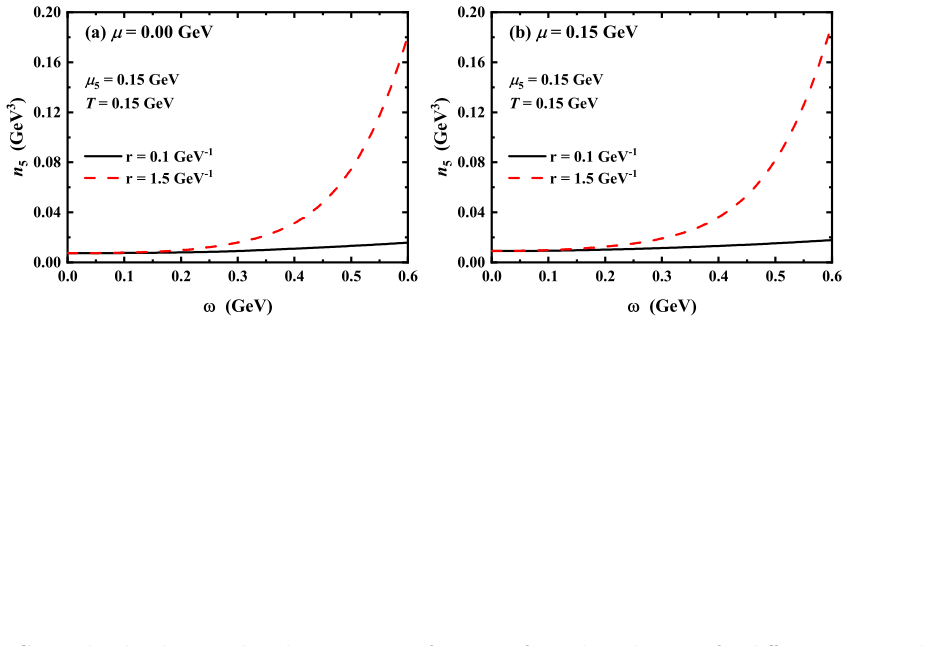
- Near $T=0.15$ GeV, chiral imbalance raises $\rho_{00}$ both close to and far from the rotation axis, so the effect is not confined to a particular radial region.
- At high temperatures ($T \ge 0.25$ GeV) the temperature effect dominates and the influence of $\mu_5$ on $\rho_{00}$ fades.
Reading between the lines
- If confirmed experimentally, the predicted link between chiral imbalance and enhanced $\rho_{00}$ would make vector-meson spin alignment a complementary observable to charge-separation measurements in searches for the chiral magnetic effect.
- Because the recombination model neglects internal spin correlations of the $\rho$ meson, repeating the calculation with a self-consistent or quark-condensation model (both cited in the paper) would show whether the $\mu_5$ enhancement survives; that cross-check does not appear in the paper.
- The local approximation used for the radial dependence means the predicted $\rho_{00}(r)$ profile describes local fluid cells, not the fireball boundary; a treatment with boundary conditions could change the profile near the edge of the medium.
- A three-flavor extension would predict whether the $\phi$ meson, which experiments measure more cleanly than the $\rho$, shows the same $\mu_5$-driven rise toward $1/3$.
Editorial analysis
A structured set of objections, weighed in public.
Referee Report
Summary. The paper studies a two-flavor Nambu-Jona-Lasinio (NJL) model in a rotating frame with a chiral chemical potential μ5. It computes the effective quark mass and pseudocritical temperature as functions of angular velocity ω, constructing a Tpc-ω phase diagram for μ5 = 0, 0.15, 0.3 GeV at μ = 0 and 0.1 GeV. It then evaluates the spin density matrix element ρ00 of the ρ meson using the recombination model of Liang and Wang, where quark polarizations are obtained from the NJL distribution functions, and studies the T, ω, and radius dependence of ρ00. The central claims are that increasing μ5 moves the critical endpoint of the Tpc-ω transition closer to the temperature axis, and that μ5 enhances ρ00 toward 1/3 around the phase transition temperature.
Significance. If these predictions hold, they provide concrete expectations for spin-alignment measurements in heavy-ion collisions with finite vorticity and topological charge. The calculations are self-consistent within the NJL model: the model parameters are fixed to vacuum pion observables, and no experimental ρ00 or phase-diagram data are used to adjust constants, so the outputs are genuine model predictions rather than fits. The phase-diagram result is a nontrivial extension of previous rotating-NJL studies, and the ρ00-r relation with μ5 is new. However, the spin-alignment section relies on a simple recombination model and, as discussed below, on a linearization that needs justification.
major comments (3)
- [Sec. III, Eqs. (17)-(19); Figs. 7-9] The numerical results for ρ00 are obtained from the first-order Taylor expansion Eq. (19) of the exact recombination formula Eq. (17), but the manuscript never checks the condition |Pq P̄q| ≪ 1 over the plotted range. In Fig. 8, ρ00 drops well below 1/3 at large ω; if ρ00 ≈ 0.2, then PqP̄q = (1-3ρ00)/(1+ρ00) ≈ 0.33 and the linearized Eq. (19) gives ρ00 ≈ 0.185, so the error in the deviation from 1/3 is about 11%; if ρ00 ≈ 0.1, the corresponding error exceeds 20% of the deviation. Since the central claim is that μ5 enhances ρ00 toward 1/3, the authors should either employ the exact Eq. (17) or provide a quantitative validity domain for the linearization.
- [Sec. IV, Figs. 2-4] The chiral transition at ω = 0 is described as a 'second-order phase transition' throughout the text, but with a finite current quark mass m = 0.006 GeV the transition is a crossover. The black solid lines in Fig. 2 and the statements about 'only a second-order phase transition' for μ = 0.1 GeV, μ5 = 0 GeV (Sec. IV.A) should be corrected to 'crossover'. The existence of a genuine CEP, where the first-order line terminates, is not affected, but the classification of the phase boundary should be accurate.
- [Sec. III, Eq. (17) and Eq. (21)] The central spin-alignment claim is computed entirely within the recombination model of Ref. [17], which assumes that the ρ meson forms from independent polarized quarks and antiquarks and neglects spin correlations. The manuscript does not test the μ5 dependence against the self-consistent NJL result quoted in Eq. (21) (from Ref. [54]) or against the quark condensation model of Eq. (20). Given that the abstract states the μ5 enhancement as a general finding, the authors should either provide such a cross-check or explicitly qualify the claim as specific to the recombination model.
minor comments (4)
- [Sec. IV, captions of Figs. 2, 4, 5, 7-9] The text and figure captions use μ = 0.1 GeV in Sec. IV.A and for the phase diagram, but μ = 0.15 GeV in Sec. IV.C and its figures. Please clarify whether these are different parameter choices or typographical errors.
- [Sec. III, Eqs. (13)-(16)] The quantities N^-↑ and N^-↓ are defined with a minus sign, so they are negative for antiparticle number densities; the text calls them 'quark (antiquark) number density' without noting this sign convention. Please clarify.
- [Sec. III, Eq. (11)] The quantization axis for ρ00 in the angular distribution Eq. (11) is not specified; presumably it is the direction of the angular velocity, but this should be stated explicitly.
- [General] There are numerous typographical issues (e.g., 'the study founds that', 'rational radius dependence', and inconsistent uses of Tpc and T_pc); a careful proofreading pass is recommended.
Circularity Check
No significant circularity: the CEP and rho_00 predictions are genuine model outputs from independently calibrated NJL parameters and an explicitly adopted external recombination model.
full rationale
The derivation chain is self-contained with respect to the paper's inputs. The NJL parameters (m = 0.006 GeV, Lambda = 626.76 MeV, Gs*Lambda^2 = 2.02) are fixed to vacuum observables f_pi = 92.3 MeV, <uu-bar>^(1/3) = -251 MeV, and constituent quark mass M = 325 MeV, as reported from Ref. [25]; no quantity appearing in the claimed predictions — the Tpc-omega CEP location, the rho_00(T, omega, r) curves, or n5(mu5) — is used to adjust a free constant. The constituent mass is obtained by minimizing the grand potential (Eqs. 8-9), and rho_00 is computed from the resulting quark and antiquark spin polarizations via the explicitly stated Liang-Wang recombination formula Eq. (17) and its small-polarization expansion Eq. (19). The recombination model is an openly adopted external assumption, not a fitted target, so the resulting mu5 enhancement of rho_00 is a genuine model prediction conditional on that assumption. The authors' own prior works appear only as technical background, not as load-bearing justification for the central claims. The one quantitative concern that the smallness condition behind Eq. (19) is not verified over the plotted range is a correctness or robustness caveat, not a circular reduction; it does not make any predicted quantity equal to an input by construction. I therefore find no circular step.
Assumptions & free parameters
free parameters (3)
- NJL parameters: m, Λ, Gs =
m=0.006 GeV, Λ=626.76 MeV, GsΛ^2=2.02
- Soft cutoff exponent N =
N=5
- Angular momentum sum truncation n =
n from -5 to 5
assumptions (6)
- domain assumption The two-flavor NJL Lagrangian (Eq. 2) with local four-fermion interaction is a valid effective model for the chiral phase transition of QCD at finite temperature, rotation, and chiral chemical potential.
- domain assumption Mean-field approximation (Eq. 3) replaces the four-fermion interaction by a condensate σ=⟨ψ̄ψ⟩; fluctuations are neglected.
- domain assumption The rotating-frame tetrad formalism and the local approximation with no boundary conditions describe the spatially dependent rotating medium.
- domain assumption The smooth cutoff regularization with shape factor fΛ(p) (Eq. 10) renders the divergent vacuum energy finite.
- domain assumption The recombination model of Liang and Wang [17] connects quark and antiquark polarizations to the ρ meson spin density matrix element ρ00 (Eqs. 17-19).
- domain assumption Spin-up and spin-down densities are decomposed using the Bessel weights J_n^2/(1+λ^2) and λ^2 J_{n+1}^2/(1+λ^2) (Eqs. 13-16).
Cite this review
Pith. "Pith review of Chiral phase transition and spin alignment of vector mesons with chiral imbalance in a rotating QCD medium." pith.science (2026). https://pith.science/paper/AKJC426Z
@misc{pith2026241206398,
  author       = {Pith},
  title        = {Pith review of: Chiral phase transition and spin alignment of vector mesons with chiral imbalance in a rotating QCD medium},
  year         = {2026},
  howpublished = {\url{https://pith.science/paper/AKJC426Z}},
  note         = {Machine review of arXiv:2412.06398}
}
abstract
We study the two-flavor NJL model under the rotation and chiral chemical potential $\mu_{5}$. Firstly, the influence of chiral imbalance on the chiral phase transition in the $T_{pc}-\omega$ plane is investigated. Research manifests that as $\mu_{5}$ increases, the critical point (CEP) of the $T_{pc}-\omega$ plane chiral phase transition will move closer to the $T$ axis. This means that the chiral chemical potential $\mu_{5}$ can significantly affect the $T_{pc}-\omega$ phase diagram and phase transition behavior. While discussing the $T_{pc}-\omega$ phase diagram, we also study the spin alignment of the $\rho$ vector meson under rotation. In the study of the spin alignment of the vector meson $\rho$, $\rho_{00}$ is the $00$ element of the spin density matrix of vector mesons. At high temperatures, $\rho_{00}$ is close to $1/3$, it indicates that the spin alignment of the vector meson $\rho$ is isotropic. It is found that increasing the chiral chemical potential $\mu_{5}$ significantly enhances $\rho_{00}$, and makes $\rho_{00}$ approaching to $1/3$ around the phase transition temperature. When rotational angular velocity is zero, $\rho_{00}$ is close to $1/3$, but as $\omega$ increases, $\rho_{00}$ significantly decreases, and deviates $1/3$, indicating that rotation can significantly cause polarization characteristics. The $\rho_{00}-r$ relationship near the phase transition temperature is studied. It is found that the farther away from the center of rotation, the lower the degree of spin polarization of the system. It is also found that the influence of chiral imbalance on the $\rho_{00}-r$ relationship is also significant.
Figures


Figures from the paper (6 more)




Forward citations
Cited by 1 Pith paper
-
Chiral vortical catalysis constrained by LQCD simulations
By fitting an angular-velocity-dependent coupling to LQCD data, the NJL model exhibits chiral vortical catalysis: rotation enhances the chiral condensate and raises the transition temperature and critical endpoint.
Reference graph
Works this paper leans on
-
[17]
Z.-T. Liang and X.-N. Wang, Phys. Rev. Lett. 94, 102301 (2005) , [Erratum: Phys.Rev.Lett. 96, 039901 (2006)]
work page 2005
-
[54]
Y.-G. Yang, R.-H. Fang, Q. Wang, and X.-N. Wang, Phys. Rev. C 97, 034917 (2018)
work page 2018
-
[1]
A. L. Watts et al. , Rev. Mod. Phys. 88, 021001 (2016)
2016
-
[2]
I. A. Grenier and A. K. Harding, Comptes Rendus Physique 16, 641 (2015)
work page 2015
-
[3]
By using the cylindrical coordinates, we can derive the general po sitive- energy solution [ 41] for the quark field from the Dirac equation corresponding to the L a- grangian given in Eq.(3) as ψ(θ,r ) = e−iEt+ipzz ceinθJn(ptr) idei(n+1)θJn+1(ptr) c′einθJn(ptr) id′ei(n+1)θJn+1(ptr) , (5) where Jn(ptr) is the Bessel function of ...
-
[4]
Wang and S.-Q
J.-H. Wang and S.-Q. Feng, Phys. Rev. D 109, 066019 (2024)
2024
-
[5]
Wang and S.-Q
X.-L. Wang and S.-Q. Feng, Phys. Rev. D 110, 086018 (2024)
2024
- [6]
Show all 65 references
-
[7]
Becattini, F
F. Becattini, F. Piccinini, and J. Rizzo, Phys. Rev. C 77, 024906 (2008)
2008
-
[8]
L. P. Csernai, V. K. Magas, and D. J. Wang, Phys. Rev. C 87, 034906 (2013)
2013
-
[9]
Deng and X.-G
W.-T. Deng and X.-G. Huang, Phys. Rev. C 93, 064907 (2016)
2016
-
[10]
Jiang, Z.-W
Y. Jiang, Z.-W. Lin, and J. Liao, Phys. Rev. C 94, 044910 (2016) , [Erratum: Phys.Rev.C 95, 049904 (2017)]
2016
-
[11]
Becattini, G
F. Becattini, G. Inghirami, V. Rolando, A. Beraudo, L. D el Zanna, A. De Pace, M. Nardi, G. Pagliara, and V. Chandra, Eur. Phys. J. C 75, 406 (2015) , [Erratum: Eur.Phys.J.C 78, 354 (2018)]
2015
-
[12]
S. Shi, K. Li, and J. Liao, Phys. Lett. B 788, 409 (2019)
2019
-
[13]
L.-G. Pang, H. Petersen, Q. Wang, and X.-N. Wang, Phys. Rev. Lett. 117, 192301 (2016)
2016
-
[14]
Adamczyk et al
L. Adamczyk et al. (STAR), Nature 548, 62 (2017)
2017
-
[15]
Becattini, I
F. Becattini, I. Karpenko, M. Lisa, I. Upsal, and S. Volo shin, Phys. Rev. C 95, 054902 (2017)
2017
-
[16]
X.-L. Xia, H. Li, Z.-B. Tang, and Q. Wang, Phys. Rev. C 98, 024905 (2018)
2018
-
[18]
Liang and X.-N
Z.-T. Liang and X.-N. Wang, Phys. Lett. B 629, 20 (2005)
2005
-
[19]
M. S. Abdallah et al. (STAR), Nature 614, 244 (2023)
2023
-
[20]
’t Hooft, Phys
G. ’t Hooft, Phys. Rev. Lett. 37, 8 (1976)
1976
-
[21]
N. S. Manton, Phys. Rev. D 28, 2019 (1983)
1983
-
[22]
F. R. Klinkhamer and N. S. Manton, Phys. Rev. D 30, 2212 (1984) . 19
1984
-
[23]
Kharzeev, Phys
D. Kharzeev, Phys. Lett. B 633, 260 (2006)
2006
-
[24]
Fukushima, D
K. Fukushima, D. E. Kharzeev, and H. J. Warringa, Phys. Rev. D 78, 074033 (2008)
2008
-
[25]
Fukushima, M
K. Fukushima, M. Ruggieri, and R. Gatto, Phys. Rev. D 81, 114031 (2010)
2010
-
[26]
L. Yu, H. Liu, and M. Huang, Phys. Rev. D 90, 074009 (2014)
2014
-
[27]
D. Hou, A. Huang, J. Liao, S. Shi, and H. Zhang, Nucl. Phys. A 1005, 121971 (2021)
2021
-
[28]
J. Chao, P. Chu, and M. Huang, Phys. Rev. D 88, 054009 (2013)
2013
-
[29]
Y. Guo, S. Shi, S. Feng, and J. Liao, Phys. Lett. B 798, 134929 (2019)
2019
-
[30]
Lv, Z.-h
J.-p. Lv, Z.-h. Yu, Z.-t. Liang, Q. Wang, and X.-N. Wang, Phys. Rev. D 109, 114003 (2024)
2024
-
[31]
H.-L. Chen, K. Fukushima, X.-G. Huang, and K. Mameda, Phys. Rev. D 93, 104052 (2016)
2016
-
[32]
Jiang and J
Y. Jiang and J. Liao, Phys. Rev. Lett. 117, 192302 (2016)
2016
-
[33]
Ebihara, K
S. Ebihara, K. Fukushima, and K. Mameda, Phys. Lett. B 764, 94 (2017)
2017
-
[34]
M. N. Chernodub and S. Gongyo, JHEP 01, 136 (2017)
2017
-
[35]
Liu and I
Y. Liu and I. Zahed, Phys. Rev. Lett. 120, 032001 (2018)
2018
-
[36]
M. N. Chernodub and S. Gongyo, Phys. Rev. D 95, 096006 (2017)
2017
-
[37]
X. Wang, M. Wei, Z. Li, and M. Huang, Phys. Rev. D 99, 016018 (2019)
2019
-
[38]
Cao and L
G. Cao and L. He, Phys. Rev. D 100, 094015 (2019)
2019
-
[39]
Chen, X.-G
H.-L. Chen, X.-G. Huang, and K. Mameda, JHEP 02, 216 (2024)
2024
-
[40]
Sun and A
F. Sun and A. Huang, Phys. Rev. D 106, 076007 (2022)
2022
-
[41]
Zhu and S.-Q
X. Zhu and S.-Q. Feng, Phys. Rev. D 107, 016018 (2023)
2023
-
[42]
K. Xu, F. Lin, A. Huang, and M. Huang, Phys. Rev. D 106, L071502 (2022)
2022
-
[43]
Cao, Phys
G. Cao, Phys. Rev. D 109, 094020 (2024)
2024
-
[44]
Cao, Phys
G. Cao, Phys. Rev. D 109, 014001 (2024)
2024
-
[45]
Qiu and S.-Q
Y.-W. Qiu and S.-Q. Feng, Phys. Rev. D 107, 076004 (2023)
2023
-
[46]
Qiu, S.-Q
Y.-W. Qiu, S.-Q. Feng, and X.-Q. Zhu, Phys. Rev. D 108, 116022 (2023)
2023
-
[47]
Bao and S.-Q
Y.-R. Bao and S.-Q. Feng, Phys. Rev. D 109, 096033 (2024)
2024
-
[48]
Chen, Z.-T
J. Chen, Z.-T. Liang, Y.-G. Ma, and Q. Wang, Sci. Bull. 68, 874 (2023)
2023
-
[49]
Sheng, L
X.-L. Sheng, L. Oliva, Z.-T. Liang, Q. Wang, and X.-N. Wa ng, Phys. Rev. Lett. 131, 042304 (2023)
2023
-
[50]
Gao, Z.-T
J.-H. Gao, Z.-T. Liang, Q. Wang, and X.-N. Wang, Lect. Notes Phys. 987, 195 (2021)
2021
-
[51]
Schilling, P
K. Schilling, P. Seyboth, and G. E. Wolf, Nucl. Phys. B 15, 397 (1970) , [Erratum: Nucl.Phys.B 18, 332 (1970)]. 20
1970
-
[52]
Xu and M
K. Xu and M. Huang, Phys. Rev. D 110, 094034 (2024)
2024
-
[53]
F. Sun, J. Shao, R. Wen, K. Xu, and M. Huang, Phys. Rev. D 109, 116017 (2024)
2024
-
[55]
Wei and M
M. Wei and M. Huang, Chin. Phys. C 47, 104105 (2023)
2023
-
[56]
Cao, Eur
G. Cao, Eur. Phys. J. C 81, 148 (2021)
2021
-
[57]
Sheng, S.-Y
X.-L. Sheng, S.-Y. Yang, Y.-L. Zou, and D. Hou, Eur. Phys. J. C 84, 299 (2024)
2024
-
[58]
F. Sun, K. Xu, and M. Huang, Phys. Rev. D 108, 096007 (2023)
2023
-
[59]
M. N. Chernodub and A. S. Nedelin, Phys. Rev. D 83, 105008 (2011)
2011
-
[60]
G. Cao, L. He, and P. Zhuang, Phys. Rev. D 90, 056005 (2014)
2014
-
[61]
Cao and P
G. Cao and P. Zhuang, Phys. Rev. D 92, 105030 (2015)
2015
-
[62]
Fukushima and T
K. Fukushima and T. Hatsuda, Rept. Prog. Phys. 74, 014001 (2011)
2011
-
[63]
D. E. Kharzeev, J. Liao, S. A. Voloshin, and G. Wang, Prog. Part. Nucl. Phys. 88, 1 (2016)
2016
-
[64]
D. E. Kharzeev and J. Liao, Nature Rev. Phys. 3, 55 (2021)
2021
-
[65]
D. E. Kharzeev, L. D. McLerran, and H. J. Warringa, Nucl. Phys. A 803, 227 (2008) . 21
2008
Reviewed August 11, 2026 · model on record in the stance chip above.
Discussion (0). Continue with ORCID to comment.