REVIEW 3 major objections 6 minor 1 cited by
Transition form factors of the $\Lambda_b \rightarrow \Lambda(1520)$ in QCD light-cone sum rules
T0 review · 3 major / 6 minor · reviewed 2026-08-11 · deepseek-v4-flash
Pith's one-line read New QCD sum-rule form factors for a rare baryon decay match LHCb.
desk verdict First LCSR form factors for Lambda_b -> Lambda(1520), filling a real low-q^2 gap; the LHCb 'agreement' is compatibility within large errors, and the unquantified LCDA model dependence is the main caveat. read the letter →
The pith
A machine-rendered reading of the paper's core claim, the machinery that carries it, and where it could break.
The reading
What carries the argument
The load-bearing object is the two-point correlation function between the vacuum and an on-shell $\Lambda_b$, written with an interpolating current for the $\Lambda(1520)$ and a weak current $\bar{s}\Gamma_\mu b$. The argument works by decomposing the correlation function into eight Lorentz structures, using the $g_{\lambda\mu}$ structure to exclude spin-1/2 contamination, and including both the $\Lambda(1520)$ ($J^P = 3/2^-$) and the $\Lambda(1890)$ ($J^P = 3/2^+$) states in the hadronic representation so that the $\Lambda(1890)$ contribution is eliminated by solving linear equations. Non-perturbative input is the exponential model of the $\Lambda_b$ light-cone distribution amplitudes with parameter $\omega_0 = 0.28 \pm 0.05$ GeV.
What would settle it
A lattice QCD computation of $f_V^t(0)$ (or of the differential branching fraction in the 1--8 GeV$^2$ bins) that lands outside $0.038 \pm 0.015$, or an LHCb measurement of the low-$q^2$ differential branching fraction more than a factor of two below the paper's central curve, would contradict the paper's central claim.
Extended reading notes
Core claim
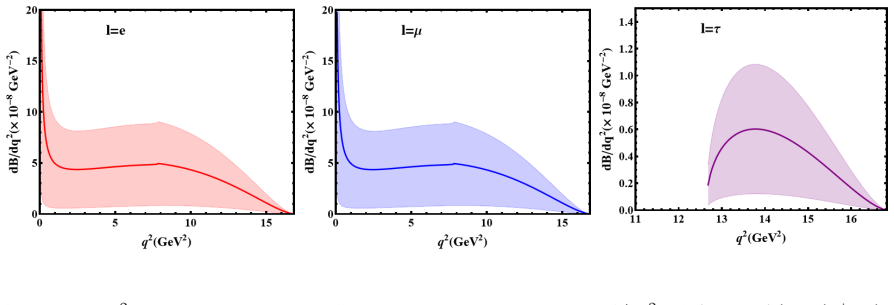
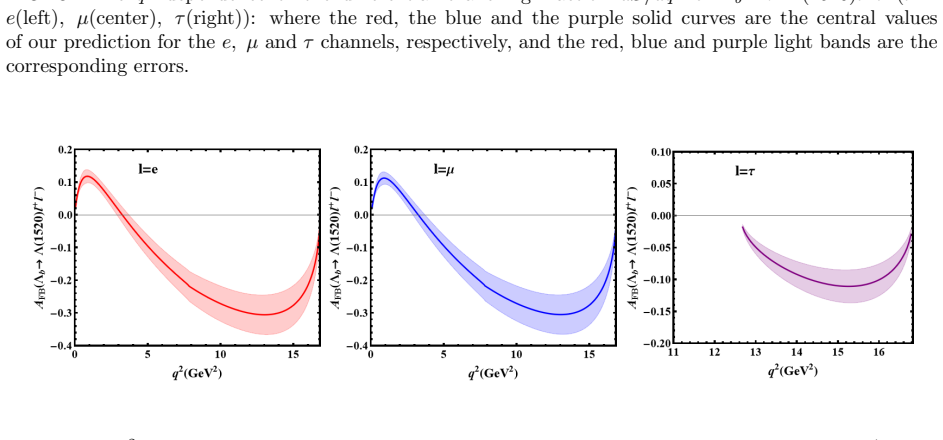
The paper's central claim is that the fourteen helicity-based form factors governing $\Lambda_b \to \Lambda(1520)$ can be extracted without contamination from spin-1/2 and opposite-parity states by matching eight independent Lorentz structures of a $\Lambda_b$-to-vacuum correlation function in hadronic and partonic representations and solving the resulting linear system. At tree level all four $f(g)^d_g(q^2)$ form factors vanish, consistent with Soft-Collinear Effective Theory at leading order in $\alpha_s$ and $\Lambda_{\rm QCD}/m_b$, and the remaining form factors obey the endpoint relations. Using the exponential model for the $\Lambda_b$ light-cone distribution amplitudes, the sum rules give $f_V^t(0)=0.038 \pm 0.015$ and similar values for the other leading form factors, roughly 75% of the light-front quark model values, an order of magnitude above one non-relativistic quark model, and below lattice extrapolations. With a $z$-series extrapolation to the full kinematic range, the predicted differential branching fraction of $\Lambda_b \to \Lambda(1520)\mu^+\mu^-$ agrees with the LHCb measurement within uncertainties across the measured $q^2$ bins, while the forward-backward asymmetry shows a single zero-crossing.
Load-bearing premise
The whole result leans on a model for how the light quarks inside the $\Lambda_b$ share momentum, fixed by one number ($\omega_0 = 0.28$ GeV) borrowed from an earlier sum-rule analysis; if that number is wrong, the predicted decay rate changes by more than the quoted error bars.
Editorial extensions
If this is right
- The low-$q^2$ form factors ($q^2 \le 8$ GeV$^2$) from this work are the only QCD-based input for $\Lambda_b \to \Lambda(1520)$ in the region lattice QCD cannot reach, so they enable Standard Model predictions for $dB/dq^2$, $A_{FB}$, $F_L$, and $S_{1cc}$ in that region.
- The consistency with SCET relations and endpoint relations at tree level supports using light-cone sum rules for heavy-to-light baryonic transitions and points to next-to-leading-order corrections as the next step for precision.
- The prediction that $A_{FB}$ has no second zero-crossing in the low-recoil region distinguishes this calculation from lattice, non-relativistic quark model, and dispersive analyses, and a future measurement can discriminate between them.
- The differential branching fraction in the muon channel, agreeing with LHCb within the roughly 80% uncertainties, provides a Standard Model benchmark for $\Lambda_b \to \Lambda(1520)$ rare decays.
- The endpoint relations are used to reduce the number of free parameters in the $z$-series extrapolation, so the full-$q^2$ form factors are constrained by a few coefficients rather than a general fit.
Reading between the lines
- If the dominant uncertainty is indeed $\omega_0$, then pinning down the $\Lambda_b$ light-cone distribution amplitude parameters from future lattice or sum-rule analyses would substantially reduce the roughly 50% form-factor errors and sharpen the comparison with LHCb; this is an implicit consequence of the paper's own sensitivity statement.
- The same two-parity-partner machinery could be applied to other excited baryons, such as $\Lambda(1890)$ itself or $\Lambda_c$ counterparts, where low-$q^2$ form factors are currently missing.
- The near-SCET structure at tree level suggests that a single-form-factor description at large recoil may hold better for $\Lambda_b \to \Lambda(1520)$ than for some mesonic transitions, and a dedicated next-to-leading-order comparison would test this directly.
Editorial analysis
A structured set of objections, weighed in public.
Referee Report
Summary. The paper computes the transition form factors for Λ_b → Λ(1520) using QCD light-cone sum rules with Λ_b light-cone distribution amplitudes. The authors carefully construct the correlation function, include the positive-parity partner Λ(1890) to remove contamination, and solve the system of Lorentz-structure equations to isolate the Λ(1520) form factors. They present results at q²=0, extrapolate to the full kinematic range using a z-series expansion constrained by endpoint relations, and predict observables for Λ_b → Λ(1520)ℓ⁺ℓ⁻, including the differential branching fraction, forward-backward asymmetry, longitudinal polarization fraction, and the S₁꜀꜀ angular observable. The main phenomenological claim is that the predicted differential branching fraction for the μ⁺μ⁻ channel agrees with the LHCb measurement within uncertainties, filling the low-q² gap left by lattice QCD.
Significance. If the result holds, it provides the first LCSR determination of Λ_b → Λ(1520) form factors in the low-q² region, complementing lattice QCD and potentially sharpening tests of the Standard Model in b → sℓ⁺ℓ⁻ transitions. The paper is transparent: it gives explicit sum-rule expressions, lists all input parameters, reports a correlation matrix for the z-series coefficients, and openly acknowledges that uncertainties are dominated by the Λ_b-LCDA parameter ω₀ and that the calculation is tree-level. These are strengths that aid reproducibility. However, the phenomenological impact is currently limited by ~50% form-factor uncertainties and by the absence of a systematic error associated with the choice of the exponential LCDA model.
major comments (3)
- [III.A, Eq. (20), Table II] The central claim of agreement with the LHCb measurement rests on the exponential model for the Λ_b light-cone distribution amplitudes, Eq. (20), with ω₀ = 0.28 ± 0.05 GeV taken from Ref. [16]. The paper itself states that the form-factor uncertainties are primarily due to ω₀, yet it provides no estimate of the systematic uncertainty from the choice of the LCDA model itself. Alternative parametrizations exist (e.g., Refs. [45,46]), and a different model could shift the form factors by more than the quoted 1σ band, potentially removing the apparent consistency in Fig. 7. The authors should either test the sensitivity to other LCDA models or quantify the model dependence in the error budget; without this, the statement that the LCSR prediction is "consistent with the experimental result very well" is not robust.
- [III.A, Eqs. (29)–(30), Fig. 2] The LCSR results are declared valid for q² ≤ 8 GeV², but the z-series fit is performed at q² = {-6, -3, 0, 3, 6} GeV² and then used to extrapolate to q²_max ≈ 16.8 GeV². The linear z-series with only two coefficients per form factor, combined with endpoint relations, may not control the extrapolation in the low-recoil region. The paper's low-recoil comparison with LHCb in Fig. 7, as well as the claim of consistency in the whole q² region, therefore depends on this extrapolation. The authors should discuss the truncation error of the z-series, e.g., by including a second-order term or by assessing the stability of the low-recoil predictions against the number of included terms.
- [III.A, Table II and text after Eq. (28)] The claim that the LCSR form factors are 'unambiguous' is somewhat overstated. While the contamination from the spin-1/2 and positive-parity spin-3/2 states is handled, the four form factors f_g^V, g_g^A, f_g^T, and g_g^{T5} are set identically to zero at tree level. This is a leading-order SCET result, not a full-QCD statement, and the physical values receive corrections at higher order in α_s and Λ_QCD/m_b. The authors note that these form factors have little impact on the large-recoil branching fraction by using LFQM and NRQM inputs, but that check is model-dependent. The text should be rephrased to clarify that 'unambiguous' refers to the treatment of the hadronic contamination within the adopted truncation, not to the absence of higher-order corrections.
minor comments (6)
- [Table I caption] The word "theatrical" should be "theoretical" in the caption of Table I.
- [Appendix B, Eq. (B3)] The phrase "axlai-vector" should be "axial-vector" in the heading preceding Eq. (B3).
- [Fig. 6 caption] The typo "obesrvable" should be "observable" in the caption of Fig. 6.
- [Fig. 7 caption] The caption reads "the differential branching dB/dq²"; it should be "the differential branching fraction dB/dq²".
- [Table IV and Appendix D] There is a notation inconsistency: the main text and Table IV use coefficients a^f_0 and a^f_1, while Appendix D and Table V label the same quantities as a^{fV_t}_1, a^{fV_0}_0, etc. The ordering of the sub/superscripts is confusing and should be made consistent.
- [Eq. (15) and Appendix A] The correlation-function decomposition in the hadronic representation uses coefficients Π^d_i in Eq. (15), but Appendix A expresses the same objects directly in terms of the hadronic form factors f^i_± and g^i_±. A short mapping between the two notations would help the reader.
Circularity Check
No significant circularity: the LCSR form factors are computed from external LCDA inputs, and the LHCb comparison is a genuine prediction.
full rationale
The paper's derivation chain is self-contained as a prediction. The form factors are obtained by matching a hadronic and a partonic representation of a correlation function, with the Lambda_b LCDAs taken from Eqs. (18) and (20); the exponential model and its parameter omega0 = 0.28 +/- 0.05 GeV come from external references [16,47], not from the present paper or from the LHCb data. The z-series coefficients are fitted to the paper's own LCSR points at q^2 = {-6,-3,0,3,6} GeV^2, which is an extrapolation of a model output, not a fit to any measured observable. The endpoint relations in Eqs. (6)-(7) and (31) are method-independent kinematic constraints, as the paper states. The differential branching fraction is then computed from the fitted form factors and Standard Model Wilson coefficients and compared with the LHCb measurement only after the prediction is made. No target observable enters as an input. There are a few self-citations ([48], [49], [61]) but they are used only to motivate the widely used exponential LCDA model or to describe the ensemble-generation procedure for error propagation; none of these citations is load-bearing for the central claim that the LCSR calculation gives a prediction consistent with LHCb. The dominant uncertainty, omega0, is an external input and is explicitly propagated and acknowledged; this is model dependence, not circularity. Therefore no circular step can be exhibited, and the paper merits a low score.
Assumptions & free parameters
free parameters (5)
- omega0 =
0.28 +/- 0.05 GeV
- Borel parameter M^2 =
3.5 +/- 0.5 GeV^2
- Threshold s0 =
3.6 +/- 0.1 GeV^2
- lambda_- =
(3.35 +/- 0.15) x 10^-2 GeV^3
- f_Lambda_b^(1), f_Lambda_b^(2) =
(0.030 +/- 0.005) GeV^3 each
assumptions (4)
- standard math Quark-hadron duality
- domain assumption Exponential model for Lambda_b LCDAs
- domain assumption Spin-1/2 contamination removal
- domain assumption Validity of light-cone OPE for q^2 <= 8 GeV^2
Cite this review
Pith. "Pith review of Transition form factors of the $\Lambda_b \rightarrow \Lambda(1520)$ in QCD light-cone sum rules." pith.science (2026). https://pith.science/paper/W2UOVEWV
@misc{pith2026241206515,
  author       = {Pith},
  title        = {Pith review of: Transition form factors of the $\Lambda_b \rightarrow \Lambda(1520)$ in QCD light-cone sum rules},
  year         = {2026},
  howpublished = {\url{https://pith.science/paper/W2UOVEWV}},
  note         = {Machine review of arXiv:2412.06515}
}
abstract
In this work, we investigate the transition form factors for $\Lambda_b\rightarrow{\Lambda(1520)}$ within the framework of light-cone sum rules (LCSR), using the light-cone distribution amplitudes (LCDAs) of the $\Lambda_b$-baryon. In the hadronic representation of the correlation function, we carefully select the appropriate Lorentz structures and isolate the contributions from both the $\Lambda(1520)(J^P=(3/2)^-)$ and the $\Lambda(1890)(J^P=(3/2)^+)$, ensuring that the form factors for $\Lambda_b\rightarrow{\Lambda(1520)}$ can be calculated unambiguously. We also provide predictions for various physical observables in the decay $\Lambda_b\rightarrow{\Lambda(1520)}l^+l^-$, including the differential branching fraction, the lepton-side forward-backward asymmetry, the longitudinal polarization fraction, and the CP-averaged normalized angular observable. Our prediction for the differential branching fraction of $\Lambda_b\rightarrow{\Lambda(1520)}\mu^+\mu^-$ is in good agreement with the LHCb measurement within the uncertainties.
Figures


Figures from the paper (4 more)


Forward citations
Cited by 1 Pith paper
-
Heavy quark mass dependence of the $\Lambda_Q$ light-cone distribution amplitude in QCD
The Lambda_Q baryon LCDA at mass m_Q equals (m_Q/m_Q^0)^2 times the LCDA at m_Q^0 evaluated at rescaled fractions x_i*m_Q/m_Q^0, times an exponentiated anomalous dimension, plus renormalon-model power corrections.
Reference graph
Works this paper leans on
-
[16]
Perturbative Corrections to Λ b → Λ Form Factors from QCD Light-Cone Sum Rules,
Y. M. Wang and Y. L. Shen, “Perturbative Corrections to Λ b → Λ Form Factors from QCD Light-Cone Sum Rules,” JHEP 02 (2016), 179 [arXiv:1511.09036 [hep-ph]]
arXiv 2016
-
[1]
Lattice QCD calculation of form factors describing the rare decays B → K ∗ℓ+ℓ− and Bs → ϕℓ+ℓ−,
R. R. Horgan, Z. Liu, S. Meinel and M. Wingate, “Lattice QCD calculation of form factors describing the rare decays B → K ∗ℓ+ℓ− and Bs → ϕℓ+ℓ−,” Phys. Rev. D 89, no.9, 094501 (2014) [arXiv:1310.3722 [hep-lat]]
arXiv 2014
-
[2]
B → Kl +l− Decay Form Factors from Three-Flavor Lattice QCD,
J. A. Bailey, A. Bazavov, C. Bernard, C. M. Bouchard, C. DeTar, D. Du, A. X. El-Khadra, J. Foley, E. D. Freeland and E. G´ amiz, et al. “B → Kl +l− Decay Form Factors from Three-Flavor Lattice QCD,” Phys. Rev. D 93, no.2, 025026 (2016) [arXiv:1509.06235 [hep-lat]]
arXiv 2016
-
[3]
Rare B decays using lattice QCD form factors,
R. R. Horgan, Z. Liu, S. Meinel and M. Wingate, “Rare B decays using lattice QCD form factors,” PoS LA TTICE2014, 372 (2015) [arXiv:1501.00367 [hep-lat]]
arXiv 2015
-
[4]
W. G. Parrott et al.[HPQCD], “Standard Model predictions for B→Kℓ+ℓ-, B→Kℓ1-ℓ2+ and B→Kνν¯ using form factors from Nf=2+1+1 lattice QCD,” Phys. Rev. D 107, no.1, 014511 (2023) [erratum: Phys. Rev. D 107, no.11, 119903 (2023)] [arXiv:2207.13371 [hep-ph]]
arXiv 2023
-
[5]
B → V ℓ+ℓ− in the Standard Model from light-cone sum rules,
A. Bharucha, D. M. Straub and R. Zwicky, “ B → V ℓ+ℓ− in the Standard Model from light-cone sum rules,” JHEP 08, 098 (2016) [arXiv:1503.05534 [hep-ph]]
arXiv 2016
-
[6]
B → P and B → V Form Factors fromB-Meson Light-Cone Sum Rules beyond Leading Twist,
N. Gubernari, A. Kokulu and D. van Dyk, “B → P and B → V Form Factors fromB-Meson Light-Cone Sum Rules beyond Leading Twist,” JHEP 01, 150 (2019) [arXiv:1811.00983 [hep-ph]]
arXiv 2019
-
[7]
Angular Analysis of the B+ → K ∗+µ+µ− Decay,
R. Aaij et al.[LHCb], “Angular Analysis of the B+ → K ∗+µ+µ− Decay,” Phys. Rev. Lett. 126, no.16, 161802 (2021) [arXiv:2012.13241 [hep-ex]]
arXiv 2021
Show all 63 references
-
[8]
Angular analysis of the decay B + → K∗(892)+µ+µ− in proton-proton collisions at √s = 8 TeV,
A. M. Sirunyan et al. [CMS], “Angular analysis of the decay B + → K∗(892)+µ+µ− in proton-proton collisions at √s = 8 TeV,” JHEP 04, 124 (2021) [arXiv:2010.13968 [hep-ex]]
2021 arXiv
-
[9]
Measurement of CP -Averaged Observables in the B0 → K ∗0µ+µ− Decay,
R. Aaij et al. [LHCb], “Measurement of CP -Averaged Observables in the B0 → K ∗0µ+µ− Decay,” Phys. Rev. Lett. 125, no.1, 011802 (2020) [arXiv:2003.04831 [hep-ex]]
2020
-
[10]
Angular analysis of the rare decay B0 s → ϕµ+µ−,
R. Aaij et al. [LHCb], “Angular analysis of the rare decay B0 s → ϕµ+µ−,” JHEP 11, 043 (2021) [arXiv:2107.13428 [hep-ex]]
2021
-
[11]
Differential branching fractions and isospin asymmetries of B → K (∗)µ+µ− decays,
R. Aaij et al. [LHCb], “Differential branching fractions and isospin asymmetries of B → K (∗)µ+µ− decays,” JHEP 06, 133 (2014) [arXiv:1403.8044 [hep-ex]]
2014 arXiv
-
[12]
Measurements of the S-wave fraction in B0 → K +π−µ+µ− decays and the B0 → K ∗(892)0µ+µ− differential branching fraction,
R. Aaij et al. [LHCb], “Measurements of the S-wave fraction in B0 → K +π−µ+µ− decays and the B0 → K ∗(892)0µ+µ− differential branching fraction,” JHEP 11, 047 (2016) [erratum: JHEP 04, 142 (2017)] [arXiv:1606.04731 [hep-ex]]
2016 arXiv
-
[13]
Branching Fraction Measurements of the Rare B0 s → ϕµ+µ− and B0 s → f ′ 2(1525)µ+µ−- Decays,
R. Aaij et al. [LHCb], “Branching Fraction Measurements of the Rare B0 s → ϕµ+µ− and B0 s → f ′ 2(1525)µ+µ−- Decays,” Phys. Rev. Lett. 127, no.15, 151801 (2021) [arXiv:2105.14007 [hep-ex]]
2021
-
[14]
Rare Decays of Lambda(b) — > Lambda + gamma and Lambda(b) —> Lambda + l+ l- in the Light-cone Sum Rules,
Y. m. Wang, Y. Li and C. D. Lu, “Rare Decays of Lambda(b) — > Lambda + gamma and Lambda(b) —> Lambda + l+ l- in the Light-cone Sum Rules,” Eur. Phys. J. C59, 861-882 (2009) [arXiv:0804.0648 [hep-ph]]
2009 arXiv
-
[15]
Lambda(b) — > p, Lambda transition form factors from QCD light-cone sum rules,
Y. M. Wang, Y. L. Shen and C. D. Lu, “Lambda(b) — > p, Lambda transition form factors from QCD light-cone sum rules,” Phys. Rev. D 80, 074012 (2009) [arXiv:0907.4008 [hep-ph]]. 36
2009 arXiv
-
[17]
Λb →Λℓ+ℓ- form factors and differential branching fraction from lattice QCD,
W. Detmold, C. J. D. Lin, S. Meinel and M. Wingate, “Λb →Λℓ+ℓ- form factors and differential branching fraction from lattice QCD,” Phys. Rev. D 87, no.7, 074502 (2013) [arXiv:1212.4827 [hep- lat]]
2013 arXiv
-
[18]
Λ b → Λℓ+ℓ− form factors, differential branching fraction, and angu- lar observables from lattice QCD with relativistic b quarks,
W. Detmold and S. Meinel, “Λ b → Λℓ+ℓ− form factors, differential branching fraction, and angu- lar observables from lattice QCD with relativistic b quarks,” Phys. Rev. D 93 (2016) no.7, 074501 [arXiv:1602.01399 [hep-lat]]
2016 arXiv
-
[19]
Dispersive bounds for local form factors in Λb →Λ transitions,
T. Blake, S. Meinel, M. Rahimi and D. van Dyk, “Dispersive bounds for local form factors in Λb →Λ transitions,” Phys. Rev. D 108, no.9, 094509 (2023) [arXiv:2205.06041 [hep-ph]]
2023 arXiv
-
[20]
Measurement of the differential branching fraction of the decay Λ 0 b → Λµ+µ−,
R. Aaij et al.[LHCb], “Measurement of the differential branching fraction of the decay Λ 0 b → Λµ+µ−,” Phys. Lett. B 725, 25-35 (2013) [arXiv:1306.2577 [hep-ex]]
2013 arXiv
-
[21]
Differential branching fraction and angular analysis of Λ 0 b → Λµ+µ− decays,
R. Aaij et al. [LHCb], “Differential branching fraction and angular analysis of Λ 0 b → Λµ+µ− decays,” JHEP 06, 115 (2015) [erratum: JHEP 09, 145 (2018)] [arXiv:1503.07138 [hep-ex]]
2015 arXiv
-
[22]
Angular moments of the decay Λ 0 b → Λµ+µ− at low hadronic recoil,
R. Aaij et al. [LHCb], “Angular moments of the decay Λ 0 b → Λµ+µ− at low hadronic recoil,” JHEP 09, 146 (2018) [arXiv:1808.00264 [hep-ex]]
2018 arXiv
-
[23]
Observation of the decay Λ 0 b → pK −µ+µ− and a search for C Pviolation,
R. Aaij et al. [LHCb], “Observation of the decay Λ 0 b → pK −µ+µ− and a search for C Pviolation,” JHEP 06, 108 (2017) [arXiv:1703.00256 [hep-ex]]
2017 arXiv
-
[24]
Test of lepton universality with Λ0 b → pK −ℓ+ℓ− decays,
R. Aaij et al.[LHCb], “Test of lepton universality with Λ0 b → pK −ℓ+ℓ− decays,” JHEP 05, 040 (2020) [arXiv:1912.08139 [hep-ex]]
2020
-
[25]
Measurement of the Λb0→Λ(1520)µ+µ- Differential Branching Fraction,
R. Aaij et al.[LHCb], “Measurement of the Λb0→Λ(1520)µ+µ- Differential Branching Fraction,” Phys. Rev. Lett. 131, no.15, 151801 (2023) [arXiv:2302.08262 [hep-ex]]
2023
-
[26]
Rare dileptonic decays of Λ b in a quark model,
L. Mott and W. Roberts, “Rare dileptonic decays of Λ b in a quark model,” Int. J. Mod. Phys. A 27, 1250016 (2012) [arXiv:1108.6129 [nucl-th]]
2012 arXiv
-
[27]
Lepton polarization asymmetries for FCNC decays of the Λ b baryon,
L. Mott and W. Roberts, “Lepton polarization asymmetries for FCNC decays of the Λ b baryon,” Int. J. Mod. Phys. A 30, no.27, 1550172 (2015) [arXiv:1506.04106 [nucl-th]]
2015 arXiv
-
[28]
Λ b → Λ∗(1520)ℓ+ℓ− form factors from lattice QCD,
S. Meinel and G. Rendon, “Λ b → Λ∗(1520)ℓ+ℓ− form factors from lattice QCD,” Phys. Rev. D 103, no.7, 074505 (2021) [arXiv:2009.09313 [hep-lat]]
2021 arXiv
-
[29]
It also should be mentioned that the errors of our results are sizable, mainly due to the high sensitivity to the error of the Λ b-LCDAs parameter ω0
should be questionable. It also should be mentioned that the errors of our results are sizable, mainly due to the high sensitivity to the error of the Λ b-LCDAs parameter ω0. Therefore, more attention should be paid to constraining the parameters of the Λ b-LCDAs. In order to ...
2024
-
[30]
Λc →Λ*(1520) form factors from lattice QCD and improved analysis of the Λb→Λ*(1520) and Λb →Λc*(2595,2625) form factors,
S. Meinel and G. Rendon, “Λc →Λ*(1520) form factors from lattice QCD and improved analysis of the Λb→Λ*(1520) and Λb →Λc*(2595,2625) form factors,” Phys. Rev. D 105, no.5, 054511 (2022) [arXiv:2107.13140 [hep-lat]]
2022 arXiv
-
[31]
Transition form factors and angular distributions of the Λb→Λ(1520)(→NK¯)ℓ+ℓ- decay supported by baryon spectroscopy,
Y. S. Li, S. P. Jin, J. Gao and X. Liu, “Transition form factors and angular distributions of the Λb→Λ(1520)(→NK¯)ℓ+ℓ- decay supported by baryon spectroscopy,” Phys. Rev. D 107, no.9, 093003 (2023) [arXiv:2210.04640 [hep-ph]]
2023 arXiv
-
[32]
Dispersive analysis of Λ b → Λ(1520) local form factors,
Y. Amhis, M. Bordone and M. Reboud, “Dispersive analysis of Λ b → Λ(1520) local form factors,” JHEP 02, 010 (2023) [arXiv:2208.08937 [hep-ph]]
2023 arXiv
-
[33]
Angular analysis of the rare decay Λ b → Λ(1520)(→ 37 N K)ℓ+ℓ−,
S. Descotes-Genon and M. Novoa-Brunet, “Angular analysis of the rare decay Λ b → Λ(1520)(→ 37 N K)ℓ+ℓ−,” JHEP 06 (2019), 136 [erratum: JHEP 06 (2020), 102] [arXiv:1903.00448 [hep-ph]]
2019 arXiv
-
[34]
The Λ b → Λ∗(1520)(→ N ¯K)ℓ+ℓ− decay at low-recoil in HQET,
D. Das and J. Das, “The Λ b → Λ∗(1520)(→ N ¯K)ℓ+ℓ− decay at low-recoil in HQET,” JHEP 07 (2020), 002 [arXiv:2003.08366 [hep-ph]]
2020 arXiv
-
[35]
The study of weak decays induced by 1 2 + → 3 2 − transition in light-cone sum rules,
T. M. Aliev, S. Bilmis and M. Savci, “The study of weak decays induced by 1 2 + → 3 2 − transition in light-cone sum rules,” Phys. Lett. B 847, 138287 (2023) [arXiv:2303.07505 [hep-ph]]
2023 arXiv
-
[36]
Rare Λ b → Λℓ+ℓ− decay in the Bethe-Salpeter equation approach,
L. L. Liu, X. W. Kang, Z. Y. Wang and X. H. Guo, “Rare Λ b → Λℓ+ℓ− decay in the Bethe-Salpeter equation approach,” Chin. Phys. C 44 (2020) no.8, 083107 [arXiv:1911.08023 [hep-ph]]
2020 arXiv
-
[37]
On the angular distribution of Λ b → Λ(→ N π)τ +τ − decay,
D. Das, “On the angular distribution of Λ b → Λ(→ N π)τ +τ − decay,” JHEP 07 (2018), 063 [arXiv:1804.08527 [hep-ph]]
2018 arXiv
-
[38]
New UTfit Analysis of the Unitarity Triangle in the Cabibbo-Kobayashi- Maskawa scheme,
M. Bona et al. [UTfit], “New UTfit Analysis of the Unitarity Triangle in the Cabibbo-Kobayashi- Maskawa scheme,” Rend. Lincei Sci. Fis. Nat. 34, 37-57 (2023) [arXiv:2212.03894 [hep-ph]]
2023 arXiv
-
[39]
Exclusive semileptonic rare decays B → (K, K ∗)ℓ+ℓ− in supersymmetric theories,
Q. S. Yan, C. S. Huang, W. Liao and S. H. Zhu, “Exclusive semileptonic rare decays B → (K, K ∗)ℓ+ℓ− in supersymmetric theories,” Phys. Rev. D 62 (2000), 094023 [arXiv:hep-ph/0004262 [hep-ph]]
2000 arXiv
-
[40]
Comparative analysis of the semileptonic Λ b → Λℓ+ℓ− transition in SM and different SUSY scenarios using form factors from full QCD,
K. Azizi, S. Kartal, A. T. Olgun and Z. Tavukoglu, “Comparative analysis of the semileptonic Λ b → Λℓ+ℓ− transition in SM and different SUSY scenarios using form factors from full QCD,” JHEP 10 (2012), 118 [arXiv:1208.2203 [hep-ph]]
2012 arXiv
-
[41]
Exclusive semileptonic rare decays B — > K(*) l+ l- in a SUSY SO(10) GUT,
W. J. Li, Y. B. Dai and C. S. Huang, “Exclusive semileptonic rare decays B — > K(*) l+ l- in a SUSY SO(10) GUT,” Eur. Phys. J. C 40 (2005), 565-577 [arXiv:hep-ph/0410317 [hep-ph]]
2005 arXiv
-
[42]
Effective Hamiltonian for B — > X(s) e+ e- beyond leading logarithms in the NDR and HV schemes,
A. J. Buras and M. Munz, “Effective Hamiltonian for B — > X(s) e+ e- beyond leading logarithms in the NDR and HV schemes,” Phys. Rev. D 52 (1995), 186-195 [arXiv:hep-ph/9501281 [hep-ph]]
1995 arXiv
-
[43]
Towards a model independent analysis of rare B decays,
A. Ali, G. F. Giudice and T. Mannel, “Towards a model independent analysis of rare B decays,” Z. Phys. C 67 (1995), 417-432 [arXiv:hep-ph/9408213 [hep-ph]]
1995 arXiv
-
[44]
Endpoint relations for baryons,
G. Hiller and R. Zwicky, “Endpoint relations for baryons,” JHEP 11 (2021), 073 [arXiv:2107.12993 [hep-ph]]
2021 arXiv
-
[45]
Predictive ability of QCD sum rules for excited baryons,
F. X. Lee and X. y. Liu, “Predictive ability of QCD sum rules for excited baryons,” Phys. Rev. D 66 (2002), 014014 [arXiv:nucl-th/0203051 [nucl-th]]
2002 arXiv
-
[46]
Distribution Amplitudes of the Lambda(b) Baryon in QCD,
P. Ball, V. M. Braun and E. Gardi, “Distribution Amplitudes of the Lambda(b) Baryon in QCD,” Phys. Lett. B 665 (2008), 197-204 [arXiv:0804.2424 [hep-ph]]
2008 arXiv
-
[47]
Light-Cone Distribution Amplitudes of the Ground State Bottom Baryons in HQET,
A. Ali, C. Hambrock, A. Y. Parkhomenko and W. Wang, “Light-Cone Distribution Amplitudes of the Ground State Bottom Baryons in HQET,” Eur. Phys. J. C 73 (2013) no.2, 2302 [arXiv:1212.3280 [hep-ph]]
2013 arXiv
-
[48]
Light-Cone Distribution Amplitudes for Heavy-Quark Hadrons,
G. Bell, T. Feldmann, Y. M. Wang and M. W. Y. Yip, “Light-Cone Distribution Amplitudes for Heavy-Quark Hadrons,” JHEP 11 (2013), 191 . . . [arXiv:1308.6114 [hep-ph]]
2013 arXiv
-
[49]
Λ b → p transition form factors in perturbative QCD,
J. J. Han, Y. Li, H. n. Li, Y. L. Shen, Z. J. Xiao and F. S. Yu, “Λ b → p transition form factors in perturbative QCD,” Eur. Phys. J. C 82, no.8, 686 (2022) [arXiv:2202.04804 [hep-ph]]
2022 arXiv
-
[50]
Establishing CP violation in b-baryon decays,
J. X. Yu, J. J. Han, Y. Li, H. n. Li, Z. J. Xiao and F. S. Yu, “Establishing CP violation in b-baryon decays,” [arXiv:2409.02821 [hep-ph]]. 38
-
[51]
Review of particle physics,
S. Navas et al. [Particle Data Group], “Review of particle physics,” Phys. Rev. D 110, no.3, 030001 (2024)
2024
-
[52]
Azizi, Y
K. Azizi, Y. Sarac and H. Sundu, ‘Investigations of Λ states with spin-parity 32 ±,” Phys. Rev. D 109, no.7, 074028 (2024) [arXiv:2402.00134 [hep-ph]]
2024 arXiv
-
[53]
An Analysis of diagonal and nondiagonal QCD sum rules for heavy baryons at next-to-leading order in alpha-s,
S. Groote, J. G. Korner and O. I. Yakovlev, “An Analysis of diagonal and nondiagonal QCD sum rules for heavy baryons at next-to-leading order in alpha-s,” Phys. Rev. D 56, 3943-3954 (1997) [arXiv:hep- ph/9705447 [hep-ph]]
1997
-
[54]
Heavy to light form-factors in the heavy mass to large energy limit of QCD,
J. Charles, A. Le Yaouanc, L. Oliver, O. Pene and J. C. Raynal, “Heavy to light form-factors in the heavy mass to large energy limit of QCD,” Phys. Rev. D 60, 014001 (1999) [arXiv:hep-ph/9812358 [hep-ph]]
1999 arXiv
-
[55]
Symmetry breaking corrections to heavy to light B meson form-factors at large recoil,
M. Beneke and T. Feldmann, “Symmetry breaking corrections to heavy to light B meson form-factors at large recoil,” Nucl. Phys. B 592, 3-34 (2001) [arXiv:hep-ph/0008255 [hep-ph]]
2001 arXiv
-
[56]
An Effective field theory for collinear and soft gluons: Heavy to light decays,
C. W. Bauer, S. Fleming, D. Pirjol and I. W. Stewart, “An Effective field theory for collinear and soft gluons: Heavy to light decays,” Phys. Rev. D 63, 114020 (2001) [arXiv:hep-ph/0011336 [hep-ph]]
2001 arXiv
-
[57]
Heavy-to-light baryonic form factors at large recoil,
T. Mannel and Y. M. Wang, “Heavy-to-light baryonic form factors at large recoil,” JHEP 12, 067 (2011) [arXiv:1111.1849 [hep-ph]]
2011 arXiv
-
[58]
Factorization of Heavy-to-Light Baryonic Transitions in SCET,
W. Wang, “Factorization of Heavy-to-Light Baryonic Transitions in SCET,” Phys. Lett. B708, 119-126 (2012) [arXiv:1112.0237 [hep-ph]]
2012 arXiv
-
[59]
Model-independent description of B — > pi l nu decays and a determination of —V(ub)—,
C. Bourrely, I. Caprini and L. Lellouch, “Model-independent description of B — > pi l nu decays and a determination of —V(ub)—,” Phys. Rev. D 79, 013008 (2009) [erratum: Phys. Rev. D 82, 099902 (2010)] [arXiv:0807.2722 [hep-ph]]
2009 arXiv
-
[60]
Predicting positive parity B s mesons from lattice QCD,
C. B. Lang, D. Mohler, S. Prelovsek and R. M. Woloshyn, “Predicting positive parity B s mesons from lattice QCD,” Phys. Lett. B 750, 17-21 (2015) [arXiv:1501.01646 [hep-lat]]
2015 arXiv
-
[61]
Extrapolation and unitarity bounds for the B → π form factor,
I. Sentitemsu Imsong, A. Khodjamirian, T. Mannel and D. van Dyk, “Extrapolation and unitarity bounds for the B → π form factor,” JHEP 02, 126 (2015) [arXiv:1409.7816 [hep-ph]]
2015 arXiv
-
[62]
Λ b → p, N∗(1535) form factors from QCD light-cone sum rules,
K. S. Huang, W. Liu, Y. L. Shen and F. S. Yu, “Λ b → p, N∗(1535) form factors from QCD light-cone sum rules,” Eur. Phys. J. C 83, no.4, 272 (2023) [arXiv:2205.06095 [hep-ph]]
2023 arXiv
-
[63]
Prospects for New Physics searches with Λ 0 b → Λ(1520)ℓ+ℓ− decays,
Y. Amhis, S. Descotes-Genon, C. Marin Benito, M. Novoa-Brunet and M. H. Schune, “Prospects for New Physics searches with Λ 0 b → Λ(1520)ℓ+ℓ− decays,” Eur. Phys. J. Plus 136, no.6, 614 (2021) [arXiv:2005.09602 [hep-ph]]. 39
2021 arXiv
Reviewed August 11, 2026 · model on record in the stance chip above.
Discussion (0). Continue with ORCID to comment.