REVIEW 2 major objections 4 minor 40 references
Ternary tree transformations are equivalent to linear encodings of the Fock basis
T0 review · 2 major / 4 minor · reviewed 2026-08-11 · deepseek-v4-flash
Pith's one-line read This paper proves that every product-preserving ternary tree transformation is equivalent to a linear encoding of the Fock basis, with an explicit invertible binary matrix $G_T$ for each ternary tree $T$.
desk verdict A genuinely useful unification of ternary tree and linear-encoding fermion-qubit mappings, but the central constructive lemma has a sign error that must be fixed before the theorem as stated is reliable. read the letter →
The pith
A machine-rendered reading of the paper's core claim, the machinery that carries it, and where it could break.
The reading
What carries the argument
The central object is the $T$-based mapping $m(T)$, defined as a fermion-qubit mapping whose $2n$ Majorana-representing Pauli operators are signed elements of the maximally anticommuting set $\tilde G_T$ obtained from the root-to-leaf paths of the ternary tree $T$. The argument is carried by three lemmas: Lemma 5.9 shows that for any chosen product stabiliser vacuum state, the pairing of the tree Pauli operators that preserves that vacuum is unique up to fermionic relabelling and pair braids; Lemma 6.2 constructs the unique pairing that is also a classical encoding, using a vertical path-ordering scheme with Y-branch inversions and phase factors $(-i)^{\#_y}$; Lemma 6.3 gives the matrix formula $(G_T)_{ij}=1$ exactly when $\Gamma_{2j}$ acts on qubit $i$ by $X$ or $Y$. This machinery turns a tree graph directly into an invertible binary matrix.
What would settle it
Enumerate, for a small ternary tree such as the five-vertex tree in the paper's Example 5.4, every $T$-based mapping whose vacuum is a product state, and check whether each one lies in the equivalence class of $m(T')$ for some tree $T'$ obtained by local Pauli relabellings; any product-preserving $T$-based mapping found outside all such classes would refute Theorem 2.
Extended reading notes
Core claim
On its own terms, the central discovery is Theorem 2: for every $n$-vertex ternary tree $T$ there is a unique $T$-based fermion-qubit mapping $m(T)$ that both is built from the anticommuting Pauli strings associated with the root-to-leaf paths of $T$ and linearly encodes the Fock basis, meaning $\lvert f_{m(T)}\rangle = \lvert G_T f\rangle$ for an explicit invertible binary matrix $G_T$; and every $n$-mode product-preserving ternary tree transformation is equivalent to some $m(T)$ under the paper's equivalence relation of qubit relabelling, local Pauli basis changes, Pauli pair braids, sign changes, and fermionic relabelling. The proof constructs the Clifford operator $C_T$ by ordering the $2n+1$ tree paths vertically, inverting the order after Y-branches, and defining phase-corrected operators $\hat\Gamma_i = (-i)^{\#_y(\tilde\Gamma_i)}\tilde\Gamma_i$; it then sets $\Gamma_{2i}=\hat\Gamma_{2i}$ and $\Gamma_{2i+1}=-i\hat\Gamma_{2i+1}$. As a concrete payoff, applying the construction to the complete ternary tree recovers the pruned Sierpinski tree transform, so the two existing literatures describe the same object.
Load-bearing premise
The completeness half of Theorem 2 rests on Lemma 5.9's classification that every pairing of tree Pauli operators whose vacuum is a product state must have the form given in Equation 49, and the proof's argument against alternative pairing structures is informal, based on there being only three Pauli matrices per qubit.
Editorial extensions
If this is right
- For every $n$-vertex ternary tree $T$, there is exactly one $T$-based mapping that is also a linear encoding of the Fock basis, so product-preserving ternary tree transformations no longer need a separate operator-based treatment.
- Any product-preserving ternary tree transformation can be represented by an invertible binary matrix $G_T$, with an explicit entry formula, so tree-based mappings inherit the update, parity, and flip rules of linear encodings.
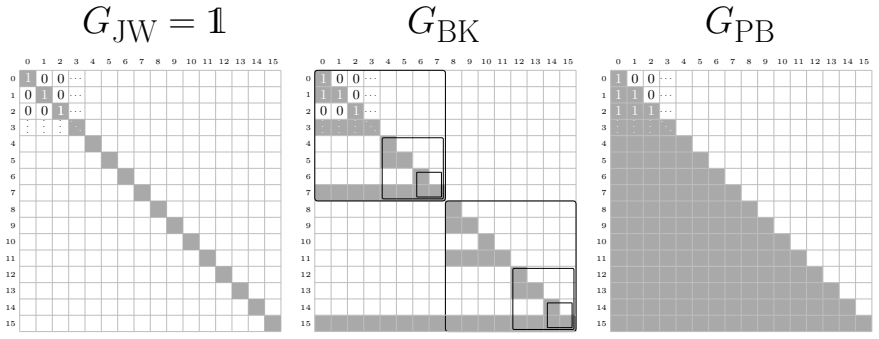
- The pruned Sierpinski tree transform is the special case $m(T)$ for the complete ternary tree, unifying two independently discovered minimal-weight constructions.
- Computational searches over linear encodings already cover product-preserving ternary tree transformations, and a linear encoding can be checked for whether it is a ternary tree transformation using the paper's characterisation.
- The template equivalence relation groups product-preserving tree-based mappings into classes that differ only by labelling and sign choices, so optimisation over these mappings can be performed on equivalence classes rather than individual Pauli strings.
Reading between the lines
- If Theorem 2 holds, then any optimisation or hardware-oriented search conducted over linear encodings has already implicitly searched the space of product-preserving ternary tree transformations; the converse is not automatic for product-breaking mappings, which remain outside the equivalence.
- The explicit matrix formula suggests that cost measures of tree-based mappings, such as Pauli weight or CNOT count, can be stated as functions of the matrix $G_T$ alone, potentially enabling matrix-based optimisation heuristics.
- A natural next step is to characterise the image of the map $T \mapsto G_T$, i.e., to determine which invertible binary matrices arise from ternary trees; the template equivalence suggests this image forms a finite catalogue for each $n$.
- The equivalence also implies that the Bonsai and Treespilation search heuristics could in principle be re-expressed as searches over binary matrices with tree-compatible update sets, although the paper does not explicitly make this algorithmic translation.
Editorial analysis
A structured set of objections, weighed in public.
Referee Report
Summary. The paper proposes a unified framework for ancilla-free fermion-qubit mappings, connecting the operator-based definition (ordered pairs of anticommuting Pauli strings) with the state-based definition (encodings of the Fock basis). It introduces an equivalence relation on mappings, defines classical, affine, and linear encodings, and then gives a refined definition of ternary tree transformations. The central claim is Theorem 2: for every ternary tree T there is a unique T-based mapping m(T) that linearly encodes the Fock basis, and every product-preserving ternary tree transformation is equivalent, under the paper's equivalence relation, to one of these m(T). The paper also identifies, for the complete ternary tree, the resulting linear encoding with the pruned Sierpinski tree transform.
Significance. If the main theorem is correct, the paper establishes a genuine conceptual equivalence between two classes of fermion-qubit mappings that have usually been treated separately: product-preserving ternary tree transformations are not an independent class but are contained, up to the paper's equivalence, in linear encodings of the Fock basis. This is a useful and non-obvious result, and the paper gives substantial supporting apparatus: a unified notational framework, a taxonomy of equivalence templates, a formula for the binary matrix G_T that defines the encoding m(T), and a concrete identification with the pruned Sierpinski transform. The paper is largely self-contained and the proofs are detailed, which is a strength. The sign defect discussed below is local and repairable, but it affects the central construction as written.
major comments (2)
- [6.1, Lemma 6.2, Eq. (63) and the paragraph after Eq. (92)] The construction of m(T) contains a sign error that invalidates the claimed vacuum and therefore the claimed linearity. The authors define bΓ_i = (-i)^{#y(eΓ_i)} eΓ_i, prove Eq. (63) that bΓ_{2i}bΓ_{2i+1}|0>^n = |0>^n, and then set Γ_{2i}=bΓ_{2i} and Γ_{2i+1}=-i bΓ_{2i+1}. But then -iΓ_{2i}Γ_{2i+1} = -bΓ_{2i}bΓ_{2i+1}, so the vacuum stabilizer acts on |0>^n as -|0>^n. Thus |0>^n is not the vacuum state of the constructed mapping. The n=1 case makes the failure explicit: eΓ_0=X0, eΓ_1=Y0 gives bΓ_0=X0, bΓ_1=-iY0, hence Γ_0=X0 and Γ_1=-Y0, so -iΓ_0Γ_1=-Z0 and the vacuum is |1>, not |0>. Consequently the Fock states are |f> -> |f⊕1>, an affine but not linear encoding. This contradicts Lemma 6.2 property 2 and the existence half of Theorem 2(a). Replacing Γ_{2i+1}=-i bΓ_{2i+1} with +i bΓ_{2i+1} repairs the construction, and this sign change is an allowed equivalence under Definition 3.4, but as written the central constructive proof is internally inconsistent.
- [5.1, Lemma 5.9, proof of part (a), paragraph after Eq. (50)] The classification of all possible operator pairings that preserve a product vacuum is load-bearing for the completeness claim in Theorem 2(b), but the proof is not rigorous. The text rules out alternative pairing structures with the sentence beginning 'But because there are only three mutually anticommuting single-qubit Pauli matrices', asserting that elements from distinct pairs would have to anticommute on a child vertex and that this would make it impossible for the product state to be an eigenstate of both products. This is a plausibility argument, not a formal proof; a full case analysis is needed to exclude exotic pairing patterns. Without a rigorous Lemma 5.9, the uniqueness assertion in Theorem 2(a) and the completeness assertion in Theorem 2(b) are not fully supported.
minor comments (4)
- [Abstract (full text)] The final sentence of the abstract states that 'every ternary tree transformation' is equivalent to a linear encoding, but the theorem and body of the paper only claim this for product-preserving ternary tree transformations; the qualifier should be added to the abstract as well.
- [6.1, Lemma 6.2] In the proof of Lemma 6.2, the sentence 'Theorem 3 proved that every classical encoding is affine' appears to reference the wrong result; Theorem 1 in Section 4.1, or Corollary 4.7, is the relevant statement that classical encodings with Pauli representations are affine.
- [Introduction, Figure 1 caption] The caption mentions 'the ternary tree transformation mTT' without defining it; either define this notation or rephrase the caption to refer to the complete ternary tree transformation.
- [Section 2, text before Eq. (27)] There is a duplicated word in 'The link is via a unique unique unitary operator'; this should be corrected.
Circularity Check
No significant circularity: the central equivalence is proved by an in-paper construction; self-citations are illustrative, not load-bearing.
full rationale
The claimed derivation is not circular. The core implication—every product-preserving ternary tree transformation is equivalent to a linear encoding—is established by an in-paper construction: Definition 5.3 maps a tree T to an anticommuting Pauli set eG_T; Lemma 5.9 gives a direct algorithm pairing those Paulis for any product vacuum; Lemma 6.2 constructs bGamma_i = (-i)^(#y(eGamma_i)) eGamma_i and proves (modulo a sign issue noted below) that the resulting m(T) is a classical/affine/linear encoding; Lemma 6.3 extracts G_T; Theorem 2 assembles these steps. Theorem 1 is proved in Section 4.1 using standard external facts about Clifford generators and the CNOT/GL_n isomorphism, not by citing the conclusion. Lemma 4.6 is attributed to [35] but fully proved in the text. The self-citations [21] and [35] are not load-bearing: Lemma 6.2 is only 'inspired by [21]' and then supplies its own proof, and Section 6.3 identifies the complete-tree case with the pruned Sierpinski transform as a corollary rather than assuming it. There is a separate internal-sign concern in Lemma 6.2: with Gamma_{2i+1} = -i bGamma_{2i+1}, the vacuum stabilizer is -bGamma_{2i} bGamma_{2i+1}, so |0>^n is a (-1)-eigenstate and the vacuum is not |0>^n as claimed. That is a correctness/consistency flaw, not a circularity: the target does not reduce to an input; it is contradicted by the definition. The completeness half also relies on the informal 'three Pauli matrices' argument in Lemma 5.9, but that is an evidential gap, not a definitional circularity. Overall, no circular step meets the quoted-equation test; the minor self-citations warrant score 2 at most.
Assumptions & free parameters
assumptions (4)
- standard math The subgroup of Clifford operators preserving the computational basis is generated by CNOT and X gates; the CNOT-only subgroup is isomorphic to GL_n(F2).
- domain assumption The 2n+1 root-to-leaf paths of an n-vertex ternary tree, read as unsigned Pauli strings, form a maximally anticommuting set.
- domain assumption The equivalence relation in Definition 3.4, including qubit swaps, local basis changes, Pauli pair braids, sign changes, and fermionic swaps, captures all trivial labelling differences between mappings.
- standard math At every labelled vertex of a ternary tree, an odd number of root-to-leaf paths exits through each of the three child branches.
Cite this review
Pith. "Pith review of Ternary tree transformations are equivalent to linear encodings of the Fock basis." pith.science (2026). https://pith.science/paper/2Q3VBRVT
@misc{pith2026241207578,
  author       = {Pith},
  title        = {Pith review of: Ternary tree transformations are equivalent to linear encodings of the Fock basis},
  year         = {2026},
  howpublished = {\url{https://pith.science/paper/2Q3VBRVT}},
  note         = {Machine review of arXiv:2412.07578}
}
read the original abstract
We consider two approaches to designing fermion-qubit mappings: (1) ternary tree transformations, which use Pauli representations of the Majorana operators that correspond to root-to-leaf paths of a tree graph and (2) linear encodings of the Fock basis, such as the Jordan-Wigner and Bravyi-Kitaev transformations, which store linear binary transformations of the fermionic occupation number vectors in the computational basis of qubits. These approaches have emerged as distinct concepts, with little notational consistency between them. In this paper we propose a universal description of fermion-qubit mappings, which reveals the relationship between ternary tree transformations and linear encodings. Using our notation, we show that every product-preserving ternary tree transformation is equivalent to a linear encoding of the Fock basis.
Figures


Figures from the paper (10 more)


Reference graph
Works this paper leans on
-
[1]
P. Jordan and E. Wigner. About the Pauli exclusion principle. Zeitschrift f¨ ur Physik, 47(9-10):631–651, September 1928
work page 1928
-
[2]
Sergey B. Bravyi and Alexei Yu. Kitaev. Fermionic Quantum Computation. Annals of Physics, 298(1):210– 226, May 2002
work page 2002
-
[3]
Mapping local Hamiltonians of fermions to local Hamiltonians of spins
F Verstraete and J I Cirac. Mapping local Hamiltonians of fermions to local Hamiltonians of spins. Journal of Statistical Mechanics: Theory and Experiment , 2005(09):P09012, sep 2005
work page 2005
-
[4]
Local spin operators for fermion simulations
James D Whitfield, Vojtˇ ech Havl ´ ıˇ cek, and Matthias Troyer. Local spin operators for fermion simulations. Phys. Rev. A , 94:030301, Sep 2016
work page 2016
-
[5]
Zhang Jiang, Amir Kalev, Wojciech Mruczkiewicz, and Hartmut Neven. Optimal fermion-to-qubit mapping via ternary trees with applications to reduced quantum states learning. Quantum, 4:276, June 2020
work page 2020
-
[6]
Clifford Algebras, Spin Groups and Qubit Trees
Alexander Yurievich Vlasov. Clifford Algebras, Spin Groups and Qubit Trees. Quanta, 11(1):97–114, December 2022
work page 2022
-
[7]
Majorana loop stabilizer codes for error mitigation in fermionic quantum simulations
Zhang Jiang, Jarrod McClean, Ryan Babbush, and Hartmut Neven. Majorana loop stabilizer codes for error mitigation in fermionic quantum simulations. Physical Review Applied, 12(6):064041, 2019
work page 2019
-
[8]
Compact fermion to qubit mappings
Charles Derby, Joel Klassen, Johannes Bausch, and Toby Cubitt. Compact fermion to qubit mappings. Phys. Rev. B , 104:035118, Jul 2021
work page 2021
Show all 40 references
-
[9]
Chien and Joel Klassen
Riley W. Chien and Joel Klassen. Optimizing fermionic encodings for both hamiltonian and hardware, 2022
2022
-
[10]
The Complexity of the Local Hamiltonian Problem
Julia Kempe, Alexei Kitaev, and Oded Regev. The Complexity of the Local Hamiltonian Problem. SIAM Journal on Computing , 35(5):1070–1097, January 2006. Publisher: Society for Industrial and Applied Mathematics
2006
-
[11]
McClean, Ryan Babbush, Peter J
Jarrod R. McClean, Ryan Babbush, Peter J. Love, and Al´ an Aspuru-Guzik. Exploiting Locality in Quantum Computation for Quantum Chemistry. The Journal of Physical Chemistry Letters , 5(24):4368–4380, 2014. PMID: 26273989
2014
-
[12]
Electronic Structure in a Fixed Basis is QMA-complete, March 2021
Bryan O’Gorman, Sandy Irani, James Whitfield, and Bill Fefferman. Electronic Structure in a Fixed Basis is QMA-complete, March 2021. arXiv:2103.08215 [quant-ph]
2021 arXiv
-
[13]
Quantum measurements and the Abelian stabilizer problem
A Yu Kitaev. Quantum measurements and the Abelian stabilizer problem. arXiv preprint quant- ph/9511026, 1995
1995
-
[14]
Dutoi, Peter J
Al´ an Aspuru-Guzik, Anthony D. Dutoi, Peter J. Love, and Martin Head-Gordon. Simulated Quantum Computation of Molecular Energies. Science, 309(5741):1704–1707, 2005
2005
-
[15]
Quantum algorithm for obtaining the energy spectrum of molecular systems
Hefeng Wang, Sabre Kais, Al´ an Aspuru-Guzik, and Mark R Hoffmann. Quantum algorithm for obtaining the energy spectrum of molecular systems. Physical Chemistry Chemical Physics , 10(35):5388–5393, 2008
2008
-
[16]
Abrams and Seth Lloyd
Daniel S. Abrams and Seth Lloyd. Quantum Algorithm Providing Exponential Speed Increase for Finding Eigenvalues and Eigenvectors. Phys. Rev. Lett. , 83:5162–5165, Dec 1999
1999
-
[17]
A variational eigenvalue solver on a quantum processor
Alberto Peruzzo, Jarrod Mcclean, Peter Shadbolt, Man Hong Yung, Xiaoqi Zhou, Peter Love, Al´ an Aspuru- Guzik, and Jeremy O’Brien. A variational eigenvalue solver on a quantum processor. Nature communica- tions, 5, 04 2013
2013
-
[18]
The theory of variational hybrid quantum-classical algorithms
Jarrod R McClean, Jonathan Romero, Ryan Babbush, and Al´ an Aspuru-Guzik. The theory of variational hybrid quantum-classical algorithms. New Journal of Physics , 18(2):023023, feb 2016
2016
-
[19]
Exact bosonization in two spatial dimensions and a new class of lattice gauge theories
Yu-An Chen, Anton Kapustin, and Dorde Radiˇ cevi´ c. Exact bosonization in two spatial dimensions and a new class of lattice gauge theories. Annals of Physics , 393:234–253, 2018. 33
2018
-
[20]
Equivalence between Fermion-to-Qubit mappings in two Spatial Dimensions
Yu-An Chen and Yijia Xu. Equivalence between Fermion-to-Qubit mappings in two Spatial Dimensions. PRX Quantum , 4:010326, Mar 2023
2023
-
[21]
Whitfield
Brent Harrison, Jason Necaise, Andrew Projansky, and James D. Whitfield. A Sierpinski Triangle Data Structure for Efficient Array Value Update and Prefix Sum Calculation, March 2024. arXiv:2403.03990 [cs]
2024 arXiv
-
[22]
Seeley, Martin J
Jacob T. Seeley, Martin J. Richard, and Peter J. Love. The Bravyi-Kitaev transformation for quantum computation of electronic structure. The Journal of Chemical Physics , 137(22):224109, December 2012
2012
-
[23]
Resource-Optimized Fermionic Local- Hamiltonian Simulation on Quantum Computer for Quantum Chemistry
Qingfeng Wang, Ming Li, Christopher Monroe, and Yunseong Nam. Resource-Optimized Fermionic Local- Hamiltonian Simulation on Quantum Computer for Quantum Chemistry. Quantum, 5:509, July 2021. arXiv:2004.04151 [quant-ph]
2021 arXiv
-
[24]
Markov, and Yunseong Nam
Qingfeng Wang, Ze-Pei Cian, Ming Li, Igor L. Markov, and Yunseong Nam. Ever more optimized sim- ulations of fermionic systems on a quantum computer. In 2023 60th ACM/IEEE Design Automation Conference (DAC), pages 1–6, 2023
2023
-
[25]
Fermion-to-qubit mappings with varying resource requirements for quantum simulation
Mark Steudtner and Stephanie Wehner. Fermion-to-qubit mappings with varying resource requirements for quantum simulation. New Journal of Physics , 20(6):063010, jun 2018
2018
-
[26]
Quantum codes for quantum simulation of fermions on a square lattice of qubits
Mark Steudtner and Stephanie Wehner. Quantum codes for quantum simulation of fermions on a square lattice of qubits. Phys. Rev. A , 99:022308, Feb 2019
2019
-
[27]
Bonsai Algorithm: Grow Your Own Fermion-to-Qubit Mappings
Aaron Miller, Zolt´ an Zimbor´ as, Stefan Knecht, Sabrina Maniscalco, and Guillermo Garc ´ ıa-P´ erez. Bonsai Algorithm: Grow Your Own Fermion-to-Qubit Mappings. PRX Quantum , 4:030314, Aug 2023
2023
-
[28]
Treespilation: Architecture- and State-Optimised Fermion- to-Qubit Mappings, 2024
Aaron Miller, Adam Glos, and Zolt´ an Zimbor´ as. Treespilation: Architecture- and State-Optimised Fermion- to-Qubit Mappings, 2024
2024
-
[29]
Local Jordan-Wigner transformations on the torus, April 2024
Oliver O’Brien, Laurens Lootens, and Frank Verstraete. Local Jordan-Wigner transformations on the torus, April 2024. arXiv:2404.07727 [cond-mat, physics:math-ph, physics:quant-ph]
2024 arXiv
-
[30]
Williamson, Jutho Haegeman, and Frank Verstraete
Nick Bultinck, Dominic J. Williamson, Jutho Haegeman, and Frank Verstraete. Fermionic matrix product states and one-dimensional topological phases. Phys. Rev. B , 95:075108, Feb 2017
2017
-
[31]
A new twist on the Majorana surface code: Bosonic and fermionic defects for fault-tolerant quantum computation
Campbell McLauchlan and Benjamin B´ eri. A new twist on the Majorana surface code: Bosonic and fermionic defects for fault-tolerant quantum computation. Quantum, 8:1400, July 2024
2024
-
[32]
Gambetta, Antonio Mezzacapo, and Kristan Temme
Sergey Bravyi, Jay M. Gambetta, Antonio Mezzacapo, and Kristan Temme. Tapering off qubits to simulate fermionic Hamiltonians, 2017
2017
-
[33]
The Clifford group, stabilizer states, and linear and quadratic operations over GF(2)
Jeroen Dehaene and Bart De Moor. The Clifford group, stabilizer states, and linear and quadratic operations over GF(2). Physical Review A , 68(4):042318, October 2003. arXiv:quant-ph/0304125
2003 arXiv
-
[34]
Symmetry-adapted encodings for qubit number reduction by point- group and other Boolean symmetries
Dario Picozzi and Jonathan Tennyson. Symmetry-adapted encodings for qubit number reduction by point- group and other Boolean symmetries. Quantum Science and Technology, 8(3):035026, jun 2023
2023
-
[35]
Whit- field
Brent Harrison, Mitchell Chiew, Jason Necaise, Andrew Projansky, Sergii Strelchuk, and James D. Whit- field. A Sierpinski Triangle Fermion-to-Qubit Transform, 2024
2024
-
[36]
Hadamard-Free Circuits Expose the Structure of the Clifford Group
Sergey Bravyi and Dmitri Maslov. Hadamard-Free Circuits Expose the Structure of the Clifford Group. IEEE Transactions on Information Theory , 67(7):4546–4563, July 2021
2021
-
[37]
Reducing the qubit requirement of Jordan-Wigner encodings of n-mode, k-fermion systems from n to ⌈log2 N K ⌉, 2023
Brent Harrison, Dylan Nelson, Daniel Adamiak, and James Whitfield. Reducing the qubit requirement of Jordan-Wigner encodings of n-mode, k-fermion systems from n to ⌈log2 N K ⌉, 2023
2023
-
[38]
Quantum circuits of CNOT gates, December 2020
Marc Bataille. Quantum circuits of CNOT gates, December 2020. arXiv:2009.13247 [quant-ph]
2020 arXiv
-
[39]
On sets of maximally commuting and anticommuting Pauli operators
Rahul Sarkar and Ewout Berg. On sets of maximally commuting and anticommuting Pauli operators. Research in the Mathematical Sciences , 8, 03 2021
2021
-
[40]
classical encoding of the Fock basis m
Brent Harrison, Jason Necaise, Andrew Projansky, and James D. Whitfield. A Sierpinski Triangle Data Structure for Efficient Array Value Update and Prefix Sum Calculation, 2024. 34 A Glossary symbol object type description Section 2 Hfermion ∼ Ln−1 i=0 A(H⊗i 2 ) The 2 n–dimensi...
2024
Reviewed August 11, 2026 · model on record in the stance chip above.
Discussion (0). Continue with ORCID to comment.