REVIEW 5 major objections 4 minor 18 references
Active Sampling and Gaussian Reconstruction for Radio Frequency Radiance Field
T0 review · 5 major / 4 minor · reviewed 2026-08-11 · deepseek-v4-flash
Pith's one-line read A training-free Gaussian process rebuilds RF radiance fields with 30–60% fewer samples than the neural NeRF2 baseline.
desk verdict A clean GP-based RF radiance field method with a real uncertainty model, but the headline 30-60% sample reduction is not yet supported because the simulated benchmark uses ground truth generated by the very model being outperformed. read the letter →
The pith
A machine-rendered reading of the paper's core claim, the machinery that carries it, and where it could break.
The reading
What carries the argument
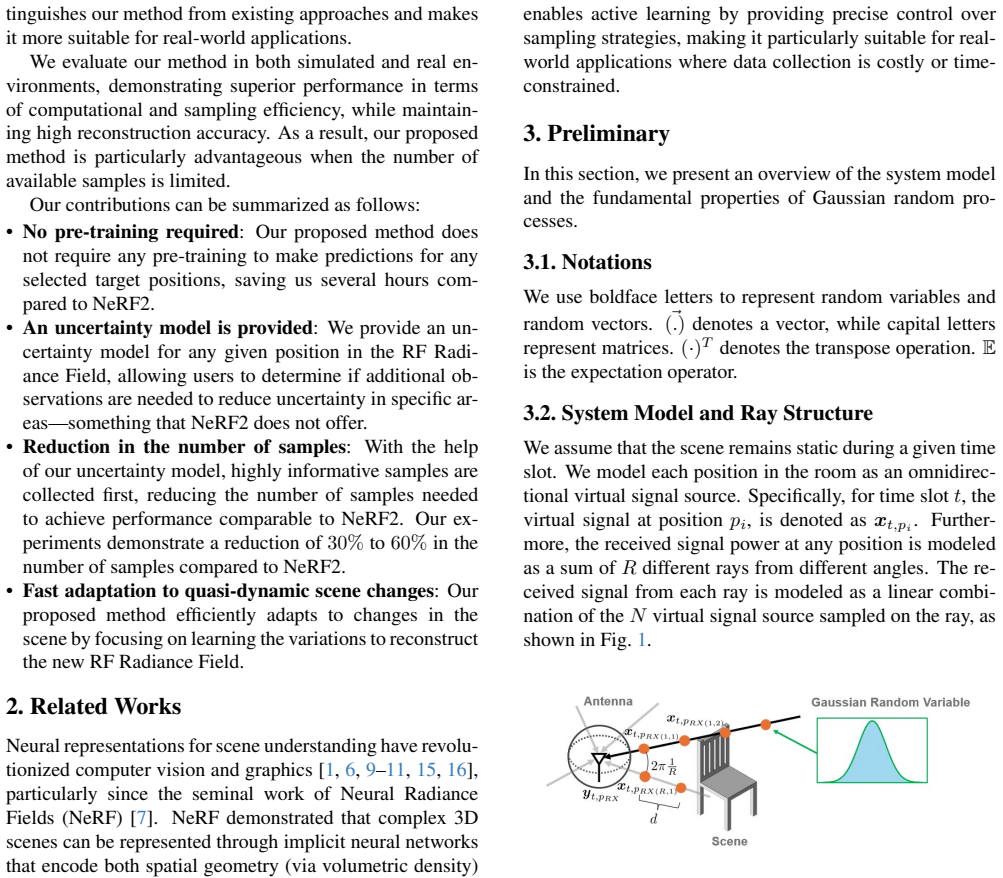
The load-bearing object is the virtual-source Gaussian process model: each spatial position p_i is a zero-mean Gaussian random variable x_{t,p_i}, the received power y_{t,p_RX} at a receiver is the linear combination sum over R rays and N samples per ray of α_{p_RX(r,n)} x_{t,p_RX(r,n)} with attenuation α = β/(n d), and the covariance between any two virtual sources is the RBF kernel $α^{2}$ exp(−||p_i−p_j||^2/(2 $l^{2}$)). The local kernel estimation step restricts prediction to observations within a distance L of the target, estimates the length scale l by maximum likelihood, and then applies the standard Gaussian conditional mean and variance formulas. That variance is the mechanism for active sampling: the next measurement is taken where the predicted variance is largest within each scene section, focusing data collection at sharp spatial gradients.
What would settle it
Place a large metal reflector in a room, measure the RF field at fine resolution, and compute the Gaussian-process predictive variance at each test point from surrounding samples; if the squared prediction errors exceed the 95% variance bands in a substantial fraction of points near the reflector, the stationary RBF-covariance assumption fails and active sampling decisions built on it become unreliable.
Extended reading notes
Core claim
The central claim is that an RF radiance field—the received signal power at any point in a scene—can be modeled as a Gaussian random process over virtual signal sources, with each measurement being a linear combination of sources along R radial rays under a simple path-loss attenuation β/(n d). With a radial-basis-function covariance whose length scale is estimated locally by maximum likelihood, conditional Gaussian prediction yields a mean and a variance at every target position. The paper argues that this training-free model needs 30–60% fewer observations than the neural NeRF2 baseline for comparable reconstruction error, and that the predictive variance can be used to pick the next sample locations, further reducing the sample budget. In the quasi-dynamic setting, the same machinery is applied to the difference field between consecutive time slots, so only the changed regions receive new measurements.
Load-bearing premise
The received power field is well described as a zero-mean Gaussian process with a smooth stationary RBF kernel over virtual sources, so the predicted mean and variance are only as trustworthy as that smoothness assumption in each local neighborhood.
Editorial extensions
If this is right
- If the central claim holds, an RF radiance field can be reconstructed and queried in about one minute on a laptop, compared with roughly six hours of training for NeRF2 on a GPU server.
- Every prediction comes with a predictive variance, so a system builder can know where the field model is still uncertain and whether additional measurements are needed.
- Active sampling guided by the highest variance reduces the sample count by 30–60% relative to NeRF2, with the largest savings in scenes that have sharp spatial variations.
- Quasi-dynamic scenes can be tracked by reconstructing the difference between consecutive time slots, so only the regions that have actually changed need to be re-sampled.
Reading between the lines
- The predictive variance from this model could double as a coverage metric for sensor placement, letting a network planner choose receiver positions that minimize the largest expected error without any additional field measurements.
- The stationary RBF kernel is the main constraint; a natural extension would be a non-stationary or anisotropic kernel that adapts to walls and reflectors, which the paper leaves unexplored.
- The 30–60% sample reduction was demonstrated in a handful of indoor, high-SNR scenarios; testing in outdoor or multi-floor environments with stronger multipath would clarify how far the result generalizes.
- Because the variance has a closed form, the approach could be embedded in an online control loop that steers a mobile robot toward the most informative next measurement, coupling reconstruction with autonomous exploration.
Editorial analysis
A structured set of objections, weighed in public.
Referee Report
Summary. The paper proposes a training-free Gaussian process (GP) reconstruction method for radio-frequency radiance fields, replacing the neural NeRF2 baseline. The received power at a position is modeled as a linear combination of virtual signal sources on radial rays, with an RBF covariance; prediction at a target uses conditional Gaussian formulas with a locally estimated length-scale and only nearby observations. The method also provides predictive variance, which is used for active sampling, and an extension to quasi-dynamic scenes by modeling the difference field between time slots. The central empirical claim is that this approach reduces the required number of samples by 30–60% compared to NeRF2 while also giving uncertainty estimates and faster adaptation.
Significance. If the sample-efficiency claims held, the paper would be a useful practical contribution: it is training-free, gives per-location uncertainty, and offers a concrete active-sampling strategy, all of which are genuine advantages over the neural baseline. The GP conditional derivation in Sections 3.3–3.4 is standard and internally correct, and the local kernel estimation idea is sensible as a computational and statistical approximation. However, the empirical evidence as presented does not currently support the headline quantitative claim, because the main simulated comparison is evaluated against ground truth synthesized by the very model being outperformed, the single real-room experiment lacks numeric detail and a matched baseline, and no comparison to simple spatial interpolation baselines is provided. The methodological ideas are promising, but the load-bearing empirical claims need substantially stronger support.
major comments (5)
- [§5.1 and §5.2.1] The 30–60% sample-reduction claim is not supported by the evidence in the three simulated scenarios. In §5.1, the dense ground-truth field for scenarios 1–3 is generated by 'the pre-trained NeRF2 model to simulate the received power across the entire room.' This means both the proposed GP method and NeRF2 are evaluated against a target function that is itself the output of the neural baseline. Such an evaluation cannot validate reconstruction of a physical RF field, and any measured advantage of the GP over NeRF2 could reflect the specific structure of NeRF2's own outputs rather than superior modeling of real propagation effects. The authors should instead evaluate against an independent physical or ray-tracing ground truth, or at minimum report results on held-out measurements not generated by either method.
- [§5.2.1, Fig. 9] The real-data experiment (scenario 4) is reported only through qualitative curves in Fig. 9, without numeric tables, error bars, or a matched NeRF2 comparison at identical sample counts. The text says 'substantial improvements in both MAE and Median AE,' but the reader cannot verify the magnitude of the improvement or the variability across initializations. Please report absolute error values at the relevant sample counts, the number of measurements used, and the corresponding NeRF2 numbers, ideally with multiple random restarts.
- [§5.2.1] No comparison is made to simple non-neural baselines such as nearest-neighbor interpolation, inverse-distance weighting, or ordinary kriging with a global kernel. Since the proposed method is a GP-based spatial interpolator, a baseline of this kind is essential to attribute the sample reduction to the specific local-kernel and active-sampling design rather than to the general idea of spatial interpolation. Without such a baseline, the claim that the method 'significantly' outperforms NeRF2 in sample efficiency is not yet established.
- [§4.1 and §5] The paper does not report the values or sensitivity of several free parameters that are load-bearing for the empirical results: the locality parameter L, the path-loss parameter β, the virtual source variance α^2, the ray parameters R, N, d, and the number of initial observations M. Equations (2), (3), (6), and (17) depend on these choices, and the manuscript states that the optimal L is left for future work. Without a sensitivity analysis or at least a table of the chosen values, the quantitative results are not reproducible and it is unclear how robust the 30–60% figure is to reasonable parameter changes.
- [§4.3 and §5.2.2] The quasi-dynamic experiments (Figs. 20–21) report MAE comparisons without showing the baseline of relearning the full field with the same sample budget or a NeRF2-based adaptive baseline. The claim that 'learning the difference' requires fewer samples than directly learning the new function needs a direct comparison under identical budgets; the current figures appear to show curves but no numeric axis scales or error bars. Please specify the exact comparison protocol, sample counts, and error metrics.
minor comments (4)
- [Eq. (2), §3.2] Equation (2) as written is dimensionally inconsistent: pRX(r,n) is a position, but the right-hand side adds the scalar n·d·2π r/R to pRX. A direction vector such as (cos(2π r/R), sin(2π r/R)) is presumably intended; please correct the notation.
- [§3.4 and §4.1] There are several typos: 'the the received signal power' in §3.4, 'RX' instead of a summation sign in Eq. (1), and 'Mloacl' instead of 'Mlocal' in §4.1. These should be fixed before publication.
- [Figs. 20–21] The MAE comparison figures for the quasi-dynamic experiment lack axis labels, numeric tick values, and a legend identifying the curves; please add these so the results can be interpreted.
- [Abstract and §5.2.1] The abstract states 'Gaussian models require significantly fewer measurements than neural models'; this is a claim about a specific comparison to NeRF2 on this dataset, not a general theorem. Please phrase the claim more precisely (e.g., 'in the evaluated scenarios') to avoid overgeneralization.
Circularity Check
No significant circularity: the GP posterior is derived from an explicit prior and conditional-Gaussian formulas; the NeRF2-generated benchmark is an external-validity concern, not a circular reduction.
full rationale
The derivation chain in Sections 3 and 4 is self-contained. The received-signal model in Eqs. (1)-(4) defines y as a known linear map of virtual sources, and the zero-mean Gaussian-process prior with RBF covariance in Eqs. (5)-(6) is an explicit modeling assumption rather than a consequence of the target predictions. The predictive mean and variance in Eqs. (15)-(16) follow directly from the standard conditional-Gaussian formulas, so they do not encode the observed data by construction. Local kernel estimation in Eqs. (17)-(19) fits the length-scale by maximum likelihood on local observations; this is parameter fitting on the same data, but the predicted values at held-out target positions are not defined to equal those observations. Active sampling selects points using the posterior variance, which depends on the kernel and sample locations; this is standard active learning and does not make the reported sample-efficiency gain true by definition. The main caveat is empirical rather than circular: simulated ground truth for Scenarios 1-3 is generated by the pretrained NeRF2 model being compared, so the reported 30%-60% sample reduction demonstrates interpolation of NeRF2's synthetic function rather than validation against physical ground truth. This limits external validity but is not a circularity of the derivation, because neither the GP predictions nor the variance estimates take the NeRF2 model as an input. The only self-citation, RFCanvas [2], is related-work context and is not load-bearing. No equation reduces to its own input, and no fitted parameter is renamed as a prediction.
Assumptions & free parameters
free parameters (5)
- l (local length-scale) =
MLE per target position (Eq 19)
- L (locality parameter) =
L = 1 m in experiments
- R, N, d (ray count, virtual sources per ray, ray sampling resolution) =
Not specified in text
- a^2 (variance of virtual signal sources) =
Selected from true transmission power
- beta (path-loss parameter) =
Adopted from NeRF2 simple path-loss model
assumptions (5)
- domain assumption The RF radiance field is a zero-mean Gaussian process with RBF covariance over virtual signal sources (Eqs 5-6).
- domain assumption Received signal power at a point is a linear sum of N virtual sources on R radial rays with attenuation beta/(n d) (Eqs 1-3).
- ad hoc to paper Local observations within distance L suffice for prediction at a target, and the kernel length-scale can be estimated locally (Sec 4.1).
- domain assumption Observations are noiseless at high SNR (Sec 5.1).
- domain assumption Quasi-dynamic changes can be modeled as an additive difference field that is itself learnable by the same GP (Eq 20).
invented entities (1)
-
Virtual signal source x_{t,pi}
Cite this review
Pith. "Pith review of Active Sampling and Gaussian Reconstruction for Radio Frequency Radiance Field." pith.science (2026). https://pith.science/paper/V7O3NO4D
@misc{pith2026241208003,
  author       = {Pith},
  title        = {Pith review of: Active Sampling and Gaussian Reconstruction for Radio Frequency Radiance Field},
  year         = {2026},
  howpublished = {\url{https://pith.science/paper/V7O3NO4D}},
  note         = {Machine review of arXiv:2412.08003}
}
read the original abstract
Radio-frequency (RF) Radiance Field reconstruction is a challenging problem. The difficulty lies in the interactions between the propagating signal and objects, such as reflections and diffraction, which are hard to model precisely, especially when the shapes and materials of the objects are unknown. Previously, a neural network-based method was proposed to reconstruct the RF Radiance Field, showing promising results. However, this neural network-based method has some limitations: it requires a large number of samples for training and is computationally expensive. Additionally, the neural network only provides the predicted mean of the RF Radiance Field and does not offer an uncertainty model. In this work, we propose a training-free Gaussian reconstruction method for RF Radiance Field. Our method demonstrates that the required number of samples is significantly smaller compared to the neural network-based approach. Furthermore, we introduce an uncertainty model that provides confidence estimates for predictions at any selected position in the scene. We also combine the Gaussian reconstruction method with active sampling, which further reduces the number of samples needed to achieve the same performance. Finally, we explore the potential benefits of our method in a quasi-dynamic setting, showcasing its ability to adapt to changes in the scene without requiring the entire process to be repeated.
Figures


Figures from the paper (9 more)


Reference graph
Works this paper leans on
-
[1]
Pifu: Pixel-aligned implicit function for high- resolution clothed human digitization
Shunsuke Chan, Shunsuke Saito, Lingyu Li, Hao Zhao, Shigeo Xiao, Kenji Sugimoto, Shohei Sakashita, and Taku Komura. Pifu: Pixel-aligned implicit function for high- resolution clothed human digitization. Proceedings of the IEEE/CVF International Conference on Computer Vision ,
-
[2]
Rfcanvas: Modeling rf channel by fusing visual pri- ors and few-shot rf measurements
Xingyu Chen, Zihao Feng, Ke Sun, Kun Qian, and Xinyu Zhang. Rfcanvas: Modeling rf channel by fusing visual pri- ors and few-shot rf measurements. In Proceedings of the 22nd ACM Conference on Embedded Networked Sensor Sys- tems, pages 464–477, 2024. 2
work page 2024
-
[3]
Sionna: An open-source library for next-generation physical layer research
Jakob Hoydis, Sebastian Cammerer, Fayc ¸al Ait Aoudia, Avinash Vem, Nikolaus Binder, Guillermo Marcus, and Alexander Keller. Sionna: An open-source library for next-generation physical layer research. arXiv preprint arXiv:2203.11854, 2022. 7
arXiv 2022
-
[4]
Muse-fi: Contactless muti-person sensing exploit- ing near-field wi-fi channel variation
Jingzhi Hu, Tianyue Zheng, Zhe Chen, Hongbo Wang, and Jun Luo. Muse-fi: Contactless muti-person sensing exploit- ing near-field wi-fi channel variation. In Proceedings of the ACM MobiCom, 2023. 1
work page 2023
-
[5]
3d gaussian splatting for real-time radiance field rendering
Bernhard Kerbl, Georgios Kopanas, Thomas Leimk ¨uhler, and George Drettakis. 3d gaussian splatting for real-time radiance field rendering. ACM Trans. Graph., 42(4):139–1,
-
[6]
Nerf: Representing scenes as neural radiance fields for view syn- thesis
Ben Mildenhall, Pratul P Srinivasan, Matthew Tancik, Jonathan T Barron, Ravi Ramamoorthi, and Ren Ng. Nerf: Representing scenes as neural radiance fields for view syn- thesis. In European Conference on Computer Vision, 2020. 2
work page 2020
-
[7]
Nerf: Representing scenes as neural radiance fields for view syn- thesis
Ben Mildenhall, Pratul P Srinivasan, Matthew Tancik, Jonathan T Barron, Ravi Ramamoorthi, and Ren Ng. Nerf: Representing scenes as neural radiance fields for view syn- thesis. Communications of the ACM, 65(1):99–106, 2021. 1, 2
2021
-
[8]
Winert: To- wards neural ray tracing for wireless channel modelling and differentiable simulations
Tribhuvanesh Orekondy, Pratik Kumar, Shreya Kadambi, Hao Ye, Joseph Soriaga, and Arash Behboodi. Winert: To- wards neural ray tracing for wireless channel modelling and differentiable simulations. In The Eleventh International Conference on Learning Representations, 2023. 2
work page 2023
Show all 18 references
-
[9]
Deepsdf: Learning con- tinuous signed distance functions for shape representation
Jeong Joon Park, Peter Florence, Julian Straub, Richard Newcombe, and Steven Lovegrove. Deepsdf: Learning con- tinuous signed distance functions for shape representation. Proceedings of the IEEE/CVF Conference on Computer Vi- sion and Pattern Recognition, 2019. 2
2019
-
[10]
Martel, Alexander W
Vincent Sitzmann, Julien N.P. Martel, Alexander W. Bergman, David B. Lindell, and Gordon Wetzstein. Implicit neural representations with periodic activation functions. In Advances in Neural Information Processing Systems, 2020
2020
-
[11]
State of the art on neural rendering
Ayush Tewari, Ohad Fried, Justus Thies, Vincent Sitzmann, Stephen Lombardi, Kalyan Sunkavalli, Ricardo Martin- Brualla, Tomas Simon, Jason Saragih, Matthias Nießner, et al. State of the art on neural rendering. Computer Graph- ics Forum, 39(2), 2020. 2
2020
-
[12]
Imaging with wifi
Stavros Vakalis, Liang Gong, and Jeffrey A Nanzer. Imaging with wifi. IEEE Access, 7:28616–28624, 2019. 1
2019
-
[13]
Gaussian processes for machine learning
Christopher KI Williams and Carl Edward Rasmussen. Gaussian processes for machine learning. MIT press Cam- bridge, MA, 2006. 3
2006
-
[14]
Mosaic: Leveraging diverse reflec- tor geometries for omnidirectional around-corner automotive radar
Timothy Woodford, Xinyu Zhang, Eugene Chai, and Karthikeyan Sundaresan. Mosaic: Leveraging diverse reflec- tor geometries for omnidirectional around-corner automotive radar. In Proceedings of the 20th Annual International Con- ference on Mobile Systems, Applications and Servic...
2022
-
[15]
Neural fields in visual computing and beyond
Yiheng Xie, Towaki Takikawa, Shunsuke Saito, Or Litany, Shiqin Yan, Numair Khan, Federico Tombari, James Tomp- kin, Vincent Sitzmann, and Srinath Sridhar. Neural fields in visual computing and beyond. InComputer Graphics Forum,
-
[16]
Multiview neu- ral surface reconstruction by disentangling geometry and ap- pearance
Lior Yariv, Yoni Kasten, Dror Moran, Meirav Galun, Matan Atzmon, Basri Ronen, and Yaron Lipman. Multiview neu- ral surface reconstruction by disentangling geometry and ap- pearance. In Advances in Neural Information Processing Systems, 2020. 2
2020
-
[17]
High- accuracy localization in multipath environments via spatio- temporal feature tensorization
Hanying Zhao, Mingtao Huang, and Yuan Shen. High- accuracy localization in multipath environments via spatio- temporal feature tensorization. IEEE Transactions on Wire- less Communications, 21(12):10576–10591, 2022. 1
2022
-
[18]
Nerf2: Neural radio-frequency radiance fields
Xiaopeng Zhao, Zhenlin An, Qingrui Pan, and Lei Yang. Nerf2: Neural radio-frequency radiance fields. In Proceed- ings of the 29th Annual International Conference on Mobile Computing and Networking, pages 1–15, 2023. 1, 2, 3 9
2023
Reviewed August 11, 2026 · model on record in the stance chip above.
Discussion (0). Continue with ORCID to comment.