REVIEW 3 major objections 6 minor 1 cited by
Improving cosmological constraints via galaxy intrinsic alignment in full-shape analysis
T0 review · 3 major / 6 minor · reviewed 2026-08-11 · deepseek-v4-flash
Pith's one-line read Adding galaxy shape-alignment statistics to full-shape clustering raises dark-energy equation-of-state figures of merit by at least 40% for a deep survey in every dynamic dark-energy model tested.
desk verdict Competent full-shape IA Fisher forecast whose headline FoM gain sits on an unmeasured IA amplitude; the conservative test doesn't cover the headline number. read the letter →
The pith
A machine-rendered reading of the paper's core claim, the machinery that carries it, and where it could break.
The reading
What carries the argument
The load-bearing machinery is the linear alignment (LA) model, which ties the galaxy ellipticity field to the tidal field through $\gamma_E(k,z) = b_K(z)(1-\mu^2)\,\delta_m(k,z)$, with shape bias $b_K(z) = -0.01344\,A_{IA}\,\Omega_m/D(z)$. Because the ellipticity field does not acquire redshift-space distortion at linear order while the density field does, the density–ellipticity cross-spectrum responds to growth and geometric distortions with a different angular dependence, helping to break the degeneracy between growth rate and distance. The Fisher forecast combines $P_{gg}$, $P_{gE}$, and $P_{EE}$ with a Gaussian covariance that includes shot noise and shape noise, then marginalizes over per-redshift nuisance bias parameters.
What would settle it
A direct measurement of the emission-line galaxy ellipticity auto-spectrum at $z\sim1.5$ that yields an IA amplitude well below $18$, or that shows a scale-dependent amplitude or a non-zero B-mode, would falsify the forecast's central claim that IA adds at least 40% to dark-energy figures of merit.
Extended reading notes
Core claim
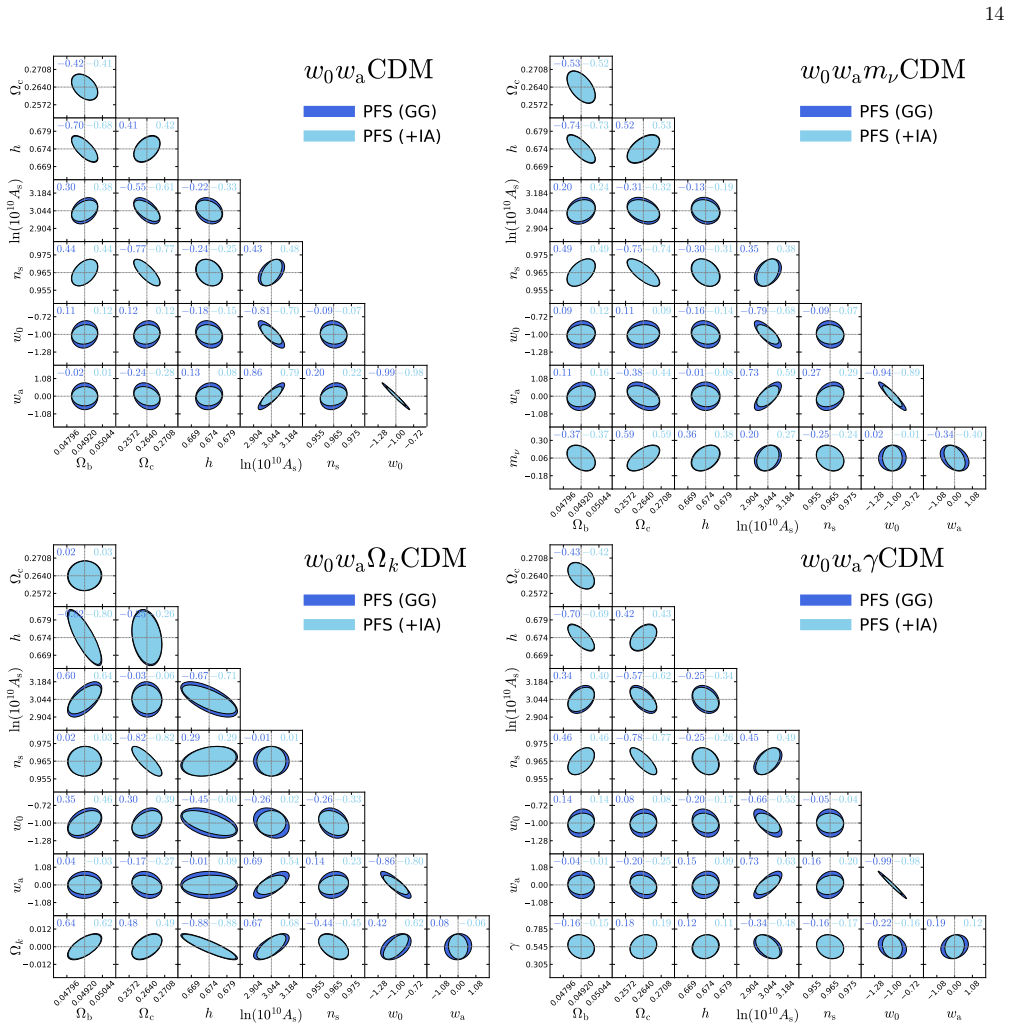
On its own terms, the paper claims that the full-shape information of intrinsic alignment—captured by the galaxy ellipticity auto-power spectrum $P_{EE}$ and the galaxy density–ellipticity cross-spectrum $P_{gE}$—contains cosmological information that the full-shape galaxy density power spectrum $P_{gg}$ alone does not. For a PFS-like deep survey, the figure of merit for the dark-energy equation-of-state parameters $(w_0, w_a)$ improves by at least 40% in every dynamical dark-energy model investigated, and for non-flat modified-gravity models the marginalized constraints tighten by 6–28% except for the dark-matter density and spectral index. In a Euclid-like wide survey the improvements are milder, which the paper attributes to the larger shape noise; with matched shape noise the gain becomes comparable. The paper also shows that IA rotates the degeneracy directions of some parameter pairs, particularly those involving $w_0$ and $w_a$, so it breaks degeneracies that clustering alone leaves intact.
Load-bearing premise
The forecast depends on the assumption that the linear alignment model, with a redshift-independent IA amplitude of $A_{IA}=18$ calibrated from blue galaxies, describes emission-line galaxy alignments at $z=0.6$–$2.4$ up to $k=0.2\,h\,{\rm Mpc}^{-1}$; if the actual amplitude is lower, evolves with redshift, or has nonlinear corrections, the forecast gains shrink.
Editorial extensions
If this is right
- Dark-energy equation-of-state constraints from a deep survey improve by at least 40% in all dynamical dark-energy models studied, so intrinsic alignment multiplies the science return of full-shape clustering without new observations.
- In non-flat modified-gravity models, adding shape alignment tightens constraints by 6–28% for most parameters, giving curvature and gravity modifications a sharper test.
- A wide survey gains less, but the gap disappears when shape noise is matched; the benefit of IA tracks the quality of shape measurement, not survey volume alone.
- IA shifts the degeneracy directions of parameter pairs such as $w_0$–$A_s$ and $w_a$–$A_s$, so joint analyses can separate effects that clustering-only full-shape analysis cannot.
Reading between the lines
- Editorial inference: If IA tracks the tidal field the way the linear alignment model assumes, then IA should also carry information about scale-dependent growth from neutrino mass or modified gravity on mildly nonlinear scales, where the paper's linear truncation at $k_{\rm max}=0.2\,h\,{\rm Mpc}^{-1}$ leaves gain on the table.
- Editorial inference: The strong shape-noise dependence implies that surveys investing in better per-galaxy shape measurement—rather than only larger area—will reap outsized cosmological returns from IA, a design tension the paper does not spell out.
- Editorial inference: The method can be extended to higher-order shape statistics and nonlinear alignment models; the paper itself notes that beyond-linear descriptions might further improve neutrino-mass and modified-gravity constraints.
Editorial analysis
A structured set of objections, weighed in public.
Referee Report
Summary. The manuscript presents a Fisher-matrix forecast for combining galaxy clustering and intrinsic alignment (IA) in a full-shape power-spectrum analysis, for a PFS-like deep survey and a Euclid-like wide survey. It models the galaxy density, density-ellipticity, and ellipticity-ellipticity power spectra using linear bias, the linear alignment model, and Gaussian covariance (Eqs. 19-28), adds a Planck compressed CMB prior, and explores models ranging from w0CDM to w0waCDM with curvature, massive neutrinos, and modified gravity. The central claim is that adding full-shape IA information to clustering significantly tightens cosmological constraints, with the dark-energy FoM improving by at least 40% for the deep survey in all dynamical dark-energy models investigated, and nonflat modified-gravity parameter constraints tightening by 6-28%; gains are milder for the wide survey.
Significance. If taken at face value, the forecast makes a useful quantitative case that galaxy IA is a complementary probe even when clustering already exploits full-shape information. The paper's strengths are the breadth of cosmological models considered, the standard and clearly documented Fisher formalism, the explicit treatment of the joint covariance, and the inclusion of robustness tests in Section VI.C and Appendix A. The main quantitative headline is, however, conditional on a fiducial IA amplitude that is not directly measured, and the manuscript's own conservative test does not report the headline FoM quantity. The qualitative conclusion that IA helps is credible; the exact "at least 40%" number is less strongly supported than the abstract suggests.
major comments (3)
- [V.A and Appendix A] The abstract's central quantitative claim is the at-least-40% improvement in FoM_theta_DE for deep surveys, but this number is only computed for the fiducial AIA = 18, kmax = 0.2 h/Mpc setup. Appendix A tests AIA = 10 and kmax = 0.1 h/Mpc but reports only 1D-marginalized error improvements (e.g., dark-energy improvements fall from about 21% to about 9% for AIA = 10 at kmax = 0.2, and become about 21% when kmax is also lowered), not the FoM_theta_DE ratios shown in Fig. 2 and quoted in the abstract. Since Fig. 9 shows the FoM gain depends strongly on AIA, the reader cannot verify whether the "at least 40%" claim survives the paper's own conservative assumptions. Please report FoM_theta_DE (and ideally FoM_theta_base) for the four Appendix A setups and qualify the abstract and conclusions accordingly.
- [I, VII, and Ref. [81]] The abstract and Section VII state that this is "for the first time" full-shape IA information is leveraged, but the Introduction (Section I) cites Ref. [81] (Shim, Okumura, and Taruya, in preparation) for "dark energy constraints with full-shape IA information." These statements are mutually contradictory. Please clarify the relation between this work and Ref. [81] and remove or qualify the "first time" and "first study" claim.
- [IV.E and Eq. (18)] The IA signal entering PgE and PEE is proportional to bK(z) = -0.01344 AIA Omega_m/D(z) (Eq. 18), with AIA = 18 assumed constant over z = 0.6-2.4 and calibrated from a shape estimator for blue galaxies rather than from direct ELG IA measurements. The paper acknowledges the uncertainty in Appendix A, but the conservative test preserves the same linear-alignment shape and only rescales the overall amplitude; scale-dependent IA, strong redshift evolution, or nonlinear corrections are not modeled. Given that Fig. 9 shows the FoM gain is very sensitive to AIA, the abstract should either state that the quantitative gains are conditional on the fiducial IA model and amplitude, or the authors should provide the FoM_theta_DE-versus-AIA curve (analogous to Fig. 9 but for the dark-energy FoM) so the headline number is not read as unconditional.
minor comments (6)
- [Abstract] "At least more than 40%" is redundant; choose "at least 40%" or "more than 40%".
- [Eq. (18)] The multiplication dots are missing in "-0.01344AIA Omega_m/D(z)", which makes the expression harder to parse.
- [VI.B] The heading "Model-dependent paramater degeneracies" contains a typo: "paramater" should be "parameter".
- [Appendix A and Fig. 10] The phrase "and fractional errors (lower)" appears twice in the caption; please clean up the duplicated wording.
- [Footnote 2] "Two cases assumingAIA(z)" is missing a space; it should read "assuming AIA(z)".
- [Reproducibility] No code or data-release statement is provided; for a forecast paper whose quantitative results depend on many survey inputs, a reproducibility statement would be helpful.
Circularity Check
No significant circularity: FoM gains are computed from an assumed IA signal model and Gaussian covariance, not fitted to the claim; the self-citations are not load-bearing.
full rationale
The central claim, the FoM improvement FoM^{+IA}/FoM^{GG} (Figs. 2-3), is obtained from the Fisher matrix (Eq. 25), the Gaussian covariance (Eq. 28), and the model spectra (Eqs. 19-21). Derivatives are computed numerically with CLASS, and no parameter is adjusted to reproduce the reported ratios. The IA amplitude AIA=18 is an input adopted in Sec. IV E (Eq. 18) from the external shape-estimator calibration [111]; Appendix A explicitly lowers it to AIA=10 and notes the amplitude 'may be lower than the fiducial value used in our main analysis,' so the headline number is conditional on an assumed signal, not a fitted target. The improvement is not an identity by construction: adding PgE and PEE also introduces the nuisance parameter bK(z) per redshift bin, so whether the marginalized common-parameter FoM increases depends on the (1-mu^2) kernels and the shot/shape-noise terms in Eq. (28). Self-citations to the authors' prior work are limited to the FoM definition and compressed-analysis comparisons (Refs. [78,79]) and to the in-preparation companion [81] for similar examples; these do not supply the forecast's quantitative content, which is anchored independently in the linear alignment model [55,56], the amplitude calibration [111], and the Euclid/PFS survey setups [85,123]. The 'for the first time' wording in the abstract is in tension with the self-citation [81], but that is a priority claim rather than a circular derivation step. Overall, no self-definitional, fitted-input-called-prediction, renaming, or self-citation-forcing circularity is present; score 1 reflects only minor, non-load-bearing self-citation.
Assumptions & free parameters
free parameters (4)
- AIA (IA amplitude) =
18 (redshift-independent fiducial)
- sigma_gamma (PFS shape noise) =
0.2
- sigma_gamma (Euclid shape noise) =
0.3
- kmax =
0.2 h/Mpc
assumptions (6)
- domain assumption Galaxy ellipticity traces the gravitational tidal field linearly (linear alignment model, Eqs. 15-17).
- domain assumption Modified gravity is captured by a scale-independent gamma-parametrization that rescales the growth amplitude only (Eqs. 9-10).
- domain assumption Observed power spectra follow linear Kaiser RSD and linear galaxy bias (Eq. 13).
- standard math Power spectrum covariance is Gaussian with shot noise and shape noise (Eq. 28).
- domain assumption The Planck-15 compressed likelihood with four parameters sufficiently captures CMB information (Section IV C).
- domain assumption The IA amplitude AIA is redshift-independent and representative for emission-line galaxy host halos (Section IV E).
Cite this review
Pith. "Pith review of Improving cosmological constraints via galaxy intrinsic alignment in full-shape analysis." pith.science (2026). https://pith.science/paper/EVLLRSGX
@misc{pith2026241208151,
  author       = {Pith},
  title        = {Pith review of: Improving cosmological constraints via galaxy intrinsic alignment in full-shape analysis},
  year         = {2026},
  howpublished = {\url{https://pith.science/paper/EVLLRSGX}},
  note         = {Machine review of arXiv:2412.08151}
}
abstract
The intrinsic alignment (IA) of galaxy shapes probes the underlying gravitational tidal field, thus offering cosmological information complementary to galaxy clustering. In this paper, we perform a Fisher forecast to assess the benefit of IA in improving cosmological parameter constraints, for the first time, leveraging the full-shape (FS) information of IA statistics. Our forecast is based on PFS-like and Euclid-like surveys as examples of deep and wide galaxy surveys, respectively. We explore various cosmological models, with the most comprehensive one simultaneously including dynamical dark energy, curvature, massive neutrinos, and modified gravity (MG). We find that adding FS IA information significantly tightens cosmological constraints relative to the FS clustering-only cases, particularly for dynamical dark energy and nonflat-MG models. For a deep galaxy survey, the Figure-of-Merit for the dark energy equation of state parameters is improved by at least more than $40\%$ in all dynamical dark energy models investigated. For nonflat-MG models, parameter constraints are tightened by $6-28\%$, except for the dark matter density and spectral index parameters. For a wide galaxy survey, improvements with IA become milder, although its joint constraints are tighter than those from the deep survey. Our findings highlight the efficacy of the galaxy IA as a complementary cosmological probe to galaxy clustering.
Figures


Figures from the paper (7 more)




Forward citations
Cited by 1 Pith paper
-
Squeezing Full-Shape Dynamical Dark Energy Constraints with Galaxy Alignments
A Fisher forecast shows that including galaxy intrinsic alignments alongside full-shape galaxy clustering improves the dark energy figure-of-merit by 42-57% and the primordial amplitude constraint by 17-19% for a PFS-...
Reference graph
Works this paper leans on
-
[81]
J. Shim, T. Okumura, and A. Taruya, in preparation (2025)
2025
-
[128]
Aviles, arXiv e-prints arXiv:2409.15640 (2024), 2409.15640
A. Aviles, arXiv e-prints arXiv:2409.15640 (2024), 2409.15640
arXiv 2024
-
[1]
P. J. E. Peebles and J. T. Yu, ApJ 162, 815 (1970)
1970
-
[2]
D. J. Eisenstein and W. Hu, ApJ 496, 605 (1998), astro- ph/9709112
arXiv 1998
-
[3]
S. Cole, W. J. Percival, J. A. Peacock, P. Norberg, C. M. Baugh, C. S. Frenk, I. Baldry, J. Bland-Hawthorn, T. Bridges, R. Cannon, et al., MNRAS 362, 505 (2005), astro-ph/0501174
arXiv 2005
-
[4]
D. J. Eisenstein, I. Zehavi, D. W. Hogg, R. Scoccimarro, M. R. Blanton, R. C. Nichol, R. Scranton, H.-J. Seo, M. Tegmark, Z. Zheng, et al., ApJ 633, 560 (2005), astro-ph/0501171
arXiv 2005
-
[5]
J. C. Jackson, MNRAS 156, 1P (1972), 0810.3908
arXiv 1972
-
[6]
W. L. W. Sargent and E. L. Turner, ApJ212, L3 (1977)
1977
Show all 136 references
-
[7]
Kaiser, MNRAS 227, 1 (1987)
N. Kaiser, MNRAS 227, 1 (1987)
1987
-
[8]
A. J. S. Hamilton, ApJ 385, L5 (1992)
1992
-
[9]
J. A. Peacock, S. Cole, P. Norberg, C. M. Baugh, J. Bland-Hawthorn, T. Bridges, R. D. Cannon, M. Col- less, C. Collins, W. Couch, et al., Nature 410, 169 (2001), astro-ph/0103143
2001 arXiv
- [10]
-
[11]
Tegmark, M
M. Tegmark, M. A. Strauss, M. R. Blanton, K. Abaza- jian, S. Dodelson, H. Sandvik, X. Wang, D. H. Wein- berg, I. Zehavi, N. A. Bahcall, et al., Phys. Rev. D 69, 103501 (2004), astro-ph/0310723
2004 arXiv
-
[12]
Okumura, T
T. Okumura, T. Matsubara, D. J. Eisenstein, I. Kayo, C. Hikage, A. S. Szalay, and D. P. Schneider, ApJ 676, 889 (2008), 0711.3640
2008 arXiv
-
[13]
Guzzo, M
L. Guzzo, M. Pierleoni, B. Meneux, E. Branchini, O. Le F` evre, C. Marinoni, B. Garilli, J. Blaizot, G. De Lucia, 18 Ωb Ωc h As ns w0 wa Ωk mν γ 10 2 10 1 100 101 σi/θi AIA = 10 fiducial kmax = 0.1hMpc−1 kmax = 0.1hMpc−1, AIA = 10 Ωb Ωc h As ns w0 wa Ωk mν γ0 10 20 30 40 ϵ(%) ...
2008 arXiv
-
[14]
Beutler, C
F. Beutler, C. Blake, M. Colless, D. H. Jones, L. Staveley-Smith, G. B. Poole, L. Campbell, Q. Parker, W. Saunders, and F. Watson, MNRAS 423, 3430 (2012), 1204.4725
2012 arXiv
-
[15]
Blake, S
C. Blake, S. Brough, M. Colless, C. Contreras, W. Couch, S. Croom, T. Davis, M. J. Drinkwater, K. Forster, D. Gilbank, et al., MNRAS 415, 2876 (2011), 1104.2948
2011 arXiv
-
[16]
B. A. Reid, L. Samushia, M. White, W. J. Perci- val, M. Manera, N. Padmanabhan, A. J. Ross, A. G. S´ anchez, S. Bailey, D. Bizyaev, et al., MNRAS 426, 2719 (2012), 1203.6641
2012 arXiv
-
[17]
Samushia, B
L. Samushia, B. A. Reid, M. White, W. J. Percival, A. J. Cuesta, L. Lombriser, M. Manera, R. C. Nichol, D. P. Schneider, D. Bizyaev, et al., MNRAS 429, 1514 (2013), 1206.5309
2013 arXiv
-
[18]
Beutler, S
F. Beutler, S. Saito, H.-J. Seo, J. Brinkmann, K. S. Dawson, D. J. Eisenstein, A. Font-Ribera, S. Ho, C. K. McBride, F. Montesano, et al., MNRAS 443, 1065 (2014), 1312.4611
2014 arXiv
-
[19]
Aubourg, S
´E. Aubourg, S. Bailey, J. E. Bautista, F. Beutler, V. Bhardwaj, D. Bizyaev, M. Blanton, M. Blomqvist, A. S. Bolton, J. Bovy, et al., Phys. Rev. D 92, 123516 (2015), 1411.1074
2015 arXiv
-
[20]
Okumura, C
T. Okumura, C. Hikage, T. Totani, M. Tonegawa, H. Okada, K. Glazebrook, C. Blake, P. G. Ferreira, S. More, A. Taruya, et al., PASJ 68, 38 (2016), 1511.08083
2016 arXiv
-
[21]
S. Alam, M. Ata, S. Bailey, F. Beutler, D. Bizyaev, J. A. Blazek, A. S. Bolton, J. R. Brownstein, A. Bur- den, C.-H. Chuang, et al., MNRAS 470, 2617 (2017), 1607.03155
2017 arXiv
-
[22]
Beutler, H.-J
F. Beutler, H.-J. Seo, A. J. Ross, P. McDonald, S. Saito, A. S. Bolton, J. R. Brownstein, C.-H. Chuang, A. J. Cuesta, D. J. Eisenstein, et al., MNRAS 464, 3409 (2017), 1607.03149
2017 arXiv
-
[23]
Gil-Mar ´ ın, W
H. Gil-Mar ´ ın, W. J. Percival, L. Verde, J. R. Brown- stein, C.-H. Chuang, F.-S. Kitaura, S. A. Rodr ´ ıguez- Torres, and M. D. Olmstead, MNRAS465, 1757 (2017), 1606.00439
2017 arXiv
-
[24]
A. J. Hawken, B. R. Granett, A. Iovino, L. Guzzo, J. A. Peacock, S. de la Torre, B. Garilli, M. Bolzonella, M. Scodeggio, U. Abbas, et al., A&A 607, A54 (2017), 1611.07046
2017 arXiv
-
[25]
J. Hou, A. G. S´ anchez, A. J. Ross, A. Smith, R. Neveux, J. Bautista, E. Burtin, C. Zhao, R. Scoccimarro, K. S. Dawson, et al., MNRAS 500, 1201 (2021), 2007.08998
2021 arXiv
-
[26]
Aubert, M.-C
M. Aubert, M.-C. Cousinou, S. Escoffier, A. J. Hawken, S. Nadathur, S. Alam, J. Bautista, E. Burtin, C.-H. Chuang, A. de la Macorra, et al., MNRAS 513, 186 (2022), 2007.09013
2022 arXiv
-
[27]
Anderson, ´E
L. Anderson, ´E. Aubourg, S. Bailey, F. Beutler, V. Bhardwaj, M. Blanton, A. S. Bolton, J. Brinkmann, J. R. Brownstein, A. Burden, et al., MNRAS 441, 24 (2014), 1312.4877
2014 arXiv
-
[28]
Nadathur, P
S. Nadathur, P. M. Carter, W. J. Percival, H. A. Winther, and J. E. Bautista, Phys. Rev. D 100, 023504 (2019), 1904.01030
2019 arXiv
-
[29]
C. Zhao, A. Variu, M. He, D. Forero-S´ anchez, A. Ta- mone, C.-H. Chuang, F.-S. Kitaura, C. Tao, J. Yu, J.-P. Kneib, et al., MNRAS 511, 5492 (2022), 2110.03824
2022 arXiv
-
[30]
DESI Collaboration, A. G. Adame, J. Aguilar, S. Ahlen, S. Alam, D. M. Alexander, M. Alvarez, O. Alves, A. Anand, U. Andrade, et al., arXiv e-prints arXiv:2404.03002 (2024), 2404.03002
2024 arXiv
-
[31]
A. G. S´ anchez, M. Crocce, A. Cabr´ e, C. M. Baugh, and E. Gazta˜ naga, MNRAS400, 1643 (2009), 0901.2570
2009 arXiv
-
[32]
Montesano, A
F. Montesano, A. G. S´ anchez, and S. Phleps, MNRAS 408, 2397 (2010), 1007.0755
2010 arXiv
-
[33]
Montesano, A
F. Montesano, A. G. S´ anchez, and S. Phleps, MNRAS 421, 2656 (2012), 1107.4097
2012 arXiv
-
[34]
A. G. S´ anchez, E. A. Kazin, F. Beutler, C.-H. Chuang, A. J. Cuesta, D. J. Eisenstein, M. Manera, F. Monte- sano, R. C. Nichol, N. Padmanabhan, et al., MNRAS 433, 1202 (2013), 1303.4396
2013 arXiv
-
[35]
M. M. Ivanov, M. Simonovi´ c, and M. Zaldarriaga, J. Cosmology Astropart. Phys. 2020, 042 (2020), 1909.05277
2020 arXiv
-
[36]
R. C. Nunes, S. Vagnozzi, S. Kumar, E. Di Valentino, and O. Mena, Phys. Rev. D 105, 123506 (2022), 2203.08093
2022 arXiv
-
[37]
O. H. E. Philcox and M. M. Ivanov, Phys. Rev. D 105, 043517 (2022), 2112.04515
2022 arXiv
-
[38]
Simon, P
T. Simon, P. Zhang, and V. Poulin, J. Cosmology As- tropart. Phys. 2023, 041 (2023), 2210.14931
2023 arXiv
-
[39]
Gsponer, R
R. Gsponer, R. Zhao, J. Donald-McCann, D. Ba- con, K. Koyama, R. Crittenden, T. Simon, and E.-M. Mueller, MNRAS 530, 3075 (2024), 2312.01977
2024 arXiv
-
[40]
Ramirez, M
S. Ramirez, M. Icaza-Lizaola, S. Fromenteau, M. Vargas-Maga˜ na, and A. Aviles, J. Cosmology Astropart. Phys. 2024, 049 (2024), 2310.17834
2024 arXiv
-
[41]
DESI Collaboration, A. G. Adame, J. Aguilar, S. Ahlen, S. Alam, D. M. Alexander, C. Allende Prieto, M. Al- varez, O. Alves, A. Anand, et al., arXiv e-prints arXiv:2411.12022 (2024), 2411.12022
2024 arXiv
-
[42]
O. H. E. Philcox, M. M. Ivanov, M. Simonovi´ c, and M. Zaldarriaga, J. Cosmology Astropart. Phys. 2020, 032 (2020), 2002.04035
2020 arXiv
-
[43]
Brieden, H
S. Brieden, H. Gil-Mar ´ ın, and L. Verde, J. Cosmology Astropart. Phys. 2021, 054 (2021), 2106.07641
2021 arXiv
-
[44]
Brieden, H
S. Brieden, H. Gil-Mar ´ ın, and L. Verde, Phys. Rev. D 104, L121301 (2021), 2106.11931
2021 arXiv
-
[45]
Ishak, J
M. Ishak, J. Pan, R. Calderon, K. Lodha, G. Valo- giannis, A. Aviles, G. Niz, L. Yi, C. Zheng, C. Garcia- Quintero, et al., arXiv e-prints arXiv:2411.12026 (2024), 2411.12026
2024
-
[46]
Boyle and E
A. Boyle and E. Komatsu, J. Cosmology Astropart. Phys. 2018, 035 (2018), 1712.01857
2018 arXiv
-
[47]
Kumar, R
S. Kumar, R. C. Nunes, and P. Yadav, J. Cosmology Astropart. Phys. 2022, 060 (2022), 2205.04292
2022 arXiv
-
[48]
Moretti, M
C. Moretti, M. Tsedrik, P. Carrilho, and A. Pourtsi- dou, J. Cosmology Astropart. Phys. 2023, 025 (2023), 2306.09275
2023 arXiv
-
[49]
M. A. Rodriguez-Meza, A. Aviles, H. E. Noriega, C.-Z. Ruan, B. Li, M. Vargas-Maga˜ na, and J. L. Cervantes- Cota, J. Cosmology Astropart. Phys. 2024, 049 (2024), 2312.10510
2024 arXiv
-
[50]
S. M. Carroll, V. Duvvuri, M. Trodden, and M. S. Turner, Phys. Rev. D 70, 043528 (2004), astro- ph/0306438
2004
-
[51]
Lesgourgues and S
J. Lesgourgues and S. Pastor, Phys. Rep. 429, 307 (2006), astro-ph/0603494
2006 arXiv
- [52]
-
[53]
Kaiser, ApJ 388, 272 (1992)
N. Kaiser, ApJ 388, 272 (1992)
1992
-
[54]
Bartelmann and P
M. Bartelmann and P. Schneider, Phys. Rep. 340, 291 20 (2001), astro-ph/9912508
2001 arXiv
-
[55]
Catelan, M
P. Catelan, M. Kamionkowski, and R. D. Blandford, MNRAS 320, L7 (2001), astro-ph/0005470
2001 arXiv
-
[56]
C. M. Hirata and U. Seljak, Phys. Rev. D 70, 063526 (2004), astro-ph/0406275
2004 arXiv
-
[57]
M. L. Brown, A. N. Taylor, N. C. Hambly, and S. Dye, MNRAS 333, 501 (2002), astro-ph/0009499
2002 arXiv
-
[58]
Mandelbaum, C
R. Mandelbaum, C. M. Hirata, M. Ishak, U. Seljak, and J. Brinkmann, MNRAS 367, 611 (2006), astro- ph/0509026
2006
-
[59]
C. M. Hirata, R. Mandelbaum, M. Ishak, U. Seljak, R. Nichol, K. A. Pimbblet, N. P. Ross, and D. Wake, MNRAS 381, 1197 (2007), astro-ph/0701671
2007 arXiv
- [60]
- [61]
-
[62]
Tsaprazi, N.-M
E. Tsaprazi, N.-M. Nguyen, J. Jasche, F. Schmidt, and G. Lavaux, J. Cosmology Astropart. Phys. 2022, 003 (2022), 2112.04484
2022 arXiv
- [63]
-
[64]
C. Zhou, A. Tong, M. A. Troxel, J. Blazek, C. Lin, D. Bacon, L. Bleem, C. Chang, M. Costanzi, J. DeRose, et al., MNRAS 526, 323 (2023), 2302.12325
2023 arXiv
- [65]
- [66]
-
[67]
N. E. Chisari and C. Dvorkin, J. Cosmology Astropart. Phys. 2013, 029 (2013), 1308.5972
2013 arXiv
-
[68]
N. E. Chisari, C. Dvorkin, F. Schmidt, and D. N. Spergel, Phys. Rev. D 94, 123507 (2016), 1607.05232
2016 arXiv
-
[69]
Kogai, T
K. Kogai, T. Matsubara, A. J. Nishizawa, and Y. Urakawa, J. Cosmology Astropart. Phys. 2018, 014 (2018), 1804.06284
2018 arXiv
-
[70]
Biagetti and G
M. Biagetti and G. Orlando, J. Cosmology Astropart. Phys. 2020, 005 (2020), 2001.05930
2020 arXiv
- [71]
- [72]
- [73]
- [74]
-
[75]
Shiraishi, T
M. Shiraishi, T. Okumura, and K. Akitsu, J. Cosmology Astropart. Phys. 2023, 013 (2023), 2303.10890
2023 arXiv
-
[76]
O. H. E. Philcox, M. J. K¨ onig, S. Alexander, and D. N. Spergel, Phys. Rev. D 109, 063541 (2024), 2309.08653
2024 arXiv
-
[77]
S. Saga, M. Shiraishi, K. Akitsu, and T. Okumura, Phys. Rev. D 109, 043520 (2024), 2312.16316
2024 arXiv
- [78]
- [79]
-
[80]
K. Xu, Y. P. Jing, G.-B. Zhao, and A. J. Cuesta, Nature Astronomy 7, 1259 (2023), 2306.09407
2023 arXiv
-
[82]
Aghamousa, J
DESI Collaboration, A. Aghamousa, J. Aguilar, S. Ahlen, S. Alam, L. E. Allen, C. Allende Prieto, J. Annis, S. Bailey, C. Balland, et al., arXiv e-prints arXiv:1611.00036 (2016), 1611.00036
2016 arXiv
-
[84]
Laureijs, J
R. Laureijs, J. Amiaux, S. Arduini, J. L. Augu` eres, J. Brinchmann, R. Cole, M. Cropper, C. Dabin, L. Du- vet, A. Ealet, et al., arXiv e-prints arXiv:1110.3193 (2011), 1110.3193
2011 arXiv
-
[85]
Blanchard, S
Euclid Collaboration, A. Blanchard, S. Camera, C. Car- bone, V. F. Cardone, S. Casas, S. Clesse, S. Ili´ c, M. Kil- binger, T. Kitching, et al., A&A 642, A191 (2020), 1910.09273
2020 arXiv
-
[86]
Spergel, N
D. Spergel, N. Gehrels, J. Breckinridge, M. Donahue, A. Dressler, B. S. Gaudi, T. Greene, O. Guyon, C. Hi- rata, J. Kalirai, et al., arXiv e-prints arXiv:1305.5422 (2013), 1305.5422
2013 arXiv
-
[87]
Man- delbaum, T
The LSST Dark Energy Science Collaboration, R. Man- delbaum, T. Eifler, R. Hloˇ zek, T. Collett, E. Gawiser, D. Scolnic, D. Alonso, H. Awan, R. Biswas, et al., arXiv e-prints arXiv:1809.01669 (2018), 1809.01669
2018 arXiv
-
[88]
Miyazaki, Y
S. Miyazaki, Y. Komiyama, S. Kawanomoto, Y. Doi, H. Furusawa, T. Hamana, Y. Hayashi, H. Ikeda, Y. Ka- mata, H. Karoji, et al., PASJ 70, S1 (2018)
2018
-
[89]
Aihara, N
H. Aihara, N. Arimoto, R. Armstrong, S. Arnouts, N. A. Bahcall, S. Bickerton, J. Bosch, K. Bundy, P. L. Capak, J. H. H. Chan, et al., PASJ 70, S4 (2018), 1704.05858
2018 arXiv
-
[90]
Chevallier and D
M. Chevallier and D. Polarski, International Journal of Modern Physics D 10, 213 (2001), gr-qc/0009008
2001 arXiv
-
[91]
E. V. Linder, Phys. Rev. Lett. 90, 091301 (2003), astro- ph/0208512
2003
-
[92]
E. L. Wright, PASP 118, 1711 (2006), astro- ph/0609593
2006
-
[93]
Komatsu and others, ApJS 192, 18 (2011), 1001.4538
E. Komatsu and others, ApJS 192, 18 (2011), 1001.4538
2011 arXiv
-
[94]
Jimenez, T
R. Jimenez, T. Kitching, C. Pe˜ na-Garay, and L. Verde, J. Cosmology Astropart. Phys. 2010, 035 (2010), 1003.5918
2010 arXiv
-
[95]
Zhao, J.-F
M.-M. Zhao, J.-F. Zhang, and X. Zhang, Physics Letters B 779, 473 (2018), ISSN 0370-2693, URL https://www.sciencedirect.com/science/article/ pii/S0370269318301527
2018
-
[96]
W. Yang, R. C. Nunes, S. Pan, and D. F. Mota, Phys. Rev. D 95, 103522 (2017), 1703.02556
2017 arXiv
-
[97]
E.-K. Li, H. Zhang, M. Du, Z.-H. Zhou, and L. Xu, J. Cosmology Astropart. Phys. 2018, 042 (2018), 1703.01554
2018 arXiv
-
[98]
Mangano, G
G. Mangano, G. Miele, S. Pastor, T. Pinto, O. Pisanti, and P. D. Serpico, Nuclear Physics B 729, 221 (2005), hep-ph/0506164
2005 arXiv
-
[99]
Kiakotou, O
A. Kiakotou, O. Elgarøy, and O. Lahav, Phys. Rev. D 77, 063005 (2008), URL https://link.aps.org/doi/ 10.1103/PhysRevD.77.063005
2008 doi
- [100]
-
[101]
E. V. Linder, Phys. Rev. D 72, 043529 (2005), astro- ph/0507263
2005
-
[102]
P. J. E. Peebles, The large-scale structure of the universe (1980)
1980
-
[103]
Lahav, P
O. Lahav, P. B. Lilje, J. R. Primack, and M. J. Rees, MNRAS 251, 128 (1991)
1991
-
[104]
Kaiser, ApJ 284, L9 (1984)
N. Kaiser, ApJ 284, L9 (1984)
1984
- [105]
-
[106]
Stebbins, T
A. Stebbins, T. McKay, and J. A. Frieman, in Astro- physical Applications of Gravitational Lensing, edited 21 by C. S. Kochanek and J. N. Hewitt (1996), vol. 173 of IAU Symposium, p. 75, astro-ph/9510012
1996 arXiv
-
[107]
Kamionkowski, A
M. Kamionkowski, A. Babul, C. M. Cress, and A. Re- fregier, MNRAS 301, 1064 (1998), astro-ph/9712030
1998 arXiv
-
[108]
R. G. Crittenden, P. Natarajan, U.-L. Pen, and T. The- uns, ApJ 568, 20 (2002), astro-ph/0012336
2002 arXiv
-
[109]
Joachimi, R
B. Joachimi, R. Mandelbaum, F. B. Abdalla, and S. L. Bridle, A&A 527, A26 (2011), 1008.3491
2011 arXiv
-
[110]
Kurita, M
T. Kurita, M. Takada, T. Nishimichi, R. Takahashi, K. Osato, and Y. Kobayashi, MNRAS 501, 833 (2021), 2004.12579
2021 arXiv
-
[111]
J. Shi, K. Osato, T. Kurita, and M. Takada, ApJ 917, 109 (2021), 2104.12329
2021 arXiv
-
[112]
J. Shi, T. Kurita, M. Takada, K. Osato, Y. Kobayashi, and T. Nishimichi, J. Cosmology Astropart. Phys. 2021, 030 (2021), 2009.00276
2021 arXiv
-
[113]
Inoue, T
T. Inoue, T. Okumura, S. Saga, and A. Taruya, arXiv e-prints arXiv:2406.19669 (2024), 2406.19669
2024 arXiv
-
[114]
Alcock and B
C. Alcock and B. Paczynski, Nature 281, 358 (1979)
1979
-
[115]
Tegmark, Phys
M. Tegmark, Phys. Rev. Lett. 79, 3806 (1997), astro- ph/9706198
1997
-
[116]
D. Blas, J. Lesgourgues, and T. Tram, J. Cosmology Astropart. Phys. 2011, 034 (2011), 1104.2933
2011 arXiv
-
[117]
Planck Collaboration, P. A. R. Ade, N. Aghanim, M. Arnaud, M. Ashdown, J. Aumont, C. Baccigalupi, A. J. Banday, R. B. Barreiro, N. Bartolo, et al., A&A 594, A14 (2016), 1502.01590
2016 arXiv
- [118]
-
[119]
Mukherjee, M
P. Mukherjee, M. Kunz, D. Parkinson, and Y. Wang, Phys. Rev. D 78, 083529 (2008), 0803.1616
2008 arXiv
-
[120]
Zhai, C.-G
Z. Zhai, C.-G. Park, Y. Wang, and B. Ratra, J. Cos- mology Astropart. Phys. 2020, 009 (2020), 1912.04921
2020 arXiv
- [121]
-
[122]
Albrecht, G
A. Albrecht, G. Bernstein, R. Cahn, W. L. Freedman, J. Hewitt, W. Hu, J. Huth, M. Kamionkowski, E. W. Kolb, L. Knox, et al., arXiv e-prints astro-ph/0609591 (2006), astro-ph/0609591
2006 arXiv
-
[123]
Takada, R
M. Takada, R. S. Ellis, M. Chiba, J. E. Greene, H. Ai- hara, N. Arimoto, K. Bundy, J. Cohen, O. Dor´ e, G. Graves, et al., PASJ 66, R1 (2014), 1206.0737
2014 arXiv
-
[124]
Hikage, M
C. Hikage, M. Oguri, T. Hamana, S. More, R. Mandel- baum, M. Takada, F. K¨ ohlinger, H. Miyatake, A. J. Nishizawa, H. Aihara, et al., PASJ 71, 43 (2019), 1809.09148
2019 arXiv
-
[125]
Matsubara, ApJ 615, 573 (2004), astro-ph/0408349
T. Matsubara, ApJ 615, 573 (2004), astro-ph/0408349
2004 arXiv
-
[126]
Aghanim, Y
Planck Collaboration, N. Aghanim, Y. Akrami, M. Ash- down, J. Aumont, C. Baccigalupi, M. Ballardini, A. J. Banday, R. B. Barreiro, N. Bartolo, et al., A&A 641, A6 (2020), 1807.06209
2020 arXiv
-
[127]
S. Alam, M. Aubert, S. Avila, C. Balland, J. E. Bautista, M. A. Bershady, D. Bizyaev, M. R. Blanton, A. S. Bolton, J. Bovy, et al., Phys. Rev. D 103, 083533 (2021), 2007.08991
2021 arXiv
-
[129]
Taruya, S
A. Taruya, S. Saito, and T. Nishimichi, Phys. Rev. D 83, 103527 (2011), 1101.4723
2011 arXiv
-
[130]
Lamman, D
C. Lamman, D. Eisenstein, J. E. Forero-Romero, J. N. Aguilar, S. Ahlen, S. Bailey, D. Bianchi, D. Brooks, T. Claybaugh, A. de la Macorra, et al., arXiv e-prints arXiv:2408.11056 (2024), 2408.11056
2024 arXiv
-
[131]
J. A. Blazek, N. MacCrann, M. A. Troxel, and X. Fang, Phys. Rev. D 100, 103506 (2019), 1708.09247
2019 arXiv
-
[132]
Z. Vlah, N. E. Chisari, and F. Schmidt, J. Cosmology Astropart. Phys. 2020, 025 (2020), 1910.08085
2020 arXiv
-
[133]
T. Bakx, T. Kurita, N. Elisa Chisari, Z. Vlah, and F. Schmidt, J. Cosmology Astropart. Phys. 2023, 005 (2023), 2303.15565
2023 arXiv
-
[134]
Okumura, A
T. Okumura, A. Taruya, T. Kurita, and T. Nishimichi, Phys. Rev. D 109, 103501 (2024), 2310.07384
2024 arXiv
-
[135]
Taruya, T
A. Taruya, T. Kurita, and T. Okumura, arXiv e-prints arXiv:2409.06616 (2024), 2409.06616
2024 arXiv
-
[136]
S. Pyne, A. Tenneti, and B. Joachimi, MNRAS 516, 1829 (2022), 2204.10342
2022 arXiv
-
[137]
Linke, S
L. Linke, S. Pyne, B. Joachimi, C. Georgiou, K. Hoff- mann, R. Mandelbaum, and S. Singh, arXiv e-prints arXiv:2406.05122 (2024), 2406.05122
2024 arXiv
Reviewed August 11, 2026 · model on record in the stance chip above.
Discussion (0). Continue with ORCID to comment.