REVIEW 5 minor 2 cited by
Call to Protect the Dark and Quiet Sky from Harmful Interference by Satellite Constellations
T0 review · 0 major / 5 minor · reviewed 2026-08-11 · deepseek-v4-flash
Pith's one-line read A new position paper argues that LEO satellite constellations already harm astronomy and the night sky worldwide, and that voluntary mitigation is insufficient without binding rules.
desk verdict A credible and well-organized policy position paper, not a research advance; the central claim holds up even though key quantitative inputs are soft. read the letter →
The pith
A machine-rendered reading of the paper's core claim, the machinery that carries it, and where it could break.
The reading
What carries the argument
The load-bearing mechanism is a set of quantitative protection thresholds plus a licensing procedure. The central threshold is the brightness limit for operational LEO satellites: a satellite should never be visible to the naked eye, expressed as $V_{\mathrm{mag}} > 7.0$ for altitudes at or below 550 km and $V_{\mathrm{mag}} > 7.0 + 2.5\log_{10}(\mathrm{SatAltitude}/550\,\mathrm{km})$ above that, so that higher satellites are held to a stricter limit to compensate for their slower apparent motion across the sky. Supporting thresholds are the recommendation that constellation orbits stay below roughly 600 km to keep satellites out of view during the darkest night hours, the limit of no more than about a 10% artificial increase in diffuse sky brightness, and radio-astronomy protection through an international electromagnetic-compatibility standard for unintended radiation from satellite electronics. These numbers convert a diffuse worry into checkable licensing conditions: an operator's application can be judged against a brightness model, a cumulative emission analysis, and a data-sharing requirement before launch.
What would settle it
Track the actual fraction of twilight exposures at a wide-field survey telescope that contain satellite streaks during its first years of operations, and compare measured twilight sky brightness at dark sites against the pre-constellation baseline; if streaks appear in far fewer than 30% of images and the diffuse background rise stays well under 10%, the central quantitative claims would be contradicted.
Extended reading notes
Core claim
The paper's central claim is that LEO satellite constellations, at present and projected numbers, are causing harmful interference to astronomy that is global, cumulative, and inadequately regulated. It asserts that neither ground-based nor space-based observatories can escape the effects, and that the interference is not merely a data-quality nuisance: it threatens the viability of twilight observations needed to find potentially hazardous asteroids, degrades the quasar-based reference frame used for navigation and geolocation, and changes the appearance of the night sky for all cultures. The authors hold that voluntary industry efforts, while real and partly effective, do not yet meet the astronomy community's quantitative target and cannot be assumed to cover future operators. On this basis they propose that States exercise their existing licensing authority under international space law to require, per satellite system, a brightness analysis, a cumulative radio-emission analysis, operational position-data sharing, and an interdisciplinary environmental assessment, alongside specific technical limits such as the recommended visual magnitude formula.
Load-bearing premise
The case for urgency rests on the accuracy of the cited estimates, notably the prediction that a wide-field survey telescope could lose up to 30% of twilight observations and the claim that satellites and debris already brighten the sky by about 10%; if those numbers are too high, the regulatory case weakens.
Editorial extensions
If this is right
- If the proposed limits are adopted, constellation operators would have to design satellites that are invisible to the naked eye, with stricter brightness limits at higher altitudes, and would need to prove compliance before launch.
- Radio-quiet zones around major telescopes would gain legal force against satellite transmissions, not just against terrestrial sources, through a global electromagnetic-compatibility standard.
- The licensing of every new constellation would include a public impact assessment covering optical brightness, cumulative radio noise, and orbital sustainability, making interference a routine part of space-approval decisions.
- Dark and quiet skies would be formally recognised as cultural and environmental heritage, giving States a legal basis to protect them under existing treaty obligations.
Reading between the lines
- Beyond the paper's claims, the same licensing criteria, if widely adopted, would create a de facto global standard that smaller spacefaring nations could enforce through their own launch-approval processes, reducing the need for a single international treaty.
- A testable extension would be to build a public dashboard that tracks the measured brightness of every operational constellation satellite against the recommended magnitude formula; that would let regulators verify compliance and would show whether the 10% sky-brightening estimate is being approached.
- Beyond the paper, the radio-interference argument suggests that direct-to-handset satellite systems, with their much larger antennas and planned downlinks to ordinary phones, may be the next acute conflict point, since their emissions are harder to steer away from radio telescopes than current fixed-terminal systems.
Signed reviews
Editorial analysis
A structured set of objections, weighed in public.
Referee Report
Summary. This manuscript, issued by the IAU Centre for the Protection of the Dark and Quiet Sky, is a policy-position document rather than an original research paper. It summarizes the state of knowledge on interference from LEO satellite constellations with optical and radio astronomy, presents direct evidence (an HST satellite trail, LOFAR detection of unintentional Starlink radiation, and BlueWalker 3 brightness), and argues that current national and international regulation is inadequate. It then proposes a set of measures for States, industry, and intergovernmental bodies, including a brightness limit (Box 1: Vmag > 7 + 2.5 log10(alt/550 km)), an orbital-altitude guideline of roughly 600 km, radio-spectrum and EMC safeguards, impact assessments in licensing, and environmental-law approaches. The paper explicitly frames itself as a position statement and notes that updates may follow.
Significance. The value of this manuscript lies in its consolidation of a community consensus into an actionable policy text, grounded in peer-reviewed and institutional references rather than new analysis. It is transparent about the inherited nature of its quantitative recommendations and uses cautious language such as 'may' and 'potentially' where the underlying estimates are model-dependent. The direct observational examples make the existence of interference difficult to dispute, and the recommendations are specific enough to be operationalized by regulators. The paper's main limitation is inherent to its genre: it does not adjudicate among conflicting estimates or quantify the economic trade-offs of regulation, but as a position statement that is not a defect.
minor comments (5)
- [Summary and Recommendations] The bullet list on page 16 contains a duplicated phrase ('observations used to calibrate geolocation' appears twice) and the following bullet repeats 'scientific discovery, technical spinoff, and fundamental services to society' twice; these should be de-duplicated.
- [Impact of reflected sunlight] The ~10% night-sky brightness increase (citing [16]) is a model-based estimate with substantial input uncertainty; the text currently hedges with 'may,' but an explicit sentence distinguishing the model status from the later 10% policy threshold in the Recommendations section would prevent readers from treating the estimate as an established measurement.
- [References] Reference [2] spells the author name as 'Mc Dowell' rather than 'McDowell,' and a few other references contain spacing or punctuation inconsistencies (e.g., 'P .' before initials); the reference list should be copy-edited for consistency.
- [Visibility of satellites in the sky] The phrase 'there are no places on Earth that can escape the effects of satellite constellations' (also in the Abstract) is stronger than the later, more nuanced discussion of altitude- and latitude-dependent visibility; consider softening it to something like 'no observatory sites are unaffected' for internal consistency.
- [Technical measures] Box 1 states that the limit applies to both photopic magnitude and Johnson V magnitude, but Figure 3 would be easier to interpret with explicitly labeled axes and a note on which magnitude system is plotted; the current figure caption refers the reader to [31] without stating this.
Circularity Check
No significant circularity: the paper is a policy position that derives no new results and does not reduce any claim to its own inputs.
full rationale
This document is an IAU CPS policy position rather than an original empirical or theoretical derivation. Its central claims—that LEO satellite constellations harm astronomy and that current regulation is insufficient—are supported by direct external evidence cited in the text: an HST satellite trail (Figure 1, ref. [13]), LOFAR detections of unintended radiation from Starlink satellites (ref. [7]), the measured brightness of BlueWalker 3 (ref. [6]), and projected constellation growth (refs. [2,3]). The quantitative estimates used to convey urgency, such as the Rubin Observatory twilight-streak projection (ref. [14]) and the approximate 10% artificial brightening of the night sky (ref. [16]), are external literature inputs rather than quantities fitted or derived within this paper, so they do not create a derivation chain that reduces to the paper's own assumptions. The recommendations (Vmag > 7.0, the 600 km altitude guidance, and the 10% background-brightness limit) are explicitly policy choices adopted from IAU/SATCON community reports (Box 1, refs. [31,32]) and are presented as recommendations, not as predictions derived from first principles. Some cited reports share authors with this paper (e.g., refs. [15,16,31]), but the paper does not invoke a self-citation chain or a uniqueness theorem to force its conclusion; those citations function as external community benchmarks. The paper itself disclaims technical derivation, stating that it 'does not delve into technical details extensively' and 'is not meant to cover the detailed discussion of technical aspects,' further confirming that there is no hidden derivation to assess. Even if the cited quantitative estimates are uncertain, that is a correctness or robustness concern, not circularity. No circular step meets the standard of reducing a claimed result to its own inputs by construction.
Assumptions & free parameters
free parameters (3)
- IAU brightness limit Vmag > 7.0 =
7.0 mag (piecewise with altitude)
- Constellation orbit altitude threshold =
roughly 600 km
- Maximum artificial sky brightness increase =
10%
assumptions (4)
- domain assumption Artificial satellites reflect sunlight and emit unintended radio emissions that can interfere with astronomical observations.
- domain assumption The dark and quiet sky has high scientific, cultural, and economic value that justifies regulatory protection.
- domain assumption Current international law, including the Outer Space Treaty and ITU Radio Regulations, provides a basis for regulating satellite interference with astronomy.
- domain assumption The quantitative impact estimates cited from simulations and measurements are accurate and representative of future constellations.
Cite this review
Pith. "Pith review of Call to Protect the Dark and Quiet Sky from Harmful Interference by Satellite Constellations." pith.science (2026). https://pith.science/paper/YEYA523P
@misc{pith2026241208244,
  author       = {Pith},
  title        = {Pith review of: Call to Protect the Dark and Quiet Sky from Harmful Interference by Satellite Constellations},
  year         = {2026},
  howpublished = {\url{https://pith.science/paper/YEYA523P}},
  note         = {Machine review of arXiv:2412.08244}
}
read the original abstract
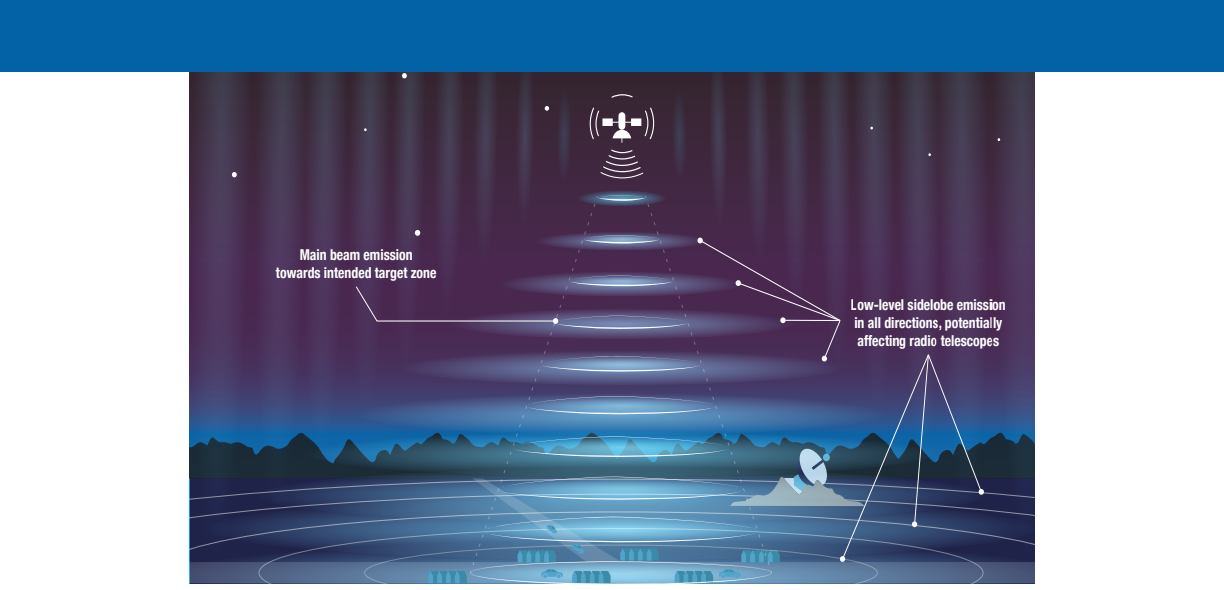
The growing number of satellite constellations in low Earth orbit (LEO) enhances global communications and Earth observation, and support of space commerce is a high priority of many governments. At the same time, the proliferation of satellites in LEO has negative effects on astronomical observations and research, and the preservation of the dark and quiet sky. These satellite constellations reflect sunlight onto optical telescopes, and their radio emission impacts radio observatories, jeopardising our access to essential scientific discoveries through astronomy. The changing visual appearance of the sky also impacts our cultural heritage and environment. Both ground-based observatories and space-based telescopes in LEO are affected, and there are no places on Earth that can escape the effects of satellite constellations given their global nature. The minimally disturbed dark and radio-quiet sky is crucial for conducting fundamental research in astronomy and important public services such as planetary defence, technology development, and high-precision geolocation. Some aspects of satellite deployment and operation are regulated by States and intergovernmental organisations. While regulatory agencies in some States have started to require operators to coordinate with their national astronomy agencies over impacts, mitigation of the impact of space objects on astronomical activities is not sufficiently regulated. To address this issue, the CPS urges States and the international community to take steps to protect the dark and quiet sky as specified in this paper.
Figures

Forward citations
Cited by 2 Pith papers
-
Characterization of Starlink Direct-to-Cell Satellites In Brightness Mitigation Mode
Starlink Direct-to-Cell satellites in brightness mitigation mode have a mean apparent magnitude of 5.16 and remain about twice as bright as Starlink internet satellites at the same distance.
-
Brightness Characteristics of the Qianfan Satellites and Evidence That Some Are Tumbling
Qianfan satellites average apparent magnitude 5.76 (5.24 at 1,000 km), and several failed Launch 2 spacecraft show periodic brightness fluctuations indicating tumbling.
Reference graph
Works this paper leans on
-
[1]
Safeguard access to the dark and quiet sky and prevent catastrophic loss of high quality observations
-
[2]
Increase financial support for astronomy to offset and compensate the impacts on obser- vatory operations and implement mitigation measures at observatories and in software
-
[3]
Encourage and support satellite operators and industry to collaborate with the astronomy community to develop, share and adopt best practices in interference mitigation, leading to widely adopted standards and guidelines
-
[4]
Provide incentive measures for the space industry to develop the required technology to minimise negative impacts. Support the estab- lishment of test labs for brightness and basic research into alternate less reflective materials and reduction of unwanted radiation in the radio regime for spacecraft manufacturing
-
[5]
In the longer term, establish regulations and conditions of authorization and supervision based on practical experience as well as the general provisions of international law and main principles of environmental law to codify industry best practices that mitigate the neg- ative impacts on astronomical observations. Satellites in LEO should be designed and...
-
[6]
Continue to support finding solutions to space sustainability issues, including the problem of increasing space debris leading to a brighter sky. Minimising the production of space debris will also benefit the field of astronomy and all sky observers worldwide. 3 INTRODUCTION: LOW-EARTH-ORBIT SATELLITE CONSTELLATIONS AND ASTRONOMY In recent years, numerou...
work page 2023
-
[7]
Bassa, C. G., Hainaut, O. R. & Galadí-Enríquez, D. 2022, Analytical simulations of the effect of satellite constella- tions on optical and near-infrared observations, A&A, 657, A75, https://doi.org/10.1051/0004-6361/202142101
-
[8]
Mc Dowell, J. 2023, Jonathan's Space Pages: Enormous (`Mega') Satellite Constellations, https://planet4589.org/space/con/conlist.html
work page 2023
Show all 39 references
-
[9]
Falle, A., Wright, E., Boley, A. et al. 2023, One million (paper) satel- lites, Science, 382, 150, https://doi.org/10.1126/science.adi4639
2023 doi
-
[10]
National Science Foundation 2023, NSF statement on NSF and SpaceX Astronomy Coordination Agreement, https://new.nsf.gov/news/statement-nsf-astronomy-coordination-agreement
2023
-
[11]
& Respler, J
Young, B. & Respler, J. 2023, Effect of upgrades to Starlink Generation 2 satel- lites on visual brightness, Zenodo, https://doi.org/10.5281/ZENODO.8226279
2023 doi
-
[12]
Nandakumar, S., Eggl, S., Tregloan-Reed, J. et al. 2023, The high optical brightness of the BlueWalker 3 satellite, Nature, 623, 938, https://doi.org/10.1038/s41586-023-06672-7
2023 doi
-
[13]
Di Vruno, F., Winkel, B., Bassa, C. G. et al. 2023, Unintended electromagnetic radiation from Starlink satellites detected with LOFAR between 110 and 188 MHz, A&A, 676, A75, https://doi.org/10.1051/0004-6361/202346374
2023 doi
-
[14]
South African Radio Astronomy Observatory 2017, Shared Sky Exhibition: The SKA’s Indigenous Art/Astronomy Exhibition, https://www.sarao.ac.za/outreach/shared-sky-exhibition/
2017
-
[15]
V., Bralower, T
Morgan, J. V., Bralower, T. J., Brugger, J. et al. 2022, The Chicxulub impact and its environmental conse- quences, Nature Reviews Earth & Environment, 3, 338, https://doi.org/10.1038/s43017-022-00283-y
2022 doi
-
[16]
N., Denneau, L., Tonry, J
Heinze, A. N., Denneau, L., Tonry, J. L. et al. 2021, NEO Population, Velocity Bias, and Impact Risk from an ATLAS Analysis, The Planetary Science Journal, 2, 12, https://doi.org/10.3847/psj/abd325
2021 doi
-
[17]
Barbosa, D., Coelho, B., Bergano, M. et al. 2022, Cyber-Cosmos: A new citizen science concept in a dark sky destination, Acta Astronautica, 200, 612, https://doi.org/10.1016/j.actaastro.2022.09.008
2022 doi
-
[18]
Venkatesan, A., Lowenthal, J., Prem, P . et al. 2020, The impact of satellite constellations on space as an ancestral global commons, Nature Astronomy, 4, 1043, https://doi.org/10.1038/s41550-020-01238-3
2020 doi
-
[19]
Space Telescope Science Institute 2023, Example of Satellite Trail in Hubble Space Telescope Exposure, https://www.stsci.edu/contents/media/images/2023/017/01H1Q4K5J650PPH3HM9Y88N7TA?news=true
2023
-
[20]
Williams, A., Hainaut, O., Otarola, A. et al. 2021, Analysing the Impact of Satellite Constellations and ESO’s Role in Supporting the Astronomy Community, The Messenger, 184, 3, https://doi.org/10.18727/0722-6691/5237
2021 doi
-
[21]
Walker, C., Hall, J., Allen, L. et al. 2020, Impact of Satellite Constellations on Optical Astronomy and Recommendations Toward Mitigations, Bulletin of the AAS, 52, Issue 2, https://doi.org/10.3847/25c2cfeb.346793b8
2020 doi
-
[22]
Kocifaj, M., Kundracik, F., Barentine, J. C. et al. 2021, The proliferation of space objects is a rapidly increas- ing source of artificial night sky brightness, MNRAS Letters, 504, L40, https://doi.org/10.1093/mnrasl/slab030
2021 doi
-
[23]
J., Kamiński, K., Kamińska, M
Michałowski, M. J., Kamiński, K., Kamińska, M. K. et al. 2021, GN-z11-flash from a man-made satellite not a gamma-ray burst at redshift 11, Nature Astronomy, 5, 995, https://doi.org/10.1038/s41550-021-01472-3 18
2021 doi
-
[24]
International Telecommunication Union 2014, Recommendation RS.2066-0 (12/2014): Protection of the radio astron- omy service in the frequency band 10.6-10.7 GHz from unwanted emissions of synthetic aperture radars operating in the Earth exploration-satellite service (active) ar...
2014
-
[25]
https://doi.org/10.5281/zenodo.5898785
Dark Sky Oases Working Group, Optical Astronomy working Group, Bioenvironment Working Group, Satellite Constellation Working Group, & Radio Astronomy Working Group 2022, Dark and Quiet Skies for Science and Society: Report and recommendations, Zenodo. https://doi.org/10.5281/z...
2022 doi
-
[26]
com/public-files/BrightnessMitigationBestPracticesSatelliteOperators.pdf
SpaceX, Brightness Mitigation Best Practices for Satellite Operators, https://api.starlink. com/public-files/BrightnessMitigationBestPracticesSatelliteOperators.pdf
-
[27]
Space Sustainability Rating: leading the path towards a more sustain- able use of space, https://spacesustainabilityrating.org/
-
[28]
IAU CPS Policy Hub, https://cps.iau.org/policy-hub/
-
[29]
United Nations 1967, Treaty on principles governing the activities of States in the exploration and use of outer space, including the moon and other celestial bodies (adopted 27 January 1967, entered into force 10 October
1967
-
[30]
J., Anderson, K., Shutler, J
Gaston, K. J., Anderson, K., Shutler, J. D., et al. 2023, Environmental impacts of increasing numbers of arti- ficial space objects, Frontiers in Ecology and the Environment, 21, 289, https://doi.org/10.1002/fee.2624
2023 doi
-
[31]
International Telecommunication Union 2019, Radio Regulations, http://handle.itu.int/11.1002/pub/814b0c44-en
2019
-
[32]
International Science Council Scientific Committee on Frequency Allocations for Radio Astronomy and Space Science, http://www.iucaf.org/
-
[33]
European Science Foundation Committee on Radio Astronomy Frequencies, https://www.craf.eu/
-
[34]
Square Kilometre Array Observatory, https://www.skao.int
-
[35]
US National Academy of Sciences, Engineering and Medicine Committee on Radio Frequencies, https://www.nationalacademies.org/our-work/committee-on-radio-frequencies
-
[36]
Radio Astronomy Frequency Committee in the Asia-Pacific region 2011, https://www.atnf.csiro.au/rafcap/
2011
-
[38]
Hall, J., Walker, C., Rawls, M. et al. 2021, SATCON2: Executive Summary, Bulletin of the AAS, 53, Issue 2, https://doi.org/10.3847/25c2cfeb.4554c01f
2021 doi
-
[39]
& Benvenuti, P
Governments of Chile, Ethiopia, Jordan, Slovakia, Spain and the International Astronomical Union 2021, Recommendations to Keep Dark and Quiet Skies for Science and Society, COPUOS STSC Conference Room Paper A/AC.105/C.1/2021/CRP .17, https://www.unoosa.org/oosa/ oosadoc/data/d...
2021
-
[1967]
610 UNTS 205, https://treaties.un.org/Pages/showDetails.aspx?objid=0800000280128cbd&clang=_en
Reviewed August 11, 2026 · model on record in the stance chip above.
Discussion (0). Continue with ORCID to comment.