REVIEW 3 major objections 5 minor 41 references
Pairing in fission: Mean-field and collective inertias study
T0 review · 3 major / 5 minor · reviewed 2026-08-11 · deepseek-v4-flash
Pith's one-line read Particle-number fluctuations match the pairing gap as a fission coordinate, so ΔN² can replace Δ in static fission calculations.
desk verdict Solid systematic study of pairing in fission; the headline Δ–ΔN^2 inertia validation is partly circular and the interchangeability claim is stronger than the evidence. read the letter →
The pith
A machine-rendered reading of the paper's core claim, the machinery that carries it, and where it could break.
The reading
What carries the argument
The central object is the effective collective inertia B_eff(s) = Σ_{ij} B_ij (dq_i/ds)(dq_j/ds) along the fission path s = Q20, where B_ij is the inverse of the perturbative cranking mass tensor. The cranking formula B(Q20) = M_{-3}/M_{-1}^2 assumes a one-body collective operator, so for the two-body operator ΔN² the paper uses its quasiparticle one-body part and compares the resulting inertia with that of the genuine one-body operator Δ. This comparison validates the one-body approximation and makes ΔN² a usable dynamical coordinate. A supporting piece of machinery is the Appendix-A sign-fixing recipe, which ensures a consistent sign for the occupation factors when constraining Δ, because otherwise individual K-blocks can contribute negative terms to the gap.
What would settle it
Compute the collective inertia for ΔN² without the one-body reduction—for example, with a generator-coordinate method using the full two-body fluctuation operator or with a full two-body cranking formula—along the same fission path in 262Rf; if the resulting inertia differs substantially from the one-body cranking value, the interchangeability of Δ and ΔN² would fail exactly where the paper claims it holds.
Extended reading notes
Core claim
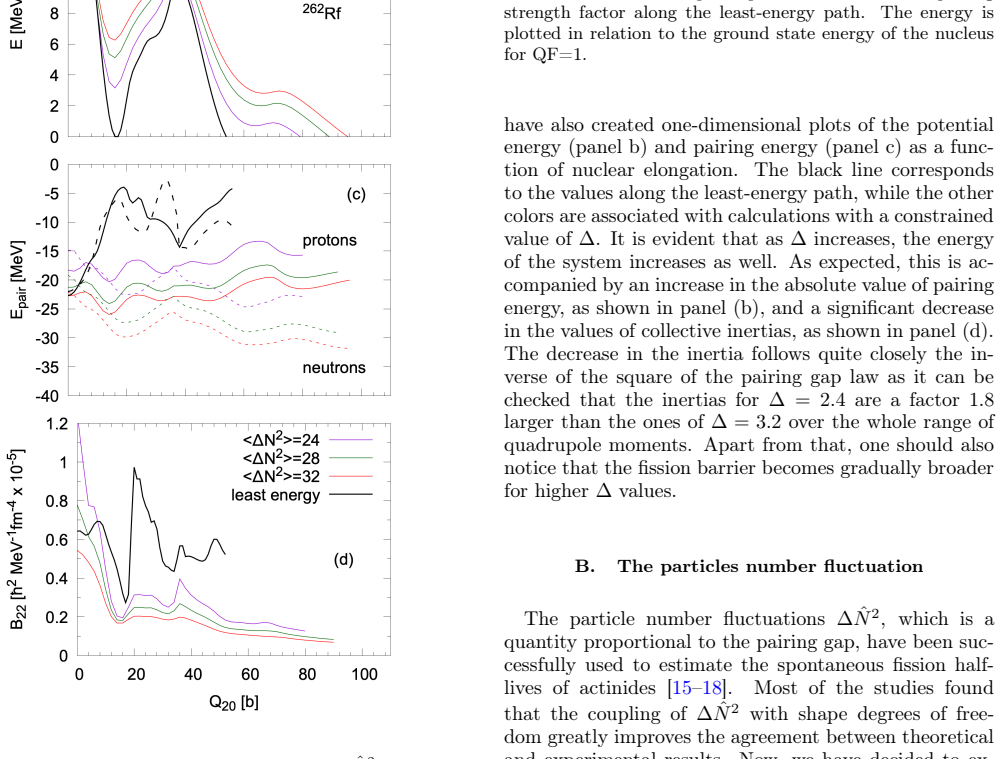
Using the HFB method with the Gogny D1S interaction for 262Rf, 260Fm, and several U and Pu isotopes, the paper shows that constraining on Δ or on ΔN² produces nearly identical potential-energy surfaces, pairing energies, and collective inertia profiles along the least-energy fission path. The load-bearing comparison is the effective inertia B_eff(s) along Q20: for fixed values of Δ and the corresponding ΔN², the inertia obtained from ΔN² with the one-body part of the operator in the cranking formula agrees with the inertia obtained from the genuine one-body operator Δ, with the agreement improving for larger pairing correlations. The authors conclude that ΔN² can be used interchangeably with Δ as a collective variable in fission studies, and that the one-body assumption for its inertia is solid. They also quantify how the quenching factor differs: increasing QF strengthens the attractive pairing interaction, lowering the barrier and inertia and reducing half-lives, with the best reproduction of experimental half-lives at QF between 1.05 and 1.10.
Load-bearing premise
The paper assumes that the perturbative cranking inertia computed from the one-body part of ΔN² is a faithful proxy for the inertia of the true two-body operator, with no independent non-perturbative benchmark.
Editorial extensions
If this is right
- Δ and ΔN² can be used interchangeably as collective coordinates in static fission calculations without changing the predicted barrier, inertia, or half-life.
- The one-body cranking formula can be applied to ΔN², making dynamic least-action fission calculations with pairing fluctuations tractable.
- Increasing pairing via Δ or ΔN² broadens and raises the barrier but lowers the inertia; the net effect is shorter spontaneous-fission half-lives.
- Scaling pairing strength via QF lowers both barrier and inertia, monotonically reducing half-lives; the D1S force needs QF ≈ 1.05–1.10 to match measured half-lives, with the effect concentrated on the symmetric first barrier.
- Since the agreement improves at larger Δ values, the effective inertia approximation is most reliable in the high-pairing region that dominates the least-action path.
Reading between the lines
- Because ΔN² is sign-independent while Δ requires an ad hoc sign-fixing recipe, ΔN² may be the more robust order parameter for constrained HFB fission calculations; the paper's agreement suggests this robustness carries over to inertias.
- The one-body reduction of ΔN² could be tested non-perturbatively with a generator-coordinate inertia computed from the full two-body operator; if the cranking agreement persists, the result would validate a much cheaper dynamical treatment.
- The QF optimum near 1.05–1.10 for D1S implies that the fitted pairing strength of this interaction is slightly too weak for fission observables; re-fitting the interaction itself could remove the need for a manual quenching factor.
- The same Δ-versus-ΔN² inertial comparison could be extended to asymmetric fission paths and to octupole degrees of freedom, where the paper already notes the QF effect is weaker.
Editorial analysis
A structured set of objections, weighed in public.
Referee Report
Summary. The paper studies how three different pairing-related quantities—the pairing gap Δ, the particle-number fluctuation ΔN^2, and a pairing-strength quenching factor QF—affect the static mean-field description of fission. Using HFB calculations with the Gogny D1S interaction, the authors compute potential energy surfaces, pairing energies, collective inertias, and WKB spontaneous-fission half-lives for 262Rf, 260Fm, and chains of U and Pu isotopes. The main methodological conclusion is that Δ and ΔN^2 can be used interchangeably as collective variables, and specifically that the one-body reduction of the two-body operator ΔN^2 in the perturbative cranking inertia is validated by comparison with the Δ-constrained inertias. The QF study shows that increasing the pairing strength lowers barriers and inertias, shortening half-lives, with an optimal QF around 1.05–1.10 for the D1S parametrization.
Significance. If the central validation claim held, the paper would provide useful justification for using ΔN^2 as a collective coordinate in fission studies, an approach used in several recent publications. The work has clear strengths: state-of-the-art HFB calculations with Gogny D1S, a consistent comparative framework for three pairing prescriptions, standard WKB half-life methodology, and a concrete empirical trend in half-lives versus QF. The paper is also honest about the numerical difficulty of constraining Δ directly, devoting Appendix A to the sign-of-v_k issue. However, as argued below, the central benchmark is not independent, so the significance of the main claim is currently weaker than the conclusions state.
major comments (3)
- [Sec. III.E and Appendix A] The benchmark underlying the central claim is not independent. As Appendix A explains, the “Δ-constrained” HFB states are not obtained by constraining the one-body operator Δ; they are ΔN^2-constrained states with the sign of v_k adjusted block by block so that the contribution to Δ is positive. Because Fig. 9 shows Δ and ΔN^2 are almost linearly related over the entire (Q20, ΔN^2) grid, the agreement of the effective inertias in Fig. 8 is largely a consistency check between two coordinate labels on the same state family. It does not test whether the one-body part of ΔN^2 reproduces the inertia of the full two-body operator, since no independent states with the same Δ but different densities are involved. The conclusion in Sec. IV that this “gives a solid ground to the use of ΔN^2 as collective variable” is therefore stronger than the evidence. A direct test would be to compute the cranking inertia of ΔN^2 retaining the two-body terms (or using the full ATDHFB response) and compare it with the one-body-part result.
- [Fig. 8] The central quantitative claim of “very good agreement” is supported only by visual inspection. No deviation metric is provided, such as the relative RMS difference between solid and dashed curves at matched Δ values, or the average absolute difference as a function of Q20 and Δ. Because this figure is the main evidence for the paper’s central conclusion, a quantitative measure is necessary to judge whether the agreement is actually satisfactory and whether it improves with pairing strength as the text asserts.
- [Sec. III.E, Eq. (5)] The definition of the path used in the effective inertia is ambiguous. If Δ or ΔN^2 is held fixed along the Q20 path, then dq_pair/ds = 0 and Beff reduces to B_Q20Q20; if instead the path is a least-energy or least-action path in the two-dimensional space, this should be stated explicitly and the derivative dΔ/ds should be provided. The comparison in Fig. 8 is difficult to interpret without this specification, because the magnitude of the pairing-coordinate contribution depends on which path is actually followed.
minor comments (5)
- [Throughout] The text contains several typos and grammatical slips, including “Univeristy” in the affiliations, “Bohadilla” for Boadilla, “paring strength” in the Fig. 5 caption, and “spontaneous fission half-live” in Sec. IV.
- [Fig. 9 caption] The phrase “the constrain on given ⟨ΔN^2⟩” should read “the constraint on a given ⟨ΔN^2⟩.”
- [Sec. III.B] The sentence “both following a quadratic trend as can be observed in Fig 1 in Ref [15]” is unclear; please specify which quantity follows the quadratic trend and which panel of Ref. [15] is meant.
- [Eq. (5)] The notation in Eq. (5) uses s for the path coordinate but the text identifies s with Q20; please make the path parametrization explicit so that the derivatives dq_i/ds are unambiguous.
- [Sec. III.B] The statement that ΔN^2 is “proportional to the pairing gap” is stronger than what Fig. 9 supports; the relation is approximately linear over the studied range, so the wording should be softened accordingly.
Circularity Check
The central validation of the one-body ΔN² inertia is not independent: the 'Δ-constrained' states used as benchmark are, by the paper's own recipe, the ΔN²-constrained states with v_k signs reset, so the Fig. 8 agreement is partly a coordinate reparameterization of the same variational family.
-
self definitional
[Appendix A and Sec. III E (Fig. 8); see also Sec. III B overlap test]
"Therefore, in order to circumvent the problem with the constraint in ∆ we have followed a simple receipt: Do the calculation with a constraint on ∆ ˆN 2, change the relative sign between uk and vk to be positive and compute the almost linear relation∆(∆ ˆN 2) to establish the correspondence between|Φ(∆ ˆN 2)⟩ and|Φ(∆)⟩."
The Δ-constrained states used throughout (Figs. 1, 8, and the overlap test in Sec. III B) are not obtained by a variational calculation with a genuine one-body Δ constraint. By the quoted recipe they are the ΔN^2-constrained HFB states with the signs of v_k reset so that their Δ contribution is positive. The paper itself notes the sign ambiguity does not affect ΔN^2 because it depends on v_k^2. Consequently the 'comparison' of the ΔN^2 one-body inertia with the Δ inertia in Fig. 8 is a comparison between two coordinates (Δ and ΔN^2) on the same variational family, linked by the almost linear map of Fig. 9. It does not test whether the one-body part of ΔN^2 reproduces the inertia of a genuinely two-body cranking response: the benchmark state is not an independent Δ-constrained state.
full rationale
The paper contains substantial independent content: the PES comparisons, the QF half-life systematics benchmarked against experimental data, and the statement that QF is an empirical renormalization are all non-circular. The QF optimum (105–110%) is explicitly an empirical artifact fitted to experiment, not a prediction, so it does not count as fitted-input-called-prediction. The central methodological claim, however, is partially circular. The validation of the 'one-body assumption' for ΔN^2 relies on comparing with Δ inertias, but Appendix A states that the Δ-constrained states are produced from ΔN^2-constrained solutions by flipping signs of v_k. Thus the Δ and ΔN^2 collective coordinates are two labels for essentially the same HFB states (same densities; phases adjusted), and the almost linear Δ–ΔN^2 relation of Fig. 9 makes the Fig. 8 agreement a consistency check between two parameterizations rather than an independent test of the two-body-to-one-body reduction. The claim that this 'gives a solid ground' is therefore stronger than the evidence supports. Because the paper's main new result reduces partly by construction to a reparameterization, the circularity score is 6. The self-citations to prior ΔN^2 studies are not load-bearing for this step and would not raise the score.
Assumptions & free parameters
free parameters (2)
- E0 (quantal ground state energy) =
0.5 MeV
- Quenching factor QF =
best agreement for 1.05 to 1.10
assumptions (6)
- domain assumption Perturbative cranking approximation yields accurate collective inertias for large-amplitude fission motion
- domain assumption Gogny D1S interaction in a 16-shell basis is a converged description of the fissioning nuclei
- domain assumption The WKB action with a single coordinate Q20 and E0=0.5 MeV is adequate for spontaneous fission half-lives
- ad hoc to paper The relation between constrained Δ and ΔN^2 is one-to-one and nearly linear
- domain assumption The one-body part of the two-body operator ΔN^2 determines the collective inertia of the pairing fluctuation
- domain assumption Time-reversal invariance and axial symmetry (K as good quantum number) hold along the fission path
Cite this review
Pith. "Pith review of Pairing in fission: Mean-field and collective inertias study." pith.science (2026). https://pith.science/paper/W7U47KWU
@misc{pith2026241208431,
  author       = {Pith},
  title        = {Pith review of: Pairing in fission: Mean-field and collective inertias study},
  year         = {2026},
  howpublished = {\url{https://pith.science/paper/W7U47KWU}},
  note         = {Machine review of arXiv:2412.08431}
}
abstract
Pairing plays a crucial role in the microscopic description of nuclear fission. Microscopic methods provide access to three quantities related to pairing, namely, the pairing gap ($\Delta$), the particle number fluctuations ($ \Delta \hat{N}^2 $), and the quenching factor (QF). The aim of this work is to analyse the impact of each of these quantities on the static description of the fission process.
Figures


Figures from the paper (5 more)


Reference graph
Works this paper leans on
- [1]
-
[2]
K.-H. Schmidt and B. Jurado, Reports Prog. Phys.81, 106301 (2018), arXiv:1804.10421
arXiv 2018
-
[3]
Future of Nuclear Fission Theory
M. Bender, R. Bernard, G. Bertsch, S. Chiba, J. Dobaczewski, N. Dubray, S. A. Giuliani, K. Hagino, D. Lacroix, Z. Li, P. Magierski, J. Maruhn, W. Nazarewicz, J. Pei, S. Péru, N. Pillet, J. Ran- drup, D. Regnier, P. G. Reinhard, L. M. Robledo, W. Ryssens, J. Sadhukhan, G. Scamps, N. Schunck, C. Simenel, J. Skalski, I. Stetcu, P. Stevenson, S. Umar, M. Verr...
work page Pith review arXiv 2020
- [4]
-
[5]
G. N. Flerov and K. A. Petrzhak, Phys. Rev. 58, 89 (1940)
work page 1940
- [6]
-
[7]
Ledergerber and H.-C
T. Ledergerber and H.-C. Pauli, Nuclear Physics A207, 1 (1973)
1973
-
[8]
Moretto and R
L. Moretto and R. Babinet, Physics Letters B49, 147 (1974)
1974
Show all 41 references
-
[9]
Staszczak, A
A. Staszczak, A. Baran, K. Pomorski, and K. Böning, Physics Letters B161, 227 (1985)
1985
-
[10]
Łojewski and K
Z. Łojewski and K. Pomorski, Nuclear Physics A345, 12 134 (1980)
1980
-
[11]
Staszczak, S
A. Staszczak, S. Piłat, and K. Pomorski, Nuclear Physics A 504, 589 (1989)
1989
-
[12]
Łojewski and A
Z. Łojewski and A. Staszczak, Nuclear Physics A657, 134 (1999)
1999
-
[13]
Pomorski and F
K. Pomorski and F. Ivanyuk, Int. J. Mod. Phys. E18, 900 (2009)
2009
-
[14]
Karatzikos, A
S. Karatzikos, A. Afanasjev, G. Lalazissis, and P. Ring, Physics Letters B689, 72 (2010)
2010
-
[16]
Sadhukhan, J
J. Sadhukhan, J. Dobaczewski, W. Nazarewicz, J. A. Sheikh, and A. Baran, Phys. Rev. C90, 061304 (2014)
2014
-
[17]
Zhao, B.-N
J. Zhao, B.-N. Lu, T. Nikšić, D. Vretenar, and S.-G. Zhou, Phys. Rev. C93, 044315 (2016)
2016
-
[18]
Rodríguez-Guzmán, L
R. Rodríguez-Guzmán, L. M. Robledo, C. A. Jiménez- Hoyos, and N. C. Hernández, Phys. Rev. C107, 044307 (2023)
2023
-
[19]
Sadhukhan, K
J. Sadhukhan, K. Mazurek, A. Baran, J. Dobaczewski, W. Nazarewicz, and J. A. Sheikh, Phys. Rev. C 88, 064314 (2013)
2013
-
[20]
J. Zhao, T. Nikšić, and D. Vretenar, Phys. Rev. C104, 044612 (2021)
2021
-
[21]
Kouno, C
T. Kouno, C. Ishizuka, K. Fujio, T. Inakura, and S. Chiba, Int. J. Mod. Phys. E31, 2250080 (2022)
2022
-
[22]
Kouno, C
T. Kouno, C. Ishizuka, T. Inakura, and S. Chiba, Progress of Theoretical and Experimen- tal Physics 2022 (2021), 10.1093/ptep/ptab167, 023D02, https://academic.oup.com/ptep/article- pdf/2022/2/023D02/42931307/ptab167.pdf
2021 doi
-
[23]
X. Guan, Y. Xin, Y.-J. Chen, X.-Z. Wu, and Z.-X. Li, Phys. Rev. C104, 044329 (2021)
2021
-
[24]
Guan, T.-C
X. Guan, T.-C. Wang, W.-Q. Jiang, Y. Su, Y.-J. Chen, and K. Pomorski, Phys. Rev. C107, 034307 (2023)
2023
-
[25]
Y.-J. Chen, Y. Su, G. Dong, L.-L. Liu, Z. Ge, and X. Wang, Chinese Physics C46, 024103 (2022)
2022
-
[26]
X. B. Wang, Y. Chen, G. X. Dong, Y. Su, Z. Li, X. Z. Wu, and Z. X. Li, Phys. Rev. C108, 034306 (2023)
2023
-
[27]
S. A. Giuliani and L. M. Robledo, Phys. Rev. C - Nucl. Phys. 88, 054325 (2013), arXiv:1305.0293 [nucl-th]
2013 arXiv
-
[28]
R. R. Rodríguez-Guzmán and L. M. Robledo, Phys. Rev. C 89, 054310 (2014), arXiv:1312.7229
2014 arXiv
-
[29]
R. R. Rodríguez-Guzmán and L. M. Robledo, Eur. Phys. J. A50, 142 (2014), arXiv:1405.6784
2014 arXiv
-
[30]
Guzman and L
R. Guzman and L. Robledo, Eur. Phys. J. A53, 245 (2017)
2017
-
[31]
Bernard, S
R. Bernard, S. A. Giuliani, and L. M. Robledo, Phys. Rev. C99, 064301 (2019)
2019
-
[32]
Rodríguez-Guzmán and L
R. Rodríguez-Guzmán and L. M. Robledo, Phys. Rev. C 106, 024335 (2022)
2022
-
[33]
Gogny, inProceeding of the International Conference on Nuclear Physics, Munich , edited by J
D. Gogny, inProceeding of the International Conference on Nuclear Physics, Munich , edited by J. De Boer and H. J. Mang, (North-Holland, Amsterdam1, 48 (1973)
1973
-
[34]
Gogny, in Nuclear Self-Consistent Fields, Trieste , edited by G
D. Gogny, in Nuclear Self-Consistent Fields, Trieste , edited by G. Ripka and M. Porneuf North-Holland, Am- sterdam , 333 (1975)
1975
-
[35]
Dechargé and D
J. Dechargé and D. Gogny, Phys. Rev. C21, 1568 (1980)
1980
-
[36]
Berger, M
J. Berger, M. Girod, and D. Gogny, Nucl. Phys. A502, 85 (1989)
1989
-
[37]
Berger, M
J. Berger, M. Girod, and D. Gogny, Comput. Phys. Comm. 63, 365 (1991)
1991
-
[38]
J. L. Egido and L. M. Robledo, in Ext. Density Funct. Nucl. Struct. Phys., Vol. 641, edited by G. Lalazissis, P. Ring, and D. Vretenar (Springer Berlin Heidelberg, Berlin, Heidelberg, 2004) Chap. 10, pp. 269–302, arXiv:0311106 [nucl-th]
2004
-
[39]
Ring and P
P. Ring and P. Schuck, The Nuclear Many-Body Problem (Springer, 1980)
1980
-
[40]
Baran, J
A. Baran, J. A. Sheikh, J. Dobaczewski, W. Nazarewicz, and A. Staszczak, Phys. Rev. C84, 054321 (2011)
2011
-
[41]
Schunck and L
N. Schunck and L. M. Robledo, Reports Prog. Phys.79, 116301 (2016), arXiv:1511.07517
2016 arXiv
-
[42]
Kondev, M
F. Kondev, M. Wang, W. Huang, S. Naimi, and G. Audi, Chinese Physics C45, 030001 (2021)
2021
Reviewed August 11, 2026 · model on record in the stance chip above.
Discussion (0). Continue with ORCID to comment.