REVIEW 4 major objections 4 minor 2 cited by
Probing Spacetime Symmetries Using Gravitational Wave Ringdown
T0 review · 4 major / 4 minor · reviewed 2026-08-11 · deepseek-v4-flash
Pith's one-line read The paper claims that any nonzero fractional shift between the twin ringdown modes of a Kerr black hole signals a violation of Kerr spacetime symmetries, and the GW150914 ringdown shows no such shift.
desk verdict A worthwhile but modest ringdown test that reframes twin-mode degeneracy as a symmetry probe; the analysis is sound, the constraints are overstated, and a sign-convention slip needs fixing. read the letter →
The pith
A machine-rendered reading of the paper's core claim, the machinery that carries it, and where it could break.
The reading
What carries the argument
The carrying object is the twin-mode degeneracy of Kerr quasinormal modes: stationarity, axisymmetry, and circularity force the two modes at fixed angular and overtone numbers to satisfy equal damping times and frequencies opposite in sign. The paper converts this degeneracy into an observable by writing the non-circular template as the Kerr template with fractional shifts in frequency and damping time for the negative-frequency twin, then estimating those shifts with time-domain Bayesian parameter estimation. The degeneracy is what lets a single loud ringdown constrain a symmetry property of the spacetime.
What would settle it
Compute the ringdown of a known non-circular black hole solution from first principles and inject it with the signal-to-noise ratio of GW150914; if recovery with the two-mode template reports the shifts consistent with zero even though the spacetime breaks circularity, the test is not measuring what it claims.
Extended reading notes
Core claim
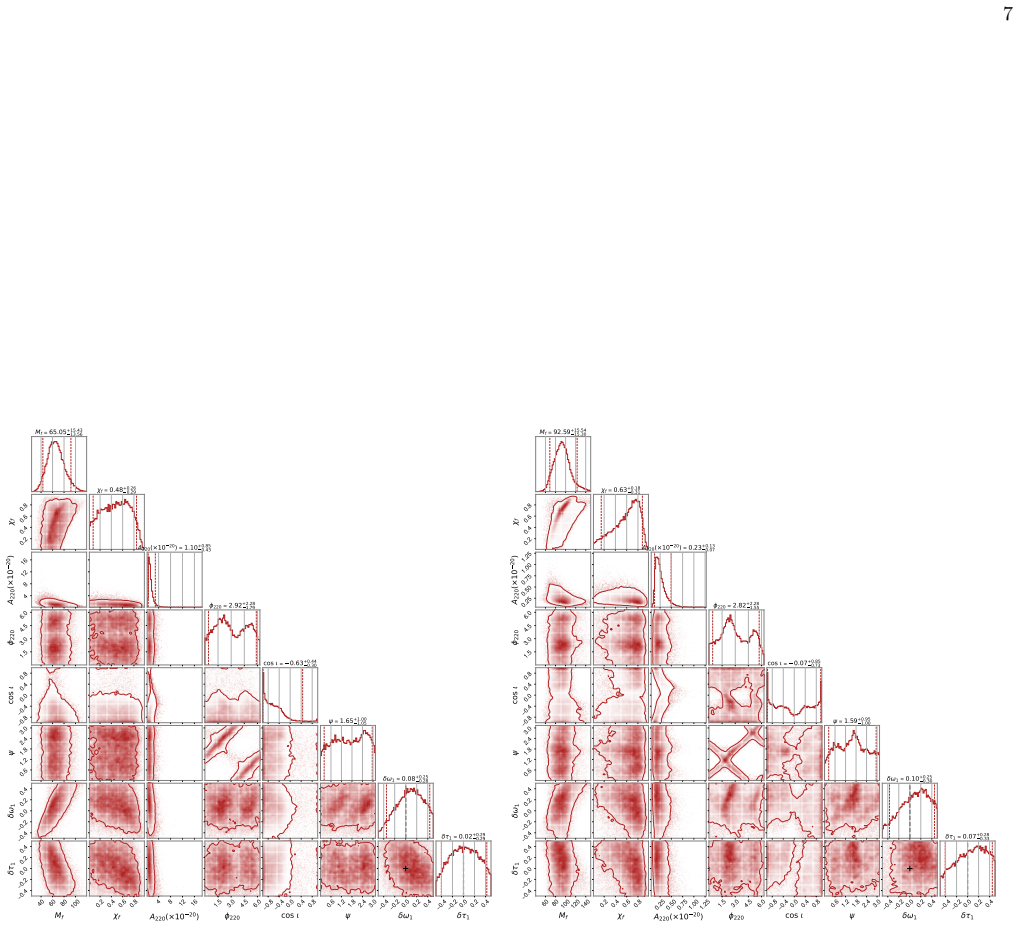
The central claim is that the ringdown of a Kerr black hole contains a built-in symmetry meter: for each mode labeled by angular and overtone numbers there is a twin whose frequency is opposite in sign and whose damping time is equal, and any departure of the fractional shifts in frequency and damping time from zero indicates a violation of Kerr's spacetime symmetries. Under the assumption that stationarity and axisymmetry still hold, this becomes a direct test of circularity. The paper applies this to GW150914 with two templates, one using only the fundamental mode and one adding the first overtone, and finds the null hypothesis of zero shift lies inside the 90 percent credible region in all cases. Bayes factors computed with a density-ratio estimator are 2.1 and 2.4, both in favor of the circular Kerr model.
Load-bearing premise
The test assumes a circularity violation would show up only as small fractional shifts in the twin mode's frequency and damping time, with the rest of the two-mode template, including amplitudes, phases, and mode content, left unchanged.
Editorial extensions
If this is right
- A future detection of nonzero frequency or damping-time shifts in any ringdown would be direct, theory-independent evidence that the remnant is not a Kerr black hole, without needing to specify a modified-gravity model.
- The GW150914 result provides a baseline: non-circular deviations are currently consistent with zero, so any theory predicting large symmetry violations is disfavored.
- Projected sensitivity of next-generation ground-based detectors shrinks the credible regions enough to distinguish Kerr from circularity-violating templates with deviations as small as about 0.04 in both shifts.
- Including the first overtone in the template allows the analysis to start at the merger and gives comparable constraints, so the test is not tied to the fundamental mode alone.
Reading between the lines
- A natural extension not developed in the paper is to stack many ringdown events; the mass-spin degeneracy visible in the single-event posteriors could be broken by combining events, sharpening the same test.
- Because the template only models small shifts in frequency and damping time, the quoted constraints do not cover a large violation that reshapes the ringdown entirely; computing the exact ringdown of a known non-circular solution would say how much of the parameter space the test actually covers.
- If circularity breaking also breaks equatorial reflection symmetry, the main analysis would partly miss it; the paper's Appendix B indicates the posteriors barely change when twin amplitudes and phases are freed, suggesting the test is fairly insensitive to that specific extension.
Signed reviews
Editorial analysis
A structured set of objections, weighed in public.
Referee Report
Summary. The paper proposes a test of Kerr spacetime symmetries, specifically circularity, using the ringdown of gravitational waves. Assuming that departures from circularity appear as small fractional shifts δω and δτ in the frequency and damping time of the negative-frequency twin QNM relative to its positive-frequency counterpart, the authors construct two phenomenological models (H1 with the 220 mode, H2 with the 220 and 221 modes) and perform Bayesian parameter estimation on the GW150914 ringdown data. They find that the deviation parameters are consistent with zero within the 90% credible regions, with Bayes factors B_Kerr/H1 = 2.1 and B_Kerr/H2 = 2.4 favoring the Kerr model. They also present injection studies for future detectors (O4 and Einstein Telescope) and a check of the equatorial Z2 symmetry assumption in Appendix B.
Significance. If the interpretation were as general as claimed, the paper would provide a conceptually clean way to probe black-hole spacetime symmetries from gravitational-wave ringdowns, complementing standard no-hair tests. The analysis uses standard, reproducible Bayesian tools (dynesty, pyRing) and public LIGO data, which is a strength. However, the result is model-dependent: the constraints apply only to the specific two-mode phenomenological deformation adopted in Eq. (3), and the posteriors are broad enough to be prior-dominated. The novelty lies more in the interpretation of twin-mode relations as symmetry tests than in the data analysis itself, which is a modest but reasonable contribution to the ringdown testing literature.
major comments (4)
- [Introduction and 'Models with non-circular deviations' (Eq. 3)] The paper's central interpretive claim—that consistency of {δω,δτ} with zero constrains departures from Kerr circularity—is limited by the small-deviation ansatz. As the authors themselves state in the Introduction, 'loss of circularity may cause more severe modifications and even a complete breakdown of the ringdown model in Eq. (1).' Within the parameterization of Eq. (3), a non-circular spacetime that changes amplitude ratios, induces mode mixing, or alters the angular eigenfunctions would not produce a nonzero δω or δτ in this template. The abstract and conclusions should therefore be rephrased to say that the analysis constrains this specific two-mode deformation, not general non-circular spacetimes, and the one-way logical statement ('any deviation from zero signifies a violation') should be accompanied by an explicit statement that the converse is not established.
- [Introduction, definition of δω, and Eq. (3)] There is a sign/notation inconsistency in the definition of δω. The text defines δω_ℓmn = (ω'_{ℓmn} − ω_{ℓmn})/ω_{ℓmn} and states that for Kerr spacetimes ω'_{ℓmn} = −ω_{ℓmn}, which would imply δω = −2. Yet Eq. (3) sets ω'_{220} = ω_{220}(1 + δω1), for which the Kerr limit, with the negative-frequency mode at e^{−iωt}, corresponds to δω1 = 0. The symbol ω' in Eq. (3) is evidently the magnitude of the frequency appearing in the exponential of the negative-frequency term, not the signed frequency used in Eq. (1). This must be clarified, because the reported posterior values and the location of the null hypothesis (δω = 0) depend entirely on the second convention.
- [Parameter Estimation with GW150914, Fig. 1] The reported 90% credible intervals for δω and δτ are comparable to the prior width: the priors are uniform in [−0.5, 0.5], and the posterior for δω1 in H1 is 0.08^{+0.25}_{−0.28}, so the half-width of the interval is only modestly smaller than the prior's 90% width of 0.45. The Bayes factors of 2.1 and 2.4 are, by Jeffreys' scale, only 'worth mentioning' and are not strong evidence. The abstract's phrase 'place significant constraints on such deviations' is therefore overstated, and I recommend reporting prior-scaled upper limits or explicitly stating that the data are prior-dominated for these parameters.
- [Appendix B (Fig. 6)] The check of the equatorial Z2 symmetry assumption does not validate the small-deviation mapping. While the posteriors of δω1 and δτ1 are similar with and without the Z2 amplitude/phase relation, the amplitude A'_{220} in the symmetry-broken model is essentially unconstrained (A'_{220} = 1.16^{+3.49}_{−0.54} × 10^{−20}). This means that the data cannot distinguish whether a violation of circularity would primarily affect amplitudes or phases rather than frequencies and damping times, so the conclusion that the test is robust to Z2 breaking should be tempered.
minor comments (4)
- [Throughout] There are several typographical errors, including 'degenaracies' (should be 'degeneracies'), 'constraint' used for 'constrain', and 'well-known fact' in the Introduction. A careful proofread is needed.
- [Parameter Estimation with GW150914] The analysis fixes the sky location to (α, δ) = (1.95, −1.27) and uses different ringdown start times for H1 and H2 (10 M_f after peak versus at the merger). These choices should be justified explicitly; in particular, the fixed sky location could bias the recovered parameters if the IMR-based values are not accurate for the ringdown-only analysis.
- [Fig. 1 caption and main text] The main text mentions only GW150914 in the parameter-estimation section, but Appendix B (Fig. 3) also presents results for GW190521_074359 without a corresponding discussion in the main text. The relationship between these analyses should be clarified.
- [Future Observations] The comparison of 'GW150914', 'O4', 'ET', and 'Zero Noise' in Fig. 2 mixes different injections: the GW150914 points are from real data, while the others are from injections with known parameters. The caption and text should state this difference explicitly to avoid implying that the real-event posterior can be directly compared with the injection-recovery posteriors on equal footing.
Circularity Check
No significant circularity: the Kerr null prediction is external and the deviation parameters are measured, not imposed; the small-deviation ansatz is an acknowledged limitation rather than a circular step.
full rationale
The derivation chain is not circular. The central prediction that δω = δτ = 0 for Kerr comes from the external QNM twin-mode relations ω' = −ω and τ' = τ, cited to Refs. [18,66–68], which are not the authors' own results. The deviation parameters δω1, δτ1 are free parameters in the H1/H2 models, estimated from GW150914 with uniform priors; the null hypothesis δ = 0 is found to lie within the 90% credible region, and the Bayes factors BKerr/H1 = 2.1 and BKerr/H2 = 2.4 are computed from the posterior via the Savage-Dickey density ratio. The conclusion is therefore a measurement outcome, not an input. The paper itself explicitly concedes that the template is "essentially an effective bottom-up prescription valid solely when the non-GR deviations are tiny" and that a genuine loss of circularity could cause "a complete breakdown of the ringdown model in Eq. (1)"; this is a stated limitation of scope, not a circular derivation. The self-citations are not load-bearing: Ref. [42] (co-authored by Mishra) provides the time-domain Bayesian analysis framework, a computational tool, and Ref. [57] (co-authored by Ghosh) is cited only as a pointer to the non-circular spacetime literature; neither supplies the Kerr symmetry prediction. There is a sign-convention inconsistency between Eq. (1), where ω' = −ω would imply δω = −2, and Eq. (3), where ω' = ω(1+δω1) with the minus sign made explicit; this is a presentational error rather than a tautology. The interpretive overreach in calling vanishing δ a "necessary and sufficient condition" for preserved Kerr isometries is an overclaim about the ansatz's completeness, not a circular step, since the null hypothesis is not constructed from the data being tested.
Assumptions & free parameters
free parameters (4)
- δω1 =
0.08^{+0.25}_{-0.28} (H1, 90% CI)
- δτ1 =
0.02^{+0.29}_{-0.29} (H1, 90% CI)
- δω2 =
0.02^{+0.25}_{-0.23} (H2, 90% CI)
- δτ2 =
0.01^{+0.30}_{-0.31} (H2, 90% CI)
assumptions (7)
- domain assumption The post-merger gravitational wave signal can be described as a linear superposition of quasinormal modes.
- standard math Kerr spacetime has twin-mode degeneracy: the m and -m modes have related frequencies and damping times.
- domain assumption Zero δω and δτ is a necessary and sufficient condition for preservation of Kerr isometries (circularity), independent of the specifics of new physics.
- ad hoc to paper Deviations from circularity are small enough that the two-mode model with shifted frequencies and damping times remains valid.
- domain assumption The perturbation has equatorial reflection symmetry, fixing the amplitude and phase of the twin mode.
- domain assumption The noise is a wide-sense stationary Gaussian process characterized by the estimated autocorrelation function.
- domain assumption Fixing the sky location to (α, δ) = (1.95, -1.27) does not bias the deviation parameter estimates.
Cite this review
Pith. "Pith review of Probing Spacetime Symmetries Using Gravitational Wave Ringdown." pith.science (2026). https://pith.science/paper/V74O4SHD
@misc{pith2026241208942,
  author       = {Pith},
  title        = {Pith review of: Probing Spacetime Symmetries Using Gravitational Wave Ringdown},
  year         = {2026},
  howpublished = {\url{https://pith.science/paper/V74O4SHD}},
  note         = {Machine review of arXiv:2412.08942}
}
read the original abstract
The uniqueness and rigidity theorems assert that the asymptotically flat, vacuum, stationary rotating black hole solution in general relativity must be the Kerr solution, exhibiting novel symmetries such as axisymmetry and circularity. In our analysis of post-merger ringdown signal from coalescing black hole binary systems, we identify potential observational signatures for deviations from these Kerr symmetries. Utilizing ringdown data from the gravitational wave event GW150914, we place significant constraints on such deviations. Our analysis introduces a new and novel approach for testing spacetime symmetries through gravitational wave observations.
Figures


Figures from the paper (3 more)


Forward citations
Cited by 2 Pith papers
-
Testing non-circular black hole spacetime with X-ray reflection
X-ray reflection data for EXO 1846–031 cannot distinguish the non-circular deformation parameter ℓ_NP from zero, remaining consistent with the Kerr hypothesis.
-
Black Hole Spectroscopy with Conditional Variational Autoencoder
A CVAE trained on simulated ringdown waveforms produces posterior estimates of remnant black hole parameters that match Bayesian inference, including overtones and a braneworld tidal charge parameter.
Reference graph
Works this paper leans on
-
[1]
B. P. Abbott et al. [LIGO Scientific and Virgo], Phys. Rev. Lett. 116, no.6, 061102 (2016)
2016
-
[2]
B. P. Abbott et al. [LIGO Scientific and Virgo], Phys. Rev. Lett. 116, no.24, 241102 (2016)
2016
-
[3]
Abbottet al
R. Abbottet al. [LIGO Scientific and Virgo], Phys. Rev. X 11, 021053 (2021)
2021
-
[4]
Abbottet al
R. Abbottet al. [KAGRA, VIRGO and LIGO Scientific], Phys. Rev. X13, no.4, 041039 (2023)
2023
-
[5]
Aasi et al
J. Aasi et al. [LIGO Scientific], Class. Quant. Grav.32, 074001 (2015)
2015
-
[6]
[VIRGO],Class.Quant.Grav
F.Acernese et al. [VIRGO],Class.Quant.Grav. 32, no.2, 024001 (2015)
2015
-
[7]
B. P. Abbott et al. [LIGO Scientific and Virgo], Phys. Rev. Lett. 116, no.22, 221101 (2016)
2016
-
[8]
Abbottet al
R. Abbottet al. [LIGO Scientific and Virgo], Phys. Rev. D 103, no.12, 122002 (2021)
2021
Show all 92 references
- [9]
-
[10]
Berti, E
E. Berti, E. Barausse, V. Cardoso, L. Gualtieri, P. Pani, U. Sperhake, L. C. Stein, N. Wex, K. Yagi and T. Baker, et al., Class. Quant. Grav.32, 243001 (2015)
2015
-
[11]
Berti, K
E. Berti, K. Yagi, H. Yang and N. Yunes, Gen. Rel. Grav. 50, no.5, 49 (2018)
2018
-
[12]
Regge and J
T. Regge and J. A. Wheeler, Phys. Rev.108, 1063-1069 (1957)
1957
-
[13]
C. V. Vishveshwara, Nature227, 936-938 (1970)
1970
-
[14]
F. J. Zerilli, Phys. Rev. Lett.24, 737-738 (1970)
1970
-
[15]
S. A. Teukolsky, Astrophys. J.185, 635-647 (1973)
1973
-
[16]
Dreyer, B
O. Dreyer, B. J. Kelly, B. Krishnan, L. S. Finn, D. Garri- son and R. Lopez-Aleman, Class. Quant. Grav.21, 787- 804 (2004)
2004
-
[17]
S. L. Detweiler, Astrophys. J. 239, 292 (1980)
1980
-
[18]
Berti, V
E. Berti, V. Cardoso and C. M. Will, Phys. Rev. D73, 064030 (2006)
2006
-
[19]
Gossan, J
S. Gossan, J. Veitch and B. S. Sathyaprakash, Phys. Rev. D 85, 124056 (2012)
2012
-
[20]
Cardoso and P
V. Cardoso and P. Pani, Living Rev. Rel.22, no.1, 4 (2019)
2019
-
[21]
Maggio, L
E. Maggio, L. Buoninfante, A. Mazumdar and P. Pani, Phys. Rev. D102, no.6, 064053 (2020)
2020
- [22]
-
[23]
Maggio, Lect
E. Maggio, Lect. Notes Phys.1017, 333-346 (2023)
2023
-
[24]
Carullo, W
G. Carullo, W. Del Pozzo and J. Veitch, Phys. Rev. D 99, no.12, 123029 (2019)
2019
- [25]
-
[26]
Cotesta, G
R. Cotesta, G. Carullo, E. Berti and V. Cardoso, Phys. Rev. Lett. 129, no.11, 111102 (2022)
2022
-
[27]
Siegel, M
H. Siegel, M. Isi and W. M. Farr, Phys. Rev. D108, no.6, 064008 (2023)
2023
-
[28]
Correia and C
A. Correia and C. D. Capano, Phys. Rev. D110, no.4, 044018 (2024)
2024
-
[29]
Meidam, M
J. Meidam, M. Agathos, C. Van Den Broeck, J. Veitch and B. S. Sathyaprakash, Phys. Rev. D90, no.6, 064009 (2014)
2014
-
[30]
Carullo, L
G. Carullo, L. Van Der Schaaf, L. London, P. T. H. Pang, K. W. Tsang, O. A. Hannuksela, J. Meidam, M. Agathos, A. Samajdar and A. Ghosh, et al. , Phys. Rev. D 98, no.10, 104020 (2018)
2018
-
[31]
M. Isi, M. Giesler, W. M. Farr, M. A. Scheel and S. A. Teukolsky, Phys. Rev. Lett. 123, no.11, 111102 (2019)
2019
-
[32]
Calderón Bustillo, P
J. Calderón Bustillo, P. D. Lasky and E. Thrane, Phys. Rev. D 103, no.2, 024041 (2021)
2021
-
[33]
Carullo, Phys
G. Carullo, Phys. Rev. D103, no.12, 124043 (2021)
2021
- [34]
-
[35]
Carullo, D
G. Carullo, D. Laghi, N. K. Johnson-McDaniel, W. Del Pozzo, O. J. C. Dias, M. Godazgar and J. E. Santos, Phys. Rev. D105, no.6, 062009 (2022)
2022
-
[36]
K. Dey, E. Barausse and S. Basak, Phys. Rev. D108, no.2, 2 (2023)
2023
-
[37]
H. O. Silva, A. Ghosh and A. Buonanno, Phys. Rev. D 107, no.4, 044030 (2023)
2023
- [38]
-
[39]
Pacilio and S
C. Pacilio and S. Bhagwat, Phys. Rev. D 107, no.8, 083021 (2023)
2023
- [40]
-
[41]
D’Addario, A
G. D’Addario, A. Padilla, P. M. Saffin, T. P. Sotiriou and A. Spiers, Phys. Rev. D109, no.8, 084046 (2024)
2024
-
[42]
A. K. Mishra, G. Carullo and S. Chakraborty, Phys. Rev. D 109, no.2, 024025 (2024)
2024
-
[43]
Baibhav, M
V. Baibhav, M. H. Y. Cheung, E. Berti, V. Cardoso, G. Carullo, R. Cotesta, W. Del Pozzo and F. Duque, Phys. Rev. D108, no.10, 104020 (2023)
2023
-
[44]
P. A. Cano, L. Capuano, N. Franchini, S. Maenaut and S. H. Völkel, arXiv:2407.15947 [gr-qc]
-
[45]
P. A. Cano, L. Capuano, N. Franchini, S. Maenaut and S. H. Völkel, arXiv:2409.04517 [gr-qc]
-
[46]
Pani, arXiv:2408.08956 [gr-qc]
F.Crescimbeni, X.J.Forteza, S.Bhagwat, J.Westerweck and P. Pani, arXiv:2408.08956 [gr-qc]
-
[47]
J. R. Gair, C. Li and I. Mandel, Phys. Rev. D77, 024035 (2008)
2008
-
[48]
Johannsen and D
T. Johannsen and D. Psaltis, Phys. Rev. D83, 124015 (2011)
2011
-
[49]
Johannsen, Phys
T. Johannsen, Phys. Rev. D88, no.4, 044002 (2013)
2013
-
[50]
Rezzolla and A
L. Rezzolla and A. Zhidenko, Phys. Rev. D 90, no.8, 084009 (2014)
2014
-
[51]
Konoplya, L
R. Konoplya, L. Rezzolla and A. Zhidenko, Phys. Rev. D 93, no.6, 064015 (2016)
2016
-
[52]
Destounis, A
K. Destounis, A. G. Suvorov and K. D. Kokkotas, Phys. Rev. Lett. 126, no.14, 141102 (2021)
2021
-
[53]
Destounis and K
K. Destounis and K. D. Kokkotas, Phys. Rev. D104, no.6, 064023 (2021)
2021
-
[54]
Fransen and D
K. Fransen and D. R. Mayerson, Phys. Rev. D106, no.6, 064035 (2022)
2022
-
[55]
C. Y. Chen, Phys. Rev. D106, no.4, 044009 (2022)
2022
-
[56]
C. Y. Chen, H. W. Chiang and A. Patel, Phys. Rev. D 108, no.6, 064016 (2023)
2023
- [57]
-
[58]
Israel, Phys
W. Israel, Phys. Rev.164, 1776 (1967)
1967
-
[59]
R. P. Geroch, J. Math. Phys.11, 2580 (1970)
1970
-
[60]
Carter, Phys
B. Carter, Phys. Rev. Lett.26, 331 (1971)
1971
-
[61]
J. D. Bekenstein, Phys. Rev. D5, 1239 (1972)
1972
-
[62]
J. D. Bekenstein, Phys. Rev. D5, 2403 (1972)
1972
-
[63]
R. O. Hansen, J. Math. Phys.15, 46 (1974)
1974
-
[64]
D. C. Robinson, Phys. Rev. D10, 458 (1974)
1974
-
[65]
D. C. Robinson, Phys. Rev. Lett.34, 905 (1975)
1975
-
[66]
Krivan, P
W. Krivan, P. Laguna, P. Papadopoulos and N. Anders- son, Phys. Rev. D56, 3395-3404 (1997)
1997
-
[67]
E. N. Dorband, E. Berti, P. Diener, E. Schnetter and M. Tiglio, Phys. Rev. D74, 084028 (2006)
2006
-
[68]
Giesler, S
M. Giesler, S. Ma, K. Mitman, N. Oshita, S. A. Teukol- sky, M. Boyle, N. Deppe, L. E. Kidder, J. Moxon and K. C. Nelli,et al., arXiv:2411.11269 [gr-qc]. 12
-
[69]
G. Faye, S. Marsat, L. Blanchet and B. R. Iyer, Class. Quant. Grav. 29, 175004 (2012)
2012
-
[70]
Blanchet, Living Rev
L. Blanchet, Living Rev. Rel.17, 2 (2014)
2014
-
[71]
C. D. Capano, M. Cabero, J. Westerweck, J. Abedi, S. Kastha, A. H. Nitz, Y. F. Wang, A. B. Nielsen and B. Krishnan, Phys. Rev. Lett.131, no.22, 22 (2023)
2023
-
[72]
H. Lim, G. Khanna, A. Apte and S. A. Hughes, Phys. Rev. D 100, no.8, 084032 (2019)
2019
-
[73]
X. Li, L. Sun, R. K. L. Lo, E. Payne and Y. Chen, Phys. Rev. D 105, no.2, 024016 (2022)
2022
-
[74]
Black hole physics: Basic concepts and new developments,
V. P. Frolov and I. D. Novikov, “Black hole physics: Basic concepts and new developments,” Fundamental Theories of Physics series (1998), Springer Netherlands
1998
-
[75]
Black Hole Uniqueness Theorems,
M. Heusler, “Black Hole Uniqueness Theorems,” Cam- bridge Lecture Notes in Physics, Cambridge University Press, 1996
1996
-
[76]
Y. Xie, J. Zhang, H. O. Silva, C. de Rham, H. Witek and N. Yunes, Phys. Rev. Lett.126, no.24, 241104 (2021)
2021
-
[77]
Anson, E
T. Anson, E. Babichev, C. Charmousis and M. Hassaine, JHEP 01, 018 (2021)
2021
-
[78]
Ben Achour, H
J. Ben Achour, H. Liu, H. Motohashi, S. Mukohyama and K. Noui, JCAP11, 001 (2020)
2020
-
[79]
Anson, E
T. Anson, E. Babichev and C. Charmousis, Phys. Rev. D 103, no.12, 124035 (2021)
2021
-
[80]
dynesty: a dynamic nested sampling pack- age for estimating Bayesian posteriors and evidences
J. Speagle, “dynesty: a dynamic nested sampling pack- age for estimating Bayesian posteriors and evidences.” Monthly Notices of the Royal Astronomical Society, 493(3), 3132–3158 (2020)
2020
-
[81]
Koposov, J
S. Koposov, J. Speagle, K. Barbary, G. Ashton, E. Ben- nett, J.Buchneret.al., dynesty: v2.1.3, doi: 10.5281/zen- odo.8408702 (2023)
2023 doi
-
[82]
Carullo, W
G. Carullo, W. Del Pozzo, and J. Veitch, pyRing: v2.3.0, doi: 10.5281/zenodo.8165508 (2023)
2023 doi
-
[83]
J. M. Dickey, Ann. Math. Statist. 42(1): 204-223 (1971)
1971
-
[84]
The Theory of Probability,
H. Jeffreys, “The Theory of Probability,” Oxford Classic Texts in the Physical Sciences, 1939
1939
-
[85]
M.Punturo, M.Abernathy, F.Acernese, B.Allen, N.An- dersson, K. Arun, F. Barone, B. Barr, M. Barsuglia and M. Beker, et al., Class. Quant. Grav.27, 194002 (2010)
2010
-
[86]
S. Hild, M. Abernathy, F. Acernese, P. Amaro-Seoane, N. Andersson, K. Arun, F. Barone, B. Barr, M. Barsug- lia and M. Beker,et al. Class. Quant. Grav.28, 094013 (2011)
2011
- [87]
-
[88]
LIGO Scientific Collaboration, LIGO Algorithm Library- LALSuite, free software (GPL), doi: 10.7935/GT1W- FZ16 (2018)
2018 doi
-
[89]
J. D. Hunter, Matplotlib: A 2d graphics environ- ment, Computing in Science & Engineering, doi: 10.1109/MCSE.2007.55 (2007)
2007 doi
-
[90]
C. R. Harris, K. J. Millman, S. J. van der Walt, R. Gom- mers, P.Virtanen, D.Cournapeauet.al., Arrayprogram- ming with NumPy, Nature 585, 357 (2020)
2020
-
[91]
Virtanen, R
P. Virtanen, R. Gommers, T. E. Oliphant, M. Haberland, T. Reddy, D. Cournapeau et. al. and SciPy 1.0 Contrib- utors, SciPy 1.0: Fundamental Algorithms for Scientific Computing in Python, Nature Methods 17, 261 (2020)
2020
-
[92]
Foreman-Mackey, corner.py: Scatterplot matrices in Python, The Journal of Open Source Software, doi: 10.21105/joss.00024 (2016)
D. Foreman-Mackey, corner.py: Scatterplot matrices in Python, The Journal of Open Source Software, doi: 10.21105/joss.00024 (2016)
2016 doi
Reviewed August 11, 2026 · model on record in the stance chip above.
Discussion (0). Continue with ORCID to comment.