REVIEW 3 major objections 4 minor 17 references
Glow reduction of ultra-low noise LmAPDs: towards photon counting infrared arrays
T0 review · 3 major / 4 minor · reviewed 2026-08-11 · deepseek-v4-flash
Pith's one-line read A redesigned infrared avalanche photodiode array cuts its self-generated glow sevenfold and detects individual photons at high gain.
desk verdict Solid glow and dark-current measurements on a redesigned LmAPD; the photon-counting claim is plausible but under-verified. read the letter →
The pith
A machine-rendered reading of the paper's core claim, the machinery that carries it, and where it could break.
The reading
What carries the argument
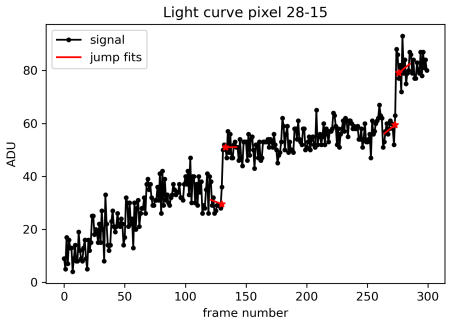
The device is a HgCdTe linear-mode avalanche photodiode array grown by MOVPE, in which photoelectrons created in a P-type absorber diffuse through a p-n junction and are multiplied in a high-field region before being collected by a readout integrated circuit (ROIC). The specific fix at the pixel level is an added metal layer that blocks the suspected glow path: light emitted by a source-follower JFET leaking through a gap in the metal architecture onto the photosensitive region. Measurements separate glow from dark current by comparing two datasets that read the array in a Fowler pattern, one clocked with drop frames and one left unclocked, so that glow appears only in the first. For the photon-counting demonstration, the load-bearing mechanism is the unusually low excess noise factor of HgCdTe avalanche multiplication, which lets a single photoelectron's amplified signal exceed the read noise; a changepoint algorithm then finds the jumps in each pixel's light curve and fits their amplitudes.
What would settle it
Expose the array to a calibrated, steadily attenuated light source and record light curves; if the jumps are photons, the detected jump rate must rise linearly with the input flux and the per-jump amplitude must remain constant. If the jump rate stays flat while flux changes, or if jump amplitudes scale with something other than the photoelectron signal, the photon interpretation fails.
Extended reading notes
Core claim
The central claim is that the glow produced by the readout integrated circuit when the array is clocked can be blocked at the pixel level, and that doing so exposes an essentially zero intrinsic dark current and enables single-photon detection. The paper measures a per-frame glow of $0.012 \pm 0.001$ e-/pixel/frame, a factor of about seven below the $0.08$ e-/pixel/frame reported for the previous chip, and a dark current of $0.07 \pm 0.03$ e-/pixel/kilosecond over a 20-hour test. At 12 V bias, where the effective read noise is below 1 e-/pixel/frame, the authors use a changepoint detection routine on up-the-ramp light curves to identify discrete jumps that they attribute to individual photoelectrons; roughly 80% of pixels visually show such photon-detection behavior, and the few jumps detected under a dark mask are smaller and about an order of magnitude rarer than expected for fully amplified glow. The implication, stated by the authors, is that glow photons may be only partially amplified and therefore distinguishable from signal photons.
Load-bearing premise
The paper's photon-counting claim rests on the assumption that the discrete jumps it detects in the light curves are single photoelectrons, not random telegraph noise, single-event upsets, or partially amplified glow photons.
Editorial extensions
If this is right
- If the measured glow and dark current hold at array scale, LmAPD arrays meet the dark-current and read-noise budget that has been identified for coronagraphic exoplanet imaging in the near-infrared.
- Because the glow is per-frame rather than per-second, high-frequency up-the-ramp readout suppresses its accumulated contribution, making fast sampling the natural operating mode for ultra-low-background observations.
- The observation that glow-induced jumps under the mask are rarer and smaller than signal jumps implies that residual glow may not fully enter the multiplication region, so it may contribute less effective noise than its raw count suggests.
- If single-photon jumps can be counted reliably, the same changepoint measurements provide a new way to measure gain, excess noise factor, glow, and dark current from the quiet portions and jump amplitudes of individual light curves.
Reading between the lines
- A direct test of the photon interpretation would be to measure the jump rate while varying a calibrated input flux: if the jumps are single photoelectrons, the rate should scale linearly with flux and the amplitude distribution should be independent of flux.
- The same light-curve jump analysis could be turned into a general-purpose detector characterization tool that extracts gain and excess noise factor per pixel, something the paper suggests but does not implement.
- If the partially amplified glow hypothesis is correct, glow suppression may be achievable by engineering the electric field profile so that parasitic photons are absorbed after the multiplication region, not just by blocking their emission.
Signed reviews
Editorial analysis
A structured set of objections, weighed in public.
Referee Report
Summary. The paper reports the characterization of a redesigned linear-mode avalanche photodiode (LmAPD) array with reduced readout integrated circuit (ROIC) glow. Using two matched Fowler-sampled datasets, one with drop frames and one without, the authors separate the ROIC glow from the intrinsic dark current and report a glow level of 0.012 e-/pixel/frame and an intrinsic dark current of 0.07 e-/pixel/kilosecond, about seven times lower than their previous chip. In a separate high-bias-voltage test at 12 V, the authors claim individual photon detection, identifying step-like jumps in light curves with a changepoint detection algorithm. They further argue, based on a qualitative comparison between masked and illuminated pixels, that glow photons are only partially amplified and can therefore be distinguished from signal photons.
Significance. If the photon-counting claim holds, this would be the first demonstration of single-photon detection in a mature, large-format near-infrared imaging array, with direct relevance to future space missions such as the Habitable World Observatory. The glow and dark-current measurements are well designed and credible: the matched datasets with and without drop frames cleanly separate the two contributions, and the 20-hour dark-current test is consistent with a null intrinsic dark current. The reported glow reduction from 0.08 to 0.012 e-/pixel/frame is itself a useful engineering milestone. However, the photon-counting evidence as presented is incomplete and requires additional calibration and statistical analysis before the central claim can be accepted.
major comments (3)
- [Section 4.1] The photon-counting claim rests on the identification of step-like jumps as individual photoelectrons, but the manuscript provides no calibrated photon flux, no detection efficiency estimate, no amplitude histogram, and no false-positive analysis for the changepoint algorithm. Without such verification, the jumps could be due to random telegraph noise, single-event upsets, or other non-photon artifacts. Please provide a quantitative validation, for example by varying the incident flux and showing that the jump rate scales linearly, or by demonstrating a resolved single-photon amplitude peak.
- [Section 4.2] The mask comparison used to argue that glow photons are only partially amplified is purely qualitative: the text reports 'very few jump detections' and 'smaller amplitudes' without giving the actual counts in masked versus illuminated pixels, the expected number of glow events based on the measured glow rate, or the statistical uncertainties. This is load-bearing for the photon-counting interpretation because it is the only evidence that glow events do not appear as full-amplitude jumps. Please report the jump rates and amplitude distributions in both regions and compare them with a quantitative prediction.
- [Table 1 and Section 4.1] The conversion gain reported in Table 1 (1.54 ± 0.01 e-/ADU) is measured at 4 V, but the photon-counting tests are performed at 12 V and no conversion gain for this operating condition is given. Without a high-bias conversion gain, the jump amplitudes cannot be expressed in electrons, and the claim that photoelectron signals are 'notably above the read noise level' cannot be checked quantitatively. Please provide the conversion gain at 12 V or otherwise specify how the jump amplitudes in electrons were obtained.
minor comments (4)
- [Abstract] Typographical error: 'essentally' should be 'essentially'.
- [Figure 5 caption] Typographical error: 'Righ' should be 'Right'.
- [Section 4.1] The phrase 'Detectors with this ability have been know for decades' contains a spelling error: 'know' should be 'known'.
- [Section 4.1] The sentence 'We believe this approach can be a new way to measure many parameters...' is speculative and does not directly support the central claim; consider moving it to the future-work section.
Circularity Check
No significant circularity: the paper's key results are independent calibrated measurements, and self-citations to prior work serve only as baseline comparisons.
full rationale
The paper is an experimental characterization report rather than a derivation. The central measurements, ROIC glow of 0.012 e-/pixel/frame and intrinsic dark current below 0.1 e-/pixel/kilosecond, are obtained from direct Fowler-sampled test sequences with the conversion gain measured independently via a photon transfer curve, and the dark-current test is explicitly separated from the glow test by running the array without clocking. The comparison with the prior chip's values from C22 is a baseline reference, not a fitted target or a load-bearing derivation, so the self-citations are not circular. The photon-counting interpretation in Section 4 relies on a changepoint detection routine and on the assumption that the observed jumps are photoelectrons, and the mask comparison in Section 4.2 is qualitative; however, an unverified interpretive assumption is a correctness or verification concern, not a circular reduction of the kind in which a claimed result is equivalent to its inputs by construction. No equation, calibration constant, or fitted parameter is reused as its own prediction. Therefore no specific circular step can be exhibited, and the appropriate finding is no significant circularity.
Assumptions & free parameters
free parameters (1)
- conversion gain =
1.54 ± 0.01 e-/ADU
assumptions (3)
- domain assumption The 'no drop frames' test isolates dark current from readout glow; clocking the array does not introduce any signal other than the per-frame glow.
- domain assumption The observed glow reduction is caused by the added metal layer blocking JFET leakage; no other chip-to-chip differences affect the comparison with C22.
- domain assumption The dark mask fully blocks light, so pixels under it receive zero illumination and any jumps there are due to glow rather than external photons.
Cite this review
Pith. "Pith review of Glow reduction of ultra-low noise LmAPDs: towards photon counting infrared arrays." pith.science (2026). https://pith.science/paper/C5Q5XOQM
@misc{pith2026241209735,
  author       = {Pith},
  title        = {Pith review of: Glow reduction of ultra-low noise LmAPDs: towards photon counting infrared arrays},
  year         = {2026},
  howpublished = {\url{https://pith.science/paper/C5Q5XOQM}},
  note         = {Machine review of arXiv:2412.09735}
}
read the original abstract
Spectroscopy and direct-imaging of ultra-faint targets such as Earth-like exoplanets and high redshift galaxies are among the primary goals of upcoming large scale astronomy projects like the Habitable World Observatory (HWO). Such objectives pose extreme instrumental challenges, in particular on detectors where dark currents lower than 1 e-/pixel/kilosecond and read noise less than 1 e-/pixel/frame will have to be achieved on large format arrays. Some technologies meet these requirements at optical wavelengths, but none do in the infrared. With this goal in mind, the University of Hawaii has partnered with Leonardo to develop linear-mode avalanche photodiodes (LmAPDs). In this paper, we report recent tests performed on LmAPDs, where we measure a ROIC glow of approximately 0.01 e-/pixel/frame, without which the intrinsic dark current is essentally zero (< 0.1 e- /pixel/kilosecond). We show that at high gain, these devices are capable of detecting single photons
Figures


Figures from the paper (6 more)


Reference graph
Works this paper leans on
-
[1]
Early release science of the exoplanet wasp-39b with jwst nirspec prism,
Rustamkulov, Z., Sing, D. K., Mukherjee, S., May, E. M., Kirk, J., Schlawin, E., Line, M. R., Piaulet, C., Carter, A. L., Batalha, N. E., Goyal, J. M., L´ opez-Morales, M., Lothringer, J. D., MacDonald, R. J., Moran, S. E., Stevenson, K. B., Wakeford, H. R., Espinoza, N., Bean, J. L., Batalha, N. M., Benneke, B., Berta-Thompson, Z. K., Crossfield, I. J. M...
work page 2023
-
[2]
Identification of carbon dioxide in an exoplanet atmosphere,
JWST Transiting Exoplanet Community Early Release Science Team, Ahrer, E.-M., Alderson, L., Batalha, N. M., Batalha, N. E., Bean, J. L., Beatty, T. G., Bell, T. J., Benneke, B., Berta-Thompson, Z. K., Carter, A. L., Crossfield, I. J. M., Espinoza, N., Feinstein, A. D., Fortney, J. J., Gibson, N. P., Goyal, J. M., Kempton, E. M. R., Kirk, J., Kreidberg, L....
work page 2023
-
[3]
and Medicine, [ Pathways to Discovery in Astronomy and Astrophysics for the 2020s] (2021)
National Academies of Sciences, E. and Medicine, [ Pathways to Discovery in Astronomy and Astrophysics for the 2020s] (2021)
work page 2021
-
[4]
Harding, L. K., Demers, R. T., Hoenk, M., Peddada, P., Nemati, B., Cherng, M., Michaels, D., Neat, L. S., Loc, A., Bush, N., Hall, D., Murray, N., Gow, J., Burgon, R., Holland, A., Reinheimer, A., Jorden, P. R., and Jordan, D., “Technology advancement of the CCD201-20 EMCCD for the WFIRST coronagraph in- strument: sensor characterization and radiation dam...
work page 2016
-
[5]
Zero dark current in H2RG detectors: it is all multiplexer glow,
Regan, M. W. and Bergeron, L. E., “Zero dark current in H2RG detectors: it is all multiplexer glow,” Journal of Astronomical Telescopes, Instruments, and Systems6, 016001 (Jan. 2020)
work page 2020
-
[6]
Finger, G., Dorn, R. J., Eschbaumer, S., Hall, D. N. B., Mehrgan, L., Meyer, M., and Stegmeier, J., “Performance evaluation, readout modes, and calibration techniques of HgCdTe Hawaii-2RG mosaic arrays,” in [High Energy, Optical, and Infrared Detectors for Astronomy III], Dorn, D. A. and Holland, A. D., eds., 7021, 70210P, International Society for Optics...
work page 2008
-
[7]
Next-generation performance of SAPHIRA HgCdTe APDs,
Atkinson, D. E., Hall, D. N. B., Baker, I. M., Goebel, S. B., Jacobson, S. M., Lockhart, C., and Warmbier, E. A., “Next-generation performance of SAPHIRA HgCdTe APDs,” in [ High Energy, Optical, and Infrared Detectors for Astronomy VII], Holland, A. D. and Beletic, J., eds., Society of Photo-Optical Instrumentation Engineers (SPIE) Conference Series9915, ...
work page 2016
-
[8]
Overview of the SAPHIRA detector for adaptive optics applications,
Goebel, S. B., Hall, D. N. B., Guyon, O., Warmbier, E., and Jacobson, S. M., “Overview of the SAPHIRA detector for adaptive optics applications,” Journal of Astronomical Telescopes, Instruments, and Systems4, 026001 (Apr. 2018)
work page 2018
Show all 17 references
-
[9]
Infrared engineering for the advancement of science: A UK perspective,
Baker, I. M., “Infrared engineering for the advancement of science: A UK perspective,” in [ Society of Photo- Optical Instrumentation Engineers (SPIE) Conference Series], Andresen, B. F., Fulop, G. F., Hanson, C. M., Miller, J. L., and Norton, P. R., eds.,Society of Photo-Opti...
2017
-
[10]
First tests of a 1 megapixel near-infrared avalanche photodiode array for ultra-low background space astronomy,
Claveau, C.-A., Bottom, M., Jacobson, S., Hodapp, K., Walk, A., Loose, M., Baker, I., Zemaityte, E., Hicks, M., Barnes, K., Powell, R., Bradley, R., and Moore, E., “First tests of a 1 megapixel near-infrared avalanche photodiode array for ultra-low background space astronomy,”...
2022
-
[11]
Linear-mode avalanche photodiode arrays in HgCdTe at Leonardo UK,
Zemaityte, E., Owton, D., Maxey, C., Gordon, J., Isgar, V., Hipwood, L., Hicks, M., Barnes, K., Thorne, P., and Baker, I., “Linear-mode avalanche photodiode arrays in HgCdTe at Leonardo UK,” in [ Optical and Infrared Interferometry and Imaging VIII], M´ erand, A., Sallum, S., ...
2022
-
[12]
HgCdTe avalanche photodiodes: A review,
Singh, A., Srivastav, V., and Pal, R., “HgCdTe avalanche photodiodes: A review,” Optics Laser Technol- ogy 43, 1358–1370 (Oct. 2011)
2011
-
[13]
SIDECAR low-power control ASIC for focal plane arrays including A/D conversion and bias generation,
Loose, M., Lewyn, L., Durmus, H., Garnett, J. D., Hall, D. N. B., Joshi, A. B., Kozlowski, L. J., and Ovsiannikov, I., “SIDECAR low-power control ASIC for focal plane arrays including A/D conversion and bias generation,” in [Instrument Design and Performance for Optical/Infrar...
2003
-
[14]
ROIC glow reduction in very low flux short wave infra-red focal plane arrays for astronomy,
Le Goff, T., Baier, N., Gravrand, O., Nicolas, J. A., Pichon, T., and Boulade, O., “ROIC glow reduction in very low flux short wave infra-red focal plane arrays for astronomy,” in [ X-Ray, Optical, and Infrared Detectors for Astronomy IX], Holland, A. D. and Beletic, J., eds.,...
2020
-
[15]
Bayesian photon counting with electron-multiplying charge coupled devices (EMCCDs),
Harpsøe, K. B. W., Andersen, M. I., and Kjægaard, P., “Bayesian photon counting with electron-multiplying charge coupled devices (EMCCDs),” Astronomy and Astrophysics537, A50 (Jan. 2012)
2012
-
[16]
Imaging with a small number of photons,
Morris, P. A., Aspden, R. S., Bell, J. E. C., Boyd, R. W., and Padgett, M. J., “Imaging with a small number of photons,” Nature Communications6, 5913 (Jan. 2015)
2015
-
[17]
Single-photon avalanche diode imagers in biophotonics: review and outlook,
Bruschini, C., Homulle, H., Antolovic, I. M., Burri, S., and Charbon, E., “Single-photon avalanche diode imagers in biophotonics: review and outlook,” Light: Science & Applications8, 87 (Sept. 2019)
2019
Reviewed August 11, 2026 · model on record in the stance chip above.
Discussion (0). Continue with ORCID to comment.