REVIEW 3 major objections 5 minor 1 cited by
On the Ability of Deep Networks to Learn Symmetries from Data: A Neural Kernel Theory
T0 review · 3 major / 5 minor · reviewed 2026-08-11 · deepseek-v4-flash
Pith's one-line read Deep networks trained from data alone cannot learn symmetries their architecture lacks, a neural kernel theory shows.
desk verdict A genuinely useful spectral error formula for kernel regression on cyclic datasets, with a real but addressable gap between the exact circulant theory and the rotated-MNIST validation. read the letter →
The pith
A machine-rendered reading of the paper's core claim, the machinery that carries it, and where it could break.
The reading
What carries the argument
The central object is the spectral error $\epsilon_s = \lambda_N^{-1}/\langle\lambda^{-1}\rangle$ of Proposition 4, derived for a circulant Gram matrix over an interleaved two-class cyclic-orbit dataset. Because a circulant matrix is diagonalized by the discrete Fourier transform, the difficulty of kernel regression on a missing orbit point reduces to a ratio of inverse frequency powers: the contribution of the class-alternating highest frequency against all frequencies. The paper uses this identity as a lens across RBF kernels, dot-product MLP kernels, and convolutional kernels, and extends it in Theorem 15 to arbitrary finite groups via non-commutative Fourier analysis.
What would settle it
Run exact NTK regression on rotated-MNIST orbit pairs without circularizing the Gram matrix and compare the prediction error to Eq. 1 per orbit pair; if the discrepancy grows with the degree to which the two orbits fail to be interleaved, for example when seeds lie near the rotation stabilizer, then the circularity approximation is load-bearing.
Extended reading notes
Core claim
On a dataset of two interleaved cyclic-group orbits with alternating labels, kernel regression on a held-out orbit point has error $\epsilon_s = \lambda_N^{-1}/\langle\lambda^{-1}\rangle$, where $\lambda_N$ is the eigenvalue of the highest Fourier frequency of the circulant Gram matrix and $\langle\lambda^{-1}\rangle$ is the average inverse eigenvalue over all frequencies. The paper shows this formula accounts for the generalization of MLPs, CNNs, and a ViT, both in the infinite-width NTK limit and for finite-width trained networks on rotated-MNIST, and that it recovers exact invariance only when the architecture is fully equivariant to the data symmetry, such as a translation-invariant global-average-pooling CNN on translated images. The central conclusion is that conventional deep networks lack a mechanism to learn symmetries that are not already built into their kernel or architecture, and that apparent symmetry learning is actually successful local interpolation in kernel space.
Load-bearing premise
The exact spectral error formula requires the Gram matrix to be circulant over perfectly interleaved orbits; for real MNIST orbit pairs the paper obtains this by diagonal-wise averaging, an approximation the authors state is not justified a priori, so the rotated-MNIST agreement depends on that post-hoc symmetrization being faithful.
Editorial extensions
If this is right
- Increasing the number of sampled angles in a class orbit monotonically lowers the predicted error, so denser symmetry sampling produces gradual improvement without a phase transition or grokking.
- Increasing class separation in kernel space increases the highest-frequency eigenvalue and lowers the error; separable classes need less orbit density to generalize.
- Equivariant architectures only guarantee perfect generalization when their built-in invariance matches the data symmetry; a global-average-pooling CNN gives zero spectral error on translations but not on rotations.
- The same spectral error formula applies to any finite group, with representation-theoretic Fourier coefficients replacing scalar DFT coefficients, so the conclusion is not an artifact of cyclic rotations.
Reading between the lines
- Editorial inference: a testable extension is to measure the spectral error directly on non-circularized data, because if real image orbits violate the interleaving assumption, the theory's quantitative predictions should degrade in a measurable way.
- Editorial inference: augmentation and self-supervised invariance losses effectively raise orbit density or class separation in kernel space, so comparing the spectral ratios they induce could predict which pretraining strategy will transfer a given symmetry.
- Editorial inference: since the frozen-kernel premise is essential to the argument, genuine symmetry learning should be sought in feature-learning regimes where the kernel changes during training; the paper's conclusion does not rule out such regimes, but leaves them unexplored.
Signed reviews
Editorial analysis
A structured set of objections, weighed in public.
Referee Report
Summary. The paper studies supervised classification on datasets with cyclic-group symmetry where some classes are fully observed over a group orbit while others are only partially observed. In the infinite-width NTK limit, the authors treat training as kernel regression and derive the spectral error formula ε_s = λ_N^{-1}/⟨λ^{-1}⟩ (Eq. 1) for a two-class interleaved dataset with a circulant Gram matrix, interpreting the numerator and denominator as class separation and orbit density in kernel space. They extend the formula to general finite groups (Theorem 15), apply it to rotated-MNIST via a diagonal-wise circularization approximation, extend it to multi-seed and multi-class settings through pairwise averaging and a one-vs-many heuristic, and analyze equivariant CNN architectures. The empirical comparisons across MLP, CNN, and ViT lead to the conclusion that conventional deep networks lack a mechanism to learn symmetries that are not embedded in their architecture a priori.
Significance. The exact part of the paper is elegant and reproducible: Eq. 1 is derived rather than fitted, the RBF circular-dataset experiments in Sec. 4.3 verify it exactly, and the non-abelian extension in App. C broadens the reach of the theory. The broad qualitative match between the spectral theory and finite-width network behavior on rotated-MNIST, together with the released code, makes this a useful contribution to the neural-kernel literature. However, the rotated-MNIST and multi-class validations, which carry the headline negative conclusion, rest on approximations that are acknowledged but not quantified. If those approximations are shown to be faithful, the paper provides an interpretable criterion for symmetry generalization; without such a check, the central claim for real data remains a plausible conjecture rather than a demonstrated consequence of the exact theory.
major comments (3)
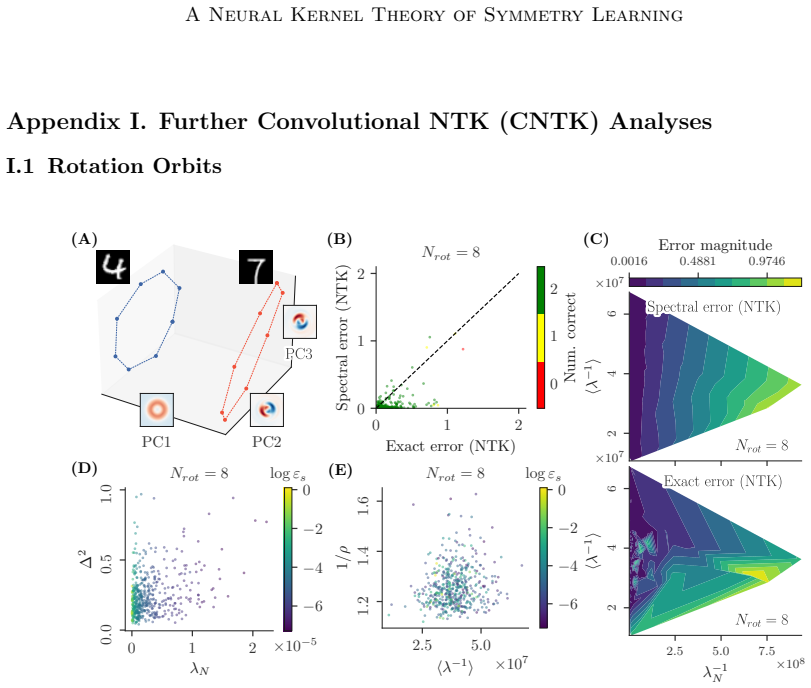
- [Sec. 4.4, 'Approximation: Circularity'] The application of Eq. 1 to rotated-MNIST replaces the true non-circulant Gram matrix K_NTK with the diagonal-wise averaged matrix \tilde{K}_NTK, a procedure the authors state 'is not justified a priori'. Because Prop. 4 and App. B prove Eq. 1 only for circulant Gram matrices on exactly interleaved orbits, the agreement in Figs. 4B and 5A-C is a correlation between the spectral error of a modified regression problem and the exact error of the original problem, not a test of Eq. 1 on the actual Gram matrix. This is load-bearing, since the same approximation enters the multi-seed and multi-class validation (Fig. 6) and therefore the paper's headline conclusion about rotated-MNIST. Please quantify the approximation error (e.g., the relative Frobenius norm ||K - \tilde{K}|| / ||K|| and the L2 difference between the leave-one-out predictors under K and \tilde{K}) and either prove a bound for dot-product kernels on non-interleaved orbits or provide a controlled dataset where the circulant assumption is satisfied exactly. The GAP-CNN discussion in Sec. 4.6.3, where the authors say the circularization 'may reshape its structure too drastically', makes clear that the approximation's fidelity is architecture-dependent and cannot be assumed from the MLP agreement alone.
- [Sec. 4.5] The multi-seed extension replaces the exact two-orbit problem with an arithmetic average of spectral errors over all cross-class orbit pairs, introduced as a 'simplifying assumption'; the text immediately notes that the resulting error 'does not capture well the magnitude of the exact error anymore'. No derivation or error bound is given for this linear averaging, and the subsequent multi-class extension relies on a one-vs-many heuristic. These steps are needed to connect the exact theorem to the realistic rotated-MNIST experiments in Fig. 6, so the conclusion that finite-width networks display no symmetry-learning mechanism on this dataset is not a direct corollary of Eq. 1. Please either derive the averaging approximation, or demonstrate its validity by comparing the average of pairwise exact NTK errors to the exact multi-orbit NTK error on the same datasets, ideally for more than two classes.
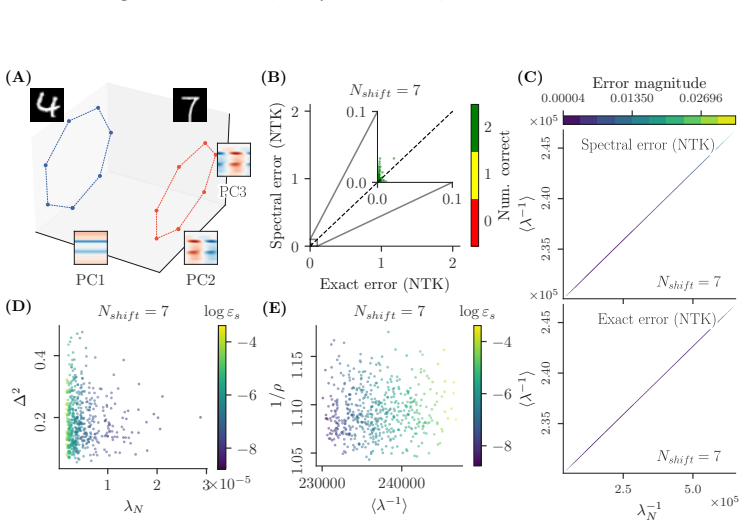
- [Sec. 4.6 and App. E] Propositions 11-14, which state that FC-CNN and GAP-CNN kernels are circulant or constant over translation and rotation orbits, are proved for the NNGP kernel, while the main-text experiments and spectral-error computations use the NTK; the authors write that 'essentially the same proofs should hold for the NTK' but do not provide them. Since Eq. 1 applies only to the exact Gram matrix, the empirical CNTK comparisons in Sec. 4.6.3 and App. I are only justified if the NTK Gram matrix inherits the circulant structure. Please supply the NTK versions of these proofs, or state explicitly which of the CNTK figures would be affected if the NTK matrix deviates from circulancy.
minor comments (5)
- [Sec. 4.4, p. 15] The phrase 'anex-post circularization procedure' should read 'an ex-post circularization procedure'.
- [Sec. 4.6.3] The references to 'Prop. 3', 'Prop. 4', 'Prop. 1', and 'Prop. 2' should point to Props. 11-14.
- [Fig. 5E and Sec. 4.6.3] The caption says 'the assumptions of the theory are too crude to capture empirical phenomenology', while the main text describes the agreement as 'worse, although still reasonable'; these two characterizations should be reconciled.
- [App. B, Eq. (6)] The label formula µ_i = µ ω^{iN} + (µ0 − µ)δ_i0 implicitly assumes the missing point is at index 0; this is stated nearby but could be made more prominent for readers applying the formula to other missing points.
- [Sec. 4.4, 'Adjustment: Symmetrization'] The symmetrized NTK error averages over removing a point from either orbit, but the individual class-specific errors are not reported; reporting them would help assess whether the symmetrization hides a systematic asymmetry between the two orbits.
Circularity Check
No significant circularity: the spectral error formula is independently derived, and the Section 4.4 circulantization is an explicitly acknowledged approximation, not a fitted input or self-referential construction.
full rationale
The paper's central result, the spectral error formula in Eq. (1), is derived in Proposition 4 and Appendix B from Gaussian/kernel regression conditioning on a circulant Gram matrix. No free parameter is fitted to the empirical target, and the derivation is self-contained given the stated circulant and interleaved-label assumptions. The rotated-MNIST application in Section 4.4 is the only place where a circularity concern could arise: the true NTK Gram matrix over two MNIST orbits is not circulant, and the authors construct a circulant Ktilde by diagonal-wise averaging, explicitly writing that this circularization 'is not justified a priori.' This is an acknowledged approximation rather than a circular reduction, because the spectral error is not defined to be the exact NTK error; it is computed from Ktilde while the comparison target is the exact error from the true K, and the agreement is checked empirically across many random orbit pairs. Notably, the authors also report a failure case for the GAP-CNN, showing that the approximation is not trivially forced. The paper's headline conclusion that conventional networks lack a mechanism to learn unembedded symmetries is a consequence of the infinite-width NTK model assumption of a frozen, architecture-determined kernel, and the authors explicitly list limits outside the NTK regime; it is not obtained by defining the conclusion into the premises. Self-citations to prior work by the same group (e.g., Abbas and Deny 2023; Ollikka et al. 2025) appear only as supporting empirical background and are not load-bearing for the derivation, which rests on external kernel-theory results such as Jacot et al. and Neal. Thus there is no circularity warranting a nonzero score.
Assumptions & free parameters
assumptions (4)
- domain assumption Kernel regression in the infinite-width limit captures the behavior of trained finite-width networks.
- ad hoc to paper The Gram matrix of the neural kernel over a two-orbit MNIST dataset is approximately circulant after diagonal-wise averaging.
- ad hoc to paper Multi-seed and multi-class errors are well approximated by averaging pairwise orbit spectral errors.
- standard math DFT diagonalizes circulant matrices and Schur orthogonality block-diagonalizes group-circulant kernels.
Cite this review
Pith. "Pith review of On the Ability of Deep Networks to Learn Symmetries from Data: A Neural Kernel Theory." pith.science (2026). https://pith.science/paper/XDZFECGU
@misc{pith2026241211521,
  author       = {Pith},
  title        = {Pith review of: On the Ability of Deep Networks to Learn Symmetries from Data: A Neural Kernel Theory},
  year         = {2026},
  howpublished = {\url{https://pith.science/paper/XDZFECGU}},
  note         = {Machine review of arXiv:2412.11521}
}
read the original abstract
Symmetries (transformations by group actions) are present in many datasets, and leveraging them holds considerable promise for improving predictions in machine learning. In this work, we aim to understand when and how deep networks -- with standard architectures trained in a standard, supervised way -- learn symmetries from data. Inspired by real-world scenarios, we study a classification paradigm where data symmetries are only partially observed during training: some classes include all transformations of a cyclic group, while others -- only a subset. In the infinite-width limit, where kernel analogies apply, we derive a neural kernel theory of symmetry learning. The group-cyclic nature of the dataset allows us to analyze the Gram matrix of neural kernels in the Fourier domain; here we find a simple characterization of the generalization error as a function of class separation (signal) and class-orbit density (noise). This characterization reveals that generalization can only be successful when the local structure of the data prevails over its non-local, symmetry-induced structure, in the kernel space defined by the architecture. We extend our theoretical treatment to any finite group, including non-abelian groups. Our framework also applies to equivariant architectures (e.g., CNNs), and recovers their success in the special case where the architecture matches the inherent symmetry of the data. Empirically, our theory reproduces the generalization failure of finite-width networks (MLP, CNN, ViT) trained on partially observed versions of rotated-MNIST. We conclude that conventional deep networks lack a mechanism to learn symmetries that have not been explicitly embedded in their architecture a priori. Our framework could be extended to guide the design of architectures and training procedures able to learn symmetries from data.
Figures


Figures from the paper (15 more)




Forward citations
Cited by 1 Pith paper
-
Zero-Shot Visual Generalization in Robot Manipulation
Disentangled latent representations with associative memory, paired with diffusion policies, provide zero-shot visual generalization on manipulation tasks, and a learned canonicalization step adds robustness to planar...
Reference graph
Works this paper leans on
-
[1]
Progress and limitations of deep networks to recognize objects in unusual poses
Amro Abbas and St\' e phane Deny. Progress and limitations of deep networks to recognize objects in unusual poses. In Conference on Artificial Intelligence (AAAI), 2023
2023
-
[2]
Git Re-Basin : Merging models modulo permutation symmetries
Samuel Ainsworth, Jonathan Hayase, and Siddhartha Srinivasa. Git Re-Basin : Merging models modulo permutation symmetries. In International Conference on Learning Representations (ICLR), 2023
2023
-
[3]
Strike (with) a pose: Neural networks are easily fooled by strange poses of familiar objects
Michael A Alcorn, Qi Li, Zhitao Gong, Chengfei Wang, Long Mai, Wei-Shinn Ku, and Anh Nguyen. Strike (with) a pose: Neural networks are easily fooled by strange poses of familiar objects. In Conference on Computer Vision and Pattern Recognition (CVPR), 2019
2019
-
[4]
Symmetry-adapted representation learning
Fabio Anselmi, Georgios Evangelopoulos, Lorenzo Rosasco, and Tomaso Poggio. Symmetry-adapted representation learning. Pattern Recognition, 2019
2019
-
[5]
Data symmetries and learning in fully connected neural networks
Fabio Anselmi, Luca Manzoni, Alberto d’Onofrio, Alex Rodriguez, Giulio Caravagna, Luca Bortolussi, and Francesca Cairoli. Data symmetries and learning in fully connected neural networks. IEEE Access, 2023
2023
-
[6]
On exact computation with an infinitely wide neural net
Sanjeev Arora, Simon S Du, Wei Hu, Zhiyuan Li, Russ R Salakhutdinov, and Ruosong Wang. On exact computation with an infinitely wide neural net. In Advances in Neural Information Processing Systems (NeurIPS), 2019
2019
-
[7]
Unified theoretical framework for wide neural network learning dynamics
Yehonatan Avidan, Qianyi Li, and Haim Sompolinsky. Unified theoretical framework for wide neural network learning dynamics. Physical Review E, 2025
2025
-
[8]
Why do deep convolutional networks generalize so poorly to small image transformations? Journal of Machine Learning Research (JMLR), 2019
Aharon Azulay and Yair Weiss. Why do deep convolutional networks generalize so poorly to small image transformations? Journal of Machine Learning Research (JMLR), 2019
2019
Show all 126 references
-
[9]
Breaking the curse of dimensionality with convex neural networks
Francis Bach. Breaking the curse of dimensionality with convex neural networks. Journal of Machine Learning Research (JMLR), 2017
2017
-
[10]
Explaining neural scaling laws
Yasaman Bahri, Ethan Dyer, Jared Kaplan, Jaehoon Lee, and Utkarsh Sharma. Explaining neural scaling laws. Proceedings of the National Academy of Sciences (PNAS), 2024
2024
-
[11]
A cookbook of self-supervised learning
Randall Balestriero, Mark Ibrahim, Vlad Sobal, Ari Morcos, Shashank Shekhar, Tom Goldstein, Florian Bordes, Adrien Bardes, Gregoire Mialon, Yuandong Tian, Avi Schwarzschild, Andrew Gordon Wilson, Jonas Geiping, Quentin Garrido, Pierre Fernandez, Amir Bar, Hamed Pirsiavash, Yan...
2023
-
[12]
Developmental changes in children’s object insertions during play
Valerie Bambha, Aaron Beckner, Nikita Shetty, Annika Voss, Jinlin Xie, Eunice Yiu, Vanessa LoBue, Lisa Oakes, and Marianella Casasola. Developmental changes in children’s object insertions during play. Journal of Cognition and Development, 2022
2022
-
[13]
B-spline CNNs on Lie groups
Erik J Bekkers. B-spline CNNs on Lie groups. arXiv preprint, 2021
2021
-
[14]
Learning invariances in neural networks from training data
Gregory Benton, Marc Finzi, Pavel Izmailov, and Andrew G Wilson. Learning invariances in neural networks from training data. In Advances in Neural Information Processing Systems (NeurIPS), 2020
2020
-
[15]
Self-consistent dynamical field theory of kernel evolution in wide neural networks
Blake Bordelon and Cengiz Pehlevan. Self-consistent dynamical field theory of kernel evolution in wide neural networks. In Advances in Neural Information Processing Systems (NeurIPS), 2022
2022
-
[16]
Spectrum dependent learning curves in kernel regression and wide neural networks
Blake Bordelon, Abdulkadir Canatar, and Cengiz Pehlevan. Spectrum dependent learning curves in kernel regression and wide neural networks. In International Conference on Machine Learning (ICML), 2020
2020
-
[17]
Addressing the topological defects of disentanglement via distributed operators
Diane Bouchacourt, Mark Ibrahim, and Stéphane Deny. Addressing the topological defects of disentanglement via distributed operators. arXiv preprint, 2021
2021
-
[18]
Does equivariance matter at scale? arXiv preprint, 2024
Johann Brehmer, Sönke Behrends, Pim de Haan, and Taco Cohen. Does equivariance matter at scale? arXiv preprint, 2024
2024
-
[19]
Bronstein, Joan Bruna, Taco Cohen, and Petar Veličković
Michael M. Bronstein, Joan Bruna, Taco Cohen, and Petar Veličković. Geometric deep learning: Grids , groups, graphs, geodesics, and gauges. arXiv preprint, 2021
2021
-
[20]
Spectral bias and task-model alignment explain generalization in kernel regression and infinitely wide neural networks
Abdulkadir Canatar, Blake Bordelon, and Cengiz Pehlevan. Spectral bias and task-model alignment explain generalization in kernel regression and infinitely wide neural networks. Nature Communications, 2021
2021
-
[21]
Vinod Kumar Chauhan, Jiandong Zhou, Ping Lu, Soheila Molaei, and David A. Clifton. A brief review of hypernetworks in deep learning. Artificial Intelligence Review, 2024
2024
-
[22]
Deep reasoning networks for unsupervised pattern de-mixing with constraint reasoning
Di Chen, Yiwei Bai, Wenting Zhao, Sebastian Ament, John Gregoire, and Carla Gomes. Deep reasoning networks for unsupervised pattern de-mixing with constraint reasoning. In International Conference on Machine Learning (ICML), 2020
2020
-
[23]
Chirikjian and Alexander B
Gregory S. Chirikjian and Alexander B. Kyatkin. Engineering Applications of Noncommutative Harmonic Analysis. CRC Press, 2021
2021
-
[24]
On the global convergence of gradient descent for over-parameterized models using optimal transport
L\' e na\" c Chizat and Francis Bach. On the global convergence of gradient descent for over-parameterized models using optimal transport. In Advances in Neural Information Processing Systems (NeurIPS), 2018
2018
-
[25]
Lee, and Haim Sompolinsky
SueYeon Chung, Daniel D. Lee, and Haim Sompolinsky. Classification and geometry of general perceptual manifolds. Physical Review X, 2018
2018
-
[26]
Group equivariant convolutional networks
Taco Cohen and Max Welling. Group equivariant convolutional networks. In International Conference on Machine Learning (ICML), 2016
2016
-
[27]
Gauge equivariant convolutional networks and the icosahedral CNN
Taco Cohen, Maurice Weiler, Berkay Kicanaoglu, and Max Welling. Gauge equivariant convolutional networks and the icosahedral CNN . In International Conference on Machine Learning (ICML), 2019 a
2019
-
[28]
A general theory of equivariant CNNs on homogeneous spaces
Taco S Cohen, Mario Geiger, and Maurice Weiler. A general theory of equivariant CNNs on homogeneous spaces. In Advances in Neural Information Processing Systems (NeurIPS), 2019 b
2019
-
[29]
Lee, and Haim Sompolinsky
Uri Cohen, SueYeon Chung, Daniel D. Lee, and Haim Sompolinsky. Separability and geometry of object manifolds in deep neural networks. Nature Communications, 2020
2020
-
[30]
Representing closed transformation paths in encoded network latent space
Marissa Connor and Christopher Rozell. Representing closed transformation paths in encoded network latent space. Conference on Artificial Intelligence (AAAI), 2020
2020
-
[31]
Learning internal representations of 3D transformations from 2D projected inputs
Marissa Connor, Bruno Olshausen, and Christopher Rozell. Learning internal representations of 3D transformations from 2D projected inputs. Neural Computation, 2024
2024
-
[32]
Lagrangian neural networks
Miles Cranmer, Sam Greydanus, Stephan Hoyer, Peter Battaglia, David Spergel, and Shirley Ho. Lagrangian neural networks. In ICLR Workshop on Integration of Deep Neural Models and Differential Equations, 2020
2020
-
[33]
Learning transport operators for image manifolds
Benjamin Culpepper and Bruno Olshausen. Learning transport operators for image manifolds. In Advances in Neural Information Processing Systems (NeurIPS), 2009
2009
-
[34]
Convit: Improving vision transformers with soft convolutional inductive biases
St \'e phane D'Ascoli, Hugo Touvron, Matthew L Leavitt, Ari S Morcos, Giulio Biroli, and Levent Sagun. Convit: Improving vision transformers with soft convolutional inductive biases. In International Conference on Machine Learning (ICML), 2021
2021
-
[35]
An image is worth 16x16 words: Transformers for image recognition at scale
Alexey Dosovitskiy, Lucas Beyer, Alexander Kolesnikov, Dirk Weissenborn, Xiaohua Zhai, Thomas Unterthiner, Mostafa Dehghani, Matthias Minderer, Georg Heigold, Sylvain Gelly, Jakob Uszkoreit, and Neil Houlsby. An image is worth 16x16 words: Transformers for image recognition at...
2021
-
[36]
Equivariant neural rendering
Emilien Dupont, Miguel Bautista Martin, Alex Colburn, Aditya Sankar, Josh Susskind, and Qi Shan. Equivariant neural rendering. In International Conference on Machine Learning (ICML), 2020
2020
-
[37]
Revisiting spatial invariance with low-rank local connectivity
Gamaleldin Elsayed, Prajit Ramachandran, Jonathon Shlens, and Simon Kornblith. Revisiting spatial invariance with low-rank local connectivity. In International Conference on Machine Learning (ICML), 2020
2020
-
[38]
Topological obstructions and how to avoid them
Babak Esmaeili, Robin Walters, Heiko Zimmermann, and Jan-Willem van de Meent. Topological obstructions and how to avoid them. In Advances in Neural Information Processing Systems (NeurIPS), 2023
2023
-
[39]
Matthew Farrell, Blake Bordelon, Shubhendu Trivedi, and Cengiz Pehlevan. Capacity of group-invariant linear readouts from equivariant representations: How many objects can be linearly classified under all possible views? In International Conference on Learning Representations ...
2022
-
[40]
Model-agnostic meta-learning for fast adaptation of deep networks
Chelsea Finn, Pieter Abbeel, and Sergey Levine. Model-agnostic meta-learning for fast adaptation of deep networks. In International Conference on Machine Learning (ICML), 2017
2017
-
[41]
Generalizing convolutional neural networks for equivariance to Lie groups on arbitrary continuous data
Marc Finzi, Samuel Stanton, Pavel Izmailov, and Andrew Gordon Wilson. Generalizing convolutional neural networks for equivariance to Lie groups on arbitrary continuous data. In International Conference on Machine Learning (ICML), 2020
2020
-
[42]
Deep learning versus kernel learning: An empirical study of loss landscape geometry and the time evolution of the neural tangent kernel
Stanislav Fort, Gintare Karolina Dziugaite, Mansheej Paul, Sepideh Kharaghani, Daniel M Roy, and Surya Ganguli. Deep learning versus kernel learning: An empirical study of loss landscape geometry and the time evolution of the neural tangent kernel. In Advances in Neural Inform...
2020
-
[43]
Learning and leveraging world models in visual representation learning
Quentin Garrido, Mahmoud Assran, Nicolas Ballas, Adrien Bardes, Laurent Najman, and Yann LeCun. Learning and leveraging world models in visual representation learning. arXiv preprint, 2024
2024
-
[44]
Disentangling feature and lazy training in deep neural networks
Mario Geiger, Stefano Spigler, Arthur Jacot, and Matthieu Wyart. Disentangling feature and lazy training in deep neural networks. Journal of Statistical Mechanics: Theory and Experiment, 2020
2020
-
[45]
Deep symmetry networks
Robert Gens and Pedro Domingos. Deep symmetry networks. In Advances in Neural Information Processing Systems (NeurIPS), 2014
2014
-
[46]
Probing transfer learning with a model of synthetic correlated datasets
Federica Gerace, Luca Saglietti, Stefano Sarao Mannelli, Andrew Saxe, and Lenka Zdeborová. Probing transfer learning with a model of synthetic correlated datasets. Machine Learning: Science and Technology, 2022
2022
-
[47]
Emergent equivariance in deep ensembles
Jan E Gerken and Pan Kessel. Emergent equivariance in deep ensembles. In International Conference on Machine Learning (ICML), 2024
2024
-
[48]
Modeling the influence of data structure on learning in neural networks: The hidden manifold model
Sebastian Goldt, Marc M\'ezard, Florent Krzakala, and Lenka Zdeborov\'a. Modeling the influence of data structure on learning in neural networks: The hidden manifold model. Physical Review X, 2020
2020
-
[49]
Hamiltonian neural networks
Samuel Greydanus, Misko Dzamba, and Jason Yosinski. Hamiltonian neural networks. In Advances in Neural Information Processing Systems (NeurIPS), 2019
2019
-
[50]
David J. Gross. The role of symmetry in fundamental physics. Proceedings of the National Academy of Sciences (PNAS), 1996
1996
-
[51]
The Lie derivative for measuring learned equivariance
Nate Gruver, Marc Anton Finzi, Micah Goldblum, and Andrew Gordon Wilson. The Lie derivative for measuring learned equivariance. In International Conference on Learning Representations (ICLR), 2023
2023
-
[52]
Dey, Soham Mukherjee, Shreyas N
Mustafa Hajij, Ghada Zamzmi, Theodore Papamarkou, Nina Miolane, Aldo Guzmán-Sáenz, Karthikeyan Natesan Ramamurthy, Tolga Birdal, Tamal K. Dey, Soham Mukherjee, Shreyas N. Samaga, Neal Livesay, Robin Walters, Paul Rosen, and Michael T. Schaub. Topological deep learning: Going b...
2023
-
[53]
Towards a definition of disentangled representations
Irina Higgins, David Amos, David Pfau, Sebastien Racaniere, Loic Matthey, Danilo Rezende, and Alexander Lerchner. Towards a definition of disentangled representations. arXiv preprint, 2018
2018
-
[54]
Deep networks always grok and here is why
Ahmed Imtiaz Humayun, Randall Balestriero, and Richard Baraniuk. Deep networks always grok and here is why. In International Conference on Machine Learning (ICML), 2024
2024
-
[55]
Robust self-supervised learning with Lie groups
Mark Ibrahim, Diane Bouchacourt, and Ari Morcos. Robust self-supervised learning with Lie groups. arXiv preprint, 2022
2022
-
[56]
Morcos, and Diane Bouchacourt
Mark Ibrahim, Quentin Garrido, Ari S. Morcos, and Diane Bouchacourt. The robustness limits of so TA vision models to natural variation. Transactions on Machine Learning Research (TMLR), 2023
2023
-
[57]
van der Ouderaa, Gunnar R\" a tsch, Vincent Fortuin, and Mark van der Wilk
Alexander Immer, Tycho F.A. van der Ouderaa, Gunnar R\" a tsch, Vincent Fortuin, and Mark van der Wilk. Invariance learning in deep neural networks with differentiable laplace approximations. In Advances in Neural Information Processing Systems (NeurIPS), 2022
2022
-
[58]
Neural tangent kernel: Convergence and generalization in neural networks
Arthur Jacot, Franck Gabriel, and Clement Hongler. Neural tangent kernel: Convergence and generalization in neural networks. In Advances in Neural Information Processing Systems (NeurIPS), 2018
2018
-
[59]
How DNN s break the curse of dimensionality: Compositionality and symmetry learning
Arthur Jacot, Seok Hoan Choi, and Yuxiao Wen. How DNN s break the curse of dimensionality: Compositionality and symmetry learning. In International Conference on Learning Representations (ICLR), 2025
2025
-
[60]
Spatial transformer networks
Max Jaderberg, Karen Simonyan, Andrew Zisserman, and koray kavukcuoglu. Spatial transformer networks. In Advances in Neural Information Processing Systems (NeurIPS), 2015
2015
-
[61]
Symmetry breaking and equivariant neural networks
S \'e kou-Oumar Kaba and Siamak Ravanbakhsh. Symmetry breaking and equivariant neural networks. In NeurIPS Workshop on Symmetry and Geometry in Neural Representations, 2023
2023
-
[62]
Brown, Benjamin Chess, Rewon Child, Scott Gray, Alec Radford, Jeffrey Wu, and Dario Amodei
Jared Kaplan, Sam McCandlish, Tom Henighan, Tom B. Brown, Benjamin Chess, Rewon Child, Scott Gray, Alec Radford, Jeffrey Wu, and Dario Amodei. Scaling laws for neural language models. arXiv preprint, 2020
2020
-
[63]
Anderson Keller and Max Welling
T. Anderson Keller and Max Welling. Topographic vaes learn equivariant capsules. In Advances in Neural Information Processing Systems (NeurIPS), 2021 a
2021
-
[64]
Anderson Keller and Max Welling
T. Anderson Keller and Max Welling. Topographic vaes learn equivariant capsules. In Advances in Neural Information Processing Systems (NeurIPS), 2021 b
2021
-
[65]
The formation and transformation of the perceptual world
Ivo Kohler. The formation and transformation of the perceptual world. Psychological issues, 1963
1963
-
[66]
LeCun, L
Y. LeCun, L. Bottou, Y. Bengio, and P. Haffner. Gradient-based learning applied to document recognition. Proceedings of the IEEE, 1998
1998
-
[67]
Deep neural networks as Gaussian processes
Jaehoon Lee, Jascha Sohl-dickstein, Jeffrey Pennington, Roman Novak, Sam Schoenholz, and Yasaman Bahri. Deep neural networks as Gaussian processes. In International Conference on Learning Representations (ICLR), 2018
2018
-
[68]
How diffusion models learn to factorize and compose
Qiyao Liang, Ziming Liu, Mitchell Ostrow, and Ila Fiete. How diffusion models learn to factorize and compose. In Advances in Neural Information Processing Systems (NeurIPS), 2024
2024
-
[69]
When does compositional structure yield compositional generalization? A kernel theory
Samuel Lippl and Kim Stachenfeld. When does compositional structure yield compositional generalization? A kernel theory. In International Conference on Learning Representations (ICLR), 2025
2025
-
[70]
When and how convolutional neural networks generalize to out-of-distribution category–viewpoint combinations
Spandan Madan, Timothy Henry, Jamell Dozier, Helen Ho, Nishchal Bhandari, Tomotake Sasaki, Frédo Durand, Hanspeter Pfister, and Xavier Boix. When and how convolutional neural networks generalize to out-of-distribution category–viewpoint combinations. Nature Machine Intelligence, 2022
2022
-
[71]
In-distribution adversarial attacks on object recognition models using gradient-free search
Spandan Madan, Tomotake Sasaki, Hanspeter Pfister, Tzu-Mao Li, and Xavier Boix. In-distribution adversarial attacks on object recognition models using gradient-free search. arXiv preprint, 2025
2025
-
[72]
Harmonics of learning: Universal fourier features emerge in invariant networks
Giovanni Luca Marchetti, Christopher J Hillar, Danica Kragic, and Sophia Sanborn. Harmonics of learning: Universal fourier features emerge in invariant networks. In Conference on Learning Theory (COLT), 2024
2024
-
[73]
A mean field view of the landscape of two-layer neural networks
Song Mei, Andrea Montanari, and Phan-Minh Nguyen. A mean field view of the landscape of two-layer neural networks. Proceedings of the National Academy of Sciences (PNAS), 2018
2018
-
[74]
Gabriel Mel and Surya Ganguli. A theory of high dimensional regression with arbitrary correlations between input features and target functions: Sample complexity, multiple descent curves and a hierarchy of phase transitions. In International Conference on Machine Learning (ICML), 2021
2021
-
[75]
Symmetry-induced disentanglement on graphs
Giangiacomo Mercatali, Andre Freitas, and Vikas Garg. Symmetry-induced disentanglement on graphs. In Advances in Neural Information Processing Systems (NeurIPS), 2022
2022
-
[76]
Smeulders
Artem Moskalev, Anna Sepliarskaia, Erik J Bekkers, and Arnold W.M. Smeulders. On genuine invariance learning without weight-tying. In Proceedings of 2nd Annual Workshop on Topology, Algebra, and Geometry in Machine Learning (TAG-ML), 2023
2023
-
[77]
Radford M. Neal. Bayesian Learning for Neural Networks. Springer-Verlag, 1996
1996
-
[78]
E. Noether. Invariante variationsprobleme. Nachrichten von der Gesellschaft der Wissenschaften zu Göttingen, Mathematisch-Physikalische Klasse, 1918
1918
-
[79]
Ensembles provably learn equivariance through data augmentation
Oskar Nordenfors and Axel Flinth. Ensembles provably learn equivariance through data augmentation. arXiv preprint, 2024
2024
-
[80]
Alemi, Jascha Sohl-Dickstein, and Samuel S
Roman Novak, Lechao Xiao, Jiri Hron, Jaehoon Lee, Alexander A. Alemi, Jascha Sohl-Dickstein, and Samuel S. Schoenholz. Neural tangents: Fast and easy infinite neural networks in python. In International Conference on Learning Representations (ICLR), 2020
2020
-
[81]
A comparison between humans and AI at recognizing objects in unusual poses
Netta Ollikka, Amro Kamal Mohamed Abbas, Andrea Perin, Markku Kilpel \"a inen, and Stephane Deny. A comparison between humans and AI at recognizing objects in unusual poses. Transactions on Machine Learning Research (TMLR), 2025
2025
-
[82]
Neural anisotropy directions
Guillermo Ortiz-Jimenez, Apostolos Modas, Seyed-Mohsen Moosavi, and Pascal Frossard. Neural anisotropy directions. In Advances in Neural Information Processing Systems (NeurIPS), 2020
2020
-
[83]
Breaking the symmetry: Mirror discrimination for single letters but not for pictures in the visual word form area
Felipe Pegado, Kimihiro Nakamura, Laurent Cohen, and Stanislas Dehaene. Breaking the symmetry: Mirror discrimination for single letters but not for pictures in the visual word form area. NeuroImage, 2011
2011
-
[84]
Suppression of mirror generalization for reversible letters: Evidence from masked priming
Manuel Perea, Carmen Moret-Tatay, and Victoria Panadero. Suppression of mirror generalization for reversible letters: Evidence from masked priming. Journal of Memory and Language, 2011
2011
-
[85]
Equivariant representation learning in the presence of stabilizers
Luis Armando P \'e rez Rey, Giovanni Luca Marchetti, Danica Kragic, Dmitri Jarnikov, and Mike Holenderski. Equivariant representation learning in the presence of stabilizers. In Machine Learning and Knowledge Discovery in Databases: Research Track, 2023
2023
-
[86]
Disentangling by subspace diffusion
David Pfau, Irina Higgins, Alex Botev, and S\' e bastien Racani\` e re. Disentangling by subspace diffusion. In Advances in Neural Information Processing Systems (NeurIPS), 2020
2020
-
[87]
Grokking: Generalization beyond overfitting on small algorithmic datasets
Alethea Power, Yuri Burda, Harri Edwards, Igor Babuschkin, and Vedant Misra. Grokking: Generalization beyond overfitting on small algorithmic datasets. arXiv preprint, 2022
2022
-
[88]
Dynamic routing between capsules
Sara Sabour, Nicholas Frosst, and Geoffrey E Hinton. Dynamic routing between capsules. In Advances in Neural Information Processing Systems (NeurIPS), 2017
2017
-
[89]
An analytical theory of curriculum learning in teacher-student networks
Luca Saglietti, Stefano Mannelli, and Andrew Saxe. An analytical theory of curriculum learning in teacher-student networks. In Advances in Neural Information Processing Systems (NeurIPS), 2022
2022
-
[90]
Sophia Sanborn, Christian A Shewmake, Bruno Olshausen, and Christopher J. Hillar. Bispectral neural networks. In International Conference on Learning Representations (ICLR), 2023
2023
-
[91]
Saxe, James L
Andrew M. Saxe, James L. McClelland, and Surya Ganguli. A mathematical theory of semantic development in deep neural networks. Proceedings of the National Academy of Sciences (PNAS), 2019
2019
-
[92]
u gelgen, Frederik Tr \
Lukas Schott, Julius Von K \"u gelgen, Frederik Tr \"a uble, Peter Vincent Gehler, Chris Russell, Matthias Bethge, Bernhard Sch \"o lkopf, Francesco Locatello, and Wieland Brendel. Visual representation learning does not generalize strongly within the same domain. In Internati...
2022
-
[93]
Laion-5b: An open large-scale dataset for training next generation image-text models
Christoph Schuhmann, Romain Beaumont, Richard Vencu, Cade Gordon, Ross Wightman, Mehdi Cherti, Theo Coombes, Aarush Katta, Clayton Mullis, Mitchell Wortsman, Patrick Schramowski, Srivatsa Kundurthy, Katherine Crowson, Ludwig Schmidt, Robert Kaczmarczyk, and Jenia Jitsev. Laion...
2022
-
[94]
The pitfalls of simplicity bias in neural networks
Harshay Shah, Kaustav Tamuly, Aditi Raghunathan, Prateek Jain, and Praneeth Netrapalli. The pitfalls of simplicity bias in neural networks. In Advances in Neural Information Processing Systems (NeurIPS), 2020
2020
-
[95]
Shepard and Jacqueline Metzler
Roger N. Shepard and Jacqueline Metzler. Mental rotation of three-dimensional objects. Science, 1971
1971
-
[96]
Investigating the nature of 3D generalization in deep neural networks
Shoaib Ahmed Siddiqui, David Krueger, and Thomas Breuel. Investigating the nature of 3D generalization in deep neural networks. arXiv preprint, 2023
2023
-
[97]
Geometry of the loss landscape in overparameterized neural networks: Symmetries and invariances
Berfin Simsek, Fran c ois Ged, Arthur Jacot, Francesco Spadaro, Clement Hongler, Wulfram Gerstner, and Johanni Brea. Geometry of the loss landscape in overparameterized neural networks: Symmetries and invariances. In International Conference on Machine Learning (ICML), 2021
2021
-
[98]
Revisiting weakly supervised pre-training of visual perception models
Mannat Singh, Laura Gustafson, Aaron Adcock, Vinicius De Freitas Reis, Bugra Gedik, Raj Prateek Kosaraju, Dhruv Mahajan, Ross Girshick, Piotr Dollar, and Laurens Van Der Maaten. Revisiting weakly supervised pre-training of visual perception models. In Conference on Computer Vi...
2022
-
[99]
Olshausen
Jascha Sohl-Dickstein, Ching Ming Wang, and Bruno A. Olshausen. An unsupervised algorithm for learning Lie group transformations. arXiv preprint, 2017
2017
-
[100]
Neural representational geometry underlies few-shot concept learning
Ben Sorscher, Surya Ganguli, and Haim Sompolinsky. Neural representational geometry underlies few-shot concept learning. Proceedings of the National Academy of Sciences (PNAS), 2022
2022
-
[101]
Stanley and Risto Miikkulainen
Kenneth O. Stanley and Risto Miikkulainen. Evolving neural networks through augmenting topologies. Evolutionary Computation, 2002
2002
-
[102]
Revisiting unreasonable effectiveness of data in deep learning era
Chen Sun, Abhinav Shrivastava, Saurabh Singh, and Abhinav Gupta. Revisiting unreasonable effectiveness of data in deep learning era. In International Conference on Computer Vision (ICCV), 2017
2017
-
[103]
Symmetry perception by deep networks: Inadequacy of feed-forward architectures and improvements with recurrent connections
Shobhita Sundaram, Darius Sinha, Matthew Groth, Tomotake Sasaki, and Xavier Boix. Symmetry perception by deep networks: Inadequacy of feed-forward architectures and improvements with recurrent connections. arXiv preprint, 2022
2022
-
[104]
Noether s learning dynamics: Role of symmetry breaking in neural networks
Hidenori Tanaka and Daniel Kunin. Noether s learning dynamics: Role of symmetry breaking in neural networks. In Advances in Neural Information Processing Systems (NeurIPS), 2021
2021
-
[105]
Probing equivariance and symmetry breaking in convolutional networks
Sharvaree Vadgama, Mohammad Mohaiminul Islam, Domas Buracas, Christian Shewmake, Artem Moskalev, and Erik Bekkers. Probing equivariance and symmetry breaking in convolutional networks. arXiv preprint, 2025
2025
-
[106]
Camargo, and Ard A
Guillermo Valle-Perez, Chico Q. Camargo, and Ard A. Louis. Deep learning generalizes because the parameter-function map is biased towards simple functions. In International Conference on Learning Representations (ICLR), 2019
2019
-
[107]
van der Linden, Alejandro Garc\' a-Castellanos, Sharvaree Vadgama, Thijs P
Putri A. van der Linden, Alejandro Garc\' a-Castellanos, Sharvaree Vadgama, Thijs P. Kuipers, and Erik J. Bekkers. Learning symmetries via weight-sharing with doubly stochastic tensors. In Advances in Neural Information Processing Systems (NeurIPS), 2024
2024
-
[108]
Tycho F. A. van der Ouderaa, Alexander Immer, and Mark van der Wilk. Learning layer-wise equivariances automatically using gradients. In Advances in Neural Information Processing Systems (NeurIPS), 2023
2023
-
[109]
Tycho F. A. van der Ouderaa, Mark van der Wilk, and Pim de Haan. Noether's razor: Learning conserved quantities. In Advances in Neural Information Processing Systems (NeurIPS), 2024
2024
-
[110]
van der Ouderaa and Mark van der Wilk
Tycho F.A. van der Ouderaa and Mark van der Wilk. Learning invariant weights in neural networks. In Conference on Uncertainty in Artificial Intelligence, 2022
2022
-
[111]
Learning invariances using the marginal likelihood
Mark van der Wilk, Matthias Bauer, ST John, and James Hensman. Learning invariances using the marginal likelihood. In Advances in Neural Information Processing Systems (NeurIPS), 2018
2018
-
[112]
Approximately equivariant networks for imperfectly symmetric dynamics
Rui Wang, Robin Walters, and Rose Yu. Approximately equivariant networks for imperfectly symmetric dynamics. In International Conference on Machine Learning (ICML), 2022
2022
-
[113]
Coordinate independent convolutional networks -- isometry and gauge equivariant convolutions on riemannian manifolds
Maurice Weiler, Patrick Forré, Erik Verlinde, and Max Welling. Coordinate independent convolutional networks -- isometry and gauge equivariant convolutions on riemannian manifolds. arXiv preprint, 2021
2021
-
[114]
Compositional generalization from first principles
Thadd\" a us Wiedemer, Prasanna Mayilvahanan, Matthias Bethge, and Wieland Brendel. Compositional generalization from first principles. In Advances in Neural Information Processing Systems (NeurIPS), 2023
2023
-
[115]
Justin N. Wood. Newborn chickens generate invariant object representations at the onset of visual object experience. Proceedings of the National Academy of Sciences (PNAS), 2013
2013
-
[116]
Worrall, Stephan J
Daniel E. Worrall, Stephan J. Garbin, Daniyar Turmukhambetov, and Gabriel J. Brostow. Harmonic networks: Deep translation and rotation equivariance. In Conference on Computer Vision and Pattern Recognition (CVPR), 2017
2017
-
[117]
Greg Yang and Edward J. Hu. Tensor programs IV : Feature learning in infinite-width neural networks. In International Conference on Machine Learning (ICML), 2021
2021
-
[118]
Tensor programs VI : Feature learning in infinite depth neural networks
Greg Yang, Dingli Yu, Chen Zhu, and Soufiane Hayou. Tensor programs VI : Feature learning in infinite depth neural networks. In International Conference on Learning Representations (ICLR), 2024 a
2024
-
[119]
Latent space symmetry discovery
Jianke Yang, Nima Dehmamy, Robin Walters, and Rose Yu. Latent space symmetry discovery. In International Conference on Machine Learning (ICML), 2024 b
2024
-
[120]
Dynamics of concept learning and compositional generalization
Yongyi Yang, Core Francisco Park, Ekdeep Singh Lubana, Maya Okawa, Wei Hu, and Hidenori Tanaka. Dynamics of concept learning and compositional generalization. In International Conference on Learning Representations (ICLR), 2025
2025
-
[121]
Yeh, Yuan-Ting Hu, Mark Hasegawa-Johnson, and Alexander Schwing
Raymond A. Yeh, Yuan-Ting Hu, Mark Hasegawa-Johnson, and Alexander Schwing. Equivariance discovery by learned parameter-sharing. In International Conference on Artificial Intelligence and Statistics (AISTATS), 2022
2022
-
[122]
Barlow Twins : Self -supervised learning via redundancy reduction
Jure Zbontar, Li Jing, Ishan Misra, Yann LeCun, and Stephane Deny. Barlow Twins : Self -supervised learning via redundancy reduction. In International Conference on Machine Learning (ICML), 2021
2021
-
[123]
Discovering viewpoint-invariant relationships that characterize objects
Richard Zemel and Geoffrey E Hinton. Discovering viewpoint-invariant relationships that characterize objects. In Advances in Neural Information Processing Systems (NeurIPS), 1990
1990
-
[124]
Understanding deep learning (still) requires rethinking generalization
Chiyuan Zhang, Samy Bengio, Moritz Hardt, Benjamin Recht, and Oriol Vinyals. Understanding deep learning (still) requires rethinking generalization. Commun. ACM, 2021
2021
-
[125]
Meta-learning symmetries by reparameterization
Allan Zhou, Tom Knowles, and Chelsea Finn. Meta-learning symmetries by reparameterization. In International Conference on Learning Representations (ICLR), 2021
2021
-
[126]
Neural networks fail to learn periodic functions and how to fix it
Liu Ziyin, Tilman Hartwig, and Masahito Ueda. Neural networks fail to learn periodic functions and how to fix it. In Advances in Neural Information Processing Systems (NeurIPS), 2020
2020
Reviewed August 11, 2026 · model on record in the stance chip above.
Discussion (0). Continue with ORCID to comment.