REVIEW 3 major objections 5 minor 64 references
THESAURUS: Contrastive Graph Clustering by Swapping Fused Gromov-Wasserstein Couplings
T0 review · 3 major / 5 minor · reviewed 2026-08-11 · deepseek-v4-flash
Pith's one-line read THESAURUS claims that swapping fused Gromov-Wasserstein couplings between two augmented views of a graph—using semantic prototypes and a momentum-updated prototype graph as the target—yields higher cluster separability than existing graph…
desk verdict A useful, well-engineered graph clustering method whose main innovation is undercut by an unnormalized marginal in the OT update; worth reviewing, but the formal issue needs fixing. read the letter →
The pith
A machine-rendered reading of the paper's core claim, the machinery that carries it, and where it could break.
The reading
What carries the argument
The engine of the method is the Fused Gromov-Wasserstein Optimal Transport coupling between the data graph $G = (A, Z)$ and the prototype graph $G_B = (B, S)$, where $A$ is adjacency, $Z$ is the encoder output, $S$ are learnable semantic prototypes, and $B = P^{\top}P$ is the momentum-smoothed prototype graph. The optimal coupling, row-normalized, gives the assignment $Q$ used as the cross-view prediction target; the Gromov term matches structural patterns between $A$ and $B$ while the fused term matches node-to-prototype attributes, and a single parameter $\alpha$ balances the two. The prototype graph and the prototype marginal distribution $\nu$ are updated by momentum ($\beta_1 = 0.99$, $\beta_2 = 0.999$), which the paper says adapts the target to the data while preventing it from being too noisy.
What would settle it
Run the same training recipe but replace the momentum-updated prototype graph $B$ with a fixed, hand-specified structural target such as an isolated graph with $C$ components; if the reported accuracy and Macro-F1 gains over Dink-Net persist, then the prototype-graph mechanism is not what produces the cluster separability the paper attributes to it.
Extended reading notes
Core claim
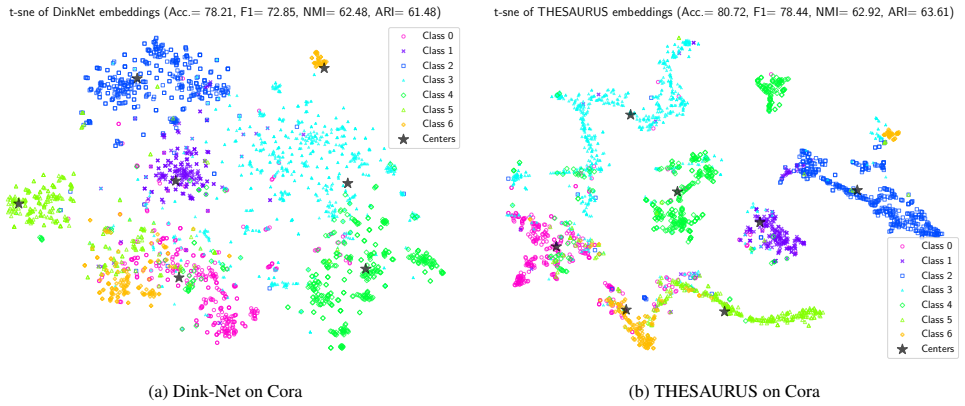
THESAURUS claims that the two classic K-means failure modes in deep graph clustering—the Uniform Effect and Cluster Assimilation—can be mitigated by making the clustering objective itself structure-aware instead of treating node embeddings as points in a metric space. The method learns soft assignments $Q$ by solving a Fused Gromov-Wasserstein problem between the augmented data graph $(A, Z)$ and a prototype graph $(B, S)$, where $S$ are semantic prototypes and $B = P^{\top}P$ is a graph built from the model's own assignment logits, smoothed by momentum. These assignments are used as swapped cross-view prediction targets: view 1's representations must predict view 2's OT-derived assignment and vice versa. Because the target carries cluster information drawn from both node attributes and graph topology, the encoder is pushed toward a representation space with large inter-cluster and small intra-cluster distances, which the paper argues is precisely what prevents majority clusters from spilling into minority ones and minority clusters from being absorbed. On nine attributed graphs, the reported accuracy, NMI, ARI, and Macro-F1 all improve over the previous state of the art, Dink-Net, with Macro-F1 gains up to 11.65 points on Pubmed.
Load-bearing premise
The target that guides training is the model's own soft assignments: the prototype graph $B = P^{\top}P$ and the marginal $\nu$ are built from the encoder's current predictions, and the paper does not analyze what happens if this self-referential target drifts or collapses instead of providing independent structural information.
Editorial extensions
If this is right
- If the central claim holds, graph clustering no longer needs a separate K-means finetune stage: the encoder is trained from the start toward cluster separability via the FGW-derived assignment targets, so the final K-means call is merely a readout.
- The swapped-prediction target should generalize across datasets to imbalanced cluster sizes, since the momentum prototype marginal $\nu$ tracks the true cluster size distribution instead of assuming uniform clusters.
- Because the Gromov term compares adjacency structure to prototype structure, the method should keep working in graphs where node attributes are weak but topology is informative, and vice versa, as governed by $\alpha$.
- The same swapped FGW framework transfers to other unsupervised tasks that can be cast as assigning points to prototypes under a structure prior, such as community detection or multi-view clustering.
- The method's reported robustness on minority clusters implies that adding more prototypes than the number of ground-truth classes does not hurt separability, which is a direct corollary of the momentum prototype graph adapting to the data.
Reading between the lines
- The self-referential target ($B = P^{\top}P$) resembles an expectation-maximization loop; one testable extension is to study whether stability depends on the momentum constant $\beta_1$, with a predicted phase transition where too-small $\beta_1$ makes the prototype graph chase the current assignment noise.
- The paper's argument that contextual prototypes distinguish 'synonymous' nodes suggests a direct comparison: on datasets with planted adjacent cross-class edges, THESAURUS should retain accuracy where distance-only baselines degrade; this is a testable hypothesis the paper does not run.
- The per-node entropy of the optimal FGW coupling could be reused as an unsupervised confidence measure, flagging boundary or ambiguous nodes that the model itself is unsure about.
- The momentum prototype marginal $\nu$ could act as an online estimator of cluster-size imbalance, which might be exported as a lightweight diagnostic for other contrastive clustering methods.
Signed reviews
Editorial analysis
A structured set of objections, weighed in public.
Referee Report
Summary. The paper proposes THESAURUS, an unsupervised graph node clustering method that combines semantic prototypes, cross-view assignment prediction, and Fused Gromov-Wasserstein Optimal Transport (FGW-OT) to align a data graph with a prototype graph. The prototype graph and prototype marginal distribution are updated by momentum from the model's own soft assignments. The paper claims state-of-the-art clustering performance on nine benchmark datasets and argues that the method mitigates the Uniform Effect and Cluster Assimilation by improving cluster separability.
Significance. If correct, the method would be a strong general-purpose graph clustering pipeline: it unifies attribute and structural information in a single OT-based training objective, releases code, and reports large gains over Dink-Net (e.g., Pubmed F1 from 67.35 to 79.00, ARI from 30.44 to 48.25). The careful class-wise analysis of Uniform Effect and Cluster Assimilation on Cora and Pubmed is a useful diagnostic contribution. However, the central OT construction is formally inconsistent as written, and the structural target is primarily self-generated, so the claimed mechanism needs substantial clarification and additional validation before the empirical results can be taken as evidence for the proposed approach.
major comments (3)
- [Eq. (12) and Algorithm 1] The prototype marginal update in Eq. (12) is {ν(t) = β2 ν(t−1) + (1−β2)(Pᵀ 1_N)}. Since P is row-stochastic, Pᵀ 1_N is a vector of soft class counts summing to N. With ν(0) = 1_S/S (mass 1), the momentum recurrence has total mass converging to N, not 1. However, Eq. (2) constrains π by π 1_S = μ and πᵀ 1_N = ν, and Definition 2 requires ν to be a probability measure. For μ of mass 1 and ν of mass N, no feasible coupling exists, so the FGW-OT problem in Eqs. (8)–(10) is infeasible as written, and the row-normalized Q in Eq. (10) is not an optimal OT coupling. The paper must state explicitly what normalization is applied after Eq. (12), or divide Pᵀ 1_N by N. If the released code already performs such normalization, the text is incomplete; if it does not, the training target is not a valid OT coupling and the reported numbers are not reproducible from the description.
- [Eqs. (5), (11), (12)] The prototype graph is defined as B = Pᵀ P in Eq. (5) and updated in Eq. (11) as a momentum average of the model's own soft-assignment co-occurrence; similarly, ν in Eq. (12) is derived from P. Thus the structural target matched by GW-OT is not an independent source of cluster or structural information: it is a function of the current model's predictions. Cross-view swapping and momentum smoothing reduce but do not remove this self-reference. This weakens the claim in Section 3 that GW-OT 'exploits cluster information in the graph structure' (Limitation L3). Please provide a stability or collapse analysis, or an ablation that replaces B and ν with a fixed structure-derived target (e.g., a coarsened adjacency matrix or an isolated-graph target) and compare the resulting performance. A concrete check is to train with random or constant B and ν and measure the performance drop; without such a check, the structural-alignment mechanism cannot be distinguished from self-confirmation.
- [Section 4 / Table 1 / Table 3] The central empirical claim is consistent improvement over Dink-Net and other baselines across nine datasets, but the main results in Table 1 for Cora, Citeseer, Pubmed, A-Photo, and CoraFull are reported without variance or multiple runs, while Tables 4–5 report five-run statistics only for ACM, DBLP, UAT, and Wiki. In addition, Table 3 lists per-dataset hyperparameters (S, α, τ, pe, px, T, lr, wd) but no validation protocol is described for selecting them. Without multi-run statistics for all datasets and an explicit model-selection rule, it is difficult to assess whether the large reported gains (e.g., Pubmed F1 79.00 vs 67.35) are robust or reflect selection on the test set. Please report means and standard deviations for all nine datasets, or justify the single-run protocol, and specify the validation procedure used to choose the hyperparameters.
minor comments (5)
- [Algorithm 1] Line 28 of Algorithm 1 refers to 'Qτ_1' and 'Qτ_2', but the loss in Eq. (4) uses Q_1, Q_2, Pτ_1, and Pτ_2; the notation should be made consistent and the quantities defined.
- [Eq. (9)] Definition 2 writes the FGW objective as an infimum over a p-th root expression minus εH(π). The placement of the entropy term with respect to the power 1/p is nonstandard and ambiguous; please clarify the exact regularized objective solved in practice.
- [Algorithm 1] Lines 9–16 update B(t−1) and ν(t−1) after processing view 1 and before processing view 2, so the two views use asymmetric prototype-graph/marginal states. Please state whether this sequential asymmetry is intentional and how it affects the cross-view assignment prediction.
- [Figure 2] The figure legend includes a 'Sphere' operation that is not described in the main text; please specify whether node representations or prototypes are L2-normalized, and where this normalization occurs in the pipeline.
- [General] The method name is spelled inconsistently as 'Dink-Net' and 'DinkNet' across the text, tables, and figures; please standardize the spelling.
Circularity Check
No significant circularity: the self-referential pseudo-labeling loop is a training objective, not a reduction of the claimed result to its inputs, and the main claims are tested on external benchmarks.
full rationale
THESAURUS computes its training target Q by FGW-OT using the prototype graph B = P^T P and the momentum-smoothed marginal nu, both updated from the model's own soft assignments P (Eqs. 5, 10-12). This is indeed a self-referential loop: the network is trained to predict, across augmented views, assignments derived from its own current predictions. However, this is the algorithm's stated training objective, namely a cross-view consistency bootstrapping step in the spirit of SwAV, not a claim that Q is an independent ground truth or a parameter fitted to a subset of data and then 'predicted'. The paper's central empirical claim, higher cluster separability than Dink-Net and other baselines, is evaluated on nine external datasets with standard clustering metrics and compared against published or reproduced baselines; the reported improvements are not forced by construction. The citation of Li et al. 2024 includes co-author Chuan Chen, but it appears only as a related-work pointer and is not load-bearing. The mass mismatch in Eq. (12), where nu converges to total mass N instead of 1 despite Definition 2 requiring a probability vector, is a feasibility or correctness issue in the OT formulation, not an instance of circular reasoning. No equation in the paper reduces to its own input in the sense of a fitted parameter being renamed a prediction, so no circularity step is flagged.
Assumptions & free parameters
free parameters (6)
- number of prototypes S =
18, 27, 98, 63, 494, 15, 57, 5, 240 for Cora, Citeseer, Pubmed, A-Photo, CoraFull, ACM, DBLP, UAT, Wiki
- FGW-OT trade-off alpha =
0.70, 0.55, 0.65, 0.45, 0.25, 0.25, 0.25, 0.95, 0.75 per dataset
- softmax temperature tau =
0.60, 0.80, 0.15, 0.60, 0.40, 0.25, 0.2, 0.65, 0.25 per dataset
- augmentation rates p_e and p_x =
e.g., Cora 0.4/0.4, Pubmed 0.2/0.0, see Table 3
- training epochs T, learning rate, weight decay =
listed per dataset in Table 3
- momentum weights beta1 and beta2 =
beta1 = 0.99, beta2 = 0.999 fixed across datasets
assumptions (5)
- standard math Entropic OT and Sinkhorn iterations converge to the stated optimal coupling for the chosen regularization
- domain assumption Random edge and feature masking preserves cluster semantics, so two augmented views should share the same node-cluster assignment
- domain assumption The momentum-smoothed prototype graph B = P^T P and marginal nu provide stable, non-collapsing clustering targets
- domain assumption Cosine similarity between embeddings and prototypes is a meaningful clustering signal
- domain assumption The number of clusters C is known and equals the number of ground-truth classes
invented entities (3)
-
semantic prototypes S
-
prototype graph B
-
prototype marginal distribution nu
Cite this review
Pith. "Pith review of THESAURUS: Contrastive Graph Clustering by Swapping Fused Gromov-Wasserstein Couplings." pith.science (2026). https://pith.science/paper/D4SDB773
@misc{pith2026241211550,
  author       = {Pith},
  title        = {Pith review of: THESAURUS: Contrastive Graph Clustering by Swapping Fused Gromov-Wasserstein Couplings},
  year         = {2026},
  howpublished = {\url{https://pith.science/paper/D4SDB773}},
  note         = {Machine review of arXiv:2412.11550}
}
read the original abstract
Graph node clustering is a fundamental unsupervised task. Existing methods typically train an encoder through selfsupervised learning and then apply K-means to the encoder output. Some methods use this clustering result directly as the final assignment, while others initialize centroids based on this initial clustering and then finetune both the encoder and these learnable centroids. However, due to their reliance on K-means, these methods inherit its drawbacks when the cluster separability of encoder output is low, facing challenges from the Uniform Effect and Cluster Assimilation. We summarize three reasons for the low cluster separability in existing methods: (1) lack of contextual information prevents discrimination between similar nodes from different clusters; (2) training tasks are not sufficiently aligned with the downstream clustering task; (3) the cluster information in the graph structure is not appropriately exploited. To address these issues, we propose conTrastive grapH clustEring by SwApping fUsed gRomov-wasserstein coUplingS (THESAURUS). Our method introduces semantic prototypes to provide contextual information, and employs a cross-view assignment prediction pretext task that aligns well with the downstream clustering task. Additionally, it utilizes Gromov-Wasserstein Optimal Transport (GW-OT) along with the proposed prototype graph to thoroughly exploit cluster information in the graph structure. To adapt to diverse real-world data, THESAURUS updates the prototype graph and the prototype marginal distribution in OT by using momentum. Extensive experiments demonstrate that THESAURUS achieves higher cluster separability than the prior art, effectively mitigating the Uniform Effect and Cluster Assimilation issues
Figures


Figures from the paper (4 more)



Reference graph
Works this paper leans on
-
[1]
, " * write output.state after.block = add.period write newline
ENTRY address archivePrefix author booktitle chapter edition editor eid eprint howpublished institution isbn journal key month note number organization pages publisher school series title type volume year label extra.label sort.label short.list INTEGERS output.state before.all mid.sentence after.sentence after.block FUNCTION init.state.consts #0 'before.a...
-
[2]
write newline
" write newline "" before.all 'output.state := FUNCTION n.dashify 't := "" t empty not t #1 #1 substring "-" = t #1 #2 substring "--" = not "--" * t #2 global.max substring 't := t #1 #1 substring "-" = "-" * t #2 global.max substring 't := while if t #1 #1 substring * t #2 global.max substring 't := if while FUNCTION word.in bbl.in capitalize " " * FUNCT...
-
[3]
Alvarez-Melis , D.; and Jaakkola, T. 2018. Gromov- Wasserstein Alignment of Word Embedding Spaces . In Riloff, E.; Chiang, D.; Hockenmaier, J.; and Tsujii, J., eds., Proceedings of the 2018 Conference on Empirical Methods in Natural Language Processing , 1881--1890. Brussels, Belgium: Association for Computational Linguistics
work page 2018
-
[4]
Bo, D.; Wang, X.; Shi, C.; Zhu, M.; Lu, E.; and Cui, P. 2020. Structural Deep Clustering Network. In Proceedings of the Web Conference 2020, Www '20, 1400--1410. New York, NY, USA: Association for Computing Machinery. ISBN 978-1-4503-7023-3
work page 2020
-
[5]
Bojchevski, A.; and G \"u nnemann, S. 2018. Deep Gaussian Embedding of Graphs : Unsupervised Inductive Learning via Ranking . In International Conference on Learning Representations
work page 2018
-
[6]
Cao, S.; Lu, W.; and Xu, Q. 2016. Deep Neural Networks for Learning Graph Representations . In Proceedings of the AAAI Conference on Artificial Intelligence , volume 30
work page 2016
-
[7]
Caron, M.; Misra, I.; Mairal, J.; Goyal, P.; Bojanowski, P.; and Joulin, A. 2020. Unsupervised Learning of Visual Features by Contrasting Cluster Assignments. In Proceedings of the 34th International Conference on Neural Information Processing Systems , NIPS '20, 9912--9924. Red Hook, NY, USA: Curran Associates Inc. ISBN 978-1-7138-2954-6
work page 2020
-
[8]
Chen, D.; Lin, Y.; Li, W.; Li, P.; Zhou, J.; and Sun, X. 2020. Measuring and Relieving the Over-Smoothing Problem for Graph Neural Networks from the Topological View . In Proceedings of the AAAI Conference on Artificial Intelligence , volume 34, 3438--3445
work page 2020
Show all 64 references
-
[9]
Chowdhury, S.; and M \'e moli, F. 2019. The Gromov -- Wasserstein Distance between Networks and Stable Network Invariants. Information and Inference: A Journal of the IMA, 8(4): 757--787
2019
-
[10]
Courty, N.; Flamary, R.; Habrard, A.; and Rakotomamonjy, A. 2017. Joint Distribution Optimal Transportation for Domain Adaptation. In Proceedings of the 31st International Conference on Neural Information Processing Systems, NIPS '17, 3733--3742. Red Hook, NY, USA: Curran Asso...
2017
-
[11]
Crouse, D. F. 2016. On Implementing 2D Rectangular Assignment Algorithms. IEEE Transactions on Aerospace and Electronic Systems, 52(4): 1679--1696
2016
-
[12]
Cui, G.; Zhou, J.; Yang, C.; and Liu, Z. 2020. Adaptive Graph Encoder for Attributed Graph Embedding. In Proceedings of the 26th ACM SIGKDD International Conference on Knowledge Discovery & Data Mining , Kdd '20, 976--985. New York, NY, USA: Association for Computing Machinery...
2020
-
[13]
Cuturi, M. 2013. Sinkhorn Distances: Lightspeed Computation of Optimal Transport. In Burges, C.; Bottou, L.; Welling, M.; Ghahramani, Z.; and Weinberger, K., eds., Advances in Neural Information Processing Systems, volume 26. Curran Associates, Inc
2013
-
[14]
Devvrit, F.; Sinha, A.; Dhillon, I.; and Jain, P. 2022. S3GC : Scalable Self-Supervised Graph Clustering. In Koyejo, S.; Mohamed, S.; Agarwal, A.; Belgrave, D.; Cho, K.; and Oh, A., eds., Advances in Neural Information Processing Systems, volume 35, 3248--3261. Curran Associates, Inc
2022
-
[15]
Douze, M.; Guzhva, A.; Deng, C.; Johnson, J.; Szilvasy, G.; Mazar \'e , P.-E.; Lomeli, M.; Hosseini, L.; and J \'e gou, H. 2024. The Faiss Library
2024
-
[16]
Fey, M.; and Lenssen, J. 2019. Fast Graph Representation Learning with PyTorch Geometric . In International Conference on Learning Representations
2019
-
[17]
Gan, G.; Ma, C.; and Wu, J. 2020. Data Clustering: Theory, Algorithms, and Applications. SIAM
2020
-
[18]
Gong, F.; Nie, Y.; and Xu, H. 2022. Gromov- Wasserstein Multi-modal Alignment and Clustering . In Proceedings of the 31st ACM International Conference on Information & Knowledge Management , CIKM '22, 603--613. New York, NY, USA: Association for Computing Machinery. ISBN 978-1...
2022
-
[19]
Z.; Wei, C.; Gaidon, A.; and Ma, T
HaoChen, J. Z.; Wei, C.; Gaidon, A.; and Ma, T. 2021. Provable Guarantees for Self-Supervised Deep Learning with Spectral Contrastive Loss. In Ranzato, M.; Beygelzimer, A.; Dauphin, Y.; Liang, P.; and Vaughan, J. W., eds., Advances in Neural Information Processing Systems, vol...
2021
-
[20]
He, K.; Zhang, X.; Ren, S.; and Sun, J. 2015. Delving Deep into Rectifiers : Surpassing Human-Level Performance on ImageNet Classification . In 2015 IEEE International Conference on Computer Vision ( ICCV ) , 1026--1034
2015
-
[21]
Hunter, J. D. 2007. Matplotlib: A 2D Graphics Environment. Computing in Science & Engineering, 9(3): 90--95
2007
-
[22]
Johnson, J.; Douze, M.; and J \'e gou, H. 2019. Billion-Scale Similarity Search with GPUs . IEEE Transactions on Big Data, 7(3): 535--547
2019
-
[23]
P.; and Ba, J
Kingma, D. P.; and Ba, J. 2017. Adam: A Method for Stochastic Optimization . arXiv:1412.6980
2017 arXiv
-
[24]
N.; and Welling, M
Kipf, T. N.; and Welling, M. 2016. Variational Graph Auto-Encoders. In NIPS Workshop on Bayesian Deep Learning
2016
-
[25]
N.; and Welling, M
Kipf, T. N.; and Welling, M. 2017. Semi-Supervised Classification with Graph Convolutional Networks. In International Conference on Learning Representations
2017
-
[26]
D.; Lei, Q.; Saunshi, N.; and ZHUO, JIACHENG
Lee, J. D.; Lei, Q.; Saunshi, N.; and ZHUO, JIACHENG . 2021. Predicting What You Already Know Helps : Provable Self-Supervised Learning . In Advances in Neural Information Processing Systems , volume 34, 309--323. Curran Associates, Inc
2021
-
[27]
Li, Y.; Chen, J.; Chen, C.; Yang, L.; and Zheng, Z. 2024. Contrastive Deep Nonnegative Matrix Factorization for Community Detection. In ICASSP 2024-2024 IEEE International Conference on Acoustics, Speech and Signal Processing ( ICASSP ) , 6725--6729. IEEE
2024
-
[28]
Liu, Y.; Jin, M.; Pan, S.; Zhou, C.; Zheng, Y.; Xia, F.; and Yu, P. 2022 a . Graph Self-Supervised Learning : A Survey . IEEE Transactions on Knowledge and Data Engineering, 1--1
2022
-
[29]
Liu, Y.; Liang, K.; Xia, J.; Zhou, S.; Yang, X.; Liu, X.; and Li, S. Z. 2023 a . Dink- Net : Neural Clustering on Large Graphs. In Proceedings of the 40th International Conference on Machine Learning , volume 202 of ICML '23 , 21794--21812. JMLR.org
2023
-
[30]
Liu, Y.; Tu, W.; Zhou, S.; Liu, X.; Song, L.; Yang, X.; and Zhu, E. 2022 b . Deep Graph Clustering via Dual Correlation Reduction . In Proceedings of the AAAI Conference on Artificial Intelligence , volume 36, 7603--7611
2022
-
[31]
Z.; Liu, X.; and He, K
Liu, Y.; Xia, J.; Zhou, S.; Yang, X.; Liang, K.; Fan, C.; Zhuang, Y.; Li, S. Z.; Liu, X.; and He, K. 2023 b . A Survey of Deep Graph Clustering : Taxonomy , Challenge , Application , and Open Resource . arXiv:2211.12875
2023 arXiv
-
[32]
Liu, Y.; Yang, X.; Zhou, S.; Liu, X.; Wang, S.; Liang, K.; Tu, W.; and Li, L. 2023 c . Simple Contrastive Graph Clustering . IEEE Transactions on Neural Networks and Learning Systems, 1--12
2023
-
[33]
Liu, Y.; Yang, X.; Zhou, S.; Liu, X.; Wang, Z.; Liang, K.; Tu, W.; Li, L.; Duan, J.; and Chen, C. 2023 d . Hard Sample Aware Network for Contrastive Deep Graph Clustering . In Proceedings of the AAAI Conference on Artificial Intelligence , volume 37, 8914--8922
2023
-
[34]
Lloyd, SP . 1957. Least Squares Quantization in PCM . Technical Report RR-5497 , Bell Lab, September 1957
1957
-
[35]
Lovasz, L. 1986. Matching Theory ( North-Holland Mathematics Studies) . GBR: Elsevier Science Ltd. ISBN 0-444-87916-1
1986
-
[36]
Lu, Y.; Cheung, Y.-M.; and Tang, Y. Y. 2021. Self- Adaptive Multiprototype-Based Competitive Learning Approach : A k- Means-Type Algorithm for Imbalanced Data Clustering . IEEE Transactions on Cybernetics, 51(3): 1598--1612
2021
-
[37]
MacQueen, J.; et al. 1967. Some Methods for Classification and Analysis of Multivariate Observations. In Proceedings of the Fifth Berkeley Symposium on Mathematical Statistics and Probability , volume 1, 281--297. Oakland, CA, USA
1967
-
[38]
M \'e moli, F. 2011. Gromov-- Wasserstein Distances and the Metric Approach to Object Matching . Foundations of Computational Mathematics, 11(4): 417--487
2011
-
[39]
Monge, G. 1781. M \'e moire Sur La Th \'e orie Des D \'e blais et Des Remblais. Mem. Math. Phys. Acad. Royale Sci., 666--704
-
[40]
F.; and Ksantini, R
Mrabah, N.; Bouguessa, M.; Touati, M. F.; and Ksantini, R. 2023. Rethinking Graph Auto-Encoder Models for Attributed Graph Clustering . IEEE Transactions on Knowledge and Data Engineering, 35(9): 9037--9053
2023
-
[41]
Nguyen, K.; Nong, H.; Nguyen, V.; Ho, N.; Osher, S.; and Nguyen, T. 2023. Revisiting Over-Smoothing and over-Squashing Using Ollivier-Ricci Curvature. In Proceedings of the 40th International Conference on Machine Learning , volume 202 of ICML '23 , 25956--25979. Honolulu, Haw...
2023
-
[42]
Pan, S.; Hu, R.; Long, G.; Jiang, J.; Yao, L.; and Zhang, C. 2018. Adversarially Regularized Graph Autoencoder for Graph Embedding. In Proceedings of the 27th International Joint Conference on Artificial Intelligence , IJCAI '18, 2609--2615. Stockholm, Sweden: AAAI Press. ISBN...
2018
-
[43]
Paszke, A.; Gross, S.; Chintala, S.; Chanan, G.; Yang, E.; DeVito, Z.; Lin, Z.; Desmaison, A.; Antiga, L.; and Lerer, A. 2017. Automatic Differentiation in PyTorch
2017
-
[44]
Pedregosa, F.; Varoquaux, G.; Gramfort, A.; Michel, V.; Thirion, B.; Grisel, O.; Blondel, M.; Prettenhofer, P.; Weiss, R.; Dubourg, V.; Vanderplas, J.; Passos, A.; Cournapeau, D.; Brucher, M.; Perrot, M.; and Duchesnay, E. 2011. Scikit-Learn: Machine Learning in Python . Journ...
2011
-
[45]
Peng, Z.; Liu, H.; Jia, Y.; and Hou, J. 2021. Attention-Driven Graph Clustering Network. In Proceedings of the 29th ACM International Conference on Multimedia , Mm '21, 935--943. New York, NY, USA: Association for Computing Machinery. ISBN 978-1-4503-8651-7
2021
-
[46]
Peyr \'e , G.; and Cuturi, M. 2019. Computational Optimal Transport : With Applications to Data Science . Foundations and Trends in Machine Learning , 11(5-6): 355--607
2019
-
[47]
Sen, P.; Namata, G.; Bilgic, M.; Getoor, L.; Galligher, B.; and Eliassi-Rad , T. 2008. Collective Classification in Network Data . AI Magazine, 29(3): 93--93
2008
-
[48]
Shchur, O.; Mumme, M.; Bojchevski, A.; and G \"u nnemann, S. 2019. Pitfalls of Graph Neural Network Evaluation . arXiv:1811.05868
2019 arXiv
-
[49]
R.; Naik, N.; and Ordonez, V
Shrivastava, A.; Selvaraju, R. R.; Naik, N.; and Ordonez, V. 2023. CLIP-Lite : Information Efficient Visual Representation Learning with Language Supervision . In Proceedings of The 26th International Conference on Artificial Intelligence and Statistics , 8433--8447. PMLR
2023
-
[50]
Tan, Z.; Zhang, Y.; Yang, J.; and Yuan, Y. 2023. Contrastive Learning Is Spectral Clustering on Similarity Graph . In The Twelfth International Conference on Learning Representations
2023
-
[51]
Titouan, V.; Courty, N.; Tavenard, R.; and Flamary, R. 2019. Optimal Transport for Structured Data with Application on Graphs. In International Conference on Machine Learning, 6275--6284. PMLR
2019
-
[52]
Tolstikhin, I.; Bousquet, O.; Gelly, S.; and Schoelkopf, B. 2018. Wasserstein Auto-Encoders. In International Conference on Learning Representations
2018
-
[53]
Tu, W.; Zhou, S.; Liu, X.; Guo, X.; Cai, Z.; Zhu, E.; and Cheng, J. 2021. Deep Fusion Clustering Network. In Proceedings of the Thirty-Fifth AAAI Conference on Artificial Intelligence , 9978--9987
2021
-
[54]
van den Oord, A.; Li, Y.; and Vinyals, O. 2019. Representation Learning with Contrastive Predictive Coding . arXiv:1807.03748
2019 arXiv
-
[55]
van der Maaten, L.; and Hinton, G. 2008. Visualizing Data Using T- SNE . Journal of Machine Learning Research, 9(86): 2579--2605
2008
-
[56]
Villani, C. 2009. Optimal Transport : Old and New , volume 338 of Grundlehren Der Mathematischen Wissenschaften . Berlin, Heidelberg: Springer Berlin Heidelberg. ISBN 978-3-540-71049-3 978-3-540-71050-9
2009
-
[57]
Wang, C.; Pan, S.; Hu, R.; Long, G.; Jiang, J.; and Zhang, C. 2019. Attributed Graph Clustering: A Deep Attentional Embedding Approach. In Proceedings of the 28th International Joint Conference on Artificial Intelligence, IJCAI '19, 3670--3676. AAAI Press. ISBN 978-0-9992411-4-1
2019
-
[58]
Wang, C.; Pan, S.; Long, G.; Zhu, X.; and Jiang, J. 2017. Mgae: Marginalized Graph Autoencoder for Graph Clustering. In Proceedings of the 2017 ACM on Conference on Information and Knowledge Management , 889--898
2017
-
[59]
Wang, S.; Yang, J.; Yao, J.; Bai, Y.; and Zhu, W. 2024. An Overview of Advanced Deep Graph Node Clustering . IEEE Transactions on Computational Social Systems, 11(1): 1302--1314
2024
-
[60]
Wei, F.; Gao, Y.; Wu, Z.; Hu, H.; and Lin, S. 2021. Aligning Pretraining for Detection via Object-Level Contrastive Learning . In Advances in Neural Information Processing Systems
2021
-
[61]
Xie, J.; Girshick, R.; and Farhadi, A. 2016. Unsupervised Deep Embedding for Clustering Analysis. In Balcan, M. F.; and Weinberger, K. Q., eds., Proceedings of the 33rd International Conference on Machine Learning, volume 48 of Proceedings of Machine Learning Research, 478--48...
2016
-
[62]
Xiong, H.; Wu, J.; and Chen, J. 2009. K- Means Clustering Versus Validation Measures : A Data-Distribution Perspective . IEEE Transactions on Systems, Man, and Cybernetics, Part B (Cybernetics), 39(2): 318--331
2009
-
[63]
Xu, H.; Luo, D.; Zha, H.; and Duke, L. C. 2019. Gromov- Wasserstein Learning for Graph Matching and Node Embedding. In Chaudhuri, K.; and Salakhutdinov, R., eds., Proceedings of the 36th International Conference on Machine Learning, volume 97 of Proceedings of Machine Learning...
2019
-
[64]
Zhu, Y.; Xu, Y.; Yu, F.; Liu, Q.; Wu, S.; and Wang, L. 2020. Deep Graph Contrastive Representation Learning . arXiv:2006.04131
2020 arXiv
Reviewed August 11, 2026 · model on record in the stance chip above.
Discussion (0). Continue with ORCID to comment.